


Latest News

Student Life

‘Making Drugs More Accurate’ offers free drug checking kits

On Aug. 24, Making Drugs More Accurate (MDMA), a non-profit organization piloted by the Canadian Students for Sensible Drug Policy (CSSDP) chapter at McGill, launched their free drug-checking and harm reduction service for McGill students. 

In a 2019 survey conducted by CSSDP McGill, 86 per cent of students demonstrated interest in an accessible drug checking service on campus. A group of students who  were eager to contribute to the initiative assembled a team to execute CSSDP’s vision and respond to student demand.

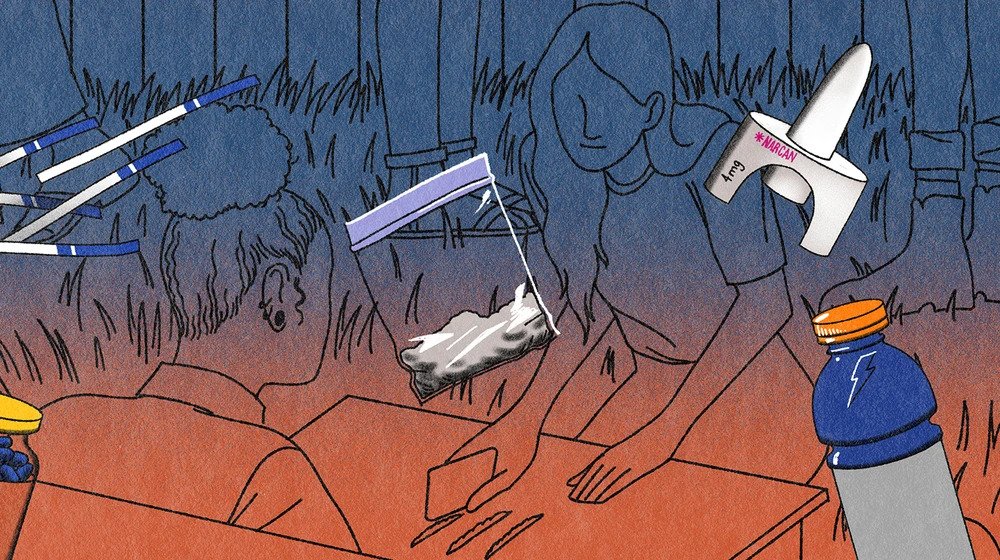
After consulting different supervised injection sites, harm reduction organizations, and overdose prevention sites in Montreal, MDMA now allows students to order free, personalized kits with chemical reagents that identify substances and verify their compositions. On their website, substance-specific instructions guide students through every step of the testing process. 

The testing kits, sourced from DoseTest and Test Kit Plus, can confirm the presence of ecstasy, ketamine, LSD, cocaine, amphetamine, and opiates in the body. Each kit also includes testing strips that can detect the presence of fentanyl—a potent synthetic opioid that greatly increases the risk of accidental overdose.

The greatest challenge for the MDMA team was realizing a method of distribution that did not require students to compromise their personal information. By requesting a unique code word from users on the order form, MDMA is able to preserve clients’ anonymity while delivering the kits. 

In an interview with The McGill Tribune, Jordan*, the founder of MDMA, explained the organization’s non-judgemental, non-coercive, harm reduction approach to drug use. 

“Ultimately, our job is not to tell people what they can and cannot use,” Jordan said. “Our job is to give people the information so that they can have a better idea of what they’re putting in their bodies, the consequences of it [….] We would like to empower people’s decision making and nothing more than that.” 

The team hopes to connect students with resources and information that can facilitate safer experiences with drugs. Jordan emphasized the importance for students to be educated, even when equipped with harm reduction tools, on the ever-present risks of substance use. 

“[MDMA’s] goal is to promote a greater degree of safety, though it’s important to remember that drug use carries inherent risk,” Jordan said. “You can never reach safety with drug use.”  

Allison Chow, U3 Science and member of the MDMA team, hopes to dismantle the stigma surrounding substance use on campus. Condemning and prohibiting drug use, Chow explained to the Tribune, makes support less accessible and places students at greater risk of drug-related injury.

“If you purport the idea of drug abstinence, you are just going to get negative consequences, [like] people overdosing, or [not knowing] when to call for help because they’re scared of repercussions,” Chow said. “Good Samaritan laws are a step in the right direction, but more needs to be done.” 

To glean insight on the unregulated drug supply students are in contact with, MDMA will be anonymously collecting and analyzing the results of their clients’ reagent tests. These statistics will provide important grounds not only for growing MDMA’s own presence at McGill, but also for motivating the implementation of similar harm reduction services at other Canadian universities. 

Although the service launched just this past month, the MDMA team said it has received positive responses from students who either support the project or want to get directly involved as volunteers. 

“Every class I go to, whenever I make a new friend, they are very interested in [the service],” Chow said. “I think that this is something that people want and need.”

MDMA is currently looking to expand their outreach and welcomes anyone interested in helping students.  

“You don’t need to be a drug user to join,” Chow said. “You just need to care about human beings, harm reduction, and be compassionate.” 

*Name has been changed.

Student Life

Backpacks on the backburner, students take on totes

On campus, students sit on benches, sifting through their totes in search of a pen or pencil, grasping into the small abyss of the bag. As the backpack fades to the background, many students have opted to stylize their school outfits with something more unique—the tote bag. Different styles appear among the crowd: A canvas tote with hand drawn artwork, thick leather designer bags, or the classic Longchamp adhered with its nifty zipper. As the trend makes its rise, one wonders why students prefer them to backpacks and whether this trend is sustainable in the long run.  

For Sasha Dodson, U1 Arts, tote bags are a fashion-forward alternative to the out-of-date backpack.

“I found it a bit more convenient and less pretentious,” Dodson said. “I think they are more spacious than hand bags or purses that kind of date you.”

Many students appreciate not only the accessibility of a smaller bag, but also the chance to elevate their look without appearing too formal. Others, like U0 Arts student Kyra Odell, jumped on the trend because of the fashionable element that comes with sporting a tote bag.

“I see everyone having tote bags and I feel like it’s both convenient and stylish,” Odell said. 

Alongside the ability to express oneself with a functional bag, the need for a backpack seems to be dissipating. As more students transition to taking notes on their electronic devices, traditional classroom supplies like binders, notebooks, or even a pen are no longer essential, rendering the bulky backpack defunct. Those returning to campus can use this opportunity to rebrand their look, with some students even painting their own designs.  

While talking to McGill students about the objects in their bags, most carried the same four or five objects: Computer, wallet, notebook, pen, and water bottle. Having less of a requirement to bring classic school items like notebooks and pencil cases, students have extra space to store crystals, shoehorns, or even reusable cutlery.

Carrying a tote is not all it seems, however. Many find themselves struggling with disorganization, unpredictable weather, and discomfort. “The rain is a concern,” Sarah Fahmy, U1 Science said. Fahmy’s classic canvas bag often soaks through on rainy days, damaging her computer and dampening her notebooks.

Fahmy’s friend, Mara Lupesco, U1 Arts, also noted the tote’s occasional lack of functionality. 

“Things seem to just be banging together in there,” Lupesco said. “I think I’m going to switch back to backpacks.” 

Though the trend has made a mark with a new wave of stylish university students, the reliance on a flimsy bag does not always seem to do the trick. 

With all of its benefits as well as downsides, the tote ultimately allows students to play around with their personal style in a subtle way, transforming themselves from the classic university student to the artsy kid with a hand-printed tote, or the elegant scholar with their suede leather dagne dover. As the world migrates to a more online lifestyle, sometimes the itch for personal style overtakes the functionality of the classic backpack. Despite this, the impracticalities of the tote make one question whether this McGill student favourite is here to stay.

Student Life

The return of Gerts

Many lower-year McGill students will draw a blank at the name “Gerts.” As a fourth-year student, I’ve only heard stories of the famous bar that’s been closed since 2018. However, with the student bar in the SSMU building reopening on Sept. 14, it’s worth reminiscing about its closure.

Alana Dunlop, Arts Sci ’21, recalled her first drink at Gerts after getting mono in her first year.

“The doctor said [I couldn’t] drink for a month,” Dunlop explained to The McGill Tribune. “A month later, I marked on my calendar that I could drink, […] I knocked on my friend’s door and he was like ‘we can get a beer at Gerts.’ So I had my first drink at Gerts.”

Ksenia Shulyarenko, Management ’20, also shared her first memory at the iconic spot, which involved an over-the-top drink.

“I was doing a scunt for hype week,  [and I had to] order a grenade at Gerts,” Shulyarenko said. “I had no idea what that was [….] Then you had to chug within a minute. It was like five drinks in one.”

The bar, which has been around since 1974, has been closed for only a small portion of its existence. Nadine Pelaez, the bar manager, said the reopening process was difficult.

“All that was left of Gerts, after three years, was the infrastructure,” Pelaez said. “Most of the equipment was broken, but the infrastructure and legacy, the connections we had with suppliers across the city, that’s really all that was left [….] These past nine months have been spent essentially building a business from nothing.”

In reopening the bar, Pelaez had to set up the entire payment system from scratch.

“Usually you start a job, and the debit machine exists, the POS exists,” Pelaez said. “It turns out it is incredibly laborious setting all of that up.” 

Looking around the bar days before its grand return, I was impressed by the massive countertop, the pool table, and the giant shelf filled with liquor––all of which has remained unchanged since the bar closed. Pelaez remembers Gerts being packed at times, but notes that health regulations will change this. 

“It was such a centre for the community, and I want it to continue to be like that,” Pelaez said. “Back in the day, it was a rowdy place [….] The liquor was really pouring here […] And now you have to stay seated at your tables.”

According to Shulyarenko, despite its occasional rowdiness,  Gerts was also a laid-back place to unwind between classes.

“It was very much a […] homey vibe, super non-threatening and relaxed,” Shulyarenko said. “You can also go there during the day to have a study session. Everyone would look at you like you’re insane if you brought your textbooks to any other bar.”

This year, Gerts will also be opening as a cafe, which will allow students to study in between classes. 

Hearing all of these stories, it is baffling to think that so many students missed out on such a central McGill experience.

“I remember fond memories where I went with people I met from [residence],” Dunlop said. “It was a very friendly place where everyone would say ‘hi’ to each other.” 

Although Shulyarenko and Dunlop have graduated, they both plan to return to Gerts when it reopens.

Album Reviews, Arts & Entertainment, Books, Film and TV, Internet, Music

What we liked this summer

A return to schoolwork entails an adjustment to our levels of consumption. In the spirit of endings, new beginnings and transitions, the Tribune weighs in on their favourite pieces of content from this summer. There’s plenty of time left until midterms for a few binges.

Book: The Authenticity Project

Suzanna Graham

In a post-pandemic world, it is easy to feel isolated from everyone around you. Clare Pooley’s debut novel, The Authenticity Project, explores this common sentiment, conveying that a simple act of kindness can bring people together. When struggling artist Julian Jessop deliberately discards his angst-filled diary, he has no expectations to later find a myriad of kind messages within its bounds. Over the course of a few months, the journal is discovered and passed between six strangers who choose to share their own struggles and attempt to help the writers before them. This feel-good novel proves that every person is looking for the same things: Love, community, and authenticity. 

Podcast: Are You Michelle From Skins?

Michelle Siegel

Starting as an Instagram TV (IGTV) series before becoming a full-fledged podcast, “Are You Michelle From Skins?” is a unique podcast on nostalgia, identity, and the complicated lens in which people view their past selves. Created and hosted by British actress April Pearson, who played Michelle on E4’s iconic teen drama //Skins//, podcast guests discuss their cultural relevance due to one role in their careers. Guests include James and Oliver Phelps, of //Harry Potter// fame, as well as Jessica Sula, who also played a character on a later generation of //Skins//. The podcast’s powerful focus on celebrating the holistic identities and experiences of actors—rather than only heralding and upholding their iconic roles— makes it worth a listen.

TV Show: White Lotus

Suzanna Graham

Written and directed by Mike White, White Lotus is a satirical ‘dramedy’ series detailing the shenanigans and adventures of several tourists, travellers, and staff at a Hawaiian resort. With a skilled cast, including hilariously over-the-top performances by Jennifer Coolidge, an ominous score, and masterful cinematography, the show is funny without compromising an edge that keeps the audience interested. Although the series explores serious themes of drug addiction, loneliness, and entitlement, it never loses its humour, thereby remaining both relatable and lighthearted.

Album: Blue Weekend

Anna Berglas

Blue Weekend, Wolf Alice’s third studio album released on June 4, 2021, features aggressive, fast-paced songs and excellent synths to capture the eeriness of life during a pandemic. On “Delicious Things,” the band’s singer Ellie Rosell delves into coming to terms with her womanhood in a man-centered society. The more lighthearted “Smile” features empowering lyrics such as “I am what I am and I’m good at it.” Ellie Rowsell knows her strengths, and one of these is vocal talent. The layering of her voice is ethereal, and each atmospheric musical intro is emotive and chilling. Blue Weekend speaks to the bravery needed to make noise, and the ability to push forward. 

Science & Technology

Proposed hydro dams put free-flowing rivers at risk

Many hydropower dam projects have been proposed around the world as countries shift toward renewable energy sources, in line with United Nations’ (UN) 2030 Sustainable Development Goals. However, a recent study conducted by the World Wildlife Fund (WWF) found that these proposed dam projects threaten the free-flowing status of 260,000 kilometres of major rivers around the world, such as the Amazon, Congo, and Irrawaddy.

Free-flowing rivers are characterized as those whose flow and connectivity are unaffected by human-induced changes. A study conducted in 2019 found that two-thirds of major rivers have lost their connectivity to dams, resulting in devastating consequences on aquatic ecosystems.

“[Dams] create a barrier in the river that, in most cases, cannot be surpassed by organisms that naturally would want to traverse the river system,” Bernhard Lehner, associate professor in McGill’s Department of Geography and member of McGill’s Global Hydrolab, wrote in an email to The McGill Tribune. “[The dams also] change the natural cycle of high and low water flows downstream of the dam, which can disconnect ecologically vital floodplains from the main river channel. They even can change the water quality as they often release water that is colder and contains less oxygen than natural flows.”

The new study, inspired by the effects dams have on river connectivity, assesses how 3700 hydropower dams currently proposed or under construction will affect the environment. One of the major obstacles of the study, however, was obtaining data regarding the projects.

“There is no international group or organization that collects and freely distributes information on global dams,” Lehner wrote. “We only had one database available to us, which was compiled by a research colleague and which only included planned hydropower dams. So we are missing many other dams in our study, such as irrigation dams or dams built for flood protection. To overcome this general problem, we have now founded our own international consortium called Global Dam Watch.”

The study also found that the energy produced by these dams would contribute to only two per cent of the renewable energy needed by 2050 to keep the global temperature increase below 1.5 degrees Celsius—a small benefit with a hefty ecological price tag.  

With the World Hydropower Congress taking place in September and the upcoming UN climate and biodiversity summits, the researchers hope that policy-makers will take their findings into consideration and make informed decisions that benefit everyone—instead of sacrificing ecosystems for the sake of clean energy.

Lehner clarified that such a debate does not call for an end to all hydropower projects: The study includes a comprehensive list of science-based solutions to build hydropower dams in a more sustainable way, such as using computer simulations to find less intrusive dam locations.

“The best solution […] is likely the most simple one, avoid building new hydro dams that are not essential, [like] those that produce little energy but have large environmental consequences,”  Lehner wrote. “In the past, we have often built hydro dams, or other types of dams, on an opportunistic basis [….] We have not always asked whether this particular dam is indeed the most useful to be built.”

The team believes that research similar to theirs influenced the European Commission to set a goal of removing barriers from 25,000 kilometres of rivers as part of their “Biodiversity strategy for 2030.”

“We can now, quite easily, produce tools that help energy planners to prioritize ‘better’ from ‘worse’ future scenarios of dam locations,” Lehner wrote. “The ultimate decisions remain to be made by politicians and managers, but science can support them in this task in order to arrive at informed decisions, which we believe is an important step forward.”

McGill, News, SSMU

Students and professors stage protest, demand vaccine mandate and a safer campus

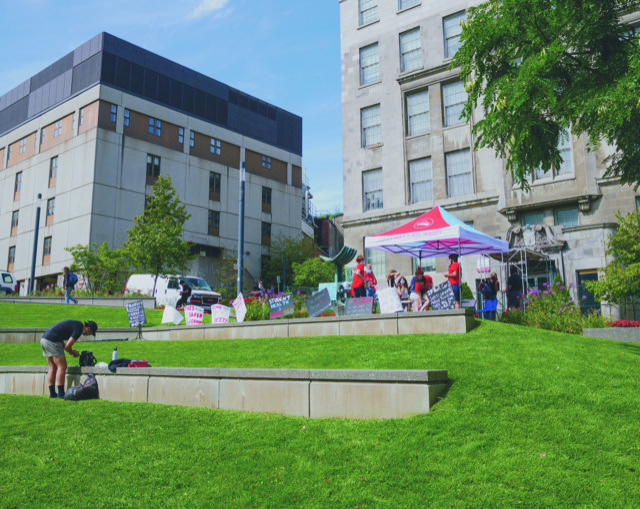
Members of the Students’ Society of McGill University (SSMU) protested outside the James Administration building Sept. 1, calling for a safe and accessible return to campus. The common area outside was decorated with SSMU banners and posters that displayed slogans, with one asking whether McGill wanted its bicentennial to be remembered as one where students did not feel safe on campus. SSMU and McGill staff demanded that McGill implement a vaccine mandate, make accommodations for both international and immunocompromised students, and include student consultation in decisions concerning COVID-19. 

SSMU vice-president (VP) of university affairs Claire Downie expressed her satisfaction with the demonstration, and argued that better accommodations for students is crucial. 

“Everyone has different needs to feel safe on campus,” Downie said in an interview with The McGill Tribune. “Right now, McGill has not provided any accommodation for its international students who are stuck abroad, or immunocompromised students who cannot be safely on campus.”

According to Downie, SSMU’s efforts to address these concerns to the administration at the end of last spring were unsuccessful.

“We have been trying to communicate with the university for several months on this issue,” Downie said. “We spoke in June or May with Fabrice Lebeau and Chris Buddle and we were just told to look at the positive, ‘the vaccine rollout is going so well, everything is going to be normal and fine. ’ But in reality that is not the case.”

Emily Black, U4 Arts and a participant at the protest, expressed concern about being back on campus as an immunocompromised person.

“McGill has suggested that students in such extraordinary situations should take a year off,” Black said. “If I were to do that, because I am on student aid, I would lose all my funding and would probably not be able to come back [to McGill].”

McGill’s response to student and faculty concerns has been to remind everyone of health and safety measures, including procedural mask requirements, distancing in non-classroom environments, contact tracing, and optimizing ventilation.

Downie explained that every Canadian university that has implemented a vaccine mandate has given students a buffer time of six weeks to get vaccinated or apply for a human rights exemption

“A vaccine mandate never means that everyone has to be vaccinated or that you will be kicked off if you are not,” Downie said. “You might have to be tested three times a week in order to be on campus, whereas a vaccinated student will be exempt from that.” 

McGill Faculty of Law professor Richard Gold argued that the university’s decision to not impose a vaccine mandate is discriminatory against vulnerable members of the community. 

“Our view is that McGill is in breach of its obligations under article 10 of the Quebec Charter of Human Rights and Freedoms by having adopted a policy that discriminates against disabled and pregnant [people], and those who live in families where individuals are at risk,” Gold said.

On Aug. 29, the Office of the Provost and vice-president (Academic) sent an internal memo to faculty deans, which a CBC reporter shared to Twitter, that stated that fear of campus safety and concern about relatives who might be at risk to possible exposure to COVID-19, were not valid reasons for an instructor to teach remotely. 

Gold argued McGill could, and should, implement a vaccine mandate as well as stricter requirements.

“We have asked McGill for months to explain the legal basis of its claim otherwise and it has refused to answer,” Gold said. “Provost Jutras at the University of Montreal concluded that the university could bring in a requirement if it decided to do so. McGill is in no different situation. In short, there is little doubt that McGill could, but refuses to, implement a proof of vaccination requirement.” 

The McGill Tribune reached out to the McGill administration for a comment on the demands for a vaccine mandate and did not receive a response.

Football, Sports

Redbirds clinch win in home opener against Sherbrooke Vert et Or

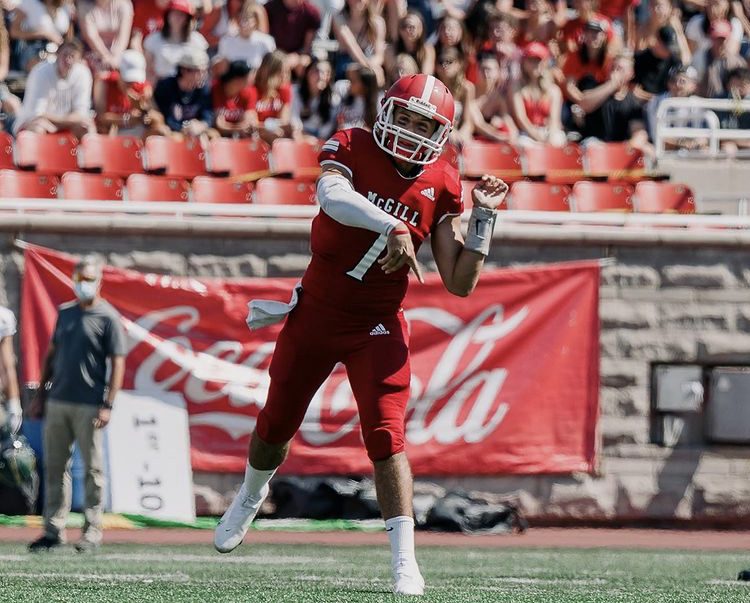
On Sept. 4, the McGill Redbirds (1–1) defeated the Sherbrooke University Vert et Or (1–1) in their first home game of the season. For the first time in 693 days, over one thousand spectators—1,628, to be exact—filled Percival Molson Memorial Stadium to witness an exciting return to varsity football.

Both teams came out with strong defensive presences in the first quarter, stopping each other in their tracks and never making it farther than a few downs before punting. McGill ended the scoreless streak with suffocating defence in Sherbrooke’s endzone, leading to a safety and a 1–0 score with 1:21 left in the first quarter. 

The second quarter brought more action, with several convincing offensive drives, before quarterback Dimitrios Sinodinos beamed a bullet pass to wide receiver Mathieu Soucy in the back right corner of the endzone. After a successful field goal attempt, McGill led 8–0 with 6:38 remaining in the first half. Sherbrooke quarterback Anthony Robichaud, however, promptly retaliated with a 53-yard-arcing throw to wide receiver Kevin Morin, and, after a successful 2-point conversion, McGill and Sherbrooke were tied with 4:48 left in the quarter. Both teams managed a field goal in the following minutes, leaving fans on a razor’s edge heading into the second half.

McGill came out guns blazing in the opening moments of the second half, but was quickly halted in what would be the worst of a string of 11 injuries throughout the game. Second-year wide receiver Dhandre Weekes suffered a severe lower body injury that had him carted away to an ambulance. The game was stopped for the next 45 minutes as both teams waited for another ambulance to assume its post. 

“A lot of guys look up to and respect [Dhandre],” Sinodinos said when asked about his teammate’s injury. “He is a really emotional player and brings so much energy to practice. He wants it so bad. To see a guy like him go down really sucks, but we came out to play for him and we got the win for him.”

Come out and play, McGill certainly did; just a few minutes after the delay, Soucy completed his second touchdown off a 39-yard high-arcing throw from Sinodinos. Second-year kicker Antoine Couture furthered the Redbirds’ lead to 21–11 with a field goal, six seconds before the end of the third quarter. 

The Vert et Or made an admirable run at McGill’s lead in the fourth quarter, but the Redbird defence ultimately stopped them in their tracks, allowing only one more touchdown with 54 seconds left in the game. The crowd erupted into cheers of celebration as McGill emerged victorious, with a final score of 21–18.

Despite the strong first showing, Soucy believes he and his team still have room to improve. 

“We did good, not great,” Soucy said. “We could have put up more points and we have a couple of things to fix up but in the end, we got the W.”

Head coach Ronald Hilaire agreed with Soucy, but was pleased with the players’ performance in the second half. 

“I felt that we bounced back from a lacklustre first half from our team,” Hilaire wrote in an email to The McGill Tribune. “At halftime, we regrouped, got our bearings, and came to play in the second half. I was proud of our team for responding that way. We need to be able to maintain [our] level of play notwithstanding the opponent we face.” 

Moment of the Game:

Quarterback Dimitrios Sinodinos lofted a 39-yard touchdown pass to wide receiver Mathieu Soucy to take a 18–11 lead with 9:20 left in the third quarter.

Quotable

“It feels so nice to be back playing for a crowd. We have been waiting for this moment for a long time. We have been working hard, with Zoom calls, and training camp so it definitely feels good to be back on the field.” — Fifth year Mathieu Soucy on the return from the two-year hiatus from RSEQ sports.

Stat Corner
Running back Elijah Woods led McGill’s running efforts, rushing 70 yards over the course of the game.

Features

The long arm of the law

This November, Montrealers will head to the polls to vote for the next mayor of the city––and perhaps the future of its police. This year more than ever, a key issue on the ballot will be the role and budget of the Service de Police de la Ville de Montréal (SPVM). 

Global protests against police brutality that erupted in the summer of 2020 following the murder of George Floyd, a Black man murdered by police in Minneapolis, sparked renewed calls for a re-evaluation of the current state of policing. Increasingly, these calls have shifted from demands for reform to demands for defunding––and even demands to do away with policing altogether. According to a poll conducted in July 2020, approximately 51 per cent of Canadians support defunding the police––redirecting funds from the police to social services. 

Montreal’s first official police department and predecessor to the SPVM, the the Montréal Police Department––a predecessor to the SPVM––was established in 1865. However, various forms of policing have existed since the city’s founding in 1843, from small citizen militias to ensembles of nighttime watchmen. 

Policing has its roots to slavery and settler colonialism, explained Ted Rutland, an associate professor at Concordia University and urban social and cultural geographer who studies urban issues in Montreal, including policing. Rutland likened early policing in Montreal to slave patrols in the United States, noting how white people were essentially “tasked with scrutinizing and reporting” racialized people.

“In Montreal, […] it was basically the job of all white people to surveil Black and Indigenous people, who were not on plantations,” Rutland said. “There were no plantations in Canada. [Instead], they were doing unpaid chores for wealthy Montrealers and so they were walking around the city, going to the market.”

Early laws in Montreal were also key in dispossessing Kanienʼkehá꞉ka (Mohawk) people of land and setting up rules and practices that limited their right to exist freely in the city. 

“There were a bunch of laws around alcohol that were specifically targeting Indigenous people in order to ensure that they were not in public spaces,” Rutland said. “The law was also used to move Indigenous people off the island in the mid-1700s to the point where for a long time there were not a lot of Indigenous people in Montreal. Even now I think there is a way in which white settlers see Indigenous people as new arrivals in the city and maybe think that this is not where they are supposed to be.”

Toward the late 1960s and early 1970s, Black people began to experience much higher rates of police surveillance and violence. 

Arts & Entertainment, Film and TV

‘Haiti Trahie’ and ‘Invasion’ reveal the imperialist truths behind a facade of Canadian benevolence

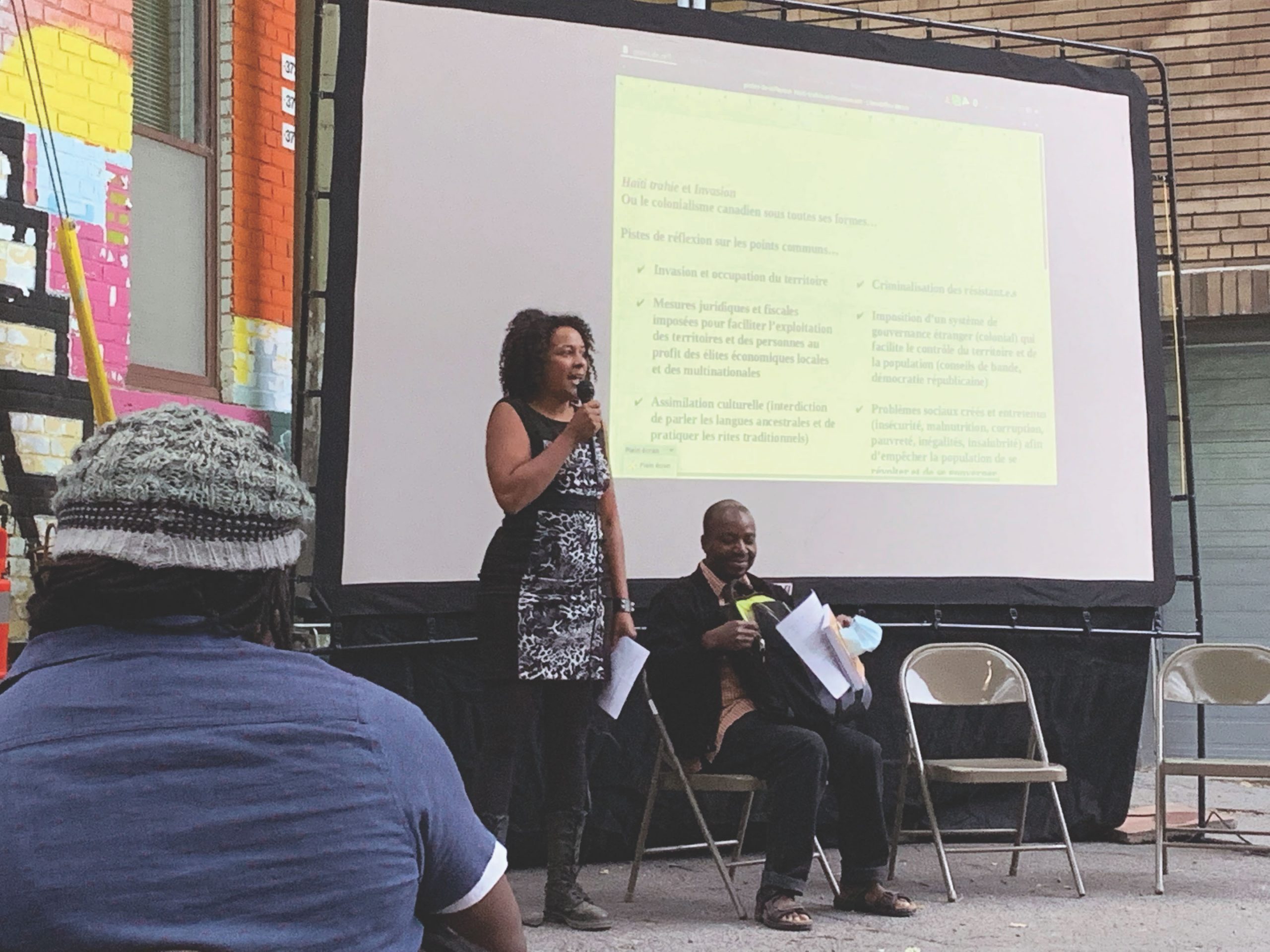
The evening of Sept. 2 was chilly, but the back alley of the Milton Park Housing Co-op was hot with the buzz of political activism. Gathering for a viewing of Elaine Briere’s Haiti Trahie and Franklin Lopez’s Invasion put on by Cinema Politica Concordia, viewers and concerned citizens ate pizza, drank coffee, and listened to Burning Cop Car

Both documentaries explore Canada’s role in the systemic racial and imperial oppression of people of colour within, and beyond, the Canadian border. In Haiti Trahie, Marie Dimanche, a Haitian activist, founder of Solidarité Québec-Haïti, and the French-English translator of the film, examines how Canada, France, the U.S., and the United Nations actively worked to undermine Haiti’s success as a democracy. Dimanche explained how external forces condemned Haiti to poverty, violence, and social strife by pressuring the government to adopt neo-liberal policies and privatize essential services—as well as instigating a coup d’etat and exiling the democratically elected Jean Bertrand to Africa. 

“There was a veil of secrecy,” Dimanche said. “The Canadian people were kept deliberately ignorant of [their] government’s role in undermining Haitian democracy.”

Meanwhile, well-respected non-governmental organizations defended the Canadian government’s actions, promoting the paternalist picture of “white saviours” intervening in the affairs of a nation deemed incapable of handling its own. 

“It’s not that [the Haitians] do not know how to govern [themselves], it’s that [the Canadian government does not] let them govern,” Dimanche said in a Q&A panel after the presentation of the films.

In a similar exploration of Canadian imperialism, Invasion documents the Canadian government’s egregious violation of the Wet’suwet’en nation’s sovereignty for the sake of the Pacific Trail pipeline. The film follows Freda Huston, a Wet’suwet’en activist, tribal chief, and Unist’ot’en spokesperson, as she resists the pipeline swallowing up her people’s territory and contends for the sanctity of the waters that her people rely upon.

“We have already said ‘no’ to these projects and that no pipelines will come on our territory,” Huston said, rejecting bottled water and tobacco offered by a Chevron representative. “No thanks, we have got clean water right there […] and that is plastic that adds to the landfills.”

After the film’s screenings, guest speaker Renel Exentus, a Haitian-Canadian activist and member of the REHMONCO, detailed how the great powers of the international community resist Haitian prosperity as those powers value profit over all else and feel entitled to Haiti’s workforce and resources. When they face resistance, they push back mercilessly. 

Together, the films encapsulate the clear pattern of imperial entitlement at the core of Canada’s foreign and domestic policies. Through emotional narration, horror-stricken interviewees, and disturbing visuals of destruction and violence, both Haiti Trahie and Invasion demonstrate the extent to which the history of our own country is saturated in oppressive ethnocentrism that we must never forget, and never forgive.

Cinema Politica will screen Haiti Trahie and Invasion again on Sept. 18 at 18:00. 

News, PGSS, SSMU

McGill Governance 101

STUDENTS’ SOCIETY OF MCGILL UNIVERSITY (SSMU)

What it does:

SSMU represents all undergraduate student interests and rights in the McGill Senate. SSMU consists of four bodies—General Assembly and Referenda, Board of Directors, Legislative Council, and Executive Council—and is led by seven elected executives, including the president, vice-president (VP), VP internal, VP external, VP student life, VP finance, and VP university affairs. SSMU, specifically the student life portfolio, also plays a large role in student life by organizing events like Activities Night and by running the undergraduate student bar Gerts

Recent Events:

Over the last year, SSMU has focussed its efforts on helping students navigate the COVID-19 pandemic and advocating for student health and safety on campus. On Sept. 1, the Society staged a protest, and over the summer it wrote an open letter, and published a report on the impact of COVID-19 on McGill students. In addition, SSMU has involved itself in social justice movements that extend beyond the Roddick gates, for example, by standing in support and solidarity with survivors of residential schools in Canada in light of the discovery of thousands of unmarked graves of Indigenous children on the grounds of these schools. 

POST GRADUATE STUDENTS’ SOCIETY (PGSS)

What it does:

PGSS is responsible for representing all graduate and postdoctoral students at McGill. Its monthly Council meetings address its policies and committees, and monitor executives’ actions and projects. There are five primary executives elected by McGill postgraduate students, and four PGSS members sit on the McGill Senate. The executives organize regular social and professional events for postgraduates at Thompson House, the PGSS’ headquarters. 

Recent Events:

PGSS has also been campaigning for wage increases for doctoral researchers in McGill’s Faculty of Science and Faculty of Medicine and Health Sciences, as wages have remained stagnant for over a decade while living expenses and tuition fees have increased.

BOARD OF GOVERNORS (BoG)

What it does:

The BoG is responsible for making all final decisions regarding the university’s financial, academic, and business matters. The BoG has 25 members who vote on policies and two non-voting student representatives, one from SSMU and another from PGSS. Notable members of the BoG include McGill’s Chancellor John McCall MacBain and Principal and Vice-Chancellor Suzanne Fortier. 12 members of the BoG are appointed by other members, while the rest are elected or appointed by different campus organizations such as SSMU, PGSS, and the McGill Alumni Association. Students may only attend the community sessions of BoG meetings. 

Recent Events:

In May 2021, Ehab Lotayef resigned from the BoG due to the Board’s refusal to consider a motion for the display of an equity statement on campus. In May 2021, the BoG approved a revised version of McGill’s Policy on Harassment and Discrimination

MCGILL SENATE 

What it does:

The McGill Senate is responsible for overseeing all academic matters at the university, including the courses offered and their curricula. 52 of the 111-member body are elected student senators. The remaining seats are filled by representatives from all other constituencies at the university—like SSMU, PGSS, and BoG—as well as McGill’s chancellor, provost, principal, and the chair of the BoG. Meetings are held once a month and are open to the public, unless they deem a topic confidential. 

Recent Events:
At the final Senate meeting of the 2020/2021 academic year, the Senate approved the Fall 2021 calendar of key academic dates, including the implementation of a Fall reading week. In February 2021, the Senate presented a report on the university’s Policy Against Sexual Violence and its efforts to educate students about sexual violence.

Read the latest issue

Read the latest issue