

Latest News

News, The Tribune Explains

Tribune explains: SSMU’s motion in support of Dollarama workers

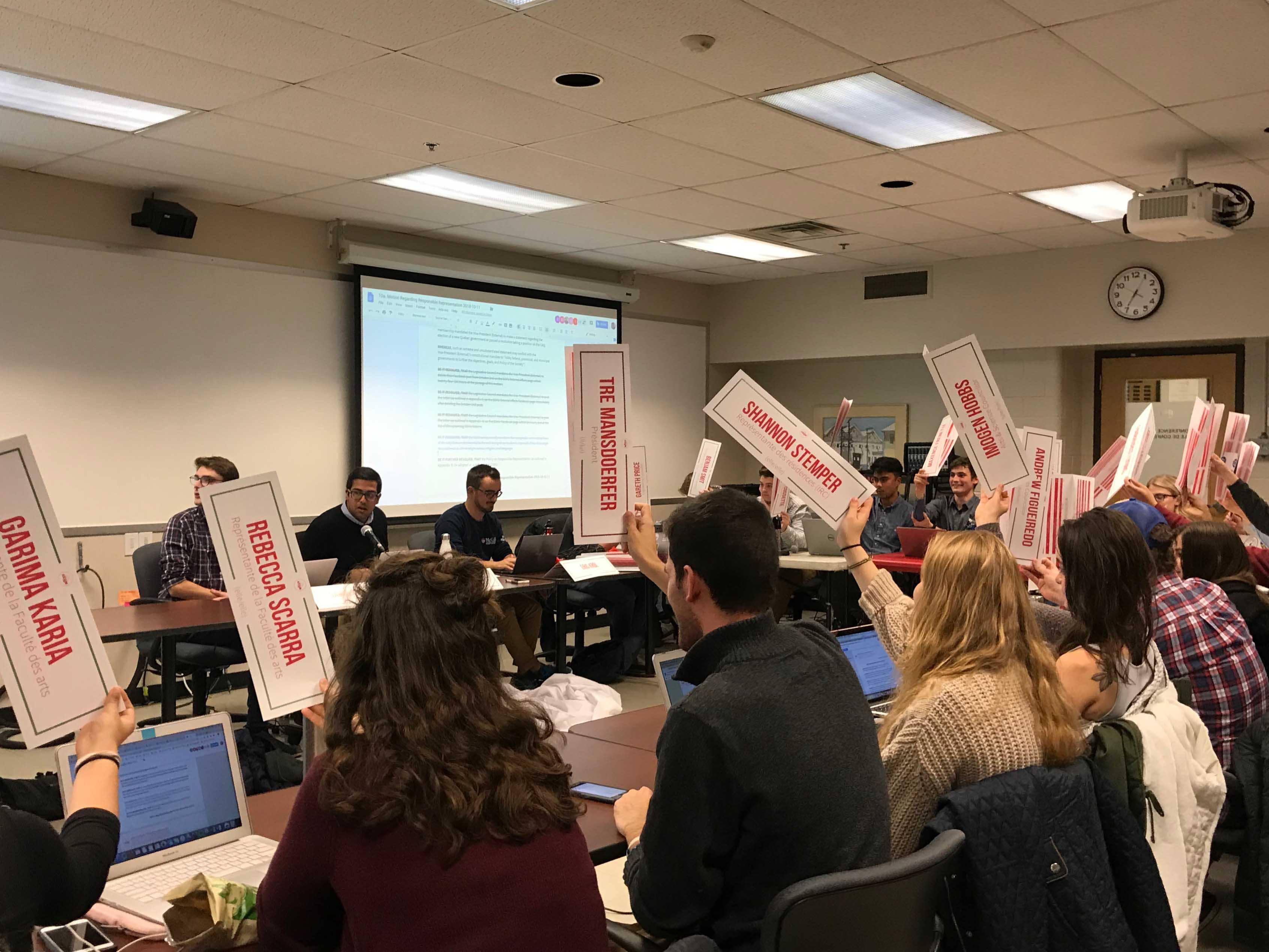
On Jan. 28, during a Students’ Society of McGill University’s (SSMU) Legislative Council meeting, councillors heard a presentation from an organizer of the Immigrant Workers Centre (IWC) about the poor labour conditions that some Dollarama warehouse employees face. Following this presentation, the Legislative Council voted unanimously to approve a motion mandating that SSMU’s Office of External Affairs support student solidarity with Dollarama warehouse workers. The Tribune examines the significance of this motion. 

How do Temporary Agencies abuse workers’ rights?

Since 2009, the IWC has concentrated its efforts on supporting temporary agency workers such as those working in Dollarama warehouses. Temporary workers tend to lack a platform from which to advocate for labour rights due to the intervention of staffing or “temp” agencies between workers and their employers. 

The use of staffing agencies by large multinational companies such as Amazon and Dollarama has become increasingly common over the past decade. Workers employed by staffing agencies are often racialized undocumented immigrants who, due to their position as contractors rather than employees, are denied many forms of labour rights. 

What are the working conditions at Dollarama warehouses?

Dollarama has a total of over 1,600 stores across Canada and Central America and employs 20,000 workers directly. Within their distribution centers, however, over 1,000 workers—most of whom are racialized immigrants—are employed by staffing agencies. 

According to the IWC, warehouse workers employed by staffing agencies are commonly paid an hourly wage of $12-15. At 40 hours a week for $15 an hour, workers earn an annual salary of just over $31,000, which falls well below Canada’s official poverty line for a family of three. Furthermore, the IWC reports that 10 per cent of warehouse workers are paid under the minimum wage. 

In addition to low pay, the IWC states that workers employed at Dollarama’s distribution centers face gruelling working conditions. It is reported that workers are expected to move boxes weighing 50 pounds every 20 seconds to reach their shift quota. Furthermore, 15-minute lunch breaks are often reduced to five minutes as it takes workers several minutes to walk across the warehouse from their workstation to break rooms. 

What are McGill’s Investments in Dollarama?

As is shown in McGill’s 2020 report on the university’s publicly traded Canadian equities above $500,000, McGill University has $3,051,682 invested in the Montreal-based dollar store retail chain Dollarama. While McGill’s holdings in the chain are not the most significant portion of the school’s many equities, the more than three-million–dollar investment makes Dollarama the 16th most valuable in McGill’s 2020 Canadian equities portfolio. According to McGill’s Statement of Investment Policy, the goal of the McGill Investment Pool is to preserve its capital while remaining within the social and ethical standards of the university. 

The monetary connection between McGill and Dollarama goes further: The Rossy Family, whose donations enabled the completion of McGill’s $14 million Rossy Wellness Hub, are the founders and the CEO of Dollarama Inc. with a reported net value of $2.52 billion. 

What will SSMU’s Office of External Affairs do? 

By approving this motion, SSMU has stated that it will mandate its External Affairs office’s campaigns department to support student campaigns in solidarity with Dollarama employees. According to the motion, this may involve submitting petitions to McGill University’s Committee to Advise on Matters of Social Responsibility (CAMSR), a committee within the McGill Board of Governors responsible for advising the Board on issues of social responsibility within its investment portfolio. Furthermore, SSMU will be allocating resources for events attempting to raise awareness about this issue.

Chill Thrills, Student Life

How to celebrate Valentine’s Day in lockdown

Whether you’re single, coupled, or ‘it’s complicated,’ one thing is for sure: This Valentine’s Day won’t be like any other. Even though Montreal has extended its stay-at-home orders, there are still plenty of ways to celebrate this heartfelt holiday. Below, The McGill Tribune shares eight ways you can get the most out of your Valentine’s day.

Hunt for roses at Old Port

If you’re looking for a grand gesture to make this Valentine’s Day, MFleurs, a Montreal-based florist, recently launched an initiative called “In Case of Love at First Sight.” The company has hidden boxes filled with roses in various spots across the city. 

“[This initiative was born] to spread a bit of joy during this time [and to promote] a bit of togetherness and love,” co-owner Angela Martignetti said in an interview with the Tribune

There are 500 roses hidden all around the city, so who knows—perhaps you’ll come across one on your next walk.

Support a local restaurant by ordering takeout 

Sure, you won’t be able to sit down in a restaurant with your special someone, but that doesn’t mean you can’t enjoy a romantic dinner together. In fact, ordering-in can make the occasion even more intimate. If you’re hungry for Italian, Weinstein and Gavinos is a classic option offering a sweeping selection of pasta, pizza, and more—including desserts like their delectable Nutella cheesecake. For sushi, try Sushi Momo, a vegan restaurant specializing in sushi rolls and Japanese entrees. Either way, decking out your dining room table with some candles and ordering in is a surefire way to enjoy this holiday.

Try your hand at handmade gifts

With many businesses closed, shopping for a Valentine’s Day present is a bit more complicated this year. However, nothing beats the pleasure of receiving a handmade gift. Whether you create a D.I.Y. pop-up card for your partner or make a keychain crafted with an inside joke, they’ll undoubtedly appreciate this unique gift made especially for them.

Impress your partner with your glamorous lockdown style

Are you rotating between sweatpants and pyjama bottoms? Or maybe you’ve given up on wearing bottoms altogether? In any case, there’s no reason why quarantine style can’t be glamorous. Impress your partner with your chic blanket skirt wrapped around your waist, a fashion staple for every occasion. Or, if skirts aren’t your thing, the blanket cape is a slick alternative. You can also go back to the basics by trying out the suggestions in this article from The New Yorker describing five innovative ways to style your sweatpants.

Get to know your partner even more deeply

Being around someone 24/7 is enough to test the limits of any relationship. That said, being unable to leave your house means the two of you can get to know each other on an even deeper level. Test your knowledge on them by guessing all their favourite things or try out these 36 questions to fall in love. For extra fun, you might even consider turning this into a drinking game.

Meet your special someone on Datamatch

Single and looking to fall in love, or just looking for a new friend? No problem! Datamatch is a student-created and student-run matchmaking service first launched in 1994. The platform operates at over 35 universities, including McGill. Starting Feb. 7, you can fill out the entertaining survey and on Valentine’s Day, your matches will be released. At the very least, you’ll have a laugh or two and who knows, you might even find true love.

Binge-watch a romantic Netflix series

If you’re looking for a romantic movie and finally sick of rewatching Love Actually, try out a classic reality love show. Love is Blind will melt your heart as contestants declare their undying love for each other through a wall just three days after meeting. Looking for something a little lighter? Instead, try watching participants on Too Hot to Handle resist the temptation to get physical with one another or risk losing $100,000.

Spend the day with friends

Although platonic friendships are often overlooked on this holiday, these relationships can be some of the most vital and meaningful connections in our lives. Whether you’re with your roommates, meeting friends over Zoom, or gathering for a virtual movie night on Netflix Party, there’s nothing like spending Valentine’s Day with your closest friends.

McGill, News

AUS candidates discuss mental health at 2021 election debate

McGill’s Arts Undergraduate Society (AUS) held a virtual debate on Feb. 4 for candidates running in the upcoming AUS elections to discuss student mental health, support for survivors of violence, and equity in the Arts faculty. Candidates running for the positions of President, Vice-Presidents (VP), Representative, and Senator outlined each of their goals for what they would hope to accomplish if elected. 

The executive positions of VP Finance, VP External, VP Academic, VP Social, and Arts Representatives are uncontested. On the other hand, there are two candidates each up for the position of President, VP Internal and VP Communications, and six candidates competing for the two Arts Senator positions.

The polling period is open from Feb. 8 until the election results are announced on Feb. 10 at 6 p.m. Many of the candidate’s platforms included common themes such as increasing mental health support for students and ensuring equity and sustainability in the McGill administration’s practices.

Candidates discussed the improvements that need to be made to the McGill Student Wellness Hub as a more supportive system for students. Paige Collins, U2 Arts Representative and one of the candidates running for Arts Senator, called for better mental health services through increased hiring in the Wellness Hub and changes in deferred exam policies.

“If elected, I’d like to advocate for increasing the amount of licensed healthcare professionals that students can access,” Collins said. “Further, I’d like to advocate for change in McGill’s policy regarding missed exams and medical notes. Currently, to receive accommodations for missed exam[s], you need to provide a medical note that falls within a 24-hour window of when the exam took place. I’d like to advocate for a 48-hour window instead.”

Another key issue the candidates discussed is ensuring the safety of survivors of gendered and sexual violence. Aiden Starosta, U1 Arts student and candidate for Arts Senator, believes that McGill is not doing enough to protect survivors and prevent further violence.

“It should be a priority for students to feel safe at McGill, and that currently is not happening considering the very real and pressing issue of sexual violence on campus,” Starosta said. “To lessen the problem, I will fight for a reworked, in-person sexual violence course, a security app for students in res[idence], increased presence of emergency and phone booths on campus, and the implementation of a zero-tolerance policy.”

On the subject of equity at the university, Maddy Evans, U3 Arts and one of the candidates running for an Arts Senator position, spoke of the lack of diversity among McGill’s faculty.  

“I hope to expand equity in McGill’s hiring practices for new professors and members of administration,” Evans said. “As of 2020 there were only 10 Black permanent professors at McGill among a faculty of over 1,700. I believe hiring more people of colour, Indigenous peoples, women, and other members of marginalized communities is incredibly important.”

Adin Chan, U3 Arts, and Alexis Zhou, U3 Arts, are both running for the position of AUS President. While Chan plans to improve current AUS infrastructure, Zhou’s anti-bureaucratic platform intends to revamp the AUS entirely.

“This upcoming election, we have an anticipated voter turnout of eight per cent, [which] means the vast majority of students, the 92 per cent, are excluded from what we’re doing here, and they’re no longer interested in our bureaucracy role-play,” Zhou said. “As student leaders, we have the responsibility to overhaul and reform the status quo […] Which is why under my leadership we will revise the constitution to make AUS the first non-hierarchical faculty association at McGill.”

Chan explained why he views bureaucracy as essential for student government as a system to monitor and regulate spending.

“The reason why there’s a lot of bureaucracy is not because we like paper,” Chan said. “It’s because we need to be very judicious about how we use the public’s funds. These are students’ money that is entrusted to these organizations that we need to be very careful with that clubs don’t use to embezzle.”

Chill Thrills, Student Life

La Poutine Week highlights the cultural diversity of Montreal restaurants

Poutine is a defining culinary aspect of student life in Quebec. For many, it is the meal of choice after a night out, or simply a quick way to satisfy any fast-food craving. More recently, restaurateurs have created many variations of the traditional dish, from St. Laurent Pizza’s butter chicken poutine to Romados’ Portuguese sausage poutine. Many of these variations were featured in La Poutine Week, an annual event hosted by the cheese company Saputo to promote local businesses. Restaurants could submit their poutines to be tasted for a $200 fee, and the dishes judged worthy are given the chance to participate in the festival. Running from Feb. 1-7, the week’s offerings showcased how chefs are reinterpreting this classic Quebecois dish with flavours from their own cultures, bringing unique tastes into Montreal for all to enjoy. The McGill Tribune has the dish on this year’s offerings.

Stroganoff Poutine,  L’Gros Luxe (The Plateau)

Inspired by a hearty Russian beef stew, this stroganoff poutine is packed with rich flavour. There was a slight sourness to the stroganoff-inspired gravy, which brought out the smoky and sweet flavours of the minced meat. What really made this poutine to die for was the addition of spring onions, a savoury twist that truly brought out the flavour of the cheese curds and meat. In addition, the fries maintained their crispy integrity, which was likely because the gravy is served on the side—a good idea since the delivery time is often enough to make even the most resilient taters soggy. In general, this poutine is a good choice if you’re looking for an exciting version of the classic poutine to satisfy your cravings.

The Shahi Chicken Poutine, Thali Cuisine Indienne (Downtown)

Offering the most affordable poutine out of all the entries for La Poutine Week—at an astonishing $6.50 CAD on SkipTheDishes, the week’s sponsor—the Shahi chicken poutine fuses poutine with the traditional Indian dish Shahi, or paneer in a tomato-based sauce. Upon delivery, the fries and gravy were already mixed together, which unfortunately resulted in mushy fries. In fact, the fries had the consistency of mashed potatoes. Despite this, the dish was worthy of its La Poutine Week entry: The sauce was extremely addicting and paired well with the cheese curds. Thali Cuisine Indienne’s poutine is definitely value for money. If you are okay with limp fries, this is a solid choice.


Mayan Poutine, La Tamalera (Mile End) 

This was by far the best option out of the three that I sampled. First, it was more affordable than the stroganoff poutine from L’Gros Luxe; second, the uniqueness of a Mexican-inspired poutine was definitely a win. The hint of lime in the pulled pork gravy brought the entire dish together, bringing out the cheese, meat, and fries. Surprisingly, the fries maintained their integrity despite being soaked in the tangy gravy. The pulled pork-based gravy was extremely juicy and proved to be a good replacement for the classic. There were a few pickled vegetables served with a dollop of sour cream that was refreshing and complimented the taste of the fries. The dish was topped off with beans, adding a heartiness alongside a sense of authenticity. This savory and unique poutine was easily my favourite of La Poutine Week 2021.

News, SSMU

SSMU revamps accessibility policy, creates commissioner position

The Students’ Society of McGill University (SSMU) adopted a new Accessibility Policy during the Legislative Council meeting on Jan. 28. Last updated in 2016 and having expired on Jan. 1, 2021, the new policy expands beyond its previous focus on physical disabilities to include a more comprehensive commitment to accessibility and introduces a new Accessibility Commissioner position to SSMU.

The policy’s amendments are grouped into six categories: Communication and promotions, programming and events, physical access, student groups, external and internal advocacy, and SSMU governance. This expansion is an effort to embody the “social model of disability,” which maintains that it is systemic barriers, including physical, attitudinal, social, that are the primary factors to an individual’s experience of disability, rather than one’s own individual experience. 

Vice-President (VP) University Affairs Brooklyn Frizzle explained that the policy aims to improve the resources offered by SSMU’s Communications Department to reduce existing barriers to accessibility.

“There are a lot of big operational changes with the Communications Department offering accommodations in terms of whisper translation or sign language interpreters […] which we’re supposed to be offered anyways, but there hasn’t been necessary financial allocations or pressure,” Frizzle said. 

Frizzle noted that the lack of enforcement mechanisms contained in the previous 2016 policy limited its effectiveness during the five years that the former policy was in effect. 

“The biggest problem was that it was just frankly unenforceable,” Frizzle said. “There weren’t any clear mandates for executives or governing bodies. From [2016] on, I don’t think there was a single report on accessibility […] presented to the council.”

To address these concerns, the new policy will mandate the creation of an Accessibility Commissioner who will be responsible for leading an Accessibility Committee that will convene biweekly. VP Student Life Maheen Akter will be responsible for the hiring and training of the new commissioner. 

“The Accessibility Commissioner is responsible for ensuring that mandates are followed,” Akter said. “The commissioner will  serve as a resource for SSMU and […] student groups in efforts to expand accessibility.”

The commissioner and their committee will work to engage the entire university population to ensure that all operations and communications are accessible.

“We’re now able to hire someone with expertise, […] somebody who will consult with student groups and staff in order to make sure all our operations are as accessible as possible,” Akter said. 

Akter will correspond with student clubs to address barriers to student participation and provide resources to address concerns about accessibility. 

“One of the other things […] that is also part of my role [is] making sure that there’s inclusion and awareness [within student clubs, and] part of that is providing training materials in clubs workshops,” Akter said.

Under the leadership of the new commissioner, the Accessibility Committee will aim to create space for students to voice concerns on accessibility at SSMU, which Frizzle notes is lacking on campus. 

“The creation of an accessibility committee [serves as] an oversight and auditing body that identifies inaccessibility at SSMU, makes recommendations and acts as […] a forum for students with disabilities,” Frizzle said. “[Right now this] doesn’t really exist on campus aside from the University Joint Board Senate Committee on Equity Subcommittee on Persons with Disabilities.”

The policy states that the SSMU Funding Committee will now ask at least one question concerning accessibility when evaluating funding applications. The accountability committee will be held responsible for ensuring that this takes place, and report to the SSMU Legislative Council at least once a semester.

Teri Phillips, director of the Office for Students with Disabilities (OSD), emphasized the organization’s shared goals with the SSMU’s reformed Accessibility Policy and explained that the OSD will apply the central aims of the policy to continue to improve their services. 

“I do welcome and look forward to working with SSMU representatives to advance our mutual objective of improving access and creating an accessible learning environment for all our students,” Phillips said.

Hockey, Sports

The rich history of McGill Martlets hockey

McGill men’s hockey has played a crucial part in developing the modern version of the sport. However, women’s hockey has made its mark as well, despite having a later start. 

Women started playing hockey at McGill in 1896, but with a slew of restrictions. They were required to wear skirts while they played and were given very little ice time—and their games did not allow male spectators, except for referees and rink employees that would guard the doors against any prospective onlookers. 

Organized play would not take off until 20 years later, when the McGill women’s hockey team participated in the first Women’s Provincial Ontario Championship in 1914. In 1920, Lady Meredith of Montreal donated the Lady Meredith Cup to the Quebec Ladies’ Hockey Association. This cup is said to be the first women’s ice hockey trophy in Canada. 

From 1921 to 1933, McGill was part of the first university-level women’s hockey league. In 1921, they played against the University of Toronto in the first-ever women’s university championship. The Women Interuniversity Athletics Union (WIAU) league, founded in 1923, would run for 50 years; however, McGill’s teams would never become champions. 

In the 1960s, McGill women’s hockey made a comeback when David Kerr, a McGill men’s hockey player, helped restore the women’s team. It was at McGill that he met his wife Sheryl, a first-year player at the time. Together, in 2007, the Kerrs would make the largest donation ever made towards a Canadian university female athletic program. The $1 million donation helped trainers become full-time employees and allowed the team to hire scouts to recruit players from around Quebec to join McGill’s team. 

The Kerrs made another, even larger, donation of $3.5 million in 2018 towards the creation of a Women in Sports initiative at McGill, helping the women’s hockey program hire their current interim head coach, Alyssa Cecere.

In 1976, the women’s team became known as the Martlets. The name referred to the coat of arms in the university logo, which has three birds, originally part of James McGill’s family crest. The symbol was also used by the McGill Martlet Foundation, a program focussed on raising money for and providing aid to McGill student athletes.

In 1985, the Martlets won the Quebec Championships, but over the next 13 years they would only manage to make the qualifying rounds once. Things began to turn around for the Martlets after the arrival of goaltender Kim St-Pierre in the 1998 season. Over the next four years, she would help the Martlets qualify for the Canadian Interuniversity Sport (CIS) women’s ice hockey championship playoffs. 

In the 21 years since the start of the USports championship, the Martlets have had four wins in 10 appearances, second only to the Alberta Pandas, with eight wins in 10 appearances. Over the past two decades, the McGill Martlets have become a dominant force in women’s hockey at the university level. 

With the creation of the National Women’s Hockey League (NWHL) and the Montreal-based team, Les Canadiennes, the talent of the Martlets has become evident: Eight of the 21 women rostered for Les Canadiennes are former McGill Martlets. The team’s general manager, Meg Hewings, explained the Martlet’s significance in an interview with the McGill Alumni Association.

“Women’s hockey is growing at an exponential rate and McGill has paved the way for that growth,” said Hewings. “McGill’s varsity hockey program has a long and rich history [….] Many of our players came out of the program, they know each other well and play well together, and they’ve brought a lot of terrific chemistry to our team.”

Multiple Martlets have also become Olympic champions with the Canadian women’s hockey team, which won four of the last five Olympic gold medals in the sport.

Although the history of the McGill men’s program may be more familiar to some, the story of the Martlets is just as significant and deserves the same recognition as the men’s.

Science & Technology

McGill researchers are shaping the future of arthritis treatment

Arthritis has been one of the most common health conditions in Canada for years, affecting people of all ages with symptoms including joint stiffness and painful inflammation. While there is no known cure, researchers are hoping to find more effective ways to treat and manage arthritis. The Arthritis Society of Canada compiles a list of the top 10 research advances each year, highlighting breakthroughs with promising results. The list for 2020 includes two McGill-led projects supervised by Dr. Hosni Cherif and Dr. Inés Colmegna.

Zombie cells and spinal degradation

Osteoarthritis is one of the most common forms of arthritis worldwide, and is caused by the deterioration of joint cartilage—tissues that cushion the ends of bones. Cherif, a postdoctoral fellow in McGill’s Faculty of Medicine and Health Sciences, led a research project on spinal osteoarthritis. 

“My research goal is to understand how intervertebral discs and joints degenerate leading to axial osteoarthritis, and the associated chronic pain,” Cherif wrote in an email to The McGill Tribune

In particular, Cherif studied the role of senescent cells, often known as “zombie cells,” which permanently stop dividing but continue to age and evade death. 

Cytokines, also known as cellular signalling molecules, are typically involved in aiding the immune response at a site of inflammation, but the accumulation of these molecules can cause degradation of the spine.

“[The] accumulation of senescent cells increases cytokine production and inflammation leading to the development of intervertebral disc degeneration,” Cherif wrote. 

Cherif’s team identified a synthetic drug, RG-7112, and a natural compound, o-Vanillin, capable of eliminating zombie cells while allowing healthy ones to proliferate. The combination of these molecules has the potential to target inflammation in the spine, thereby reducing the associated chronic pain. 

“This will lead to better management or the alleviation of persistent pain to improve the quality of life of patients with osteoarthritis,” Cherif wrote. 

Currently, Cherif is expanding his research in drug discovery to treat spinal osteoarthritis by testing out the signalling pathways of other senotherapeutic agents, molecules that specifically target cellular senescence. 

“Understanding the mechanism of cellular senescence and disc degradation will facilitate [the] development of novel disease-modifying drugs,” Cherif wrote.

The more the better: High dose vaccine protection

Rheumatoid arthritis (RA) is an autoimmune type of arthritis in which the immune response mistakenly targets host cells, causing joint damage and inflammation. This makes patients more vulnerable to the adverse effects of viruses such as influenza.

Colmegna, an assistant professor working in the Division of Rheumatology at the McGill University Health Centre, led a study focussing on the implications of influenza infections in RA patients. 

Specifically, Colmegna studied the effect on antibody production of a standard dose of the influenza vaccine versus a high dose in those with RA. Antibodies are molecular markers that recognize and bind to foreign invaders, signalling their presence to the immune system and initiating an immunological response. 

“The findings of our study indicate that compared with the standard dose influenza vaccine, RA patients who receive the high-dose are two to three times more likely to generate ‘protective’ antibodies against the influenza virus,” Colmegna wrote in an email to The McGill Tribune. “This may be associated with a reduced risk of developing influenza.” 

By increasing the likelihood of generating more antibodies against influenza, the higher dose increases the effectiveness of the body’s response to infection.

This study is the first of its kind to show that it is possible for those with RA to achieve better protection against influenza by using an existing high dose vaccine. 

“Canadian guidelines recommend that RA patients receive an annual standard dose influenza vaccine,” Colmegna wrote. “However, many RA patients do not generate protective antibodies post-vaccination [….] With this approach, a larger number of patients with rheumatoid arthritis might be protected against influenza, a disease that in these patients is associated with significant morbidity and mortality.”

Colmegna hopes that her research findings will increase the availability of high dose vaccines to better protect RA patients against the influenza virus.

McGill, News

McGill plans to implement Tier 2 in-person academic activities

In an email to the McGill community on Feb. 5, Deputy Provost (Student Life and Learning) Fabrice Labeau announced that McGill would begin implementing some in-person activities on campus as early as Feb. 8. These in-person activities, called “Tier 2 academic activities,” are optional learning opportunities for students currently in the Montreal area who would like to return to campus. 

The Ministry of Higher Education officially announced the gradual rollout of in-person learning activities in a press conference on Feb. 4. Associate Provost (Teaching and Academic Programs) Christopher Buddle told The McGill Tribune that the safety of students and staff will be prioritized during the roll out of Tier 2 teaching activities. 

“Planning was […] done with strict adherence to all the public health directives and guidelines,” Buddle said. “That’s actually why some activities will take a little bit of time before they’re ready to go. We have to make sure that [all] the safety measures are in place [….] Students will be notified [about in-person activities] through their faculties and instructors in the coming days and weeks.” 

A procedural mask mandate for indoor spaces on McGill’s campuses will be implemented along with pre-existing campus safety regulations. For Rachel Kalmanovich, U2 Arts, however, the prospect of a sudden return to in-person learning is daunting despite the difficulties of online classes. 

“I’m generally a little bit nervous,” Kalmanovich said “When I signed up for [my] conference I wasn’t really expecting things to go in person. I definitely don’t think I feel comfortable being in an in-person space at this point in time.” 

The administration cited the positive impact they believe returning to campus will have on students’ mental health as a driving force behind beginning Tier 2 in-person activities.

“For [some] students the ability to come to campus for some activities could be quite impactful and very important because we know that a lot of students are feeling quite isolated,” Buddle said. “An opportunity for some students to engage even just a little bit with the campus […] can be quite important for members of our community.” 

While some academic activities will be offered under Tier 2, other student services, like clubs and some Wellness Hub services, will remain online. 

“[Under] the new government directives, we are told that [McGill] can offer [student services] in person, based on demand,” Labeau said. “Our first couple of weeks are going to be really about gauging demand. We know that for the Wellness Hub there hasn’t been much demand for in-person mental health services. But [for] in-person physical health services, [we know] there was demand, so […] it’s going to be done on a case-by-case basis.” 

The return to in-person teaching also came as a cause for concern for some educators at the university. Jessica Rose, grievance officer for the Association of Graduate Students Employed at McGill (AGSEM), voiced some of the union members’ concerns regarding the safety of in-person teaching. 

“The university maintains that as long as their protocols are in place, and are being followed, that the environment is categorically safe,” Rose said. “Of course, protocols are simply a matter of behaviour and compliance […] so the question of whether or not they’re consistently maintained […] determines whether or not they consider the environment to be safe.” 

Rose expressed frustrations with the McGill administration’s decision to implement in-person teaching. 

 “For people who have health concerns, there are procedures for accommodation which include […] the right to opt out of in-person teaching altogether and to teach remotely or to do other tasks as a TA without losing [your position],” Rose said. “But there are also other conditions that aren’t taken as seriously. [McGill has] been very explicit that if you have dependents who have health conditions, or if you live with somebody who has a health condition that puts them at greater risk for negative outcomes from COVID-19, they don’t care.”

McGill, News

Eating Disorder Awareness Week forms community in isolation

Content warning: Mentions of eating disorders.

The Students’ Society of McGill University’s (SSMU) Eating Disorder Resource and Support Centre (EDRSC) held its third National Eating Disorder Awareness Week (EDAW) from Feb. 1 to Feb. 5. The events and discussions throughout the week highlighted the impact that social media and the pandemic have had on eating disorders or disordered eating. The workshops provided guidance on mindful eating, fatphobia, and supporting affected loved ones. 

McGill cut its Eating Disorder Program in 2017 due to changes made to the structure of counselling and psychiatric services at the time, among other factors. In its place, SSMU established the EDRSC to fill a lack of resources. 

During the “Disordered Eating in a COVID-19 Context” event, Ffion Hughes, U4 Arts and a survivor of anorexia nervosa, shared how working from home in constant proximity to her kitchen has made it challenging to maintain a positive relationship with food. 

For the most part, I’ve been able to stay in control over my eating,” Hughes said. “But in a sense, it’s too much control.”

Confined now to her apartment, Hughes says that the pandemic has left it up to herself to enforce the boundaries that make balanced consumption easier. 

“In years past, I’ve been able to go to the library, where I could not think about food for a while,” Hughes said. “[Now], I’m constantly surrounded by triggers.”

Odessa Grimard is a U3 Science and floor fellow for Solin Hall residence who has experienced disordered eating. Grimard explained that isolation may be especially triggering for those in recovery. 

“Folks don’t have the social checks of other people around them to realize that their behaviour is not [normal],” Grimard said. 

Grimard also grapples with the decreased visibility of students’ mental health challenges in the remote learning context. With the loss of communal spaces, students’ struggles are obscured and preventative measures inhibited when they are most needed.

“In previous years, I had students study until 3 a.m. as a form of anxious [behaviour], and we’d see them and be able to reach out and support them, but we can’t see that anymore,” Grimard said. 

Those fighting mental health issues and disordered eating during the pandemic are forced to seek support themselves. Elizabeth Hales, U0 Arts, expressed the challenge of finding and accepting aid as a first-year student. 

“My therapist is back home,” Hales said. “Coming into a new city with no support system, being unable to meet new people, it’s hard to validate myself and realize it’s okay to get help, even though I’m not the worst I’ve ever been.”

During “Fatphobia: An Introductory Workshop,” Mariam Elmi, a student at the University of Ottawa, described her search for a community of minorities affected by eating disorders or disordered eating. 

“Within mainstream eating disorder stories and discussions, I often feel like I’m the odd one out because I don’t see people who look like me,” Elmi said. “I didn’t see anyone like me until I went to a support group over Zoom last night. I thought, ‘Finally I’m not alone.’” 

Cyndi Owens, a local wellness advisor, concluded the “Disordered Eating in a COVID-19 Context” event by calling upon students to support one another through their shared challenges. 

“The only connection we have left [is] grief,” Owens said. “We’re all not okay in different ways [….] The key is a network of support [….] Bother each other, make use of each other, then change will be sustainable and be rooted in a core rather than something that feels like it might overtake us.”

Students can find resources and support for disordered eating or eating disorders at the EDRSC and Student Wellness Hub.

Montreal, News

Bar des Pins to be revamped by Milton Park community group

Bar des Pins, a student-favourite sports bar at the corner of avenues Parc and des Pins is set to be purchased by Société du Développement Communautaire (SDC) Milton Parc, a group member within Milton Parc Citizen’s Committee (CCMP). A recent report by the Students’ Society of McGill University Vice-President (VP) External suggests that SSMU may begin engaging in conversations with the Milton Park Community (CMP)—a housing cooperative network that the SDC is a member of—about forming a partnership.

The CCMP is a not-for-profit organization which strives to improve the democratic and collective autonomy of Milton-Parc residents. Its past projects have included organic fair trade food banks, an environment committee, and a partnership with SSMU’s Trash 2 Treasure initiative.

In an email to The McGill Tribune, Nathan McDonnell, VP of the CCMP, elaborated on the SDC’s role as community landlord of the Milton Parc neighbourhood, noting that it owns Presse Café, Basha’s, Marché Lobo, and Café St Barth, as well as other offices and businesses along Parc Avenue. The SDC currently has its sight set on numerous properties, like the former Hôtel-Dieu hospital, the Royal Victoria Hospital, and the parking lots on Saint Urbain.

McDonnell spoke to the imminent purchase of Bar des Pins by the SDC.

“[One] family has owned [Bar des Pins] for several decades,” McDonell said. “Since the father has become elderly and unable to run the business anymore, the sons […] wanted to sell the bar even before the pandemic.”

Bar des Pins falls within the Milton Parc community land trust, which gives the SDC rights of first refusal to buy it, effectively keeping it off the private market when sold.

“[The land trust is] a kind of post-capitalist form of property ownership where 1500 people live without landlords in community-controlled housing.”

McDonnell described SDC members’ vision for the future of the Bar. 

“[It could be] a unique family-friendly community café [or] bistro, a place with healthy, local, maybe all vegetarian food, amazing coffee, and lots and lots of community events,” McDonnell said. “It would be run as a solidarity cooperative, a democratic model where workers and customers are co-owners. It would be a model for a democratic and ecological economy.”

CCMP members are interested in collaborating with SSMU on the new business.

In an email to The McGill Tribune, SSMU VP Finance Gifford Marpole wrote that the decision to collaborate with SSMU has only come up once in dialogue with the CCMP and that no firm decisions have been made concerning the Pins café yet.

Marpole explained that SSMU would have to produce a robust financial analysis should it become seriously interested in forming a partnership with the site.

“[It would involve] rigorous analysis to determine the feasibility, sustainability, and benefit of such a collaboration,” Marpole said. “The decision would have to be brought to the students and voted [on] by them. It would definitely be brought to the attention of students. That’s important to SSMU’s policy on transparency.”

According to SSMU VP External Affairs Ayo Ogunremi SSMU has yet to seriously consider the partnership.

“SSMU has a history of collaborating with organizations and communities in Milton Parc,” Ogunremi said in an interview with the Tribune. “It’s established positions to work on inter-generational housing with the community, for example.”

Regardless of SSMU’s decision to financially back the project, the expected timeline for Bar des Pins’ purchase and renovation remains unclear.

A representative of Bar des Pins said that the establishment has yet to be sold to anyone and did not elaborate on its potential redevelopment.

The projected date for a renovated Pins café remains unknown. CCMP treasurer Adam Gwiazda-Amsel, U4 Arts, said that the SDC is currently negotiating the purchase of the property from its current owners.

“As such, it is unlikely that [the Pins café] will be operational before this summer at the earliest,” Gwiazda-Amsel said.

Read the latest issue

Read the latest issue