

Latest News

Student Life

Cinched for the gods

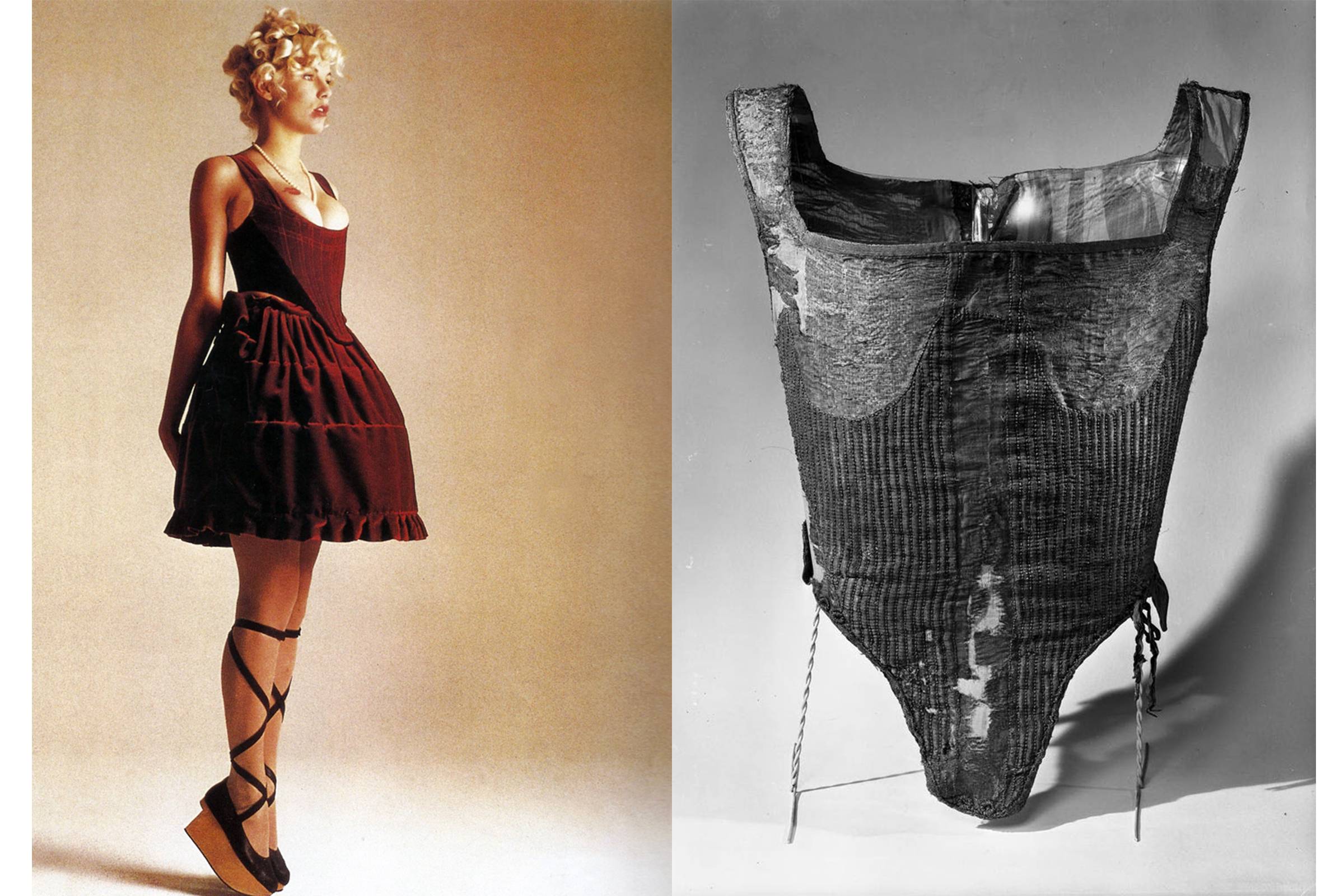
Whether you’re a Pinterest mom, an Instagram baddie, or a dedicated Vogue reader like myself, you may have noticed one article of clothing taking over celebrity fashion within the past year: The Vivienne Westwood corset. Worn by the likes of Bella Hadid, FKA Twigs, and Barbie Ferreira, the corset is a rare vintage find from Westwood’s 1980s collections. Screen printed with baroque paintings, the garment revamps a classic piece of British women’s historical costume. Corsets, however, come with concerns over health complications and a legacy of patriarchal oppression. To understand how we’ve arrived at this recent trend, it requires a look into the history of one of the most iconic and controversial garments of Western fashion. 

For over four hundred years, corsets were worn to support and contort women’s bodies into the body shape that was considered ideal. In the Elizabethan era, corsets created a flat, cone-shaped torso, while in the Victorian era, corsets created a dramatic hourglass shape. The ideal silhouette of a woman was just one factor within the ever-changing fashion trends.

Catherine Bradley, Senior Academic Associate and costume designer in McGill’s English Department, noted that the comfort level of the corset-wearer depended on what kind of corset was in stylesome more painful than others. 

“The Victorian corset was more adverse in terms of physical effects [than the Elizabethan style],” Bradley said. “In this time period, the idea of women as physically frail, with their heaving bosoms and shortness of breath, [came] from the fact that their lungs were constrained and their waists were constricted. I think it inadvertently created this idea of the weaker sex.”

Most people likely associate the corset with such negative physical effects. In one of the most memorable moments in Pirates of the Carribean, Elizabeth Swann faints off the edge of a cliff because of a tightly cinched corset. Along with limiting lung capacity, tightly laced corsets can force organs to shift and cause muscular atrophy over time. When worn correctly, however, traditional corsets are not torturous to wear. 

“It’s kind of like getting braces. At first it’s uncomfortable, but then you get used to them,” Bradley said. “I know costume designers who will wear corsets when they’re working long hours and their backs get tired; they wear them for support. And in my many years of putting actors into corsets, they seem to enjoy wearing them. Corsets change your whole physicality.“

Bradley explained that in the 18th and 19th centuries, there was a societal expectation for women to wear a corset to signal their respectability and moral righteousness. In a sense, this parallels how women are expected to wear bras today. While they do provide support, many women wear them out of a societal convention of modesty, shaping the wearer into an acceptable figure of femininity.

Today, corsets are nowhere near as rigid as the Elizabethan and Victorian ones made of whalebone and coutil. Modern corsets, like the one popularized by Vivienne Westwood, often include stretchy panels and flexible, synthetic boning, making them much more breathable and comfortable. Westwood’s design reinvented the corset by turning an upper-class undergarment into a sexy, comfortable top, offering a symbolic reclamation of women’s sexuality through a costume of the past.

The recent corset trend will not permanently disfigure you or make you faint off of a cliff. However, the history of corsets highlights an important theme of women’s fashion that continues today: Body shapes go in and out of style just like fashion trends. Instead of wearing corsets, women today are expected to achieve a perfect figure through other means, whether it be plastic surgery, intense dieting, or obsessive workout routines. Even the trend of waist-training comes with all the negative effects of corset-wearing, minus the benefits of lumbar support. Although we are far past the days of corsetry as a fashion staple, maybe we aren’t as far removed from our collective fixation on controlling women’s body shapes as we think we are. 

Arts & Entertainment, Books

D&Q hosts celebrity cartoonists Jason Lutes and Sophie Yanow

On Oct. 1, Librairie Drawn & Quarterly hosted a virtual discussion between two distinguished comic book artists, Jason Lutes, author of Berlin, and Sophie Yanow, author of The Contradictions. Despite its virtual setting, the event provided an intimate look into the creative processes and relationship between the two renowned graphic novelists.

Lutes, a New Jersey-born artist currently residing in Vermont, is nothing short of a cartooning celebrity. His comic book Berlin, a magnum opus of over 500 pages and a 22-year production time, is a tour-de-force of visual storytelling. Originally planned as a 24-magazine set, the comic chronicles life in Weimar Republic Berlin, from 1928 to 1933. The book follows Marthe Müller, a young art student haunted by a family tragedy; Kurt Severing, a bespeckled, chain-smoking journalist overwhelmed by his industry’s changing morals; and the Brauns, a working-class family, torn apart by politics. Berlin is made up of three volumes, and in 2018, D&Q published a collected version, framing all three books’ intricately-woven story as one gargantuan epic.

Yanow, an up-and-coming graphic novelist, just released her third book, the Eisner award-winning comic book entitled The Contradictions, a monochromatic, minimalist masterpiece that follows a younger, fictionalized Sophie at 20 years old. When she moves to Paris to study abroad, Sophie meets Zena, a radical vegan and anarchist activist who encourages her to become more politically engaged. In this semi-autobiographical coming-of-age story, Sophie hitchhikes her way across inky European cobblestones, questions her identity, and is forced out of her personal and ideological comfort zone, all in an attempt to discover her place in the world.

“I had this sense that […] this is kind of a coming of age story […] that takes place when a character is 20, because it’s […] that kind of place […] between a more firm adulthood and […] being a kid,” Yanow said.

And yet, despite the distance between Yanow now and the fictionalized Sophie in her book, Yanow feels that The Contradictions’s Sophie embodies an intense sentimental memory. Later, Yanow likened her protagonist’s maturation to Berlin‘s Marthe Müller, speaking largely of how Lutes’ work had inspired her own, and later asked him how he found the ability to write characters so distant from himself. 

In response, Lutes described his two-year research process prior to writing Berlin.

“I would read as much as I could [of] first-person narratives, [noting the] little mundane things […] like how people drink their tea or how much firewood you need to stack in the back alley to get through winter,” Lutes said.

Lutes also mentioned how his challenging upbringing as a middle-child in a quarreling family forced him to be the family mediator, which taught him empathy. He spoke on how he was frequently figuring out what family members needed in order to avoid conflict and understand each other’s intentions and underlying feelings. Later, when Lutes was in high school, he began participating in role-playing games such as Dungeons & Dragons, where he learned to put himself into the minds of other characters and creatures. This also gave Lutes the skills to develop his characters.

“One was a writer, one was an artist, that’s comics,” Lutes said. “And then I […] put them on the stage of Berlin, and then […] watched what they would do. Everything we make is an extension of ourselves.” 

Perhaps this quality of autofiction makes both of these books so well-loved by readers around the globe. In both, there exists a ferocious, universal tenderness in the authors’ approach to the lost, wandering characters, all trying desperately to find themselves in a hungry, changing political world.

McGill, News

Divest McGill forms coalition, writes open letter with 18 divestment groups across Canada

The Divest Canada Coalition, a consortium of climate action groups at 19 Canadian universities, penned an open letter in September 2020 calling on universities across the country to divest from fossil fuels.

The coalition’s demands centre on divestment, but also address related issues such as the violation of Indigenous sovereignty, the oppression of marginalized communities, and systemic racism in policing.

The letter calls for full divestment of funds from companies that extract, process, and transport fossil fuels by 2025. It emphasizes that nothing short of complete divestment is acceptable, and demands that universities put at least five per cent of its funds towards community investments that “advance racial, economic, environmental, and social justice.”

Divest McGill organizer Zahur Ashrafuzzaman, U1 Arts and Science, believes that the new coalition will connect divestment groups and help to build a collective power.

“This is the first time that this many universities have come together to form a real concrete coalition which we can use as a platform […] to get the ball rolling on a national level,” Ashrafuzzaman said. “We’re calling for a just recovery from COVID-19, where we want [universities] to start investing in communities and divesting from these corporations, industries, and institutions that cause people harm. [This means] the fossil fuel industry, but also [systems] like the police and the prison industrial complex.”

Since 2012, Divest McGill has focussed its advocacy towards the Committee to Advise on Matters of Social Responsibility (CAMSR), the Board of Governors committee which has failed to recommend that McGill divest three times. The Post-Graduate Students’ Society, the Students’ Society of McGill University, the McGill Faculty of Arts, and the McGill Association of University Teachers all take the position that McGill should divest. 

Divest McGill’s tactics to lobby the administration have included rallies and direct actions. In February 2020, the group obstructed the James Administration building to put pressure on CAMSR and push for fossil fuel divestment.

SSMU President Jemark Earle is the only McGill student on CAMSR. He has been communicating with Divest McGill to understand how to use his position to amplify their voices.

“I wholeheartedly agree with the points raised in the open letter that was co-signed by Divest McGill,” Earle wrote to The McGill Tribune. “McGill is falling behind in comparison to institutions that have committed to full fossil fuel divestment.”

The new Divest Canada Coalition more closely links Divest McGill to climate action groups across the country. Clara Sismondo, an organizer with Climate Justice University of British Columbia, explained how the letter demands that universities use the pandemic as a catalyst for transformative social change.

“The COVID-19 pandemic and the climate crisis are both symptoms of colonial, capitalist, and white supremacist systems,” Sismondo wrote to the Tribune

. “For us, COVID-19 is a stark reminder that we need massive system change.”

In June 2020, McGill and other major Canadian universities signed the Investing to Address Climate Change Charter (IACCC), a resolution that aims to address environmental sustainability with respect to endowment funds, which universities use to generate revenue through investment. 

While the IACCC symbolically places limitations on McGill’s investments, the document sets no concrete restrictions. It only suggests that signatories will “measure” the carbon intensity of investments, “evaluate” their progress, and commit to reducing fossil fuel investments over time.

Pierre Boisseau, McGill’s Senior Director of Institutional Communications, wrote to the Tribune on behalf of Principal Suzanne Fortier. He did not directly address Divest Canada’s open letter. 

“[The IACCC] is just one of the many ways universities are working to address climate change,” Boisseau wrote. “McGill […] has already committed to an ambitious plan of actions that involves its investments, academic mission, operations, governance and management, [including] decarbonization of the McGill Investment Pool [….] [The university] is aiming to achieve a 33 per cent carbon emission reduction of its public equity portfolio versus its equity benchmark by 2025.”

McGill, News

McGill Board of Governors discuss potential declining international student rate

At their Oct. 1 meeting, the McGill University Board of Governors’ (BoG) passed revisions to the university’s Gift Acceptance Policy, stating that accepting gifts does not mean the university endorses the donor’s positions. It also discussed the status of student enrollment, McGill’s anti-Black racism action plan, and heard reports from four committees, notably the Building and Property Committee, which outlined its request to proceed with the development of the Fiat Lux Library Project.  

During the open session of the meeting, Principal and Vice-Chancellor Suzanne Fortier remarked on concerns about the potential decrease in international student enrollment due to the COVID-19 pandemic. She and Associate Provost (Teaching and Academic Programs) Christopher Buddle discussed complications posed by the closure of the Canadian border and its impact on student enrollment for the upcoming Winter semester.

“The decline in enrollment in international students does seem to be mostly in first-year students,” Buddle said. “As the principal said, many of these students enrolled […] with the hope that they would be able to come to Canada […] sometime during the fall or at least during the winter […] and the difficulties in getting coordination from the federal and provincial governments on that does raise a real danger that those students will […] decide that Canada isn’t a good place for them […] and they’ll go somewhere else.”

Following these remarks, Marc Weinstein, Vice-Principal of University Advancement, presented his memorandum on a revised Gift Acceptance Policy. Weinstein explained that the policy, which has not been revised since 2014, needs to be updated to take into account the new technologies for donations.

“We’ve seen, over the last couple of years, an increased number of requests from donors to provide potential philanthropy through new giving vehicles, which we didn’t anticipate in the first gift acceptance policy,” Weinstein said. “[With] the fact that there’s more public scrutiny related to McGill’s individual corporate donors, we felt that we really had to revise McGill’s Gift Acceptance Policy.”

The revision to the Gift Acceptance Policy includes a definition of what constitutes a gift, what types of gifts McGill is willing to accept, and the clarification that a gift is irrevocable once given. 

“We’ve added mention that the acceptance of gifts does not mean the university endorses or approves of the donor’s views, opinions, or businesses or activities,” Weinstein said. “We clearly specify that endowments should be […] managed by the university.”

Moment of the Meeting:

Principal Suzanne Fortier announced a historic moment for McGill: The official opening of McGill’s medical campus in Outaouais. Fortier noted that the program is extensive, allowing those living in the region to complete their entire medical school track at the Outaouais campus, and the program is being delivered completely in French. 

Soundbite: 

“This week, the McGill’s action plan to address anti-Black racism was shared with the community [.…] It’s being implemented, and there’s been a lot of consultations with our community, particularly our Black community, on this plan [….] There are very important initiatives that are being put in place in response to what we see as continuing racism particularly against Black people.” — Principal Suzanne Fortier, on the status of McGill’s efforts to address anti-Black racism. 

Student Life

A productive day in quarantine

With Montreal’s recent re-entry into the red zone, students now find themselves back in quarantine mode. Whether isolating due to exposure to COVID-19, quarantining after testing positive, or simply limiting their contact in accordance with provincial recommendations, students in Montreal will be spending more time indoors during the coming months. Understanding how hard having a productive day in quarantine can be, The McGill Tribune has compiled a list of ways to make the days less dreary with easy tips to maximize time, space, and brain capacity. 

Divide up your day 

While this may seem tedious, giving structure to your day will help separate school from free time and establish a consistent and healthy routine. Some psychologists have found that people are more productive when they map out their goals and consider how long tasks will take. One way to do this is by using the Pomodoro technique, in which students set a timer for 25 minutes and work uninterrupted during that time. After the 25 minutes are up, students can schedule an allotted amount of time for a break. This technique is also great for planning out a day to ensure ample study and free time. 

Make time to go outside 

Whether through a porch or outdoor space, it is important to remember to get fresh air daily. Especially with the colder months approaching, ensuring time outdoors will not only increase one’s vitamin D levels, but will also help to refocus the day. Taking a walk, playing frisbee with housemates or family in the park, or even just sitting on a stoop can help relieve anxiety and may improve some feelings of isolation. 

Don’t feel pressure to be persistently productive 

Many students assume that because they are home all day, they should be constantly productive, whether by working out, completing coursework, or applying for internships. As boundaries between work and leisure begin to blur, remember that pre-pandemic students had downtime commuting, walking to classes, and enjoying wine nights with friends. A great way to relax and feel connected to friends is by scheduling video chats. Be it while students are eating or just hanging in their rooms, scheduling time out of their day for socialization can help break up working hours while still maintaining a healthy work-life balance.  

Study outside of bed

Separating study space from sleeping space is extremely important for students’ mental well being. The more time people spend in bed, the longer it generally takes for them to fall asleep and the more they tend to associate their bed as a workspace, rather than a place to sleep. Studies also show that working in bed is vastly unproductive, as limited space decreases focus. Studying in bed also creates a negative feedback loop wherein students have trouble falling asleep, and as a result, struggle to stay productive during the day. By designating an area to study, students will have an easier time staying focussed, and an easier time getting a full night’s rest.

Set limits on social media usage 

Without the social pressure of judgmental eyes in McLennan or professors banning phone usage in class, it is easy for students to scroll through social media while doing schoolwork from the privacy of their living space. By trying to limit social media usage through their device settings, or tracking their screen time through apps like OFFTIME and Moment, students can improve their focus in class by being their own parents and practicing self-control. 

Take time to meditate 

While this may feel like a waste of time, everyone has an extra seven minutes in their days to set aside. After only a week of meditating each morning, students may begin to see its positive effects. Waking up and meditating by using a guiding app, such as Headspace, Calm, or Insight Timer, has been shown to improve cognition, memory, and temper. Additionally, the McGill Student Wellness Hub and The Office of Spiritual and Religious Life offer free online meditation tools. By setting a daily reminder and incorporating this into a morning or night routine, students can improve their work habits and motivation.

Montreal, News

Growing COVID-19 case count pushes Montreal into the red zone

Quebec’s provincial government announced on Sept. 30 that Montreal is now one of three zones in the province under a red alert due to its rapidly growing number of COVID-19 cases. From Oct. 1 to 28, the city will enforce new restrictions on public and private gatherings designed to limit in-person contact in an attempt to minimize the effects of the pandemic’s second wave. 

The red zone is the highest level of alert according to Quebec’s colour-coded scale. Zones are determined based on indicators such as regional case count, hospitalization rates, and public health capacities. With 1,107 new cases in Quebec reported on Sept. 26 alone, public health officials recommended a 28-day partial lockdown to promote public health and safety in the Montreal community. 

Under the red zone restrictions, various public spaces will be closed, including bars and restaurants. Public and private gatherings, even outdoors, are prohibited, and residents are expected to limit their social circle to those living in their household. 

Although restrictions are currently set for 28 days, the province can extend this timeline if public health experts do not see substantial improvement in the number of new cases and rates of hospital admission. Public compliance with Montreal’s red zone restrictions in the coming weeks will be pivotal in limiting the spread of the virus. McGill Faculty of Medicine professor David Buckeridge sees the 28-day period as necessary for calculating the effects of the restrictions. 

“There’s a lag between when [an] infection occurs, [when] symptoms begin, and when the next person [becomes] infected,”Buckeridge said in an interview with The McGill Tribune. “Twenty-eight days will be about the time we start to see the effects of these restrictions.”

The possible extension of the 28 day restriction period, however, presents challenges for local businesses. McGill Retail Management and Operations professor Maxime Cohen sees a robust online presence as crucial for small businesses hoping to survive this next stage of the pandemic.

“Hopefully […] small business owners will understand [the] importance of digitization and moving to the e-commerce world,” Cohen said. “Several smaller [businesses] that still haven’t made [the] switch will unfortunately be hit quite hard.” 

Regardless of how long Montreal remains a red zone, the reduced number of students living in Montreal due to online classes has affected businesses that depend on student traffic. With McGill’s recent announcement confirming that the Winter 2021 semester will be delivered online, many small businesses will continue to depend on government subsidies to make up for lost revenue. 

Although closures are intended to prevent unnecessary exposure to the virus, Thom Haghigat, U3 Science, who tested positive for COVID-19 despite maintaining a small social circle, worries that this 28-day period could backfire. 

“When you’re going for a whole month without seeing any people, and then suddenly the restriction is taken off, I feel like a lot of people will end up [socializing] after the whole ‘red zone’ is over,” Haghigat said.

Student disregard for public health regulations has been a serious concern since classes resumed in September. The Milton-Parc community has had one of the highest neighbourhood COVID-19 case counts for the past two weeks due to indoor gatherings. Montreal public health physician David Kaiser, however, believes that universities have a responsibility to find ways to safely compensate for the lack of social interaction that comes as a result of online classes. 

“There’s a social component to being in university,” Kaiser said. “It can’t just be up to students to come up with solutions [….] The universities [need to] really help students identify how to make changes over the next few months so that people can stay sane [and] happy [while keeping] the risk of transmission […] low.”

Science & Technology

Exploring how artificial intelligence could redefine health care

Before Siri and Alexa, programmers created Eliza. Developed in 1964, Eliza was the first chatbot capable of recreating conversations between a psychotherapist and a patient. This chatbot pushed the boundaries of artificial intelligence (AI), a still-emerging field at the time, into the domain of health care. Despite researcher’s best efforts, the integration of AI into medicine was slow in the following decades. This slow progress accelerated, however, when the global COVID-19 pandemic challenged health care systems’ abilities to treat larger populations in need of immediate attention. AI-augmented care has emerged as the leading solution to efficiently manage patients and apply the ever-growing collection of data to diagnostic medicine.  

Dr. Samira Rahimi, a professor in the Department of Family Medicine at McGill, is using AI to monitor senior residents in long term care (LTC) facilities in Montreal and Toronto. Her ongoing project, AiCoV19, funded by Roche Canada’s COVID-19 Open Innovation challenge, uses biosensors in smartwatches to continuously track potential COVID-19 symptoms in elderly patients.

“The goal is to integrate data from these sensors into an algorithm that can detect abnormalities in vital signs and predict an infection earlier,” Rahimi said in an interview with The McGill Tribune. “The biggest advantage of AI-based, real-time monitoring is how quickly a health care professional can be alerted upon detection of concerning signals.”

AI is often glorified as a solution to numerous problems, however it is not yet capable of spontaneous consciousness. Instead, AI learns within the algorithms it is given.

“What makes AI so powerful is its capacity to translate big data into an automated algorithm that captures complex relationships and trends,” Rahimi said.

One of the most challenging obstacles facing doctors and nurses on the front-lines of COVID-19 is the inability to process the magnitude of data constantly being collected and updated worldwide. Deep learning is a specialized category of AI that loosely resembles networks of neurons in an attempt to mimic human intelligence and complete tasks that require layers of information processing. AI has become the basis of multiple global tools being used to tackle the pandemic. One such tool was created by MIT data scientists to forecast infections and deaths. Leaving computers to the task of reading research papers on COVID-19 as well as collecting and predicting future trends provides physicians more time to look after patients.  

With mounting evidence supporting the benefits of AI in diagnostic support, patient monitoring, and personalized care, its strongest proponents still wonder why it has yet to be embraced on a wider scale. The answer to that question is complex, but for many, this hesitation can be attributed to open debates surrounding the right to information security and the further questions of ethics that come with big data projects. 

“Data access continues to be a barrier in AI adoption in health care,” Rahimi said. “AI project proposals undergo [a] rigorous process to seek approval. There is a lack of open-source data available to researchers, which is the most valuable asset for any developer. AI continues to be part of the few scientific fields where the practice of open-science is still heavily debated.”

Although the global pandemic has revealed the necessity of AI in health care, it is important to reflect on the long term opportunities for AI-augmentation in tackling health-related problems. According to the World Health Organization, the expected shortage of health care workers in North America is projected to exceed 14.5 million by 2030. Rahimi points out that the incorporation of AI technology can resolve some of these anticipated issues by expanding health care access, improving administrative efficiency, and providing insight into selecting the most appropriate treatment paths for each patient.

Ask Ainsley, Student Life

Ask Ainsley: How do I network remotely?

Dear Ainsley, 

I’m a fourth-year Arts student stressed about post-graduation life. I was under the impression that I’d have lots of networking opportunities in my final year of undergrad. However, since classes have gone online, I’m finding it hard to make connections with employers and professors. I’m worried I won’t have anyone to ask for letters of recommendation. How do I go about networking now that McGill is operating virtually? 

Sincerely, 

Scared Hopeless Youth (SHY)


Dear SHY, 

Thanks for sharing, and just know that it’s totally normal to feel overwhelmed right now! Although networking can seem more difficult during the pandemic, it’s definitely not impossible. While it’s always hard to get started, a good first step is to get reacquainted with old connections. Reach out to familiar mentors, friends, and professors. Since you’ve already made a first impression, these conversations may feel more natural and lead to new contacts, and even new opportunities. 

It may seem daunting to connect with professors virtually, but look at the situation from their point of view—they’re used to seeing their students in person, and now many are teaching to a sea of Zoom squares. Now more than ever, professors want to connect with students, so take advantage of this by connecting outside of class. Online office hours cut your commute time down to zero, making it easier to fit meetings with professors into a busy student schedule. It’s a good idea to come with prepared questions, as this will better acquaint your professors with you and your academic interests. It’s also beneficial to familiarize yourself with your professors’ research beforehand so that you know how they can best help you in your professional pursuits. If they get to know you and your enthusiasm for their field, they’re more likely to write you a strong recommendation letter. 

The remote semester can also be a great time to strengthen your online professional presence: Take some time to spruce up your CV, cover letters, and LinkedIn account. The Career Planning Service (CaPS) is a great resource for help with your CV and cover letter, and is currently offering online appointments. LinkedIn can be a great tool to get your name on potential employers’ radars, but make sure that you’re taking breaks to avoid becoming overwhelmed by the unrealistic expectations it often sets up as a social media platform. Nonetheless, you can still leverage it to your advantage. You can start by building a network of people with whom you have something in common: Peers with shared student organizations are great starting points. Once you have built a network that mirrors your real-life one, you can begin to leverage it for further connections. Identify some people in organizations or companies you’re interested in getting involved with, and reach out to intermediaries, which you can find through the “How You’re Connected” tool. From there, these intermediaries can introduce you to the people you’re looking to connect with. 

Now is also the perfect time to speak to employers outside of your home city, since most calls and interviews are conducted virtually. With more remote positions available now than ever, it is a great time to set your sights further afield.

Although online career fairs and networking events may seem awkward or uncomfortable, it is a good idea to attend them anyway. Decreased attendance in comparison to in-person networking events can work to your benefit: You’ll have more time to ask questions and build relationships. Remember that once you’ve been introduced to someone, it’s always important to follow up! Even just sending a quick follow-up email and reminding potential employers of your interest will make you more likely to stay on their radar. 

Finally, remember that networking can be daunting even in the best of times, so try not to let the difficulty of undertaking it online discourage you. Taking time to strengthen your job application materials or reaching out to professors can help you feel more in control of your future. Don’t worry if networking sometimes falls to the wayside—you can always return to it when you feel more energized

Good luck!

Ainsley


McGill, News

Collective agreement ratified at AGSEM’s TA General Assembly

The Association of Graduate Students Employed at McGill (AGSEM) held its Teaching Assistant (TA) General Assembly online on Sept. 30 to vote on the new tentative TA Collective Agreement (CA). After two years of negotiations, AGSEM’s Bargaining Committee presented the tentative contract to the AGSEM Unit 1(TA) membership. The meeting concluded with a secret ballot vote, with 89.91 per cent of members voting in favour of ratification.

TA Bargaining Chair Jessica Rose and elected bargaining committee members Jean-Philip Mathieu and Farid Attar have been in negotiations with McGill University since the previous TA CA expired in June 2018. During the presentation of the tentative contract, the bargaining committee briefed members on various sections of the agreement, including those concerning discrimination, harassment and sexual violence, retroactive pay, union rights, and employment procedures.

“[Article 6, on Discrimination, Harassment and Sexual Violence] was a negotiation that took a very long time,” Rose said. “Our mandate was to update this section to include the policy on sexual violence, which did not exist when we were […] negotiating […] the [previous] collective agreement. We wanted to expand the language that came from [McGill’s] sexual violence policy to be more specific to TA working conditions and to add additional protection when it comes to relationships between teaching staff and students, which applies to TAs in multiple ways.”

The two years of bargaining between the union’s committee and the McGill administration escalated to conciliation with a provincial mediator after McGill stalled on equity-related issues and retroactive pay for TAs. Over summer 2020, members of AGSEM’s Executive and Bargaining Committees prepared for the assembly, creating a presentation to help communicate the details of the bargaining process to the union members.

“This [was] a mountainous task, we knew this from the beginning,” Attar said.

With 89.91 per cent of the union’s membership voting in favour, the ratified agreement will now be brought by McGill’s Bargaining Committee to the McGill Board of Governors. Once both parties sign the contract, AGSEM will follow up with current and former union members to inform them of which changes they could be impacted by. In an email to The McGill Tribune, AGSEM President Kiersten van Vliet highlighted that there remains work to be done to improve the working conditions of TAs, and that this round of negotiations has helped set priorities for future agreements.

“A [CA], while such an important document, is never a guarantee without strong enforcement outside of negotiations and there are so many things the union needs to address that cannot necessarily be codified in that document—things related to changing the culture around this power differential between TAs and their course supervisors,” van Vliet said.

The Bargaining Committee will be preparing a report of recommendations for the next round of negotiations, which will begin after the new agreement expires on July 31, 2023. The committee’s report will also help maintain institutional memory of the most recent bargaining process. 

Rose cited higher engagement amongst TAs than ever before, attributing the jump in involvement to the creativity of the tactics that the members of AGSEM employed. In addition, she believes that issues such as the lack of adequate safety precautions and increasing focus on equity have helped to mobilize the student body to participate in the bargaining process.

“There were a number of barriers […] in this round of bargaining, [and] I expected COVID-19 to be the biggest barrier, but it has not turned out that way,” Rose wrote. “I believe that members voted overwhelmingly to ratify this agreement to affirm what we did achieve, and not to give up on what we have not yet achieved. As far as TAs are concerned, preparation for the next round of bargaining begins today.”

Basketball, Sports

The five biggest winners if the Los Angeles Lakers win the NBA Championship

With the Los Angeles Lakers closing in on their 17th NBA Championship against the injury-plagued Miami Heat, The McGill Tribune looks at who would reap the greatest benefits from the Lakers’ potential win. 

LeBron James

After a disappointing 2018-2019 season beset by a groin injury, LeBron returns to the finals for a historic tenth appearance, competing for his fourth NBA Championship title. Critics and fans alike have regularly pointed out Lebron’s poor finals record (3-6) when comparing him to Michael Jordan. While a fourth championship may not place him above Jordan in the GOAT debate, it will make him the only player to carry three separate franchises to an NBA championship. LeBron knows the significance of this title—regardless of the injuries to key Heat players Bam Adebayo and Goran Dragic, he will need this fourth ring in his quest to step out of Michael Jordan’s shadow.

Anthony Davis

Davis was ranked first by ESPN out of high school, drafted as the undisputed number-one pick after winning a national championship at Kentucky, and since the beginning of his professional career, has made six All-Star appearances and warranted three All-NBA first teams. Despite these accolades, Davis never had much playoff success with the Pelicans, losing to the Golden State Warriors in 2015 and 2018. Questions have always risen about Davis’ ability to lead a winning team and now more than ever, he needs to prove he can win. While Davis did not have much help in New Orleans, barring Jrue Holiday, he currently has a partnership with Lebron James. While Davis may not win the Finals MVP, if the Lakers emerge victorious, his maiden ring in the bubble will distinguish his career from the greats before him who failed to win.

Rajon Rondo

At just 21 years old, Rajon Rondo won his first championship with the Celtics in 2008, beating the Kobe Bryant-led Lakers in six games. Despite losing against the Lakers in a 2010 Finals rematch, Rondo was seen as the future of the Celtics. However, an Eastern Conference Finals defeat to Miami’s Big 3 saw Rondo being traded to the Dallas Mavericks for 3 role players and a first round pick. While his stints in Chicago and New Orleans gave him the nicknamePlayoff Rondo, he was never able to get past the second round. Winning his second ring with the Lakers more than 10 years later would truly solidify his legacy, reminding the entire league that he is still a savvy veteran leader, and one of the smartest basketball players in the league today.

Dwight Howard

Since his 2009 loss to the Lakers, Dwight Howard has failed to make it to the finals. After a short-lived and turbulent season with the Lakers in 2012, his stints in Houston, Atlanta, Charlotte, and Washington saw his career plummet from a franchise-player to an unwanted roster liability. After playing a crucial role against Nikola Jokic and the Denver Nuggets in the Western Conference Finals, Howard vowed to ‘take full advantage” of his return to the NBA Finals. If the Lakers win, Howard could redeem himself in the eyes of Laker fans and prove that he is a valuable defensive anchor on a championship-winning team. The win would show the league that he has grown from his mistakes as he enters what could be the last free-agency of his career.

Rob Pelinka

When the NBA first restarted in the bubble in August, reports surfaced that the General Manager of the Lakers, Rob Pelinka, had little support as the executive of the year, despite the Lakers taking the first seed in the Western Conference standings. Unsurprisingly, the under-appreciation of a front office is typical whenever LeBron is on a roster. However, the Lakers’ performance in the playoffs and finals highlights Pelinka’s success. After missing out on Kawhi Leonard late in free agency, he surrounded LeBron and Anthony Davis with versatile players such as Kentavious Caldwell-Pope and Markieff Morris. Analysts often overlook the efforts of the front office, but Pelinka should deservedly gain respect across the league as an established GM, rather than Lebron’s puppet. 

Read the latest issue

Read the latest issue