Latest News

McGill, News

Samosa sales banned due to sanitation scandal

Samosa sales provide cheap on-campus food for McGill students every year. While the Students’ Society of McGill University (SSMU) has no record of receiving a fine from Montreal Inspection des Aliments for samosa sales before, inspectors shut down and fined a sale in the basement of Burnside Hall on Oct. 22. The inspectors were evaluating the nearby Soupe Café when they noticed the club McGill Students for China Care hosting a samosa sale fundraiser. The club executives requested anonymity in their comments to The McGill Tribune.

“The first thing I remember was asking the two men […] how many samosas they wanted,” a China Care executive said. “Then a badge came out, he waved his hand over the box and said ‘arrêt’. Before we even had the chance to react, they began to demand we cease our samosa sale, stating that the service was not up to regulations […] He threatened us with a fine of $300. I asked him where we could find these rules, because if we had known, we would have followed them. He didn’t have a straight answer, saying that we should look it up.”

The China Care executives described their shock after their interaction with the inspectors and questioned whether they were racially profiled.

“I wondered if they would have been more lenient and accepted our changes were we white and francophone as they were,” a China Care executive said. “But instead, we were three young women of East-Asian descent who didn’t speak French. As if looking down on us for not knowing, he barely bothered to explain who he was or what his purpose [was in] confronting us.”

Another executive member described the cause of their club and the impact that the inspectors left on them.

“I understand that this was a professional doing his job, but he really made this tiny student club raising money for orphans feel like criminals,” the China Care executive said. “I was texting someone and I turn around and this adult man is telling us to shut down; it was all very sudden. He flashed […] his ID, and it’s not like I knew what to look for on the badge. Having seamlessly done a dozen food sales for various clubs, this really caught me off guard and I feel like [the inspectors] didn’t respect that. Restaurants expect this, but we aren’t a restaurant.”

SSMU will be covering the fine, as they are the parent organization in charge of McGill Students for China Care. According to SSMU Vice-President (VP) Finance Sam Haward, the amount of the fine, which will be administered in about a month, will range between $2,250 and $54,000. Haward explained that the samosa sale violated safety regulations regarding hygiene and internal temperature. 

“The fact that anyone could put their hands into the cardboard box, and [that samosas] were served in a newspaper was unhygienic,” Haward said. “The samosas were well below 60 degrees, which is the law [for hot-food serving].” 

SSMU is working to advertise the newly enforced standards to student clubs hosting food-sale fundraisers in the future. 

“We have provided signage for groups that are having events this week,” Haward said. “[We reached out to] every club that we know of that is having a food sale this week [regarding] what we can do to help them have their sale.” 

To avoid another fine, SSMU has decided to suspend samosa sales until new procedures are implemented to address heating and serving requirements. 

“For the time being, bake sales will be okay, provided that the groups provide the proper signage for allergies [and use] gloves and napkins,” Haward said. “We will be releasing a guide next week [that] outlines the requirements for preparing and serving food [while at] events or [when] tabling.” 

SSMU VP Student Life Billy Kawasaki noted that the updated standards and policies will be enforced on a regular basis. 

“We will include [serving standards] in the club workshops going forward [and] talk about how clubs should conduct themselves while doing food sales,” Kawasaki said. “For the time being, we do not have procedures yet, so that is the first part we are addressing.”

Off the Board, Opinion

Reflections on racism from the election

The 2019 federal election was my first experience voting. When I was a child, voting seemed like a distant, adult future; growing up outside of Canada also made that future seem more inaccessible, because my participation in Canadian political issues was always online, thousands of kilometres away. But finally, this fall, that seemingly distant time arrived.

However, when I found myself at the ballot box on Monday morning, the decision was a lot more challenging than I expected. I found myself going back-and-forth, from strategic choices to bold candidates, from the Liberal Party, to the New Democratic Party (NDP), to the Green Party. I started with prioritizing Middle Eastern foreign policy with my family’s safety in mind, to looking at my own safety as a racialized person in Canada, and as a woman. Every choice I made, there was a policy or issue I felt I was neglecting, so I would start over. 

Despite spending 20 years building my anticipation, the whole election cycle was emotionally draining. In particular, the rhetoric surrounding racism, xenophobia, and discrimination were sore spots for me.

Jagmeet Singh, the leader of the NDP, is the first racialized person to lead a major federal party in Canada; he also wears a turban. In Quebec, Bill 21 was passed in June, legislation that prohibits ‘public servants in positions of authority’ from wearing religious symbols like Singh’s turban. For Quebecers like myself grappling with Bill 21 and the subsequent increase in hate crimes, Singh became a beacon of hope during the election. While he was campaigning in Montreal, a man told Singh to “cut off” his turban to “look like a Canadian” in the middle of the Atwater Market. As someone who has been a victim of hate crimes in the past, having a figure like Singh demonstrate immense strength throughout his campaign was empowering, but the backlash against him shows how much further we have to go in order to adequately address hate in this country. 

Additionally, the Bloc Québécois saw major gains adding 32 seats: 1.4 million Quebecers voted for the party on Monday. Coupled with their support of Bill 21, the Bloc’s rising popularity shows how far Quebecers specifically still have to go to address hate in the province. 

This was also an election featuring an alt-right candidate, with Maxime Bernier leading the People’s Party of Canada. Although Bernier did not even win his own seat, the damage was already done; he had his chance to spew his hateful racist and anti-immigrant throughout his campaign, at the debate, and on Twitter. Seeing posters of his candidates go up outside my window and seeing thousands of people across Canada actually vote for this party is evidence of the rising far-right sentiments across the country, even in Montreal. 

I remember when Prime Minister Justin Trudeau’s old blackface and brownface pictures were leaked; despite clear evidence that Trudeau participated in a centuries-old racist caricature, Liberal candidates first response was to defend him, instead of apologizing to Black and Brown communities affected by his insensitivity. Of course, Trudeau’s blackface and brownface is only a symptom of the larger issue of systemic racism in Canada, but the response was the most disorienting part for me. From a government that has paraded diversity, the first step to allyship is accepting blame and reflecting on one’s own mistakes; although Trudeau apologized, his party did not deliver. 

Unfortunately, even with the release of the final report on Missing and Murdered Indigenous Women and Girls in June, or the recent ruling by the Canadian Human Rights Tribunal to pay reparations to First Nations children traumatized by the child welfare system, Indigenous issues were not a major platform or point in the election. Scandals like Trudeau’s brownface and blackface exist in a larger conversation of systemic racism, discrimination, and settler-colonialism in Canada; therefore, Indigenous peoples should have been placed at the forefront of platforms. 

Despite the lower points of this election, continuing to support local social justice movements is necessary. At McGill, students should continue supporting student organizations like the Black Students’ Network, the Muslim Students Association, and the Indigenous Student Alliance. Students should also demonstrate proper allyship for Black, Indigenous, and other people of colour by showing up to demonstrations on-and-off campus. 

This election period is over, and with the newly-elected Liberal minority government, new challenges arise in tackling systemic racism in the country. For Black, Indigenous, and people of colour, elections have historically always been a disheartening time. Regardless of the outcome, and even though not much has changed, we can still learn from the events of this cycle.

McGill, News

300 Montrealers march against racism and gentrification in Parc-Extension

Foul weather did not deter protestors at the fourth annual Mass Demonstration Against Racism on Oct. 27. The Collective Against Hate and Racism marched through the Parc-Extension neighbourhood in Montreal to protest Bill 21, Quebec’s law banning visible religious symbols, Bill 9, an immigration reform geared toward prioritizing “skilled workers,” and the rise in hate crimes in the province. The march began with speeches by representatives from the Fédération des Femmes Québec, Le Droit d’Enseigner pour Toutes et Tous, Justice Femme, Solidarité sans Frontiéres, Forum Musulman Canadien, and Parc-Ex Contre Gentrification

Amy Darwish, spokesperson for Parc-Ex Contre Gentrification, highlighted the importance of the protest’s route shift out of downtown. 

“Today’s march is taking place in the streets of Parc-Extension and […] this is no coincidence,” Dawish said. “Parc-Ex has long been a neighbourhood [that the] working class, low income immigrants, and racialized folks call home. While it’s one of the poorest neighbourhoods [in Montreal], its also one where residents have built long standing efforts of mutual aid and a lot of people support each other to get by despite negligent landlords, exploitative workplaces, and exclusionary immigration system. All this is changing with the arrival of UdeM’s campus.”

Despite Parc-Ex’s history of strong community ties, the group fears the opening of the Université de Montréal’s (UdeM) new campus in their neighbourhood and anticipates increased gentrification. Organizers of the protest believe this is another instance of racism in Quebec, this time affecting one of its most vulnerable neighbourhoods. Samar Majzoub, president of the Forum Musulman Canadien, outlined the need for government response to the situation.

“It is not acceptable for any government to shy away from defending the basic rights of women and its citizens,” Majzoub said. “The only thing that will solve [racism] is to come together. Our call is not to say that we are racist in Quebec, it is to say that there is a problem that needs to be […] taken care of very seriously.”

In a march that lasted around two hours, approximately 300 people circled Parc-Ex chanting ‘No one is illegal’ and ‘The people united will never be defeated.’ Despite the protest’s peaceful nature, police presence was heavy—there were four Service de Police de la Ville de Montréal (SVPM) buses were parked on side streets nearby. 

The peaceful protest drew a diverse crowd, reflecting the wide range of issues raised by the collective, including many immigrants. One such protester, Jordan,* a student at UdeM, described his disappointment at the lower level of awareness of this social justice march versus the recent climate strike.

“I remembered how a lot of people were here when there was the climate march, and I found it a bit unfair that there is not as much enthusiasm for these kind of social justice marches against racism,” Jordan said. “I wanted a more intersectional approach and to see [more] people of colour.”

Some onlookers video-taped the protesters, peeking out of shop windows while organizers passed out flyers titled ‘Why we are here,’ outlining the Collective’s grievances in a single page document. For the organizers, the main priority was to denounce racism in Quebec.

“We will not stop, [because] this is a human rights issue,” Majzoub said. “We are not giving up and we are very optimistic. It is a matter of time. And we believe, as Quebecers and Canadians, we can find common ground in understanding what human values are.”

*Jordan’s name has been changed to preserve their anonymity.

Student Life

Obscure McGill Halloween costumes

Are you dreading yet another late-October decision between angel, devil, and Hugh Hefner? Could this be the year you finally say no to the Magic Mike squad theme? If you’re ready to be the quirkiest person at any party, take a look at The McGill Tribune’s list of obscure Halloween costumes that are guaranteed to leave your peers speechless.

Not-Intended-to-be-Suggestive RVC Asian Pear

After somehow making yourself round and gold, wrap yourself head-to-toe in revealing white fishnet. Be clear with everyone who asks; you are not a sexy Teletubby. On the contrary, you are a fruit with the crisp texture of an apple, but the flavour of a pear, accurately cradled in protective foam.

Froshie Who Slept Through Beach Day

Pull up to your Halloween function in full frosh gear. Do not let a conversation finish without confirming that beach day wasn’t really that much fun, right? But you did have a crazy time on boat cruise. To stay true to the costume, you should be thoroughly loose by 9 p.m, get lost on your way back to your dorm, and make sure to tearfully confide in an acquaintance that you weren’t asked to rush your frosh leader’s frat.

Mind-Body Dualism

After spending Halloween fully silent, reveal to your concerned friends that you left your mind and consciousness at home while your body seized the night. If they’re still worried about you, they clearly have not read and understood Descartes.

Brønsted-Lowry Base

You need everyone to know that you are capable of accepting a lone pair of electrons. Balloons, cardboard tubes, and a permanent marker should be enough to get your message across, but a precise structure true to molecular orbital geometry will impress your friends that much more. Whatever you do, do not accidentally dress up as a Lewis Base! It’s already been done a thousand times.

Big Suze’s Sorority Little

McGill’s principal and vice-chancellor has never been forthcoming about which sorority she rushed, or what Twisted Tea flavour she prefers. These mysteries aside, this costume is simple: Throw on a pair of Lululemon leggings, translate your Instagram bio to Greek, and erect a large image of Big Suze above your head. Try to show her some fun, but don’t get too crazythe future of our school rests on your shoulders.

James Naismith

The McGill alumnus and inventor of basketball is easily recognized by his thick lampshade mustache, spectacles, and centre part. Those you can nail with a trip to Dollarama and a mirror; the real trick to this costume is embodying Naismith’s guiding belief of muscular Christianity. Naismith swore by this philosophy. You will need to be absolutely ripped and hold a strong conviction in the power of sports to pull this one off, but actual Christian faith is optional.

McGill’s Divestment Policy

Do not leave your room on Halloween. No revelry allowed. If your friends ask the next day, explain that for twenty-four hours, you did not exist.

Samosa Sale

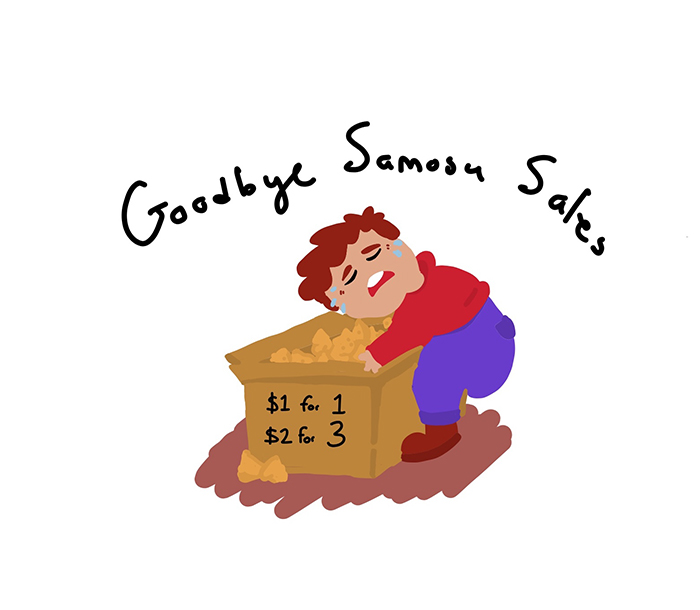
Same execution as McGill’s Divestment Policy, but in an earlier stage of grief.

Gert’s

Same execution as Samosa Sale, but if anyone below third-year asks about your costume, tell them that they wouldn’t understand. 

McGill Mental Health Services

Commit to plans with as many people as you can. Make it clear that you care about them and want to spend time with them. Of course you’ll dress up as a three-hole-punched Jim Halpert with the girls! Yes, you would love to be a SoundCloud rapper with the lads! Then cancel all plans on Halloween day and proceed along the lines of McGill’s Divestment Policy, Samosa Sale, and Gert’s.

News, The Tribune Explains

Tribune Explains: The Men’s Varsity Teams Naming Process Committee

Following years of activism by Indigenous students, Principal and Vice-Chancellor Suzanne Fortier announced her decision to rename McGill’s men’s varsity sports teams in an email on April 12. As part of the announcement, Fortier stated that a steering committee would be established to determine a new name that would better represent the school’s values of equity, academic freedom, and integrity. The McGill Tribune looked into how the committee will work and what it hopes to accomplish. 

What is the purpose of the committee? 

The steering committee was created to establish an open and transparent process and to facilitate community participation. The committee, composed of both students and staff, will gather input from the larger McGill community to make an informed decision on a name that they feel best represents the university’s values. 

Who will be a part of the committee? 

Currently, the committee is receiving student nominations, which are open until Nov. 6.  The administration has called on members of the McGill community to nominate potential student members through their website. Once the nominations have closed, four members of the voting committee, composed of McGill Athletics and Recreation’s acting executive director Phil Quintal, the director of the sports program Geoffrey Phillips, former varsity coach Mr. Hubert Lacroix, and Deputy Provost Student Life & Learning Fabrice Labeau will decide on 10 final nominees. To ensure the involvement of different parts of the sports community, these 10 positions will be filled by five current student athletes, three alumni from McGill sports teams, and two current varsity team coaches. The committee will also include non-voting representatives from the Student Society of McGill University (SSMU) and the Post-Graduate Student’s Society of McGill (PGSS). 

How will the committee decide on a new team name?

Once formed, the committee will follow a six-step procedure to brainstorm and agree on a new name. The first step will be to gather input from the McGill community through an online submission system, focusing on groups that the committee feels will provide valuable input. This will include members of the sports community such as coaches, students, and alumni, as well as those outside of McGill athletics, such as #ChangeTheName campaign organizers. With this input, the committee will decide on the essential qualities for the name and create a shortlist. Finally, they will ensure each proposed name’s viability by making sure that none of the options are trademarked or overused by other athletic teams. Once a preferred name is decided upon, a vote will occur within the committee requiring a two-thirds majority to be passed, and a report including the recommendation for a new name will be presented to Fortier. 

When will the committee decide on a new name?  

While no set date has been determined for the announcement of a new name and logo, it is expected that they will be decided upon by the 2020-21 athletic season, which begins at the end of August 2020. Students interested in the progress of the committee will be able to keep up with their activities through their website

Made by McGill was discussed actively at senate.
McGill, News

Student senators call on administration to adjust use of ‘Made by McGill’ funds

At the second McGill Senate meeting of the year, Arts Senator Henrique Mecabô called on McGill’s administration to increase the allocation of funds raised by the ‘Made by McGill’ campaign for student services. In the next five years, funds from the campaign will be dedicated into four areas: Bursaries and scholarships, hands-on experiences for students, research and faculty projects, and facility expansion. Donations would therefore not be designated to improving student services unless the donor specifically requests it. 

I would not say [that] the problem is that McGill is asking for more money while such essential services are lacking funds, but that McGill, knowing [that] such funds are lacking, suggested donation allocations that do not seem to include student services,” Mecabô wrote in an email to The McGill Tribune. 

In response, Vice-Principal University Advancement Marc Weinstein pointed to the Rossy family, who specifically requested that their $11 million donation be used to fund the Rossy Student Wellness Hub. 

“I would like to emphasize that the hub model that’s been put forward for McGill is innovative and incredibly interesting, and now [that] we’re seeing better service through that and the support of the university, [but] it doesn’t mean [efforts towards improving mental health are] going to end there,” Weinstein said. “When we know a potential donor, like [the] Rossy family, has had a major interest in making sure students are getting the right [and] appropriate services, we bring these parties together and that’s how we get some of these larger gifts.”

Senator Derek Nystrom inquired about policies for determining whether donations come from ethical sources, referring to donations from the Sackler Family, whose pharmaceutical company contributed to the opioid crisis. Music Senator Sebastien Duckett voiced concerns about whether donations from the fossil fuel industry should be considered morally irresponsible, though Weinstein said that the decision was complicated.

“On the one hand, those entities we are referring to are making money legally, so therefore, why would we not accept those donations?,” Weinstein said. “On the other hand, there’s the moral decision, which, without getting into a big debate about it here today, is something that [is] on our minds. But we haven’t really come out with a platform on it [as] it is sensitive and challenging.”

Students’ Society of McGill University (SSMU) Vice-President University Affairs Madeline Wilson questioned the impact of accepting donations from companies with ties to the fossil fuel industry on Made By McGill’s public image. Weinstein asserted that there are specific socially responsible funds that environmentally-conscious donors can contribute to, and said that the administration is sensitive to these issues.

“It’s something that the administration is looking at and understands that it is a challenging situation in relation to becoming hard-line on one end or the other,” Weinstein said.

Sound Bite:

“We do have the ability for people to invest in socially responsible funds, [like our] fossil-free fund. So we can encourage people to invest their money in various areas of investments. We are not talking about where the money will be used, but how it will be invested, so it follows in their own wishes.  Most of our portfolio is in fact invested in socially responsible, around 80 percent.” —McGill Principal Suzanne Fortier

Flashback:

Arts Senator Derek Nystrom addressed controversies surrounding donations made by the Sackler Foundation between 2014 and 2017. McGill has recognized the Foundation in their ‘James McGill Circle’ panels outside of the Leacock building, which lists the names of prominent donors. Weinstein asserted that there are procedures that ensure McGill has done due diligence before accepting donations.

News, SSMU

SSMU Legislative Council addresses affordable housing with new committee

The Students’ Society of McGill University’s (SSMU) fourth Legislative Council meeting of the year saw the long-awaited creation of an Affordable Student Housing Committee, first proposed in February 2019. The motion to create the project in collaboration with the nonprofit housing organization Unité de travail pour l’implantation de logement étudiant (UTILE) passed 24 to 1.

The idea of addressing SSMU rent concerns was introduced last year when a question on the SSMU 2019 Winter Referendum found that 77 per cent of voters were interested in addressing housing accessibility. Students strengthened their concerns around the issue in January 2019, when a SSMU-commissioned report by UTILE revealed that McGill students pay the highest rent of any student population in Montreal.  

During the debate period, Senator André Lametti raised concerns that parts of the motion did not reflect the original question posed in the Winter 2019 Referendum.

“The question was, ‘Would you like SSMU to further prioritize affordable housing, including, but not limited to, further actions to explore developing student housing?’” Lametti said. “The way this question was worded was not an unconditional endorsement of SSMU getting into real estate development. I think it was much more cautious in that respect.”

In response, Vice-President (VP) Finance Sam Haward assured the council that the affordable housing issue would be carefully thought-out.

“This is a smart plan,” Haward said. “If you look at what Concordia [University] is doing with the Woodnote [housing project], you’ll see how big a commitment this is. This is a multimillion-dollar contribution from just the SSMU, probably. So it needs to be done properly. […] Especially right now, with the building closure, it’s not like money isn’t necessarily tight.”

During debate, VP Internal Sanchi Bhalla asked if the committee would consider providing temporary housing along with permanent housing. VP External Adam Gwiazda-Amsel said that the idea could be considered.

“No one direction has been espoused yet, mostly because there is no committee,” Gwiazda-Amsel said. “The strength of something like [creating this committee] is it very much can be adapted to McGill’s needs. So in the sense that McGill has a much higher proportion of international students than Concordia […] transitory spaces [for students] could be considered.”

The council moved on to discuss the recent moratorium on food sales, which was instituted after health inspectors shut down a student-club–run samosa sale. President Bryan Buraga addressed concerns about the effects of the ban on student groups’ finances.

“We were informed [while holding a samosa sale that] one of our SSMU clubs was in violation with health and safety codes,” Buraga said. “This led to a fine [which could range from] between $2,250 and $54,000. [Because of this], SSMU has taken steps to prevent future samosa sales for the time being until we are able to […] follow these health and safety codes.”

Flashback:

Professor Gregory Matthew Mikkelson, President Elect of the McGill Association of University Teachers (MAUT), joined the meeting to request SSMU’s support for an initiative attempting to reform internal governance at McGill. The initiative, which concerns the appointment of academic deans, would require the selection process to be an open and transparent process and prevent the Principal from chairing her own advisory committee. SSMU’s Legislative Council endorsed the initiative unanimously.

Sound-bite:

“The problem is the utter domination of university governance by the central administration and a few key members of the Board of Governors. What is the solution? Greater democracy, and greater transparency [and] also a move toward more local decision making, which I actually think of as an aspect of greater democracy. The general principle being, we should only be governed by those who have our consent.” – Gregory Matthew Mikkelson

Sports

10 Things: Creative sports Halloween costumes

Halloween is an exciting time for everyone, but finding a costume that is affordable and unique can be challenging. This year, The McGill Tribune’s sports writers put together a list of costumes for fans looking to do something more interesting than just wear their favourite athlete’s jersey. These ideas turned the best sporting traditions into Halloween costumes that are sure to make an impression at any party this weekend. 


Group costume: Shaquille O’Neal

Grab eight of your closest friends and the largest trench coat that you can find at Eva B: It’s time to stack up three by three, glue on a fake goatee, and shave your head. That’s right, you’re going out as Shaquille O’Neal. All you need to do now is to prepare some mediocre basketball commentary and practice ducking under doorways. You’ll be the life of any party.

Bonus tip: If your costume is convincing enough, cover to get into clubs is one-for-nine.


Paris 2024 Paralympic Games logo

When the Paris 2024 Paralympic Games logo was announced on Oct. 21, the internet immediately had one unified response: Why is it so attractive? While the seductive lips atop an Olympic flame/gold medal logo may be problematic for the Paralympic Games, it is ideal for the Halloween reveller who wants this season’s most timely and sexy Halloween costume. To begin, either pull out your Vancouver 2010 Olympic shirt or start from scratch by drawing the Olympic rings on a dollar store white tee. Add a golden-blonde wig and gold lipstick, and you’re ready to be the center of attention during your night out on the town. 


Group costume: Michael Phelps and his 28 Olympic medals

This one is for all you floor fellows looking to find bonding activities for your students. Get a swimsuit and a pair of goggles for yourself and have a party to make medals from recycled cardboard and gold paint. This is a perfect opportunity to get rid of those boxes that have just taking up space since you moved in. Get detailed by making the medals match the years and events of all of Phelps’s wins. This group costume is also great for making sure that you don’t get separated on your big night out. After all, who could miss 23 gold circles, three silver circles, and two bronze circles running around Saint-Laurent. 


The Stanley Cup

We have to face the truth at some point: Going as your favourite athlete for Halloween is pretty basic. But going as the trophy from your favourite professional sports league is unique and eye-catching. This Halloween, wrap yourself in tinfoil and attach a small silver bowl to a headband for the perfect Stanley Cup costume. This outfit is perfect for the hockey fan who wants to stand out from the crowd while staying on a budget. However, if your team hasn’t won the Cup in a while, be warned that you may be mercilessly mocked.


The Ghost of the Montreal Expos

For a costume that evokes both nostalgia and tragedy, try the ghost of the Montreal Expos. Since Montreal lost its MLB team in 2004, the phantom of the Expos has haunted sports bars around the city. Borrow an old jersey and cap from one of the fans still holding out hope for the team’s return, throw them on over a classic white sheet, and mutter the names of Expos legends like Vladimir Guerrero, Andre Dawson, and Pedro Martinez. 


Draymond Green watching Fergie sing “The Star-Spangled Banner”

At the 2018 NBA All-Star Game, Fergie delivered an interpretation of “The Star Spangled Banner” that was so awful that people laughed mid-performance. Notable among those unable to conceal a smirk was Draymond Green. The three-time All-Star knew he was on camera, but still couldn’t mask his reaction. Initially, his mouth was half-open, and he looked like he was about to sneeze; then, the corners of his mouth turned up, giving way to a cheeky grin. Recreate the look by pairing the expression that perfectly summarized everyone’s thoughts about that performance with a black warm-up jacket and your best buddy Steph Curry giggling right beside you. Add a portable speaker to the costume to bump the Fergie National Anthem remix all night long!


Group costume: LeBron James on Taco Tuesday

If you and your friends are looking for a fun group costume this Halloween, LeBron James and his tacos could be the perfect fit. For this getup, you will need at least two people, but the more people you have in your group, the wider the variety of tacos you can represent. For LeBron James—preferably the tallest person in your group—you will need a jersey, shorts, sneakers, a shooting sleeve for the left arm, and a headband. For the tacos, simply buy or make taco costumes. Try to make sure you can still dance in them, though. The final touch will be ensuring that the LeBron periodically yells “It’s Taco Tuesday!” at the top of their lungs throughout the night. 


Couples costume: Aaron Judge and José Altuve

There finally exists the perfect couple’s costume for that pair with a drastic height disparity: Aaron Judge and José Altuve. Once you find someone with a big enough height difference, the rest is simple. However, if your difference is not 33 centimetres, extreme methods like crouching can help your costume look more authentic. Finding uniforms for this costume is important, but what matters most is that you show that baseball doesn’t care about size, only talent and the opportunity for a hilarious photo op


Couples costume: Deflategate

We all know at least one annoying Patriots fan who will not stop talking about Tom Brady’s greatness. That’s why, this Halloween, you and anyone else this Pats fan has been driving up the wall will go as Deflategate, also known as Tom Brady and a deflated football. Play rock-paper-scissors to decide who gets to go as Brady and comfortably wear a number 12 Patriots jersey all night long. Unfortunately, the loser will have to don an inflatable football costume, which may be a little less suited to the dance floor. But, not to worry, because once you have brought this costume together by visually deflating the football with some tape, the looks of disgust on the faces of Patriots fans everywhere will make your effort worth it. 


Arsene Wenger’s endless struggle with the zipper on his parka

It’s a tale as old as time: Arsene Wenger and his parka. Every Arsenal fan has, at some point, watched as Arsene stood on the sidelines and battled a zipper that never seemed to cooperate. While he commanded respect from his players and many others within the soccer world, he was never able to get that zipper under control. For this costume, you will need a suit, with a red tie, and a long parka. Stand off to the side for most of the evening while you try to zip up your coat. You’ll never manage to get that zipper up, but it’s bound to be a conversation starter when people inevitably ask you what you’re doing. 

Out on the Town, Student Life

Behind the bar at Poincaré

Located in Chinatown, local and environmentally-conscious Cantine Poincaré is a hidden gem to enjoy on a chill night out with friends. The selection of craft beers and fermented snacks offers a unique, genuine Quebec pub experience. The McGill Tribune sat down with chef and co-founder Jeremiah Bullied, who also teaches fermentation classes at Concordia University. He spoke on the relationship between Quebec and craft beer.

“I think craft beer in particular is something that really reflects Québécois culture a lot,” Bullied said. “I feel like craft beer is like the wine of Quebecit is something that people take to.”  

The three other owners of the restaurant are experienced in the craft beer industry: The team consists of Hugo Jacques, a sommelier from Montreal microbrewery Isle de Garde; Francis Melançon from Gaspesian microbrewery Pit Caribou; and Samuel Boivin Provost, from the local staple brewpub Dieu du Ciel. Their expertise is evident in the attention to detail in the products they serve. Anyone should be able to find something to enjoy, from their tasty double IPA to their exotic Chardonnay cider. 

“A lot of people [who] come in after work or during lunch […] are young, […] have good taste in food and music, [and] appreciate a weird little spot like this,” Bullied said. 

Not only does Poincaré have a wide range of unique beverages, they also have a range of fermented and cured snacks. The Poincaré experience is best defined by the seasonal fermented menu, which reflects Bullied’s expertise in fermentation and natural methods of food preparation. 

“Fermenting […] ticked a lot of boxes for me […] because it is a low intervention way of transforming food,” Bullied said. “You still have to prepare [ingredients], but they kind of transform themselves, […] and to me. There is an element of magic to that, there [are] a lot of cool flavours and a lot of cool textures that are unlocked.”

The fermented snacks, including pickles and chorizo, are a tasteful companion for any drink or conversation. 

“There’s definitely a notion that these are good bar snacks,” Bullied said. “It is something you can dine on casually without having to eat a meal. [Poincaré is a place for] people who […] want to party but with good wine […] in a place that isn’t a club but isn’t boring either [….] Even though it is very casual, there are some fine dining elements, and there really is some quality in [the ingredients].”

Without a doubt, quality is all the owners’ primary focus, and they are committed to giving their clientele the best experience that they can possibly offer. 

“In the [service] industry, […] it is about how you make people feel,” Bullied said. “People that come here want to feel cool. They want to feel that they received a product of quality, and attention, and effort. You have to communicate a certain amount of attention to detail, and you kind of have to be having a good time.”

Students in search of a trendy new hangout spot should check out Poincaré for funky and well-made food and drinks in an industrial space. 

Chill Thrills, Student Life

Café Zenoli is a gem hidden in plain sight

Living in Montreal offers students a unique learning experience, as the city is filled with a multitude of cultural and artistic opportunities. Yet, many Montrealers find themselves at the same well-known franchises, succumbing to the saturation of chain restaurants and coffee shops. For those looking for alternative places to have their daily dose of coffee, the family-owned Café Zenoli in downtown is a perfect spot. 

In 2017, Robert Chechile and Leonardo Calderone opened Café Zenoli at 250 rue Sherbrooke, a corner frequented by many pedestrians on their way to school or work. With an assortment of pastries, sandwiches, pizzas, calzones, and speciality breads, the café is particularly attractive to passersby looking for a casual meal or mid-day snack. Zenoli is a combination of the names of the café’s two signature pastries: Their cannoli—which was recently ranked among the best in the city—and their zeppole. The name reflects the owners’ Italian roots, love of food, and even greater love of feeding people. 

“It comes from my mom and her sisters,” Chechile said. “[The] first thing they would do is sit down and fix you something, […] so I always try to bring a bit of that hospitality here. I love making people try what we have. It’s a nice feeling, […] and the clients appreciate it. That’s the environment I try to build here with my clients and my staff.” 

The easygoing Zenoli staff only add to the experience of dining at the café. Unlike several downtown cafés, Zenoli employees do not insist on a minimum purchase to dine-in or a time limit per table. Students looking for a serene place to work are not forced to break their budget or rush their tasks. Regulars often return to avoid the hustle and bustle of the city and to spend an hour in a space with a sense of community, as the café offers a cozy space to sit and read, catch up on emails, or just chat with a friend. This comfortable and friendly dynamic among the staff is evident to their customers. 

“People come back to a place because of how you make them feel,” Chechile said. “[With] regular customers, […] you get to know them, and they tell you about their families and what’s happening [….] That’s the biggest difference between [being] a small business owner that is actually here and one of those franchises. It’s a whole community. If I’m in the back and I see a client I know, I have to come say ‘hi.’”

In addition to friendly service, Zenoli provides food to-go and catering services. The café also prides itself on its zero-waste policies, donating all leftover food to a local rehab center. The focus on hospitality and generosity extends not only to customers, but also the community.  

“My wife helps out. Her vacation time was spent here, and my partner’s wife’s too,” Chechile said. “It’s really a partnership. I’m not here to make millions of dollars, I just enjoy what I am doing, and a bonus is I get to see my kids so much more now too because they come in and give me a hand, […] and their friends come by too. It’s a little family we have here.” 

With their home-style Italian pastries, friendly staff, and hospitality, Zenoli makes for an optimal place to take a break from everyday stresses and enjoy the finer things in life: Coffee, food, and community. 

Read the latest issue

Read the latest issue