Latest News

Editorial, Opinion

It was the landlord, with the lead pipe, in the moldy basement

Finding housing in Montreal can be a harrowing experience for students who are not properly informed about their tenant rights. For this reason, many students find themselves in illegal renting agreements, a scenario that can lead to serious problems such as costly repairs which should have been covered by their landlord. Both the city of Montreal and McGill must offer resources for student tenants to inform and advocate for themselves.

On Oct. 23, the City of Montreal provided an excellent example of the ways such problems could manifest. Mayor Valérie Plante announced that the city will begin the process of forcing roughly 24,000 property owners, including landlords, to replace their lead water pipes. In the past, Montreal allowed homeowners to replace lead pipes at their own discretion. However, in light of an expanded awareness regarding the dangers of lead poisoning and revised standards about what constitutes safe levels of lead particulates, the city will now finance the replacement of lead pipes for homeowners, and allow them to pay back the cost over a 15-year period. The city’s decision to take the issue of lead poisoning into its own hands should be commended, and Plante has correctly framed this process as an issue of public health. 

On the city’s website, an interactive map that displays the entirety of Montreal is available; however, the website is exclusively in French, which limits accessibility to anglophone communities. If people search by address, they can click on their residence or apartment building to see the probability that its pipes are lead-based. While this map marks McGill residences as unlikely to contain lead, this is not a guarantee. McGill has the responsibility to inform the student body about their rights and obligations as tenants in Montreal, as well as assuring students that the water they consume on campus, and in residences, is uncontaminated. In addition, Montreal’s municipality has a responsibility to make sure everyone in the city has the same level of accessibility to information regarding public health issues.

This type of scenario, one which involves ambiguity about whose responsibility it is to make costly repairs, poses an issue for student tenants. Tenant rights in Quebec are robust but students must also be  informed and understand those rights. One resource McGill students have is McGill’s student housing website that breaks down both tenant and landlord rights and obligations.

The power dynamic between a landlord and tenant can make it extremely difficult for residents to advocate for themselves, even if they are informed about their housing rights. Racialized tenants are particularly vulnerable, since racial and social discrimination is a prevalent issue in Montreal. Further, international students who may speak English or French as a second language face additional challenges when it comes to navigating illegal or unjust behaviour from landlords. 

Students should also know how to make use of alternative resources in navigating housing situations. One such resource is the Legal Information Clinic at McGill, which helps break down robust legal jargon for students. Additionally, websites like shouldyourent.com and groups like Chez Queer Montreal can help students and marginalized individuals find safe living spaces and landlords. 

For students who do find themselves in unlivable circumstances, whether it be due to the environment or their relationship with their landlord, it is crucial that McGill is able to offer them support and resources. Having temporary housing available is a crucial step that the Students’ Society of McGill University (SSMU) should take, especially in the case of international students who may have no other options if they are forced out of a living situation. SSMU should proceed with its Affordable Housing Committee, a project in collaboration with The Unité de travail pour l’implantation de logement étudiant (UTILE). Collaborating with UTILE would be an effective way to provide accessible housing for students in need. 

The lead pipe replacement issue is an example of the ways in which rental relationships in Montreal can be challenging. It is imperative that the city offers the necessary resources, information, and support to its residents so that they may safely and comfortably advocate for themselves. Finally, McGill also has a moral obligation and professional responsibility to continue supporting student tenants. 

McGill, News, Private

AUS Legislative Council debates future of recording ban

On Oct. 16, the Arts Undergraduate Society (AUS) Legislative Council was close to undoing its recording ban, but ended up tabling the motion until the next meeting after some councillors raised concerns about student safety. Instituted during last semester’s debates about POLI 399, a summer exchange course in Israel, Article 10 of the Standing Rules of Council prohibits audio and/or visual recording by councillors or members of the gallery.

Legislative Council approved Article 10 during the Feb. 14 meeting, prior to discussing POLI 339. Some councillors echoed the concerns cited during that meeting, regarding their safety and that of gallery members.

Until Sept. 18, the ban included campus media, subject to a two-thirds majority vote; however, major campus media outlets now have a permanent exemption. 

“[We’re taking] that step further now, in the name of transparency and accountability [by] removing the ban altogether,” AUS President Jamal Tarrabain said.

While anyone would be able to record, Article 10 requires that recordings be ‘sonically comparable’ to what is heard by individuals at council meetings and must capture the full conversation without emphasis on certain individuals or the exclusion of others.

This amendment would be enforced by the publication of official AUS recordings, which will be released immediately following meetings.

A representative from the History Students’ Association (HSA) raised concerns over the possibility of official recordings being taken from the AUS website, selectively edited, and then republished elsewhere. Tarrabain explained that such issues are unlikely to occur.

“Honestly, I think that that’s stretching the realities of what will happen to an AUS Legislative Council recording,” Tarrabain said. “In the grand scheme of things, we’re kind of small fish. There was no issue with recording or any of that stuff prior to that one motion and that one debate. We had no issues with this whatsoever, and in previous years, there was never a recording ban in place.”

Canadian Studies Councillor Brent Jamsa explained that recordings can help the AUS be more transparent. 

“At the end of the day, we are elected officials,” Jamsa said. “We need to be held accountable. The minutes are comprehensive and amazing but audio just [helps to] really tell students what goes on here every day.” 

HSA councillor Dalton Ligett, however, warned against trivializing councillors’ safety concerns with VP Social Kim Yang agreeing, disclosing past incidents with stalking and harassment for things that she had said in council. 

“Individually, I have been attacked before for calls that I’ve made regarding investigations, especially ones regarding sexual assault,” Yang said. “Someone could say I still stand strongly by what I said in that recording on legislative council, it doesn’t make it any [worse] to be followed around by three men.”

Unable to reach a unique conclusion, the council agreed to table the motion for the next meeting so as to give themselves more time to look for precedents in other student bodies, namely the Student Society of McGill University, that would serve as a guide.

 “There could be other successful models that we could be emulating on campus,” Tarrabain said. 

Council will reconvene on Oct. 30, at 6:00 p.m.

Flashback

AUS President Jamal Tarrabain’s motion to repeal the recording ban saw two sides facing off at the latest legislative council. One side emphasized the primacy of students’ easy and open access to elected officials, with the other side primarily concerned with questions of students’ safety and how to prevent organizations with malicious intent from doctoring councillors’ remarks.

Sound Byte

“That looks like that bird potentially has feet, and the martlet is a flightless bird with no feet whatsoever, so perhaps the [History Students’ Association] wanted to make the assertion that […] that [their logo] isn’t 100 per cent a martlet but a martlet hybrid, perhaps,” — CSAUS councillor Brent Jamsa, commenting about the History Students’ Association successful motion to change their logo.

Creative

Standing with First Nations Youth: A Protest in Solidarity

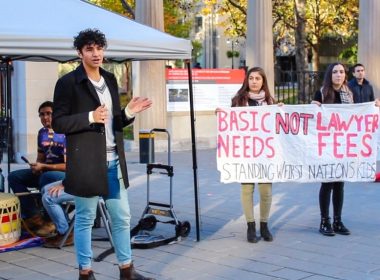
The Canadian federal government has appealed a ruling by the Canadian Human Rights Tribunal, that ordered them to pay reparations to First Nations children and their families who were separated by the child-welfare system. In response, on Oct. 19, Students’ Society of McGill University Indigenous Affairs Commissioner Tomas Jirousek and the Indigenous Student Alliance organized a protest in solidarity with the victims, calling on the government to improve on reconciliation.

“We don’t know when that next campaign will come, we don’t know how quickly we’ll need to mobilize and we don’t know which way we’ll need to call for allies. But I just hope that our non-Indigenous friends, again, are ready to listen to that call and ready to act and stand with us.” – Tomas Jirousek

Video by Aidan Martin and Sarah Ford

Features

Speak your truth

When New Zealand Prime Minister Jacinda Arden’s pregnancy made news in July last year, I was talking to a relative about how the former Pakistani Prime Minister Benazir Bhutto was actually the world’s first elected head of government to give birth in office. While telling the story in Urdu, the language in which I usually talk to my family, I unconsciously switched to English to say the words “in office” to avoid the mental effort of searching for the right words to say in Urdu.

Women's hockey book
Hockey, Sports

In conversation with Denbeigh Whitmarsh

Third-year French Literature major and author Denbeigh Whitmarsh has always had strong opinions about women’s hockey.

Two summers ago, Whitmarsh’s great-aunt—and women’s hockey pioneerRhonda Leeman Taylor asked for help writing a memoir. Taylor organized the first Women’s Canadian National Hockey Tournament in 1982 and was the first woman to sit on the board of the Canadian Amateur Hockey Association.

“She knew it was special, what she was doing way back in the ’70s and ’80s,” Whitmarsh said. “She’s always wanted to write a memoir.”

Taylor and Whitmarsh self-published the memoir, titled Offside, on Oct. 5. The pair spent the summer of 2018 looking through a box of memorabilia with articles and photographs from Taylor’s time on the ice. Because Taylor suffers from focus problems due to a career-ending spinal injury in 2004, Whitmarsh wrote most of the book. 

“I made notes of everything and then organized those notes into chapter ideas,” Whitmarsh said. “I’d call my aunt, and she would tell me all these stories about what happened, and who was who, and how everything went down [….] Writing a book and publishing it in four months is quite a task, but […] we made it happen.”

With recent developments in women’s hockey, Whitmarsh believes that Offside was written at just the right time. 

“It’s a critical time for women in hockey currently, because of the media attention that is being received following the folding of the [Canadian Women’s Hockey League] and the creation of the [Professional Women’s Hockey Players’ Association] and the Dream Gap Tour,” Whitmarsh said. “[It’s] allowed us to start a widespread conversation about the discrimination that still exists at multiple levels, and what we need to do to move forward.”

Despite the fact that women’s hockey has been around for over 100 years, Whitmarsh found that there was often very little information to work with.

“I think the most challenging part [about writing the book] was that there was a lack of documentation for that era,” Whitmarsh said. “Being in History [at McGill], I was looking for everything to back up what [Taylor] said, […] but I couldn’t find anything. That […] itself [speaks] to the discrimination.”

As Whitmarsh researched the era, she found surprising stories about what women like her great-aunt faced. Worries that women might get breast cancer from getting hit in the breast with a puck had to be dispelled by studies. Dozens of girls, like Olympic runner Abby Hoffman, secretly played on boys’ teams and were kicked off and even taken to court when they were discovered.

These stories profoundly affected Whitmarsh as an athlete.

“I wanted to play hockey, I wanted to be a part of that, but I knew that I couldn’t because I was a girl,” Whitmarsh said. “It wasn’t until I was 12 that I started playing in a girls’ house league in Uxbridge, [Ontario] […] and I was like, ‘Oh, I can play hockey too. It’s not just for boys.’” 

Although Whitmarsh only plays the occasional pickup game of hockey nowadays, she is still heavily involved in athletics, running cross-country and track for McGill and training for triathlons in the summer. She knows that she will keep playing after she graduates next spring.

“I’m a sports person for life,” Whitmarsh said. “I think I would like to do some longer [triathlons], join another women’s hockey league when I can [….] I don’t know exactly what form it’s [going to] take yet, but I definitely want to continue in some way.” 

Whitmarsh, like her great-aunt and generations of female hockey players before her, found ways to continue to play the sport she loves despite the world telling her she that couldn’t. Her exploration of women’s hockey’s not-too-distant past strengthened her beliefs in equality and the importance of strong female role models. 

Offside is available in ebook and print forms on Amazon, at Chapters, and in other libraries and bookstores across Canada.

McGill, News

Protest held for Indigenous peoples traumatized by the child-welfare system

The Canadian federal government has appealed a ruling by the Canadian Human Rights Tribunal, that ordered them to pay reparations to First Nations children and their families who were separated by the child-welfare system. In response, on Oct. 19, Students’ Society of McGill University (SSMU) Indigenous Affairs Commissioner Tomas Jirousek and the Indigenous Student Alliance (ISA) organized a protest in solidarity with the victims, calling on the government to improve on reconciliation. 

Jirousek, a member of the Kainai First Nation of the Blackfoot confederacy, began the protest with a land acknowledgment and spoke on the intense trauma that Indigenous survivors of the child-welfare system experience.

“These aren’t just numbers on a factsheet,” Jirousek said. “These are kids who aren’t getting their childhoods back. These are kids who are spending nights, years away from their parents [and] cultures, just because the federal government doesn’t think [that] they are worth the money.”

Jo Roy, a member of the Abenaki First Nation, student representative for the Social Work Students’ Association (SWSA) and a current member of the Indigenous Affairs Committee, began by telling the story of Dene siblings who were reunited after separation and foster care. Betty-Ann Adam Dene was separated from her siblings during the ‘Sixties Scoop’, only to reunite decades later. Birth of a Family was a documentary that was filmed about their reunion.

“Please don’t think that the pain of Indigenous peoples is far removed from your lives here in this city, because it is not,” Roy said. “It is experienced by [Indigenous people] around you. [This] is why we’re standing here together, because the pain must end [….] It is not right to challenge the collective right for First Nations children to have a future free of pain.” 

The Sixties Scoop refers to a period of provincial child welfare policies starting in the 1950s, where thousands of Indigenous children were forcibly removed from their families under false pretenses and placed in foster homes or adopted into white families across Canada and the United States. Children within this system often fell into vulnerable positions, leading to systemic abuse and harassment. As part of federal assimilation policies, children were forced to discount their languages and cultures. Residential schools, which were government-and church-run institutions, were created to forcefully assimilate Indigenous children. 

Noah Favel, member of the Poundmaker Cree Nation and former co-chair of the ISA, spoke about the continued systemic discrimination by the Canadian government. Favel situated the protest in the larger conversation of structural barriers faced by Indigenous people. 

“[The federal government’s] decision [to cease funding] perpetuates a system of poverty for people who are already so impoverished,” Favel said. “[…] Issues with housing, food security, and healthcare. [To] place this trauma on Indigenous children, who are already grappling with so many other issues […], people who are struggling to maintain our language, our heritage, [and] our customs. To put [this decision] on us when we have bigger things to focus on, it really hurts.”

The ruling specifies $40,000 for each child taken away from their family since Jan. 1, 2006 and for each of their parents or grandparents, amounting to an estimated $8 billion in compensation. Over 50 per cent of children in foster care are Indigenous, despite only representing seven per cent of children under 15. According to Indigenous Services Minister Seamus O’Regan, the federal government cannot come up with a plan to identify survivors and provide compensation by the Dec. 10 deadline. Nakuset, member of the Cree Nation and the Executive Director of the Native Women’s Shelter of Montreal, has worked at the shelter for 20 years. She began by talking about her own experiences with family separation, as she is the first person in her family to have children who were not taken by the system. 

“This is a really difficult subject because my mother went to a residential school,” Nakuset said. “Because of her experience at residential schools, I ended up being a part of the Sixties Scoop, and being taken far away from my community [in Saskatchewan] and brought here to Montreal, where I was forced to grow up in a culture that wasn’t mine and to be ashamed [of my origins]. I was able to find that strength and go find my roots, and get my Indian status back, and get my education.”

The Truth and Reconciliation Commission (TRC) was a report funded by residential school survivors in 2008 to help them share their stories, and to investigate the full lasting impacts of this system. The document came with 94 calls to action for reconciliation. According to Nakuset, the reports and recommendations still did not elicit government action.  

“TRC came out a couple of years ago […] when Trudeau came into power he said he was going to implement all 94 of the [recommendations.] He’s done 10,” Nakuset said. “Then the inquiry into [Missing and Murdered Indigenous Women and Girls] finished, with 231 calls to justice announced […The] fact that all these recommendations have been put forward and no one is doing anything about it speaks volumes.”

Science & Technology

Leaping into the sixth mass extinction

Environmental scientists believe that most animal groups today are facing global population declines. The magnitude of the declines is so great that many are referring to this as the beginning of the sixth mass extinction.

Amphibians are one of the most affected groups: Their estimated extinction rate since 2007 is 211 times greater than the background rate of extinction, the base rate of extinctions that would occur without human influence. Furthermore, the International Union for Conservation of Nature and Natural Resources (IUCN) estimates that 40 per cent of assessed amphibian species are threatened by extinction. In Quebec, blue-spotted and eastern red-backed salamanders, amphibians native to the province, are facing a decline even greater than the global average.

Dr. David Green, a professor in the Department of Biology, explained that scientists have long been aware of the world’s declining amphibian populations.

“The [phenomenon] of declining amphibians [was] first noticed by scientists who study amphibians 30 years ago at the end of the World’s First Congress of Herpetology,” Green said in an interview with The McGill Tribune.  “It was written in Science and picked up [by] The New York Times, and that really started it off.”

While population declines are occurring across multiple animal groups, amphibians are particularly important to ecosystem health, particularly water ecosystems.

“[Amphibian larvae] help to balance the nutrients in [the aquatic] system, […] and then they transform, and they take all that material out of the ponds and […] go out on the land,” Green said. 

In addition to playing a crucial role within ponds, amphibian larvae are part of land-based ecosystems. They provide an essential link between aquatic and terrestrial ecosystems and are an important food source for other animals on land.

Though scientists have been aware of amphibian population declines for decades, the causes are less clear and are still being investigated today. 

“One of the major threats here and everywhere is largely habitat loss,” Green said. “That’s the elephant in the room.”

While the reasons behind these declines is not straightforward, disease may play a large role. 

“The cause people are concerned with right now is diseases, particularly the chytrid fungal disease,” Green said. “Chytrid fungal infections have become nearly ubiquitous in the amphibians of the world, but this couldn’t have been possible without something causing the immune systems of the organisms to weaken.”

The amphibian immune system is unique in that its primary component is the skin. Glands under the skin of amphibians secrete compounds that attract a diverse collection of microorganisms, which serve as a strong line of defence against pathogens. 

“So we have a succession of things,” Green said. “Chytrid […] is lethal as a disease. It’s also ubiquitous. You get diseased when you’re immunosuppressed. If part of your immune system is environmentally-based, […] then habitat destruction and habitat change can affect the immune system.”

Today, conservationists tackling these declines are focused on raising larvae safely before returning them to their environment, but Green is skeptical about small-scale solutions to global problems. 

“It’s not a frog problem,” Green said. “It’s a people problem.”

For Green, the solution is in the way we manage global society. People should be concentrating resources in urban centres, and trying to build up instead of out. 

While experts have previously been optimistic about the state of amphibian populations, Green warns that dismissing their decline as simply a warning sign is a dangerous mentality. Since amphibians occupy such a central position in their respective food webs, their loss could be more than simply a cautionary notice.

“[Amphibians] are not the canary in the coal mines,” Green said. “They are the miners.”

Science & Technology

Searching for the first stars

Astrophysicist Jeff Peterson of Carnegie Mellon University delivered a lecture on Oct. 9 about the quest to study ‘cosmic dawn,’ the ‘turning on’ of the very first stars in the universe. Estimated to have occurred 150300 million years after the Big Bang, physicists have sought to study signals from this crucial epoch for years—and now, they may have finally done so.

“This is a scientific adventure,” Peterson said. “But it’s also a physical adventure.” 

From the origins of the universe to the atomic levels of hydrogen, Peterson’s freewheeling talk, hosted by AstroMcGill, gave a cosmological crash course on the long and winding road to cosmic dawn. 

In 1964, armed with a supersensitive antenna, radio astronomers Arno Penzias and Robert Wilson set out to detect incredibly faint radio waves from space. The experiment hit a roadblock when they found that their data showed a mysterious disturbance spread evenly throughout the sky. Initially convinced that it was simply a problem with their antenna, they had, in fact, detected the Cosmic Microwave Background (CMB) radiation. Given off by the Big Bang itself, the CMB is the oldest electromagnetic radiation in the known universe. A cosmic signature that fills all space, the CMB offers physicists a snapshot of the early universe as it was when a drop in temperature caused the formation of the first neutral hydrogen atoms.    

Physicists believe that 370,000 years after the Big Bang, these hydrogen atoms arose from the rapidly cooling, ionized plasma soup that comprised all matter. With time and gravitation, the atoms began to form clumps, growing in size and eventually collapsing into themselves to form the first stars. The light given off by these stars fundamentally altered the properties of the remaining hydrogen, allowing it to absorb some of the CMB at a radio wavelength of 21 centimetres. Theorists predict that this absorption of the CMB should manifest as a ‘dip’ in its thermal spectrum, so while it might not be possible to study these stars by their light, astronomers should be able to locate them indirectly by using this ‘dip.’

“So we have a quest,” Peterson said. “Can we measure this dip in the spectrum?”

Armed with radio telescopes and stationed in the most far-flung places on Earth, Peterson and his team set to work.

Radio telescopes pick up on the CMB, but in most places, the signal is disrupted by FM radio waves broadcasted by radio stations and the like around the world. To escape this disruption, scientists studying the CMB have travelled to such places as the Australian Outback and Marion Island, located 2,000 kilometres south of Cape Town in the middle of the Indian Ocean.

Singling out this infinitesimal dip from the pervasive radio disturbance of the universe is no small task. Yet, in February 2018, the Experiment to Detect the Global Epoch of Reionization Signature (EDGES) team, based at the Murchison Radio-astronomy Observatory in Western Australia, reported the first possible detection of the hypothesized dip.

“There are five or six teams around the world that are trying very hard to find out [if] this [is] correct,” Peterson said. 

This announcement has generated a frenzy of speculation and excitement. Some believe that these results might prompt a reappraisal of scientists’ understanding of dark matter, the mysterious form of matter that remains undetected despite being thought to account for 85 per cent of all matter. For now, Peterson advises caution: Until another team corroborates the EDGES findings, all of the excitement remains nothing more than conjecture.

“This will explode into a giant field,” Peterson said. “It may be 50 years before we map this, but human beings will do it […] because we won’t be able to resist.”

McGill, News

Foreign Policy Panel hosted by Max Bell School wraps up elections

The McGill Max Bell School of Public Policy partnered with the Canadian International Council to host a talk titled “Foreign Policy and Foreign Interference: The 2019 Canadian Elections” on Oct. 17.  Jennifer Welsh, Canada 150 Research Chair in Global Governance and Security at McGill, moderated a panel of Canadian policy experts to discuss foreign policy issues and the country’s ability to address them.

Panelists discussed how foreign interference in the Canadian election may not have been as bad as it was in the 2016 United States’ election. Despite the decreased severity, Taylor Owen, Beaverbrook Chair in Media, Ethics and Communications Studies at Max Bell, described how digital infrastructure has shaped the nature of this election’s discourse. 

“I think this might be the first real social media election that [we have seen],” Owen said. “[With] the parties, the media, [and] the public all participating on this plane of relatively superficial interaction. The election was small because our debate was small.”

Rohinton Medhora, President of the Centre for International Governance Innovation, also commented on the spread of misinformation and uninformed voters. 

“If we had a thin, shallow debate on foreign issues is at least as important a fact as if the bad guys are interfering,” Medhora said. “We are woefully uninformed, from a Canadian perspective, on how the rest of the world is doing.” 

Additionally, the panelists discussed the election’s failure to address major foreign policy issues that the next government will have to manage. Medhora acknowledged that there has been plenty of discussion on major policy issues, such as Canada’s relationship with the United States and the incarceration of Canadians in China, but Canada’s foreign policy had so far failed to address allies who do not hold the same liberal values as Canada.

“We haven’t really had a deep discussion on how Canada deals with countries like China [….] who do not share our heritage values,” Medhora said. 

When it comes to the trend of nations slipping towards non-democratic regimes, Marie-Joëlle Zahar Political Science Professor and Director of the Research Network on Peace Operations at the Université de Montréal, argued that Canada needs to reevaluate some of its alliances. 

“We assume that we are operating in a liberal world and that therefore liberal countries are going to stand together on issues and that is not the case,” Zahar said. “It becomes more difficult to have a conversation with other countries with which we [believe] share [our] values, when in fact [we] are drifting apart.”

In response to a question about Canada’s role in protecting democracy, the panel highlighted the importance of matching Canada’s digital infrastructure to the realities of foreign policy.

“There have always been foreign powers in campaigns and in elections,” Owen said. “We need to focus on the [digital] infrastructure itself and how we make it as democratic and transparent as possible. If we do that, [then] we will reveal the actors that are attempting to manipulate us.”

The panelists also admitted that it is unclear why Canada has not seen the same democratic backsliding as is prominent in other Western countries.

“We have a firm sense of ourselves as internationalists,” Zahar said. “We are not a country that goes it alone. Not committing to unilateralism […] is a good check against authoritarianism.”

Regardless, Medhora emphasized the importance of Canada’s foreign policy despite its size on the world stage.

“Canada, even if it might be a small player, should not shy away from doing something,” Medhora said. “We were two per cent of the war effort in World War II, that didn’t stop us from joining the war. [….] Small countries [like Canada] can contribute [to global discourse], and they should.”


MLB World Series
Baseball, Sports

2019 World Series Preview

The 2019 World Series begins Oct. 22, when the Houston Astros host the Washington Nationals at Minute Maid Park. The Nationals, who had never won a playoff series before 2019, are undoubtedly the underdog: Their 93–69 regular season record was only second-best in the National League (NL) East and 14 wins worse than the Astros. Nevertheless, the team has captured the hearts of many baseball fans this postseason, from taking down the Los Angeles Dodgers in the NL Division Series (NLDS) to fun antics from 20-year-old Juan Soto, who has to drink grape juice instead of champagne with his teammates to celebrate because he’s still underage. On the other hand, the American League (AL) was always between the Astros and the New York Yankees, so Houston’s spot in the World Series comes as no surprise. 

Fangraphs gave the Nationals a 7.2 per cent chance of winning the World Series at the beginning of the season; by May 24, that number had fallen to just 1.5 per cent. However, the team went 73–38 for the rest of the season to clinch the first NL wild card spot. They defeated the Milwaukee Brewers 4–3 after eighth-inning heroics from Soto to advance to the NLDS against the 106-win Dodgers. It took them all five games, but the Nationals upset Los Angeles with a Howie Kendrick grand slam in the tenth inning of Game 5. Washington then dominated every moment of the NL Championship Series (NLCS) against the St. Louis Cardinals: They allowed just one run and four hits through the first two games in St. Louis before returning home to win 8–1 and 7–4 in Games 3 and 4, respectively. 

The Nationals have relied heavily on starting pitchers Stephen Strasburg, Max Scherzer, Patrick Corbin, and Anibal Sánchez and relievers Daniel Hudson and Sean Doolittle, so their extra four days of rest are a critical factor. Beyond Hudson and Doolittle, however, their bullpen is lacking, so they will need long outings from their starters for a chance at the title. Elsewhere, they have solid players in Soto, Trea Turner, Anthony Rendon, and Victor Robles, but their lineup is otherwise unremarkable. 

If the tale of a team that went from a .392 win percentage to NL champions in five months is not compelling enough for fans wondering who to root for in the 2019 World Series, perhaps their quasi anthem is. Since Gerardo Parra made the Billboard Hot 100 single “Baby Shark” his walkup song in mid-June, Washington has gone all-in. From the little shark keychain hanging in their dugout to adult fans wearing shark costumes to games, “Baby Shark” has an awesome presence at Nationals Park, which has got to be worth something.  

The Astros have a kid-friendly creature of their own: Their mascot Orbit is notorious for playing pranks on opposing teams’ players. However, they also have arguably one of the best teams of all time. Fangraphs gave them a 17.8 per cent chance to win it all before the season even began and a 35.2 per cent chance before the start of the playoffs. 

The Astros have few weaknesses. Starting pitchers Gerrit Cole and Justin Verlander have been lights-out from the mound, and though Zach Greinke has had two bad outings this postseason, he is still a good option to turn to. AL MVP candidate Alex Bregman owns the second-highest Wins Above Replacement by Baseball Reference (bWAR) in the league, and George Springer, Jose Altuve, Michael Brantley, and Yuli Gurriel all put up strong offensive numbers this season. Josh Reddick, Robinson Chirinos, and AL Rookie of the Year candidate Yordan Álvarez have been struggling in the postseason, however. 

According to Fangraphs, the Astros have a 72.1 per cent chance of winning, but Soto and the Nationals will not go down easily. This series will feature outstanding pitching performances, late-inning dramatics, and a lot of emotion. Ultimately, the Astros will claim their second World Series title.  

Read the latest issue

Read the latest issue