


Latest News

Science & Technology

Nobel Prize winner in Chemistry inspires McGill students

On Sept. 26, a sea of undergraduate and graduate students packed into the Pollack Hall auditorium. They were there to listen to Martin Chalfie, an acclaimed geneticist and winner of the 2008 Nobel Prize in Chemistry, speak about his discovery of the green fluorescent protein (GFP).

GFP is a bioluminescent tracker derived from the crystal jelly, a species of jellyfish that glows bright green under UV light when activated by calcium ions in seawater. By attaching GFP to a protein, scientists can observe its pathway through the systems of living organisms. Chalfie found the protein particularly interesting because his research primarily concerned nematodes, a type of roundworm with transparent skin, which makes it easy for him to observe GFPs flow. The biological marker allowed scientists to move away from dead specimens and instead work with live ones, since GFP doesn’t hurt or damage the organism.

“[Before], in order to do any of [our] experiments, we had to prepare the specimen, which meant killing it,” Chalfie said. “We were just getting a step of what was going on; we had no idea of what was happening over time.” 

GFP has a vast range of applications that go beyond its original intent. From detecting the HIV-1 virus to locating explosive dynamite in active landmines, the versatility of bioluminescence is impressive.

Chalfie’s talk was not limited to the conclusions of his experiments. He also shared some valuable wisdom with the audience on the true nature of science. According to Chalfie, there are certain traits that society has attributed to scientific success that are blatantly untrue. 

For one, few scientists are actually lone geniuses. This stereotype likely emerged from prodigious pioneers of the past, such as Galileo Galilei or Albert Einstein. Today, however, scientific research is done by teams of devoted individuals, whose passion and hard work negate any need for a photographic memory. Chalfie used his university transcript as an example of this. 

“I showed my transcript at a college reunion after [winning] the Nobel,” Chalfie said. “Everyone came up to me and said, afterwards, ‘Thank you for showing that. I was embarrassed about my transcript.’” 

Chalfie also proposed an amendment to the scientific method based on his experience. The scientific method is a structured manner of conducting an experiment that has long been drilled into the heads of eager baking-soda-and-vinegar science fair students. The six steps begin with a question and end with a discovery. In the modern and professional context of research, Chalfie said, the discovery tends to come before the hypothesis. It is not uncommon for raw data to emerge in an unexpected way that will require scientists to completely rethink their approach. According to Chalfie, science is chock-full of stumbling and failure, and falls short of the exceptionally precise reputation that precedes it. As a result, a great deal of discoveries actually happen by accident. 

“I know people who have had very successful experiments by throwing their parts on the floor,” Chalfie said. “It’s not exactly the scientific method, but it’s something!” 

In fact, the cultivation of the bioluminescence from jellyfish was one such accident. Osamu Shimomura, an organic chemist and marine biologist who shared the 2008 Nobel Prize with Chalfie, noticed that certain elements in seawater activated the glow in the organism because he threw his species into the sink one night before closing the lab. 

Although Chalfie paints a generous picture that attempts to distribute much of the credit of his Nobel Prize to chance and luck, it is clear that his contribution to science lies not only in his team’s discoveries, but also in his unique scientific approach.


Off the Board, Opinion

Social media: The scrapbook of our time

Being a naturally private person, I have never felt social media came easily to me. I’ve often found myself sympathizing with those who criticize my generation for our tendency to overshare online, not because I see it as symptomatic of narcissism, but simply because I don’t share the same impulse. As a result, my  presence online has always felt phony and contrived. My resentment for the practice is only emphasized by the fact that I, like many, feel compelled to stay active on social media, for no other reason than my inability to remember life without it. 

None of this would be so strange if I weren’t such a sentimental person. I’ve always liked taking photos, keeping diaries, and collecting souvenirs, and I’ve always hated throwing things away. In this way, self-documentation has always been important to me, and it’s a practice that runs in my family.  

In August, I visited my grandfather, who more so than anyone I know my own age, is an ardent oversharer. Having always been a prolific writer, my grandfather made a hobby of chronicling family history after retirement. During our most recent visit this summer, he presented me with a manila envelope containing about a dozen printed pages. He explained that it was a condensed history of all the sailors in our family, dating back to the 1850s. The pages contain sophisticated descriptions of boats that our family has sailed, significant voyages they have taken, and even a brief excerpt from a diary entry written by my great grandfather.

“None of this would be so strange if I weren’t such a sentimental person. I’ve always liked taking photos, keeping diaries, and collecting souvenirs, and I’ve always hated throwing things away.”

Having spent many years as a commercial fisherman in Yarmouth, Nova Scotia, my grandfather included some of his own stories as well. He compiled all this information a couple years back, but said that he was reminded of the document when he learned that I had spent the past summer bartending on a commercial cruise ship. He was pleased to learn that I was carrying on the family tradition. 

There’s one section in the document where he describes the cast of characters one might have encountered in a ship’s crew in the 1930s.

“By occupation alone they were hard men, working at a difficult, dangerous job. Individuals might be either gentlemen or the scum of the earth,” my grandfather wrote. 

Reading this made me equally as pleased to have joined their ranks.

A couple years ago, my now 91-year-old grandfather joined Facebook. Like me, he posts infrequently and seems relatively uninterested in the platform, which is a shame; because it would make staying in touch easier and I think he would be great at it. Instead, his preferred method of communication are phone calls—long ones. Unlike me, his reticence to communicate online stems more from a lack of familiarity with the platform than any feelings of self-consciousness. Were he more tech-savvy, there’s no doubt in my mind that he would come up with some excellent content, being such a natural storyteller.

Whether or not I’ll ever successfully get over my own internet shyness, I’ve come to appreciate social media as not only a communication tool, but also a means of cataloguing and recording personal history. Those quick to criticize my generation for oversharing or for being self-involved misunderstand that it’s human nature to want to record one’s experiences. From our grandest adventures to life’s minutiae, stories and storytelling remain an invaluable part of the human experience.

McGill, News

McGill student creates #NoFutureNoChildren movement to inspire climate action

The #NoFutureNoChildren movement, a pledge to not have children until the Canadian government takes effective action toward addressing climate change, was started by a McGill student. Since creating the pledge, Emma Lim, U0 Science, has gathered over 4,000 signatures.

While Lim has only been engaged with climate activism for about a year, she has already made a global impact. On Sept. 23, she participated in the first United Nations (UN) Youth Climate Summit, and marched alongside Greta Thunberg on Sept. 27 during Montreal’s global climate march. While her pledge is not the first of its kind, Lim’s movement specifically targets the Canadian government, denouncing its failure to recognize the urgency of the current ecological crisis. 

Sophie Arseneault, U1 Arts and official spokesperson of the movement, spoke with The McGill Tribune about the reasoning behind the pledge. 

“[It is] surfacing from a place of fear, as well as frustration,” Arseneault said. “It’s our generation’s way of saying that, if the government doesn’t act on the promises that they’ve already established, we don’t feel safe establishing our own families [….] So this is the closest that we can get to politicians’ hearts [….It’s a way] to alarm politicians to [realize] that the children of today are at risk, but the children of tomorrow are facing even greater risks.”

The pledge is not intended to replace or compete with other forms of climate activism, such as fossil fuel divestment, veganism, and school strikes. Arseneault clarified that it is an urgent cry for help to the leaders of Canada. 

“[We] aren’t looking at one specific policy, we’re only asking that the promises and the policies that have already been established be answered, realized, [and] put into effect,” Arseneault said. “[Major] companies shutting down pipelines and ending their practices that increase carbon dioxide emissions, that’s what we’re looking for.” 

McGill students striking on Sept. 27 for the Global Climate March expressed their doubts regarding the #NoFutureNoChildren.

“I’m really glad that people are taking a stand but I don’t know if this exact pledge is the best means of doing that,” Julia Elson, U4 Chemical Engineering, said. “I don’t know if just pledging to not have kids is enough for the Canadian government to provide a substantial action plan for climate justice.” 

Others, including Meagan MacKenzie, U3 Arts and Science, are concerned about the potentially discriminatory socio-economic implications and repercussions of the movement. 

“I think it’s a really cool, radical, political action [but] I’m doubtful of the impact,” MacKenzie said. “I do think that there is a potentially slippery slope with regards to shaming people for having children. Traditionally, marginalized folks or people from [developing countries] tend to have a lot of children, yet they aren’t the ones who are really creating much of the global [climate] impact. So I think that it’s great but should be used with a bit of caution.”

Arseneault believes that people’s reluctance to sign the pledge stems from a misinterpretation of its intent, sparking controversy on social media. Outrage about this pledge has caused certain detractors to harass Lin online.

“This isn’t a campaign to reduce population growth,” Arsenault said. “It’s not even a campaign to try to invite youth of our generation to stop all ambitions of growing a family. It’s a pledge that we hope [that we] will be able to step back from [….] It’s a pledge [that aims] to push the government to act on the promises already made, to stop creating more promises.” 

The Tribune spoke with anthropology PhD student and professor Adam Fleischmann, who also took to the streets on Friday, about the #NoFutureNoChildren movement. With a research focus on non-state climate actors, Fleischmann views the pledge as a compelling political strategy. 

I think one of the reasons why this action is so powerful is [because it is] a symbolic force trying to cause [a] social echo,” Fleischmann said. “Saying you’re not going to have [kids] for a specific cause, [….] really hits people in the chest [….] And if we’re going to uphold any sort of shred of our ideal of representative democracy, then we have to think that the leaders will eventually respond if there are enough of us, right?”

Fleischmann does not see this environmental movement as clashing with other efforts ranging from individual-to systemic-level climate action. 

“Often, I think [….] that this person is pledging to not have children is like, this is their action,” Fleischmann said. “I haven’t eaten meat in 10 years and part of it is to make a little bit of a difference on climate change, but more of it is to signal to those around [me] that there’s an emergency.”

Montreal, News

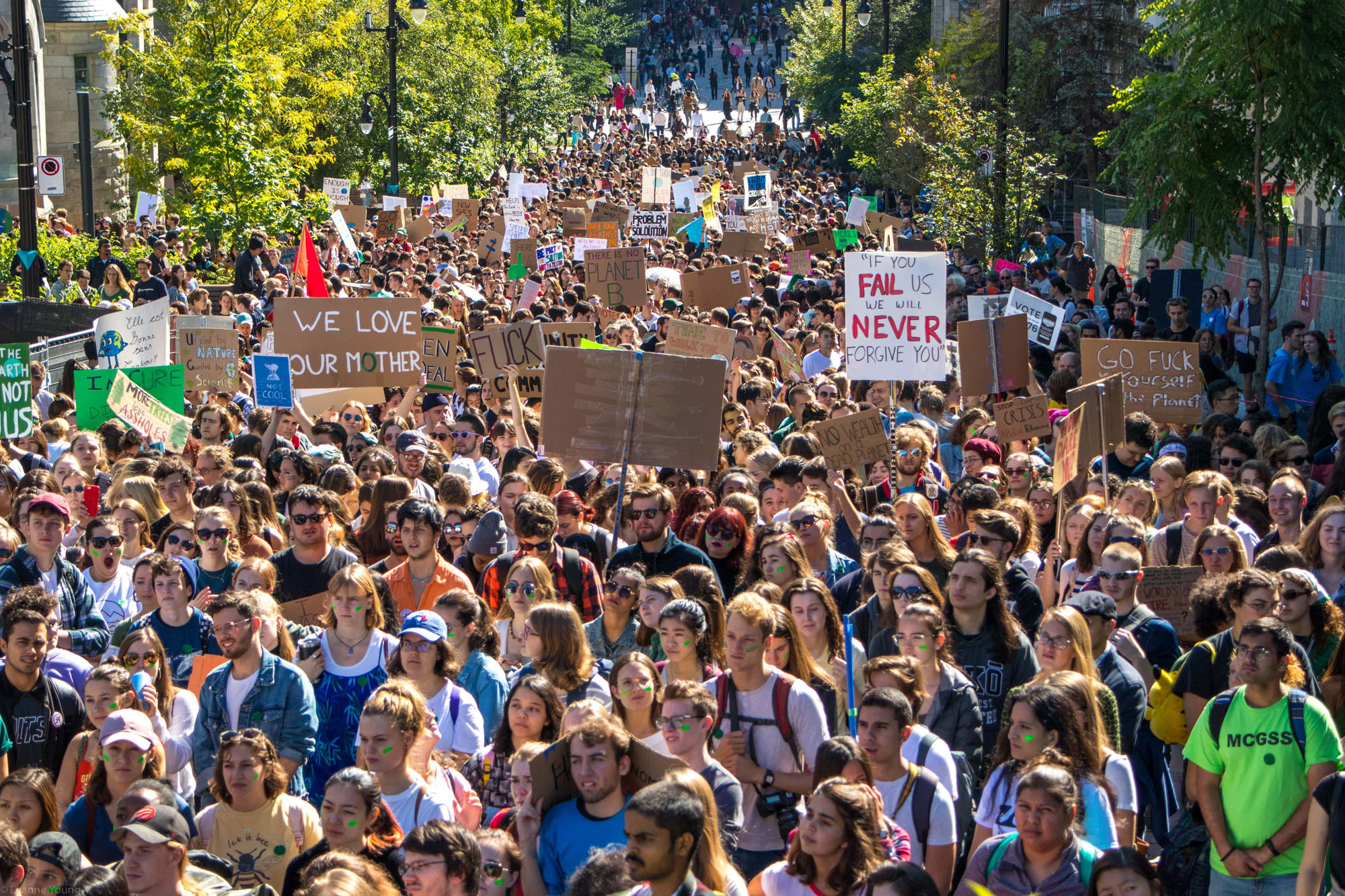
500,000 people march for climate justice in Montreal

Montreal held its second march for climate justice on Sept. 27: The march was part of a series of worldwide climate protests taking place this month, with millions rallying across the globe. 

On Sept. 18, McGill’s Senate failed to pass a motion to cancel classes for the strike, although Provost and Vice-Principal Academic Christopher Manfredi asked professors in an email to be accommodating of students who wanted to attend the strike. Several Montreal universities and CEGEPs cancelled classes, including Concordia University, Dawson College, and John Abbott College.

The Arts Undergraduate Society (AUS), the Macdonald Campus Students’ Society (MCSS), the Medical Students’ Association, the McGill School of Environment, and the faculties of law and nursing voted to strike.

McGill’s protest was organised by Climate Justice Action McGill (C-JAM) in coordination with strikes at other Montreal universities and the larger Montreal climate march. Students and faculty members presented three demands to McGill: Publicly acknowledge that fossil fuel companies cause “grave injurious impact” that disproportionately affects marginalised populations, divest from the fossil fuel industry, and pressure the provincial and federal governments to recognise the United Nations Declaration on the Rights of Indigenous Peoples (UNDRIP).

Tomas Jirousek, a member of the Kainai First Nation and Students’ Society of McGill University (SSMU)’s Indigenous Affairs Commissioner, wants McGill to publicly recognise that Indigneous communities are among the most affected by the climate crisis, despite contributing to its effects the least.

“Indigenous people have been fighting [for] climate justice, long before non-Indigenous people joined us in this fight,” Jirousek said. “We have always been fighting to protect this land, and as Indigenous nations, we always will.”

English Professor Darek Nystrom resigned from the Board of Governors (BoG) in April, alongside fellow Board member Darin Barney, over concerns that McGill would once again fail to divest from fossil fuels.

“[Barney and I] spent our time on the Board of Governors explaining that investing in fossil fuels is as if your house is on fire, and you decide to give some money to the guy that’s going to pour more gasoline on that fire,” Nystrom said.

Nystrom was inspired to join the climate justice movement after being impressed by a presentation that Divest McGill gave to the BoG.

“We kept trying to persuade the other Board members of the need to divest, but for three years they kept finding one reason after another not to do so, and I fear that they are heading for another such decision,” Nystrom said. “Because they had stopped listening to us, Darin and I felt that we had no other choice but to resign.”

Nystrom expressed his frustration with Board members and politicians for passing the responsibility to solve the climate crisis over to younger generations.

“The next time someone my age looks at you and they think they’re giving you a compliment by saying ‘you give me hope,’ look them in the eye and say, ‘and what are you going to do with that hope?’” Nystrom said.

16-year-old Swedish climate activist Greta Thunberg addressed a crowd of at least 500,000 people at the Montreal rally. Thunberg has garnered worldwide attention for starting the #FridaysForFuture striking organisation. This peaceful movement calls on students to skip school every Friday to protest outside of their local town halls for climate action.

On Sept. 23, Thunberg gave an emotional speech at the United Nations (UN) Climate Action Summit, criticising world leaders for their failure to prevent irreversible climate damage.

“This week, world leaders […] gathered in New York for the UN Climate Action Summit,” Thunberg said. “They disappointed us again with their empty words and insufficient plans. We told them to unite behind the science, but they didn’t listen [….] It should not be up to us, but somebody needs to do it.”

Thunberg also met with Prime Minister Justin Trudeau before the march, telling him that he was not doing enough to prevent climate change. 

“[Canada is] very similar to Sweden, where I’m from,” Thunberg said at the march. “You are a nation that is allegedly a climate leader, and Sweden is also a nation that is allegedly a climate leader. In both cases, it means absolutely nothing.”

Thunberg noted that throughout history big changes tend to follow massive grassroots movements. She believes that skipping school and work to protest is necessary to enact change at the global level.

“Some say that we are wasting lesson time, but we are changing the world,” Thunberg said. “So that when we are older, we will be able to look our children in the eyes and say that we did everything we could back then.”

Emerging Trends, Student Life

Finsta culture creates space for more personable social media

Finstas, or “fake Instagrams,” is a trend among young people who create a secondary Instagram account for the purpose of expressing themselves more freely. The content posted on these accounts often differs greatly from what is posted to a finsta user’s main account, a real Insta, and is often less polished. While this trend is increasingly popular with students, those who are unfamiliar may wonder about the purpose of having two diametrically opposite Instagram accounts, and why one account does not suffice. 

Despite the variations and differing styles of the accounts, finsta users tend to agree that secret accounts are beneficial for dealing with social media pressure, and they value having a private space online. Finstas typically create a setting where users allow their personality to take centre stage without worrying about what others might think. Delina Efrem, U0 Science, shares her experience with finstas, detailing the unspoken pressure that surrounds a lot of social media. 

“There are too many lurking eyes on your main account,” Efrem said. “It just feels uncomfortable. When I’m posting on my main [account], it has to be in tip top shape because I want people to like it. When I post on my finsta, it’s because I like it, and I want people to enjoy it.”

The desire to appear perfect on social media affects many people who share their lives online, especially young people. This pressure to present a perfect version of oneself is reinforced by the growing industry of Instagram influencers who make a living off of promoting brands on their personal accounts. Apprehension about posting on main accounts is a fear  many Instagram users relate to. Zoe Karkossa, U3 Science, explained the difference between primary Instagram accounts and finstas intended for friends.

“In the context of a finsta […], you have the privacy to express yourself in a way that isn’t public, in a way that you won’t be judged for,” Karkossa said.

A traditional Instagram account comes with an unspoken set of standards that a majority of users follow. It creates a platform where people are held accountable for their actions by the public. By alleviating the stress of a public platform, finstas offer their users more freedom to broadcast their authentic selves. However, this freedom can also encourage a space that enables unhealthy behavior under the guise of being candid and relatable.

“[Finstas can] allow for enabling, since you can take your night out and spin it as something funny or no big deal, [and] a good time,” Karkossa said. “A lot of people will do that in their finsta, talk about how much they go out. It’s nice to have a safe space to talk about that but a lot of [it is] also enabling [….] It’s easy to hide if you have actual problems.” 

To the people that use them, finstas represent an overall positive progression of social media. 

“There’s more of a sense of authenticity, [which allows] for more actual social connection,” Karkossa said. “Not necessarily deep conversations, but relating [to people] on a deeper level than sending hearts in Instagram comments].”

The rise of finstas is a subculture creation wherein individuals no longer feel the pressure to uphold a perfect image online. It represents a new wave of social media culture led by young people, which allows them to feel more free and connect with one another in a more meaningful way. 

Chill Thrills, Student Life

Bike and scooter-shares are changing the way Montrealers commute

With concern for climate change at an all-time high, autumn in Montreal is a great time for students to explore new eco-friendly ways to get around the city. BIXI and JUMP bikes and Lime and Bird e-scooters offer fun, cost-effective options that do not contribute to the pollution problem exacerbated by carbon-emitting cars, buses, and trains. With these small but mighty vehicles more accessible than ever, The McGill Tribune investigated Montreal’s four bike and scooter-shares. 

BIXI bikes 

The first public bike-sharing system of its kind in Montreal, BIXI bikes became a part of the city in 2009 with 3,000 bicycles available across at 400 stations. Today, there are over 7,250 bikes in 600 stations. Unlike other providers, Bixi bikes are only docked at designated stations, meaning they are more easily located for riders in a pinch. The availability and sheer volume of bikes makes for a particularly fast and accessible ride, often faster than waiting for a bus or metro. Additionally, using Bixi can be much cheaper than relying on public transport or Ubers. A 30-minute trip would cost only $2.95; unlimited 30-minute trips throughout the day cost $5.25 for one day, $15 for three, $34 for 30, and $94 for a year. In addition to the standard BIXI, 100 blue motorized e-BIXIs are also available throughout the city. 

JUMP e-bikes 

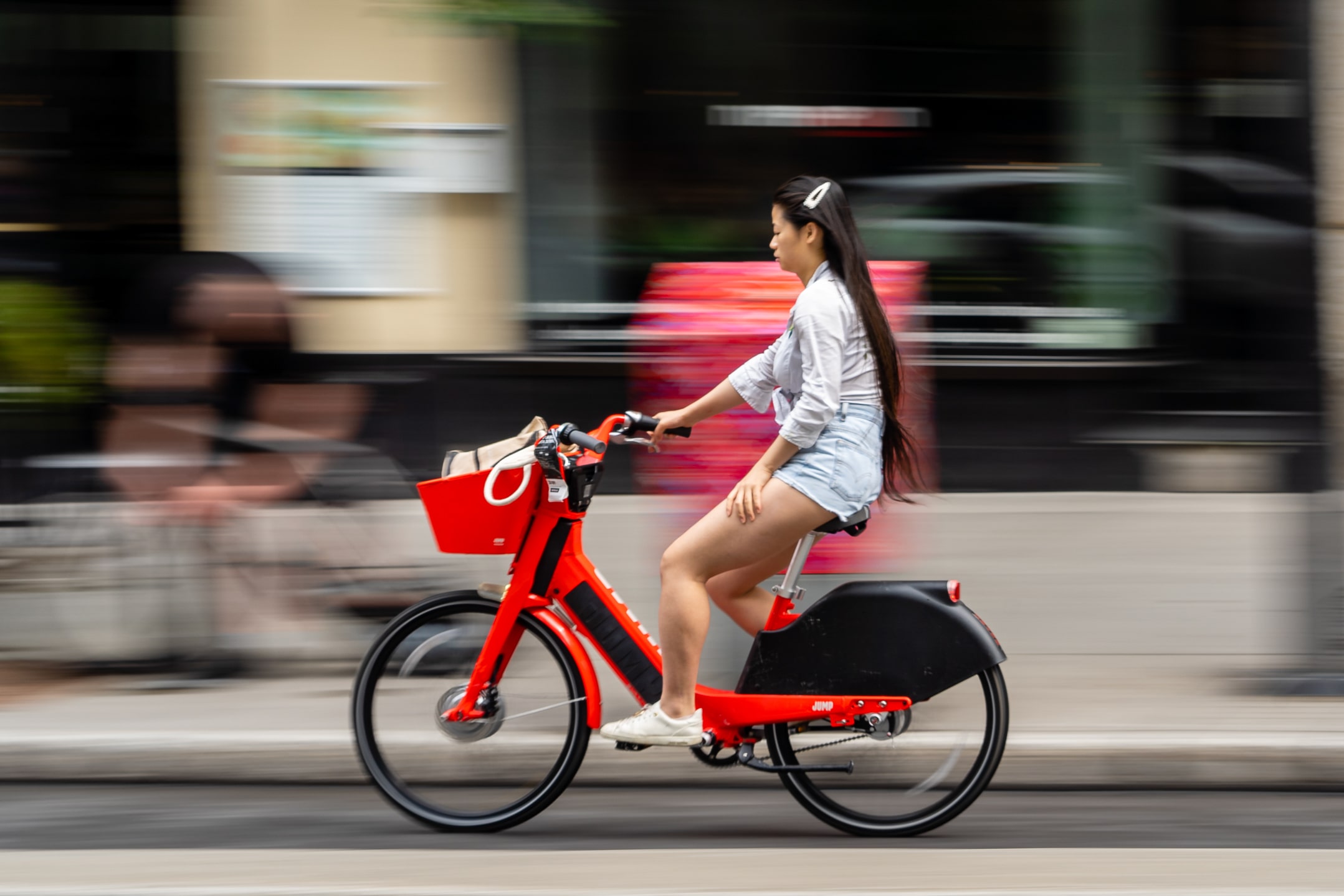
The bright red bicycles with the spacious baskets are slowly becoming a feature of the city. JUMP e-bikes, which are owned and operated by Uber, can ease a tough commute up Montreal hills. These bikes can be unlocked for free through the Uber app but cost 30 cents per minute of use, making them significantly more expensive than BIXI. Furthermore, since Jump bicycles can be picked up and dropped off at any public bike rack, they are more difficult to find than regular BIXI bikes but easier to find than the rarer e-BIXIs. And while JUMP bikes allow for a quicker commute, for safety purposes, they have a speed limit of 32km per hour. Due to their speed, JUMP requires that users wear helmets while riding. 

Lime e-scooters 

Lime scooters, the ubiquitous neon green electric scooters from an electric bike startup formerly known as LimeBike, have become a familiar sight across Montreal, whether in the center of the sidewalk or discarded at the bottom of the Lachine Canal. The fact that Lime scooters are dockless paired with riders’ tendency to leave scooters everywhere led Montrealer Pascal Robichaud to post a collection of Lime parking infractions to Flickr. Despite controversy over the haphazardly parked scooters, Lime attracts many riders curious about how e-scooters operate. After the first push, e-scooters require little effort to move. Riders simply press down on the throttle on the right handle bar to accelerate and squeeze the hand brake on the left to stop. The scooters cost $1 to unlock in the Lime app by scanning a QR code on the scooter and, like JUMP e-bikes, cost 30 cents per minute of use. 

Bird e-scooters 

Sleek, matte black Bird e-scooters are new to Montreal’s scooter-share scene, appearing for the first time in early September as part of a pilot project that will run until Nov. 15. Only 250 dockless Bird e-scooters have hit the streets, joining Lime’s fleet of 430. Operation is comparable to Lime, with a right-hand throttle and a left-hand brake. However, Bird’s cleaner aesthetic comes at a price: Scooters cost $1.15 to start and an additional 35 cents per minute. Unlike Lime, Bird will soon adopt a monthly rental plan that would allow riders to pay a flat fee for unlimited use of a scooter for a month or more.

McGill, News

Foreign policy talk warns attendees about Canada’s future

On Sept. 24, the Max Bell School of Public Policy hosted a lecture titled “Canadian Foreign Policy at a Crossroads” as a part of their Fall 2019 Policy Lecture Series. Roland Paris, a professor of international affairs at the Graduate School of Public and International Affairs at the University of Ottawa, spoke about the mounting challenges facing Canada’s next government. Paris is a non-resident fellow with Chatham House in the UK and a former senior foreign policy advisor to Prime Minister Justin Trudeau.

In his talk, Paris spoke to the changing dynamics of international politics that he believes will force Canada to rethink its policies. As an example, Paris’ recounted America’s political situation, saying that it has made it significantly less reliable as a partner than it has been in the past. Meanwhile, populist nationalism has resurged in Europe, while China has begun to assert itself on the world stage, targeting Canada and others by applying political. According to Paris, the structure of institutions, alliances, and policies that have supported a relatively open and stable international order for decades is quickly degenerating, and Canada is transitioning from this American-led international order into something different.

“Maybe by the time [students] reach middle age, the contours of this new international order will be clear,” Paris said. “But for now, what is clear is that the existing order is foundering. To paraphrase the Italian Marxist philosopher Antonio Gramsci: ‘The old is dying, but the new is not yet born.”

Paris emphasized that this transition is not just of academic interest, but also has immediate and severe implications for Canadians. As a country with few security threats and privileged access to the US, the world’s largest and wealthiest market, Canada is accustomed to occupying a relatively comfortable position in international affairs.

However, Paris believes that these conditions are being called into doubt. Canada’s liberal identity which is dependent on a generally reliable US, is now being threatened by the angry populism and America-first chauvinism that is bubbling to the surface under Trump’s presidency.

“We are an independent country, and we don’t want to be subservient to the United States,” Paris said.

A colossal 75 per cent of Canada’s merchandise exports go to the United States, accounting for approximately 20 per cent of our Gross Domestic Product (GDP). Few countries are as dependent on a single trading relationship as Canada is on the US. Paris highlights that this vulnerability is one way in which the fraying of international order poses a direct challenge to some of Canada’s core interests.

“China and the United States […] have been weaponized in trade, using their own markets as an instrument to extract concessions in other areas or to coerce states for political ends,” Paris said.  “Canada has been on the receiving end of this.”

Aria Yousefi, a graduate student of public policy, commented on Paris’ talk.

“I think he provided a really good perspective on how we need to reaffirm our values [as Canadians] whilst expanding our relationship,” Yousefi said. 

After the lecture, professors, graduate students, and foreign policy enthusiasts lingered to exchange their views on the issues Paris brought to the table.

Jennifer Welsh, a professor of global governance and international security in the Department of Political Science at McGill, spoke to Paris’ analysis of Canada’s current condition.

“I think what Roland demonstrates […] is the importance of clarity […] in this complexity. How do we actually diagnose what we are?” Welsh said. “We’ve got to diagnose our situation. And then we have to speak without jargon […] about what some of our choices are that we need to make.”

To conclude, Paris emphasized that public policy experts need to make sense of how the world is changing and how those changes will affect Canada.

“[Current political leaders] will need all of [students’] brainpower in the years to come,” Paris said. “We will need your help in figuring out how to position Canada for success in this brave new world. So study hard, because it’s no exaggeration to say that your country will need you in this moment of uncertainty and of opportunity.”

Out on the Town, Student Life

Gardens of Light: A multi-sensory gateway in the heart of Montreal

Every autumn, the Jardin Botanique of Montréal presents themed outdoor gardens that showcase diverse cultures. This year’s Gardens of Light guides visitors around the globe through its illuminated Chinese, First Nations, and Japanese Gardens. 

Chinese Gardens 

The Chinese Gardens were first featured in the Montreal Botanical Gardens in 1991. Beautifully crafted by the Shanghai Institute of Landscape Design and Architecture, the scene is the result of a collaboration between the Parks Department of the City of Shanghai and the Jardin Botanique de Montréal. The landscape strives for a  perfect balance of water, stone, plant, and architecture. An arrangement of plants and minerals are embellished with luminescent lanterns that recount Chinese tales and traditions. 

Chinese lanterns date back to the Han Dynasty, when monks traditionally used them on the 15th day of the lunar year to honour Buddha. For the Gardens of Light exhibition, lanterns were handcrafted by artisans in the Shanghai region and imported to Montreal. 

The stone sculptures by the water, which incorporate grey rocks imported from Lake Tai in China and yellow rocks from Saint Hélène Island in Montreal, represent an alliance between Montreal and China. 

First Nations Gardens 

The First Nations garden spans 25,000 square metres and is the largest garden in North America dedicated to people of First Nations and Inuit descent. The First Nations portion was first included in the Gardens of Light exhibition in 2015. With over 300 different plant species and 5,000 trees and shrubs, this garden mimics a peat bog, a tundra, and coniferous forest. The Sacred Tree recounts stories of the Circle of Life and the forces of nature. In the evening, multicoloured lights illuminate the Tree, illustrating the four seasons. Florent Vollant, an Innu Singer and spokesman for the First Nations Garden, explained the garden’s message of tolerance.

“[The garden acts] to break down the barriers of ignorance and intolerance between Native and non-Native people,” Vollant said. 

Japanese Gardens

The Japanese Garden, carefully crafted by architect Ken Nakajima, offers scenes of serenity that contrast with our fast-paced way of life. Funded by subsidies from the governments of Japan, Canada, and Quebec, the exhibit includes a walk through the Japanese Pavilion, which provides a glimpse into Japanese history and culture. The Japanese garden is minimalistic and pays special attention to spatial arrangement. The stones lining the garden are a unique variety of peridotite specially imported from the asbestos mines in Thetford Mines, Quebec. At night, the selected Japanese plants and flowers are lit, exposing their radiant beauty.  

Gardens of Light offers its visitors a tranquil and fascinating walk through different cultures around the globe. The exposition ends on Oct. 31. Doors are open until 9:00 p.m. on weeknights and until 10:00 p.m. on weekends. Tickets, which include admission to the garden during the day and fixed-time entry to the Gardens of Light, are available online

Arts & Entertainment

Man’s best friend and musical inspiration

I was six years old when I first heard the terse, yet bluntly delivered question: Who let the dogs out? It was the audition song of choice for the Big Bad Wolf on Shrek Idol, a post-credit interactive game on the Shrek 2 DVD. “Who Let The Dogs Out”  by The Baha Men is a song that has permeated mass cultural consciousness, whether in a film soundtrack, a karaoke bar, or in a bonus feature to an animated cinematic masterpiece. However, this song is more than just an aural novelty. It is a cultural enigma, a song with no one proven author, and the subject of a near-decade-long investigation.

On Sept. 25, Cinéma Moderne hosted the first day of Montreal’s Film POP, part of the POP Montreal International Music Festival beginning with the comedy documentary by Brent Hodge Who Let The Dogs Out. The film follows Ben Sisto, an unemployed music enthusiast on a boredom and curiosity-fueled quest to determine who really wrote the famous song. 

The documentary opens on a bird’s eye view of a Caribbean beach. We hear a phone conversation between Sisto and music industry lawyer Lita Rosario. Sisto questions Rosario about the rights of “Who Let The Dogs Out,” and the docu-plot is revealed.

Over the course of 70 minutes, Sisto takes the audience on an intricate journey, a whodunnit filled with twists and turns. “I am the world’s foremost expert on ‘Who Let The Dogs Out’,” Sisto announces  before correcting himself and joking: “undisputed expert.” He then begins his story of how he spent eight years tracking down all the individuals who claimed to have come up with the catchy hit’s hook, all prompted by the observation of an incomplete Wikipedia entry in the song’s authorship section. Sisto goes to the Baha Men, who freely admit that the song is a cover that they got from their producer, who concedes that he heard it from a hairdresser in London, who heard it from his friend who brought the song on a tape recorded at a festival in Trinidad and Tobago. 

Sisto traces the origins of the lyrics back decades before the Baha Men song became a hit. He takes the audience from the Caribbean, to the UK, to the US, each interview adding to the web of mystery surrounding the song. Every producer, singer, rapper, and pop group interviewed offers legitimate evidence of having written the chorus, making the mystery all the more exciting.

The tone of the film is comic, yet honest. Sisto is aware that his quest is incredibly random and specific, yet his investigative process is utterly captivating. From start to finish, one is both bewildered and in awe at how enthralling this very niche story is. Every player’s evidence-backed claim to the “Who Let The Dogs Out” chorus sheds light on the rough waters of copyright attainment in the music industry. Yet it also sheds light on the nature of creativity and originality. There is something eerily beautiful about the Bermuda triangle that is the origin of “Who Let the Dogs Out”; it shows that such creation is a shared part of the human artistic experience. Ultimately, the question of authorship becomes less important than the resulting legacy of the track. The mere privilege to have been submerged—albeit, by accident—into this subculture of “Who Let The Dogs Out” fanaticism may just be enough. The dogs were never let out by one single person, as Hodge’s film suggests, but rather by all of us, ready to be released when the right moment of inspiration hits. 


Men's Varsity, Soccer, Sports

McGill men’s soccer beats UQAM at Homecoming

McGill men’s soccer (233) returned to action with a victory against the Université du Québec à Montréal (UQAM) Citadins (232) on Sept. 27, ending a three-game winless streak. McGill remained composed in an intense game that featured over 30 fouls and six yellow cards. Third-year forward Dalen Saheb led the way with a goal and an assist in the critical 21 Homecoming win for McGill.  

“It was pretty important to get the win,” fourth-year forward Mehdi Ibn-Brahim said after the game. “We’re definitely desperate for points to get into the playoffs, and for sure the crowd helped us win. We are definitely pushing closer to the playoffs now, and we are in contention.”

McGill set the tone for the match early on, putting relentless pressure on the Citadins’ backline and keeping the ball almost exclusively in the opponent’s half. By the 10th minute, the Citadins keeper had already made four saves, and McGill continued to control the possession and create chances for the rest of the half. UQAM did give McGill the occasional scare, however, as the ball nearly found the back of the net in the 39th minute when a long-range effort hit the post before the follow up narrowly glanced wide and went out for a goal kick. This served as a wake up call for McGill: Less than a minute later, second-year forward Florian Bettelli latched onto a through pass from Saheb and calmly slotted the ball past the keeper, giving the home side a 10 lead. McGill continued to push forward, but found themselves up by only one at the break. 

The second half proved to be a very different story, as it was the Citadins who came out firing and kept the ball in the McGill half for the first 20 minutes of play. UQAM found success attacking on the left wing, forcing McGill’s defence to deal with a multitude of crosses and shots. The Citadins looked likely to score, but, in the 74th minute, McGill struck back. A series of intricate passes down the left flank resulted in third-year midfielder Cameron Butterfield being brought down in the box. Saheb stepped up and converted the penalty, extending the lead to 20. UQAM later scored on a penalty of their own, but it was not enough as McGill held on for the 21 victory. 

With the win, McGill moved up to third place in the league, but only one point separates them from sixth place Concordia. Head Coach Marc Mounicot stressed the importance of every match heading into playoffs.

“I told them before the game that [for] every game we play until the end of the season, a loss [means] we will stay in the bottom, and a win will give us a chance to go back in competition for playoffs,” Mounicot said. “Every game will be a war.” 

McGill men’s soccer will look to carry their momentum through their last five games of the regular season as they continue to push for a playoff berth. They play next on Oct. 3 at Percival Molson Stadium against Concordia. 


Moment of the Game:

Third-year midfielder Cameron Butterfield was fouled after a counter-attack on the left wing, which led to third-year forward Dalen Saheb scoring the winning goal from the penalty spot.

Quotable: 

“Some of them defended like lions today.” – Head Coach Marc Mounicot on his team’s stellar defensive performance.

Stat Corner: 

By the tenth minute, McGill had registered an impressive five shots, forcing UQAM’s keeper into four saves. 

Read the latest issue

Read the latest issue