Latest News

Commentary, Opinion

Quebec’s Inter-University Transfer Agreement: Unique, but overlooked

Quebec’s Inter-University Transfer Agreement, or Autorisation d’études hors établissement (IUT-AEHE), is a program that allows students to register for courses throughout the province. An opportunity of this nature is especially valuable in Montreal, the city housing the greatest number of universities in Canada. With McGill and Concordia as an anglophone pair to complement the francophone Université de Montréal and UQÀM, Montreal provides a rich environment for students to take advantage of the IUT-AEHE program and broaden their university experience. However, for the program to take effect, Montreal, the provincial government, and Quebec universities must make it a priority to support it. 

The promise of the IUT program is undermined by tensions between anglophone and francophone universities in Quebec—namely, the multimillion-dollar deficits at McGill and Concordia; but an inflexibility in the systems of these schools’ departments is just as much at fault. Registration in Concordia’s film production department requires enrollment in the BA program, blocking it off entirely from inter-university students. Likewise, many of McGill’s departments follow a similar policy, preventing students from enrolling in certain classes unless enrolled in one of the department’s programs. The rationale is reasonable, as anglophone universities in Quebec face budget cuts, and with them, shrinking staff, resulting in lack of space for visiting students in certain departments. But this restricts an important aspect of university: Experimentation in fields outside one’s discipline. As a university without a fine arts department, the IUT program provides a stellar opportunity for students in McGill’s career-focused programs to dip into studio arts. This requires universities to open up their programs to both students dedicated to studying in these fields and experimenters hoping to dabble in the discipline. In part, the value in belonging to a university is in the services provided. While McGill offers its students well-equipped labs, an extensive library collection, and music practice spaces, it lacks facilities to practice studio arts—something that could potentially compensate for the university’s lack of fine arts programs. Access to the resources to practice ceramics, photography, film, or even glass blowing and metal-working—all found at Concordia—is difficult and expensive to organize individually. 

While most universities cannot provide students this access independently, given diverging administrative priorities when allocating funding—McGill is more interested in funding research than anything else—the IUT program is a step towards the sort of collaboration between universities that allows students to maximally engage with the exploratory nature of university. However, the restrictions imposed by different university departments are an impasse for this crucial inter-university collaboration, and almost nullify its value entirely. Opening programs to other universities would allow students to become more well-rounded and avoid being pigeonholed in one discipline, taking advantage of the window of opportunity that universities ought to provide.

Despite the program’s many virtues, its built-in bureaucratic obstacles—such as the aforementioned registration restrictions—only further complicate a student’s ability to take advantage of its opportunities. A program like this ought to be appropriately advertised to the student body—listed in course registration, for example. Keeping students aware of this program and encouraging participation is crucial for its existence. 

Student participation keeps such programs alive and pushes them to grow; the years at university offer a limited window for the kind of multi-disciplinary immersion that should be central to higher education. Engagement between disciplines and between student bodies is precisely the sort of experience that gives value to university: To walk in many aspects of life. Universities such as McGill must help foster this sort of experimentation.

Commentary, Opinion

Albania’s new AI minister is begging for failure

Earlier this month, Albania’s prime minister Edi Rama presented a novel push in technology: An AI member of parliament named Diella, dressed in traditional Albanian clothing. Diella’s work responsibilities include trying to combat corruption, hiring tenders for infrastructure projects, and navigating users through Albania’s websites to ensure easy access to legal documents. 

The introduction of AI into government structures is not unique to Albania; the Quebec Superior Court recently introduced a pilot project empowering judges to use artificial intelligence for research and writing assistance while judging cases. The Court has created 10 distinct robots, each with its own specialty in Quebec law. 

As AI grows in prevalence as a tool of institutional modernization, McGill students and faculty members are, too, adopting the technology to accomplish academic tasks. McGill has already implemented AI chatbots from Microsoft’s Copilot system to aid professors in communicating with students and other faculty. Yet with instructors given relative autonomy in their use of AI, professors must be cautious in using the generative tool in ethical ways, maintain academic integrity and transparency, and verify the accuracy of the AI-informed content presented in their classrooms. 

While it is tempting to hastily and indiscriminately harness the power of AI for the sake of efficiency and perceived progress, McGill—like Quebec’s courts and Albania’s parliament—must be cautious to protect against the dangers institutional reliance on AI technology poses, principally its struggles with accuracy and thorny questions of accountability that arise when these bots malfunction. Reliance on AI in complex institutional settings risks introducing new complications while leaving systemic issues unaddressed. 

In the case of Albania, Dellia represents a shallow attempt to solve the Albanian corruption crisis. Prime Minister Rama first introduced Diella at a Socialist Party conference on Sept. 11, insisting that the use of AI in the hiring of tenders would help remove bias. According to Transparency International, Albania faces high levels of corruption with a score of 41/100 on the Corruption Perceptions Index, a problem Rama is attempting to tackle in line with the nation’s goal to join the European Union by 2030. Using AI to achieve high-profile goals may seem to signal Albania’s dedication to being at the forefront of technological progress in the Balkans, but rather testifies to the nation’s reckless disregard for the risks of hyperreliance on AI technology.

Applications of AI in alternative settings reveal the shortcomings of relying on machine learning in high-profile contexts. Studies show up to 40 per cent of companies rolled back AI initiatives in July 2025, voicing concerns over its reliability and serious bug issues. Google’s AI model Gemini was shown to display emotional breakdowns and refuse to finish prompts, with developers admitting they were unable to explain the behaviour and did not understand the model’s response. If Diella were to have the same breakdowns, it could have serious ramifications, such as shutting down infrastructure development in the country or terminating existing contracts and deals.

More worryingly, a recent report found that AI models were even willing to disobey commands and blackmail prompters if the bots were threatened with shutdown or suspected that they would be turned off. If Diella were to exhibit similar behaviours, the consequences could be much larger than seen in commercial chatbots, as Diella has extensive access to the government’s databases and authorization to give contracts. 

AI also has a problem of unintelligibility in its thinking, a phenomenon known as the black box effect. This makes understanding generative models’ actions and decisions almost impossible for users, stirring concerns about controlling AI behaviour. Diella’s motives could be hidden from Albania’s government; Quebec court judges could offer verdicts with nonsensical rationale; McGill communications could be impaired and made incomprehensible. 

The push for AI integration is too aggressive, and much of its implementation is seemingly more symbolic than practical. As institutions race to appear more technologically progressive, they must resist the temptation to adopt AI merely for prestige or convenience. To be a leader in innovation is not to place blind faith in algorithmic solutions.

Features

To all my relations

A critical examination of land acknowledgements and relationality

It’s not easy to talk about land acknowledgements. They are situated in a complicated web of relationships, discourses, and histories of responsibilities. The practice of researching whose land you work, learn, or live on is simple, and so is typing the words of a land acknowledgement. Delivering one—whether out loud, in an email signature, or on a website—is not difficult either. What complicates land acknowledgements is the misunderstanding of relationality.

Relationality is a framework for understanding the world we inhabit that recognizes our interconnection with animals, water, land, and each other. Unlike colonial views, which see humans as independent units and land as property to control or exploit, relationality emphasizes the importance of connection. The disjuncture between these worldviews informs how the interpretations of land acknowledgements, their purposes, and political meanings have diverged between Indigenous and settler imaginations. While land acknowledgements are becoming more routine across present-day Canada, their purposes are increasingly mistaken.

Land acknowledgements, also known as territorial acknowledgements, were popularized in 2015 following the publication of the Truth and Reconciliation Commission’s (TRC) reports. The TRC’s mandate was to inform Canadians about residential schools by documenting accounts from survivors and their families, and publishing a report alongside 94 Calls to Action for reconciliation. While the use of land acknowledgements is not included in the calls to action, it introduced a new era of reconciliatory efforts to mend relationships between Indigenous Peoples and settlers.

Most land acknowledgements recognize the traditional territories of Indigenous nations, relevant treaties, and the responsibilities of those who live here. Land acknowledgements are meant to assert everyone’s responsibilities to Indigenous Peoples and the land; however, without understanding the relational frameworks they are rooted in, they risk becoming performative, insincere, or futile.

Concordia University’s Indigenous Directions Leadership Group has worked to frame land acknowledgements as more than just a formality. Resources developed by Wahéhshon Shiann Whitebean, now assistant professor of Indigenous Studies at McGill, contend that Concordia’s land acknowledgments recognize Indigenous Peoples’ rich and vast histories on these lands and waters, and that this is their home. 

At their core, land acknowledgments emerge from two types of relationships: Relations between people and relations between people and the land.

Human relationships are uncontestably complicated. We offend, we lie, we love, we harm. The relationships between Indigenous folks and settlers are especially fraught, woven with centuries of settler-colonialism. The import of diseases that killed hundreds of Indigenous Peoples in Eastern Canada, the forced relocation of entire nations, the genocidal assimilationist policies enacted by the Canadian government, and the ongoing epidemic of Missing and Murdered Indigenous Women and Girls (MMIWG) have seeded mistrust, anger, and intergenerational traumas within many Indigenous folks today. Land acknowledgements bring the history of this relationship to the fore. Too often, this reminder produces guilt that slips into resentment, rather than motivating responsibility and change.

Catherine Richardson Kinewesquao, a Métis professor at Concordia University, emphasizes that land acknowledgements reflect a commitment to cultivating positive relationships. In an interview with //The Tribune//, she said that recognizing “ongoing connection, relationality, protocol, and a little bit about your intent” is integral to writing a responsible land acknowledgement. Not only should we acknowledge the traditional territories, but also incorporate a commitment to healing these connections.

We should commit to change out of desire for a better tomorrow, not guilt from yesterday. Acknowledging those whose traditional territories you live in is a first step in entering relationships with Indigenous communities and peoples. 

Richardson argues that these recognition protocols are not novel concepts to Indigenous Peoples. 

“You’re entering someone else’s space,” she said. “These Indigenous nations here in Northern Turtle Island, they are sovereign. It’s not just polite or respectful, it’s actually a protocol.” 

She cites the Haudenosaunee’s Thanksgiving Address, which greets and thanks the natural world.  

“It’s about showing gratitude. [….] I would probably say every religion in the world that I know says some kind of grace.”

Canadians tend to believe that they are alienated from their relationships with Indigenous Peoples and the land, framing their disconnection as a lack of relationality and therefore of responsibility. In distancing themselves, settlers attempt to absolve themselves of accountability to reconciliation, as many regard themselves as too distant to be relational. Disconnection makes us ignorant of our inherent interconnectedness and shapes how non-Indigenous peoples conceptualize their involvement with Indigenous issues such as land acknowledgements.

In an interview with //The Tribune//, Maya Pan-Miller, a U1 Philosophy and Linguistics student said, “I don’t think it’s necessarily up to us [non-Indigenous people], per se, to say if land acknowledgements are helpful or not. It’s not our past that’s being affected.” 

Will Meslin, U3 Political Science, echoed a similar sentiment in an interview with //The Tribune//

“I’m not a good judge of that,” he said, on what should be included in a land acknowledgement. “[My] opinion should be irrelevant. [….] What should be included should be dependent on […] what actual Indigenous Peoples want to see. I don’t think it’s enough for me, a white guy, to be like, they should be represented in this capacity.” 

While well-intentioned, settlers often approach land acknowledgements in ways that place the responsibility on Indigenous peoples. Though this may arise from respect, it risks reinforcing the idea that settlers exist outside these relationships.

We’re not separate from each other, our histories, or the land. This is what Indigenous Peoples want settlers to appreciate through the use of land acknowledgements. 

Instead, Richardson argues that non-Indigenous peoples mustn’t remove themselves from these dialogues, absolving themselves of the responsibility to educate themselves. 

“You do your work and figure out where you are,” she said. 

Reconciliation is not achieved by Indigenous Peoples laying out the foundations and settlers just colouring in the lines. We know where our roots are. We know that these are our traditional territories. The resources from Concordia’s Indigenous Directions state that the best way to deliver a land acknowledgement is to infuse it with what is personal to the one presenting it. Scripted land acknowledgements, especially those written by Indigenous Peoples, excuse non-Indigenous people from doing the heavy lifting required to fully respect and recognize their relationships to their neighbours, treaties, and Indigenous traditional territories.

In a written statement to //The Tribune//, Vanessa Reid, high school teacher and English Department Head at the Toronto District School Board (TDSB), explains how non-Indigenous settlers play a central role in renewing and nurturing these connections. 

“I think [it’s important to include] notions of relationality and how we can better recognize our equal humanity; as a species, we have not done this well. I also think we should consider caring for our more-than-human relatives,” Reid writes. “I always think about the giant maples in my backyard and how they are a habitat for so many birds, insects and animals. They provide so much! I appreciate the oxygen that these maples make and how, when I breathe, they are a part of me.” 

Every morning at Reid’s high school, students speak a land acknowledgement, which was created by her and her students in NBE3U, a contemporary Indigenous literature class in the Ontario high school curriculum.

Beyond our relationships with people, how we are in relation with the land is another source of misunderstanding. Colonial entities such as the Canadian government have historically viewed land relationships as transactional, which is evident in how they approached treaty-making processes in Canada, as well as present-day dialogues about their contents. For example, in negotiations for Treaty 1, which covers lands across Southern Manitoba, the Crown’s terms involved the cession, surrender, and release of land. The Indigenous nations did not understand that land surrender was central to the terms of the agreements; rather, the Anishinaabe viewed the agreements as agreeing to share the land with the settlers. 

Furthermore, non-Indigenous settlers often express detachment from the lands that they live on. 

“My personal relationship to land feels negligible,” said Meslin. “I’m so disconnected from the land that I live on.” 

This is a common sentiment among students who grew up in big cities, like Meslin, who was raised in Toronto. To feel disconnected from the land is to also feel disconnected from the responsibilities entailed by your existence on these territories, like fighting for Indigenous land rights, protesting development on the Greenbelt, or even refraining from littering.

Indigenous Peoples view their relationships with land as reciprocal, a commitment to responsibilities to the land that is embodied in their traditions, practices, and protocols. For example, offering tobacco or asemaa is a traditional practice in Anishinaabe culture (as well as other Indigenous groups) as a way to enter and maintain relationships with the spiritual and natural worlds. It is necessary to give before anything is taken. To many Indigenous Peoples, it is impossible not to be in relation to the land. 

“It’s funny how we call land—we can call it dirt, soil, Mother Earth, or real estate,” said Richardson. “What we call the soil is actually the remains of our ancestors. Bones, Ash, DNA. So we are, in so many ways, part of the land.” 

Criticisms of land acknowledgements by many non-Indigenous people represent how their purposes are misunderstood. 

For example, Canadian lawyer Peter Best writes on his Substack, “Instead of binding us together with a constructive vision of the future, with their unrelenting, misrepresentative focus on the distant past, [land acknowledgements] push us apart.” 

This perspective positions the past, present, and future as independent, with the notion that we cannot use our histories to guide how we act moving forward. He characterizes Indigenous Peoples as having an unhealthy obsession with the past, as though the past does not have lasting effects on the present. Ironically, land acknowledgements are meant to set a framework for substantive change toward the future, whether personal, cultural, or relational. 

Indigenous scholars have critiqued land acknowledgements, pointing out the limits and contradictions of this vehicle of recognition. Instead of renewing relationships between people and land, land acknowledgements today legitimize the colonial state and settler occupation. They read as performative allyship without action and authentic relations.

Over time, land acknowledgements have changed context, meaning, and purpose in their co-optation by corporations and institutions. Co-opted land acknowledgements are no longer about challenging power, emancipation from oppression, or relationality. They have become impersonal and hollow, dissolving the relational frameworks upon which they are meant to be written. They instead serve as a box to be checked for a company’s reconciliatory policies or a mechanism to erase settler guilt. In this sense, land acknowledgements are no longer even about Indigenous Peoples, histories, or land. 

Reconciling these worldviews is not a new challenge, nor is it a simple one—we have been taught to conceptualize land and relationships in a very particular way. This is not an impossible task, though. Taking the time to understand the true purposes of land acknowledgements within Indigenous frameworks is a step toward deconstructing these misleading perspectives. When you go from seeing land as something you can be detached from to seeing it as interwoven in your food, livelihood, ancestors, and more, you can begin to understand how crucial it is to recognize the histories of whose land you live on. It’s undeniable that we are in relation with each other and the land. What is important is how we wish to conduct ourselves in these relationships. We must pledge to respect and care for these lands and each other in the name of truth, reconciliation, and relationality. This is our collective responsibility.//If you are writing a land acknowledgement, I recommend you consult the resources by Concordia University’s Indigenous Directions, native-land.ca, and the Guide to Acknowledging First Peoples & Traditional Territory by the Canadian Association of University Teachers (CAUT). These materials provide guidance in acknowledging the traditional territories and treaties relevant to your address. I also highly encourage you to make the acknowledgment personal to your relationships with others (Indigenous and non-Indigenous) and the lands you occupy.//

Editorial, Opinion

McGill cannot ‘check off’ reconciliation

Sept. 19 marked the commencement of McGill’s 2025 Indigenous Awareness Week, an 11-day event series celebrating Indigenous cultures and histories. The series also highlights the critical role McGill community members play in reconciling the historical and current impacts of settler colonialism. The week features guest lectures, campus Pow Wows, traditional cooking tasting events, and even a Legacy Game at Percival Molson Memorial Stadium, saluting the Indigenous roots of lacrosse

But, concrete actions speak louder than an annual event series. While McGill has taken important steps forward, the university has failed to deliver more than a mere perfunctory commitment to institutional change, offered misleading claims to progress, and consistently neglected substantial reconciliation.

McGill frames the initiatives scheduled during Indigenous Awareness Week as a step towards achieving the 52 Calls to Action identified by its Task Force on Indigenous Studies and Indigenous Education. The calls to action fall within five categories: Student recruitment and retention, physical representation and symbolic recognition, academic programs and curricula, research, and building capacity and human resources. 

On the Office of Indigenous Initiatives’ (OII) website, McGill’s progress on these 52 calls to action is monitored; three task force items are described as “in progress,” forty as “achieved,” and nine as “achieved and further expanded.” Initially sounding promising, these progress updates are at best misconstrued and at worst downright false.

McGill erroneously describes Call to Action 31: Indigenous Studies Program as being “achieved and further expanded,” despite the university failing to institute an Indigenous Studies major. In fine print, the website states that additional steps are necessary to fully complete this goal, but the action item remains deceptively marked as “achieved.”

McGill’s use of the word ‘achieved’ holds rhetorical significance, implying that it is somehow possible to ‘finish’ reconciliation—an inherently reflective, evolving process. This discourse epitomizes McGill’s approach towards reconciliation: Treating an ongoing responsibility as a task that must be checked off for the sake of plausible deniability as McGill continues to incite harm against Indigenous groups in Quebec. 

Despite years of organizing by the Kanien’kehá:ka Kahnistensera (Mohawk Mothers) against McGill’s New Vic Project, the university has continued construction and engaged in an ongoing legal battle to evade Indigenous consent—despite clear evidence of potential human remains

Last November, McGill removed a pine sapling planted by Kanien’kehá:ka women in commemoration of the Palestine Solidarity Encampment, asserting the pine had been planted without consent by the university and therefore had to be removed. This defence represents an appalling contradiction to the sentiments McGill alleges in every land acknowledgement it utters. McGill acknowledges that it resides on stolen, unceded land, but weaponizes a claim of property ownership to justify the erasure of Indigenous tradition and action.

Clearly, McGill is only comfortable with convenient reconciliation. The recent redesign of the Y-Intersection to include Indigenous art, culture, and history is a beautiful gesture, but purely symbolic. At the very centre of the exposition, the university irreverently placed a decorative urn honouring founder James McGill, a slave owner, colonial figure, and exploiter of Indigenous communities and their financial reserves.

Beyond failing to meaningfully address its 52 Calls to Action, McGill has left 94 federal Calls to Action unaddressed entirely. The Truth and Reconciliation Commission of Canada’s (TRC) 2015 report, a product of research spearheaded by Indigenous leader Murray Sinclair, offers tangible recommendations through which institutions can promote reconciliation of colonial histories and Canada’s residential school system. Notably, a number of McGill’s 52 Calls to Action actually undermine those of the TRC, allowing the university to cherry-pick its course of redress, while still operating under the guise of reconciliation.

TRC Call 71—calling on institutions to submit all evidence of remains of Indigenous children killed in residential schools—is explicitly undermined by McGill’s dismissal of the Mohawk Mothers and continued construction at the New Vic site. McGill has also failed to join the National Centre for Truth and Reconciliation (NCTR), successor of the TRC, as a university partner, despite 17 other educational institutions in Canada doing so.

As the events of Indigenous Awareness Week come to a close, McGill cannot continue to limit its commitment to Indigenous communities to mere display and symbolic action. The university must cede to the demands of the Mohawk Mothers, demonstrate its commitment to both institutional and federal calls to action, and transform its reconciliation practices from a superficial, public-relations exercise into a profound lived practice of accountability and repair. 

Off the Board, Student Life

Do not let student jour-nihilism win

I was ecstatic when I earned the role of “party nun” in my elementary school’s production of The Sound of Music. Alongside 20 other fourth-graders, I acted as a lineless backdrop, twirling around the abbey during “How Do You Solve a Problem Like Maria” before ripping off my habit to reveal a glittery gown for “So Long, Farewell.” As my parents reminded me after the show, “the difference between ordinary and extraordinary is the extra.”

While perhaps less blasphemous, my current job as a student journalist requires a similar “extra-ness”, —”extra-ness” in trying to do justice to others’ perspectives on campus and the change they call for at their events. Working to speak truth to power in this source-forward way is the foundation of The Tribune‘s mandate, allowing us to both communicate what is and advocate for what could be. Yet, as a well-meaning acquaintance asked me last year, “All love, Mairin, but who’s reading campus papers anyway?”

I was unsure how to answer. I struggle all the time with combatting what I call “student jour-nihilism”: The sense that it is impossible to appropriately capture the injustices of the world in, or drive tangible change through, a 600-word story, so why write one, anyway? Yet falling into this pernicious trap is what will squash campus papers’ earnest, compassionate, and incredible coverage that has cemented so much invaluable social change

Journalist spaces are undeniably in trouble. A proliferation of artificial intelligence and other ‘efficiency’ measures have certainly contributed to the 10,000 media job losses in Canada since 2020. Never mind the emotional burnout those covering the most horrific facets of humanity face, explaining why 56 per cent of journalists in the United States considered quitting in 2024. 

If legacy outlets are in peril, student newspapers are left even more vulnerable, with their coverage not buoyed by subscribers, major advertising revenue, or legal teams. Student journalists have to manage their course loads while working tireless hours each week as writers, researchers, fact-checkers, and editors. They must account for the disciplinary and safety threats posed by criticizing their university’s administration and navigate deadlock as the student demands they cover are met with indifference—or ignored entirely. How can we keep screaming as our voices get hoarser?

When my own student jour-nihilism edges too near, I am reminded of author Omar El Akkad’s observation that “to be accused of speaking too loudly about [injustice] is to be told, simply, to keep quiet.” The difference between ordinary reporting and extraordinary journalism is the extra time and care student journalists invest in being unapologetically and tirelessly LOUD. It is the solidarity campus papers show with their student communities by preserving and publicizing their peers’ ferocious drive toward what is right. It is how student journalists paint a vision of what is radically possible: By fighting an uphill battle against present injustice, in their own words and on their own terms. It is believing in the power of those words to reverberate.

When I stepped into my role as a Managing Editor at The Tribune, I read decades of coverage to reflect upon what the paper has historically missed in its publishing. In the process, I stumbled across a 2011 Sports article about my late brother Brendan, who was an advocate for LGBTQ+ athletes. I bet the author never expected Brendan’s family to encounter the piece. But seeing some of the grief I carry with me every day reflected on a page reminded me more than ever that campus papers speak directly to students’ souls and preserve archives of what matters most to them, years down the line.

As the piece about Brendan states, “there’s [always] someone [who] paves the way forward.” Despite student jour-nihilism’s attempts to undermine them, campus papers pave the way by persistently reminding fellow students that their missions for change are seen, heard, and honoured. Student journalists must persist in being fierce and hopeful as they boldly amplify their peers’ galvanizing work, and as they write their own words of dissent and ambition that dare to imagine something better. We cannot say “So Long, Farewell” to campus journalism when it immortalizes the fight for our shared humanity.

Research Briefs, Science & Technology

Designing culturally safe interventions in obstetrics

Sept. 28, 2025, marks five years since the death of Joyce Echaquan, a 37-year-old Atikamekw woman who died of pulmonary edema—fluid accumulation in the lungs—due to medical negligence in a northern Montreal hospital, Centre Hospitalier de Lanaudière. Joyce livestreamed the persistent mistreatment and discrimination she endured while seeking medical attention, sparking public outrage over the racist practices and lack of cultural safety. This ultimately led to the development of Joyce’s Principle: A call to action that aims to end systemic racism by guaranteeing Indigenous Peoples’ equitable access to all social and health services without discrimination.

In a recent study in the Journal of Transcultural Nursing, Hilah Silver, a doctoral researcher in McGill’s Department of Family Medicine, aimed to design culturally safe practices for Indigenous birth in a Montreal high-risk obstetrical unit following Joyce’s Principle. 

Transfers to specialized obstetric care units prevent pregnant people from getting critical community and family support. They also limit access to traditional Inuit and Cree perinatal traditions and foods; this detachment is one of the primary stressors evacuees face. These observations motivated a working group of perinatal nurses and physicians in the high-risk obstetrics unit to develop short-term cultural safety interventions alongside Indigenous collaborators that are already driving meaningful impact.

“[We] focus on a sense of safety and respect as defined by the communities themselves, and how that gets embedded and realized in the services provided,” Silver explained in an interview with The Tribune.

The study also used a participatory research framework, ensuring that Indigenous stakeholders participated in the conceptualization, design, and continuous involvement in research processes. Together, Joyce’s Principle and the participatory research framework guided the development and implementation of interventions to address the negative consequences associated with maternal evacuation.

In phase one, Silver and an Inuk researcher consulted 14 Inuit and Cree participants and 26 Indigenous and non-Indigenous perinatal providers to operationalize Joyce’s Principle within the unit. 

“A lot of the community consultations took place during the pandemic,” Silver noted. “[It was] incredibly challenging to navigate.” 

Even so, the consultations centred community-defined safety and generated a clear set of priorities for change. Four key interventions were distilled in the second phase: Developing and testing an Indigenous-led cultural safety training program for perinatal staff; increasing family presence and support during childbirth; improving access to traditional country foods; and supporting Inuit and Cree perinatal traditions.

The cultural training program involved two online presentations. The first was an introductory presentation led by the Nunavik liaison midwife, focusing on Inuit health, the realities of northern living, and the current healthcare system in Nunavik. The second was given by a Cree midwife and a patient partner on informed choice versus informed consent. These were followed by in-person workshops with Inuit midwives to deepen understanding of perinatal traditions and methods of supporting families in the context of evacuation. 

Staff completed questions before and after the training, demonstrating that this program not only provided knowledge of cultural safety, but also increased the use of the knowledge in practice. Although evaluating Cree and Inuit satisfaction with the interventions and their impact on maternal-infant health outcomes is ongoing, Silver explained that the independent impact assessment of the Inuit midwifery workshop was positive.

“It showed an important increase in our hospital staff’s sense of ability to act on, and be aware of their knowledge and actions about cultural safety,” Silver said.  

Alongside the workshop series, the team expanded visitor policies, installed food storage facilities, and expanded access to Inuit and Cree cultural items and perinatal traditions. Initial feedback on these interventions was encouraging, indicating rapid uptake and promise for meaningfully improving outcomes. 

Ultimately, this demonstrates how Joyce’s Principle can move from pledge to practice, and illustrates the importance of keeping collaboration at the centre of the design, implementation, and evaluation of research. Continued efforts such as these are vital for decolonizing medical frameworks and ending systemic racism embedded in healthcare in Quebec and beyond.

Behind the Bench, Sports

“Unofficially the best,” McGill Women’s Squash aims to secure varsity status

The McGill Women’s Squash Team has emerged as one of the most successful in Canada since the COVID-19 pandemic. The players have rebuilt their team and gone on to capture two consecutive Jesters League Championships in 2024 and 2025. This year, they are aiming for a third straight title—all without varsity status.

McGill Squash Head Coach Yvon Provençal explained in an interview with The Tribune just how involved the players are in overseeing the team.

“[The team members] select good leaders for captains who take care of the organization,” he said. “I do the coaching, but [the students] organize. [….] We’re getting some of the top players in North America.”

Unlike varsity sports like football, hockey, basketball, or soccer, squash at McGill is classified as a ‘club sport.’ As a club sport, the team receives no university funding and cannot attend some official competitions.

Each year, the Women’s Squash Team plays in the Jesters League, a competitive Ontario league of 10 universities. The league features four meets over six months each season. Two are sectionals, where two teams compete, and two are crossovers, where all teams gather to play. 

Despite winning the Jesters for two years straight—and therefore proving the team’s ability to compete with, and often outperform, teams in the Ontario University Athletics (OUA) league—the Women’s Squash Team is unable to participate in the OUA Championships due to their lack of varsity status. 

Sofia Llewellyn, co-captain of the McGill Squash team, explained how frustrating this exclusion is in an interview with The Tribune.

“I think our biggest [question] is why can’t we just play in the OUA?” she asked. “We’ve played all the teams in [Jesters] and beaten all of them. We are unofficially the best women’s [university] team in Canada.”

Former team captain Ava Bicknell added in an interview with The Tribune that the team feels stuck.

“I think we’re still at a kind of stagnation where we can’t go much farther until we get the varsity status,” she said.

Squash’s lack of varsity recognition affects more than just its competitive opportunities, Llewellyn explained. Without university funding, the team must handle every administrative detail on its own, from organizing travel and accommodations to fundraising for tournaments. 

“We have to drive on our own to get to tournaments,” Llewellyn said. “And then we stay at hotels that are far away from [the tournaments] because they’re cheaper.” 

Despite these challenges, the team has also worked to raise funds on campus. Bicknell shared that the team hosts events to teach McGill students squash, and takes an active role during McGill24, the university’s annual fundraising and community engagement day. 

“McGill24 is a big, big thing for us,” Bicknell said. “I think bigger for us than some of the other varsity sports because we solely rely on [that event] for money.”

The team’s accomplishments have not gone unnoticed. Llewellyn pointed out that Squash Québec has donated to the McGill team over the past few years during McGill24 to show their support. The team also earned a sponsorship deal with Dunlop.

However, this year’s team has still reached out to McGill Athletics about earning varsity status; according to Llewellyn, a review of all McGill teams will take place this semester to determine which programs receive this status based on team performance, among other criteria. Due to funding limitations, only a select number of teams will be classified as varsity

“It’s a lot more difficult to get the varsity status than people may think,” Llewellyn said.

The team, per Bicknell, is encouraging all McGill students to come support them at their first sectional on Oct. 4, held at the McGill squash courts near the B2 Gym.

“It helps raise awareness that we have a team, that we’re a strong team, and it puts some respect on the sport,” she said. “For us, the main thing is being a student and an athlete. Let us relax a little bit and not have to handle all the organizing, travel, and fundraising strictly on our own, but have McGill bear some of that burden as well.”

McGill, News

McGill hosts “Reconciliation and Resistance” keynote with Dr. Niigaan Sinclair

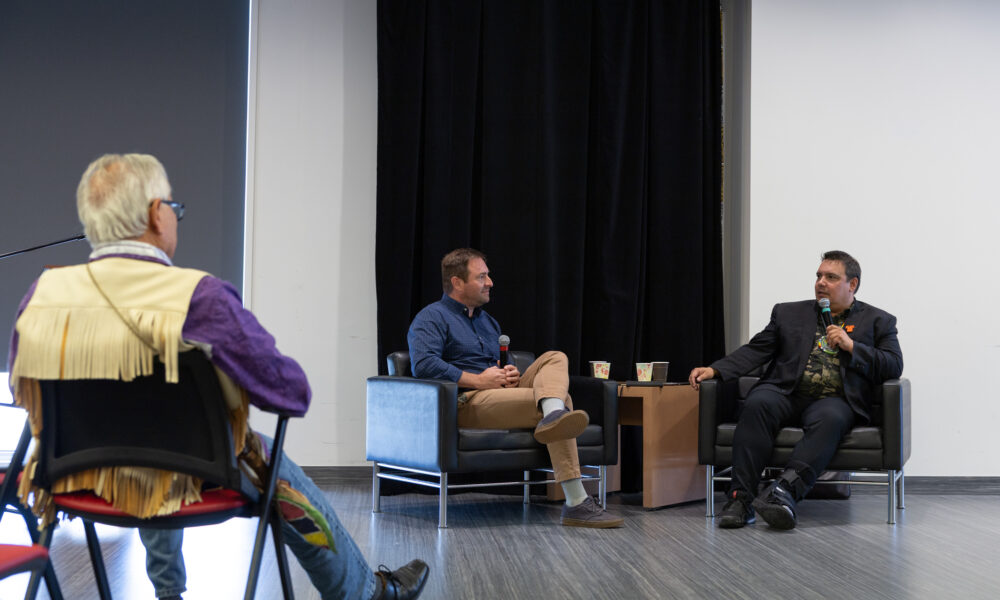
McGill’s Office of Indigenous Initiatives hosted a keynote conversation titled “Reconciliation and Resistance: Where Are We Now?” on Sept. 24 in the Donald E. Armstrong Building. The talk was led by Dr. Niigaan Sinclair—Anishinaabe scholar at the University of Manitoba and son of Truth and Reconciliation Commission (TRC) Chairman Murray Sinclair—and moderated by Veldon Coburn, Faculty Chair of the Indigenous Relations Initiative at McGill. The keynote aimed to reflect on Canada’s progress since the release of the TRC’s 94 Calls to Action in 2015. 

The TRC operated from 2008-2015 as part of the Indian Residential Schools Settlement Agreement, and worked to document the history and impacts of Canada’s residential school system. Over six years, the commission gathered testimony from over 6,500 witnesses, including survivors, about the residential school system. In 2015, the TRC released their final reports, including 94 Calls to Action directed at governments, institutions, and Canadian society to address the enduring effects of residential schools and make progress towards reconciliation.

The keynote began with a statement from Elder Ka’nahsóhon Kevin Deer, who called on the audience to remember the importance of gratitude and reciprocity in their relationships with the natural world.

“Because all of this love from our Mother comes without fail, and all she asks in return is that we acknowledge and give thanks,” Deer said. “This past Sunday, in our longhouse, we had sacred ceremonies, song, dance, speeches and rituals, because we’re so happy that we’re coming down to the end of the growing season. And our Mother gave us all of this love.” 

Coburn then introduced Sinclair, who began his talk by speaking on Winnipeg’s role in Canada’s Indigenous history, including its residential school system.

“Winnipeg is the ground zero in the center of the continent, and that means that we inherit everything,” Sinclair stated. “Good, bad, great, ugly, we inherit it all. We are the first footsteps. The residential school system [was] the first footsteps of theft of Indian lands, [was] the first footsteps of the imposition of Indian agents and the removal of children.”

He then spoke on the broad lack of knowledge among Canadian court officials on Indigenous rights in the realms of culture, health, and rental subsidies. Coburn furthered the talk by introducing the topic of racism’s far-reaching fiscal impact.

“Racism is a very expensive, bad fiscal policy,” Coburn described. “It’s very expensive to house Indigenous Peoples in jail each year, [costing] about $120,000 to $250,000 [CAD], and that stems from racism in policing, the courts, the correctional system, and education, depriving [Indigenous Peoples] of the opportunities that anyone else has.” 

Sinclair illustrated these systemic inequities through a story shared with him by Manitoba Premier Wab Kinew, who has spent time visiting Indigenous men in youth offender centres. Kinew explained to Sinclair that he initially went to these centres to guide young Indigenous men away from homelessness, addiction, and crime. But what struck Kinew most, Sinclair recounted, was not just the over-policing or poverty Indigenous Peoples experience, but rather the absence of basic opportunities and experiences provided during their upbringing.

“You know how we all had these experiences where we developed fine motor skills?” Sinclair asked the audience. “Because of the removal of [Indigenous men’s] uncles and their fathers into jails before them, they never got a chance to throw the ball in the backyard with another person. Think about all of the social skills and fine motor skills they never had the opportunity to learn. And then suddenly you thrust them into positions and jobs in which they’re [expected to have those skills].”

Sinclair then returned to the topic of the residential school system, emphasizing how it stripped Indigenous children of their cultures and identities. He highlighted the significance of the orange shirt as a symbol of resistance. 

“[Your home] was a place in which you were fostered and grown, and your language and tradition was there, and most markedly, your grandmother was there, who gave you an orange shirt and said, ‘Please wear that for your memory,’” Sinclair described. “[At residential schools], you couldn’t even wear the orange shirt. That’s why [Orange Shirt Day happens]. We put on that orange shirt because we say enough is enough with the division, enough is enough with the hate to decide wonderful people don’t matter. We’re going to do this. We’re going to say, ‘Everybody matters for one day.’”

The keynote concluded with a closing remark from Deer, who offered a broad reflection on the roots of Indigenous inequality in Canada and the need for collective change. 

“All of these things that we’re doing are coming back to haunt us,” Deer stated. “We don’t like how the air is contaminated, the water is contaminated, the land is contaminated, and the food that we eat is all full of chemicals and pesticides. But there is a solution. [….] The common denominator of this problem is money. If we understand that, why can’t we change? We can come from a place of love, seeing everybody as equals.”

Research Briefs, Science & Technology

New scoping review maps Indigenous harm reduction, barriers, and gaps

Indigenous Peoples across North America and Oceania experience higher rates of drug-related harm than other populations. These harms are shaped both by the historical and ongoing impacts of settler colonialism. While Indigenous Peoples in these regions are often willing to access health services that reduce the risks of drug use, access and trust make it difficult to do so. A new scoping review examines the use of harm-reduction services across Canada, the U.S., and Australia, while also highlighting a notable research gap in New Zealand.

After screening 578 references, the researchers distilled the evidence into 28 studies. The majority came from Canada, fewer came from the United States and Australia, and none came from New Zealand. The review covered industry standard tools—needle-syringe programs, naloxone, supervised consumption, drug checking, peer support, and safer-supply alcohol services—and examined where these services are reaching Indigenous communities and where they are falling short.

The review indicated that people who use drugs tend to see harm-reduction services as practical and helpful. However, non-using community members and some providers tend to be more skeptical of their utility. Examples stated in the study range from large urban sites to reservations and regional settings, as well as youth-focused programs in Australia. This suggests the issue is not a lack of willingness to use these services but rather barriers such as constraints on access, visibility, and availability.

Camille Zolopa, first author of the review and PhD candidate in McGill’s Department of Counselling Psychology, explained this in an interview with The Tribune

“Whenever Indigenous Peoples who use drugs were surveyed, they tended to be equally interested as non-Indigenous people. [They were] willing to use the various specific harm reduction strategies that were being discussed.”

The review organized barriers with ‘five A’s.’ Approachability is the degree to which services are visible to their intended population. Acceptability is the alignment between clients’ and providers’ cultural and social backgrounds. Availability and accommodation cover service volume, hours and service types. Affordability is clients’ capacity to pay for care. Lastly, appropriateness is the technical and personal quality of care. The literature repeatedly cites low visibility, stigma, and racism in care, as well as short or inconsistent hours and transportation barriers.

The logistics of providing adequate services are more complicated for rural and remote communities. In addition to distance, staffing constraints, and reduced hours—which are common constraints all over—anonymity and privacy become decisive factors in smaller cities.

In terms of solutions, the review noted that culturally grounded approaches and peer roles are associated with higher acceptability. Participants at Canadian supervised consumption sites described peer injection networks as “circles of trust” with “kinship-like bonds,” emphasizing relational care. One study reported “American Indian and Alaska Native” Harm Reduction Talking Circles as highly acceptable, helpful, and culturally aligned, with quality of life improving with the number of sessions attended. Early evidence also linked Managed Alcohol Programs with reconnection to kin and culture.

“[While] there are still some people who express hesitancy, there were others who conceptualized harm reduction as more in line with Indigenous ways of healing,” Zolopa said.

The review also flagged a crucial gap, as no Māori-focused studies from New Zealand were returned in the database searches.

“We didn’t find any studies from New Zealand, and we know that Māori people face a lot of disproportionate drug-related harms, including over-incarceration,” Zolopa said. “It would be great to see more community-based, participatory research.”

Because the evidence base is uneven across regions and interventions, the study stops short of firm claims. Instead, it maps recurring patterns and outlines the next steps: Indigenous-led, community-based evaluations that track outcomes like uptake, safety, and quality of life; comparative work on rural versus urban models; and dedicated research with Māori communities. Simply put, harm-reduction uptake rises when services are clear, culturally safe, and keep clients’ information private.

“Harm reduction is important. It saves lives and people who use drugs,” Zolopa said. “And Indigenous Peoples who use drugs have been on the front lines of this fight for a long time.”

Out on the Town, Student Life

Taking curiosity off campus

Classes define student life. They structure our days, determine our cohorts, and funnel our inquiry. Academic courses may be the most influential classes in our lives, but they are not the only ones available to us. Montreal is full of beginner-friendly workshops that offer alternate outlets for our curiosity and creativity. The Tribune has put together six classes around the city to add to your weekly schedule—no midterm exams required.

Matcha preparation

Montreal’s thriving cafe culture has made it easy to find a good cup of coffee—but when it comes to matcha, the options can be disappointing. If you’re tired of paying $10 CAD for swampy-coloured lattes, it may be time to take matters into your hands. At Sakao Japanese Tea, you can enroll in a workshop led by Reina Sakao, a fourth-generation member of a Japanese tea house. In this hands-on class, you’ll learn proper matcha preparation techniques while exploring the history and production of this beloved tea. You’ll also get to taste four different grades of matcha and three types of Japanese sandwich-style desserts called Monaka.

Pottery wheel throwing

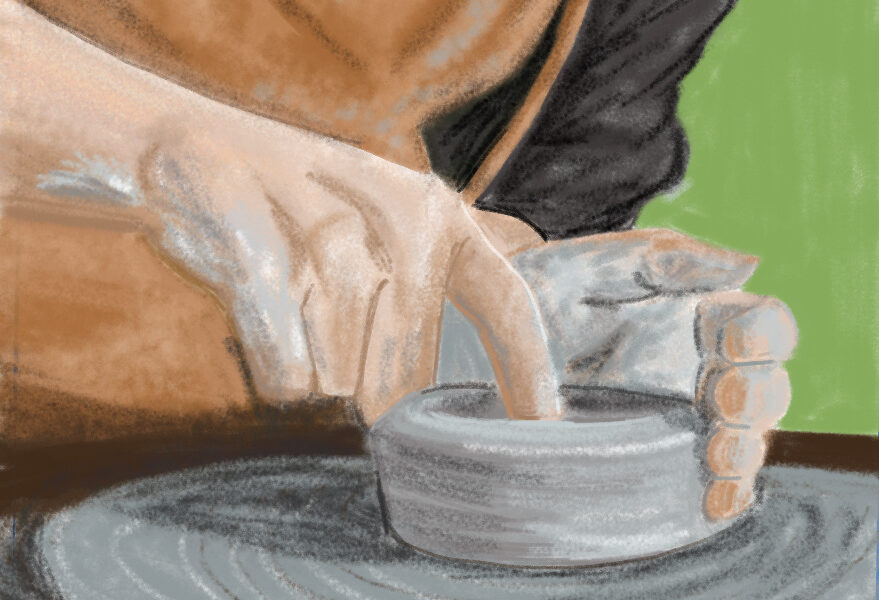
If you’ve ever dreamed of trying your hand at pottery, Les Faiseurs offers the perfect entry point. Their two-and-a-half-hour introductory class will teach you the basics of wheel throwing in a beautiful, welcoming studio. Designed specifically for complete beginners, the session walks you through each step—from centring the clay to shaping your first pieces. Whether you’re looking for a new creative outlet or just want to get your hands dirty, this class is a great way to dip into the world of ceramics. But keep your expectations tempered: You’ll quickly find that mastering the pottery wheel is much harder than it looks. Luckily, Les Faiseurs also offers six-week courses for those who catch the clay bug and want to build on the basics. 

Woodworking

Perhaps you’re ready to replace your screen time with sawdust. Les Affutes offers a variety of woodworking workshops with projects ranging from beginner to advanced. Experts can guide you through a range of courses from simple wood frames to intricate hanging mobiles. Under their supervision, you’ll learn how to safely use woodworking tools while simultaneously building your next handmade piece and confidence in a fresh skill set. 

Silkscreening

LESPACEMAKER is a community-based workshop that’s helping democratize technical know-how in Montreal. If ink is your medium of choice, their screen printing workshop offers a comprehensive introduction to the art of silkscreening. Designed for first-timers, their four-hour classes walk you through both the theory and practice of screen printing on paper. You’ll learn how to prepare visuals, expose a screen, and work with water-based inks. 

Jazz dance

Cat’s Corner has been bringing the joy of dance to Montreal since 1998. From tap to Balboa, they offer a wide range of swing-era styles in a fun, inclusive environment. New to swing dancing? Drop by for a Friday night intro class—no partner or experience needed. For those ready to dive deeper, their eight-week beginner sessions are a great way to build rhythm on the dance floor.

Knitting

Fibre arts can be daunting. If your self-taught sessions have looked more like knotting than knitting, a class at Les Laines Biscotte might be just what you need. Their six-week sessions are designed to build both skills and confidence, with experienced instructors guiding you every step of the way. For something more flexible, à la carte classes offer drop-in style learning tailored to your schedule and goals. Located around Montreal, these classes are a great opportunity to untangle the basics.

Read the latest issue

Read the latest issue