






Published by the SPT, a student society of McGill University
 urban child
November 15, 2025
urban child
November 15, 2025
 Students protest for Palestine at Parliament, in photos
June 21, 2025
Students protest for Palestine at Parliament, in photos
June 21, 2025
 Moments of celebration
March 30, 2024
Moments of celebration
March 30, 2024

 How can I show you I’m doing better if there’s nothing good for me to do?
April 13, 2026
How can I show you I’m doing better if there’s nothing good for me to do?
April 13, 2026
 Your health, your problem
April 8, 2026
Your health, your problem
April 8, 2026
 On becoming Chinese
March 30, 2026
On becoming Chinese
March 30, 2026
Author: Asher Kui, News Editor
You pass by this intersection daily—whether on a BIXI bike back to your Plateau apartment, or on your stream of grocery shopping activities at Metro and Dollarama in the Complexe La Cité. Yet it rarely registers in your memory, silently blending into your daily routine. Where is it?
On av. du Parc, coin de la rue Milton, are the premises of what used to be Chez Gautier. Originally a fur trading store, it was later turned into a sewing machine shop before pastry chef Moïse Gautier acquired it in 1976. Gautier, who owned the Belgian pastry shop right next door, transformed the small space into a Parisian-style café, which in the 1980s and 1990s attracted many locals and tourists. While it was rumoured that in 2012, his daughter Stéphanie Gautier took the business into her own hands and renovated it in her father’s legacy, Chez Gautier ultimately shut down indefinitely a year later. A real estate developer purchased the property in 2013, and it has remained vacant ever since—along with its unused parking lot.
For 12 years, the empty property has been left abandoned while its futility continued to bring harm to the community socially and environmentally. Today, the Milton-Parc community has spoken: The Chez Gautier campaign petitions for the property located at 3487 av. du Parc to be transformed into a housing program to accommodate the community’s growing needs.
Since 2019, asking rents on the Island of Montreal have surged by 71 per cent. Centraide Montreal announced in 2023 that 360,000 households, representing one in five across the city, cannot afford rent and basic necessities. Amid the soaring housing costs, the Chez Gautier campaign calls on the city to take concrete action. The first step of the campaign is to pressure the city to acquire the land from private estate developers, ensuring its service to the community’s urgent needs.
//Expropriation as a political tool//
In an interview with //The Tribune//, Jacob Réal, Membership Delegate of the Chez Gautier campaign, explained that one of the campaign’s core goals is to set a political example for affordable housing in Montreal.
“The project is part of a fight for decommodifying housing on the Island of Montreal. We aim to establish a political precedent that expropriation of unused land is a possibility in constructing more social housing in the heart of Montreal,” Réal said. “The way of solving a housing crisis [should be] […] a confrontation between locals and land speculators.”
Expropriation is defined as a municipality’s forcible acquisition of private land for public utility through compensating the landowner financially. The Chez Gautier campaign urges Montreal’s city council to use Articles 51 to 56 of the Loi sur la Société d’habitation du Québec to acquire and expropriate the vacant property. While this legal tool exists, the city council has rarely applied it in Montreal’s housing context, making the campaign an ambitious one.
Sophie Keenan, Campaign Assistant of the Chez Gautier Campaign, wrote to //The Tribune// that the campaign remains in its early stages, with a focus on pushing the city to obtain the land.
“Right now the campaign is focused on pressuring the city to expropriate the lot, which would be a precedent-setting victory [….] This is a long-term project,” she wrote.
To move toward this goal, the campaign is engaging in community outreach and petitioning for enough signatories to trigger a legal process. Yet expropriation raises questions about political will and public perception. Réal highlighted how expropriation, although an effective measure, may be received poorly in the community.
“While [expropriation] is possible, [the city] has never done it because it can be viewed as aggressive towards the neighbourhood’s landowners,” he said.
While expropriation may face resistance, other recent government actions show where priorities lie. The Coalition Avenir Québec (CAQ) recently drafted a new regulation that reduces the number of variables when calculating annual rent increases—a move many Montrealers see as yet another sign of how the city’s policies favour landlords over tenants.
“We need to change the narrative that the way out [of a housing crisis] is to collaborate with real estate developers and speculators, as they are incentivized to maintain a housing crisis [….] We are trying to use expropriation and direct government action to create a mixed-use neighbourhood that encourages developers to incorporate affordable housing into the city,” Réal said.
In June, the Milton-Parc Citizens’ Committee (MPCC) finalized the Chez Gautier petition, which has since been in circulation around the neighbourhood. Réal noted that the majority of Milton-Parc residents support the project.
//Private landowners vs public need//
The push to transform Chez Gautier has not been without resistance. While many in Milton-Parc view the campaign as an opportunity to reclaim long-abandoned space for the community, others are concerned about what new housing might bring to the neighbourhood.
Réal acknowledged that some worry the project might increase the number of unhoused individuals in the area, but he described those concerns as out of touch.
“There are a few neighbouring groups that are vocally against the project, but their point of view is, frankly, not in tune with reality. They accuse us of wanting to establish a second La Porte Ouverte […] or even working in secret for them.”
La Porte Ouverte is a shelter that supports people experiencing homelessness, offering different events to accompany unhoused individuals towards a better quality of life. Yet a group of nearby residents has complained that La Porte Ouverte’s presence has attracted people experiencing homelessness to the neighbourhood.
Benjamin Forest, associate professor at the Department of Geography at McGill, wrote to //The Tribune// explaining that in urban theory, people experiencing homelessness are usually not in neighbourhoods with high housing costs.
“[Unhoused peoples’] locations are influenced both by the location of services available and by policing decisions [or in other words, whether] the police permit [them] to stay,” Forest wrote. “Social services tend to be located in low-income areas and police will typically funnel the homeless into lower income areas.”
Nadine Mailloux’s report //Don’t Look the Other Way// investigates a complaint made by a group of Milton-Parc citizens, which calls the homelessness situation in the neighbourhood a crisis due to the severity of safety problems, insalubrity, and violence. While the complaint ultimately aims to change the government’s approach to ending chronic homelessness, it nonetheless reflects a tension common in many urban areas, where anxiety about safety and cleanliness overshadows evidence of the systemic conditions that sustain homelessness.
Moreover, homelessness affects Indigenous Peoples in Canada disproportionately. According to the 2018 census enumeration of unhoused persons, Indigenous Peoples made up 12 per cent of Montreal’s people experiencing homelessness, while representing less than one per cent of the city’s population. This stark disparity illustrates that homelessness cannot be reduced to mere neighbourhood-level complaints—it is tied to Quebec’s colonial legacy that continues to challenge and discriminate against Indigenous Peoples.
Still, Keenan emphasized the importance of not drawing preliminary conclusions based on demographics, as this may manifest false assumptions. The information must be handled with care.
“I push back against highlighting a specific group as the most ‘unhoused’ […] as these types of assumptions turn into misconceptions and stereotyping that we have been working to unpack in our community engagement,” Keenan said. “Wherever they might hail from, we want to propose a systemic solution to a systemic problem, aiming to avoid talking points that lean too heavily on identity politics frameworks while striking a balance of recognizing specific needs and specific ways of living.”
Keenan affirmed that through the Chez Gautier campaign, the Milton-Parc neighbourhood will reap benefits no matter what form of housing program it assumes.
“No matter whether the lot becomes a co-op for elderly people, non-profit housing for low income families, or permanent housing for unhoused Indigenous individuals, it will positively impact the safety and well-being of the neighbourhood,” she said. “Safe and comfortable housing cannot be more of a detriment to the neighbourhood than an ugly, abandoned lot which continues to negatively affect the health and perception of the neighbourhood.”
//Environmental stakes and urban development//
Chez Gautier also claims that the empty parking lot contributes to the urban heat island effect, negatively impacting the health of residents. Low-income families are disproportionately affected due to limited access to air conditioning, while the elderly are vulnerable due to reduced heat tolerance.
In an interview with //The Tribune//, Raja Sengupta, associate professor in the Department of Geography and the Bieler School of Environment at McGill, clarified that the urban heat island effect is actually a nighttime phenomenon.
“All of the solar radiation that’s falling on the concrete around us, especially in downtown Montreal, is going to heat up and get stored,” he said. “The tall concrete structures absorb all that energy [which is released] for the next four or five hours. At 1:00 a.m. at night, that’s when the night temperature is six to seven degrees warmer [than rural areas].”
He continued to explain that the intensity of the urban heat island effect depends on two factors: Sky view and vegetation. While the Chez Gautier campaign affirms that constructing a building on an empty parking lot may ameliorate the urban heat effect, Sengupta’s research provides an insightful imperative.
“Put green roofs on top, and you [may] see a reduction of what is called surface urban heat island. If you were to convert the parking lot into a green park […] the nighttime temperature [may be reduced] by one degree,” Sengupta said. “Why not more? The area has other buildings. [Putting vegetation on one building] is not going to [instantly] bring the temperature down by 9 degrees.”
While one project cannot undo the structural drivers of the urban heat island effect, each redevelopment may promote positive change and continue a trend of ecological urbanism. Choosing to incorporate green design elements—such as a rooftop garden—is a huge leap towards improving the quality of life of Milton-Parc residents.
When navigating between fostering social and environmental improvement along with conserving the city’s patrimony, Réal expressed his skepticism toward the city council.
“The city poses extremely strict regulations on certain individuals, but gives a lot of freedom to developers, often distributing exemptions,” he said. “The only way to preserve the character of a neighbourhood is to involve the local community in decisions that involve development.”
The Chez Gautier campaign stresses that both environmental and heritage concerns must shape development decisions, and that community participation is essential to building an ecological and patrimonial future.
//A long-term vision for Chez Gautier//
Keenan maintained that Chez Gautier will be a long-term project, and that predicting a calendar as of today is unrealistic.
“If the petition succeeds and the city moves forward to expropriate the lot, we will confer with experts to conduct the necessary studies and community consultations,” Keenan wrote. “It is hard to know what a realistic timeline will be at this current stage, but the project will most likely have multiple phases over multiple years.”
In the meantime, McGill students have plenty of opportunities to get involved in the Milton-Parc community. The Milton-Parc Food Bank and Midnight Kitchen are food cooperatives that work to increase food accessibility in the neighbourhood. Art Hives brings residents together through art sessions, while La Porte Ouverte is seeking volunteers to support its mobilization and administrative efforts.
Too often, students remain in the McGill bubble, detached from the realities of the city. But it’s time for McGill students to stand up for their community. Our strength lies in our numbers. McGill’s enormous student population must show the community that we care. Sign the Chez Gautier petition, keep up with information, and volunteer. Milton-Parc’s future is in our hands.
Keenan called for McGill students to approach the people experiencing homelessness with empathy and compassion.
“This area is so populated by young people but many of these [unhoused] individuals go ignored for most of the day [….] Saying hello and offering a smile to individuals who reside on the sidewalks on their walks to and from school is a very simple start for students,” Keenan wrote.
“Remove your bias from pretending that poverty is invisible,” she wrote. “Human kindness does not always require pocket change.”
//For more information and instructions on signing the petition and subscribing to their newsletter, visit the Chez Gautier website.//
//*Quotes from Jacob Réal were translated from French.//

I am eight years old, and it’s Rosh Hashanah. I’m sitting in a synagogue, and I don’t really know why. I know that I like the singing, and I like seeing my grandma. I like all of the standing up and the sitting down and standing up again. What I like even more is fluffy challah, steamy Matzo Ball Soup, and knowing the evening will bring quality time with my family. I like that I’m a part of this happy thing, but I don’t exactly know what this thing is.
I learned through my time spent in synagogue that Judaism is not a universal practice, but for each individual to define for themself. I began to approach Rosh Hashanah and my Jewish identity through the lens of culture, family, and gratitude. Judaism is a vast, diverse, and evolving religion that can be observed and celebrated in any which way—with community, with your family, or even by yourself. Here are The Tribune’s tips for a fulfilling and joyous Rosh Hashanah.
Gather with your community
Organize a time to come together with friends, whether they are Jewish or not, to mark the significance of this time. This is an opportunity to share memories of past celebrations and teach your non-Jewish friends something new about the sacred holiday.
Enjoy the simple and accessible treat that is apples and honey—a traditional Rosh Hashanah snack, signifying the goal of a sweet and fruitful year. An easily prepared and delicious treat, apples and honey are a Rosh Hashanah staple.
Connecting with family is also a great way to mark the new year and connect with Jewish culture. Call your parents, grandparents, aunts, uncles, or cousins, and wish them “Shanah Tova Umetukah”: A good and sweet year.
Get ambitious in the kitchen
Is there any better time to tackle the family challah recipe than the High Holidays? Spending holidays away from home can be a bittersweet thing, for which a potential antidote could be tasting traditional food. If the family recipe is lost in translation, or simply didn’t make it to Montreal, check out this recipe for a classic braided challah.
Ditch the kitchen, and hit the classics
Some don’t have the willpower, time, or space to make bread from home—and that’s okay. Instead of waiting for your dough to proof, taste the foods from home at classic Montreal restaurants. Check out Schwartz’s Deli for smoked meat, Beauty’s Restaurant for a classic Jewish breakfast (lox, latkes, and blintzes), or Snowdon Deli for a hot brisket sandwich and killer french fries.
Look out for on-campus events
Independent Jewish Voices McGill (IJV), a chapter of IJV Canada, is a group focused on organizing and uniting Jewish students who support Palestinian liberation and strive to fight the harmful blurring of anti-Zionism and antisemitism. They frequently host student-led events, such as their recent potluck dinner, creating a space for students to come together and celebrate from the comfort of their campus.
Take a moment to reflect
Find a space where you feel at peace, maybe under a tree in Jeanne-Mance Park or in bed with your journal, and look back on the past year. Perhaps make intentions for the year ahead, or think about your favourite moments of the past year. Consider both the highs and lows, and what can be learned from these experiences. If being this intentional with your reflection feels unlike yourself, keep these ideas of gratitude and new beginnings in mind as you go through each day.
Remember to be kind and generous with the people in your life. The world is a confusing and scary place, and it can be easy to lose yourself in the slurry of anxiety and pessimism. Channel your appreciation for the good in the world into producing more of it. Create a feedback loop of positivity, nourishing both yourself and the world around you.

 Varsity or bust: Inside the fallout of McGill Athletics’ restructuring
December 3, 2025
Varsity or bust: Inside the fallout of McGill Athletics’ restructuring
December 3, 2025
 Varsity Report Card: Fall 2025
December 3, 2025
Varsity Report Card: Fall 2025
December 3, 2025
 2025’s sports equinox: Four major leagues, one historic night
November 4, 2025
2025’s sports equinox: Four major leagues, one historic night
November 4, 2025
On Sept. 10, American right-wing activist and co-founder of Turning Point USA, Charlie Kirk, was fatally shot by Tyler Robinson on the Utah Valley University campus. Kirk’s death has sparked significant debate over the appropriateness of mourning him, given his bigoted political views. Professional athletes’ reactions have ranged from Instagram tributes to on-field measures. For instance, Los Angeles Dodgers pitcher Blake Treinen had Charlie Kirk’s name embroidered on the side of his hat and the New York Yankees held a moment of silence in Kirk’s memory before their game on Sept. 10. These tributes to Kirk illustrate the growing overlap between professional sports and explicit political discourse, raising questions about the messages teams and athletes convey to fans when engaging with polarizing figures.
The Yankees’ tribute to Kirk has sparked conversations around professional sports amplifying political messages, which only benefits teams’ most privileged fans. Many saw the move as a moment of unity, while others pointed out Kirk’s radical rhetoric and controversial views. Kirk was well known as a figure who prompted a rise in right-wing conservatism amongst youth in America: Much of his popularity was cultivated by promoting misinformation and conspiracy theories, particularly through his anti-vaccination views and belief that the 2020 U.S. Presidential election was fraudulent. He emphasized a desire for the U.S. to return to a Christian state, advocated for anti-abortion policies, and supported the Second Amendment. He openly supported the National Rifle Association, despite the United States’ ongoing issues with gun violence. On top of this, Kirk held racist views, once stating, “If I’m dealing with somebody in customer service who’s a moronic Black woman, I wonder is she there because of her excellence, or is she there because of affirmative action?”
The Yankees have received ongoing backlash on social media for their selectivity in memorializing Kirk, as they have not held a moment of silence for any gun violence victims since 2016, after the Pulse nightclub shooting in Orlando. Notably, the team did not hold a moment of silence for the recent death of Melissa Hortman, lawmaker and leader of the Minnesota Democratic Caucus, who was slain along with her husband on June 14 in an act of political violence. This contrast raises questions as to why certain deaths are commemorated while others are ignored, suggesting that the Yankees’ decision to honour Kirk reflects an alignment with the charged nature of what he represented, rather than a consistent solidarity with victims of gun violence.
On the surface, honouring a victim of political assassination may appear neutral, even respectful. Yet in Kirk’s case, given his role in advancing regressive right-wing politics, the gesture legitimizes harmful rhetoric, which can be damaging to the racialized and non-Christian groups Kirk made hateful claims about. Tributes like these blur the lines between memorializing and political endorsement. Further, this choice could create broader acceptance among the Yankees’ fanbase that such exclusionary opinions are justifiable, as Kirk’s life—as much as his death—reignited debates about the point at which political statements become hate speech.
The team doubled down on the right-wing undertones they assumed in holding a moment of silence for Kirk when President Donald Trump attended the Yankees’ next game, honouring the victims of 9/11. By posing for photos with Trump, the Yankees continue to align themselves with his politics, reinforcing the likelihood that their choice to honour Kirk was not a gesture to memorialize gun violence victims, but rather an intentional Republican political positioning.
Ultimately, Kirk’s death highlights broader questions: How far can public figures and institutions go in promoting conservative politics before their platforms become outright exclusionary? What responsibility do sports teams have in deciding which voices to elevate and which to ignore? The Yankees’ tribute to Kirk shows how sports have never been separate from larger political issues. They have reminded us that moments of silence are never truly neutral; they signal whose voices are deemed morally worthy of remembrance.

On Sept. 15, a group of approximately 50 McGill and Concordia students and community members gathered at McGill’s Y-intersection for a “Vigil for Gaza” organized by Students for Palestine’s Honour and Resistance at McGill (SPHR). Students raised Palestinian flags around the area as the sun set. Around 6:45 p.m., a student with a microphone began the chant, “We will honour all our martyrs,” which the audience promptly picked up. Students lit candles as it got dark.
A representative from SPHR began by speaking about the current situation for people in Gaza.
“We are on day 710 of this genocide,” they stated. “There have been almost 200,000 martyrs. But numbers do no justice to each martyr, each with name, a family, with a home, and with hopes and dreams. [….] Their graves are not marked by tombstones, but by the rubble of their homes.”
The speaker also emphasized how McGill and similar institutions are complicit in this killing because of their refusal to divest from companies which profit from weapons used by Israel.
“McGill is responsible for every penny it invests in this genocide,” they said.
The next speaker, an SPHR representative for graduate students, turned the solemn theme of mourning into a call for action.
“We vow to remember every martyr in Palestine with every action we take,” they expressed.
This speaker also noted that the death toll from the genocide in Gaza since Oct. 7, 2023, may be six times the amount reported by the Gaza Health Ministry. Other reports estimate the toll to be 40 per cent higher than the Gaza Health Ministry reports.
A McGill professor next spoke about the complicated mixture of anger, sadness, and love that she saw reflected in the crowd at the vigil. She echoed similar emotions of immense mourning for Palestinians, but also spoke about finding strength, community, and resilience in those who gathered to participate in collective grieving. The professor read a poem by Palestinian Poet Hiba Abu Nada, called “I Grant You Refuge.” She explained that Abu Nada wrote this particular poem only ten days before she was killed by an Israeli airstrike in Gaza on Oct. 20, 2023, at the age of 32.
Afterwards, SPHR representatives began two prayers, one read in Arabic, the other in English, dedicated to all those who have been killed in Gaza.

In an interview with The Tribune, a spokesperson for SPHR explained why they decided to host the vigil, and what the most important takeaways for McGill students and administration are.
“We are gathered here tonight to mourn the hundreds of thousands of lives lost in the genocide in Gaza, and to continue to fight for academic divestment,” they said. “We call on McGill to end its complicity […] by divesting from weapons companies among other complicit companies, and ending academic partnerships with complicit institutions. [….] Students must join the fight for divestment.”
The McGill Media Relations Office (MRO) commented on these calls in a written statement to The Tribune.
“The analysis by the Committee [on Sustainability and Social Responsibility] confirmed that the University had no exposure to companies involved in the production of controversial weapons at the time of the review [on July 8, 2024],” the MRO wrote.
Another student attending the vigil voiced what they hope will come from pro-Palestine activism on university campuses like McGill’s.
“We want to see McGill divestment, and we want to see Concordia divestment,” they explained. “We also want [these universities] to stop policing students. Both McGill and Concordia have been increasing their security for the purpose of policing students on campus who are speaking out.”
“McGill University is firmly committed to freedom of expression and has no issue with lawful activism and protest, regardless of the cause,” the MRO wrote.
A McGill community member in attendance shared that they hope this vigil will lead to further action for Palestine in an interview with The Tribune.
“We are taking the time to honour the past, to mourn together, and then to use it as fuel to continue to fight for justice into the future,” they expressed.

 Critics must balance linguistic priorities with human impact when discussing Air Canada’s faux pas
April 7, 2026
Critics must balance linguistic priorities with human impact when discussing Air Canada’s faux pas
April 7, 2026
 The pattern behind Hassan’s denial of entry
April 7, 2026
The pattern behind Hassan’s denial of entry
April 7, 2026
At 12:23 p.m. on Sept. 10, far-right activist Charlie Kirk was assassinated in front of a crowd of 3,000 at Utah Valley University. An hour and 20 minutes later, Ruth Marshall, a professor of religious studies and political science at the University of Toronto (UofT), tweeted: “Shooting is honestly too good for so many of you fascist c**ts.” Because of this tweet, UofT placed Marshall on leave and opened an investigation into her actions. If she is found to have caused UofT ‘reputational harm,’ Marshall may be terminated. This respect for procedure is commendable, but Marshall’s tweet demonstrates that she should not be a university professor and justifies her immediate firing.
It is important not to conflate Marshall’s suspension with other instances of censorship following Kirk’s death. The Trump administration has used the event as justification to attack and silence its political opponents, casting all criticism of Kirk or his movement as ‘hate speech’; unsurprisingly, no such move was made against far-right groups following the murder of Minnesota Democratic lawmaker Melissa Hortman in June.
However, in Marshall’s case, her words were neither justified nor defensible. She was not criticizing the administration’s actions or Kirk’s views: She was calling for further violence. That is a line that should never be crossed in political debate.
In her tweet, Marshall calls Kirk a fascist, which he was. Kirk described all undocumented immigrants as “would-be rapists” to justify shooting them; he said that gay people wanted to “corrupt children,” a well-known homophobic dog-whistle; he implied trans women should be lynched. Kirk’s arguments were also frequently based on conspiracy theories: He famously denied the validity of the 2020 election. Such disregard for truth and democracy, along with blatant normalization of violence, is the foundational material on which fascist movements are built. But before it is a movement, fascism is a rhetoric that claims: Some lives are worth less than others. Some people deserve to be killed. Marshall’s tweet espoused that rhetoric.
It is common these days to hear that free speech and open diversity of opinion are integral to universities and to society as a whole. It is true that society cannot progress without debate. However, proper and productive debate is not ritualized ‘destruction’ of ‘opponents,’ but rather honest discussion between good-faith parties with the aim of learning and moving forward towards a better reality for all.
Some things, however, are not up for debate. An opinion that justifies violence as a means to a political end is not worth platforming: It intrinsically rejects dissent, and so it is antithetical to the mission of universities. Charlie Kirk was killed on the campus of Utah Valley University while promoting violent views. He should not have been invited to the campus at all. Ruth Marshall, having projected similarly violent opinions, should not be allowed on UofT’s campus.
It would be naive, of course, to claim that Marshall’s deviation from proper and respectful debate was the actual reason for her suspension. Earlier this year, Marshall herself rightly called out UofT for failing to formally condemn professors using similarly violent language against pro-Palestinian protesters and journalists.
Rather, UofT may have had much more pragmatic reasons for sanctioning Marshall. On the right and far-right, Kirk’s death has prompted explicit talk of war and revenge. Tweets celebrating the murder could reasonably be expected to provoke violent retaliation against Marshall’s colleagues, her students, and herself. UofT has not publicly stated its reasoning in sanctioning Marshall. After her suspension, however, UofT blocked public access to her department webpage, which presumably contained information on the location of her office. On Monday, the building where she works was closed.
One of the great successes of liberal democracy has been unprecedented safety from political violence. Before the late 20th century, most of our ancestors lived in dread of brutal, arbitrary attacks. Free speech is fundamental to preserving this achievement—but only when it serves discourse rather than destroying it. The moment we use our freedom of expression to call for violence against our political opponents, we abandon the very principles that make free speech worth defending. Universities, as guardians of open inquiry, have both the right and the responsibility to draw this line.

With the increasing presence of Artificial Intelligence (AI) in everyday life, professors are grappling with the extent to which AI should be allowed in the classroom. Some allow AI as long as usage is disclosed, some strictly prohibit it, and others view it as a tool that encourages students to cheat themselves out of an education. Despite mixed perspectives from its professors, McGill has taken a definitive stance: Integrating AI use into academia.
The university promotes AI usage in its new module on MyCourses titled “Generative AI for Teaching and Learning,” where students and professors alike can explore McGill’s recommended Generative AI (Gen AI) prompts.
The module, designed by Associate Director of Learning Environments for Teaching and Learning Services Adam Finkelstein, offers a variety of services, including prompts to help create semesterly study plans and guides to navigating tricky social situations.
“In 2023 the [Academic Policy Committee’s] Subcommittee on Teaching and Learning (STL) created a working group on AI that drafted recommendations on using Gen AI for teaching and learning at McGill. One of the key recommendations, later received by Senate, was to develop an ongoing university-wide awareness program on using Gen AI in teaching and learning,” Finkelstein wrote to The Tribune.
The module focuses on three key areas: Vitality of using AI ethically and responsibly; Gen AI for teaching support; and Gen AI for student learning support. Finkelstein emphasized the importance of including AI ethics at the beginning of the module, focusing on AI malfunctions like bias and hallucinations, as well as prioritizing safe AI use to protect users’ privacy.
“Part of the rationale for providing examples of how to use Gen AI to support learning is to help close the gap between the students that are already successfully using AI to support their learning and those that have never used it at all,” Finkelstein noted.
Despite controversy among professors and students alike surrounding the extent to which AI should be used in the classroom, Finkelstein maintained that the university must evolve alongside technology.
“AI is here, in almost everything we do, so we need to address it head on and not try to avoid the dialogue on its impact.”
This rhetoric echoes debates that took place following the invention of pocket-sized calculators and their potential use in schools throughout the 1970s. Many worried that calculators would stunt students’ computational abilities and make them overly reliant on machines, preventing them from learning through mistakes. Today, calculators are not only accepted but required for many courses.
However, AI is not the calculator. In fact, calculators are still disallowed in early education to emphasize the importance of young students learning fundamental math skills. The difference with AI is that it has the potential to serve not just as a calculator—an instrument to cut out the middle man of tedious arithmetic—but as a convoluted, robotic writer. While McGill’s Gen AI module encourages the use of AI to cut out the tedium of creating study guides and increasing memory and retention, does it act as a method of damage control, reducing stress and thus reducing cheating? Or does it risk acting as a gateway drug of AI reliance, diminishing students’ necessary exercise of critical thought?
Considering the controversial and highly-debated nature of AI-use in academia, The Tribune sat down with Renee Sieber, associate professor jointly appointed in the School of Environment and the Department of Geography. Named one of the Top 100 Brilliant Women in AI Ethics for 2025, Sieber provided helpful insight into what a future of AI, or a lack of one, could look like.
“Well, first of all, a calculator does not reason,” Sieber told The Tribune concerning the comparison with the calculator. “We tell calculators to do a bunch of steps, but what we’re instead doing is giving the reasoning over to AI, so these are not the same thing.”
Not only is Gen AI incomparable to the calculator, but its side effects are far more detrimental. Sieber emphasized the need to think more critically and ethically about AI use—an aspect she feels is missing in McGill’s Gen AI module.
“There are always problems when one talks about ethics in the classroom, especially in reference to technology, that it is shelved to the last possible moment, compressed into the last week or a single class, instead of being infused, diffused in all aspects of the technology,” Sieber said.
Furthermore, Sieber raised concerns with widespread Gen AI use: On a global scale, AI adoption among larger firms has already been declining since the middle of 2025, as 95 per cent of Gen AI adoptions have found 0 per cent return on investments. Beyond the implications of Gen AI shrinking the entry-level job market, there is a chance that the implementation of Gen AI itself will also soon shrink.
“The venture capitalists that are pumping enormous amounts of money in […] haven’t seen the investment,” Sieber noted. “And when we have this infrastructure, whether it’s a data centre or it’s money—when these run out, what’s going to happen?”
McGill’s Gen AI module encourages AI use among professors—a priority that Sieber worries will result in decreased demand for teaching assistants (TAs). The module for teaching includes sections describing Gen AI use for creating course outlines, developing assessments, and assuring clarity. There are also sections describing how to design AI in or out of a course.
“What makes me very distrustful is that […] the subtext of those modules is you don’t need teaching assistants anymore. You can use the AI to do the work of the teaching assistants or to do your own evaluations.”
She goes on to describe the likely low lifespan of Gen AI, as investment returns are underwhelming and datacentres are running out of internet content to harvest. Her worry is that modules, such as this one, will discourage the hiring of TAs and other teaching support, which will be detrimental in the case that Gen AI dies out sooner than expected.
“It has enormous, incalculable implications for education. So you destroy the infrastructure of education, […] and then we have to regenerate everything. Sometimes you can’t regenerate stuff,” Sieber urged. “You can’t regenerate that stuff after it’s been hollowed out so much.”
Sieber concluded by describing another key aspect she feels the module is missing: How Gen AI can shape how one thinks. Gen AI is often denoted as an objective source, but Sieber argues that this is not completely the case. She references instances where Gen AI has filtered out events of radical activism concerning the protection of the environment, focusing instead on smaller ‘band-aid’ fixes. Though these filters can seem negligible, the wider impact has slow and worrying effects.
“It is changing our brains cognitively and what we think is acceptable in subtle ways,” Sieber described. “You tell the technology something which feeds something back to you, and you get shaped in how you think about the world.”
While Gen AI may seem like a quick and easy solution to hasten the teaching and learning processes, the downsides heavily outweigh its convenience, branching out to many different areas of harm: Accelerating environmental destruction, gutting the infrastructure of institutions beyond repair, and altering the ability to think critically. In a period where Gen AI is pushed as an inevitable technology that must be integrated into our daily lives, it is important to remember the corruption that is entangled within. The tedium of creating a course outline or a study guide is not the enemy, and it surely is worth the protection of our environment, our universities, and our brains.
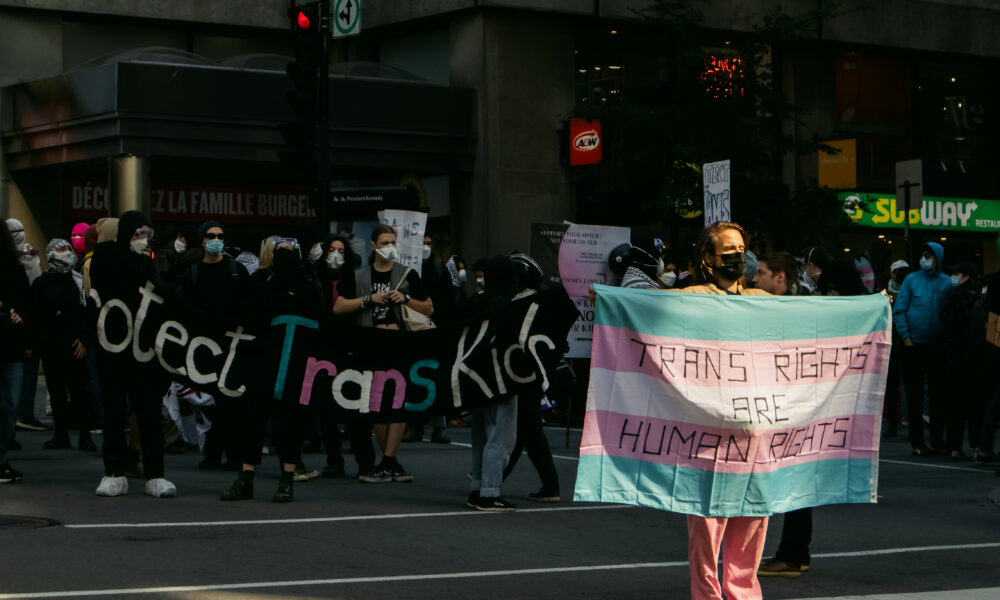
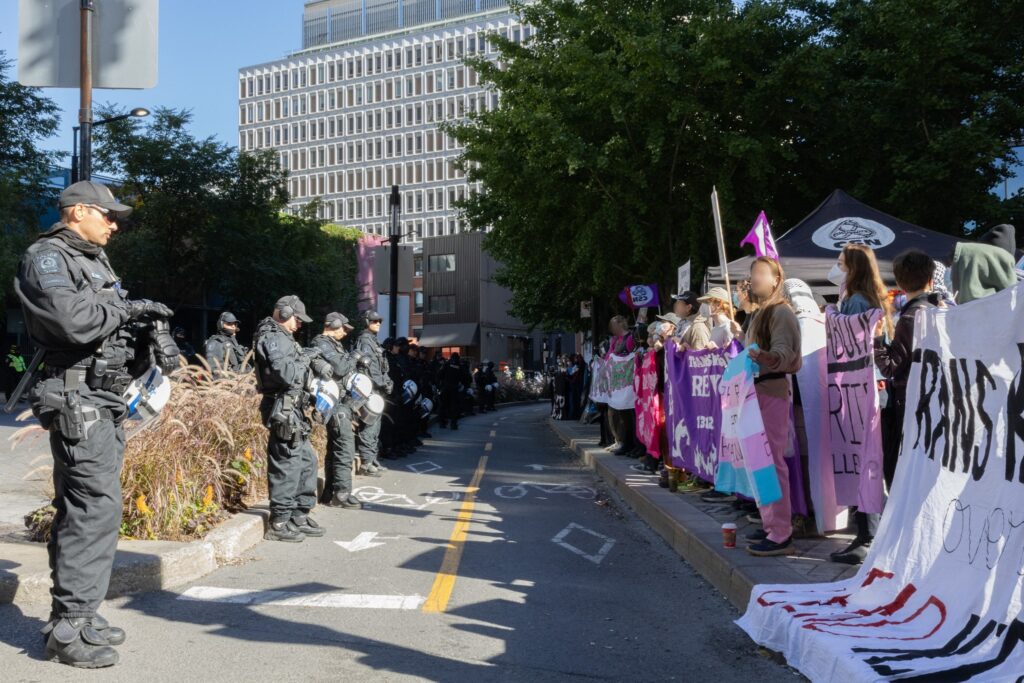
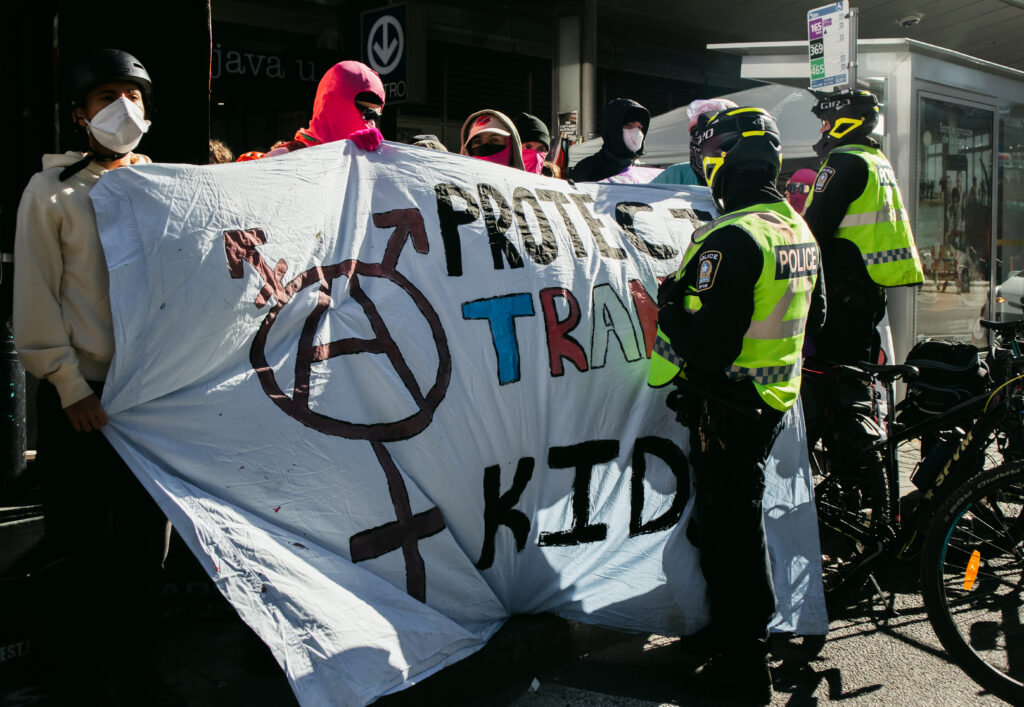
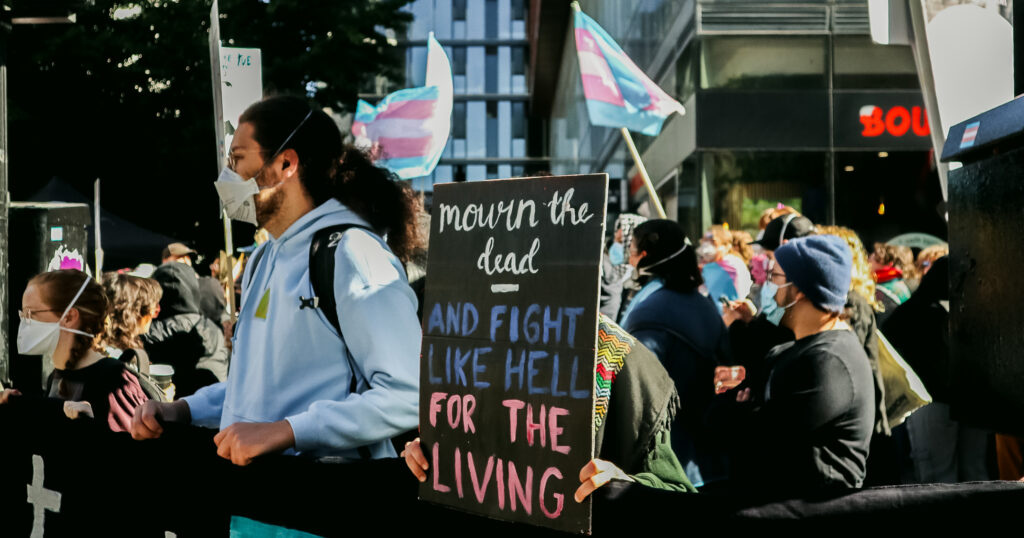
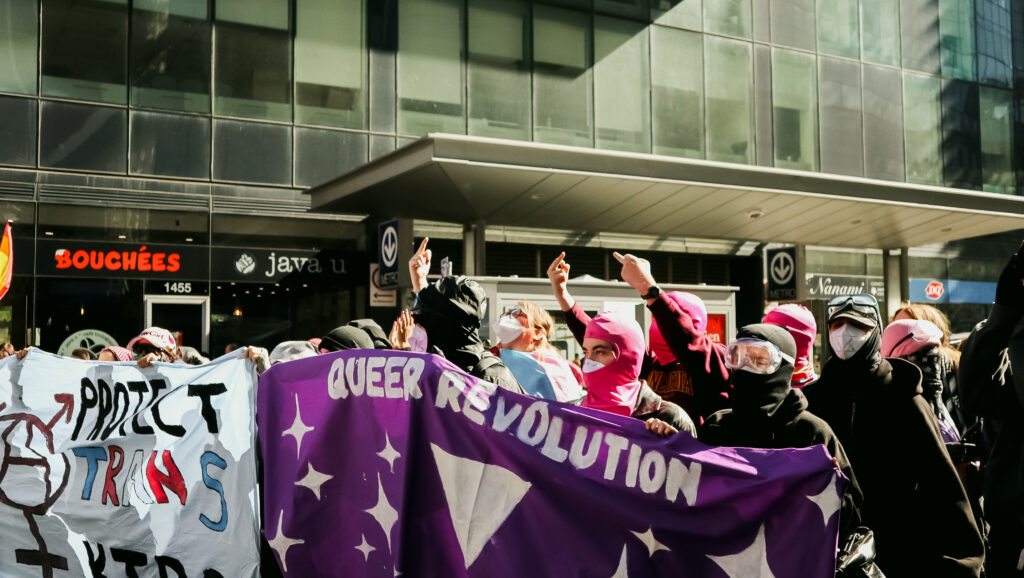
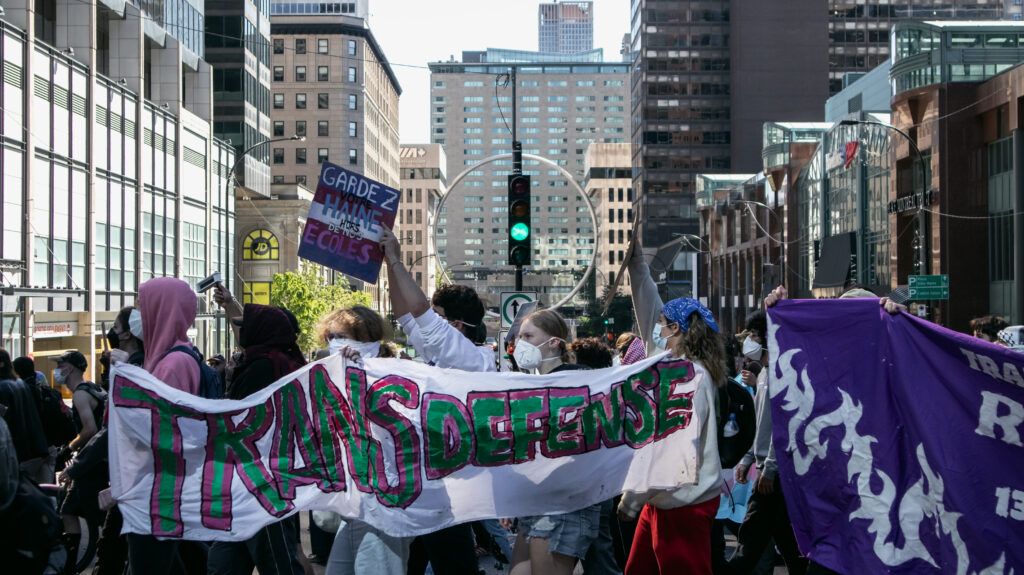
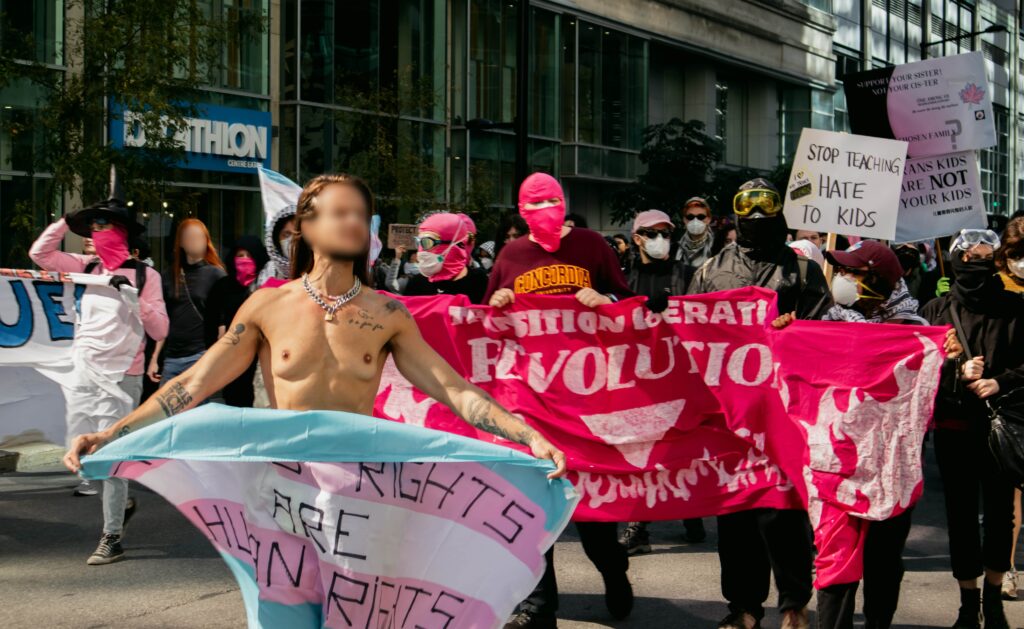
Queer McGill’s counter-protest against Ensemble pour protéger nos enfants (EPPNE)’s anti-transgender demonstration began at 9:00 a.m. on Sept. 20, as protesters gathered in preparation for the arrival of EPPNE demonstrators at 11:00 a.m. Some EPPNE members arrived early in response, holding signs which read, “Protect children.” One counter-protester held a banner which stated, “Don’t be your child’s first bully.”
EPPNE is a right-wing organization petitioning to remove any mention of queer identities from Quebec’s K-12 curricula on the grounds that teaching youth what they describe as “gender ideology” infringes on parents’ rights to pass on their own religious or moral beliefs to their children. EPPNE further argues that children having knowledge of homosexuality or transgender identities erodes their innocence, and that this knowledge is used to indoctrinate adolescents into the 2SLGBTQIA+ community.
Celeste Trianon, a front-line advocate for the counter-protest and founder of a legal clinic that helps trans individuals change their legal genders and names, outlined how EPPNE’s petition—and others like it—would affect queer children in an interview with The Tribune. She stated that this movement would hinder self-acceptance among youths while increasing anti-transgender violence in educational and residential spaces.
“Schools are already unsafe as it is for trans kids,” Trianon said. “[Schools having] the right to out students to their parents [could] literally put kids in situations of homelessness. So, will [schools] actually protect children, or will [schools] put them in further danger?”
The counter-protest was held in honour of Sam Nordquist, a 24-year-old transgender man from Minnesota who was kidnapped and tortured for a month by his former online girlfriend and six others before dying in February 2025 from his injuries. Despite evidence that the extensive violence towards Nordquist was hate-based, the case was not ruled a hate crime, a distinction which could potentially influence sentencing severity.
Trianon shared with //The Tribune// that Canadians should be especially concerned for trans safety considering the current backsliding of queer rights in the United States, demonstrated by such violence against transgender individuals and the way this violence is disregarded.
“Sam Nordquist […] was effectively killed because of transphobia, and his death has basically been left completely unaddressed by most authorities,” Trianon said. “It’s a sign of what’s coming right now. Even in death, trans people often don’t have dignity.”
Once the EPPNE demonstrators assembled, counter-protesters followed them, from rue Guy and rue St. Catherine to McGill’s Roddick Gates. Meanwhile, the Service de Police de la Ville de Montreal blocked several streets from entry along the way, and then pepper-sprayed one counter-protester who attempted to bike past.
In an interview with The Tribune, one pair of counter-protesters who wished to remain anonymous stated that while they were happy to have some separation from the demonstration created by the police presence, their past experiences being tear-gassed by police forces made it difficult to see the authorities as protection.
“Police should be protecting us, not looking as if they were targeting or suspicious of us,” one said. “They have a mission to keep the peace, but there is no peace when someone pepper sprays you in the face.”
“I have been chased before during demonstrations, so [their presence] is a trauma,” the other said. “If they come near you, you have to run.”
At noon, the last remaining EPPNE demonstrators left the Roddick Gates, with over 50 of the 200 originally assembled counter-protesters still present. Despite this, police remained, surrounding the crowd on all sides.
In a written statement to The Tribune, Queer McGill event coordinator Juno Adams stated that group solidarity through counter-protests is necessary in the fight against transphobic legislation, explaining that what transgender individuals at McGill want from their fellow students is solidarity through actions like these.
“We are victims of an oppressing society that seeks to deprive us of basic human rights and we do not need pity, we need action and support,” Adams wrote. “Banning trans identities from both curriculum and culture within schools will cause kids to perpetrate more harm towards others and themselves. Simply put, removing queer identities from schools will kill kids in more than one way.”

The past decade has seen sports betting morph from a shadowy practice into a multibillion-dollar industry embedded in the heart of professional sports. With states across the U.S. legalizing gambling and Canada following suit in 2021, betting odds now flash across live broadcasts, podcasts casually reference parlays, and ESPN even operates their own sportsbook, known as ESPN Bet. What was once a shrouded subculture of sports has become a key facet of the fan experience, but in the wrong direction: Away from the love of the game. Behind sports betting’s flashy sponsorships and lucrative profits lie a set of troubling consequences that threaten athletes and fans alike.
A recent NCAA survey revealed that 58 per cent of participants aged 18 to 22 admitted to engaging in at least one sports betting activity in their teenage years. The number jumps to 67 per cent among students living on college campuses, many of whom report betting frequently and at higher rates. These statistics should alarm anyone concerned with youth well-being, especially considering colleges may inadvertently be fuelling such habits. Widespread exposure to gambling normalizes high-risk financial behaviour, particularly among students already navigating the financial and emotional instability of university life.
The negative effects reach well beyond the bettors themselves: Athletes at both collegiate and professional levels are bearing the brunt of gambling’s darker impulses. Countless players have described receiving anonymous direct messages after games from disgruntled bettors who claim they ‘ruined’ a parlay. These are not just harmless rants—messages often include violent threats, racial slurs, and in some cases, extend to players’ families and loved ones via online platforms. One key example of an increased rate of online hate towards athletes is NCAA’s March Madness. The line between passionate fandom and dangerous harassment is being erased by sports betting, in service of the toxic entitlement of gamblers who see athletes as little more than pawns in their gambling chess games.
The stakes for fans who have money riding on games distort the athlete-fan relationship tenfold. Instead of receiving admiration or criticism rooted in their performance, players face livid bombardment tied directly to someone else’s bank account. For younger college athletes, this creates an environment of pressure and hostility that will inevitably erode both their mental health and physical performance at terrifying rates.
Yet, while players grapple with these threats, leagues and media companies have doubled down on their partnerships with betting firms. The New York Times recently reported that leagues have signed massive deals with betting giants like FanDuel and DraftKings, with ESPN corroborating that leagues are actively using gambling to boost engagement and keep fans watching longer. Terrifyingly, these companies are not only profiting financially, but are consistently farming data from their users. The sports business model is leaning towards the notion that gambling profits come before athlete and fan protection.
Such crass corporate complicity ought to increase the leagues’ responsibility to protect athletes. At the very least, organizations should implement stricter safeguards, such as enhanced monitoring of online abuse, to protect athletes from harassment. Leagues should also reconsider their excessive use of gambling advertisements during events, which now dominate sports coverage in ways eerily reminiscent of cigarette ads in the 20th century.
Permissive policymakers must also consider the overall costs of gambling revenues: The internal struggles of players that go unheard, and the battles between leagues and athletes regarding safeguarding. Studies already suggest that younger demographics are more susceptible to gambling addiction, with long-term consequences ranging from financial ruin to enduring mental health struggles. If universities are reporting majority participation rates in betting, we may be witnessing the beginning of a generational problem.
Sports are meant to inspire—to showcase human resilience, teamwork, and passion. When gambling overshadows the game itself, athletes are reduced to numbers on a betting slip, and fans fall into the façade of a rather sinister buzz of ‘competition’ and ‘excitement.’ The question is no longer whether betting will poison athletics, but how much sports leagues, their athletes, and their followers are willing to tolerate before stronger gambling regulation steps in. The world of sports, both college and professional, must act soon, or risk letting gambling rewrite the true spirit of competition.
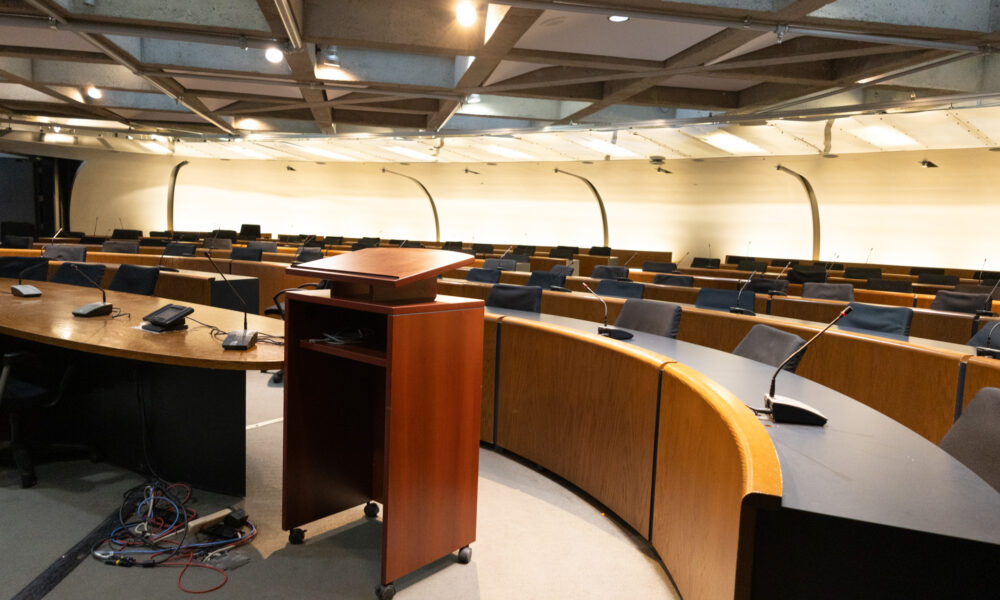
The McGill Senate convened on Sept. 17 for its first meeting of the academic year. Central topics of discussion were the Nominating Committee’s decision to remove Professor William Clare Roberts from the Committee on Student Discipline (CSD) because of a post Roberts made on X, and proposed revisions to the Code of Student Conduct and Disciplinary Procedures.
The meeting started with memorial tributes to the late Faculty of Engineering professor emeritus Tomáš J.F. Pavlásek, medicine and health sciences assistant professor Kalonde Malama, and former Faculty of Science professor and director of the Redpath Museum Valerie Pasztor.
The memorials were followed by McGill President and Vice-Chancellor Deep Saini’s remarks on his priorities for McGill’s long-term future: To transform, expand globally, celebrate locally, and unite. He noted that McGill will increase its partnerships and establish centralized campuses around the world.
The Senate then debated whether to remove Roberts from the CSD. The discussion stemmed from a widely circulated post on X in which Roberts wrote, “I used to think BDS (boycott, divest, sanction) was a good idea. I’ve come around, though: nothing short of ‘full economic and military support for Hamas and Hezbollah’ is appropriate.” As both organizations are designated terrorist entities in Canada, the Nominating Committee recommended Roberts’s removal as Vice-Chair of the CSD, citing concerns about perceptions of his impartiality in student discipline cases.
While the Chair of the Nominating Committee and Provost and Vice-Principal (Academic) Christopher Manfredi assured that the Committee was carrying out removal procedures properly, some senators remained unsure.
Catherine Lu, professor in the Department of Political Science, argued that the Committee’s move implied the university’s administration distrusts one of its own bodies, thereby weakening wider confidence in McGill’s institutional procedures.
“I can say clearly that I don’t agree with Professor Roberts,” Lu said. “But as an academic institution, do we want to set the precedent of taking a professor’s extramural remarks about off-campus politics as a reason to impute such a great risk or perceived bias in on-campus administrative proceedings?”
Victoria Kaspi, professor in the Department of Physics and Academic Staff Representative on McGill’s Board of Governors, countered such opposing remarks, saying the Committee had appeared to follow procedure in Roberts’ removal. She added that, given the impact of Roberts’ words, there must be limits to what is acceptable to say.
“In a case where someone is adjudicating something like discipline, bias is so important,” Kaspi said. “I’m not sure how much more bias one could show.”
Senator Susan Aloudat, Students’ Society of McGill University Vice-President of University Affairs, said that she was uncomfortable accepting the decision.
“I feel compelled to speak because I am a student, but also a member of the Nominating Committee,” Aloudat said. “I don’t disagree that it was important to think about these [matters] as a Nominating Committee, but […] the process could have used more diligence.”
The motion to remove Roberts from the CSD was ultimately carried with 42 in favour, 26 against, and 12 abstaining.
Interim Deputy Provost (Student Life and Learning) Angela Campbell next discussed the administration’s proposed changes to the Code of Student Conduct, stressing that reforms made to the Code are not intended to “wield a hammer on students,” but to modernize the Code.
The proposed Code now includes mental-state standards that categorize offences based on intent level. The draft also introduces a “not responsible” pathway—likened in debate to a “non-criminally responsible framework”—allowing the CSD to move serious cases out of disciplinary channels if its members conclude the student could not appreciate the nature of the ‘right-or-wrong’-ness of their actions, without requiring a medical diagnosis as evidence. Some senators pressed on what would justify such findings, highlighting the span of committee discretion that could be allowed.
Structural updates to the Code include shrinking the CSD and Appeal Committee to four members by default, and six on request, thus converting the Committees’ legal assessor into a voting member. The Code also now uses the Canadian civil standard of proof—a balance of probabilities—meaning that conduct is judged to have occurred on a ‘more likely than not’ basis.
The Senate then moved to debate who is permitted to sit on the CSD and its Appeal Committee. The revision to the Code would allow adding an alumni jurist nominated by McGill’s Board of Governors to these Committees, which Víctor Muñiz-Fraticelli, associate professor for the Faculty of Law and associate professor of political science, saw as blurring the line between academic autonomy and Board control.
“Are [Board members] going to be nominating people to take part in what is essentially an academic disciplinary procedure?” asked Muñiz-Fraticelli. “That seems to me to be a radical departure from principles of academic self-governance and [demonstrates], at the very least, a deep mistrust by the board [toward] the very people that function and operate in this university.”
Moment of the meeting: Saini discussed the Sustainability Park, part of the redevelopment of the former Royal Victoria Hospital, describing it as a large interdisciplinary hub intended to connect research and teaching across fields.
Soundbite: “I think there’s a lot of concern about the use of the word ‘celebrating’. [….] We need to acknowledge all of the history that’s been here, not just Quebec, but also the Indigenous history that exists. [….] And I was wondering why that’s not a larger integration as part of this movement.”—Arts and Science Student Senator Chloé Muñoz, on Saini’s priority for McGill to “celebrate locally.”