
Latest News

Arts & Entertainment, Film and TV

Zacharias Kunuk’s new film reclaims Inuit myths for Inuit Voices

At the Toronto International Film Festival on Sept. 14, Inuit filmmaker and co-founder of Isuma Productions, Zacharius Kunuk, received the Best Canadian Feature Film Award for his latest work, Uiksaringitara (Wrong Husband). This award recognizes his career’s continued influence—defined by innovation, community, and cultural reclamation. Over two decades after his 2001 hit film Atanarjuat: The Fast Runner, Kunuk once again reclaims myth from the colonial lens, showcasing Inuit life in all its cultural richness. He asserts that Indigenous life is not an archaic history to be caricaturized, but that it belongs to a present and future to be expanded on in Indigenous pop culture. 

Uiksaringitara carries this narrative forward, using its plot to intertwine themes of survival, personal struggle, familial ties, and spiritual guidance into mythology. The film opens with a promise of two young lovers, Kaujak and Sapa, pledged to one another at birth. Their relationship is split apart when Kaujak’s mother remarries after her husband’s death, forcing Kaujak into another camp. She sets out on a journey to find Sapa, guided by spirit helpers, blurring the line between physical and mythical. 

Uiksaringitara also captivates its audience by combining authenticity with imagination. It pushes against Hollywood’s reductive portrayal of Indigenous characters through its careful casting. The film’s cast consists almost entirely of new Inuit actors, allowing community dynamics of traditional narratives and spiritual practices to shine through naturally, rather than be distorted by old Hollywood conventions. His film is not to be examined through the Western lens; shamans and spirit guides are reflections of Inuit cosmology, not metaphors to be critiqued. This intention of creating community, rather than international critical acclaim, is a sentiment reflected by many contemporary Indigenous filmmakers.

Kunuk is not working alone in his reclamation of the screen—he is part of a larger scheme in contemporary Indigenous media. Wapikoni Mobile is a Montreal-based travelling film studio that works with Indigenous youth across Québec and Canada. Their short films construct narratives of everyday life, joy, humour, and continued resilience, despite the harmful stereotypes imposed on them by film history. Abenaki filmmaker Alanis Obomsawin contributes to this larger movement as well, using film as a political tool. In her 1993 documentary Kanehsatake: 270 Years of Resistance, she depicts the events of the Oka Crisis through an Indigenous lens. Her work dismantles the harmful narratives perpetuated by Canadian media, which have often portrayed the Kanehsatake people as violent aggressors. 

In Uiksaringitara, Kunuk’s attention to detail, evident in his use of language, extends to his visual portrayal of Inuit culture. During the filmmaking process, he consulted elders to ensure accuracy in all aspects, notably in the costume department. Their deep knowledge contributed to the rejection of stereotypes through a hands-on approach, as they taught the younger community sewing traditions. The costumes in Uiksaringitara are handmade from caribou and sealskin, using methods of Inuit clothing tradition. Every aspect of these films is reconstructed with painstaking care, not as static museum pieces, but as living things. Compared to old Hollywood’s mocking costumes of fringe jackets and cowboy clothes, the contrast is stark. 

Kunuk’s work also revives the Indigenous tradition of oral history, giving voice to Inuit culture for future generations. Both Atanarjuat and Uiksaringitara are filmed entirely in Inuktitut, with the former being the first Canadian film produced entirely in the language. Québecers in particular know the power of language in preserving culture and building identity. Yet, this urgency rarely extends to the Indigenous languages spoken here long before the arrival of French or English. Their language is not a relic of the past, but a living vessel of culture and identity. 

Kunuk and his peers do more than fight stereotypes: They transcend them. Uiksaringitara creates an art world where Inuit audiences see themselves not as exotic relics, but as protagonists. This is art made first for the community, and then for the world. Kunuk writes Inuit life into the present tense, claiming the screen as a space of belonging, imagination, and cultural sovereignty.

McGill, News, Recap

Recap: Canada recognizes Palestine, UN calls out genocide, and McGill does not divest

On Sept. 21, Canada, under the leadership of Prime Minister Mark Carney, officially recognized Palestine as a state, advocating for a two-state solution between Palestine and Israel. The UK, Australia, and France have also recently announced their recognition of a Palestinian state. 

Carney’s speech on the matter adhered to Canada’s longstanding support for this solution as a means for peace—except, now, Canada formally recognizes both of the states involved. Recognition of Palestine by Canada and other nations creates space for the United Nations (UN) and its member countries to legally oppose Israel, opening the door for Israel to face consequences for breaching the UN Charter

On Sept. 16, a UN Commission of Inquiry concluded that Israel has committed genocide in Gaza, citing the scale of Israel’s killings of, blocking of aid to, and forced displacement of Palestinians in its 72-page report. The inquiry states that the prime minister of Israel, Benjamin Netanyahu, is legally responsible for the genocide. 

Amidst these updates, McGill’s Media Relations Office (MRO) maintained that the university will not divest. 

“The analysis by the [Committee on Sustainability and Social Responsibility] confirmed that the University had no exposure to companies involved in the production of controversial weapons at the time of the review [on July 8, 2024],” the MRO wrote to The Tribune.

In an interview with The Tribune, a representative from Independent Jewish Voices (IJV) who wished to remain unnamed expressed that increasing international recognition of Palestine is an overdue show of support.

“It’s so incredibly dangerous for [Canada] to be doing this so late in the game, and […] it’s also such an easy way for the Canadian government to clear their conscience of genocide-enabling and still continue to allow the promotion of arms, [and] still continue to [not take a stance on] the [Boycott, Divestment, and Sanctions] movement,” the representative said. 

The representative also emphasized that IJV’s goals remain the same: For McGill to divest from companies complicit in Israel’s genocide, and to acknowledge the atrocities that have occurred against Palestinians. 

“[Student] demands have stayed the same throughout this entire genocide, and [in] the 75 years before that, and IJV […] has been in coalition with [Students for Palestine’s Honour and Resistance], Law Students for Palestine, all of these other groups, to reinforce this message,” they stated. 

Know Your Athlete, Martlets, Soccer, Sports

Know Your Athlete: Ann Stephanie Fortin

Dominating once again, the Martlets Soccer program has had a valiant start to their season, conceding zero goals in five of their opening nine games. This remarkable defensive effort can be largely credited to their new arrival, Ann Stephanie Fortin, the team’s starting goalkeeper. On Sept. 21, Fortin made eight saves, including against a crucial last-minute penalty kick, to add to her shutout tally in a 0-0 tie versus the Bishop’s University Gaiters at Percival Molson Stadium.  

Although Fortin, a native of Ste. Julie, Quebec, has only just begun her McGill career, she is already on a path to paving a legacy. In an interview with The Tribune, she credited her impressive performances to her teammates and emphasized the importance of being on the same page during games. 

“We work as a team, and we are very strong defensively,” Fortin said. “That is what puts me in the position to make [big plays].” 

Before McGill, Fortin played for the Rice University Owls from 2021 to 2024, a National Collegiate Athletic Association (NCAA) Division I program in the United States. Now, Fortin brings her talents and experience to the Réseau du sport étudiant du Québec (RSEQ). Fortin described playing soccer at Rice as a time when she learned a lot about herself. 

“[Rice had] a bit of ups and downs, but ultimately confirmed values that were important to me as a person,” she noted. “It was a great experience, academically incredible, [and] that is why I finished my bachelor’s there.” 

McGill provided Fortin with the tools she was missing. 

“I came to McGill [because], one, I knew what I needed as a player, and I knew what I needed as a human being,” she said. “[I saw] that so many players on the team operated the same way I wanted to operate, [which] made for a natural transition. I know half, if not three-quarters of the [McGill] team. We grew up together, and we went to the same training centre together. We all know how to work with each other.”  

Fortin’s college career represents a unique situation, as she has played collegiate athletics in both Canada and the United States. She spoke on the key differences between the two systems. 

“I don’t think it is a secret how important it is for an athlete over [in the NCAA] to be physically powerful, fast, and have an incredible amount of endurance,” Fortin stated. “The mentality behind the [United] States approach to soccer is focused on that.” 

In contrast, Fortin highlighted the Canadian college soccer model as more technical and closer to how teams in Europe play. 

“European teams will do video [analysis],” she explained. “They will look at [videos] after every training [session]. That is what we do at McGill, [which] I really like.” 

Soccer and a passion for goalkeeping have long been significant in Fortin’s life. In her youth, Fortin represented the Canadian Under-15 National Team and participated in the Under-20 National Team camp in 2021

“[Playing for Canada] is my favourite memory,” she expressed. “[When] we played against Mexico, that was the highlight of my career. The pride of being able to represent your country, there is nothing like that.”  

Speaking about whether she has considered what her soccer career will look like post-McGill, Fortin emphasized the importance of staying present. 

“Honestly, right now, I don’t even want to think about that. I want to have fun and keep trusting the process,” she said. “That is the team’s motto right now, and [mine as well]. I’m having fun while I perform, and it has been a long while since that has happened for me.”  

With only six games left in the regular season, Fortin looks to continue her hot streak from the backline and push the Martlets toward the RSEQ Championship in late October. 

McGill, News, SSMU

SSMU Legislative Council meeting covers staff hiring and gender-affirming care access

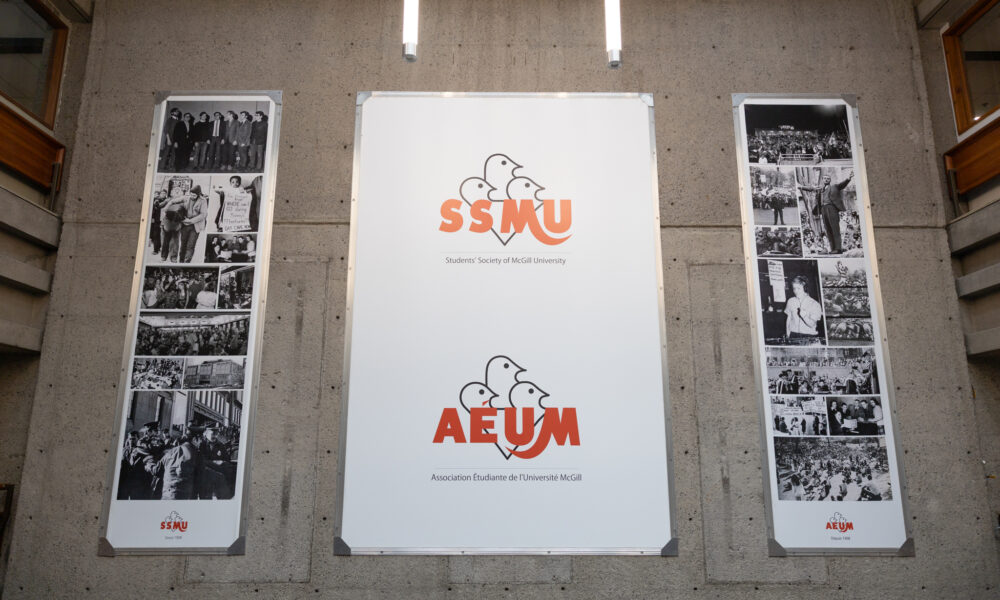
The second Students’ Society of McGill University (SSMU) Legislative Council (LC) meeting of the year took place on Sept. 25, with 23 members of the Council present. SSMU President Dymetri Taylor started the meeting with three announcements. 

The first was that the PT/OT Councillor had resigned, but elections were in progress to appoint a new one within the next few weeks. Taylor then announced that the SSMU Vice-President (VP) Internal and VP Finance positions are vacant, with replacements to be discussed later in the meeting. The third announcement was that SSMU members now receive a discount on VIA Rail tickets. The discount’s use will require SSMU members to present their McGill University IDs upon boarding. 

Deputy Speaker Yasmin Beeai then outlined that councillors will have two proxies and two unexcused absences available to them, adding up to four permitted absences for LC meetings, throughout the academic year. She also presented the Absences and Reporting Schedules, stating that the LC’s committees must submit their reports in a timely manner. 

“[Committee] reports are due […] five days before the meeting [they are to be presented at],” Beeai said. “Late reports count as half of an absence, and missing reports count as one absence.”

VP Clubs and Services Hamza Abu Alkhair proposed to amend this rule to give newly active services more time to submit reports to the LC. 

“It’s only been a month [of] these services [running], so I want to give them a good opportunity to actually know [where they are],” Abu Alkhair said. 

The reporting schedule was sent back to the Steering Committee for review. 

Taylor next proceeded with an account of Gerts Bar’s and Cafe’s finances. The bar is projected to make around $130,000 CAD in surplus this year, while the cafe has made $1,000 to $2,000 CAD in surplus per week this semester. 

VP External Affairs Seraphina Crema Black then discussed an initiative where students may contact the Member of Parliament (MP) who represents the university through Liberal McGill. McGill students, along with MP Marc Miller, can thereby discuss a lobbying campaign that could put pressure on the Coalition Avenir Québec to reconsider their tuition hike for anglophone universities.  

Following this, VP University Affairs Susan Aloudat confirmed that SSMU has implemented the Menstrual Health Project, providing free hygiene products in washrooms across campus. 

The LC moved to motions for approval. The first motion proposed edits to the SSMU’s Accountability Plan, proposing that the Accountability Commissioner meet with SSMU executives twice a year, instead of once. The motion passed unanimously. 

The second motion on the table concerned gender-affirming care in the student health insurance plan. When SSMU initially added gender-affirming care to the plan, it was not voted on directly by the student body. Thus, this motion proposed to put the question of gender-affirming care insurance to students during the Fall Referendum. The motion passed through a secret ballot, with one vote not-in-favour and one abstaining. 

The third motion addressed the need to fill the SSMU VP Internal and VP Finance positions in a timely manner. President Taylor articulated that this would normally be done through a by-election, but that this process would be too lengthy. Therefore, he proposed to form a committee of LC members and members of the SSMU Board of Directors who would be responsible for reviewing applications and selecting candidates for these positions. 

The LC established a committee of four councillors, two directors, and the Internal Logistics Coordinator as a non-voting member to select the VP Internal; the Council also established a second committee to select the VP Finance, composed of two councillors and three directors.

The application period for both VP positions will tentatively run from Sept. 29 to Oct. 5, with interviews and candidate selection occurring from Oct. 6 to Oct. 8. 

Moment of the meeting: President Taylor noted that turnout for First-Year Council elections was very high, with 16 candidates in the running.

Soundbite: “There’ll be a discussion item later this year […] for allocating a budget [to] first years [that] all of the first year councils on campus can work with when it comes to making events for students, by students.”—Dymetri Taylor, on first year engagement.

Commentary, Opinion

Montreal’s new language policy furthers Legault’s war on a ghost of Anglophone supremacy

Last March, the city of Montreal provided a new guide for frontline workers. The internal guide, obtained by the Montreal Gazette, is titled, “Exemplary Conduct in the French Language: Mechanisms for Informing the Public,” and offers instructions on how government employees should speak to anglophone customers. One sample script reads: “We are delighted to serve you in French. Do you understand me if I continue in this language?” 

If the citizen does not understand French or demands service in English, employees are to inform them about legal restrictions on providing services in English and provide an informational pamphlet, two versions of which exist: one French and one bilingual. Yet, only the French version can be displayed in public; the other must either be requested by the citizen or provided at the employee’s initiative. 

That is to say that, if a hypothetical English-speaker enters a government building, it would be impossible for them to discover the government’s shift in language services policy: All the publicly accessible pamphlets that would inform of such a policy change are in French—the language which, presumably, they cannot read if in need of such a pamphlet.

This Kafkaesque insanity represents the latest stage in Montreal’s municipal compliance with Bill 96, the Coalition Avenir Québec (CAQ)’s 2022 expansion on the Charter of the French Language

The Charter of the French Language, commonly known as Bill 101, was introduced in 1977, when francophones earned significantly less than anglophones who dominated Montreal’s corporate elite. Immigrants primarily assimilated into English, and French-speaking Quebecers seemed an archaic underclass on its way towards total demographic obliteration. In this context, the Quiet Revolution occurred. In 1960, “Québécois” was not yet a word used in common parlance. By 1976, a newly elected sovereigntist provincial government received a mandate to call for an independent Quebec nation. 

45 years later, Bill 96 requires that government services be provided exclusively in French. Thus, Montreal, with its long history of providing bilingual public services, now puts forth guidelines instructing workers on how to assert French exclusivity. 

Today, francophone hegemony is the norm across Quebec. The lofty ambition set forth in the 1970s of maintaining a French island within the vast swaths of English-speaking North America has been virtually achieved. The unilingual anglophone elite have all but entirely vanished. Most anglophones emigrated post-Bill 101; those who stayed became increasingly bilingual. 

Today, almost 95 per cent of all people in Quebec speak French. Virtually no large English-speaking population exists in Quebec outside of Montreal: The CAQ essentially targets Montreal specifically. Attention must then be afforded to the ideology of the CAQ, and of its founder and leader François Legault, who views the further diminishment of English in Montreal as a war waged by honest Quebecers against the urban anglophone elite. 

Before the 2023 McGill tuition hikes were announced, Quebec’s Minister of the French Language stated: “It’s time to regain some ground.” Prior to his inaugural term, Legault urged CAQ supporters to push for a new Quiet Revolution. This sentiment is especially popular with rural voters who likely hold inherent skepticism against large urban conglomerations, with linguistic differences serving as a conduit for punishment of the cosmopolitan elite. 

When will this nationalist impulse be satiated? When government services are rendered entirely in French? When “bonjour-hi,” alongside the casual bilingualism it implies, is entirely eliminated from common practice? When Montreal’s iconic English universities are francized or destroyed? Populism will always seek more enemies, and in need of an out-group to pit itself against, the CAQ inevitably seeks complete eradication of English language use in Montreal. The mere fact that French will always remain a minority language in North America is bound to produce linguistic tension. In some sense, it must necessarily induce linguistic protectionism, lest French be reduced to a cultural curiosity rather than, as the Quebec government sees it, “the common language of the Québec nation.” Few would argue that the protection of French is entirely unnecessary in the maintenance of a Quebecois nation. The question is if, this time, this tightening of legislation perhaps seeks an enemy that is no longer potent.

Art, Arts & Entertainment

‘Weci | Koninut’ cements voices of Indigenous land-stewardship in both present and future

What do you dream about? Hopes, fears, a pigeon wearing a coconut hat? What about your memories, or the pieces of yourself you can still hold on to? Weci | Koninut, a new installation in the Quartier des Spectacles, uses dreamlike experiences to ground audiences in the six seasons of Atikamekw culture, opening a doorway to the past and hopefully carrying its pieces into the future.

Created by Indigenous artists Julie-Christina Picher and Dave Jenniss, Weci | Koninut guides visitors through the six Atikamekw seasons, from Pitcipipon (pre-winter) to Takwakin (autumn). It specifically details the artists’ relationship with the Atikamekw people’s sacred land of Notcimik—how their ways of living and hunting there changed through the seasons.

Six colourful, boxy structures called ‘dreamcatchers’ facilitate the experience, each one separated through the middle by a woven mesh with space on either side to lie down. These dreamcatchers encourage visitors to come closer and activate the sounds, music, and spoken stories of the represented season. In one dreamcatcher, you hear footsteps crunch through the snow; in another, the excitement of the music seems to herald the coming of a more prosperous season.

These sounds, plus a spectacle of light that is projected down onto the audience member, do not give away too much. Even when there are spoken stories, you may not be able to understand them—that is the point.  

Weci | Koninut is, above all, a meeting point where our voices mingle with those of our ancestors,” explained Picher and Jenniss in a press statement. 

“The dreamcatchers are thresholds that invite surrender to the rhythm of the Atikamekw seasons, guided by imagination and by the dialogue that unites us with the Earth.” 

In creating a dialogue that concerns itself with both the present and past, the installation prompts our imagination to fill in some of the blanks for us.

The design of the dreamcatchers themselves helps create a connection among visitors. While separated from each other by the woven mesh of the dreamcatchers, participants still find even the most unintentional connection through a shared fascination with the structures or interest in how another reacts to their dream. Although nobody hears the same thing, the unspoken presence of another carries them into a reverie, expressing the idea that there’s always someone to help, to comfort, to brave the seasons.

These quiet connections with others echo the bond with the land that this installation conveys, where, as Picher and Jenniss mention in their statement, “each gesture and breath recalls the living bond with the land.” The land is presented as a living, breathing thing; it’s something that has to be worked through, something that presents obstacles, yet also joys and successes. This land emphasizes how these bonds of affection are the result of unity between people and the Earth.

In this project, every interaction between the audience and the art becomes part of the larger story. It’s where, despite being in the middle of the largest city in Quebec, a modern perspective can seamlessly drift into a lucid imagination about a culture that so valued—and still values—guardianship of the land. 

With all this talk of dreaming and resonance with ancestors, it’s still important to remember that this art was not meant to memorialize a long-forgotten past. Weci | Koninut is, by its nature, echoing the lives and the callings of ancestors, but it also asks audiences to do more than just listen and move on. After all, dialogue means nothing if it does not bring change. 

The act of dreaming and awakening to the same sounds, music, and voices of history juxtaposed against the backdrop of an overwhelming metropolis brings one closer to understanding contemporary Indigenous voices. Remember: These stories of culture are still living and breathing today as they have for generations. Just as dreaming is a sign of sleep, sleep is a sign of refreshment, and this installation refreshes our continued need for connection to nature and to those we’ve failed to listen to.

Commentary, Opinion

Safety and speech aren’t either/or

Hate-fuelled harassment deserves a firm legal answer. But Canada’s Bill C-9—also known as the Combating Hate Act—risks the criminalization of non-obstructive protests near community institutions, serving more as a tool to stifle political protest than to combat hate.

As currently drafted, Bill C-9 would establish new intimidation and obstruction offences to apply in the vicinity of houses of worship and buildings primarily used by an “identifiable group” for community and education purposes. It would also ban public display of certain terrorist or Nazi symbols when intended to promote hatred. The bill defines ‘hatred’ as detestation or vilification, but creates allowances for the symbols to be displayed for legitimate purposes, including journalism, religion, education, or art, and a narrow good-faith removal—a temporary and necessary display solely to identify and remove hateful material. Bill C-9’s stated intention—to keep people safe—is admirable. However, the line between respectful political dissent and actions fueled by hatred is dangerously blurred throughout the bill.

On multicultural campuses like McGill, a blurry legal line like that in Bill C-9 can give undue power to administrations at the expense of students’ freedoms of speech and assembly. Protests are designed to be disruptive: They interrupt routines, access, and comfort, even when peaceful. They are supposed to be //felt//. The bill’s intimidation offence condemns any conduct with the intent to provoke a state of fear in order to impede access to community buildings. Through the incorporation of conceptions of ‘intent’ into the bill, police officers will be given the jurisdiction to assess the intentions and goals of protestors, meaning that they can charge protesters with hate-based acts without proof of threats or physical obstruction. Though the bill permits protestors to be “at or near” a site to communicate information regarding their demonstration, this right only applies in the event of obstruction, not intimidation. Threatened with a potential penalty of 10 years of imprisonment, protests will be likely to self-censor.

On paper, Bill C-9 is content-neutral, and its access rules hinge on where conduct occurs, not on viewpoint. However, the political geography of recent protests means enforcement will inevitably fall unevenly. Because Bill C-9 is applicable when conduct occurs at or near protected sites, pro-Palestine demonstrations near Jewish institutions and counter-protests near mosques are the most likely to be policed. If protest behaviour is perceived as intimidation or impedes access—even without a hard blockade—police will be empowered to make arrests on the basis of hateful action. In other words, the text targets conduct, but the political geography of recent protests shapes who is most vulnerable to enforcement.

Bill C-9 also removes Attorney General consent for hate-propaganda charges, which heightens the risk of charge-first, acquit-later outcomes. Its clause banning the use of symbols during demonstrations creates even more space for the criminalization of protest. Currently, the bill denounces any imagery that resembles banned symbols closely enough to the extent that it could be confused as such. This definitional elasticity invites law enforcement to act on visual uncertainty in fast-moving demonstrations. 

If Bill C-9 is enacted, students’ ability and right to protest on campus will be severely suppressed. Under this legislation, tactics that simply look like impeding entry—or are read by on-site law enforcement as intimidation intended to impede access—will carry high legal risk for protesters. This subjectivity in assessing criminality is damaging and unconstitutional; drawing clear, well-defined lines around police officers’ legal authority matters as much as the bill’s stated intent. Otherwise, the bill will not serve anyone; not minority student groups, not faculty members, not protestors, not even police who are asked to adjudicate in fast-paced moments.

Canada needs a firm answer to hate-fueled harassment, but Bill C-9 is not it. The Combating Hate Act should be amended to protect access without criminalizing political voices: That’s how we keep our doors open, our arguments loud, and our rights intact.

Behind the Bench, Rugby, Sports

Despite losing World Cup final, Canada Women’s Rugby still has lots to be proud of

Before the Women’s Rugby World Cup Final kicked off on Sept. 27, Canada and England’s women’s rugby squads had already etched their names into the history books. When they walked onto the pitch at Twickenham Stadium in the London suburbs, a sold-out crowd of nearly 82,000 rugby fanatics greeted them with a roar, eager to see the Canadian and English national teams face off for glory. A watershed moment in women’s sport, this tournament was more than a chance to prove which team was the best in the world: It was an opportunity to capture the eyes of viewers across the planet.

The matchup promised excitement at every turn. England’s squad, known as the Red Roses, had not tasted defeat since their loss in the 2022 World Cup final at the hands of the New Zealand Black Ferns. They had made the final in each of the previous six World Cups—which happen once every four years—but were victorious only in 2014. The Red Roses were looking to shake off their 1–5 finals record and turn over a new leaf, elevating them to the status of the undisputed number one team in the world.

Canada, on the other hand, has a much less storied rugby past. They had only made one World Cup final, coincidentally losing to England in 2014. However, they were undefeated throughout 2025 and ranked second in the world. Win or lose, Canada could look back at the 2025 tournament as a whole and take pride in the history they had already made. They guaranteed their best finish ever in a World Cup, and a victory in the final would have been the cherry on top. 

Both teams had remarkably similar paths to the final. England started out red-hot, winning all three of their group stage games and out-scoring their opponents 108-17. They saw off Scotland in the quarterfinal, winning 40-8, and survived a test against France in the semi-finals. Canada started their tournament with a bang as well, winning all three of their group stage games including a 65-7 romp over Fiji and a flawless 42-0 victory against Wales. The crowning moment of their tournament occurred in the semi-finals, where the Canadians went up against perennial powerhouse New Zealand. The Black Ferns had not lost a World Cup knockout round match since 1991, and were the two-time defending World Champions. 

Powered by Queen’s University Gaels alum and 2022 U SPORTS Athlete of the Year Sophie de Goede, who scored a try and a penalty kick, and made three conversions, Canada pulled off one of the greatest upsets in the history of women’s rugby. They went from fundraising just to attend the World Cup, to being one win away from the greatest achievement in program history. The win against New Zealand proved that Canada can go toe-to-toe with anyone, and should be considered one of the best teams in the world from now on. The victory was more than just a chance to go for the gold—it marked a significant milestone and turning point for women’s rugby in Canada.

In the final, Canada got off to a quick start, with wing Asia Hogan-Rochester scoring a try in the opening five minutes of the game to make it 5-0 in favour of the Canadians. However, England struck back with tries from Ellie Kildunne, Amy Cokayne, and Alex Matthews before the thirty-minute mark. Successful conversions on all three tries left Canada facing a 21-8 deficit at halftime. England’s proficiency in the scrum and staunch defence proved to be too much for Canada, and the Red Roses triumphed 33-13 to cap off an unheralded run of 33 games unbeaten

Despite the defeat, Canada’s players and fans should be immensely proud of the team’s efforts. While they may not have had the fairy tale ending they were hoping for, the World Cup solidified Canada as a rugby powerhouse for years to come and represents a new chapter in the story of women’s sport in Canada.

Out on the Town, Student Life

Happy hour, happy life: A guide to 5 à 7 in the city

After a long day of classes, extracurriculars, and small talk, McGill students often find themselves in search of an affordable, relaxing outing. While the low prices at Gerts and Blues can make for a cost-effective evening, The Tribune has compiled a list of restaurants and bars throughout Montreal that also offer discounts and deals. This fall, escape the McGill bubble and enjoy some new eats and cheap drinks. 

Lola Rosa 

Though technically still within the McGill sphere, located just a block down from Milton Gates, Lola Rosa offers a variety of plant-based menu items from tacos asada to curry, gyro to braised tofu. The restaurant also offers a selection of desserts and caffeinated beverages, serving an excellent cappuccino. While the food is delicious, and the ambiance is warm and intimate (with a range of music choices from Addison Rae to Grimes), it is also economical for broke university students, who can receive a 15 per cent discount with a McGill student ID. For those who live far away from campus, Lola Rosa is the perfect spot to unwind after a day of classes and catch up with a friend over a $14 CAD platter of nachos. If caffeine alone fails to ease your day, Lola Rosa also offers alcoholic coffee beverages. 

Le Majestique Bar

For delicious seafood on a budget, Montreal is home to many restaurants that offer deals on oysters—but the atmosphere in Le Majestique is unbeatable. Their typical price for oysters is $3.75 CAD, which drops down to $2.50 CAD for their happy hour deal between 5:00 p.m. and 7:00 p.m. The space, although not particularly spacious, is always bustling with large crowds until 3:00 a.m. Begin your night with an economical platter of oysters and signature cocktails, transitioning into a longer night of casual partying. 

Urbanista 

If you’re in search of a hot pregame bar or simply an evening of many cheap cocktails, Urbanista, located in the heart of the Plateau area, is the ideal place to go. Their happy hour, from 5:00 p.m. to 9:00 p.m., promotes two-for-one cocktail deals—an ideal arrangement for students on a budget. With booths lining the bar and eclectic, vintage lights hanging from the ceiling, Urbanista curates a laid-back vibe conducive to a night of tipsy chatting among a large group. 

Bar Bootlegger

In competition with Le Majestique, Bar Bootlegger is yet another Montreal bar that offers happy hour deals on oysters—but their happy hour menu extends past the $1 CAD oysters, including deals on drinks as well. Available every day of the week between 5:00 p.m. and 7:00 p.m., Bootlegger sells local beer or cider pints for only $5 CAD and signature cocktails for $13 CAD, rather than their usual pricing of around $19 CAD per cocktail. On Tuesdays, enjoy free entry to the spot, with live jazz performances starting at 9:00 p.m. 

Barbossa 

Barbossa is a known favourite among McGill students. Free entry before 10:00 p.m. is not the only deal this spot offers: It also provides a variety of happy hour deals—$10 CAD martinis all night on Mondays; $10 CAD margaritas on Tuesdays; $10 CAD espresso martinis on Wednesdays. From Thursday through Saturday, Barbossa promotes two-for-one cocktails between 8:00 p.m. and 10:00 p.m. Any day of the week, stop by Barbossa for great deals on drinks and enjoy music from local DJs. Whether you are in the mood for a martini or an amaretto sour, jazz music or house, Barbossa has it all, coupled with a groovy, checker-printed dancefloor. 

Out on the Town, Student Life

 How to prepare for Piknic Electronik

There are many annual events in Montreal that you don’t want to miss out on: Piknic Electronik is one of them. Let’s demystify this iconic event so that you’re fully prepared for your night at Parc Jean-Drapeau. From metro lines to dress codes, The Tribune has put together a guide for everything you need to know to have a well-prepared, stress-free experience. 

Tickets

First order of business: Tickets. General admission tickets start at $24 CAD, and many McGill students choose to purchase them in the fall, while classes are in session. Don’t stress about buying tickets super early: In an interview with The Tribune, Natasha Pfeffer, U2 Arts, said that she bought her tickets last-minute and still managed to attend in the Fall semester.

“I booked my ticket about a week before I went, and I went September 14, so late summer, early fall season, and this is my first time going.” 

However, if you’re set on a specific night, the Piknic Electronik website drops tickets well in advance. 

Piknic Electronik runs every Sunday for six months, from May 18 to Oct. 12, so there are plenty of opportunities to attend. Going at the beginning of the fall semester, before the stress of school hits, is a great way to enjoy the weather with your friends. 

Transportation

If you’ve heard about Piknic, you might know that it takes place on an island, and it’s not exactly walkable from campus. Most students take the metro, where a one-way ticket costs $3.75 CAD, or use their OPUS card. This fee is often more affordable than services like Uber, even if you’re travelling in a group. At the end of the day, taking the subway is much more convenient—but it’s also fun. When taking the metro, be ready for noise, energy, and speed to secure a coveted seat. 

“My best transportation tip is to take the metro with friends. Don’t go alone because the hectic aspect can get really scary,” Pfeffer suggested.

It’s also important to note that you will need to switch lines at the Jean-Drapeau (Yellow Line) metro stop, so make sure you have your route nailed down beforehand. But don’t stress—if you and your friends had a little too much fun at the pregame, you can always just follow the crowd.

Packing

When it comes to packing, Piknic has restrictions on bag sizes, so pack light and prioritize the essentials. Besides, you don’t want to carry a bag that weighs you down and limits your dance moves. Luckily, the venue allows you to bring non-alcoholic sealed beverages, so it’s a good idea to pack a plastic water bottle—hydration is always key. 

“All I really needed was my phone and ID,” Pfeffer told The Tribune

You want to worry less about what to pack and more about what to wear. Outfits can vary depending on who’s DJing that night. At some events, you’ll see funky, eclectic accessory choices. At others, you might spy event-goers rocking sweatpants. But most of the time, you can count on spotting fun hats, face gems, and shimmery scarves.

Weather

Before you plan out your night, remember to check the weather. Oftentimes, especially deeper into fall, the weather is anything but sunny and pleasant. Don’t dress for a delightful spring day if the forecast calls for torrential rain. Don’t be afraid to pack ponchos or umbrellas—you’ll still look great. Prioritize comfort over everything; it’s hard to enjoy the music and vibes of Piknic Electronik when you’re freezing to the bone.

No matter what you choose to wear, what you pack, or how you get there, Piknic Electronik is an exciting event that you shouldn’t miss out on, and it’s sure to be full of excitement and amusement for you and your friends.

Read the latest issue

Read the latest issue