


Latest News

Art, Arts & Entertainment, Culture

The forgotten history of the Montreal coffeehouse

Before the price of coffee skyrocketed and the death of third spaces; before the tyrannical reign of Ticketmaster and the monopolization of the music industry; before we slipped into antisocial seclusion and let blue light mollify our beautiful brains, there was once an invaluable institution, home to art, community, and political activism: The glorious 1960s coffeehouse.

Even though coffeehouses were ubiquitous in the 1960s, they were popular long before the folk revival. The first coffeehouse opened in Constantinople in 1555 and became the centre of debate and business affairs. Coffeehouses then spread to Western Europe in the 17th century, evolving into the Paris salons essential to the French Enlightenment. In 1676, the coffeehouse reached Boston, and later permeated North America.

After World War II, Montreal welcomed an influx of Italian and Portuguese immigrants whose newly opened cafes became social and political hubs, much like the renowned literary cafes in Paris. In a grand melting pot of espresso, post-war counterculture, poetry, politics, and music, the illustrious coffeehouse was born. Several coffeehouses dotted the streets of Montreal, imbuing creativity and companionship into youth culture and the city at large.

Coffeehouses were a fusion of the jazz club, the beatnik poetry joint, and the espresso bar. Montreal had a web of coffeehouses in the 1960s, including Le Pot Pourri and the Flaming Ember Coffeehouse on rue Stanley, the neighbouring Café Andre, Finjan Club in Côte-des-Neiges, and The New Penelope, a famous venue on the corner of av. du Parc and Sherbrooke Ouest.

In dimly-lit cafes filled with the silver haze of smoke, people from all walks of life would gather to hear folk music, intimate jazz sets, and poetry readings. They would pack into basements and revamped Victorian homes, eating peanuts and sipping espresso; they would talk art and politics, meet strangers, make friends, and be inspired. Audience members were exposed to a range of talent and influences, while aspiring artists were given platforms and an entry into the arts scene. Montreal’s coffeehouses hosted famous performers like Muddy Waters, Frank Zappa, Joni Mitchell, and Bob Dylan, who gave his first-ever Canadian performance at Le Pot Pourri.

Performers would play to an eager, well-caffeinated audience, and without backstage areas in such small venues, they would mingle with cafe-goers after their set. Thus, the integration and accessibility of the coffeehouse circumvented many race and class boundaries of the 1950s and 1960s. At the intersection of art, coffee, and conversation, the coffeehouse was a democratizing institution that harboured political conversation and artistic collaboration. Supported by welcoming meeting places, 1960s youth were encouraged to be social, artistically integrated, and politically engaged.

However, by the end of the decade, many of Montreal’s coffeehouses shut their doors—except the long-standing Yellow Door Coffeehouse on rue Aylmer, which remains devoted to community service and social integration. Ever since the death of the coffeehouse, artistic collaboration and social interaction have plummeted. Without third spaces to foster affordable socialization, the loneliness epidemic will continue. As of 2022, only 19.3 per cent of Canadians meet a friend on an average day. Our generation parties less, socializes less, and even has less sex. This shortage of gathering spaces perpetuates our lack of cohesive aesthetics, sweeping political movements, and community. There will be no art in a world where artists cannot afford to pay venue fees—in a world where everything costs money, even the air we breathe.

We must rally the youth. We must revive the coffeehouse. If we do not actively defend the arts, if we do not seek company, inspiration, and human connection, we are at risk of losing them forever. We cannot forget the glory days of the Montreal coffeehouse, for the coffeehouse may just be the light at the end of a dark, socially deprived, artistically barren tunnel.

Author Kendyl Daley is the host of and a frequent performer at the monthly literary coffeehouse, Ninth Life Coffeehouse.

Science & Technology

A reflection on McGill’s science programs from graduating SciTech staff writers

Antoine – BSc, Honours Biology

Dear Bio,

If you’re into bio, you’d better learn to love DNA. Breathe it. Dream about it. Because everything comes back to DNA. What’s the reason behind ‘phenomenon X?’ A gene. ‘Phenomenon Y?’ Another gene. Are you curious about the composition of a microbial community? Sequence another gene. You will not go a single day in biology without encountering DNA, so you might as well make peace with it.

And while we are here—a message to the department: Where are the plant courses? Apart from BIOL 205, the course selection for plant people is literally a desert. But plants are fun. Plants are essential. Plants are, quite frankly, carrying the entire biosphere on their backs—so why does McGill only offer half a plant course for a biology degree? Plant people, and plants themselves, of course, deserve better.

Tip to incoming bio students: Don’t procrastinate—or you may regret it after your midterm— and get involved in research early. You certainly won’t regret that.

Cheers, and I hope to never have to hear about DNA again,
Antoine

José – BEng, Chemical Engineering

To all engineering students, and to the incoming class of 2030,

Chemical engineering was quite the journey—and quite the learning curve. It’s a program that pushes you to your limits and teaches you temperance. It’s a career that forces you to problem-solve, then to solve your own problems. It’s a path that taught me concepts in math, physics, and a bit of chemistry, but it was also where I learned a lot about myself. More than anything, it’s a degree that puts you on the spot and forces you to ask yourself whether you are good enough. To anyone who finds themselves questioning this, I simply want to say: You are.

What advice can this cynical, outgoing undergrad offer? Take risks, maintain a healthy level of skepticism, allow yourself to make mistakes, open every door you can, regardless of perceived limitations, and surround yourself with people whom you love—and who love you.

Why is the last point so important? Many years ago, after telling my father I wanted to pursue this career, he looked at me, smiled, and then hugged me. From then on, I knew I was not facing this uphill battle alone. I hope you’ve had, or will find, your version of that too. 

Keep your head up, and enjoy the experience. ¡Mucho éxito!
José

Michelle – BSc, Psychology

Dear incoming freshmen,

Like many students at McGill, I came in thinking I had my future mapped out. As a first-year student in the biomedical sciences freshman stream, I had always imagined myself following the traditional “pre-med” path. So, when the time came to declare a major at the end of my first year, Anatomy and Cell Biology seemed like the “logical” choice.

However, my expectations quickly shifted when, over the summer, I had the chance to work as a mental health worker. This experience changed the way I wanted to approach medicine entirely. My vision was not only to be knowledgeable in the sciences, but also in understanding people—how their behaviour, emotions, and lived experiences shape them. By the end of that summer, I had switched into Psychology.

After four years, I still hope to pursue medicine, but I now graduate with a perspective shaped by a degree that gave me passion, hope, and a more well-rounded view of the world. I’ll leave you with this: The right path is not always the one that looks best on paper, but the one that makes you excited to keep learning.

Here’s to finding the major you didn’t know you needed,
Michelle

McGill, News

Black Sisterhood at McGill targeted with online racist harassment

Content warning: Mentions of racial violence

After Black Sisterhood at McGill (BSISSY) began recruiting members to start an Alpha Kappa Alpha (AKA) sorority chapter at McGill, co-founders Lena Karis Moussio, U1 Arts, and Astou Badiane, U1 Arts, received racist comments and threats of violence through the organization’s Instagram account. The account was subsequently taken down after being falsely reported. 

Established in 1908, AKA was founded in the United States at Howard University, a Historically Black College or University (HBCU). As the oldest Greek-letter organization established by Black women on a college campus, AKA aims to foster unity and friendship among college women while simultaneously advancing and uplifting Black communities. In a written statement to The Tribune, Moussio and Badiane described BSISSY’s mission in creating an AKA chapter at McGill.

“Aiming to bring a chapter of Alpha Kappa Alpha Sorority, Inc. to McGill, […] [BSISSY is] a sorority based on Black excellence, Black sisterhood, and […] giving back to the community,” Moussio and Badiane wrote. “[It is] a space where Black women can be themselves and feel safe, without having to be someone else.”

However, once BSISSY began recruiting on social media, their Instagram account was targeted with racist comments and private messages.

“The comments we were receiving were asking what the point of doing this was, if white guys could join, and saying things like ‘If it were white people doing this, we would’ve burned the school down,’” Moussio and Badiane shared. “Someone even told us to ‘stay segregated’ and called us ‘baboons.’ I think the worst was the person who told us to shut down the school because they wanted to ‘shoot’ us. That was really scary.”

The BSISSY Instagram account—alongside Badiane’s personal page—was later banned due to “child sexualization,” a claim with no relevance to the organization’s social media activity. 

“It was such a hard day for me. I couldn’t do anything, I was just so sad and discouraged. I kept asking myself what we had done wrong,” Badiane said. “However […] after that, we knew the project would continue no matter what. It was just our social media that had been affected, not our connections or the work or preparation we had already done for the project.”

In an interview with The Tribune, N. Keita Christophe, assistant professor in McGill’s Department of Psychology and principal investigator of the Cultural Development Science Lab, explained that such experiences are unfortunately not uncommon among Black university students. 

“It just makes me sad, you know, because it’s consistent with […] my experience recruiting for our students, consistent with a lot of things that individual students […] over the past several years have come in and talked about,” Christophe said. “It’s just another reminder that racial discrimination is still common in our society, and that trickles down all the way to our campuses.”

Christophe then emphasized the importance of institutional dedication to dismantling systemic racism and fostering a welcoming and diverse community.

“Institutions like McGill [must] continually [drive] a culture that is maximally inclusive and accepting, and […] [signal] that when people don’t act in the spirit of equity, diversity, and inclusion, that this is inconsistent with the values of the university,” Christophe said. “Continuing to invest in [affinity groups] […] signals as an institution [that] we are supportive of people creating community, and we aren’t putting up roadblocks to that.” 

In a written statement to The Tribune, McGill’s Media Relations Office (MRO) highlighted the university’s ongoing efforts toward combatting anti-Black racism on campus. 

“In 2020, McGill launched an Action Plan to Address Anti-Black Racism to ensure the University enters its third-century with a firm commitment to equity and inclusion,” the MRO wrote. “Every member of our campus community deserves to work and learn in a respectful, inclusive, and supportive environment. Likewise, we all share a responsibility to foster a climate that rejects hate, intolerance, and harassment.”

Following the incidents on social media, Moussio and Badiane report having received support from the McGill administration.

Antoine-Samuel [Mauffette] Alavo, the liaison officer for Black students, reached out and asked for a meeting that will take place in the coming weeks,” they wrote. “He has already brought us a lot of support for what’s next. We’ll see over time what measures will be put in place.”

Christophe added that, beyond institutional support, allyship from both Black and non-Black students is important in combatting anti-Black racism.

“It’s one thing for people that are personally affected by unequal social structures to advocate for themselves […] but I think it’s also important for people that are even benefiting from existing structures, people with privilege in different areas, to also speak up for those that are oppressed and help them out,” Christophe said. 

Moussio emphasized the solidarity McGill community members extended toward the organization following this incident.

“I never thought that my video would go viral and that we would get so much support from the McGill Black community,” Moussio wrote. “Even non-Black people have been very supportive, and we’re truly grateful that people understand that the goal is to fight against racism and sexism at McGill, and that Black girls should have the same college experience as everyone else.”

BSISSY will be hosting its next meeting on Friday, April 10 at 6:30 p.m. in the Black Student Space, Ferrier Building 216.

Arts & Entertainment, Books, Culture

Preserving childhood magic in adulthood

As kids, we ache to grow older; as adults, we ache for childhood. The Tribune shares three childhood books that capture this longing.

The Little Prince by Antoine de Saint-Exupéry – Bianca Sugunasiri, Arts and Entertainment Editor 

Grown-ups become preoccupied with the most inconsequential matters. Peering at the world blindly, they neglect what is laid bare in their hearts, unsure of what they’re searching for. They forget everything that was once painfully obvious as children. 

The Little Prince is a story of a stranded pilot once discouraged from drawing elephant-eating-boa constrictors, and the clever little prince he meets in the desert—a child tired of always and forever explaining things to grown-ups. The little prince is a character full of wonder, and wiser than most every grown-up I’ve ever met. His inquisitive heart never relinquishes a question once asked. In his dedication, author Antoine de Saint-Exupéry notes that although all grown-ups were once children, few remember it. 

In finishing this book, you find yourself with more questions than you would’ve thought to ask—why is it that when making a new friend, grown-ups only ask about inconsequential things like their age, but never what their voice sounds like, or whether they collect butterflies? You will also follow the little prince to otherworldly places: Secrets in the land of tears, a planet with forty-four sunsets, and a glass dome with a tamed rose inside. He reminds grown-ups that their “matters of consequence” matter very little. The Little Prince is a book which you will mourn after finishing. It will leave you listening for the golden-haired prince laughing amongst every interaction you will have.

The Phantom Tollbooth by Norton Juster – Alexandra Lasser, Arts and Entertainment Editor

Though it’s difficult to pick a single moment that began my love of literature, reading the first pages of Norton Juster’s The Phantom Tollbooth is definitely in the running. The story follows Milo, a young boy bored with life, until a mysterious tollbooth appears and whisks him away to a land of imagination and endless wordplay. There he learns that the ordinary is not always boring, and that one can make an adventure out of every day. Juster’s world-building conjures images as vivid today as they were upon first reading. It is a novel that isn’t afraid to dive into the ridiculous, hysterical nonsense that children—and adults, secretly too—find amusing.

For all those longing for a world unburdened by the everyday routines that melt weeks into years, The Phantom Tollbooth escapes the confines of time and space as the princesses, Rhyme and Reason, are missing. Milo and readers are charged to tackle the beautiful chaos of the world to restore logic and meaning to life. As a student, the pressure of work and assignments makes the idea of a world without structure enticing, and Juster appeases that, but not without a lesson. Chaos is not sustainable; eventually, rhyme and reason must return to grant purpose and organization to a society, leaving readers to appreciate the consistency of each new day. 

Love You Forever by Robert Munsch Malika Logossou, Managing Editor

As children, we are rarely confronted with the reality of aging, of watching those who care for us grow old. But with time, that innocence fades, and this reality grows closer, scarier, and harder to ignore. Love You Forever by Robert Munsch traces a boy’s life from infancy to adulthood, marked by his mother’s unconditional love for him as expressed through her singing: I’ll love you forever / I’ll like you for always / As long as I’m living / my baby you’ll be. She is present at every stage of his life, even going to her son’s house once he’s grown, opening his bedroom window and crawling inside, collapsing the distance between childhood and adulthood as if it never existed. However, the story shifts as the boy grows older and his mother ages. Their roles reverse as he holds her and sings the same song back, later sharing it with his daughter. Revisiting Love You Forever as an adult reminds readers that love—whether from a parent, guardian, or anyone who shapes us—moves in cycles and endures over time.

Sports

As the 2026 World Cup expands, access to it narrows

Last July, a father and asylum-seeker took his two children to the Fédération Internationale de Football Association (FIFA) Club World Cup final at MetLife Stadium in New Jersey. He was cited for a minor drone ordinance violation in a nearby parking lot. Instead of releasing him, officers handed him to Immigration and Customs Enforcement (ICE) agents. He spent 11 weeks in arbitrary detention before self-deporting to Colombia. The 2026 World Cup final will be played on the same field this summer, just over one year later.

The 2026 edition promises the largest World Cup yet: 48 teams and 104 matches across 16 host cities—11 in the U.S. and five split between Canada and Mexico. FIFA’s infamous slogan is that “football unites the world,” but as the tournament grows in size and spectacle, the world it claims to welcome is shrinking, staged behind the most restrictive entry regime in World Cup history. Fans from Haiti—who will compete for the first time in 52 years— Iran, Senegal, and the Ivory Coast face almost a complete travel ban that suspends tourist visas for those without one already in hand. Fans from Algeria, Tunisia, and Cape Verde—which qualified for its first-ever World Cup this yearmust deposit up to $15,000 USD per person under the State Department’s Visa Bond Pilot Program just to obtain a tourist visa. Under a new rule expected to take effect before the tournament, travellers from 42 additional countries will be required to provide five-year social media disclosures as a condition of entry.

This is not what was promised. The U.S., Canada, and Mexico pitched the 2026 tournament to FIFA in 2018 as the United Bid—a trilateral showcase of continental cooperation. For the first time, human rights commitments were embedded directly into the hosting agreement. Each host city was required to develop action plans addressing discrimination, workers’ rights, and protections for vulnerable populations. The bid’s campaign video declared the tournament would be “more inclusive [and] more universal than ever.”

Those commitments have been hollowed out, pressing FIFA to match its rhetoric with action. As of March 2026, only four of the 16 U.S. host cities had published their plans, and Amnesty International found that none of them addressed protections from ICE operations. ICE’s acting director, Todd Lyons, testified this February that the agency would be a “key part of the overall security apparatus for the World Cup” and refused to rule out enforcement at venues. From January to October 2025, ICE arrested at least 92,392 people in and around the 11 U.S. cities hosting World Cup matches. Of these arrests, 65.1 per cent involved immigrants with no criminal convictions. Amnesty International’s March 2026 report described the U.S. as facing a “human rights emergency” and warned that the tournament was drifting far from the safe and inclusive event promised eight years ago.

FIFA is not a neutral arbiter of these failures. President Gianni Infantino has met with U.S. President Donald Trump at least a dozen times since January 2025.  In December 2025, Infantino created the FIFA Peace Prize and awarded it to Trump at the World Cup draw for his “tireless efforts to promote peace.” An institution so closely aligned with the administration producing immigration policies that leave so many human rights organizations and fans in fear is in no position to challenge them.

In 2018, Infantino gifted Trump a referee kit with yellow and red cards, joking that the red card could be useful for Trump if he wanted to kick anyone out. Trump picked it up, grinning, and pretended to throw it at the press. Today, that ‘joke’ has hardened into reality. A tournament that bars, targets, and surveils the very fans it is supposed to unite is a bigoted red card being wielded before the games have even begun.

Editorial, Opinion

60 years after Gloria Baylis’ landmark case, Canadian legal systems still fail to redress systemic racism

From Jan. 29 to March 8, 2026, a new exhibition at Montreal’s Sanaaq centre revisited the story of Gloria Baylis, a Black nurse who, in 1965, became the first person in Canada to successfully challenge racial discrimination in employment under the law. Baylis was denied a nursing position at the Queen Elizabeth Hotel after being falsely told that the position had been filled, which prompted her to bring the case forward under Quebec’s newly introduced Act Respecting Discrimination in Employment. She won. 

Today, Gloria Baylis’ precedential case is commemorated as a turning point in Canadian law. However, the persistence of similar cases in the present reaffirms the limits of the Canadian system. While legal precedent now exists, the institutional frameworks used to assess and ‘counter’ racism continue to obscure its structural nature, making incidents of discrimination susceptible to dismissal as the government continues to operate under the guise of progress. 

Although the $25 CAD penalty imposed on the Queen Elizabeth Hotel was symbolic, Baylis’s case offered undeniable proof that Canadian institutions could be held accountable under the law for racial discrimination in employment. The case also reshaped how discrimination could be publicly confronted. Prior to Baylis’s challenge, many Black individuals were reluctant to report discriminatory experiences, often fearing retaliation or believing that such claims would not be taken seriously. Following the ruling, more individuals came forward, allowing advocacy groups like the Negro Citizenship Association to document patterns of racial discrimination and build the case for watchdog agencies, such as the Federal Human Rights Commission and Quebec’s Commission des droits de la personne et des droits de la jeunesse (CDPDJ). 

Yet, just over 60 years later, Wanda Kagan’s case is a reminder of the inadequacy of current legal frameworks to identify and address racial discrimination. After decades of working within Montreal’s public health system, Kagan filed a complaint with the CDPDJ, alleging that systemic racism had stalled her career advancement despite her qualifications and seniority.

However, the CDPDJ’s institutional design inherently constrains its ability to recognize and, by consequence, redress incidents of systemic racism. The CDPDJ does not provide clear public guidelines for how systemic racism in employment should be proven or dealt with, and such complaints are evaluated using the same standards as individual discrimination claims. In Kagan’s case, instrumental context—such as her race and the demographic composition of her workplace—was omitted from the commission’s statement of facts, minimizing a pattern of unequal treatment to a mere administrative ‘oversight.’ 

The limitations evident in Kagan’s case are not proper to a single complaint: They are part of a broader, recurring discrepancy in Quebec’s confrontation with systemic racism. Former Quebec Premier François Legault has repeatedly refused to formally acknowledge systemic racism as a fact of Quebec’s history and structural design. For example, the province refuses to consistently collect standardized, disaggregated, race-based data across employment or public institutions, making patterns of discrimination difficult to identify, and even harder to prove. Instead, complaints are assessed in isolation, reducing systemic racism to coincidental incidents that can be dismissed as irregularities instead of structural inequities that must be fundamentally addressed.

The aforementioned limitations in recognizing the full extent of systemic racism are also embedded within McGill itself. The University’s selective institutional memory celebrates its legacy of prestige while simultaneously minimizing the conditions of injustice upon which it was built. James McGill, the university’s founder, was a slave owner who amassed the majority of his wealth—which he then used to fund the creation of the school—through enslaved labour and the fur trade. 

Throughout the 20th century, McGill imposed restrictions on admission and instituted barriers to medical training and hospital internships for Black students. These histories are rarely foregrounded or acknowledged in McGill’s narrative—instead, McGill continues to maintain and re-embed systemically racist structures on campus. In September 2025, the university dissolved the Faculty of Medicine’s main equity, diversity, and inclusion body. As of 2023, Black professors represented merely 1.6 per cent of McGill’s teaching staff, with only 4.4 per cent of the student body self-identifying as Black. McGill’s omission of its historical and current perpetuations of anti-Black racism is purposeful. This selective institutional memory shapes how inequality is understood in the present and how it will be addressed in the future.

To move beyond commemoration, Quebec must formally recognize systemic racism as a structural reality to be addressed at a foundational level. Institutions like McGill must move past selective remembrance and commit to transparent accountability and meaningful support for Black students and scholarship. Without using the knowledge of the past as a catalyst for change, McGill risks not just perpetuating, but promoting practices of inequality.

Student Life

Winter 2026 report card: On-campus dining

As finals season looms upon us, we get ready to say goodbye to our social lives, regular sleep schedules, and hobbies. In this time of despair, trips to the grocery store get farther and farther apart, causing many students to fall into a vending-machine-anchored diet. Arguably worse than the barely functioning existence we all enter each exam period is the endless waiting for grades McGill bestows upon us each semester. While The Tribune would love to promise early marks back, that is slightly beyond our reach. Instead, we present the marks of the best on-campus dining in hopes that the vending machines get some time off this April. 

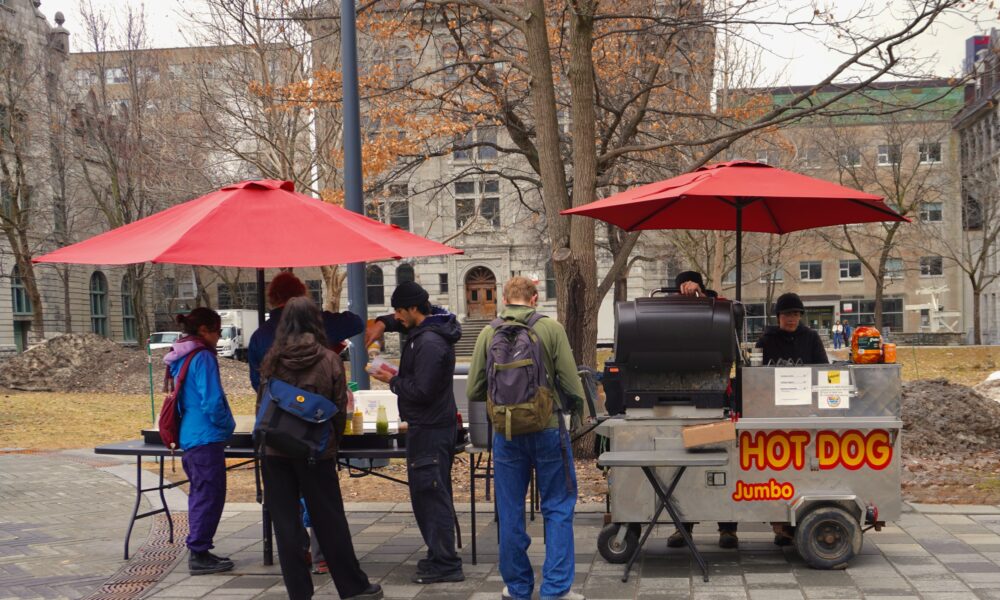
Hot Dog Man: A

This McGill classic needs no introduction. Hot Dog Man’s return to campus each spring acts as the unofficial first flicker of light at the end of a very snowy tunnel. The hot dogs themselves are great: The efficiency, faint taste of charcoal, toasted bun, and plethora of toppings make this staple something to write home about. The cart offers an original jumbo dog, a vegan option, and a Polish kielbasa. Perhaps even better than the sausages themselves is the excitement that hits as you stand in line with your friends, surrounded by fellow hot dog lovers. The Hot Dog Man unites McGillians across faculties and years, fostering a true sense of community amongst 40,000 students. This makes the Hot Dog Man an iconic part of our fleeting years at McGill and worthy of the coveted A grade. 

Vinh’s Café: A

Vinh’s Café has two locations, one in the Genome Building and the other in the Strathcona Music Building. It offers fresh Vietnamese food at affordable prices. Known for their bánh mi’s, Vietnamese coffee, and pho, Vinh’s is a convenient and delicious lunch on campus that won’t hurt your wallet beyond repair. Pick up one of their loyalty cards and get your 10th bánh mi for free!

Frostbite: A-

If you take a sharp left when you enter McConnell Engineering, you will stumble across Frostbite, McGill’s very own ice cream shop. Open Monday to Friday from 12:00 p.m. to 5:00 p.m., Frostbite is entirely student-run and the perfect mid-day treat. McGill’s worst-kept secret is arguably the shop’s Toonie Tuesday special, where you can grab a ‘baby scoop’ in exchange for a single toonie. In addition to Toonie Tuesday, Frostbite gives out a free scoop to anyone who scores less than 30 per cent on an exam worth 15 per cent or more of their final grade. With rotating and interesting flavours to choose from, the only thing holding Frostbite back from that top score is the massive line that forms each Tuesday. 

SNAX: B+

Squeezed into the hallway between Leacock 26 and Rooms 111 and 112 is SNAX cafe. SNAX is affordable, conveniently located, and good at what they do. Since it is primarily a coffee shop, SNAX only offers a small selection of baked goods and delicious Montreal bagels; the somewhat limited menu results in a good but not excellent final grade. Nonetheless, SNAX is the perfect caffeine boost or hunger fix when running between classes. So, before frantically meeting with a TA in an attempt to master the entire syllabus, gift yourself an afternoon sweet treat and grab a double chocolate cookie for $2.75 CAD. 

McConnell Engineering Cafeteria: B+

Tucked above the racecars and Dispatch in the McConnell Engineering lobby is the McConnell Engineering Cafeteria, home to Mezze Café and Booster Juice. While both options are delicious and close to the indoor seating that is so essential in the winter, their prices turn a trip to the cafeteria into a special treat, with most meals being above $10 CAD. Mezze offers Mediterranean fare made with halal ingredients for both breakfast and lunch, and Booster Juice has an array of smoothies to choose from. What makes these options stand out is the incredibly kind employees who consistently take time to chat, smile, and laugh with each customer.  

Science & Technology

Has spring felt weird this year? This is why

Spring has felt unusually out of sync this year, with winter lingering well into late March and only brief, inconsistent stretches of warmth. Is this just a strange season or a symptom of climate change? In an interview with The Tribune, Robert Fajber, Assistant Professor in McGill’s Department of Atmospheric and Oceanic Sciences, shared his thoughts on the city’s recent weather patterns.

“Montreal kind of follows […] the same overall climate and weather patterns that we see for most of the mid latitudes,” Fajber said.

As a result of climate change, Montreal has warmed up by 1 to 1.2 degrees Celsius over the last 50 years. With this warming comes a shift in precipitation.

“Globally, precipitation changes by about two per cent per degree of global warming,” Fajber said. “However, local extreme precipitation changes more like seven per cent per degree. So if you have an extreme rainfall event, and the local warming is two or three degrees, expect that extreme rainfall event to be more like 20 per cent stronger.”

According to climate data comparing recent decades to the mid-20th century, winters in Montreal are becoming shorter and milder. Between 1950 and 1980, the city experienced about 148 frost days—the number of days when the minimum air temperature is below zero—per year, but today that number has dropped to around 130.

Winter is also shifting in time: It now starts later, moving from around Oct. 10 to Oct. 18, and ends earlier, with the last frost day arriving closer to April 20 instead of April 29. These trends are based on 30-year climate normals, which smooth out year-to-year variability, but individual winters can still differ widely, as seen this year.

To explain this year’s odd spring temperatures, we need to understand what drives the North American climate. Much of North America’s climate is shaped by an “east–west dipole,” where one side of the continent experiences cold conditions while the other is warmer. This pattern is driven by atmospheric waves, influenced by temperatures in the Pacific and Atlantic Oceans.

Depending on how these waves shift, Arctic air can be pulled further south, bringing colder conditions to regions like eastern Canada. This year, unusually strong flows of cold Arctic air occurred, cooling Montreal.

Predicting these patterns is becoming more challenging. Over the past decade, both oceans have experienced unprecedented heat waves, starting with the Pacific “blob” around 2014, and more recently, extreme warming in the Atlantic since 2023. These ocean influences are now interacting in complex ways, making climate patterns harder to predict.

“Most climate models actually show the Atlantic as being one of the slowest places that [has] warmed on the planet,” Fajber said. “The North Atlantic warms very slowly because this is an area where the ocean actually draws down a lot of water, and as that water basically goes away from the surface. It takes heat with it.”

Looking ahead, scientists expect Montreal to see climate trends that largely mirror the past half-century. Winters will likely continue to shrink, snow cover will decline, and extreme weather events will intensify.

However, new uncertainties are emerging. In addition to the unexpected warming of the Atlantic Ocean, sea level rise remains unknown. While sudden and large-scale ice loss is considered unlikely in the next 50 years, it could significantly raise water levels in the st. Lawrence River, impacting people living on its shores.

Beyond gradual warming, extremes are the real story. Heavy precipitation and severe storms are intensifying faster than average conditions and will likely have the greatest impact on daily life.

As these changes accelerate in Montreal, adaptation strategies must go beyond individual action. While personal efforts can help, they are often limited in scope.

“We are much better when we work together on adaptations than when we try to work by ourselves,” Fajber said.

Commentary, Opinion

Critics must balance linguistic priorities with human impact when discussing Air Canada’s faux pas

On March 22, an Air Canada plane departing from Montreal collided with a Port Authority firetruck at LaGuardia Airport in New York City. The crash, which tragically killed pilots Captain Antoine Forest and First Officer Mackenzie Gunther, elicited an outpouring of grief. Shortly after the event, Air Canada CEO Michael Rousseau released a video statement delivered entirely in English, with French subtitles, offering his condolences. However, Rousseau immediately faced backlash from figures including Prime Minister Mark Carney and Bloc Québécois (Bloc) Leader Yves-François Blanchet, who said that the condolence message was insensitive in its unilingual format. 

Shortly thereafter, the House of CommonsCommittee on Official Languages summoned Rousseau to Ottawa to defend his decision to speak solely in English, leading the CEO to deliver a public apology first in French and eventually resign from his position at Air Canada. While Rousseau’s resignation was not explicitly linked to his court summons, its timing happened to coincide with the scandal timeline. The controversy surrounding Rousseau’s English condolence message garnered a significant amount of attention, even as communities struggled to make peace with the pilots’ deaths. While it is important to consider the potential impacts of exclusively using English in messages addressing Canada’s bilingual communities, this debate must not overshadow the severe human impact of the Air Canada tragedy itself. 

Yves-François Blanchet expressed particular disappointment, given that Captain Antoine Forest was a francophone Quebec resident. In Blanchet’s view, Rousseau’s refusal to speak in French signalled a blatant disregard for Forest’s heritage and Canada’s bilingual identity. However, Rousseau attested that he made this linguistic decision primarily due to his lacklustre French. According to Rousseau, speaking in French would have significantly curtailed his ability to articulate a crucial message with the nuance and sensitivity it warranted. Furthermore, the video was subtitled in French, reducing potential language barriers for francophone Canadians. Clearly, public gripes with Rousseau stem from concerns about francophone representation rather than reservations over practical aspects of the message’s linguistic accessibility. It appears politicians are more concerned with the optics of Rousseau’s decision than its actual impact on communities. 

Undoubtedly, the languages that public figures choose to use for important communications can signal which linguistic groups are prioritized and considered mainstream. Especially given Canada’s complicated linguistic history, it is understandable that Carney, Blanchet, and others would raise an eyebrow at Rousseau’s pattern of unwillingness to speak French. For Mario Beaulieu, the Bloc’s spokesperson on Official Languages, Rousseau’s statement was an unwelcome manifestation of Anglophone encroachment within Quebec.

Condemnation of the condolence message has quickly escalated into a public spectacle separate from the airline tragedy itself, becoming  a medium through which to critique English-language dominance in Quebec. However, given the tragic human toll of the crash, it is inappropriate and insensitive to use the tragedy as a vehicle for political discourse. This crash has had a deep personal impact on francophones and anglophones alike—weaponizing it to further a political agenda, and memorializing it as a language scandal is abhorrent

As Canada grapples with its fraught linguistic legacy, national memory should inform political rhetoric without reducing issues to an anglophone or francophone-serving binary. French and English language use are not mutually exclusive, and should be treated as complementary facets of Canadian culture rather than opposing forces. Legislation like the Official Languages Act exists to meld a shared national identity under two vastly different language systems, a process that, though worthwhile, will be inherently messy and imperfect. While Canadian leaders must take steps to promote French-language equality, this process should not overshadow the humanity of those citizens it claims to serve. Though Rousseau’s linguistic choices must be examined critically, focus should be placed primarily on the event’s human impact. An overemphasis on language politics during a time of mourning eclipses the humanity of those Quebecers that francization claims to serve.

McGill, News

COFAM rallies outside the Arts building demanding counteroffer from McGill

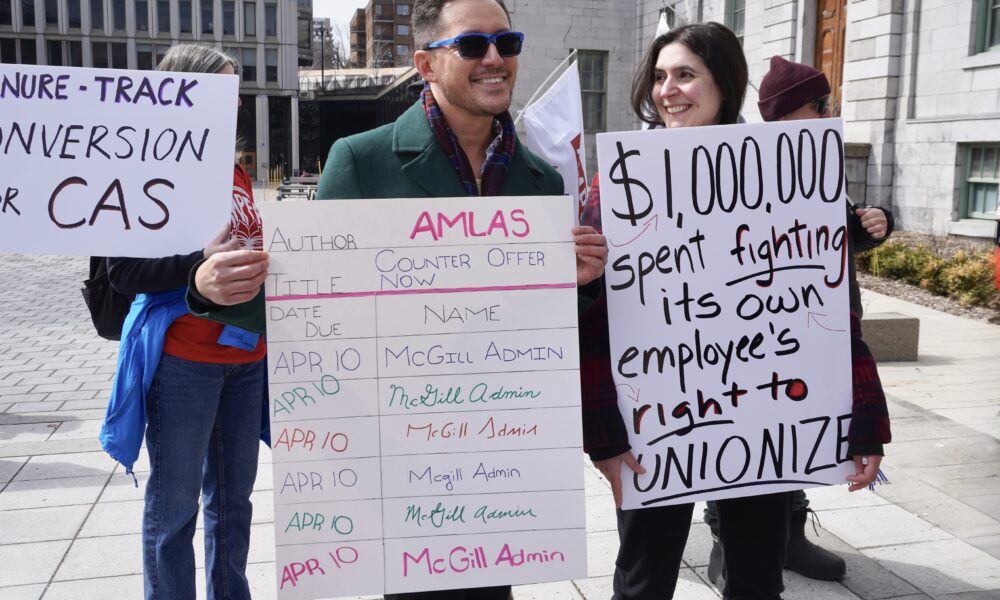
On April 2, around 60 professors gathered outside the McCall MacBain Arts Building in a rally organized by the Confederation of Faculty Associations of McGill (COFAM). Following a few speeches delivered by faculty representatives, the group walked to the James Administration Building while chanting “Le mépris, ça suffit !” and “Quoi ? Une contre-offre ! Quand ? Maintenant !

COFAM consists of five associations: the Association of McGill Academic Staff of the School of Continuing Studies (AMASCS/AMPEEP), the Association of McGill Professors of Education (AMPE), the Association of McGill Professors of the Faculty of Arts (AMPFA), the Association of McGill Professors of Law (AMPL/AMPD), and the Association of McGill Library Academic Staff (AMLAS). Amid ongoing negotiations with McGill to improve faculty working conditions, the rally marked COFAM’s launch of the “Full Counter-Offer Now!” campaign.

In an interview with The Tribune, Edward Dunsworth, associate professor in the Department of History and Classical Studies and organizer with AMPFA, explained that professors have gathered at the rally to denounce McGill’s stalling tactics in bargaining.

“The university has been around [for] 200 years,” Dunsworth said. “[Professors] have never been unionized until the last few years, compared to the rest of Quebec, where [at almost] every other university [professors] are unionized [….] More and more faculties are continuing to unionize, so McGill needs to adapt to that new reality and bargain seriously, and get things moving at the bargaining table.”

Dunsworth continued to mention that COFAM had delivered their list of demands in July 2025. Up until the rally, COFAM still has not received an adequate or complete response from McGill.

“One thing that’s been really challenging is that McGill has responded piece by piece to certain articles,” Dunsworth noted. “It’s really difficult to bargain like that. We need a full response to be able to properly negotiate and possibly make advances in one area and make compromises in another. It’s impossible to do that without a full picture of what the counteroffer is.”

Barry Eidlin, associate professor in the Department of Sociology and second vice president at AMPFA, delivered a speech to the crowd highlighting why a counteroffer is important for achieving COFAM’s non-monetary demands.

“We believe in this university, and we want to be able to teach our students with adequate support,” Eidlin said. “We have a message to the administration today. Come to the table, negotiate. You might not like something in the offer, that’s fine. That’s why you make a counteroffer. That’s how bargaining works. Rest assured that this is not a problem that the McGill administration can simply ignore, because we’re not going away.”

COFAM’s non-monetary demands call for better transparency and fairness for faculty, with little to no financial impact on the university. Such demands include a tenure-track pathway for ranked Contract Academic Staff (CAS), improved retirement options, and more transparent regulations in tenure, appointments, renewals, and promotions. In a speech to the audience, Kyle Kubler, a CAS faculty lecturer at the McGill Writing Centre and the AMPFA’s treasurer, highlighted some of COFAM’s other non-monetary demands—including enshrining academic freedom into the framework of labour relations.

“We’ve seen over the past couple years the way that our academic freedom has been challenged in various situations. We want to take academic freedom, put it into our collective agreement, and make it stronger than it currently is,” Kubler said. “[We also want] unique recognition for our Black and Indigenous colleagues, to identify ways that we can also recognize the service and the research that they do for their academic profiles, as well as making sure that the histories of racism and colonialism are […] recognized within our country.” 

Dunsworth highlighted that bargaining must happen more efficiently in the interests of both the university and its faculty.

“We have made some progress in bargaining, but we need to move things along quickly,” Dunsworth said. “That’s the best for the university, for us to reach a deal, carry on doing the teaching and research and service that we care a lot about and want to continue to do.”

Read the latest issue

Read the latest issue