


Latest News

Science & Technology

Say ‘no’ to the nocebo

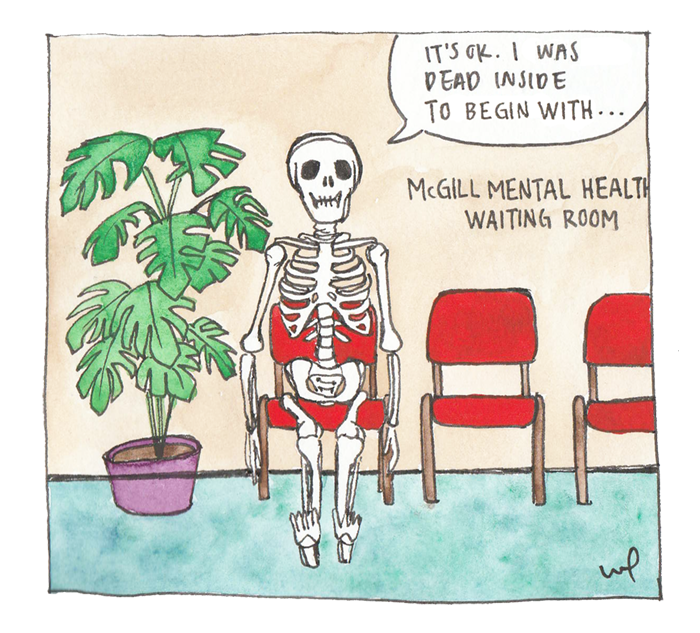
It’s that time of year again, when mental health initiatives are becoming more active. With finals looming ahead, it may seem like the pervading mood on campus is generally negative. However, it’s important that we question whether these initiatives themselves are responsible for subconsciously swaying our mood this way.

The number of McGill students seeking mental health or counselling services on campus has increased by 57 per cent over the last three years. While the implementation of a Fall Reading Week could work to combat this spike in demand, a nation-wide mental health epidemic requires more systemic solutions. Investigators have a plethora of suspects: Our sedentary, sunlight-deficient lifestyle, the prospect of graduating jobless, or the feelings of isolation brought about by superficial connections made over social networks. A psychological phenomenon called the nocebo effect could partially cause this post-modern mental health decline in students.

Known as the evil cousin to the placebo effect, the nocebo effect occurs when negative expectations result in negative consequences, which in some cases are tangible physiological changes. For example, when a physician warns a patient that a procedure may hurt, studies have found that the patient ends up reporting more pain than if the suggestion hadn’t been made.

In 1998, the nocebo effect led to an unnecessary evacuation at a high school in Tennessee. A teacher reported feelings of dizziness, nausea, and headaches after noticing the smell of gasoline in her classroom. The school was evacuated and 99 students and teachers went to the emergency room reporting similar symptoms. An investigation later found no evidence of toxins in the environment, and no gasoline leak of any kind, concluding that it was a mass psychogenic illness.  

Similarly, we can deliberate whether the mere suggestion of the symptoms of depression is partially responsible for this growing pandemic. Jay Olson, a PhD student in Psychiatry at McGill, agrees with this hypothesis.

University students are often told that their program is difficult and that many of them will end up depressed,” Olson said. “Promoting awareness of mental health issues is good for obvious reasons, it reduces stigma and increases reporting of symptoms. But it could also help reinforce symptoms similar to the nocebo effect.”

While “Trying to Stay Afloat?” posters on campus play a significant role in destigmatizing mental health issues, it’s possible that they play a part in stimulating the symptoms through the nocebo effect.

Research on this topic is sparse; the broad effects are difficult to study due to the numerous variables that must be taken into consideration. Olson and his colleague, Samuel Veissière, an assistant professor in Psychiatry and Anthropology at McGill, are discussing ways to study the relationship between mental health initiatives and the nocebo effect.

With finals in sight, it’s important to be mindful of the nocebo effect’s impact on student well-being. Spend a minute sharing something interesting you’ve studied with a friend. Instead of taking lots of short interspersed study breaks scrolling through your newsfeed, save up and schedule a longer break to relax. Phone a friend, catch up on Riverdale, or buy yourself a cheesecake. Take up the activities that provide the positive reinforcement necessary to alleviate possible symptoms of the nocebo effect, and be successful this exam season.


Student Life

The link between gut health and mental health

University life can pose a challenge to maintaining healthy eating habits. From sugar-filled bars grabbed swiftly on the way out the door in the morning, to late-night cups of Tim Horton’s, the rigors of academia do little for the average student’s physical health. But stress-eating processed candy and grabbing rushed slices of pizza can be detrimental for mental health too, as research shows an important link between gut health and mental health.

While we may think of our bodies as belonging to ourselves, we are actually home to millions of microorganisms. These microbes, which include a variety of bacteria, viruses, and fungi, have tremendous potential to impact our physiology as they colonize many parts of the body, including the gut.

In turn, a 2017 University College Cork study suggests that gut bacteria may influence their host’s anxiety and depression. Increasing the number of ‘good’ bacteria in the gut can reduce stress, improve memory, and lower social anxiety.

Mariia Taguer, a third-year PhD candidate in Microbiology and Immunology, studies the community of diverse microorganisms living in the gut, which is collectively known as the gut microbiome. In addition to improving mental health, Taguer considers having a strong microbiome to be of great importance, as it impacts the immune system.

“[The gut microbiome] helps to clean our immune system,” Taguer said. “A lot of diseases we’re finding now, like inflammatory diseases, [relate] to how our gut microbiota [work with] the immune system. This is really based on […] disturbances to our gut microbiota […] in our early years, which can lead to an altered immune system [.…] It helps to digest a lot of our food [by breaking down] certain foods down for us. Fibre, which we can’t digest ourselves, is [broken down] by [gut] bacteria.”

For students looking to boost their mood, diet is an easy place to start. Instead of reaching for coffee when feeling under-the-weather, students should reach for a mango. Packed with healthy fibres that gut bacteria thrive on, the fruit is bound to improve stomach health—which can improve mental health, too.


Healthy eating habits are not a substitute for therapy or medication. If you are struggling with mental health, McGill offers both counselling and psychiatric care.


Mango and lime sorbet recipe

Makes 4 servings.

Ingredients

  • 500g frozen mango chunks

  • 1 lime, zest and juice

  • 100ml coconut water

  • 1 tbsp caster sugar (optional)

  • 200g fresh raspberries

  • 100g fresh coconut shavings

  • Fresh mint to garnish

Instructions

  1. Place half of the mango into a food processor. Add both the juice and zest of the lime to the mix. Process the ingredients until they are well mixed and the sorbet is formed.

  2. Taste your sorbet for sweetness. Add sugar to taste.

  3. In order to achieve the consistency you like, gradually add small amounts of mango and coconut water until you’re satisfied.

  4. For a fun way to plate your sorbet, place a few berries in the bottom of a clear glass. Add a couple spoonfuls of your sorbet on top of the berries. Decorate with more berries, shaved coconut, and a pinch of fresh mint.

Recipe adapted from Love Your Gut.

Letters to the Editor, Opinion

Letter to the Editor: Clarifying McGill’s student-athlete recruitment processes

In his Nov. 28 article in The McGill Tribune, “Selective success: A McGill recruiting story,” Patrick Beacham touched on several important issues relevant to recruiting; however there were several inaccuracies in his article that need correcting.

Recruiting talented student-athletes is a complex process, much of which is governed by university leagues such as the U Sports nationally or the RSEQ in Quebec. When it comes to the financial packages offered to student-athletes at McGill and its sister institutions, there are rules to ensure parity. In Quebec schools, the maximum that can be awarded to a student athlete is the equivalent of tuition and its associated ancillary fees. In Ontario schools, the maximum financial package available to athletes is $4,500. At McGill, all of our level I teams (hockey, swimming, basketball, volleyball, soccer, football) and select level II teams have financial awards available for student athletes. And while there's always room to increase the number of McGill athletes who receive financial help, it's rare for McGill teams to lose a recruit based on finances alone.

As for McGill's ability to recruit compared to other schools, Beacham was correct in stating that all athletes must meet the same academic standards as any other student applying to McGill. However, I take exception to the statement that McGill struggles to stay competitive. Last year, our four big sports—men’s and women's hockey, and men’s and women's basketball—won their divisions and competed at the national championships. The Martlet basketball team was crowned the best university team in the country. Many of McGill’s other teams had successful seasons as well, and the University is now considered a leading performer in both athletics and academics.

Also deserving of clarification is the information related to admissions. The process of admitting athletes to McGill has improved significantly in recent years, with potential recruits receiving early admittance more often, and more attention being given to cases where students face extenuating circumstances.

Much of this information could have been provided by interviewing the Athletics staff responsible for following a recruit from the time he or she expresses interest to McGill, to the time they receive their acceptance. There is indeed a good story here, as the path from potential recruit to pulling on a McGill jersey is worth chronicling, but it’s important to ensure that the process is reflected accurately.


Marc Gélinas is the Executive Director of McGill Athletics and Recreation.

Read the latest issue

Read the latest issue