

Latest News

Commentary, Opinion

First Nation children have received a settlement of reckoning, not closure

The federal government’s recent $23 billion CAD settlement with the Assembly of First Nations (AFN) and plaintiffs in the Moushoom and Trout class actions for First Nations children harmed by Canada’s discriminatory child welfare system marks an important step in acknowledging the deep injustices and violence against Indigenous communities. The settlement is the product of years of legal battles, brought forth through the relentless advocacy of Indigenous leaders and organizations, that led to the Canadian Human Rights Tribunal (CHRT)’s 2016 ruling acknowledging Canada had willfully discriminated against First Nations children for decades. The settlement is, without question, historic—the largest of its kind in Canadian history—and a direct response to decades of the government’s neglect and systemic racism. But while financial compensation may provide a measure of restitution, it does not—and cannot—erase the ongoing impacts of Canada’s inequitable welfare policies. To call this settlement a full and final expression of justice would be to misunderstand the very nature of what justice means.

Indigenous children in Canada account for slightly over seven per cent of the country’s total child population, yet they make up more than 50 per cent of the children in the child welfare system. First Nations children in particular are over 17 times more likely to end up in the youth care system. Indigenous communities today continue to fight for their right to care for their own children. For decades, Canada’s child welfare system has perpetuated the colonial project of family separation, a legacy of residential schools and the Sixties Scoop—the forced removal of Indigenous children into non-Indigenous care, causing cultural loss and trauma. The Canadian government’s chronic underfunding of on-reserve child welfare and education services and its failure to uphold Jordan’s Principle—meant to ensure First Nations children receive essential care without jurisdictional disputes—only exacerbate these harms. 

As part of its 2016 ruling, the CHRT also demanded that Canada reach an agreement with First Nations to reform the child welfare system. In 2024, the federal government put forward a new $47.8 billion CAD reform proposal that was rejected by AFN leaders. These leaders claimed that the proposed 10-year reforms were inadequate to address ongoing structural issues. Further, some leaders felt the proposal favoured certain regions such as Ontario, particularly since it did not include children and families in the Northwest Territories (NWT)—an oversight that many took as a direct affront to legal equity. The exclusion was due to the fact that federal funding for child and family services in the NWT is provided through transfer payment agreements with the territorial government, not through the First Nations Child and Family Services Program. Chiefs from across the country voted to pass a subsequent resolution to ensure that NWT communities would be included in the reform proposal. 

Canada’s response to demands for inclusivity in reconciliation efforts reveals a priority for appearing committed to reform, even at the cost of dividing communities. Instead of working toward a national solution, the federal government announced last month that it is pursuing a separate deal with the Chiefs of Ontario and Nishnawbe Aski Nation to reform Ontario’s on-reserve child welfare system, stepping away from negotiations that include all provinces and territories. This move deepens the divide within First Nations communities and undermines the goal of achieving equitable child welfare for all. 

The Canadian public must stay engaged. Too often, the national focus on Indigenous issues fades once high-profile headlines disappear. With an upcoming election, there is growing urgency to secure a fair deal for First Nations welfare reform, especially as some Indigenous leaders have recalled the lack of funding and support for their communities during the Harper era. Regardless of which party wins the next majority, justice for Indigenous peoples, beyond simple monetary methods, must be a top priority. For students who can vote in the expected upcoming election, this is an opportunity to use your voice. For those who cannot vote, apathy and reticence are not the answer. Supporting Indigenous communities is crucial, on our own campus and beyond. 

That being said, money alone does not bring back stolen childhoods, repair fractured families, or undo the intergenerational damage caused by Canada’s policies. The recent government settlement is a necessary recognition of harm, but one that must be followed by concrete, comprehensive plans to actively prevent such harm from happening again.


Cross-Country / Track, Sports, Swimming

Moments of brilliance in the Red and White’s pursuit of the RSEQ and U SPORTS podiums

At a university where academic rigour sets a high bar, McGill’s varsity athletes continue to raise it even higher—smashing school records and bringing home hardware to cap off a season to remember.

Between early morning practices and late-night study sessions, McGill’s track and field, badminton, and swimming teams have exceeded boundaries and delivered exceptional performances. This season, they shattered school records, earned personal bests, and brought home medals in all three colours at their respective championships. Much of this success can be attributed to the steady leadership guiding these teams, coaches and captains alike. 

McGill Men’s and Women’s Track and Field

The McGill track and field team delivered standout performances at the 2025 U SPORTS National Championships, hosted by the University of Windsor, capping off a season defined by relentless perseverance. The Redbirds and Martlets showcased their depth of talent, with the men’s team finishing second and the women’s team third at the Réseau du sport étudiant du Québec (RSEQ) Championships earlier this season—laying the foundation for a strong showing at Nationals.

At Nationals, the Martlets earned impressive top-10 finishes. Third-year sprinter/relay runner Donna Ntambue led the charge, capturing bronze in the women’s 60m and emerging as the team’s top point scorer. Second-year jumper Rebecca Warcholak impressed in the triple jump, placing seventh with an 11.88m leap, narrowly missing her personal best.

The Redbirds showed versatility, with all three of their relay teams—4x200m, 4x400m, and 4x800m—having qualified for Nationals. The 4x400m and 4x800m squads’ valiant efforts resulted in seventh-place finishes for both. Third-year sprinter/relay runner Luca Nicoletti shone across both relays and the 300m sprint, while first-year distance runner Ben Gates and third-year middle-distance/relay runner Sean Adams showcased remarkable endurance, competing in multiple relays.

For fourth-year men’s team captain Devin Chapple, the season epitomized growth that extended beyond the track. 

“It’s rewarding to look back at all the [personal bests] and incredible team moments that shaped my progression to captaincy,” Chapple wrote to The Tribune. “When you put in that work and see it pay off with a big performance, there’s no other feeling like it [.…] I see it as a privilege to train, and over time you realize how much fun you’re having.”

McGill’s track and field success at Nationals went beyond medals; it was a testament to shared ambition and the undeniable thrill of seeing dedication turn into achievement. With a powerful blend of veteran leadership and rising stars like Gates and Warcholak, the team’s future has never looked brighter.

McGill Men’s and Women’s Badminton

Despite a tough weekend at the RSEQ Championships, strong individual performances showed why McGill Badminton remains a force to be reckoned with.

Although several players battled injuries and illnesses throughout the tournament, the teams pushed through adversity and delivered impressive results. On the men’s side, third-year captain Nicolas Germain fought his way to a well-earned third place in men’s singles, showing tremendous perseverance and focus, especially in a tightly contested semifinal match.

The women’s team also had standout performances, led by fourth-year Eliana Zhang who captured gold in both women’s singles and women’s doubles, partnering with second-year Sammi Pan. By overcoming tough opponents such as L’Université du Québec à Montréal and Université Laval, they proved that McGill’s doubles play is defined not just by skill, but by exceptional teamwork and strategy.

Beyond the results on paper, what stood out most was the incredible team spirit. Germain emphasized in a statement to The Tribune how the cheering and support from teammates on the bench made a real difference during challenging matches. For Germain, who calls the team his “second family,” what defines McGill Badminton is its creation of lifelong friendships and a deep sense of belonging within the greater badminton community.

Germain also credited Head Coach Hooman Bagheri’s motivating and collaborative approach to fostering a supportive environment where players can thrive. 

“Having an open-minded coach who listens to everything we have to say is invaluable,” Germain wrote. 

Whether helping players refine specific skills or encouraging them to take on leadership roles, Hooman’s guidance has clearly been pivotal in shaping the team’s success.

Altogether, the RSEQ Championships were a true reflection of the team’s grit, chemistry, and desire to constantly improve, leaving them proud of how far they have come together.

McGill Men’s and Women’s Swimming

The McGill swim team delivered a historic performance at the 2025 U SPORTS National Championships, hosted by the University of Toronto, to solidify their place among Canada’s elite programs. Guided by Head Coach Peter Carpenter, the 2025 U SPORTS Women’s Coach of the Year, the Martlets and Redbirds demonstrated remarkable mental strength, resilience, and an unshakable team spirit.

The Martlets raised the bar at McGill, securing a historic second-place finish at Nationals—the highest in school history. Their achievement was fueled by their consistent effort, as they placed swimmers in nearly every final. Despite winning only five medals—two silvers and three bronzes—their ability to score points across the board was extraordinary.

The Martlets’ composure was built on the leadership of fourth-year captain Naomie Lo. Lo’s transformational approach to leadership uplifts her teammates, leaving a lasting impact on the team’s culture. 

“Some [athletes] need in-depth conversations to work through their challenges, while others prefer to seek help after they’ve processed their emotions […] embracing that there isn’t a one-size-fits-all approach to leadership has truly shaped how I support and guide those around me,” she wrote to The Tribune

Lo’s compassionate leadership style led the Martlets, especially during the highly anticipated relay swim. Lo, fifth-year Elizabeth Ling, third-year Iris Tinmouth, and second-year Maya McGhan powered through the 4x200m freestyle relay, setting the pool ablaze as they shattered the team record by an incredible five seconds and claimed a well-deserved silver medal. Lo explained how some team members felt burdened by a perceived “curse”—believing a fourth-place finish was inevitable, behind the consistent top three teams (University of Toronto, University of British Columbia, University of Calgary) who are bolstered by a handful of Olympians. 

This Nationals also marked the final appearance for Lo and Ling, inspiring an emotional and relentless fight to leave everything in the pool. The entire Martlet team continued to shine, with Lo’s prowess earning her silver in the 200m butterfly, while second-year Emilie de Chazal (200m butterfly), Ling (100m freestyle), and Tinmouth (800m freestyle) each claimed bronze.

The Redbirds also made waves, finishing fourth overall—a result that exceeded expectations and highlighted the program’s bright future. First-year phenom Loïc Courville-Fortin led the charge, breaking team and U SPORTS records in the 200m individual medley (IM) and 200m backstroke. His silver medal in the 200m IM, where he edged out Olympian Clement Secchi (BA ‘22)’s previous McGill record, was a highlight of the meet. Courville-Fortin added another podium finish with bronze in the 200m backstroke, while second-year Mats Baradat secured silver in the 400m freestyle. The Redbirds also set a new team record in the 4x100m IM relay, further underscoring their growing strength.

More than medals, it is the team’s culture that truly makes them stand out. Coach Carpenter described the team as “relentless,” an unstoppable group that rises to every challenge and never retreats. Captains Lo and sixth-year Bruno Dehem-Lemelin echoed this sentiment, emphasizing the familial bond that unites the team.

As the season concludes, all three teams look to the future with immense promise. With a blend of seasoned leaders and emerging talent, these programs are poised to continue their ascent, driven by a shared commitment to excellence. Their success at both the RSEQ Championships and U SPORTS Nationals is not just a reflection of their athletic ability, but also a celebration of the communities they have built—families that compete together, triumph together, and inspire together.

McGill, Montreal, News, SSMU

SSMU fights injunction against PAGIP in appeals court, demands anonymous plaintiff come forward

The Students’ Society of McGill University (SSMU) attended the Court of Appeal on March 11 to debate the plaintiff, currently referred to as X, in an ongoing lawsuit pertaining to an injunction against the Policy Against Genocide in Palestine (PAGIP). X v. SSMU calls for the student union to pay for alleged irreparable damages amounting to $125,000 CAD experienced by the anonymous plaintiff, a former McGill student. The plaintiff side argued that the damages and injunction they have fought for are the result of SSMU planning to ratify PAGIP, which contains rhetoric they claim is antisemitic.

PAGIP was originally passed in the 2023 SSMU Fall Referendum, with 78.7 per cent of non-abstaining voters in favour. If ratified, it would mandate SSMU take an official stance in solidarity with Palestine and demand McGill divest from companies with ties to Israel. Shortly after SSMU announced the referendum results, X filed a demand for a provisional and interlocutory injunction on Nov. 21, 2023. They argued that PAGIP should not be enacted, as in doing so SSMU would violate its commitment to represent and facilitate dialogue among all its membership. 

On May 22, 2024, Quebec Superior Court Justice Shaun E. Finn granted X’s demand for an interlocutory injunction on the PAGIP and approved their request to file their suit anonymously. In the March 11 hearing, SSMU’s defence sought to appeal Justice Finn’s decisions.

Over the last year, SSMU’s legal team has fought for the injunction to be lifted, arguing that its Board of Directors retains the right to ratify motions passed by the student body. In the March 11 appeal hearing, SSMU argued that as X is no longer a McGill student, they cannot file for “ongoing damages” against the student union.  

The student union’s defense attorney, Sibel Ataogul, first presented SSMU’s general defense against X’s claim to compensation for alleged irreparable harm. She argued that X’s argument against PAGIP stemmed from ideology rather than genuine concerns for students’ safety, which Ataogul stated does not qualify as a credible basis for the claim.

Ataogul then invited the prosecutor, Michael Bergman, to justify his client’s claims that PAGIP’s ratification would be discriminatory and personally harmful to the plaintiff.  

Bergman stated that wording used in PAGIP was antisemitic and that ratifying the policy would put Jewish students on campus at a higher risk of harm. He then informed the court of an expert witness in antisemitic rhetoric he wished to call upon on a later date to explain how ratifying the motion would create further division on campus. 

“[SSMU is] free to adapt whatever resolutions they like,” Bergman said. “But a policy that on its face stands to be reasonably antisemitic will put Jew[ish] students in disdain.”

The court’s judge, Justice Christine Baudouin, refuted this claim, questioning Bergman as to why a specialist is necessary to argue that PAGIP’s rhetoric is antisemitic if it was immediately clear to his client that this was the case.  

In response, Bergman stated that the broader context PAGIP was introduced into during the 2023 referendum must be taken into account in the case. He referenced alleged threats made against X when some students discovered they controlled an Instagram account dedicated to the ‘No’ campaign, a movement that campaigned against PAGIP during the referendum period, as evidence of antisemitism on campus during Fall 2023.

Justice Baudouin pointed out that none of the messages X received showed direct intentions of violence and X was never harmed, leading the judge to question X’s anonymity in the case. The judge further expressed doubt about the university’s neutrality in this case, questioning if X’s legal team communicated with McGill on this issue.

“McGill has politics, the injunction is considered political,” Baudouin said. “McGill doesn’t have a position on this injunction? I find that surprising [….] McGill is the white elephant here.”

Ataogul seconded this point, stating that the prosecution’s claim that supporters of PAGIP would threaten violence was a baseless mischaracterization of SSMU members, meant to validate X’s anonymity. She ended her argument by stating that McGill was using X’s anonymity to obscure administrative objections to PAGIP’s ratification.

“Everyone knows who [X] is, and nothing happened,” Ataogul said. “McGill is hiding behind this student so they don’t have to reveal who’s opposing student democracy.” 

The court is currently deliberating on the issue of X’s anonymity. Should the judge rule in favour of SSMU, X will be mandated to either come forward or drop their charges. A trial on the merits of PAGIP will be decided at a future hearing. 

McGill, News, SSMU

“I have no idea what’s going to happen next”: SSMU VP University Affairs’ future uncertain following new agreement with McGill

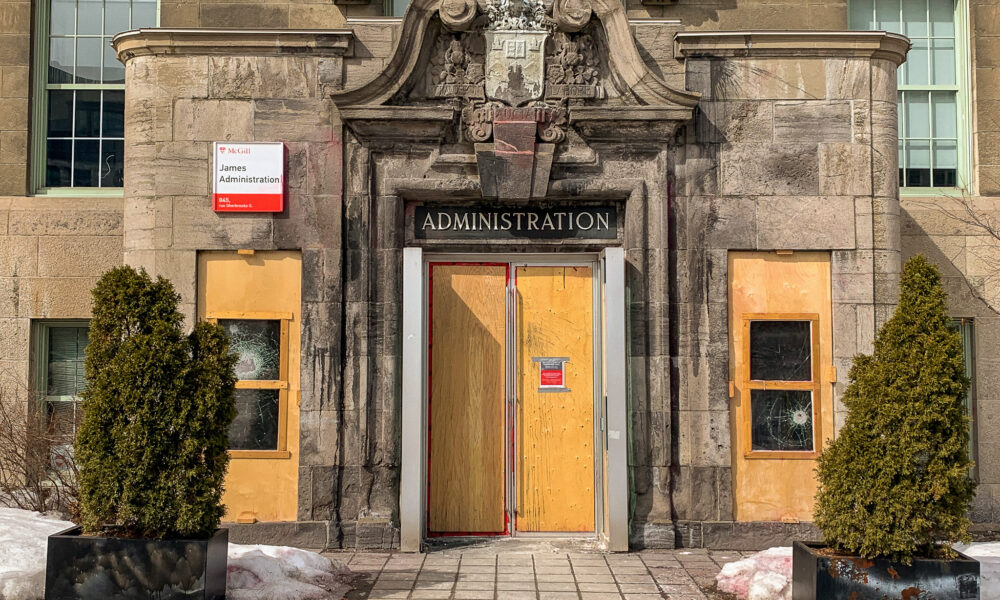
The Students’ Society of McGill University (SSMU) and the administration signed a new Memorandum of Agreement (MoA) on Feb. 28, outlining the terms of their relationship. However, a newly added clause barring students with any disciplinary record at McGill from serving as executives at SSMU has put current Vice-President (VP) University Affairs Abe Berglas at risk of removal from their position.

Under clause 14.4 of the new MoA, executives and directors at SSMU cannot have a disciplinary record at the University, cannot have been suspended from McGill, and cannot have been found responsible for an infraction of the Code of Student Conduct and Disciplinary Procedures. There is no recent precedent of an MoA between McGill and SSMU containing a clause pertaining to the disciplinary record of a student society executive.

In a March 14 disciplinary hearing with the Committee on Student Discipline, Berglas was found to have violated the Code based on an action they spearheaded at the start of the school year. Berglas told The Tribune that in August, they and four other students entered School of Religious Studies professor Douglas Farrow’s classroom and passed out pamphlets with select quotes from the professor’s published work which the demonstrators believed to be transphobic and homophobic. At the bottom of the pamphlet, Berglas wrote a note that students seeking support could reach out to their VP University Affairs email. This demonstration, which Berglas claimed took no more than two minutes, resulted in a charge of violating articles five and 10.c. of the Code. 

“One of the arguments I made in the [disciplinary] hearing was that this sort of awareness campaign of handing out flyers is part of my role, it’s part of the Trans Advocacy Plan,” Berglas said in an interview with The Tribune

Article five states that it is a violation of the Code to intentionally interfere with university activities and 10.c. writes that students cannot “create a condition that unnecessarily endangers or threatens or undermines the health, safety, wellbeing, or dignity of another person, [or] threatens to cause humiliation.” At the disciplinary hearing, the committee ruled that while Berglas had not violated 10.c., they had breached the Code under article five.

“The MoA makes the consequences of a finding of guilt much more severe—essentially puts my job at risk,” Berglas said. 

“The question is now whether McGill will try to enforce [the ruling],” they continued. “It’s possible that because the agreement was signed in the middle of my disciplinary process, I’ll be sort of grandfathered in, but there’s certainly nothing in the MoA that suggests that. So I have no idea what’s going to happen next.”

SSMU President Dymetri Taylor wrote to The Tribune that he doubts McGill will enforce clause 14.4 in this instance given their term will end on May 31. 

“Executive terms for this year are close to being concluded. Creating more work for the remaining Executives would only earn the ire of the current team,” Taylor wrote. 

According to Berglas, McGill inserted clause 14.4 into the new MoA 14 days before the old document was set to expire. This gave SSMU little time to contest the clause, as if the parties did not rapidly reach an agreement, SSMU would lose access to the University Centre and other rights afforded by the MoA. Berglas claims that SSMU tried to extend negotiations but that McGill refused. 

Responding to these allegations, the McGill Media Relations Office (MRO) wrote that the MoA reflects the interests of both signatories. McGill did not respond to questions on the timeline of 14.4’s insertion into the agreement.

“These provisions are rooted in McGill’s view—presumably shared by the SSMU as a signatory to the MoA—that students who hold significant fiduciary responsibilities […] should be credible, trustworthy leaders whose reputation and record are unblemished by a recent and/or serious offence under the Code of Student Conduct and Disciplinary Procedures,” the MRO wrote. 

Berglas contested the idea that the Code serves as an appropriate indicator of what defines a model student, and maintained that the clause could have a “chilling effect” on executives’ activism in the future by limiting avenues for dissent.

“Activists are so frequently told […] ‘if only you were less disruptive, you would be more effective,’” Berglas said. “And if I am doing the most minimal action I can think of […] and they’re deciding that even that two-minute silent handing out of flyers gets the level of obstruction, there’s really nothing any student can do to voice their discontent in a situation like this.”

Out on the Town, Student Life

Four gates, one Chinatown

At the very heart of Montreal, nestled alongside the bustling downtown blocks, is Montreal’s very own Quartier Chinois. Occupying roughly one square block, the neighbourhood is portrait-framed by four ornate Paifang gates—the most of any Chinatown in Canada—denoting the cardinal directions. 

Robert Frost once said “Good fences make good neighbours,” and the same could be said of those gates. As picturesque as they may be, the four gates embody a fundamental tension of immigration: The desire to carve out a home that reflects your cultural identity, at odds with the ongoing pressure to integrate into Western society. The four sides of the micropolis stand as a physical way to claim the space in response to the ongoing decline of the Chinese population in the area caused by gentrification starting in the 1970s, yet also a reminder of the limitations faced by the Chinese diaspora, marking out what space does and does not belong to them despite being a multigenerational community contributing to the wider city of Montreal.

With a history that goes as far back as the mid-to-late 1800s, Montreal’s Chinatown is one of the oldest Asian communities on the continent. It was first referred to by the term “Chinatown” in 1902 by the French newspaper La Presse. The area was initially residential, following a new wave of Chinese immigrants that arrived from British Columbia after completing the transcontinental railroad in 1885. Many moved to Montreal in hopes of escaping the systemic discrimination faced on the West Coast, particularly the Head Tax legislation, which charged Chinese immigrants $50 CAD per person for the privilege of working in Canada, later raised to $500 CAD. The Chinese Exclusion Act of 1923 banned the entry of Chinese immigrants for 24 years, impeding family reunions and community development. As a result of this unique cocktail of circumstances and systemic discrimination, Montreal’s Chinatown garnered a reputation as a sort of sketchy bachelor society of Mahjong gambling and criminal network disputes. Reflecting on the underground political turmoils, the newspaper La Patrie would describe Chinatown in 1936 as a place where “a simple spark is enough to trigger a vendetta.” 

Chinatown has changed a lot since the 1930s, becoming relatively commercial and tourist-accessible. It now intertwines historical reverence with a thriving participatory culture. As a result of a number of street widening and urban renewal projects introduced in the 1960s, Chinatown shrank by a third: Pagoda Park, three Chinese churches, a residential sector, and several family-run businesses were shut down to make room for the Palais des congrès, Complex Guy-Favreau and the Ville Marie Expressway. This, in turn, forced many residents to relocate, scattering much of the population to Côte-des-Neiges and Saint-Laurent. 

Today, Chinatown has much to offer to students visiting the area. Sun-Yat-Sen Park centres Chinatown as a public square for people to socialize and enjoy taichi in the summer. Alongside it is the pedestrian-only strip mall of rue de la Gauchetière, where street festivals are held during the Mid-Autumn Moon Festival and Lunar New Year. 

One of Chinatown’s famous features is its large and diverse food scene. Regardless of one’s taste, there is something for everyone. Visit the self-serve Hong Kong-style bakery Pâtisserie Coco or the Dragon’s Beard Candy stall for a unique sweet tooth treat. For a savoury fix, don’t miss out on soup dumplings from Sammi & Soupe Dumpling. If you’re in the mood for spice, Restaurant Kanbei specializes in Szechuan-style cuisine and is a local favourite for its numbing-spicy peppercorn flavours—try the Spicy Sichuan hot pot for the full effect. For an all-you-can-eat experience, Happy Lamb Hot Pot offers a free buffet for birthdays when you purchase a soup base. Don’t forget to swing by G&D Supermarket for all your Asian grocery needs.   

As Montreal’s Chinatown continues to grow and evolve today, it remains a living testimony to the resilience and cultural pride of the community which helped shape it, offering both a rich history and an accessible culinary experience for visitors and students alike. 

Science & Technology

Ask the Trib: SciTech edition

I recently met with my counsellor and found out that I would need to take two more years of classes in order to finish my Math degree (I’m already in my third year…). I’m not sure where to go from here—I’m torn between dropping out, taking a year off to hike the Appalachian trail (but I’d need to live with my parents for a while), or putting my head down and finishing the two years. 

-Sincerely, COURSE CORRECTING

Dear COURSE,

First of all, that’s a bummer, and it always takes some time to adjust when your five-year plan (inevitably) doesn’t go as you hoped. Take some time to lick your wounds, but don’t give up! You’re already three years in (as a Math major, you’ll know that’s still more than 50 per cent of the way there, even with the extra year). We suggest looking into summer classes, to see if you might be able to take a couple of credits off your plate in the coming years. As for the Appalachian trail, that sounds like fun! Ask your counselor whether you could take only a semester off, rather than a full year, if that helps decrease the amount of time you’d have to live at home. You also might want to consider whether a semester in the woods might leave you feeling refreshed, resolved, and ready to get back in the classroom, or if all the integrals and derivatives will dribble out of your ears with the birdsong, leaving you unsure of yourself when you get back to the concrete jungle.

Help! I asked my Computer Science professor for an extension on an assignment, and then when the time came to turn it in, I only got a 44 per cent! I want to keep going to office hours, though… How can I look my prof in the eye and keep working with them through the end of the semester?

-Sincerely, FAILED THE ASSIGNMENT

Dear FAILED,

Oofbut hey, we’ve all been there. The important thing is to use this as a learning experience. In our experience, profs appreciate directness and honesty when you’ve messed up, rather than a string of excuses (no matter how eloquent your fabricated email may be…). If you want to save your relationship with the prof, own up to your mistake, ask what you could have done better, and show you’re interested in improving. While it may sting in the moment, showing you can learn from your mistakes will impress a professor a lot more than a heartless B minus. Also don’t forget to swing by FrostBite if your assignment was worth more than 30 per cent of your grade!

I’m a Biology student who’s never really had to do presentations in class before. All of a sudden, I have a ton of in-class presentations coming up at the end of the semester! I’m feeling overwhelmed trying to finish them all, and I’m worried about freezing in class. Any advice to help get them all done? 

-Sincerely, STAGE FRIGHTENED

Dear FRIGHTENED, 

Presentations are scary! We feel you—that’s why we write for the newspaper. But you’ve got this: Take your time with each presentation, and practice, practice, practice. The key to remembering your lines is twofold: Care about what you’re saying (if possible…) and know your material well. If you can practice by presenting to your roommates, friends, or a sympathetic stuffed animal, that will go a long way in your performance. As science students ourselves, we encourage you to aim for an interesting and engaging presentation, even though dry presentations with walls of texts on endless powerpoint slides are often the norm in science. For inspiration, try imitating professors who you find to be good speakers, or watch some SciShow videos to get an idea of what effective science communication looks like. 

McGill, News, Private, SSMU

SSMU Board of Directors discusses implications of new MoA on student union sovereignty 

The Students’ Society of McGill University (SSMU) Board of Directors (BoD) met on March 11. The discussion was dominated by clause 14.4 of the recently signed Memorandum of Agreement (MoA) between the McGill administration and SSMU.

The meeting began with a presentation from Bounce, a platform that centralizes clubs, services, and events for student unions. SSMU President Dymetri Taylor expressed interest in the platform but noted that further internal discussion was necessary before any decisions could be made.

The meeting then moved to discussing clause 14.4 of the MoA, which prevents any student with a disciplinary record, a history of suspension, or who is found responsible for violating the Code of Student Conduct and Disciplinary Procedures from being a SSMU Officer or Director.      

During the meeting’s question period, Taylor explained that while the student union opposed the wording in clause 14.4, they ultimately accepted the terms of the agreement under pressure from time constraints.

“We were on a strict deadline: If the MoA was not signed by [Feb. 28], then the MoA would be null and void, meaning that all clubs and services of the SSMU would no longer be able to use the McGill name,” Taylor said.

Director Fawaz Halloum asked if a legal review of clause 14.4 would be possible. Taylor asserted that on the week of signing the agreement, SSMU consulted their legal team, who concluded that there were no issues with the clause. Taylor noted, however, that SSMU is looking to amend this clause in the upcoming summer. For this to occur, the Board would need to put forward a motion to approve reopening the MoA. 

The meeting then turned to motions approved at the Legislative Council meeting on Feb. 18. Among others, this included the ratification of the motion regarding the Policy on Black Student Enhancement and Inclusion, moved by Vice-President (VP) External Hugo-Victor Solomon.

In the discussion period that followed, VP University Affairs Abe Berglas spoke on McGill bringing disciplinary action against them for distributing pamphlets before the lecture of Professor Douglas Farrow, detailing his published works they deemed transphobic and homophobic. 

“I am going to guess that the university is very interested in symbolically showing that this is an offence, because they are trying to lower the bar of what they consider a disruption in classes as they are sick of protestors and they want to be seen as cutting down on their protest culture,” Berglas said.

Under clause 14.4 of the MoA, if Berglas is found guilty, McGill may remove them from their position as a SSMU Officer. Executive terms end on May 31. Halloum commented on the threat he believes this clause poses to SSMU’s sovereignty and urged the Board to take a stronger stance against the clause.

“When McGill dictated these criteria, it rendered activists, especially targeted activists, inadmissible to places of power in their union where they can actually change things,” Halloum said. “It’s alarming to let a dominating power dictate who can run in your politics based on their own criteria, and their own criteria is not objective.” 

Solomon and Taylor responded by saying that these issues had already been discussed in previous confidential sessions.

Halloum then put forward an auxiliary motion to seek and declassify a written legal opinion on clause 14.4 of the MoA, concerned that SSMU is at risk of a civil lawsuit due to discrimination against a particular group of students. However, after a rerun of the vote, with only Halloum and Director Hamza Abu Alkhair voting in favour, five voting against, and the rest abstaining, the motion failed to be added to the meeting agenda. Taylor noted that the Board can turn to their internal council for legal advice who is already familiar with the details of the MoA, and will not cost the student body an additional fee.

Sound bite:

“It’s a hassle and a half [for McGill] to even do that, it’s redundant to do that, and the year is almost over. [McGill] can suck it up and deal with it. That’s the best way to put it.” — Taylor on Berglas’ potential removal from their position.

Moment of the meeting:

Upon first putting forward the auxiliary motion on clause 14.4, no director seconded Halloum’s vote in favour of the motion. VP Internal Zeena Zahida asked the Speaker to run the vote again. 

Emerging Trends, McGill Recommendations, Out on the Town, Student Life

From pubs to parades: Montreal’s versatile Saint Patrick’s Day scene

Every year, around March 17, St. Patrick’s Day celebrates Irish culture and offers university students a chance to take part in time-honoured traditions both on and off campus. The Tribune asked students how they mark the occasion.

For some, St. Patrick’s Day is a chance to engage with the city’s cultural events. Juniper Fu, U1 Arts, participates in daytime events that are orchestrated by the city, such as the St. Patrick’s Day Parade on rue Sainte-Catherine.

“When I was in Cégep, I learned a lot about the history of Montreal and how there are many Irish descendants and that they contributed to the development of the city,” Fu told The Tribune. “I do think St. Patrick’s Day is quite unique because of the city’s large Irish presence.” 

Beyond its historical significance, Fu views the holiday as a celebration of the upcoming spring season, as it marks a bright turning point from what she described as Montreal’s “depressing and bone-chilling” winter.

Nighttime activities, high-energy events, and celebrating through drinking, dancing, and fun are also a big part of St. Patrick’s Day culture. Gonzalo Rodriguez, U4 Arts, described his typical celebration as a night for raves and partying events.

“Because St. Patrick’s Day is a big part of the weekend, a lot of the people or companies who run these events go big,” he explained.

Rodriguez highlighted Montreal’s vibrant nightlife, especially along its main clubbing streets, where the mayhem never stops. While St. Patrick’s Day celebrations in Montreal resemble those in other major cities, he suggested its scene is uniquely exciting.

“Montreal is the best place for celebrations,” Rodriguez claimed.

While many enjoy what Montreal offers for this holiday, other students like Sonia Narvaez, U1 Arts, and Lucy Heras, U1 Engineering, prefer to celebrate in a more calm and contained setting. 

“[I like] spending time with friends: I think it would be more fun to go to someone’s house than to go to a club because it can be crazy,” Narvaez stated.

“I feel like in general, though, that’s what we prefer. We don’t hate bars but we just prefer to be with friends,” Heras added. “It’s more comfortable.” 

Narvaez and Heras also emphasized that St. Patrick’s Day does not have to revolve around excessive drinking, despite McGill’s ‘work hard, play hard’ culture. They mentioned the Ginger Run, a student-friendly event that offers an alternative to heavy partying.

Another distinctive event that takes place on campus is the annual St Patrick’s Gerts celebration. Aaron Jain, U1 Science, discussed how there are also multiple alternative parties taking place on and around campus, thanks to the school’s location in the city.

“The same darty culture that you find at more suburban or isolated campuses is cool at McGill because you can go from bars and clubs to little courtyard parties that you would see at an apartment complex,” Jain told The Tribune

He also highlighted his preference for this unique celebration dynamic instead of the typical scene at most universities, which he described as “one large cult-following street party.” By emphasizing more intimate parties and courtyard gatherings close to campus, he described how, instead of excessive drinking in large crowds, celebrating becomes an opportunity to enjoy time with friends and make it more personal.
Overall, the campus and city offer a large variety of ways in which one can celebrate St. Patrick’s Day. Whether you like to enjoy city parades, nighttime raves, friendly gatherings, or on-campus events—such as 4 Floors which made a return this year—a versatile city like Montreal always has you covered.

Sports

Big ticket: Ticketmaster and Fanatics forge new deal

Fanatics has formed a commercial partnership with Ticketmaster to launch the Fanatics Ticket Marketplace, offered exclusively on the Fanatics App, which already stocks products such as sports apparel, e-sportsbooks, and fantasy sports games. While the deal promises convenience, concerns over pricing and corporate dominance remain. The parties have neglected to publish the financial details of the arrangement, but spokespeople from both companies have established that the deal involved no equity, meaning neither company nor any of their respective personnel has gained ownership stake in the other. 

By integrating Fanatics’ merchandise sales with Ticketmaster’s ticketing platform, the agreement aims to streamline purchases for sports consumers. Additionally, Ticketmaster may choose to integrate Fanatics’ merchandise into its platform, which the companies claim would create a unified experience for fans seeking both tickets and gear in a single transaction or through one account.

With a consumer base exceeding 100 million sports fans, Fanatics brings a vast audience to the partnership. Ticketmaster, which dominates live event ticketing, provides access to a global market of sports attendees. The collaboration is positioned as a step toward digital-first engagement, where fans can seamlessly transition between purchasing tickets and memorabilia.

Concerns arise from the large chunk of the marketplace that this deal is certain to corner, as both companies have faced criticism regarding their business practices. Ticketmaster has been scrutinized for its service fees and perceived market monopoly, with incidents such as the Eras Tour ticketing fiasco drawing both public and regulatory attention. Fanatics has its own challenges, including customer complaints over product quality and delayed deliveries.

While the partnership may simplify transactions, consolidating ticketing and merchandise within two dominant companies may reduce competition and lead to higher prices rather than providing savings or enhanced service quality.

As far as the future, the integration of ticketing and merchandise sales could lead to several developments, and the success of these initiatives will depend on execution. While a streamlined process could enhance convenience, questions remain about whether pricing structures will change or if additional fees will emerge under the new system.

The partnership objectively strengthens the market position of both companies, particularly against emerging competitors. Ticketing platforms such as SeatGeek and StubHub have sought to differentiate themselves through lower fees and customer-friendly policies—selling tickets through their platforms instead of through Ticketmaster is the significantly less caution-taped alternative. Meanwhile, brands such as Nike and Adidas compete with Fanatics for dominance in sports merchandise.

By integrating ticketing and retail, Fanatics and Ticketmaster create additional barriers for smaller companies attempting to enter the sports commerce space. This raises regulatory concerns about further industry consolidation and its potential effects on pricing and consumer choice.

The market success of the companies involved is well exemplified by Fanatics founder Michael Rubin, who has built a reputation not only as a sports business mogul but also as a key figure in celebrity circles. His widely publicized White Party, held annually in the Hamptons on July 4, attracts a guest list that includes high-profile athletes, entertainers, and business leaders. These gatherings have drawn criticism for their exclusivity and opulence. For some, Rubin’s lavish social lifestyle raises questions about Fanatics’ focus on consumer affordability and accessibility in sports commerce. The low confidence in its leadership makes it challenging to give the company the benefit of the doubt.

Public response to the announcement has been divided. Some fans may see the partnership as a positive step toward simplifying the purchasing process, while others express skepticism. There is reason to doubt the simple rationale that integrating ticketing and merchandise is mutually beneficial—often, customers buying tickets to a show will not choose to shell out for a shirt or poster at the same time. Thus, the real question of whether this benefits consumers or simply reinforces corporate dominance remains. The ultimate impact will depend on whether fans see tangible improvements in service and pricing.

While the Fanatics-Ticketmaster deal aims to enhance convenience and engagement, its long-term effects on pricing, competition, and consumer satisfaction remain uncertain. As the partnership unfolds, sports fans and industry analysts alike will be watching closely to determine whether it represents progress or further consolidation of corporate power in the marketplace.

Sports

Canada’s Jack Crawford skis his way to success

Canadian alpine skier Jack Crawford continues to make his mark on the international stage, securing a silver medal in the super-G World Cup in Kvitfjell, Norway. His podium finish on March 9 places Crawford into the top 10 of the super-G standings as he prepares for the highly anticipated World Cup Finals in Sun Valley, Idaho. 

Crawford was born in Toronto and has been skiing since he was six years old. He has steadily built an impressive career in alpine skiing, establishing himself as one of Canada’s top speed-event athletes. He first gained international attention through strong performances at the junior level, competing at the International Ski Federation (FIS) World Junior Championships

Crawford’s defining moment came at the 2022 Beijing Winter Olympics, where he won bronze in the alpine combined event, marking Canada’s first-ever Olympic medal for that event. This achievement solidified his reputation as a rising star in the sport. Since then, he has continued to thrive on the World Cup circuit, earning multiple top-10 finishes and podium placements in both downhill and super-G. His silver medal in Kvitfjell is the latest milestone in his career, demonstrating his ability to compete with the world’s best, with his hopes now set on progressing to the World Cup Finals and future Olympic Games. 

The World Cup super-G event was a highly competitive race, drawing some of the world’s top alpine skiers to one of the most challenging courses on the circuit. The Kvitfjell course, known for its demanding turns and steep, high-speed sections, tested the technical skill and endurance of every competitor. Crawford delivered an outstanding performance, finishing in second place and securing silver. 

Crawford’s strong result, an incredible time of 1:09.36, was a testament to his precision and his ability to navigate the icy conditions with confidence. As the season nears its end, Crawford’s success in Kvitfjell adds momentum to his career, proving he is a serious contender among the skiing elite.

Crawford expressed his excitement after securing second place, telling Alpine Canada that competitors had to give it their all and put everything on the line for the race, as the demanding course would determine who qualified for the World Cup finals. Crawford also discussed his smooth performance and how he was able to transition speeds between sections, saying that his versatility helped him gain an edge over his opponents. He also pointed out that the Canadian team has historically performed well in Kvitfjell, crediting their success to the snow conditions, which resemble those in Canada; he was no stranger to the very low temperatures, icy areas, extreme winds, and deep snow pits. Being able to practice and prepare in a similar setting to where he was competing propelled both his and his teammates’ performance.  

From growing up skiing in Georgian Peaks, Ontario, and eventually moving to Whistler to complete his youth skiing career, Crawford has only elevated his abilities over the years. His skill set bolsters the Canadian team, who historically have only had three top-five finishes and one bronze medal in the event in 2014

His new silver medal status symbolizes Crawford’s ability to handle high-speed, technical courses, and is an exemplary testimony to his talent. Crawford’s steady rise, from his historic Olympic bronze in alpine combined to his continued success on the World Cup circuit, reflects his dedication and raw talent. As he looks ahead to the season finale, his recent achievements position him as a strong contender on the international stage, further elevating Canada’s reputation in the world of alpine skiing.

Read the latest issue

Read the latest issue