Latest News

Features

Knit purl, knit exhale

Using fibre arts to de-stress and re-focus

We sat on the comforter in her bedroom, the winter rain drumming on the window. Under the loop, wrap it around, and pull it through. Under, wrap it around, pull it through. Again. This is the way my mother taught me to knit. Over time, the words have faded into my fingers, and the once-vivid memory of learning has exiled itself to my muscles.

If I’m being honest, I’m not a particularly brilliant or speedy knitter. I prefer using simple stitches, and my scarves still turn out squarish or small. But for me, kitting isn’t about the product; it’s about the process. Years after my mother’s lessons, I still pick up a scarf project over the summer to chill out after stressful work days. When doing readings for school, I still knit to give my hands something to occupy themselves with so I can concentrate on the texts. I noticed that the simple repetitive motion of drawing the yarn back and forth is relaxing, meditative, and a way to channel my fidgeting so I can focus.

I wondered if I could unravel other crafters’ stories with fibre arts and see if there is something unique with the needle and thread as a tool for de-stressing and concentration. One consensus was that the slow and gradual repetition is calming—like hearing the predictable splash of a wave on the sand or the low beat of the bass in R&B music.

“[Crochet] is continuous. I don’t have to look at it. I don’t need to think. My brain can just relax,” Evi Missios, Vice President of the McGill Knitting Club, said in an interview with The Tribune.

Noa Garmaise, U2 Management, who has knitted since the age of six, echoed the sentiment: “I think just the repetitive nature of it is very relaxing for me.”

Research backs this up.

“A lot of stress-reduction activities are simple, repetitive things,” said Blaine Ditto, a professor in the Department of Psychology at McGill.

The same response is triggered by other relaxing activities, like watching a video of a tortoise chomping on a banana, listening to our favourite song on loop, or going on a walk and feeling the rhythm of our feet pressing on the pavement. With knitting, people experience the effects of calming through repetition in two distinct ways: A distraction from negative thought patterns and a form of tactile stimulation allowing us to better engage with our environment.

Between midterms, work deadlines, and growing political concerns in my hometown of Washington, DC, I’m often consumed by day-to-day worries. As a student, my life is a constant muddle of coloured chunks on Google Calendar and pages of to-do lists. While stress responses are normal, they’re supposed to fluctuate, surging occasionally to help us manage imminent physical threats and respond to urgent situations. However, ruminations on the future and anticipatory concerns can lead to high levels of continuing stress without a productive outcome.

“People are running scenarios a lot,” Ditto said. “One of the strange things about the stress response is that, in addition to running into the stresses of everyday life, people are sort of creating stress by trying to anticipate and solve problems in advance [….] While taking your mind off of current and possibly future issues, you’re just sinking into this slow, relaxed breathing state.”

When I knit, the turning of the needles over and over between my fingers and the gradual counting of stitches pull me away from my worries and into the present because I’m able to be immersed in my hands instead of my head. The tactile nature of fibre arts provides a sharp contrast to our intangible anxieties. The rhythm of the stitches parallels the slow, relaxed breathing that comes with untangling ourselves from the busyness in our head.

In re-centering ourselves in the present moment through tactile repetition, we also practice mindfulness. As David Dunkley, an associate professor of Psychology at McGill, noted in an interview with The Tribune, mindfulness can apply to any activity that allows us to focus in the moment.

Fibre arts are also unique in that they are portable and easy to bring out in a pinch.

“I keep my knitting and crochet in my bag, so if I’m feeling kind of stressed I can pull it out and, right where I’m sat, I can start destressing right away. I bring it to bars, I bring it to class, I bring it everywhere,” said Jess Sekora, Primary Rep of the McGill Knitting Club.

“If I’m really stressed, like if I have three assignments due this week, I don’t care,” Missios shared. “I would still take out two hours during my day [to crochet] because I knew it would help me. I could just chill for a second and not have to worry about what I have to get done.”

Doing fibre arts doesn’t have to fully cut us off from the world; it can actually tie us into it. I have to remember whether I have to knit or purl, but I’m still able to engage with my surroundings. In class, the mindless repetitive motion is grounding, letting me listen to my professors unobstructed by distractions on my devices.

There is an ongoing scientific debate about the correlation between fidgeting and focus. For example, a 2024 review study published in School Psychology Review finding significant variation between individuals in the efficacy of fidget toys, with no overall positive correlation between fidgeting and focus. However, studies recognize the different ways people find to self-regulate: Kathrine Isbister, a professor of Computational Media at the University of California, Santa Cruz, writes in The Conversation that, “Psychology research about sensation seeking tells us that people often try to adjust their experiences and their environments so that they provide just the right level of stimulation.” Acknowledging that much of the support for fidgeting in focus and relaxation is anecdotal, she emphasizes the importance of trusting people’s personal experiences and allowing them to dial in their sensory input to suit their needs.

For many, including myself, the fibre arts are an aid to consume and absorb information. Garmaise said that, while knitting, she likes to listen to a podcast, and when she was younger, she would read. Missios said that she crochets while watching television. Sekora was knitting a rather intricate hat during our conversation.

For many fibre artists—especially for those who use it while listening to music or looking at screens—knitting and crochet act as a buffer against pure online consumption because they’re still productive activities. We’re not only giving ourselves a tactile repetition that calms us, but—unlike going for a walk or playing a game—we’re also creating something useful and lasting.

“I just found myself being on my phone too much and my screen time being high. I felt sluggish, I just didn’t feel good. And then when I started crocheting, I felt like I was actually productive with my life,” Missios said.

Instead of feeling frustrated or unfulfilled by looking at screens, I’ve gained a sense of accomplishment because I know that I’m producing something that takes effort, patience, and skill. Students, whether for assignments or in relationships, often fall into perfectionism, which sets unachievably high standards. When I knit, the emphasis is on growth, my standard being only to continue manipulating the yarn and improve over time.

“[Through knitting and crochet], I’ve learned patience and letting myself make mistakes. Knitting takes a while, but you really have to let yourself go through the process of it, of creating. There’s no deadlines. It’s just a craft, and it’s not going to be perfect,” Sekora said.

Like many art forms, the community around knitting and crochet is incredibly tight-knit and welcoming. Historically, knitting has not just been an idle hobby, but a way to come together as an act of personal and political expression, especially for women. When I was a kid, my mother brought me and my sister to the Maryland Sheep and Wool Festival, a pastoral event to peruse yarns, pet sheep, and meet other knitters, shepherds, weavers, spinners, and dyers. The fibre arts community doesn’t just encompass those with needles and hooks but all levels of the art, from animals to manufacturers to our homes. At McGill, the Knitting Club has fostered a space to connect and teach other knitters and crocheters, bringing a slice of the community to our campus.

“I mostly don’t even do it for the crochet itself. I was having a hard time finding a friend group at McGill, and then when I came across the Knitting Club, I was like, ‘These people are like me,’” Missios said.

When I knit, I am usually not among other knitters, instead working on a piece while in class, listening to an audiobook, or watching a show with my roommate. Yet, this practice started with my grandmother, then my mother, then me. The skill has been passed through my family generationally, and I now use it to ground myself and relax. Knitting is a thread that connects me to my family, my community, the physical world, and a sense of calm amid my knotted thoughts. When you don’t know what to do with yourself, start with a stitch.


Commentary, Opinion

As non-profit Autism Speaks closes operations in Canada, the federal government must learn from their missteps

When the federal government unveiled its new Framework for Autism in Canada strategy last year—following years of activism demanding a plan to address disparities—the reaction from families impacted by autism was strongly critical.

Opponents argued that the new autism strategy lacked two essential ingredients: Dedicated funding and firm deadlines. This news coincided with the decision of the non-profit Autism Speaks (AS) to close its Canadian operations last month, this time eliciting celebration from many in the autism community.

AS had long ago gained a reputation as a controversial organization. Its original mission was to find a “cure” for autism, and in later years it ran offensive advertisements and indulged the idea that vaccines may cause autism—a theory that experts have repeatedly proved to be false

Now, in a decisive moment where critics are calling for the federal government to establish better support for those in the autism community, AS’s missteps should act as guidance towards more effective and comprehensive federal autism support. 

This starts with including the voices of those with autism. For its first decade of operation, AS did not have representation of individuals with autism on its Board of Directors. While the Canadian government purports to use a “Nothing Without Us” principle—ensuring those with lived experience are meaningfully involved—there must be a standard of continued consultation with autism advocates and stakeholders when implementing recommendations.

In 2024, AS allocated only 12 per cent of spending towards services and support going directly to people with autism and their families. The organization’s Canadian branch reported spending about five million dollars to connect families with resources over the past eleven years. For reference, the company has had an average expenditure of as much as four million dollars annually, since 2006. The remaining money was spent on research, fundraising, and awareness. 

AS also repeatedly ignored advocates and neglected to address their complaints. In 2009, they released an ad campaign, titled I Am Autism, comparing autism to cancer and blaming autistic children for their parents’ failed marriages. After aggressive backlash, AS removed the clip and promised to shift away from negative, fear-based messaging. However, they continued to produce content with the same harmful tone, framing autism as a tragic condition. In 2019, their 100-Day Kit for parents of newly diagnosed autistic children mentioned the stages of grief for those who want their children to “get better.” While the toolkit does contain useful material to help parents adjust, it also attributed spousal arguments to displaced anger about autism, and included a parent testimonial comparing their child’s diagnosis to that of leukemia. Autism is not a fatal disease.

Now, the autism community in Canada is speaking up about its disappointment with the federal framework, which lacks substantial initiative for support for those with autism and their caregivers. The federal government needs to address their disappointments—both from AS and from the government’s own past failures—and deliver a detailed plan that avoids repeating these past mistakes. 

The government’s excuse for its insufficient autism support resources has been largely attributed to jurisdictional squabbles, as they cite the fact that healthcare is under provincial control. Quebec released an action plan on Autism Spectrum Disorder for 2017-2022, which was generally comprehensive but also lacked clarity on enacting measures. No specific updated action plan has been released since.

In recent years, AS changed its mission statement, apologized for its harmful ad, appointed members with autism to its board, and stopped funding research casting doubt on vaccines. But its response was belated. While AS Canada claims public perception was not a factor in its closure, the damage was done and it was clearly too late to make amends.

To operationalize their new strategy, the Public Health Agency of Canada (PHAC) has established the National Autism Network, setting aside six and a half million dollars over five years. As this sum gets carved out, the Canadian government should note the failures of AS to prioritize services. They need to avoid following in their footsteps by dedicating sufficient amounts to reducing diagnosis wait times, opening up spots in group homes, and improving access to education. 

There’s still time, however, for the federal government to get it right.

Editorial, Opinion

Privatization derails transportation accessibility

Montreal’s public transit system is at its breaking point. Ongoing weather and power disruptions to the Réseau express métropolitain (REM) light-rail network, budgetary challenges within the Societé de Transport de Montréal (STM), and most recently, the looming threat of privatization of essential transit services have left users and workers frustrated. Recent plans to outsource STM’s paratransit minibus system are the catalyst for fierce opposition from union members and riders who argue that privatization will increase costs and reduce service quality for those who rely on accessible transportation. 

With public transit funding stagnating and private interests creeping into essential services, Montreal must make a choice: Invest in a robust, publicly-controlled transit system, or risk an unreliable, inequitable future shaped by corporate priorities. The need for sustainable public investment has never been more urgent.

Public transit is more than a convenience: It is a fundamental service that ensures mobility, equity, and accessibility in urban centres like Montreal. Paratransit, a door-to-door public transit service for people with disabilities, is particularly a lifeline for many residents such as seniors and people who use mobility aids and cannot access standard bus and metro services. The ability they provide to move freely, easily, and safely within communities offers numerous benefits. Paratransit provides wider access to services and employment opportunities, while also playing a crucial role in combating social isolation, especially among the elderly. 

Currently, over 12,000 people rely on paratransit daily. Although taxis—which make up 90 per cent of paratransit trips—are already privatized, the STM’s decision to outsource a portion of its publicly-operated minibuses marks a dangerous shift toward deeper privatization. The STM has framed this move as a cost-cutting measure, but privatization in public transit has historically led to diminished service, higher costs for customers, and reduced accountability of the companies who own the transit services.

Beyond immediate accessibility concerns, this decision reflects a broader trend: When public services are privatized, they cease to be goods accessible to all. Private companies are not accountable to residents in the same way that tax-funded institutions are, giving them the opportunity to prioritize profit over community needs. 

Meanwhile, 2,400 STM maintenance workers have overwhelmingly voted in favour of a strike mandate, signalling deep unrest over the direction of transit funding and labour conditions. Workers have repeatedly raised alarm bells about the consequences of increased subcontracting—when jobs are outsourced, employees lose union protections, wages stagnate, and working conditions deteriorate. Accessibility is not just about transit users, but about workers’ rights. Poor working conditions disproportionately impact employees with disabilities, mental health concerns, or other barriers to employment. If transit jobs become precarious, who will ensure the transit system runs efficiently, safely, and reliably? As such, even small acts of privatization can have a far-reaching and detrimental ripple effect for workers and customers alike.

Additionally, given the incompatibility of sustainability with financial profit under capitalism, private companies unfortunately have little incentive to invest in green transit solutions. Without aggressive public investment, Montreal risks entrenching an environmentally unfriendly dependency on cars—which are themselves inaccessible to many due to disabilities or expense—instead of advancing sustainable, collective transportation solutions.

Montrealers, too, must take an active role in supporting and advocating for public transit. The government needs to see that there is a demand for well-funded, publicly-operated transportation. Consumer power matters—if we want strong public transit, we need to use it, support it, and defend it against privatization. 

Students, in particular, have a responsibility to push back against transportation’s privatization. If you can afford a transit pass, pay for it—fare evasion only weakens the system. In addition, McGill itself must explore ways to subsidize or provide free transit passes, a practice that many other universities have already adopted. This would not only ease financial burdens on students and faculty but encourage more people to rely on public transport over cars. 

Public transportation is a public good. Without proper investment and protection from privatization, corporate profit motives threaten this right to accessibility. The government must be held accountable, and we must continue to demand a transportation system that works for everyone.

McGill, News

Student living at La Citadelle claims lack of support from McGill following the death of her roommate

Content Warning: Mentions of suicide

Mabel,* U0 Arts, woke up in her shared dorm room in La Citadelle Residence on Jan. 11 and realized something was seriously wrong. In the moment, Mabel wasn’t sure who to turn to. With her friend Alex,* U0 Arts, Mabel decided to go down to the lobby of La Citadelle to ask for help at the front desk. After police arrived, they found that her roommate had passed away. As Mabel tried to recover in the coming weeks, she found herself tangled in bureaucracy and felt unsupported by McGill’s response to her needs.

Alex described the man at the front desk of La Citadelle who called the police as inconsiderate and said he didn’t seem to be taking the issue seriously.

“When he called the police, he said, ‘These girls are complaining that their roommate is unresponsive in the bathroom,’” Alex told The Tribune. “He just did not take it seriously at all. [He wasn’t acting like] he was calling the police about somebody’s life. And then he was saying, ‘You guys should have come down earlier.’ He was just being so insensitive.”

The McGill Media Relations Office (MRO) did not respond to The Tribune’s request to comment on this interaction.

When the police arrived at La Citadelle, they found that Mabel’s roommate had passed away. The Quebec coroner’s office has not confirmed the cause of death.

Mabel was connected with McGill’s Suicide Case Manager, and they spoke over the phone. 

“At that point, I really didn’t want to talk about it because it was a few hours after it happened, and I just kind of wanted to, I don’t know, sit, just be able to process my feelings,” Mabel said.

Mabel told The Tribune that she never met the Suicide Case Manager in person, but they kept in contact through email. 

Since her room had to be treated as a crime scene, Mabel received a key card from the Building Manager to room 2503 in La Citadelle, where she could move her belongings over the next few days.

On Jan. 11, Mabel was allowed one trip to retrieve essentials from her room. She claims she was not told when she would be able to retrieve the rest of her belongings and had to reach out to McGill Student Housing and Hospitality Services (SHHS) by email multiple times before she received a response.

Room 2503 had a different layout from the room she was living in before, and Mabel said she was surrounded by friends and had the space and stability she needed to start to heal. However, 10 days after she moved in, Mabel reported receiving an email from SHHS telling her she had to move out. 

 In an email exchange acquired by The Tribune, Mabel explained to SHHS  that she thought she would be able to stay in room 2503 for the remainder of the semester.

“At the time of receiving this room, I was under the impression that this room was a permanent solution, as communicated by the Building Manager, who assured me it would not be rented out to anyone else and stated that offering me this room was the least he could do under the circumstances,” Mabel wrote to SHHS.

Mabel claimed that prior to being offered room 2503, she was told she could consider living with a friend. She said if she had known her stay in room 2503 would only be temporary, she might have chosen the option to move in with a friend instead. 

In her email, Mabel expressed her desire to stay in room 2503, saying it gave her a sense of safety she did not want to lose. 

“When I moved into this room, it became a space of stability for me after a deeply traumatic experience,” Mabel wrote. “The prospect of having to move again is overwhelming and disruptive to both my academic and personal life [….] All of this combined has caused considerable physical and mental distress, including nightmares and difficulty focusing on my studies.”

Mabel wrote to SHHS that she was distressed by the prospect of having to move into a room that had a similar floor plan to the one she woke up in on Jan. 11.

“Moving to a room with a similar setup and bathroom as my previous one would be particularly traumatic given what I witnessed there firsthand [….] Being placed in a similar environment would trigger those memories, severely affecting my mental well-being,” Mabel wrote to SHHS.

According to an email obtained by The Tribune, SHHS offered Mabel accommodation in other residences, and the option of moving into a single room in La Citadelle. However, Mabel wanted to stay in La Citadelle in order to remain close to her friends and was wary that a single room would be too isolating.

“Throughout this process, McGill administration has repeatedly assured me that they would help me with anything I need to recover from this experience,” Mabel wrote to SHHS. “The support I require is to remain in the space where I feel safe and can begin to rebuild after what I went through. This room has become a place where I can grieve and process what happened, with the support of friends. ”

In the email communications, a spokesperson for SHHS expressed their sympathies and recommended Mabel reach out to the Suicide Crisis Manager she had been put in contact with. However, they made it clear that Mabel was expected to move into a room reserved by SHHS by the end of the week, despite her concerns.

“When I reached out to [the Suicide Case Manager], hoping to hear about the situation, she didn’t really support me through it,” Mabel told The Tribune. “She was like, ‘Yeah, I’m sorry, you just have to move out.’” 

In an email acquired by The Tribune, SHHS explained to Mabel that room 2503 is not a permanent rentable space for students, and was only made temporarily available under exceptional circumstances.

The Tribune reached out to the MRO to inquire whether any steps were taken to make 2503 a workable space for Mabel to live in for the rest of the semester but was not provided any specific answers.

“As a matter of respect for the privacy of those grieving, as well as for the protection of personal information – consistent with McGill policy and in accordance with the law – we will not comment on details of services offered or rendered to any individual student,” MRO wrote to The Tribune.

Six days after being told she had to live in a different room, Mabel moved her belongings into room 1803 of La Citadelle. McGill offered to provide her with boxes and tape for the move, which she refused. McGill’s response to her needs following the passing of her roommate left Mabel frustrated and questioning McGill’s care for students’ mental health.

The MRO maintained that McGill is committed to supporting students living in residences, particularly those impacted by the passing of the student on Jan. 11.

“Our principal focus is on efforts to extend concrete support to members of our campus community who were close to the deceased student,” the MRO wrote. “This occurs through our Student Wellness Hub, the Office of the Dean of Students, and the Residences team.” 

For Mabel, these existing supports are not enough. 

“[McGill is] such a bureaucratic system,” Mabel told The Tribune. “It’s very much a whole facade, I think, the whole support thing. They’re here to talk. They’re here for therapy or counselling, but in a situation like [this one], you need to be very much aware of specific people’s needs.” 

If you are in distress, or need someone to talk to, support is available through the Student Wellness Hub. If you or someone you know needs immediate help, call 9-8-8, Canada’s suicide crisis line, or 9-1-1.

*Mabel and Alex’s names have been changed to preserve their anonymity.

Cross-Country / Track, Hockey, Martlets, Men's Varsity, Sports, Volleyball

McGill athletes strive for victory in playoffs

Last week was a milestone for McGill Athletics as several teams competed in playoff games and meets, striving to move onto future playoff rounds or to surpass their season bests.

McGill Swim RSEQ conference championship: 

The men’s and women’s swim teams dominated their respective competitions on Sunday, Feb. 16, both taking home their fifth consecutive Réseau du sport étudiant du Québec (RSEQ) titles. 

The swim teams did not just win: They left their competitors in the dust. The Martlets came in first with 996 points—a more than 250-point lead over the second-place finishers, the University of Ottawa (uOttawa) Gee-Gees. Women’s swimming also saw 28 podiums, winning 13 gold medals, seven silver medals, and eight bronze medals. The team took home gold in all five relays in the competition. 

The Redbirds similarly cruised to victory, coming in at 952.5 points, a whopping 367 points ahead of the second-place uOttawa. They secured 13 golds, nine silvers, and nine bronzes, adding up to 31 podiums overall. 

While the conference sweep was a collective effort, some swimmers stood out from the pack, with Elizabeth Ling and Loïc Courville-Fortin being named the RSEQ athletes of the week. During the championship, Ling took home six gold medals. Meanwhile, Courville snagged five golds, and broke both the McGill and RSEQ records in the 200-metre individual medley. 

Nineteen athletes per team have qualified for the U SPORTS Championship and will head to Toronto on March 6 to round out their impressive season. 

Redbirds Hockey OUA quarterfinals: 

McGill Men’s Hockey took to the ice Wednesday, Feb. 19 for the first game of a best-of-three Ottawa University Athletics (OUA) Quarterfinal series against the Université du Québec à Trois-Rivières (UQTR) Patriotes. The Redbirds secured the victory 2-1, bringing them one step closer to an OUA Championship.

The fight was far from over as the two teams matched up again on Feb. 21. The Patriotes managed to slip one past Redbird goalkeeper Alexis Shank only 109 seconds after the starting whistle. Shank took this as a personal hit and only allowed 1 out of 31 shots in for the remainder of the game. Rookie Maxime Pellerin turned the match around with 4:40 left in the first period when he tied it up with a wrist shot. Left winger Stephane Huard kept this momentum going, taking a quick shot to bring the Redbirds up 2-1. However, the Patriotes fought back and tied the game 2-2 at the end of the first period—a goal that would be their last of the game. 

Mathieu Gagnon and William Rouleau—who recently brought home gold at the International University Sports Federation (FISU) World University Games—each added a goal to make the score 4-2. This score remained until the Patriotes opted to remove their goalie and put six men on the ice with five minutes left, which allowed Redbirds’ Pellerin to tally his second goal of the game on an open net and seal the outcome of the playoff series in McGill’s favour. 

This impressive win has upset the standard of the OUA playoffs, as UQTR has won the OUA Championships for the last three years. This victory sets the Redbirds up well as they head to the semifinals against their well-known rivals, the Concordia Stingers, on Feb. 26 at 7:30 p.m.

Martlets Volleyball RSEQ semifinals: 

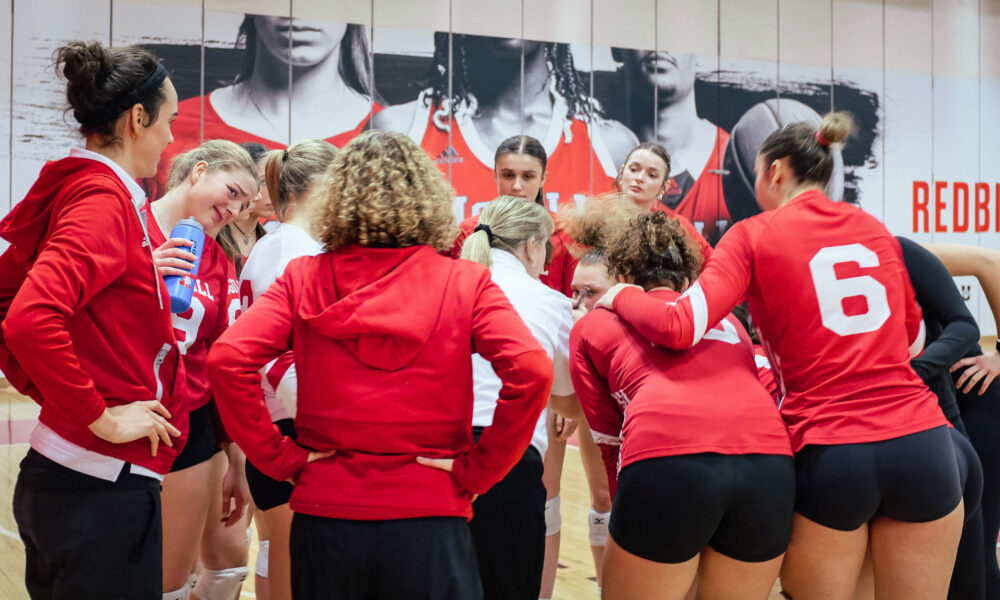
Martlets Volleyball faced up against the Université de Montréal Carabins in the first of a three-game semifinal series on Feb. 21 at the Centre CEPSUM. The fourth-ranked Martlets were successful in their aim to bring down the top-seeded Carabins in the matchup, which ended in a 3-1 victory for McGill. Elyssa Lajmi, who has been a powerhouse for the Martlets this season, led the team with 15 kills and 2 aces. Rachel Leduc and Sandrine Methot also had impressive performances, scoring 11 and 8 kills respectively, to bring the Martlets the victory. 

However, with a first-round win in a best-of-three series, it is only too easy to get comfortable. The Martlets fell to the Carabins the following day at Love Competition Hall in a battle that went to five sets. The game was truly a team effort by the Martlets, as it was the first time this season that five players achieved double digits in scoring—Lajmi put up 17, Leduc had an impressive 16.5, Charlotte Chouinard-Laliberte helped out with 15.5 points, and Emilia Grigorova and Methot each added 11 points to the scoreboard. Despite this, the match went to the Carabins, who had a 15-9 victory in the fifth set. 

In the third and final series game at Centre CEPSUM on Sunday, Feb. 23, both teams looked for a spot in the RSEQ Championship series. Though the Carabins were victorious in three straight sets, it is a testament to McGill’s perseverance that in the second two sets, the game got closer and closer. While the first set went to the Carabins 25-17, the second set went 25-20 to the Carabins, and the final set was a nail-biting 26-24 Carabin victory. 

(Armen Erzingatzian / The Tribune)

Track and Field RSEQ Championships:

McGill competed in the RSEQ Championships on Feb. 22, with the Martlets placing third while the Redbirds placed second out of ten teams. Athletes competed in several events, many with the hopes of qualifying for U SPORTS championships.

The Martlets secured two gold medals, with Julie Bortolato placing first in the pole vault and Rebecca Warcholak winning the triple jump. Vanessa Lu Langley scored a silver medal in the 60-metre hurdles, matched by silver medals from both the 4×200-metre and 4×800-metre relay teams. The 4×400-metre relay team placed bronze, as did Kaelie Sanogo in the pentathlon.

For the Redbirds, gold medals came from Luca Nicoletti in the 300-metre, Sacha Dernoncourt in the 1000-metre, Robert Gerstner in the long jump, and the 4-800-metre team who had previously broken the school record in the uOttawa Winter Classic. The 4×200-metre and 4×400-metre relay teams each clinched a silver medal, as did Ben Gates in the 600-metre, Samuel Hepworth in both the 1000-metre and the 1500-metre, and Kilty McGonigal in the heptathlon. To top off the Redbirds’ thirteen-medal tally were bronze medals from William Sanders in the 300-metre and Gerstner in the 60-metre and triple jump.

Between March 6 and March 8, qualifying athletes will compete in the U SPORTS National Championships in Windsor, BC. All athletes who won a gold medal at RSEQ Championships automatically qualify for a spot at Nationals.

McGill, News, SSMU

SSMU’s VP Finance could be hired, versus elected, after the Winter 2025 Referendum

The Students’ Society of McGill University (SSMU) Legislative Council approved the Motion Regarding Amendment to the Constitution on Feb. 13. Two items of the motion are now up for student vote on the Winter 2025 Referendum ballot: The decision to hire instead of elect the SSMU Vice-President (VP) Finance, and the choice to cut the SSMU VP Sustainability and Operations role entirely.

Hugo-Victor Solomon, current SSMU VP External, began drafting a motion in the Fall term to make VP Finance hired after learning that under a VP Finance with no fiscal or accounting experience who dispensed funding liberally, the SSMU went into a $1.3 million CAD deficit.

Both Solomon and SSMU President Dymetri Taylor attributed current VP Finance Pauline Jolicouer’s background in finance as a reason why SSMU has managed to achieve a $290,000 CAD surplus this year. Solomon described the prevention of disaster and positive ripple effect having a strong VP Finance has on SSMU’s operations.

“Given that SSMU does manage a portfolio of essentially $10 million [CAD], you want to have faith that someone in that position knows how to do their job, so that everyone else can do theirs,” Solomon said.

Gursween Padda, VP Finance of the South Asian Studies Students Association, expressed a hired SSMU VP Finance could ensure their financial competency and timely reimbursement for SSMU clubs and services.

“[A VP Finance’s] nucleus is really money, and making sure they’re getting the money they need to run and not go into debt,” Padda told The Tribune. “And that requires particular skills.”

According to section 10.3 of the SSMU Constitution, if the referendum question passes, the VP Finance will be hired by the Board of Directors (BoD) at the same time other executives are elected by the student body. Anyone interested can put their name forward for consideration, just as in an election. Taylor clarified that either a Board-appointed hiring committee, or the Legislative Council, would look predominantly at these candidates’ experience in finance to select a VP, although Taylor reported SSMU is still deciding between “options on the table” for selecting this committee.

Padda expressed that she felt it would be best to have an external body hire the SSMU VP Finance, to avoid conflicts of interest.

“When the governing body has so much power that they can choose who’s elected or not, that’s not democracy,” Padda said.

The appointed candidate would then be placed on SSMU’s Referendum ballot for ratification by the student body, providing what Solomon termed a “veto” mechanism in case SSMU members are not in favour of the recommended candidate. If students invoke this “veto” privilege, SSMU would have to hold an additional special Referendum to appoint a new candidate, or the BoD may “delegate them responsibility of the position [without] the voting power,” according to Solomon. This would mirror Hamza Abu Alkhair’s appointment to Director of Clubs and Services in January 2025.

Taylor and Solomon described how concerns about the VP Finance role emerged alongside discussions about the VP Sustainability and Operations’ utility, following Meg Baltes’ resignation in November 2024. Both Taylor and Solomon reported that after the SSMU by-election to establish a new VP Sustainability and Operations failed to meet quorum, executives did not experience any internal issues with portfolio management. 

Solomon’s motion thus seeks to eliminate the VP Sustainability and Operations role and formally designate its responsibilities to the VP Internal, excluding building oversight, which would be delegated to the President. Taylor explained how from an executive standpoint, the VP Sustainability and Operations role is expendable, having been established in 2016 but only occupied twice since. 

“Compared to all the other portfolios, the VP Internal and the VP Sus-Ops likely have, quote-unquote, the ‘least’ amount of work,” Taylor said. “They’re both kind of the halves of what makes the actual position in its entirety.”
Solomon and Taylor additionally argued for the $42,000 CAD cutting the role would save. Taylor described some potential uses as hiring a third porter for the University Centre to help extend building hours, or contracting internal security for Gert’s. The two also cited a consultation process listed in the Motion of speaking extensively with SSMU paid staff, before soliciting general student feedback in mid-January through the SSMU Instagram.

Campus Spotlight, Student Life

News of a policy change comes out of the Blues

Blues Pub is one of the several student-run bars on campus, providing cheap beverages, delicious food—the grilled cheese is top-tier—and entertainment. While Blues is run by the Engineering Undergraduate Society (EUS), it has made the McConnell Engineering Building basement a classic Friday night pit-stop for students from all faculties. One of Blues’ distinguishable features is that it offers live musical performances from bands and DJs, creating an authentic vibe and welcoming environment—which might explain the reaction of students after being hit with news of an amendment to Blues’ policy. 

On Feb. 11, Instagram was turned upside down when Blues announced that only students with a Faculty of Engineering McGill ID would be allowed entry. Engineering students would still be allowed two 18+ guests. The announcement resulted in a swift public outcry from unhappy students. While the rationale behind the decision was not made public, students speculated that overcrowding at Blues may have been a driving factor.

Pinak Ghosh, a recent graduate from the Faculty of Engineering and a regular at Blues for years, commented on the bar’s crowd evolution since the pandemic.

“I remember the first Blues back from COVID, during E-Week Feb. 2022. Since then I’ve been a regular [….] When I first went it really was just engineers, only the graduating students really had an attachment to Blues [….] Since they introduced live music many more people from other faculties started coming,” he wrote in a statement to The Tribune.

Though the spacious McConnell basement’s circular area can fit a large crowd, it has its limits. According to Álvaro Tomassoni, U2 Engineering, the growing popularity of Blues has recently led to overcrowding issues that could explain the introduction of the policy—though he considers it a bit extreme. 

“The lineups at Blues have gotten significantly longer than what I’m used to, especially compared to last year [….] I don’t think [Blues] should be closed to other faculties of course, but I think there should be an order of people who can go in first,” Tomassoni said in an interview with The Tribune

The following day, Blues Pub deleted its initial publication and subsequently posted another announcement apologizing for the policy change, revoking it, and stating that the upcoming Friday night Blues would continue as usual, with no priority for engineers. They also announced the formation of a working group “in order to better hear the engineering community.” While some cheered on student activism, others highlighted how quickly things can escalate on social media. The comments on the initial announcement were filled with students sharing their opinions—both support for the policy and critiques of its consequences were expressed blatantly.

Other student bars on campus took this as an opportunity to promote their own activities. On the same day, Bar des Arts (BdA), 4à7, Detention Den, and MUSA Bar posted a joint statement in a humouristic video intended to “condemn [Blues Pub’s] protectionist policies” and welcome students from all faculties to attend their events.

Though the ban was lifted, the overcrowding issue remains salient. Tomassoni offered a potential solution which would allow Engineering students to take advantage of their priority access while still accommodating students from other faculties—therefore making everybody happy.

“I think a good idea to [prioritize people in Engineering] would be to make it so that from 4 to 6, which is happy hour, […] you can only go in if you’re an engineer and you can have one guest. And then from 6 p.m., it’s open to everyone else,” he suggested. 

Looking forward, the creation of a working group will foster discussion about other ways to manage Blues’ crowd, allowing students’ voices to be heard and Blues to remain a welcoming environment for all. As Blues’ second commandment states: “Thou Shalt Bring Engineers and Friendgineers Alike.”

Student Life, Student of the Week

Student of the Week: Khadijatu-Dimalya Ibrahim

Khadijatu-Dimalya Ibrahim is driven by a simple yet powerful belief: Change starts at home. Before tackling global issues, she prioritizes uplifting and supporting those immediately around her. A U2 student in Software Engineering and Islamic and African Studies, Ibrahim is a source of positivity and kindness, dedicated to leaving a lasting impact on and off campus. 

As co-founder of the Black Muslim Association (BMA), Ibrahim has helped create space for Black Muslim students to find community, education, and self-empowerment. Her impact has not gone unnoticed; this year, she received the Centre Culturel Islamique de Québec (CCIQ) Memorial Award, which honours the six men who lost their lives during the 2017 Quebec City mosque attack. The award recognized her work advocating for Muslim inclusion, particularly for Black Muslims.

Ibrahim’s advocacy began well before her time at McGill. As President of Dawson College’s Muslim Student Association (MSA), she led initiatives combining activism and community care. In 2021, she spearheaded a bake sale that raised $4,000 CAD for the Nisa Foundation, a non-profit organization providing shelter, financial assistance, and resources for Muslim women and families in need. Ibrahim also hosted an event called  “Try the Hijab,” inviting non-Muslims to experience wearing the hijab to challenge misconceptions and humanize the experience of women wearing the hijab.

Her desire to embrace intersectionality and create spaces for others to do so in a world that often forces compromise led her to co-found BMA at McGill. 

“It’s wanting to balance both of my identities without having to forego any of them,” she shared with The Tribune. “In certain spaces, it’s more my ethnicity that takes precedence; it just so happens that there are some activities I can’t do. There is a cognitive dissonance where you pick, [and] either leave your faith at the door [or your ethnicity], and I wanted both activities that deal with my faith and people that look like me too.”

Through the BMA, Ibrahim seeks to educate Black Muslim students about their rich history, culture, and religion, all while challenging stereotypes around African culture. The association hosts events fostering unity and support for Muslim communities in Montreal, including a recent food drive on Feb. 1 for the Sister Sabria Foundation. While she aims to challenge anti-Muslim prejudice, her primary focus is on building a strong community for Black Muslims on campus, with hopes of expanding her reach internationally, particularly to the U.S. and African countries. 

“Black spaces are important for ourselves​​—for us, by us,” she told The Tribune. “We really want to […] allow people to enjoy who they are.” 

However, her work is not limited to the Black Muslim population. While balancing academics and extracurriculars, Ibrahim also finds time to volunteer at the Bilal Islamic and Cultural Center of Quebec in Montreal, organizing local events to strengthen bonds and representation.

Receiving the CCIQ Memorial Award on Jan. 3 was deeply meaningful for Ibrahim. It highlighted the importance of remembering the 2017 tragedy, combating Islamophobia, and humanizing Muslim communities. Ibrahim shared how her father, a devout man who attends mosque each morning, is constantly subject to the lingering fear of Islamophobic violence. 

“I saw my dad in these men. And, even if I didn’t see my dad in these men, they are human lives,” she explained.

Appearing on CityNews Montreal to discuss her award was another milestone in her advocacy, allowing Ibrahim to reach an audience beyond social media.

Looking ahead, Ibrahim hopes people take away from her experience that university degrees, personal interests, and even hobbies can play an important role in helping local communities and creating cultural spaces.

“University is the only place where you’re sheltered but also an adult. You can easily protest, and while it can be a process where you are lonely, university makes you navigate with [like-minded people],” she said. Ibrahim’s work exemplifies the power of leadership and self-empowerment. By embracing her intersectionality and challenging the barriers that come with it, she has created a space for others to do the same.

“The main point is […] equipping us with the knowledge we need to be proud and confident whether it comes to our culture or our faith as well.”

Basketball, Cross-Country / Track, Hockey, Sports

Game changers on and off the field—the stories of four Black Canadian women athletes

Black athletes have consistently pushed boundaries in both sport and civil rights to further opportunities for others. In many cases, the success or popularity of a sport can largely be attributed to the hard work and dedication of Black competitors. It is especially crucial to recognize the contributions of these trailblazers during Black History Month, to fully acknowledge their impacts. Alongside the modern superstars growing their respective sports, it is equally important to thank past athletes who may not have been as popular or well-known during their time, but whose advocacy has led to greater opportunities for modern Black athletes.

Kingston, Ontario’s Aaliyah Edwards may only be a 22-year-old rookie, but she has proven that she can hang with the best. The sixth overall selection in last year’s WNBA draft by the Washington Mystics, Edwards was Team Canada’s youngest player at the Tokyo Olympics at 18 years old, and was a two-time U.S. Basketball Writers Association All-American during her time at the University of Connecticut. Her community in Kingston remains incredibly important to her. This past summer, she ran a co-ed basketball development camp in Kingston intended to inspire young hoopers across the province. The camp helped athletes realize that their basketball dreams may be reachable.

Some athletes have the chance to shine, only to have the opportunity to compete on the world stage swept out from underneath them. What sets them apart is how they respond. While Canadian Sports Hall of Fame inductee Barbara Howard’s time in the spotlight may have been short, her 40 years off the track are the greatest part of her lasting legacy. Howard first gained attention when, in a time trial, she set a mark in the 100-yard dash that was good enough to break the Commonwealth Games record. 

In 1938, Howard became the first woman athlete of colour to represent Canada in an international sporting competition. However, she never got the opportunity to compete again, as the Second World War derailed plans for future competition. Undeterred, Howard returned to Vancouver to teach at an elementary school for four decades. She continued to break barriers, being the first member of a visible minority to be hired by the Vancouver School Board.

Sarah Nurse has become one of the biggest hockey superstars in the nation. A decorated forward with two Olympic medals and five World Championship medals for Team Canada, Nurse is a dominant force for the Toronto Sceptres in the Professional Women’s Hockey League (PWHL). Few athletes can claim as much responsibility for their sport’s success as Nurse. As the creator of the Professional Women’s Hockey Players’ Association, Nurse was part of the team that founded the PWHL itself, an incredible achievement. She then joined the executive committee for the league’s labour union, advocating for her fellow PWHL athletes.

Like Nurse, Angela James had no equal on the ice. The current crop of PWHL stars owe much of their success to James, a women’s hockey pioneer. In a time when women’s professional hockey leagues were few and far between, James showed her true dominance on the international stage. She won four World Championships as the team captain, and was one of the first three women to be inducted into the Hockey Hall of Fame. In her international career, James recorded 33 goals and 21 assists for a total of 54 points. She was inducted into the Order of Hockey in Canada in 2021.

These athletes should be lauded for their continuous efforts to grow women’s athletics across the board. Their influence in their sports, coupled with their advocacy away from the playing field, makes them perfect role models for young athletes. James and Howard did not receive nearly enough attention in their playing days, and their inductions into the Canadian Sports Hall of Fame show a renewed effort in ensuring that their legacies are preserved forever. For Nurse and Edwards, their work away from competition may be the most important aspect of their careers, and should be given an enormous amount of credit for being a driving force in the popularity of women’s sports.

Commentary, Opinion

President Deep Saini owes McGill students more than his own partisan renditions

McGill President and Vice-Chancellor Deep Saini’s recent messaging surrounding the on-campus pro-Palestine protests against investments and ties to Israel have repeatedly characterized those involved as violent and vandalizing, leaving little mention of the intent behind their actions. His language does not merely criticize the breaking of windows—to me, it paints the protestors as threats to order itself, erasing the political urgency that led to their demonstration.

This fear-mongering language—referencing mob rule, cacophony, and terror—functions to spread antagonism towards the protestors’ destruction of property, both on the night of Feb. 5, when protestors smashed the windows of various McGill buildings, and prior. Saini’s brief mention of the university’s resolute stance on Boycott, Divest, and Sanction (BDS) regarding the State of Israel hints that the property damage stood for more than vandalism; however, his critical language suggests the contrary.

These evident biases in the frequent messages to the McGill community beg the question of the president’s obligations. On the one hand, he speaks on behalf of the administration, representing those at whom the damages were directed. However, he is also addressing the McGill community directly, and therefore owes his audience a comprehensive and nonpartisan truth that avoids the demonizing language he employs. In the latter regard, Saini’s rhetoric strays far from the mark.

Given the growing antagonism between the administration and the protestor body, Saini’s rhetoric only fosters further division, rather than bridging the divide. His duty, rather than offering his own vision of the protestors, should be to service the broader McGill community with information and resources such that individuals may draw their own conclusions. His position as President of McGill means that his language does not merely inform the McGill community—it actively influences their perception. When such communication is dismissive of the central motivation behind the political activism it condemns, Saini’s audience must contend with the blurred lines between fact and presidential opinion. Saini thus fails his presidential duty to the McGill community, which notably demands a leadership role in promoting McGill’s broad well-being. In assuming such a role, he obligates himself to each constituency of the university—the administration, the faculty, and the student body—in equal part. As such, his commitment to community well-being calls for constituents who are, if not in agreement, then in decorum; Saini’s harsh rhetoric definitively harms this presidential ideal.  

This is not to say that Saini ought to promote the protestors’ actions as noble or well-meaning. On the contrary, doing so would fail his imperative in equal measure to his reductive condemnations. Rather, the notices Saini issues to the McGill community are obliged to fact and incontrovertible truth—or as close to this as such a memo can manage. That is, it is his imperative to present the community not with an argument, but the firm basis on which his audience may construct one, be it for or against those in question. The president’s current language, describing the Feb. 5 protestors as violent vandals, disrupting peace and education, serves no purpose but to curate the information reaching his audience, and thus influence student-held views; or perhaps it only serves to alienate the student body. His rhetoric reminds me of what I saw in the mainstream media, demonizing pro-Palestinian protestors rather than truly listening to their demands, engaging with their arguments, and walking a moderate line between the parties in dispute. 

This being said, it is crucial that students turn their attention to the motives behind Saini’s presentation of student protest. As it stands, Saini presents the McGill community with a highly curated and reductive view of events focused on the physical destruction of property while ignoring the pressing message behind the protests. This stands firmly against the McGill community’s right to unambiguous, axiomatic truth on which to form its own decisive opinion. As such, his imagery and language deserve at once criticism and skepticism. Indeed, Saini’s communications—while riddled with notions of antagonism and presumption in line with the administration’s ongoing use of disparaging language surrounding the BDS goals—are not to be completely neglected. However, they cannot be taken as a source, nor even a cross-section, of truth. Rather, Deep Saini’s words are best regarded as they are: Another divisive, albeit reputed, man’s opinion.

Read the latest issue

Read the latest issue