


Latest News

Science & Technology

Our universe through the James Webb Space Telescope

For some, seeing images of distant galaxies induces feelings of excitement and curiosity. For others, it sparks fear and a sense of insignificance. And who can blame them? It’s easy to feel small when living in a seemingly infinite universe.

The James Webb Space Telescope

On Feb. 14, at the sixth McGill Physics Society Colloquium of 2025, guest speaker Sarah Rugheimer—an astrobiologist and Associate Professor at York University—delivered a lecture on the James Webb Space Telescope, the most technologically advanced space observatory ever created. Known for its breathtaking images of distant galaxies and cosmic phenomena, Webb has opened new frontiers in our understanding of the universe.

Rugheimer began by explaining the remarkable technology behind Webb, focusing on its primary mirror, which is composed of 18 smaller, gold-plated mirrors that measure a combined 6.5 metres in diameter.  

“These 18 different [mirrors] are each getting their own image, and then they have to be brought together to sing as one choir, so to speak, so that they actually are functioning as a single telescope,” Rugheimer said in her lecture.

The mirrors work together to concentrate their light onto one smaller secondary mirror which reflects back to the telescope’s processing system, ultimately allowing Webb to capture extremely high-resolution images. To reflect their light onto such a small point, each mirror must be able to adjust its position within eight nanometres of precision, equivalent to one ten-thousandth of a human hair.

Webb & Hubble

Before Webb claimed the title of ‘most advanced telescope ever built,’ the Hubble Space Telescope was the reigning champion. Hubble, a reflecting telescope, captured the first images of deep space, revealing thousands of galaxies, each with hundreds of billions of stars. First launched in 1990 and still functioning today, it has fundamentally changed our understanding of the universe. 

While Hubble captures light in the ultraviolet and visible spectrum, Webb’s much larger mirror surface allows it to capture longer, infrared wavelengths of light. Because our universe is expanding, light waves from distant galaxies are subject to the Doppler effect, meaning they have been stretched by the time they reach us. These stretched wavelengths are redshifted into the infrared frequency range, making Webb an ideal candidate for capturing them.

“James Webb [Space Telescope] is needed in order to see those most distant galaxies because that light has really shifted to those infrared wavelengths. So Webb is able to just look back further than Hubble ever could,” Rugheimer explained. 

Infrared wavelengths also paint a clearer picture of our universe, since they travel right through clouds of gas and debris, revealing details that Hubble couldn’t capture.  

Together, these telescopes give us clues about the early stages of the universe’s formation. The light emitted from these distant galaxies has often been travelling for billions of years by the time it finally reaches the telescopes’ point of view.  

“Hubble can see back to about a billion years after the Big Bang, and Webb is able to go back to 0.3 billion years.” Rugheimer said. “Telescopes are time machines in a way, because of the constant speed of light. The further we look away, the earlier the parts of the universe we see.” 

From exoplanets to our own solar system

Webb’s scope isn’t limited to galaxies and supernovas: It is also helping scientists explore exoplanets—planets outside of our solar system. Rugheimer highlighted the TRAPPIST-1 system in particular, containing three Earth-sized exoplanets in the habitable zone, where conditions may be suitable for life.

Closer to home, Webb has also captured the clearest picture of Neptune’s rings in existence and imaged water plumes on one of Saturn’s moons that are larger than planet Earth.

Rugheimer shared a personal moment during Webb’s launch on Christmas Day, 2021, reflecting on the significance of Webb in our journey through the universe. 

“We were watching it on our cell phone, my husband and I, and I started to cry as this telescope launched: This is really the telescope of our generation.”

McGill, News, The Tribune Explains

The Tribune Explains: McGill’s ongoing construction projects

In August 2024, McGill Vice-President (Administration and Finance) Fabrice Labeau and Provost and Executive Vice-President (Academic) Christopher Manfredi announced the provincial government’s changes in its funding mechanism for university construction and renovation projects. As a result of these changes, new projects and all calls for tender for construction have been halted at McGill.

At McGill’s second budget town hall of the academic year on Feb. 7, President and Vice-Chancellor Deep Saini highlighted additional financial pressures the university is facing. 

In light of the university’s projected financial deficit, The Tribune breaks down the funding processes behind current and future construction projects at McGill, and examines the timelines of these various projects.

What are some of the outstanding construction projects at McGill?

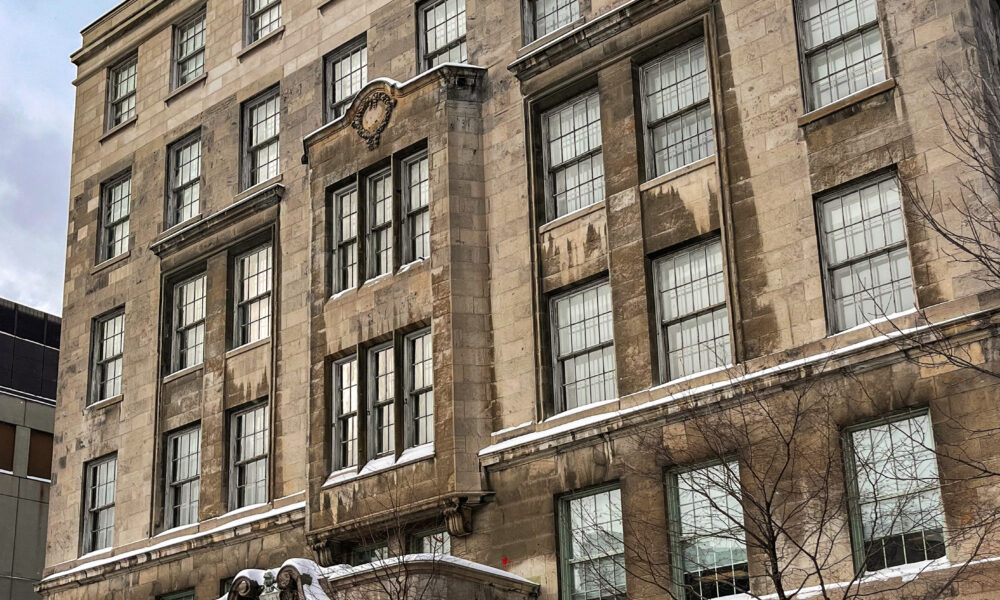
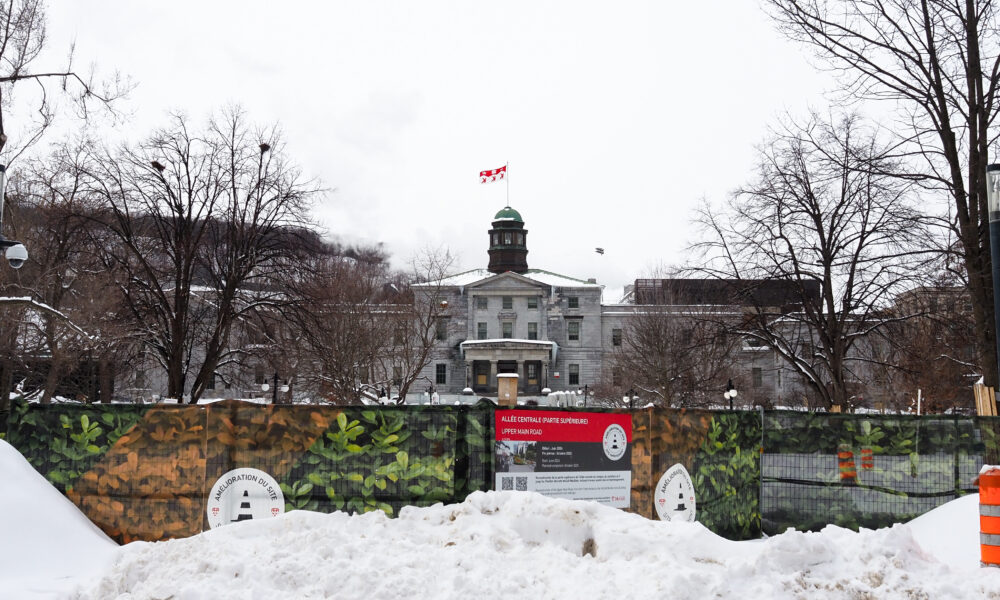
The McGill Downtown Campus’ Upper Main Road, otherwise known as the Y intersection, has been under construction for eight months. The project was outlined in McGill’s 2019 Master Plan, with construction beginning in June 2024. The Master Plan set out short-, medium-, and long-term plans to improve the built environments of McGill’s Downtown and Macdonald campuses. 

In a statement to The Tribune, the McGill Media Relations Office (MRO) wrote that although some construction projects may seem stalled, it can be due to the phasing of work and environmental factors.

“The Y intersection redesign is a project that involves ground infrastructure,” the MRO wrote. “Though some work can happen during frost periods, other phases must wait for warmer periods.”

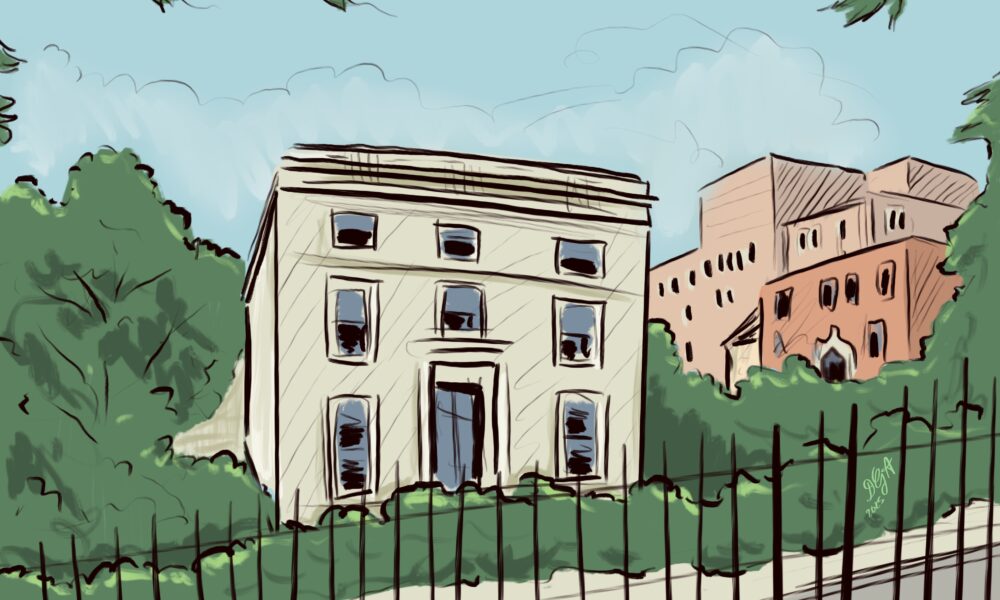
The New Vic Project, which was first introduced in 2015, has been under construction since 2022. The project takes place in part on the grounds of the former Royal Victoria Hospital, whose Allen Memorial Institute was a site of the CIA’s MK-ULTRA mind control and chemical interrogation experiments. Since its inception, the Kanien’kehá:ka Kahnistensera (Mohawk Mothers) have contested the project, arguing the site may hold unmarked graves. Despite the Mothers’ calls to halt construction and undertake a comprehensive investigation of the site, McGill maintains that the New Vic will be completed and inaugurated in 2028.

Other ongoing construction and renovation projects include the Strathcona Music Building, the Raymond Building on the Macdonald Campus, the New Residence Hall, and the McConnell Arena. Currently, there are over 60 ongoing or planned construction projects at the downtown campus.

Pending or new construction projects, like the Fiat Lux library project, have been suspended until further assessment.

How will cuts to McGill’s financial budget affect current and future construction projects?

The McGill Media Relations Office (MRO) wrote to the The Tribune, clarifying that construction projects are not affected by McGill’s financial budget.

“Capital projects like construction are not part of the operational budget. They have their own envelope,” the MRO wrote. “Government rules require that these remain totally separate.”

What factors may affect the timeline of McGill’s construction projects?

McGill construction projects require governmental approval as they are heavily funded by the provincial government of Quebec. With Labeau and Manfredi’s announcement on the government’s yearly cap on provincial funding, the university has to suspend new construction projects. In turn, this may delay the completion date of various construction projects.

In addition, any construction or renovation project in the Golden Square Mile must be approved by the Ministre du Patrimoine Pascale St-Onge due to the neighbourhood’s historical significance. 

The Golden Square Mile, bordered by Avenue des Pins on the north, covers most of McGill’s Downtown Campus. Most construction projects on campus therefore require this second layer of approval, adding time to their completion.

For more information on McGill’s current construction projects, visit the McGill Interactive Accessible Network Map. For future construction projects, visit McGill’s Campus Planning and Development Team’s Master Plan.

Off the Board, Opinion

McGill’s “gatekeeper courses” are against the spirit of education

The first time I expressed my desire to attend McGill, my enthusiasm was met with a warning: “You might get in, but it’s difficult to stay in.” They meant that although the university does not have the traditionally single-digit acceptance rates of American Ivy Leagues, the difficulty and low averages of many McGill courses make passing classes almost as difficult as getting into the university itself.

Courses taken early in one’s degree, like BIOL 200 (B- average in Fall 2022 and Fall 2023), MATH 140 (B- average in Fall 2023 and C+ average in Winter 2024), and ECON 209 (B- average in Fall 2023 and Winter 2024, and C average in Summer 2024) have been notorious for their incredible difficulty, leaving a sense that the course is designed to “weed people out” of the program or school. This seems extremely counterintuitive, especially in a student’s first or second year when they are just starting to navigate university life and venture into new areas of study. 

University degrees are structured so that students must learn the foundations of their desired program before moving on to upper-level courses that will make use of those same concepts throughout the rest of their degree. The purpose of early-degree prerequisites should be to solidify students’ knowledge in preliminary concepts before they either specialize or proceed to upper-level courses, not to discourage those who don’t immediately excel. 

Yet, even for those who don’t get “weeded out”, the high-intensity nature of these foundational courses might weaken a student’s academic foundation. When a student spends a prerequisite course cramming and struggling to keep up rather than thoroughly absorbing the information—especially if they are taking several of these types of courses at once—they will enter future classes without a strong enough grasp on the foundational material to succeed. 

As such, these courses essentially “gatekeep” certain degree programs by demotivating students with intense and excessive requirements, leading them to transition to another program they might be less passionate about, or even to a different school entirely. Foundational courses at McGill seem to serve as a test instead of an opportunity to learn, be inspired, and build important skills that will be useful in upper-year courses. Such a system design fails to reward a desire to learn, meaning students end up neglecting courses that inspire them in favour of courses they know they will pass.

The feeling of working hard and still struggling academically has adverse mental health implications, especially for those with learning disabilities or for students who are struggling to adjust to university life. The first year of university requires coming to terms with newfound independence, residence life, unfamiliar social situations, and, for some, even a new country and culture. Unnecessary academic pressure makes this transition even more difficult.

It is true that McGill is a world-class educational institution and therefore needs to hold itself to certain academic standards, but the purpose of a university is to teach and uplift, not to hastily thin the crowd of first-years probing a newfound interest in economics or biology. If courses prioritized supporting students to retain information and less on trying to “weed people out,” then a more accurate sample of people who would not thrive in a program or at the school would self-select. This is a much better alternative than discouraging students with a passion for their desired program by subjecting them to intense preliminary courses and low-grade averages. Instructors can and should encourage learning and retention without compromising academic rigour, and course material should be appropriate for the level of the course. McGill as an institution should be uplifting the students it accepts, rather than using difficult early-year classes to prey on their downfall.

McGill, News

McGill Senate discusses smashed windows and budget cuts at Feb. 12 meeting

Smashed windows of campus buildings, academic freedom, and upcoming budget cuts were among the discussion items at the McGill Senate’s Feb. 12 meeting.

The meeting began with memorial tributes to Patrick Dias in the Faculty of Education, Patrick Farrell in the Department of Chemistry, and Abraham Fuks in the Faculty of Medicine and Health Sciences. McGill President and Vice-Chancellor Deep Saini, the Senate Chair, then moved to the Report of the Senate Steering Committee

Saini then addressed the Senate regarding the protestors who smashed windows of the Leacock, McCall-MacBain Arts, Dawson Hall, and James Administration Buildings on the night of Feb. 5. Saini noted that “an anarchist group […] with no known connection to McGill” has taken responsibility, stating they were protesting McGill’s refusal to divest from companies with ties to the state of Israel. The base repairs are expected to cost McGill hundreds of thousands of dollars. 

“Even higher, though, is the price to our collective morale,” Saini said. “Our campus cannot continue to bear the brunt of outrage caused by a war half a world away.”

Saini then read two written statements from instructors whose classes were writing exams in Leacock when the protestors smashed the building’s windows before concluding that the university cannot make decisions “rooted in response to threats.” From there, he opened the floor to comments.

Arts Senator Anzhu Wei noted students’ frustration with a lack of communicable channels with McGill, particularly surrounding the university’s investments in companies connected to Israel. Wei highlighted that 78.7 per cent of voting students in the Fall 2023 referendum voted in favour of the Policy Against Genocide in Palestine, which called on McGill to divest from such companies. An injunction subsequently suspended the policy. 

“I’m not saying that McGill should make any decisions in response to violence or intimidation,” Wei said. “I think where a lot of the frustration comes from is that disconnect between what students want and what students want to say and what they perceive McGill to be taking in as input.”

The Senate moved on to address McGill’s expected budget cuts as the result of a projected $15 million CAD deficit for the current fiscal year. Engineering Senator Nathaniel Quitoriano asked what role the Senate would have in determining how the cuts will be allocated given the Senate’s jurisdiction over academic matters at McGill. Saini responded that budget cuts are administrative in nature, but situations of academic concern would be brought to the Senate, such as the hypothetical amalgamation of departments.

“Or, in an extreme scenario, there’s a suggestion to eliminate a faculty to save money,” Saini said.

The Senate then addressed questions from members. The first—submitted by Wei and Arts Senator Vivian Wright, concerning artificial intelligence and pedagogy—was deferred to Provost and Executive Vice-President (Academic) Christopher Manfredi, who was not present but provided a written response. Manfredi also answered the second question—submitted by Quitoriano and Member-at-Large Christa Scholtz—about the Report on the Policy on Indigenous Membership

Student Senator Abe Berglas raised concerns regarding this report’s accessibility. 

“It’s quite difficult, if you start from the main page of the Office of Indigenous Initiatives [website], to find the report. I wouldn’t have been able to find it if I didn’t work backwards from the full hyperlink,” said Berglas.

Saini noted the feedback before turning Senators’ attention to the annual reports on the Action Plan to Address Anti-Black Racism, Student Life and Learning, the Committee on Student Services, the Equity, Diversity, and Inclusion (EDI) Strategic Plan, and the EDI Committee.

The meeting ended with a confidential session regarding an honourary degree.

Moment of the Meeting: 

The two written statements from instructors—who were teaching and invigilating when the protestors smashed windows in Leacock—reported a climate of uncertainty, with one noting that some students screamed out that there was a shooting, while another described locking the doors and calling security. 

Soundbite: 

“If you think that the university should have a role in thinking through these issues, such as the ones raised by BDS, I suggest that we just have an academic conference where we talk about these things [….] I think it would be wrong to not do things just because the [protestors who smashed the windows] want something.” — Senator Catherine Lu in response to Saini’s request for comments in regard to academic freedom.

A previous version of this article stated that Catherine Lu was an Arts Senator. In fact, Lu is an Arts Faculty Senator. The Tribune regrets this error.

Science & Technology

Confronting anti-Black racism in Canada’s healthcare system

With a national identity built upon the idea of being a cultural “melting pot,” racism often gets swept under the rug in Canada. Despite curating this idealized image of inclusivity, racism is ingrained in the nation’s history and institutions, including the Canadian medical system

Khandideh Williams, a PhD Candidate in McGill’s Department of Family Medicine, shed light on inequities in healthcare through her recent publication in BMC Public Health, which explores how Black individuals perceive and experience anti-Black racism in Canadian healthcare.

“I started my work in 2020, which as we know, a lot was happening in 2020, including the murder of George Floyd. His murder brought about widespread conversations about anti-Black racism both at McGill and within my department,” Williams said in an interview with The Tribune. “It was through engaging in those discussions and learning more about anti-Black racism myself on my own time that I realized that that’s something I would like to focus on.” 

Williams interviewed 32 Black volunteers in Montreal who represented 20 different ethnicities and whose ages ranged from young adults to seniors. The diversity of the participants was reflected in their experiences of racism, supporting William’s hypothesis.

“The Black community, especially [in] Montreal, is extremely diverse. Whether we’re talking about place of birth, mother tongue, or ethnicity, we’re an extremely diverse group with diverse worldviews, ideas, and ways in which we approach different situations,” Williams said. “So for my project, I approached it with this logic that if the Black community itself is diverse, then it follows that experiences of racism are diverse.”

Williams’ research focused on two central questions: Did participants perceive racism during their healthcare interactions, and how did their unique identities and social positions influence their experiences and perceptions of racism?

For participants, the perceived racism was most often subtle and covert, manifesting itself through microaggressions and harmful stereotypes. 

“One common stereotype was that of the strong Black woman: ‘Black women don’t feel pain, so they don’t need anesthesia. They don’t need pain medication because they’re strong; their skin is stronger.’ Or that ‘Black men are drug dealers; they’re delinquents. So, we’re also not going to give them drugs because they’re going to abuse it,’” Williams said. 

The study also revealed that Black immigrants’ perceptions of anti-Black racism in Canada varied depending on their country of origin. For example, participants who had come from the UK and the U.S. found racism to be more openly discussed and overtly expressed in those countries than it was in Canada. They noted that the socially taboo nature of race discussions in Canada often made it harder to identify racism in their everyday lives. 

Contrastingly, immigrants from African countries may not have had prior experiences with anti-Black racism before coming to Canada.

“In Nigeria, in many African countries, Black people are the dominant group [….] Blackness or race is not necessarily what people use to classify people in such societies,” Williams explained. “So when [a participant from Nigeria] came here, he knew that there was this thing called Blackness, but he didn’t really understand its implications until he and his mother experienced it.” 

Williams’ research also highlights the impact of intersectionality on racism. Experiences and perceptions of racism are informed by more factors than just race, including gender and age. Williams is now focusing on a second phase of her project—a quantitative analysis with data from Quebec, Ontario, and British Columbia—to determine if these intersectional trends are consistent across Canada.

Ultimately, Williams’ work highlights the urgent need for open conversations about race and racism in Canada. We can’t make our communities and institutions equitable until we acknowledge that they are fundamentally unjust.

“I think our country is still battling with their comfort in even tackling the issue. To tackle an issue means to first acknowledge that it exists,” Williams said. “But I think many people are not yet ready to do that.”

News, PGSS

PGSS councillors debate McGill’s proposed labour cuts and referendum question selection

The Post-Graduate Students’ Society (PGSS) of McGill University held its second council meeting of 2025 on Feb. 12. After approving the agenda, PGSS councillors moved on to discuss budget cuts, hiring freezes, and questions for the upcoming referendum

The first discussion item was the potential impact of staff cuts in the Faculty of Arts on Teaching Assistant (TA) positions. This follows Provost and Executive Vice-President (Academic) Christopher Manfredi’s announcement that the university will cut 250-500 positions in response to a $15 million CAD budget deficit for the upcoming fiscal year. 

Zoe Neubauer, a third-year PhD candidate in History, explained that an internal survey in the Graduate Department of History and Classical Studies found that proposed cuts to the teaching support budget would adversely impact graduate students’ education, scholarly research, and quality of life. They requested that the PGSS circulate the survey results to all Post-Graduate Student Associations (PGSAs) in the Faculty of Arts and formally condemn the university’s proposed labour cuts.

All new business items involved adding questions to the upcoming PGSS referendum taking place April 7-14. One of the motions sought to add a referendum question on PGSS lobbying the government to make labour rights applicable to graduate research. In other words, it sought to add a question to the referendum to get the PGSS to ask the Government of Quebec to classify graduate research as a job, not just part of academic coursework. 

This motion sparked a 27-minute debate among attendees. Opponents raised concerns that such a change could affect the tax status of grants and awards and put students’ education at risk if they failed to meet job requirements. 

“Making the argument to consider grad students—Master’s and PhD students—completely as employees will completely […] disregard the fact that [they] are still students,” PGSS External Affairs Officer Naga Thovinakere said.

Supporters argued that the broader PGSS membership should decide these debates through a referendum vote and with campaigning from ‘Vote Yes’ or ‘Vote No’ committees rather than just the 60 voting members present. 

“The debates that we’re having right now and the nitty-gritty can be further dealt with [in the future],” Sheheryar Ahmed, External Affairs and PGSS representative from Graduate Islamic Studies, said. “Right now, we should focus on whether or not this should be a question that the general student body should have an opinion on.”

With 14 votes in favour and 18 against, the motion did not pass.

The council voted in favour of adding a question to the referendum on approving a new provider for online primary and mental health care for members. This referendum question stands to switch PGSS’s telemedical services from current provider Dialogue, for which members pay $45 CAD per year, to Digital Doctor, a service hosted by Maple, for $25 CAD per year, maintaining the current opt-out option. 

In addition to Digital Doctor primary care, councillors also passed a motion to add a question to the referendum regarding mental health care under the service. This would be an additional $30 CAD per year fee that members could add to their Digital Doctor primary care subscription, allowing access to online mental health care; this motion also passed with an overwhelming majority. 

Moment of the Meeting:

In its final motion of the night, the council voted to include a referendum question proposing a significant reduction to the PGSS Special Projects fee. If approved, the fee would drop from $4.60 CAD to $1.50 CAD, citing severe underuse. According to the motion, the fund has primarily served as a contingency for potential legal fees and website maintenance rather than supporting new projects in recent years.

Sound bite: 

“It’s useful [and] important to have access to some kind of virtual healthcare platform. [It is] just too bad that this requires us giving money to privatized healthcare, and it’s unfortunate that the state of our public healthcare system means that [private virtual healthcare] is something we want to do, which I and my members are opposed to [….] But I’m not opposed because we’re not going to fix the public healthcare system at PGSS [council].” — School of Urban Planning PGSA representative Brenagh Rapoport, discussing the switch to Digital Doctor. 

A previous version of this article did not list Zoe Neubauer’s name. The Tribune regrets this error.

Martlets, Men's Varsity, Sports

The faces of McGill’s athletic legacy

For the majority of university athletes, recognition comes in the form of trophies, accolades, and team victories. A special way McGill honours its varsity athletes is by wrapping doors in the Athletic Complex with their images, featuring team members from a range of sports from artistic swimming to rugby. The doors were recently rewrapped to feature current student-athletes. 

Martlets Soccer midfielder Elisabeth Pronovost, U3 Science, reflected on the experience, sharing that it feels surreal to see her photograph every time she goes to the gym and even joking that she sometimes hides her face when using her door so McGill students don’t make the connection. 

“I feel really at home at McGill, and knowing that I represent the team on that door just makes me feel like it’s both ways,” she shared. “It’s not just me enjoying McGill, but also I’m really a part of it.”

Beyond showcasing the athletes themselves, the photographs represent team memories and unique journeys that have brought these athletes to McGill. For artistic swimmer Sonia Dunn, U1 Science, that journey began at five years old. 

“One of my elementary school friends, her older sister did artistic swimming, and she invited me to her year-end show as a playdate because she found the sport really boring,” Dunn recalled. “She even brought toys so we could go play somewhere else. But I didn’t want to leave—I was just captivated from the beginning.” 

That moment sparked her dedication to the sport, a passion that has now earned her a place memorialized in the athletic centre. For artistic swimming, the rewrapping of the doors celebrates more than Dunn’s athleticism; it provides recognition of an underappreciated sport.

“McGill is one of the only universities in Canada where artistic swimming is a varsity sport, while at a lot of other schools, it’s just a club,” Dunn explained. “So, to have the additional honour of being recognized in the sports complex is really special. Obviously, it’s kind of a niche sport, so any recognition we can get is definitely a positive.”

That sense of pride extends past the walls of the athletics complex. Whether it’s the roar of the home crowd at McGill’s annual November artistic swimming meet or the soccer team’s trip to Paraguay to promote women in sports, the connections formed through competition are unforgettable. 

Nicolas Vicente Louis, U3 Management, recalled a particular bonding moment with the rugby team. 

“We had a trip to Quebec planned two winters ago, and 30 of us guys split between five or six cars, we just went away for the weekend,” Vicente Louis recalled. “[We] had a blast. We rented a chalet and just had a good time and a half.”

For those whose faces now grace the athletic complex doors, the honour is both a personal milestone and an inspiration for future athletes. Vicente Louis spoke about growing up playing rugby with his younger brother, who is currently playing rugby in high school in London. 

“There’s only one guy out of the 45 who gets a door. It’s very special […] and even in a few years, when we come back for alumni games, if my picture’s still up there, it’ll be a cool souvenir,” Vicente Louis reflected. “An added benefit is that it’ll help incentivize my little brother to come and join the team.” 

More than just a photograph, the doors tell the stories of McGill’s athletes—stories of perseverance, community, and the deep passion that makes them more than just competitors. They are a lasting tribute to the spirit of McGill sports.

“I truly feel like the team is a family, and the coaching staff is also part of that family. Representing McGill, to me, means so much and it’s like a part of who I am—a part of my identity now,” Pronovost expressed.

Art, Arts & Entertainment

When there are no words

When I was little and my parents were checking out at the grocery aisle, I would wander over to the greeting cards and wait. It was only upon discovering the floral-fronted sympathy cards that I began to realize death was all around us. With a history as banal as its subject matter, death is the unknowable reality of our everyday lives. It is one of the few universal experiences we all share and yet our relationship to it is anything but simple. In navigating loss, we often ask: What is there to be said when words fail? 

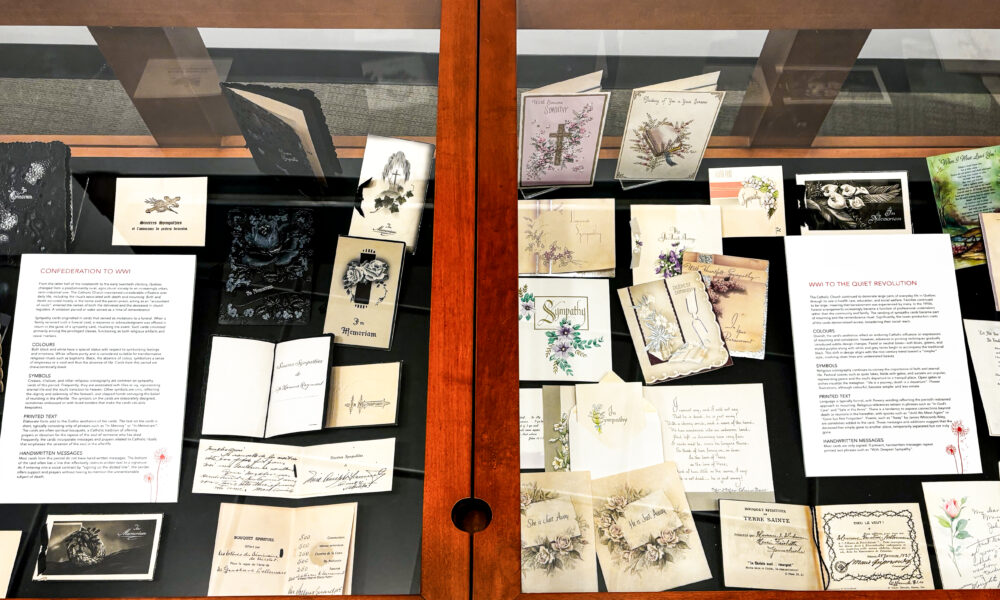
Hosted in the Osler Library of the History of Medicine until Apr. 1 and curated by the Maude Abbott Medical Museum of the Pathology Society, When There Are No Words explores the shifting sociocultural attitude towards grief through a collection of uniquely Québécois sympathy cards. The exhibit examines evolving perspectives across four primary chronological periods—Confederation to World War 1, World War I to the Quiet Revolution, the Quiet Revolution to the end of the millennium and contemporary times—tracing Quebec’s transition from a predominantly French Catholic society to an increasingly secular, multicultural one through our popular understanding of loss. 

Originating out of necessity, in a time when letters were the primary means of remote communication, sympathy cards were initially responses to funeral invitations and simple tokens to not yet provide support but rather acknowledge grief in a time where there are no words. Often featuring black motifs and restrained text, the cards offered support without having to mention the effectively unmentionable topics of death directly, exercising sensitive restraint and respect through euphemism. Through depictions of angels and written phrases such as “pray for us and the souls of purgatory,” the cards from this era reflect the Catholic overtones that dominated society, filtering into every aspect of life—even death.

From World War I through the Quiet Revolution, an “enlightened” perspective on death emerged. Sympathy cards from this period embraced minimalist pastel palettes and imagery intertwining religion and nature—gardens, gates—reframing death as a journey rather than a final departure. Handwritten cards added a personal touch but mostly echoed printed text, reinforcing tradition over individuality. 

The Quiet Revolution marked one of Quebec’s most profound cultural shifts, particularly in its ever-growing detachment from Catholicism. As Quebec secularized, skepticism of the Church grew. With rising resentment, home wakes declined, and sympathy cards shifted from funeral invitations to secular expressions of empathy. By the end of the millennium, sympathy cards had begun to trade out religious aspects for themes of nature and individualist spirituality. 

With an understanding shaped by recent scientific advancements, death is increasingly interpreted through the contemporary lens as a medical phenomenon. Sympathy cards can come from healthcare and ICU workers, reaching out to patients and their families. With personalized handwritten messages and cursive fonts mimicking the intimacy of handwriting, these cards reflect the highly individualized nature of loss. The collection’s inclusion of many more English cards than in earlier periods also reflects the changing demographics of Quebec.

In this time, we begin to reevaluate our understanding of loss, particularly the nonlinear, decentralized grief which affects not just family members but everyone who was close to the deceased. When a husband dies he leaves his wife a widow, but what is there to be said about the silently bereaved—such as the mourning of miscarriages, stillbirths, pets, ex-partners, or the passing of friends and coworkers? When society fails to acknowledge grief, is it made any less real?  

“There is a poem by Kenneth Patchen,” said Rick Fraser, Director of the Maude Abbott Medical Museum in an interview with The Tribune. “‘There are so many little dyings that it doesn’t matter which of them is death.’ I think he was expressing that we lose things all the time. There are little deaths and there are big deaths and we must pay attention to each of them because they are all a part of our lives.”

An exhibit that captures the quiet weight of grief, When There Are No Words gives voice to what words often fail to express. Quebec’s sympathy cards are not relics of the past—they are privileged living artifacts that evolve alongside us. They portray Québécois sympathy in its most intimate form. As the exhibit reminds us all—sometimes it really is the thought that counts. 

When There Are No Words is on view at the Osler Library until Mar. 30.

Hockey, Sports

Team USA dominates Finland 6-1 at the 4 Nations Face-Off

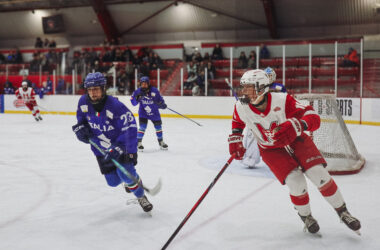
On Thursday, Feb. 13, Team USA defeated Finland in a 6-1 victory in the 4 Nations Face-Off at Montreal’s Bell Centre. The tournament—featuring top National Hockey League players from the U.S., Canada, Finland, and Sweden—is a showcase of elite international hockey. It also serves as a preview for next year’s Winter Olympics in Northern Italy, giving fans an exciting sneak peek of what’s to come.

In the first period, Finland set the pace early against the U.S., with defenseman Henri Jokiharju putting the first point on the board. This lead was cut short when left winger Brady Tkachuk struck next, tying the game for the Americans with a quick goal. Finland struggled to match the U.S.’s intensity, spending much of the remaining period defending their own zone. Goaltender Juuse Saros was under heavy pressure, making several key saves to keep Finland in the game. 

Finland controlled much of the second period, fending off Team USA’s shot attempts for the first nine minutes. Finland’s strong defence limited the U.S.’s offensive chances as the Americans looked to gain more puck possession. Despite Finland’s defensive skills, the U.S. began making more advances late in the period. Left winger Matt Boldy deflected a shot right past Saros, giving Team USA a 2-1 lead heading into the final period.

In the third period, Team USA closed down all competition with Finland in a quick turnover. Leading 2-1 at the start of the third period, the U.S. took advantage of a power play just 15 seconds in, as right wingman Matthew Tkachuk’s shot deflected off a defender’s stick and past the Finnish goalie. A mere 11 seconds later, left winger Jake Guentzel extended the lead to 4-1, finishing with a strong shot from the left circle. 

At this point in the game, there was a noticeable shift in the crowd’s energy. There was an outpour of booing and nagging from fans, solely directed at Team USA thus far in the game. A surprising number of fans were cheering for Finland, despite being so far from home. However, spectators’ loyalties switched as the Americans began to stack up goals. “USA” chants slowly rippled through the crowd as people inevitably jumped on the winning team bandwagon. 

At 3:00 into the third period, Brady Tkachuk scored his second goal of the game, just before his brother, Matthew Tkachuk, sealed the 6-1 victory with another power-play goal at 11:13. An unexpected four-goal outburst secured the win for Team USA, keeping them as a top contender in the 4 Nations Face-Off.  

The game had its share of scrappy moments and physicality, with players exchanging a few heated confrontations throughout the match. Both teams were aggressive, particularly in the second period, when tempers broke after some hard hits and close calls. A few minor scuffles broke out as players fought for possession in front of the net, but both teams kept their focus, and the game remained under control, with Team USA ultimately securing a significant victory.

Team USA’s 6-1 victory over Finland was a statement win in the 4 Nations Face-Off, solidifying the team’s elite hockey reputation. After a competitive first two periods, the U.S. pulled ahead in the third, proving their ability to dominate against such strong international competition. This victory put them in a strong spot moving forward, and inevitably helped them prepare for their matchup against Canada on Feb. 15, which they won 3-1. Meanwhile, Finland went on to restore their reputation after playing against Sweden on Feb. 15, winning 4-3 in overtime. 

Moment of the Game: Matthew Tkachuk took a shot from the point and scored by deflecting the puck off a defenceman’s stick and 11 seconds later, Jake Guentzel scored with a snapshot, all within the first 26 seconds of the third period. 

Stats Corner: Team USA took 32 total shots on net, while Finland took 21.

Art, Arts & Entertainment

Wieland exhibit at the MMFA wears its heart on its sleeve

Joyce Wieland stares with dots of navy for eyes, a dash of white for a nose, and no mouth. She is pale and faceless, yet her portrait seems to pose defiantly. She is challenging us. 

Heart Onwhich opened at the Montreal Museum of Fine Arts (MMFA) on Feb. 8—commemorates Joyce Wieland, a Canadian filmmaker and artist. Her work is deeply political and feminist, spanning a wide array of mediums. Oil paintings, cardboard collages, plastics, photography, films, and quilts line the large stone halls of the MMFA’s Michal and Renata Hornstein Pavilion

“Visitors will discover the beauty of her sensational paintings, the layered wit of her textile pieces, and the eloquence of her experimental films,” writes Anne Grace, Curator of Modern Art at the MMFA, in the exhibition press release.

Every piece in the exhibit draws a narrative as Wieland blends elements of animation, comics, and storyboarding. The foundations of her distinctive visual storytelling begin in the first room, with collage. The first few rooms showcase her early works of the late 50s and early 60s, including the faceless self-portrait, Myself (1958). Within this first room, the cardboard collages are experimental and full of wonder. It feels as if she was simply using the materials she had on hand, imbuing the work with a nostalgic and homemade quality. Her paintings in the first room are defined by bold-coloured backgrounds, wide strokes, and a spread of smaller illustrations and symbols. 

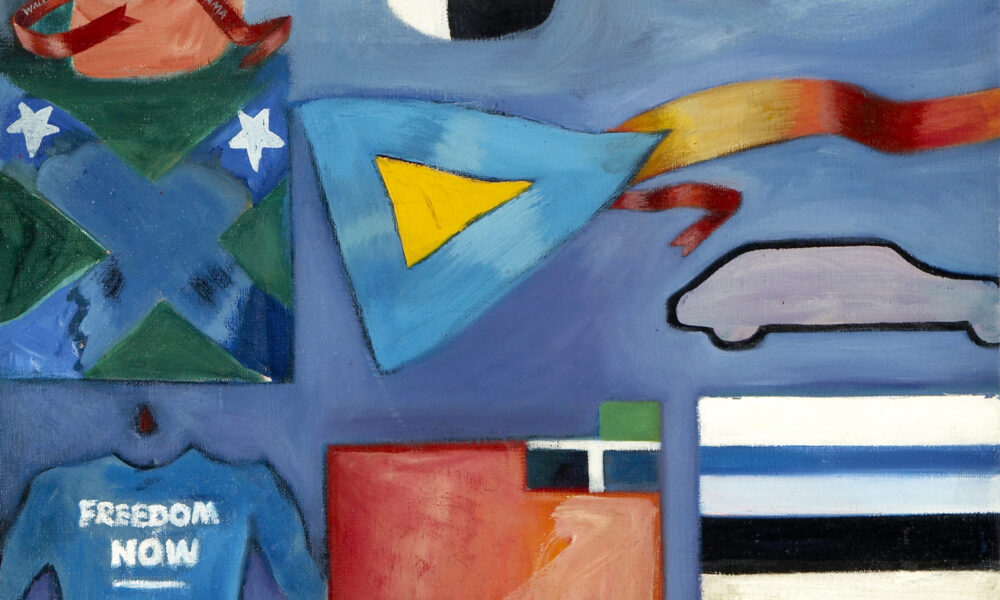
Even in her paintings, she incorporates collage: Each illustration could work as a standalone symbol, yet she combines it with others within the same painting. In March on Washington (1963), linked rings, a black-and-white heart, a Confederate flag, and a shirt emblazoned with “FREEDOM NOW,” among other symbols, recount both the tension and unity during the civil rights movement in the United States. Viewers can move their eyes through each symbol on the canvas and see a narrative unfold about the fight for racial solidarity.  

She pushes further into storyboarding with the painting Untitled (Sinking Liner)  (1963), which breaks the canvas into four sections like a comic and shows each frame of a sinking ship. She calls these “filmic paintings” as they mirror the films projected alongside the tangible displays. The films seem to tie together each element of storytelling as if each painting and collage culminated into the visuals of her films. The museum also incorporates her photography, many of them displayed on monochromatic film rolls, as if the visitor is given a peek behind the scenes, into her camera itself.

“With her seductive wit and piercing intelligence, Joyce Wieland asked us all to do better, to care more,” writes Georgiana Uhlyarik, Fredrik S. Eaton Curator of Canadian Art at the Art Gallery of Ontario, in the exhibition press release.

Wieland cements her political focus with the collection of her quilts, embroidery, and plastic artwork. She explores Canadian identity with O Canada (1970), a series of embroidered women’s lips mouthing the newly official national anthem. The embroidery brilliantly acts as an animation of singing the anthem as each embroidered lip acts as a frame that visitors can see the song being sung when their eyes move across the fabric. Many of her pieces are also made of plastic, which often feature a collage of brightly coloured plastic ‘pillows’ that recreate movie frames, flags, and a mirror. 

As visitors walk through the exhibition, the range of experimental mediums may seem scattered, lacking a centralized identity. Yet, Wieland’s multiple mediums, coupled with the curators’ choice to feature them all, challenge the idea that artists must stick to one form to craft their artistic identity. The camera roll alongside the finished films defy what it means to present a complete project as the plot of artistic development is what is celebrated. Her radical switches from painting to film to plastic mirror the revolutionary political changes of the 60s and 70s. Wieland may have started faceless, but her features are fleshed out with each storyboard, activist painting, film, and photo.

Heart On was curated by Anne Grace and Georgiana Uhlyarick. Tickets are available online until  May 4.

Read the latest issue

Read the latest issue