


Latest News

Science & Technology

When a DNA test doesn’t go the way you expected…

Imagine taking what appears to be a harmless DNA ancestry test, expecting to uncover more information about your heritage, only to be met with the discovery that your assumed parent is not biologically related to you.

Direct-to-consumer DNA tests—such as those provided by 23AndMe and Ancestry—typically provide three pieces of information: The consumer’s ethnic heritage, an estimation of certain phenotypical characteristics, and a computation of the consumer’s biological relationships to other users within the database. With nearly 30 million people having taken these tests worldwide, it is estimated that nearly one million of them receive a “Not Parent Expected” (NPE) result, accounting for three per cent of all users. 

In a recent publication in the journal BMC Psychiatry, Juliette Careau, a research assistant at the Douglas Research Centre and a recent graduate from McGill’s Master of Science in Mental Health program, investigated the mental health experiences of individuals who received NPE results from their DNA ancestry test.

“This sort of news out of the blue can be very shocking and stressful for participants,” Careau said in an interview with The Tribune. “To them, it was like losing half of themselves; it was like losing half of their family tree.”

Careau also emphasized that this experience is heavily under-researched, leaving people who discover this news with a lack of resources and no established strategy to help navigate this distressing period of time.

“Our goal was to learn more about this topic and how it can affect people, with the hopes of potentially producing resources for this population, as […] there is a lack of appropriate resources,” Careau said.

Careau collected data from 52 participants by conducting in-depth interviews, yielding qualitative data for the study. In 51 cases, participants learned that their assumed father was not their biological father, with the other case being a participant who learned that neither assumed parent was biologically related to them.

The results suggested that there were five overlapping themes at play. First, participants typically describe the experience as an extraordinary shock with a negative impact on their mental health. “I’m trying to figure out who the hell I am,” Participant 41 said in their interview with Careau.

Second, participants reported a severe disruption to their self-identity. 

“Other studies I’ve read found similar results in terms of the feelings of grief experienced by self-identity loss,” Careau said.

Next, it was commonly reported that the NPE news often ruptured relations with the mother specifically. This impact was often more damaging in cases where the participant was revealed to have been conceived through an affair. 

“Often in psychological studies, we see that we tend to blame our mother more than our father for different life events [in general],” Careau noted.

The fourth theme was that participants often sought social support through friends, spouses, or online groups through platforms like Facebook. 

“These groups were typically very useful for them, as it was very helpful to share their experiences and [be] validated by others,” Careau explained.

Lastly, a common theme across participants was seeking out mental health professionals. Interestingly, the study’s findings showed that not all participants found this support helpful.

“Some people did consult with mental health professionals [….] The experience with these professionals was a big mix,” Careau said. “[Participants said] they were not appropriately trained for the specificities of their situation.”

Careau stressed the importance of establishing future implications and guidelines for this population, with her research group working towards developing resources for clinicians to use in these specific situations.

While NPE results may appear to be a rare occurrence, they nevertheless affect one million people globally. Moving forward, examining the impacts that this type of news can have on genealogical test-takers through a more quantitative approach may help to establish better resources for those dealing with the aftermath of taking a ‘harmless’ DNA ancestry test.


Student Life

Soft power in hard times

Over the holiday, I visited the New York Public Library’s Polonsky Exhibition, a permanent collection of “treasures” that includes the original Winnie the Pooh stuffy—a surprisingly familiar Farnell Alpha bear model donated by Christopher Robin himself. Though nearly a century older, the plushy beared resemblance to my own childhood teddy. While we think of time as fixed in sepia tones, the reality of history is dynamic—relentlessly and perpetually “in the happening.” Stuffed animals have always occupied the heart-shaped, rose-tinted blindspot in our rearview mirror, capturing moments of sentimentality that transcend time. 

Though Richard Steiff of the Steiff company made the first stuffed bear in 1902, they had not come to be known as “Teddy Bears” until a historical moment involving renowned sportsman and American president Theodore Roosevelt. Roosevelt had gone on a bear hunting trip in Onward, Mississippi, with Governor Andrew Longino. While many people in his party managed to find game, Roosevelt was down on his luck. Hoping to uplift the president’s spirits, the group’s guides captured a bear to present to him. Upon finding the defenseless bear tied down to a tree, Roosevelt refused to kill the animal, declaring it unsportsmanlike. His act of mercy was quickly immortalized in newspaper headlines and political cartoons. The bear, depicted as increasingly small and more endearing with each iteration, perfectly framed Roosevelt as a tenderhearted, everyman-father archetype. Inspired by Clifford Berryman’s Washington Post cartoon of the story, Morris Michtom, a Brooklyn candy maker, manufactured a popular series of toy bears called “Teddy’s Bear” in honour of Roosevelt’s compassion

Stuffed animals surged in popularity around the Great Depression, when resources were scarce and the United States grappled with widespread economic hardship. Unlike the utilitarian woodblock toys typical of the time, plushies offered something more human: Unconditional love, soft solace and a friendly face—a much-needed emotional refuge from the harsh realities of a then-insecure world.

Today, stuffies occupy a similarly special, bear-shaped hole in the hearts of students navigating the pressures of academia. For science students especially, balancing rigorous coursework, intensive labs, and the emotional weight of studying a world in perpetual crisis can be overwhelming. Sukaina Haider, U0 Science, suggested that these challenges make moments of plush respite all the more necessary.

“In science, we’re going through the trenches. I think if anything, we’re more inclined to run home to something comforting,” she said in an interview with The Tribune.

Jorey Alharbi, U0 Engineering, reflected on how their beloved teddy bear brought familiarity and sentimental warmth to their bare-walled dorm room.

“I don’t have a lot, just one big teddy bear that my grandmother gave me before she passed. It’s the first thing I move; it helps establish home,” they shared. 

It’s integral to recognize that stuffies aren’t just inert toys—they’re transformed by the process of play. Naiya Delprat, U2 Arts, has a massive collection of 106 stuffies, nearly all named—of which she brought 28 from New York to Montreal.

“When you play with your stuffies they become your friends, you never outgrow your friends,” she said.

For some, stuffed animals provide a sense of companionship. Grace Caldwell, U1 Arts, reflected on her relationship with her stuffies, highlighting that wanting the best for them is a form of self-care.

“I feel like we take care of each other,” she told The Tribune. “A stuffy is a false hug and real hope. Every kid should have a stuffy, whether or not you want to hold onto it is your decision, but everyone is entitled to comfort.”Born and raised in Winterpeg, Manisnowba—where the grass isn’t quite greener, it’s probably just dead or dying—I’ve always had a soft spot for Winnie the Pooh. Named after her Manitoban caretaker Harry Colbourne’s hometown of Winnipeg, “Winnie” was a real black bear who served as the inspiration for Christopher Robin’s stuffed animal, and the timeless children’s character it became. The humble origins and international success of the character along with all its plush peers represent a whispered promise: Even the smallest things in life have their way of leaving a mark on this big world.

Basketball, Soccer, Sports

The Tribune’s sports highlights of the week

From stunning McGill Martlets home games to historic soccer rivalry matches, The Tribune Staff Writers share their sports highlights of the week

McGill: Martlets Basketball secures a comfortable win at home against Concordia Stingers on Jan. 16

With the Stingers pressing high and the Martlets looking to reset, Emma-Jane Scotten, U5 Arts, saw it coming before it happened. Concordia’s #23 telegraphed the pass, and Scotten jumped with perfect timing to get a fingertip on the ball. The deflection sent it flying toward midcourt, and that was all the invitation Daniella Mbengo needed.

Mbengo, U2 Social Work, plays guard for the team and has already racked up 16 points for the Martlets this season. 

Already in motion, Mbengo turned on the jets and scooped up the loose ball in stride. The crowd roared; Mbengo surged forward, the open court ahead of her. She left Concordia’s Nelly Owusu behind quickly and easily. First two hard dribbles, then three, before she laid the ball off the glass.

The ball dropped through clean, and McGill’s bench erupted. Concordia’s frustrated defence was disarrayed.

Mbengo shouted, triumphant, as she turned back toward her teammates. Scotten was there first, and they met in an explosive chest bump. Erica Simeone, U1 Science, sprinted over, clapping Mbengo’s hand approvingly. The Martlet energy surged.

That single play—Scotten’s anticipation, the speed and poise of Mbengo—was more than just two points. It was a momentum-pin, and Mbengo’s strength of presence may well have won McGill the game. A spark that ignited the Martlets, as they ricocheted into the next possession, already in control of the game.

The game closed out 69-62, and put the Martlets above 1,000 points recorded this season. With an 11–7 record, the Martlets have continually impressed and made McGill proud—despite suffering a loss away against Concordia Jan. 18, two days later. 

The Martlets will play the Bishops Gaiters on Jan. 23 at Love Competition Hall.

International: Barcelona’s five-star fiesta in El Clásico comeback stuns rickety Real Madrid

In a historic Spanish Super Cup final in Jeddah, FC Barcelona mounted a stunning comeback to dismantle Real Madrid 5-2, securing their record-extending 15th title. The match epitomized everything great about El Clásico: Goals, intense rivalry, and moments of individual brilliance.

Madrid struck first through Kylian Mbappé, who showcased his trademark pace by breaking free from the halfway line after regaining possession on account of Vinícius Júnior’s defensive acumen. The French forward made no mistake, clipping the ball past Wojciech Szczesny to give Los Blancos an early lead. However, Barcelona’s response was swift and decisive.

Seventeen-year-old sensation Lamine Yamal equalized the match with a brilliant individual effort, cutting in from the right and finding the near post with a precise low finish. The momentum shifted further when Eduardo Camavinga’s late challenge on Gavi resulted in a penalty, which Robert Lewandowski calmly converted to put Barcelona ahead.

The floodgates opened as Raphinha added a third, connecting with a cross to head home. Before halftime, Barcelona’s counterattacking excellence was on full display as Yamal and Raphinha combined to set up for the fourth. After the break, Raphinha notched his second, completing Barcelona’s five-star performance.

The drama was not over, as Szczesny received a red card for his reckless tackle on Mbappé outside the area. Rodrygo offered Madrid a glimmer of hope with a well-executed free kick past substitute keeper Iñaki Peña, but it proved merely a consolation. Despite Madrid’s numerical advantage, Barcelona’s commanding lead proved insurmountable. Carlo Ancelotti’s post-match assessment was telling: “We defended badly and that cost us the game.” For Barcelona, this victory not only secured silverware but also reinforced their dominance over their eternal rivals, following their 4-0 triumph in October’s league encounter.

Science & Technology

Think you know how your friends feel? Think again

Can you always accurately tell how your friends are feeling? What about the stranger across from you on the metro? Can you differentiate between someone smiling out of happiness, excitement, or contentment? 

If you think “yes,” recent research may come as a surprise.

Alexandrija Zikic, a graduate psychology student working in McGill’s Child and Adolescent Social Competence Lab (CASC Lab), recently published a paper in Personality and Individual Differences. This paper explores the relationship between measured empathic accuracy—one’s ability to accurately interpret the thoughts and feelings of those around them—and self–reported levels of cognitive empathy, which is defined as the ability to recognize and understand someone else’s emotions.

“Both of these things should theoretically measure the same thing, [but] they don’t always— they’re not always associated with each other,” Zikic said in an interview with //The Tribune//. 

Zikic’s team investigated this discrepancy, attempting to understand the relationship between empathic accuracy and cognitive empathy. First, the team had participants complete a survey to self-report their levels of cognitive empathy. 

They answered explicit questions like, ‘I can often understand how people are feeling even before they tell me,’ [and other] things like that,” Zikic explained. 

Then, the researchers measured empathic accuracy using two different methods: Once through an interaction with a friend they brought to the lab, and a second time by watching six short films of adult strangers speaking about an emotional experience.

Surprisingly, the results of the cognitive empathy and empathic accuracy tests—which one might expect to align perfectly—had no association. 

“My ability to read the emotions of one adult often has nothing to do with my ability to read another adult. It also has nothing to do with my ability to read my friend,” Zikic said.

These findings indicate that the ability to read others’ emotions depends not only on empathic ability but also on how much others are expressing themselves and how accurately these expressions reflect their feelings.

The study also questioned if and how levels of empathic accuracy change between speaking with a friend versus a stranger. One might expect higher levels of empathic accuracy when participants were speaking to friends rather than when watching a video of a stranger. However, this was not the case.

“[Participants] did better with the six adults every single time,” Zikic said.

This may be partly because the researchers presented the videos of the strangers in a uniform, controlled environment, and the strangers were prompted to display their emotions prior to being filmed.

“[The strangers in the videos] have to do this whole visualization procedure beforehand to really get themselves in the zone to re-feel those emotions and communicate them,” Zikic described. 

The interactions they had with friends were much more natural and spontaneous, providing a better representation of everyday life. 

“[When talking to a friend] you’re not just paying attention to how the person’s feeling. You have to think of responses in your head. You’re thinking, ‘Am I being supportive? What should I say next?’ There’s a lot more things going on that you have to think about,” Zikic explained.

The study’s findings also showed that gender significantly predicted empathic accuracy, with women being measured to have higher levels of empathic accuracy than men. However, the study found that men report their levels of empathic accuracy more accurately than women, who tend to overestimate their ability. Combined, these findings highlight the social pressure women feel to be empathetic.

Zikic’s work shows that being able to accurately express yourself and communicate your feelings is critical to being understood. So, don’t assume you and your friends know how each other feel; talk about your emotions and clarify what has been lost in translation. 

“We can’t necessarily assume people are reading our minds,” Zikic said.

Local Stories, McGill Recommendations, Student Life

Looking to get more involved with campus life?

Despite all the snow January brings, many students are eager to return to campus in the new year and start fresh. For many students, New Year’s resolutions mean a commitment to participate in new campus activities that they have not tried before. Looking forward to activities ranging from joining clubs to attending events like OAP, students seem determined to be a part of campus life in 2025. 

Sean Overton, U0 Engineering, for one, is planning on being more involved in campus life by joining clubs this semester. For Overton, the Winter semester offers a chance to create a new routine. 

“Now that it’s the second semester, I am more used to managing my time so I want to join even more clubs,” he explained in an interview with The Tribune.

The recent reopening of Gerts is another boon for students looking to engage with the community in one of McGill’s classic third spaces. Eleanor Casey, U1 Arts, expressed her enthusiasm for the student-run bar. 

“Especially in the winter when I don’t really feel like going too far or trying out new places, Gerts is always a nice place to go to,” she said. 

Other campus bars like  Bar des Arts (BdA) and Blues Pub are places that McGillians are looking forward to attending in 2025. Especially with the cold winter weather, the affordable food and drinks combined with the lively environment make these fun and welcoming spaces very popular amongst students. 

Blues’ layout enables people to move more freely around without constantly feeling claustrophobic, which is one reason why so many students love it.

“Blues has really good grilled cheese and since it’s a circular area it’s very accessible,” Ella Bjork, U1 Arts, highlighted.

Exploring campus does not only mean hanging out downtown: Many downtown-campus pupils tend to forget that the Macdonald campus also has its hidden gems. 

“I really want to visit the Macdonald campus because I heard it is very pretty in the spring with all the flowers,” Casey said.  

This year, McGill students are committed to explore campus more, although they are also looking for fun  places that allow intellectually stimulating activities are also welcome in 2025. Bjork explained in an interview with The Tribune how visiting the Redpath Museum is a must. 

“There is a lot of natural history, animals, rocks and shells. Coming from an Art History major, I really recommend it because it’s very rich with history,” Bjork stated. 

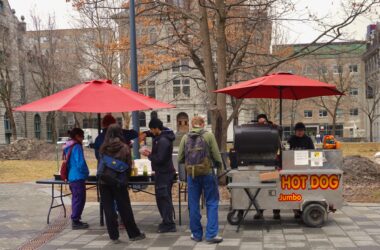
Bridget Cohl, U2 Engineering, cannot wait to be able to relax and hang out on the Lower Field when spring finally arrives in Montreal—a feeling that is shared by many students eagerly awaiting the warm weather and the return of the hot dog man

“We have a really pretty campus to just sit around in summer or spring to read a book or talk to friends,” said Cohl. 

“I love getting a hot dog on a warm day and sitting on the grass of the Lower Field,” added Casey. 

The St. Patrick’s Day celebrations such as the Ginger Run and dressing up all in green to wait in line for a drink at concerningly early times in the morning are also impatiently awaited by students. 

Finally, Open Air Pub (OAP) is a classic McGill way to cap off the semester on a good note, with some live music, cheap beer, and good vibes. 

“I am really looking forward to going to OAP if I don’t have too many finals and I am also very excited for St. Patrick’s Day,” Cohl said. 

The McGill campus has a lot in store this year for students looking to get involved. Be sure to keep an eye out for upcoming opportunities and events and make the most of your campus experience.

Behind the Bench, Sports

Football fan’s misogynistic tirade caught on camera sparks social media outrage

For many sports fans, the National Football League (NFL) playoffs are the best time of the year. In many parts of the country, a chill in the air and a dusting of snow on the ground can only mean one thing: The race for the Super Bowl is on. Philadelphia and Green Bay, home to National Football Conference (NFC) powerhouses the Eagles and the Packers respectively, are two of those places. These two cities—while more than 1,500 kilometres apart, and with Philadelphia over 10 times larger in population—have more in common than you might think, with passionate fanbases and high expectations coming into the playoff season. 

This passion, while admirable, can cause serious issues if it boils over. A major concern in sports viewership is the well-being of women spectators in stadiums. In a survey conducted by Sportsbook Review, 44.7 per cent of women reported feeling unsafe being alone in their home football stadiums, let alone being a visiting fan. Being surrounded by rowdy football fans, especially in intense situations, can be a threat to the safety of women fans. For one fan, this threat became reality on Jan. 12 in Philadelphia’s Lincoln Financial Field, when the hometown Eagles played the Packers in a heated Wild Card battle. Ally Keller and her fiancé, Alex Basara, attended the game in support of the Packers. Being an away fan in a hostile environment is a difficult undertaking, but typically, the home fans stay civil. However, at the Sunday game, tensions came to a high when the Packers were ruled short on what would have been a crucial touchdown. Basara made a comment that while the Packers may not have scored, they were still within a yard of the end zone and likely would score a touchdown on the next play.

That’s when the conflict, which has since been seen by millions on social media, began. Eagles fan Ryan Caldwell seemingly took issue with Keller and Basara’s reaction to the play, saying that the Packers “were still not in [the end zone].” After Basara explained his reasoning for being optimistic, Caldwell proceeded to go on a misogynistic rant against Keller, calling her (amongst other remarks) an “ugly dumb c***.” In statements to the press, Basara noted that the comments had begun as soon as the couple sat in their seats, with the occasional playful jab turning into more serious insults, culminating in the video posted to Basara’s X account. Internet sleuths quickly discovered Caldwell’s identity, and his employer, consulting firm BCT Partners, announced in a statement on their X account that Caldwell was let go from the company.

While the Eagles went on to defeat the Packers 22-10 and look to face the Los Angeles Rams in the NFC Divisional round, the incident between Caldwell and the two visiting Packers fans left a sour taste in the mouths of Philadelphia fans who have been fighting to restore the image of their city. Hard-working and blue-collar, Philadelphia has long held a reputation for belligerent fans itching for the chance to get into fights with anyone who will oblige. Some of these stereotypes are not entirely unfounded: The Eagles’ former home, Veterans Stadium, had its own jail for unruly fans, a feature added to Lincoln Financial Field during its construction that was later scrapped. However, passionate fans do not lead to conflict, and this incident should not further the negative opinions people may have about Philadelphia and its fans.

The unfortunate reality faced by countless women who simply want to attend games in peace is that sports fandom can be a “boys’ club,” and this incident is a telling example of how gender can be a barrier to entry for women sports fans. Not one person stepped in to help Keller against Caldwell’s stream of misogyny besides her fiancé. If just one of Caldwell’s friends seen beside him in the video cautioned him, Keller may have had a positive game day experience and Caldwell may well still be employed. This behaviour will continue unless it is made clear that it will not be tolerated by fellow man sports fans. The fact that Caldwell was punished for his actions is encouraging, but it is abundantly clear that there is more work to be done.

Out on the Town, Student Life

Bringing warmth and spice to the coldest days

While the snow is beautiful, the frigid temperatures and grey skies can make it easy to give in to laziness and just stay home watching lecture recordings in pyjamas. However, we can bring the coziness of our living rooms out into the cold, wintery streets with a piping hot spiced beverage! This week, I visited six of my favourite cafés near campus to determine which has the best wintery, joyful seasonal drinks. 

Café Humble Lion – White chocolate latte 

Before I begin this review, I should say that I’m not the biggest coffee fan in the world, so this may rank lower for me than it would for most people. This coffee was good, although they could have gotten more creative with it. It tasted exactly what one would expect a regular latte with white chocolate syrup added to it to taste like. However, because this cafe is close to campus—and the fact that this was still a pretty solid coffee—I would come again. I think they could have levelled this up by adding peppermint or something nutty to the mix, but one can still appreciate the simplicity and quality of a good Humble Lion latte, and I could never turn down the little added sweetness of the white chocolate flavour. 

Overall rating: 7/10 

It was good. I’m ready for better. 

Edmond Café Cantine – Orange hot chocolate 

I walked into this cafe and asked for their best seasonal winter drink. The barista consulted another barista to prepare a special citrus-themed drink that was not featured on the menu. I do not kid when it comes to chocolate, so I was very excited. After trying it, I noted that it was creamy, and had a buttery, deep chocolate flavour. The orange was very subtle (maybe they forgot to add it?), but it still managed to be one of the best hot chocolates I’ve tasted in Montreal—and the café’s ambience gave it extra brownie points!

Overall rating: 9/10 

Café SaintBarth – Hot chocolate 

This cafe is much closer to McGill than some of the others, and its ample desk space and cute decor make it a great study spot. The hot chocolate itself was adorable and delicious, topped with plenty of whipped cream, although it tasted a tad watery. While I would recommend the Edmond hot chocolate more, the convenience of this location boosts its rating.

Overall rating: 9/10 

Che Churros and Empanadas – Hot chocolate 

This hole-in-the-wall empanada shop in the Plateau is a personal favourite of my roommates and me. I ordered their hot chocolate, which they only serve during the winter season. It was gorgeous—complete with colourful marshmallows, chunks of peppermint, dolloped whipped cream and sprinkles. What more could you ask for? Unfortunately, the hot chocolate was far too milky for my taste, feeling more like an over-decorated hot glass of milk. While the hot chocolate did not deliver, their empanadas and customer service are top-tier, so I will be going again.

Overall rating: 5/10 

Le Darling – Dirty chai 

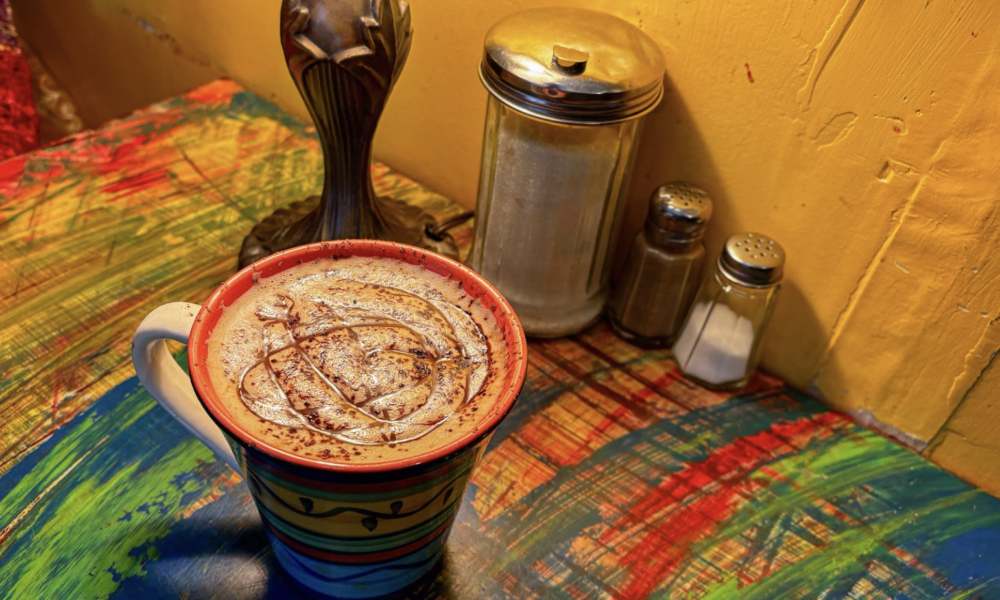
Sometimes you just need a hot, cozy, spicy chai, and some caffeine to get the work done. I enjoyed this drink and highly recommend having a little study session at Bar Darling. The quirky furniture and mood lighting is chef’s kiss and there is plenty of space to spread out your belongings. Now, when it comes to their coffee, they know how to do it right. It’s classic, delicious, and the service is incredible.

Overall rating: 9/10

Out on the Town, Student Life

Winter ventures in Montreal

Whether you’re a returning McGill student, starting your first semester, or visiting on exchange, Montreal offers endless activities, festivals, and places to explore—even during the cold winter months! Diving into these experiences is a fantastic way to discover the city’s unique character, especially for newcomers.

Montreal is renowned for its festive winter entertainment, with Igloofest standing out as the iconic January-February event. The festival attracts people across Canada to the Old Port for lively performances, international music, food, drinks, and an energetic atmosphere in a unique harbourfront setting.

Joshua Farmer, U1 Arts, called Igloofest a top winter highlight and a “must-do” for students in an interview with The Tribune.

“Not everyone comes from a place where they experience seasons, so when you are spending a night out in the snow with other people, it’s a super festive and seasonal way to enjoy the winter,” Farmer said. 

Igloofest not only celebrates winter but also offers a great first impression for students who’ve never experienced it. Farmer noted that the festival is a great way to meet people, with students attending from both local and distant places, highlighting its welcoming social atmosphere for newcomers to McGill.

While Montreal festivals like Igloofest are a rite of passage for students, they’re not the only ways to embrace the fun side of the winter season. Farmer emphasized how shopping during this time of year offers distinct advantages.

“In Montreal, winter is a good time to go vintage shopping and thrifting because everyone has donated their old clothes after getting new items from Christmas and the holidays—so I think that’s a really good time to dig through bins, hit the boutiques, and get some good new finds,” Farmer said. 

Eleanor Casey, U1 Arts, enthusiastically shared her love for thrifting as a fun winter activity. She listed some recommendations in an interview with The Tribune

Renaissance is my favourite place to thrift, especially for winter apparel. You can find great jackets and layers at Renaissance, Salvation Army, and Eva B. on St. Laurent,” Casey said.

Conveniently, these thrift stores in the Plateau and Mile End area happen to be surrounded by cafes and restaurants filled with aesthetic decor and great ambiance. Sean Overton, U0 Engineering, talked about how much he enjoys the wide range of food options and cafes to visit in the area, specifically on Ave. Mont-Royal. 

“L’Avenue is one of my favourite restaurants on Mont-Royal and the Huevos Rancheros is my go-to meal that I recommend everyone should try,” he said. 

Another great outdoor winter activity for McGill students to partake in is ice skating.

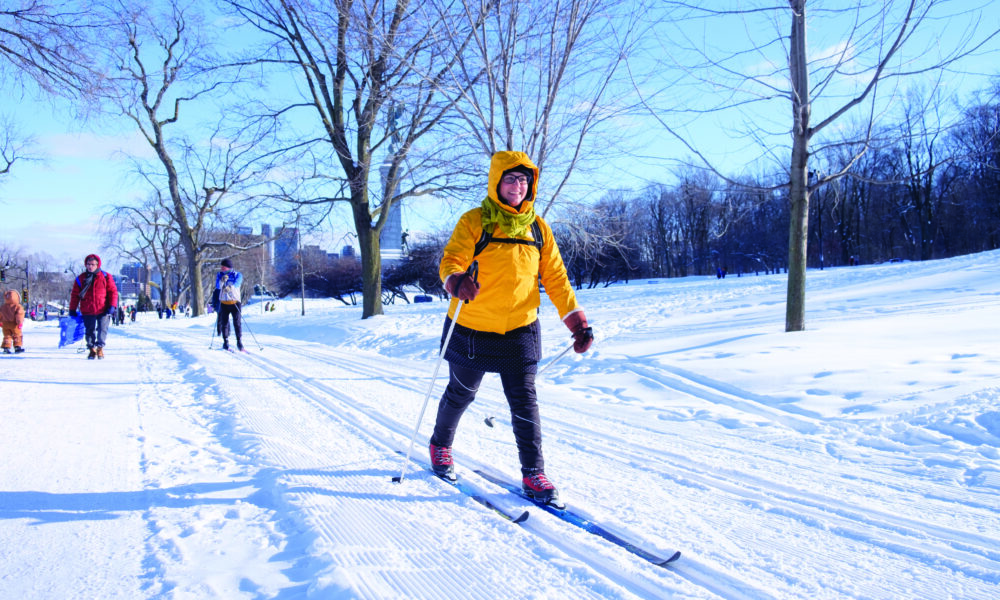
“It’s a low-cost activity you can do with your friends, especially if you own skates—it’s free if you bring a pair at locations like Place des Arts, Mont Royal, and Parc La Fontaine.  It’s a great way to enjoy the outdoors without feeling too cold, thanks to the exercise from skating,” Overton said.

While meandering through shops and cafes or skating outside in parks are all amusing ventures and ways to enjoy the city, Montreal’s famously freezing temperatures can make it challenging on the coldest days. Thankfully, with the city’s rich art and cultural scene, there are plenty of museums to admire, such as the Montreal Museum of Fine Arts

“I would suggest going to the Musée des Beaux-Arts de Montréal because they have really cool contemporary and old art exhibitions that are super appealing to people, especially students who are pursuing art-related degrees like myself,” Ella Bjork, U1 Arts, said in an interview with The Tribune.

Bjork also highlighted the museum’s convenience for McGill students during cold weather, noting its short walking distance from campus and the warm, cozy atmosphere inside.

Montreal proves that winter offers endless fun in all forms. Despite the cold, the city never fails to deliver its special charms, ensuring both locals and newcomers can enjoy its festivities and activities.

McGill, News

AGSEM experiences negotiation delay for Unit 3 union members

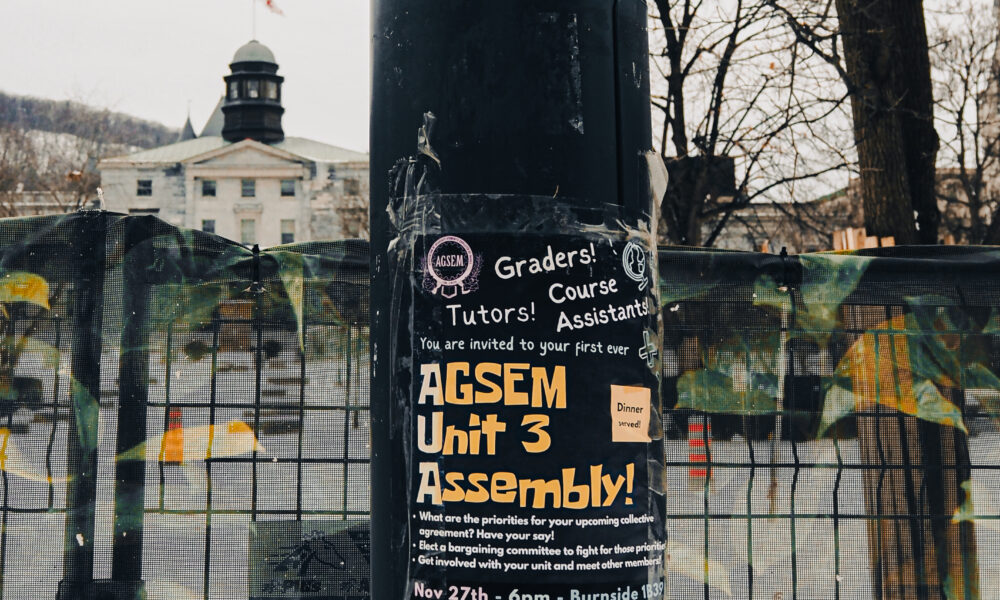
On Nov. 27, the Association of Graduate Students Employed at McGill (AGSEM) elected a bargaining committee to negotiate on behalf of Unit 3, representing over 250 members. Unit 3 is composed of “course-based academic casuals,” which include graders, course assistants, and graduate teaching fellows. Unit 3 is separate from AGSEM’s Units 1 and 2, which represent teaching assistants (TAs) and invigilators, respectively.

Despite Unit 3’s fairly recent formation, they have already elected bargaining committees to negotiate working conditions. AGSEM’s priorities for Unit 3 include pay equity with TAs, protections against harassment and discrimination, and clearer workload definitions. All members are also able to voice their own experiences during negotiations as part of Unit 3’s open bargaining agreement.

Donnie Morard, a PhD candidate in History and Classical Studies and member of the Unit 3 Bargaining Committee, elaborated on the negotiation process in an interview with The Tribune

“Unit 1 TAs went into bargaining last year, so we pushed really hard to make sure these other groups of workers would be protected under a union,” Morard said. “One of the key issues is McGill creates these positions of graders who oftentimes have very similar jobs or tasks as TAs.”

Morard explained that this lack of distinction between a TA’s and a grader’s duties can create inequities. Although some TAs may head tutorials, run office hours, and officiate labs, the responsibilities of many TAs can also be limited to only grading assignments—much like Unit 3 workers.

“Some TA-ships are simply just grading. It’s the exact same job, [a grader] is just as qualified, but it’s more than a $10 [CAD] difference [in pay], along with less protections in terms of hiring and workloads,” Morard said. “We want to close that gap.”

Megan Millet, U3 Arts and a member of the Unit 3 Bargaining Support Committee, noted that this disparity between jobs falling under Unit 3 and those under other Unit divisions varies by department and faculty, making it difficult to ensure consistent protection for AGSEM members.

“What we’ve noticed in Unit 3 is that [McGill] has like 50 different titles for job postings to make sure it is difficult to make sure who falls under Unit 3,” Millet said in an interview with The Tribune. “We’re trying to consolidate this to make sure everyone can be represented, and so that McGill can’t just create new positions whenever they want.”

While McGill is aware of Unit 3’s demands, they have not yet met with AGSEM to discuss them. However, Morard argues that McGill can negotiate the non-monetary aspects as soon as possible.

“There’s a lot of non-monetary aspects to our collective agreement as well, such as hiring practices or topics dealing with harassment and discrimination.” Morard stated. “One of the things we’ve proposed is to hold off on the monetary demands, and we can essentially submit on the non-monetary proposal and start working on this to get the ball rolling.”

However, seeing as the semester has only just begun, Morard expressed some understanding for McGill’s slow deliberation process. In the meantime, AGSEM continues to assess their priorities for future negotiations.

“As of now, we are gathering data by calling up students and Unit 3 members from other departments and faculties for their experience,” Millet explained. “We’re always looking for more people to help join us to make sure we can represent everyone properly.”

In an email to The Tribune, the McGill Media Relations Office (MRO) declined to share the details of their negotiations with AGSEM.

“McGill works with well over a dozen unions, doing our utmost to undertake all negotiations in a timely manner,” the MRO wrote. “That said, we do not comment publicly on details of talks with them.”

Despite these delays, Morard remains optimistic about the future of labour relations at McGill.

“[Unions] create solidarity among different groups of workers on campus and, even though I think the administration doesn’t necessarily like this change, we see McGill union culture becoming stronger,” Morard stated. “I think [unionizing] is not something we can do at the bargaining table, but instead something that we could just do.”

McGill, News, The Tribune Explains

The Tribune Explains: McGill’s Canada Award

In October 2023, the Quebec provincial government announced its plan to increase tuition at English universities for out-of-province Canadian students.

While the government’s original plans were to nearly double tuition rates, in December 2023, Higher Education Minister Pascale Déry settled on hiking tuition rates by about 30 per cent. In an effort to sustain out-of-province undergraduate applications, McGill launched the Canada Award, while Concordia University launched the Canada Scholars Award—both of which subsidize part of the increased tuition for most out-of-province students.

According to McGill’s Fall 2024 Admissions Profile, 22 per cent of the university’s incoming undergraduate class is from Canada beyond Quebec. For these out-of-province students, The Tribune unpacks the Canada Award.

What is the total monetary value of the Canada Award?

The Canada Award is valued at $3,000 CAD annually, with $1,500 CAD disbursed to recipients each semester. The Award offers up to $12,000 CAD over the course of eight semesters, translating to four years of full-time study. 

The award is classified as taxable income, which means recipients must report the return on their T4A tax slips. McGill issues these students a T4A tax slip each February for the award granted in the prior year term.

Why did McGill launch the Canada Award?

In a 2023 CBC interview with journalist Mark Kelley, McGill Vice-President (Administration and Finance) Fabrice Labeau mentioned that the Quebec government’s intention to raise tuition rates would “price [McGill] out of the market and close access to […] degrees and to the McGill experience.”  The Canada Award was thus created to maintain the university’s competitiveness.

“So what we’re trying to do here is [to send] a message to our students and our prospective students […] saying, you’re welcome here at McGill,” Labeau said to CBC. “We’re going to help you overcome these new barriers that have been put up by the government.”

In another statement, McGill President and Vice-Chancellor Deep Saini said that the university’s success is founded in the talent of a diverse student body, and the Canada Award aims to support students who otherwise would not be able to come to McGill.

Who is eligible for the Canada Award?

Currently, the Canada Award is offered to out-of-province, full-time undergraduate students admitted to McGill in Fall 2024 or Winter 2025, in the Faculties or Schools of Agricultural and Environmental Science, Architecture, Arts, Arts & Science, Education, Music, Nursing, and Science.

Additionally, students who have undergone an interfaculty transfer in Fall 2024 or Winter 2025 from an ineligible faculty to an eligible faculty can also receive the Canada Award.

To qualify for full-time status, students must be registered and billed for 12 or more credits per semester. If students receiving the award withdraw from a course with a refund and fall under 12 credits, the award will be revoked. However, if students withdraw from a course after the refund deadline, they can keep the award.

Students in part-time studies due to a disability can also claim the Canada Award, so long as their disability is recognized by Student Accessibility and Achievement.

For students entering McGill in the Fall 2025 and Winter 2026 semesters, the Canada Award will still be offered, albeit with added restrictions: Canada Award recipients will also have to be in receipt of a one-time or renewable Entrance Scholarship or Bursary.

Students who deferred their admission to the Fall 2025 semester or beyond will only receive the Canada Award if they meet the Fall 2025 eligibility criteria.

How is the Canada Award issued? Does it interact with other scholarships or bursaries?

The Canada Award requires no application. It is automatically deducted from tuition rates on e-Bills for eligible students. During the add-drop period, if a student fluctuates between full-time and part-time status, the Award will simultaneously be added and dropped on their student fees account menu.

McGill scholarships and bursaries are distributed regardless of whether a student is a recipient of the Canada Award. 

For more information on the Canada Award, visit McGill’s Scholarships and Student Aid website.

Read the latest issue

Read the latest issue