

Latest News

McGill, News

Divest McGill plans escalated tactics following administration’s announcement

Divest 101, an information session held by the student group Divest McGill, took place on Jan. 21, drawing a crowd of around 40 students to a Burnside basement classroom. The meeting was led by members Guido Powell and Rachel Ivey, who discussed the group’s response to McGill’s plans to decarbonize. The meeting emphasized the importance of continued action, despite the Board of Governors’ (BoG) repeated decisions against fossil fuel divestment. 

Following a report by the Committee to Advise on Matters of Social Responsibility (CAMSR), McGill Principal and Vice-Chancellor Suzanne Fortier announced that the university would not be withdrawing its close to $148 million investment in the fossil fuel industry. This marks the third time that McGill has rejected community demands, choosing instead to decrease the number of investments it has in the fossil fuel industry.

For Divest McGill members like Millie Murray, U0 Science, McGill’s repeated decision to maintain its sizeable holdings in fossil fuel companies has fallen short of expectations. 

“Most recently, [McGill] responded [to calls for divestment] by essentially saying divestment is superficial and we don’t need to do it,” Murray said. “And then they released this statement […] about their commitment to carbon neutrality, but it is all very vague.” 

The BoG has committed to taking several steps towards their goal of carbon neutrality, such as reducing the carbon footprint of the McGill Investment Pool and increasing investments in the school’s fossil-fuel-free fund. However, according to Audrey Nelles, U0 Science, the university has not adequately addressed student demands.

“We, as students, should expect a lot of our university and divestment is kind of the bare minimum in terms of climate justice,” Nelles said. 

As part of a growing movement, over 1000 institutions around the world have divested from fossil fuels. In some instances, students have resorted to more public tactics to get the attention of their university’s administration. At the University of British Columbia, a group of students participated in a hunger strike for divestment. During a recent Harvard-Yale football game, student environmental activists garnered international attention by storming the field. Nelles spoke on previous attempts coordinated by Divest McGill in garnering the same attention.

“In the past, Divest has occupied the office of the principal, we have camped out outside of James Admin, [and have] returned [our] diplomas,” Nelles said. “I think that [it is] important to continue doing these public actions because that does put a lot of pressure on the university.” 

While members of Divest McGill were unwilling to divulge details regarding the group’s specific plans for the coming year, this most recent refusal to divest by the university has prompted the group to consider alternative actions. Ella Wischnewsky, U1 Arts, explained that the group’s current focus will be to pressure the McGill administration in more impactful ways. 

“As far as working with [McGill], we are still doing that in a way but at least in this coming semester, we are looking to do a little bit more of escalation tactics [in our protests],” Wischnewsky said. 

Despite the decision from the BoG, support for divestment is still strong on campus. The resignation of tenured faculty professor Gregory Mikkelson drew national attention, while the creation of the Paid by McGill video spread awareness for Divest McGill’s cause. Actions concentrated on drawing public attention to McGill’s continued investment in fossil fuels will be essential components of the group’s unrelenting eight-year-long campaign for divestment.

“[McGill] is very concerned with their image,” Nelles said. “If we show the other side of that image [and show] that, no, McGill is not a leader in sustainability [and]  they are actually contributing to climate change, then that has a lot of power.”

Arts & Entertainment

McSWAY presents their first poetry slam ‘Say It Because You Mean It’

Hidden away behind a yellow door, deep in a basement of brick and mortar, McGill held its first poetry slam of the semester. Hosted at The Yellow Door, McSway Poetry Collective, is a student-run group that regularly organizes open mics and writers’ workshops as a means to encourage artistic expression at McGill. Their most recent event on Jan. 23, Say It Because You Mean It, saw 12 poets grace their stage to battle it out with their best spoken word. By the end of the night, and after two rounds of lighthearted audience judging, three poets claimed top honours. 

To gauge the audience’s judging, McSWAY began the slam by offering one of their own members to kick off the competition. As part of her symbolic participation in the slam, Lucia De Luca, U4 Education, performed a heartfelt, bilingual poem, discussing the strains that dementia bore on her relationship with her grandmother. 

De Luca’s vulnerable expression of a personal hardship was echoed in many of the performances that would follow. The poets made individual use of figurative language and rhythmic cadences to broach issues of queer identity, body image, drug use, sexual assault, suicide, and mental illness. For much of the night, the audience lay struck by each poet’s masterful use of beautiful language to communicate often difficult subject matter. Dawson College student Marikje van den Hoeven, who would go on to win the slam, performed a piece in the first round about the power dynamics in heteronormative intimacy between men and women. 

Other performers focussed on more ambiguous narratives, using her poetry as a means to emphasize the emotions and feelings attached to the tangible contexts that originated them. Eliza Prestley (U3, Arts) performed a short poem that blended the topography of a city with remnant images of a fleeting connection with a loved one, as a way to illustrate the process of accepting loss. 

“The air in this city tastes like you / are less landmark / and more smog / lining every street / stitched into the sweater I lent you last week,” Prestley began her poem, “Cannot live in a house / on a pedestal but I / am not tall enough to get you down / so I hold you / balloon on string / I knew / it was going to burst / one day, / someday.”

To close the night, McSWAY had invited Chris Masson, a veteran in the spoken word scene. Currently an educator of poetry, the Concordia creative writing alumnus has toured nationally to perform his own poetry, and has also competed in slam competitions throughout Canada. Masson commended the talent of the performers he had seen that night and stressed the need for creative outlets provided by groups such as McSWAY. When he took to the stage, Masson blended intense physicality with emotional volatility, frequently shifting between humour and sombre reflection.

His poetry included a love letter to the city of Montreal; an analysis of mass consumerism, which he likened to a zombie invasion; and a discussion of the 2012 Quebec student protests. His standout poem, “Be My Next Mistake,” explored the romantic tumult that results from the many faces a partner can sport. With a dramatic crescendo that contrasted the poem’s more lighthearted beginning, Masson’s performance embodied the personal bent that characterized many of the night’s earlier poems.

“Be my hurdle out the gate! / Be my fat-free chocolate cake! / My true love I leave for fate! / My ‘why did we start in the place?’ / Be my… be my… be my next mistake!” Masson performed. A flurry of snaps flooded the venue as Masson bowed off the stage. 

By the night’s end, audience members and poets alike exited into the cold Montreal air with a renewed inclination for rhythm and rhymes. Such is the importance of events like McSWAY’s: To uncover hidden gems of artistic expression, and to foster new interest in otherwise neglected avenues of creativity. 

Arts & Entertainment, Theatre

“The Complete Works of Shakespeare (Abridged)” triumphs

Shakespeare has long been the butt of jokes and the subject of moans in classrooms. Though considered foundational to many curricula, his 500-year-old prose can be impenetrable. To resolve that issue and address many of the Bard’s prepubescent critics’, Tuesday Night Café Theatre (TNC) presented The Complete Works of Shakespeare (Abridged) in their 2020 debut production.

Performed Jan. 15-18 by the combined creative geniuses of actors Mitchel Csermak, Nick Vecchione, and Antoine Guimbal, all three U2 Arts, The Complete Works is a blindingly fast-paced romp through all 38 of Shakespeare’s plays. The three third-year theatre students carried off the ambitious production with minimalist set design and masterful theatre-making skills. Plays were cut to the barest of bones—the first run through of Hamlet takes 12 minutes, but we get a bonus 30 second version as well. Highlights include the ‘comedic lump’ constituted by all 16 of Shakespeare’s comedies.

Given the aforementioned moan-inducing nature of Shakespearean English, playwrights Adam Long, Daniel Singer, and Jess Winfield’s script does a neat job of stripping back well-known plots to their familiar tropes. These tropes constitute the building blocks of much of modern cinema, from romantic comedies to heist films. For that reason, audience members did not need to have enjoyed their middle school English classes, or even have read any Shakespeare, to enjoy the show and get the antics. 

Admirably, some of the best-known Shakespearean embellishments, including fart jokes and exits pursued by bears, survive the scripts’ zealous trimming of the Shakespearean canon. Even though the script only retains a handful of lines from such classics as Romeo & Juliet, actors perform the most famous lines in the original language. Viewers unfamiliar with original text could still enjoy Shakespeare’s texts, as any original readings were sandwiched between jokes original to the script and the three theatre students’ highly entertaining physical comedy. Audiences were treated to a rendition of the famous balcony scene, along with dialogue questioning the importance of the balcony itself. 

The efforts of the actors are no small contribution to the success of this particular production. The trio constructed famous battlements or balconies in a hexagonal black box space with no more than a single costume or prop to each of the three actors. Each only momentarily leaving stage after they have entered it—usually to seize another rough-looking but fully functional prop or costume piece. Vecchione conjured each female character with a single tousled wig and his feminine charms.

As both actors and producers, Vecchione, Csermak, and Guimbal delivered a high-powered, fast-paced, no doubt exhausting show that left their audience gasping with laughter. Despite the huge efforts required on the part of the actors, they never let the strain show, maintaining excellent comedic timing throughout. 

Student theatre at McGill does a lot with a little. However, this production went above and beyond, allowing the ability of the actors to transport their audience through Shakespeare’s canon. It is a pleasure to write about a student production at this caliber, and to laud The Complete Works as an absolute success. TNC’s 2020 dramatic season at McGill is off to a very strong start.

TNC’s next production, Bhopal, runs Feb. 19–22, 7:30 p.m. at Tuesday Night Café Theatre (3485 McTavish St.). Tickets are $10 for general public and $6 for students/seniors. Reserve tickets at [email protected]


Montreal, News

Dozens attend a discussion about Indian fascism

Students filled a Bronfman classroom to its capacity on Jan 13. to listen to several speakers at India Civil Watch Montreal’s first series of teach-ins mapping the rise of global fascism. The event discussed the current crisis faced by Indian democracy amidst the rise of Hindu nationalism under the leadership of the Bharatiya Janata Party (BJP) and the party’s leader Nerendra Modi. The talks were facilitated by Ayesha Vemuri and Mehak Sawhey, both PhD students in Art History and Communications, and featured speakers from the Faculty of Arts. 

The event was organized in support of the protests against the recent passage of the Citizenship Amendment Act (CAA) and enforcement of the National Register of Citizens (NRC). The CAA provides a fast track to Indian citizenship for religious refugees from Afghanistan, Bangladesh, and Pakistan. Notably, this act excludes Muslims from refugee status despite the countries mentioned in the legislation holding a Muslim majority population. 

Swahey’s speech centred around the problems introduced by the anticipated implementation of the NRC. Already implemented in the northeastern Indian state of Assam, residents with “questionable citizenship status” have their status determined by Foreigner’s Tribunals, which Amnesty International argues places a disproportionate burden of proof on defendants to advocate for their rights.

“Legal documents are required to acquire citizenship [according to the NRC]. This is a huge problem in India where documentation is very poor. These people are now living in detention centres in India. With this situation, Genocide Watch has issued a warning for India,” Sawhey said. “When the NRC was first implemented in Assam, 1.9 million people were rendered stateless.” 

The next speaker was Mritiunjoy Mohanty, an economics professor at the Indian Institute of Management Calcutta whose  research focuses include political economy, structural change, and labor. Mohanty described how Modi’s policy of demonization, which banned 500 and 1000 Rupee notes, has disproportionately affected the informal sector. 

“The economy is going through […] a remarkable and unprecedented slow-down,” Mohnaty said. “This is a situation where stagflation is occurring […] with almost zero real wage growth. [The informal sector] accounts for 50 per cent of [economic] output and almost 90 per cent of employment.”

Nerendra Subramanian, a McGill professor of political science, researches the intersections between caste, race, and gender in India. He spoke about the recent changes Hindu nationalism has undergone as it increases in popularity. 

“[Hindu nationalism] presents [India] as a Hindu nation, even though [20] per cent [of the population] are not Hindus,” Subramanian said. “[Their] rhetoric sounds inclusionary but [their] mobilization and practice is exclusionary and periodically violent. Hindu nationalists have an ambivalent relationship with democracy […] Multicultural institutions matter in diverse societies, including in India: They helped consolidate democracy in what may be the most culturally diverse society in the world.”

The event attracted students from McGill who were engaged by recent media coverage about the Modi government. Julia Kossakowski, U2 Science, attended the event because she wanted to learn more about Indian democracy.

“I didn’t know much before coming into the talk,” Kossakowski said. “There were so many different viewpoints represented. I’m excited for the other [teach-ins] [.…] Now that I’ve started learning about [these issues], there’s no reason to stop.”

Arts & Entertainment, Film and TV

Pop Dialectic: Is Tanner Zipchen a Canadian movie legend or failure?

Last week, long-time Cineplex pre-show host Tanner Zipchen announced on his personal Twitter account that he had been let go from his position. UK-based media conglomerate Cineworld had just acquired Cineplex, and a change in the Canadian market had been expected. Yet, Zipchen’s legacy remains divisive. The McGill Tribune debates whether Zipchen’s departure is an ultimate blow or a win for Canadian moviegoers. 

Tanner Zipchen had no plan

Joey Caplan

2011 will go down in history as one of the most innovative years in the history of cinema. No, I am not referring to the cinematic masterpiece known as Drive, nor the technical marvel of Scorsese’s Hugo. Instead, we can only admire 2011 as the year where the expression ‘early bird gets the worm’ came true. Alas, the Cineplex pre-show as we knew it was born.

Everyone remembers their first time; going to see Crazy, Stupid, Love alone without  anyone to stop you. You arrive at the theatre 10 minutes early, popcorn, drink, and Maltesers in hand. You sit down in your non-reclining seat and think to yourself: “What am I going to do with the next 10 minutes of my life?” Suddenly, a disembodied voice echoes through the theatre: “Download the Timeplay app for prizes and more!” Time freezes; you know what needs to be done. You open your iPhone 4S and click ‘Download’ just in time for the quiz questions to start. A few minutes later, you see your name on the big screen, signifying that you are the Timeplay champion. Nothing can stop you now; you have become a Timeplay god. 

Fast forward to 2015.  The pre-show begins, and you immediately notice that Marc Saltzman is not performing his brief reviews of tech that you were never going to buy; Gear Guide is gone. Suddenly, what appears to be a somewhat good-looking 20-something named Tanner Zipchen manifests on the screen and announces himself as the “casting call winner,” whatever that means. He starts to interview famous people, pretending he belongs. He does not. He interviews Toni Collette and says he had a nightmare about her. He has no followup. It’s creepy. He never had a plan. 

In 2016, you start to show up to movies on time, you no longer arrive early, and skip the pre-show. 

Tanner Zipchen still has no plan. He came, he ruined Timeplay and the pre-show with his casual, innocent obnoxiousness, and now he leaves, his name perpetually fastened to the very thing he sought to destroy. 

In defence of Tanner Zipchen

Kaja Surborg

Canada’s collective heart broke on Jan. 13, as a tweet that would ring out across the country was published. 

“Today, I was let go from Cineplex [and] am no longer the host of the pre-show,” the tweet from former Cineplex pre-show host Tanner Zipchen read. “Thank you for all the love and support over the years, especially those who’ve been with me since the voting days. It’s been an honour being a part of your group hangouts, date nights, & family outings.”

Zipchen connected with a new generation of Canadians who felt that he was one of them. In 2015, when Cineplex hosted an open casting call, and moviegoers got to vote for their favourite pre-show host, Zipchen won the vote

“He’s a core part of the Canadian experience,” Sophia Kamps, U3 Arts, shared in an interview with The McGill Tribune

Indeed, Zipchen truly represented the diversity that Canada so loves. Hailing from Saskatoon, Zipchen brought one of the most under-represented groups of Canadians to the big screen: Saskatchewanians. As he grew into his onscreen role of game host and interviewer over the years, Canada realised that they made the right choice in voting for him. 

Now, we are left with an undeniable void in our moviegoing experience. There is no one to represent us on red carpets and press junkets. There is no one to tell us to turn off our phones. And, most importantly, the comforting voice that encouraged us to log on to the TimePlay app is gone. A heartless UK-based company, Cineworld, has taken a key thread in the fabric of contemporary Canadian life and torn it out. Canada will recover, but we will never forget.

Football, Sports

Super Bowl LIV Preview

The Kansas City Chiefs and the San Francisco 49ers will face off in Super Bowl LIV on Feb. 2 in Miami, Florida. This will be the Chiefs’ first Super Bowl in 50 years. Their last appearance was Super Bowl IV against the Minnesota Vikings in 1970, where they secured their first title. The 49ers are looking to capture their record-tying sixth Super Bowl, with their last Lombardi Trophy coming in 1995 after a victorious Super Bowl XXIX against the San Diego Chargers. 

The two teams have had similar paths to this final game. Both won their divisions to secure a first-round bye in the playoffs, making this is the seventh year in a row that both teams in the Super Bowl have not had to play Wild Card Weekend. The Chiefs, 12–4 in the regular season, won their divisional game in historic fashion, overcoming a 24–0 first half deficit against the Houston Texans, before going on to defeat the Tennessee Titans in the AFC Championship game. The 49ers topped the Minnesota Vikings easily in the divisional round and remained dominant in their NFC Championship victory over future Hall of Famer Aaron Rodgers and the Green Bay Packers. 

Despite equally impressive seasons, each team arrives at the Super Bowl with their own set of strengths and weaknesses. Kansas City finished the regular season sixth in total yards per game (379.2) and fifth in passing yards per game (281.1). In contrast, San Francisco’s offence boasted an extremely strong  ground game, ranking second in rushing yards per game (144.1). The 49ers’ true strength, however, was on the other side of the ball, ranking second in total yards against per game (281.8) and first in passing yards against per game (169.2). The Chiefs improved their defence significantly throughout the season as well, with 19.2 points per game (PPG) allowed, and finished the season allowing fewer total points than the 49ers, who recorded 19.4 PPG at season’s end.

The most important factor in this game will be the match up between Kansas City’s offence and San Francisco’s defence. The Chiefs have exposed teams in the last two seasons when they play man coverage. This is a result of their dynamic playmakers, wide receiver Tyreek Hill and tight end Travis Kelce, catching balls from generational talent quarterback Patrick Mahomes. Thus, teams are forced to play primarily zone defence, where they are picked apart by both the run and short passes. The 49ers are in the unique position of having the right players to cover the Chiefs and can create real problems for Chiefs’ offensive coordinator Eric Bieniemy. All-Pro cornerback Richard Sherman and linebackers Kwon Alexander and Fred Warner are fantastic in coverage, which will create one of the more dominant defensive lines in recent memory. 

The most interesting comparison in storylines, however, is the difference in coaching. The 49ers are led by third-year Head Coach Kyle Shanahan, who first gained praise for his fantastic offensive play-calling and designs during his time as offensive coordinator for the 2016 NFC Champion Atlanta Falcons. The Chiefs are led by Andy Reid, a future Hall of Fame coach whose previous Super Bowl appearance as a head coach came in 2005 with the Philadelphia Eagles. Many will be pulling for Reid to capture his first Super Bowl as a head coach and cap off an all-time career. 

Ultimately, the Chiefs will struggle to stop the 49ers’ run attack and their offence will come up just short, with San Francisco emerging victorious 35–31. The entire contest should live up to the standard excellence of competition set in previous years.

Out on the Town, Student Life

Tsujiri offers a taste of Japan

As a part of a wave of Asian dessert places cropping up around the city, the international matcha chain Tsujiri opened a new location on Crescent in December. The Japanese tea shop has been serving matcha since 1860, having started as a chaho, meaning tea shop in Japanese, in Kyoto and now aims to bring authentic Japanese tea into the heart of Montreal.

Tsujiri Montreal distinguished itself from the other Canadian branches in Vancouver and Toronto by expanding beyond their internationally renowned counter-service. Paco Cheng, the owner of Tsujiri Montreal, integrates a dine-in area serving dishes exclusive to select locations of the chain such as  large-sized parfaits and freshly prepared matcha soufflé.

“Some of the [other Canadian Tsujiri chains] only offer the counter menu […], which serves ice cream, lattes, and parfait,” Cheng said. “But in Montreal, we also have a dine-in section. We have a café for the customers for drinks and desserts, and at the back, we have a restaurant, [where we serve products] prepared fresh everyday.”

Cheng added that the branch aims to bring a genuine matcha experience to Montreal by using tea directly from Japan.

“[Some other tea stores] use powder, [and] they use [flavouring], which is, in our opinion, unhealthy,” Cheng said. “We sell authentic tea […], which is imported directly from Japan. We really want to keep the highest standard we can.”

Matcha drinks could be used as an alternative for other stimulants, such as coffee or energy drinks. According to a 2017 study published on Food Research International, matcha tea may have an effect on reaction speed and long-term memory, which can be useful for students who wish to study long hours.

“Matcha is a healthy drink if you compare [it] to coffee, which makes you high very quickly and leads to a quick drop,” Cheng said. “Matcha itself has a lot more nutrition than any other teas. The way we make matcha [is] we take tea leaves, we process it by drying them, and then we stone grind the tea leaves into a fine powder. So when you start to drink the matcha, you actually drink the entirety of the tea leaves.”

Tsujiri takes the stimulating effects of the product and twists them into new and exciting combinations. Perusing through their Instagram page, one can see all things green ranging from matcha noodles in a modern take on chasoba to their own take on the American sundae. For Tieng Yin, counter-service staff at Tsujiri, she found the store’s take on a beloved fuel for students, coffee, to be her favourite. 

“My favourite product here is the Kinako Kuromitsu Latte,” Yin said. “[There is…] Japanese black sugar, and soy bean powder inside the drink.” 

The store’s inventive use of these green tea leaves has attracted a diverse range of customers who are eager to experience the world-famous Tsujiri matcha products. Locals and tourists alike come to visit and try out the drinks and desserts Tsujiri has to offer.  

“Montreal is a special city,” Cheng said. “I can see there are local people, people from Europe, or anywhere else in the world, and they come into our store and start to enjoy the same tea as we do in Japan or in Asia.”  

Out on the Town, Student Life

Café Olimpico opens downtown location

For those who feel that the Mile End is too far away yet crave Café Olimpico’s delicious lattes and wonderful atmosphere, the world has decided to grant their wish. A new location, just a few blocks from campus on Boulevard Robert-Bourassa, north of Sainte-Catherines, opened in December. 

‘Montreal’s Best Café’, as their website boasts, has a rich and deeply rooted history. Since its opening in the 1970s in Mile End, it has been a legendary staple of Montreal’s café scene. Jonathan Vannelli, the current owner of the three Café Olimpicos across the city, is the grandson of Rocco Furfaro, the original founder, and has been a member of the family business since he was 16, rising through the ranks from busboy to owner. 

 “My main goal is to continue my grandfather’s tradition,” Vannelli said. “His vision for the café is to always build a community, offer a great espresso at an affordable price, and to build relationships with customers by offering the best service possible.”

This vision of a cafe centred around good company and great coffee has proven successful, highlighted by their spot on The Telegraph’s list of “The 50 Greatest Cafés on Earth”. Vannelli explained that remaining true to Furfaro’s values throughout the café’ and being a family business is what distinguishes them from the myriad of Starbucks or other café franchises that keep springing up across urban centres like Montreal. Another thing that sets them apart from corporate cafés is the coffee itself.  

“We use six blends [… and] our beans are all freshly roasted in Italy and shipped to our door,” Vannelli said. “My grandfather’s recipe hasn’t changed in 50 years. We still keep a great relationship with our coffee suppliers.” 

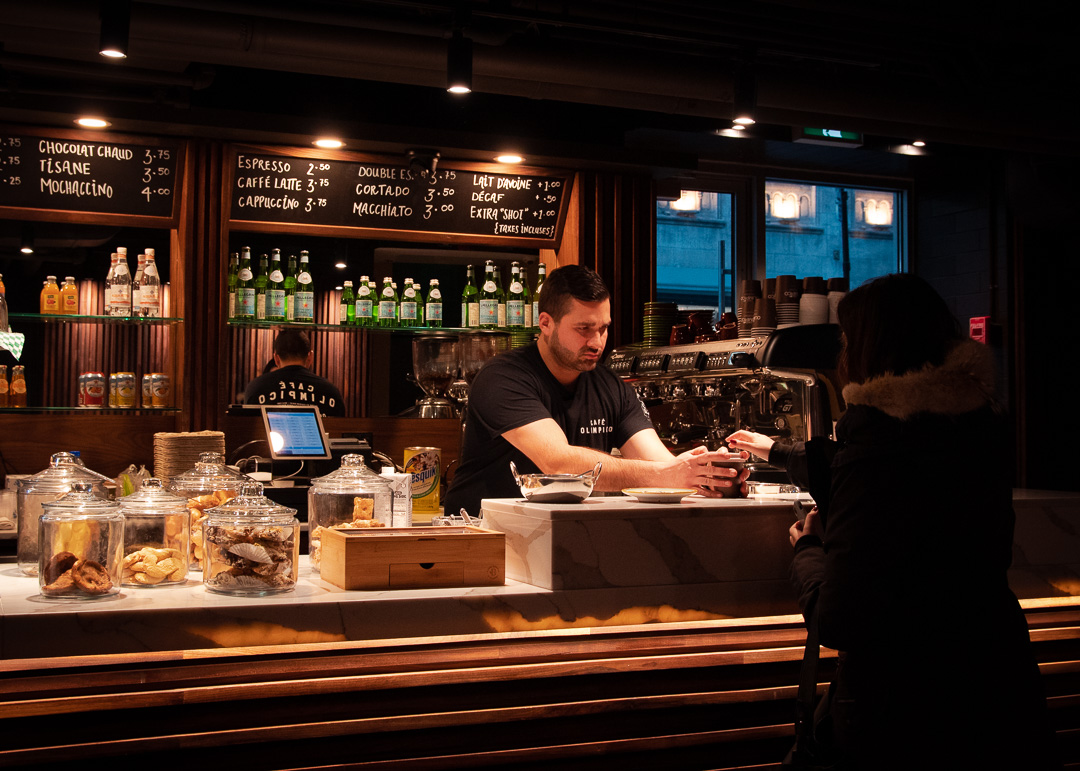
There are a few differences between this new location and its renowned counterpart in Mile End. Firstly, the cost of products are higher downtown, which the owner explains is perfectly normal because rent is higher there. However, even with the increase, prices remain affordable given the quality of the coffee. The location is also much smaller, with only 12 seats packed into a bedroom-sized space. The café is clearly catered to those working in the downtown area who only have five minutes to stop by and gulp down their espressos. While the space is a comfortable and pleasant environment, it is not the most ideal atmosphere to sit and study in. Vannelli describes how developing this aesthetic took some time to create.

 “It was a long process,” Vannelli said. “I did everything myself with the help of my designer. We wanted the design to stay true to our roots, with the walnut wood finishes and marble counters, and yet make some small changes, such as the design and aesthetic of the wood panels along the walls and bar.” 

The design is more modern and structured, but the feeling of something shared and great coffee is not lost. The new Café Olimpico remains true to the family name and every expectation longtime customers might have. If you ever have a second of your day to make the short walk from campus, Café Olimpico is definitely worth it.

Montreal, News

Over 100 march in protest against nationalist Indian government in Montreal

Over 100 people marched in protest against India’s government outside Montreal’s Parc metro station on Jan. 26. The march, hosted by India Civil Watch Montreal, was part of a worldwide protest against the right-wing Bharatiya Janata Party (BJP), headed by Prime Minister Narendra Modi. The BJP government has come under fire for adopting discriminatory policies against Muslims and other marginalized groups in India. 

Sonali Huria, a former researcher for the National Civil Rights Commission of India, explained that the date was chosen to coincide with the anniversary of the Indian constitution coming into effect. Huria noted that the constitution enshrines equality in its preamble.

“While [the] crisis that India [faces] is unprecedented, what is also encouraging is that the pushback from the grassroots is historic,” Huria said. “I stand here in solidarity with the people, the ordinary citizens who are pushing back against this fascist regime. I reiterate my faith in the Constitution, in the preamble.”

The Montreal march through the streets of the Parc-Extension neighbourhood was in solidarity with the Citizenship Amendment Act protests, an ongoing series of protests in India against a piece of legislation viewed by demonstrators as discriminatory. Passed in December 2019 to provide a path to Indian citizenship for minorities fleeing persecution, the Citizenship Amendment Act applies to Hindu, Sikh, Buddhist, and other religious minorities, but explicitly excludes Muslim minorities.

Since protests began on Dec. 4, 2019, over 3,000 individuals have been arrested. Darin Barney, who attended the march in Montreal, criticized the Indian government for its actions against the demonstrations.

“The oppressive response of the state to [the] protests is unjustified, and we need to call attention to the brutality of that regime,” Barney said. “It’s important for democratic people everywhere to stand up in solidarity with people who are struggling against those kinds of measures by right-wing governments.”

Ayesha Vemuri, a PhD student in communication studies, explained that the protests originated as a grassroots effort from all corners of Indian society.

“What’s remarkable about the protests in India right now is the fact that it isn’t being led by any political party [or] by one central movement,” Vemuri said. “It is common people, a lot of people who have never protested or in their lives [….] The other thing is that it’s remarkable because it’s mostly being led by women. Women are coming out and sitting in these spaces every single day. And they’re cooking there [and] they’re taking care of their kids there [….] This is about common people standing up for themselves, their own rights, and their neighbours’ rights.” 

Saeesh Mangwani, U3 Arts, attended the march and commented that the protest movement also included concerns about the legal status of the formerly autonomous region of Kashmir.

“There are so many [issues with this government], it depends on how far you want to go,” Mangwani said. “The major ones that should be noted are that the state has revoked the special status of Kashmir and essentially made it a territory [governed centrally by India] after years of police repression. It’s just a blatantly undemocratic unilateral decision to make Kashmir a part of India […] There is [also] unrest in the northeastern states. The government of India has [historically neglected] that part of the country and [now] it’s just aggravated.”

Despite the government crackdown on protests, Komal Mohite, a PhD student in history and a student activist for the last 10 years, credited the demonstrators for sparking international attention.

“No matter how hard Modi and his gang of goons try to intimidate us, our protests are too much for them,” Mohite said. “Just yesterday, lawmakers in the European Union passed a resolution against the [policies of the Modi government], calling it undemocratic [….] So yes, the international community has taken notice of our protests. They have taken notice of the fascism that is propagated by [Modi].”

McGill, News

‘Drug Addicts Are Human Beings’: Confronting the stigma surrounding addiction

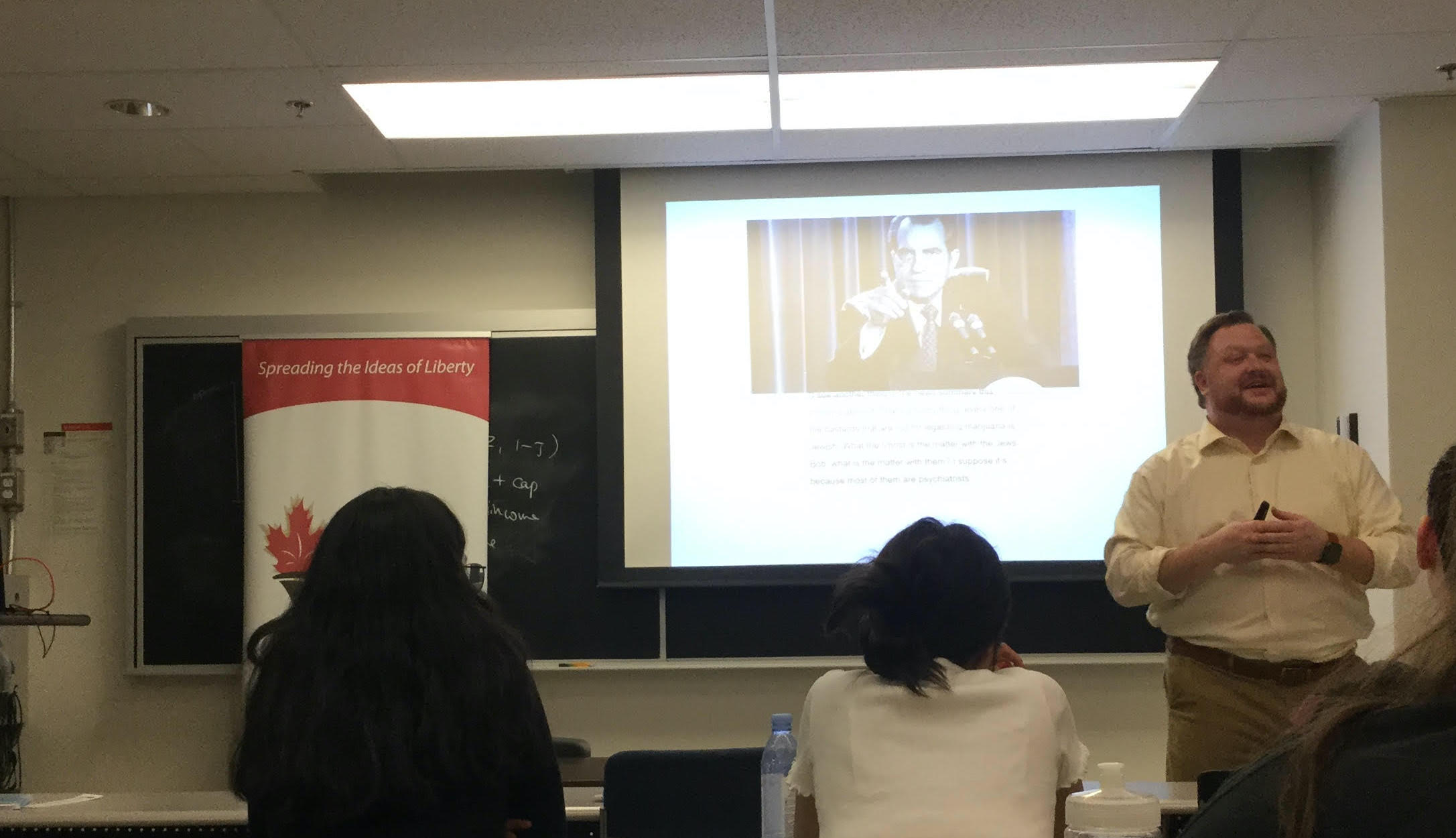
On Jan. 23, the Institute for Liberal Studies and the McGill Political Science Students Association hosted “Drug Addicts Are Human Beings,” a talk to examine the negative impacts of the war on drugs and the ways in which drug addicts are dehumanized. The talk featured keynote speaker Trevor Burrus, a research fellow at the Cato Institute who lectures for various organizations, including the Federalist Society and the Institute for Humane Studies. Although not directly affiliated with McGill, the Institute for Liberal Studies hosts talks about the ideas of liberty and freedom on for a wide range of topics.

Burrus began his talk with a question to challenge the audience’s perceptions of drug users. 

“The fundamental question at the heart of the drug war is, ‘Why do alcoholics get treatment and heroin users get cages’?” Burrus said. “Why would we have to dehumanize someone so much because of the specific drug they use [….] The drug war is evil and we must end it.”

According to Burrus, the three main prongs of the war on drugs are perceptions of the drug, perceptions of the drug user, and dehumanization of the drug user. Burrus described each of these claims and argued that the US American federal government has manipulated public perceptions of certain drugs in order to target marginalized and racialized groups.

Burrus referenced a 2012 incident in which a Florida man ate part of a homeless man’s face to show how police will lie about drugs to create false panic in the population. He explained how common drug abuse is by providing statistics on alcoholism. 

“All drugs are pretty much the same,” Burrus said. “20 per cent of the drug users are [chronic users]. 20 per cent of drinkers are alcoholics, but we do not punish the 80 per cent because of the 20 per cent. The same is true of heroin.”

Burrus encouraged everyone to be empathetic toward drug users.

“We need to give a human face to those who need help, not a jail cell,” Burrus said “We can change if we want to, [but we need to] see drug users as human beings.”

After Burrus’ talk, several students brought up how they are working to improve the campus culture around drugs. One student told the audience that there is actually a safe injection site at Concordia University, which allows people to use drugs in a safer setting. Furthermore, the Canadian Students for Sensible Drug Policy is currently trying to create a similar program at McGill.

Jeanne Cholot, a Concordia art history student, learned about the stigma around drug users and was compelled to share her knowledge.

“I think it was really honest,” Cholot said “[Burrus] was very satirically revealing blunt information that makes you understand how messed up it is. It was pretty entertaining. I’ve done my own research [about drugs and drug users], but I engaged with the talk.”

Sabine El-Chidiac, Educational Program Manager for the Institute for Liberal Studies, was excited to be back at McGill.

“[The Institute for Liberal Studies] comes to McGill at least once or twice a year,” El-Chidiac said. “We like [coming here]. Student groups will ask us to bring people [sometimes]. McGill students are great, they are always very engaged and have good questions.”

Read the latest issue

Read the latest issue