Latest News

Features

The witching hour arrives in Montreal

Montreal is no stranger to witchcraft, and the Occult is embedded in local popular culture. Bars such as Datcha host Jazz and Tarot Thursdays, psychics have doors across the city, and even storefronts on Rue Sainte Catherine display Tarot cards, incense, crystals, and other spiritual objects.

Basketball, Martlets, Sports

One point victory lifts Martlet Basketball over Citadins

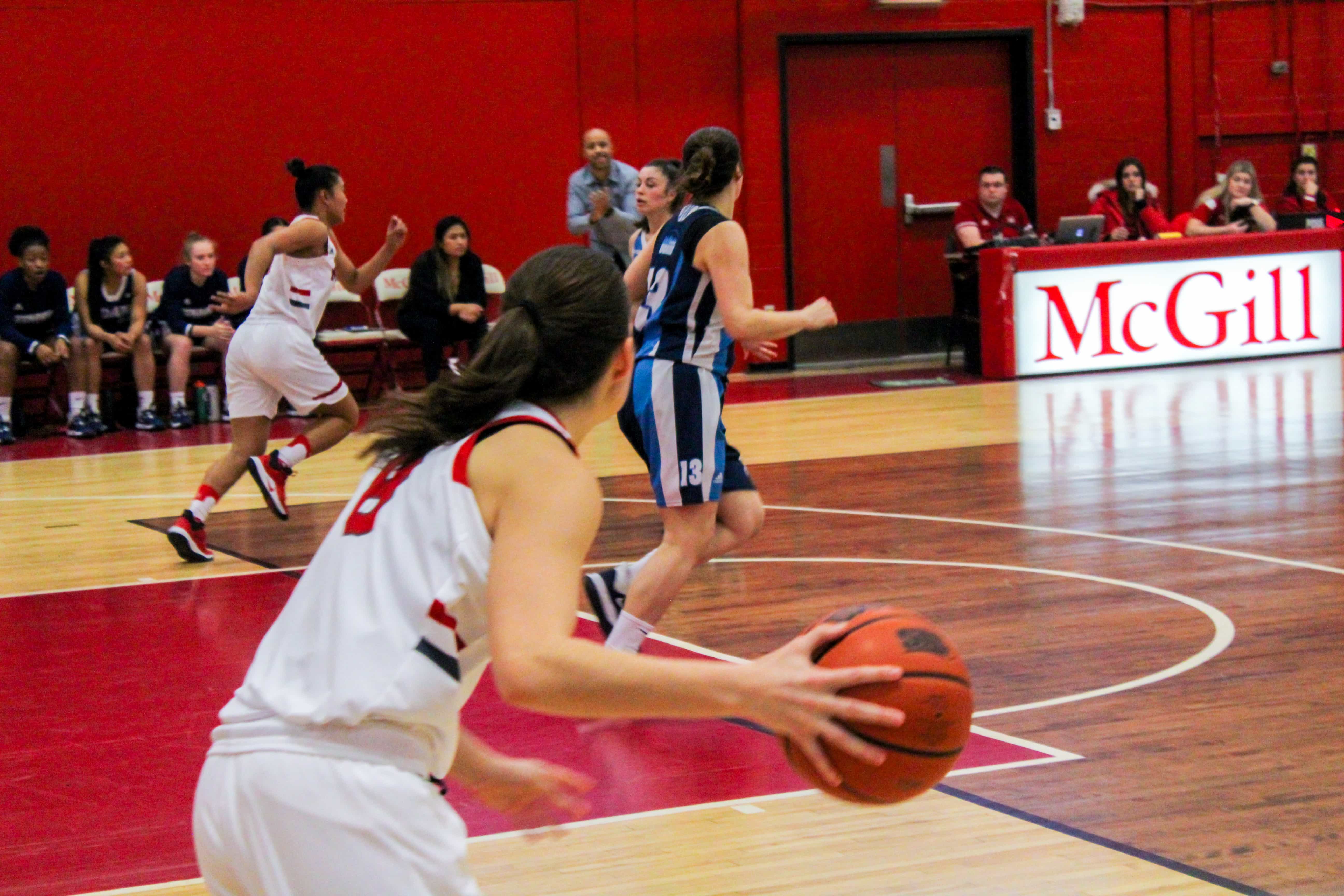
Martlet Basketball (3–7) defeated the visiting Université du Québec à Montréal (UQÀM) Citadins (4–5) by a single point, 54–53, in a hard-fought game on Jan. 18. This was a much-needed win for a struggling Martlet team, who started the new year with three consecutive losses, including one to the same UQÀM team a game prior. In this contest, however, stalwart defence and active rebounding, along with the late-game heroics of fifth-year guard Gladys Hakizimana, elevated the Martlets to victory.

A quick start to the game saw the Martlets up by five early, much to the delight of the packed crowd in Love Competition Hall. But, UQÀM was prepared to compete, quickly deploying an effective full-court press. McGill adjusted well in response and found themselves ahead 13–10 at the end of the quarter.

McGill’s defence stifled the Citadins in the second period, frequently stealing the ball or forcing shot clock violations, all while holding the Citadins to a frigid 18 per cent from the field. The Martlets went ahead by eight, their largest lead of the game, but a renewed full-court press led to a 9–0 run from the Citadins and a slim halftime lead, 23–21.

Entering the third period, McGill’s offensive rebounding kept them in the game, and another steal put McGill back in the lead. UQÀM began to hit their shots, however, and a dagger three-pointer looked to have McGill back peddling. The Martlets responded to the adversity, though, and entered the final period trailing by just two points, 39–37.

“I think it takes a little bit of poise [to win tough games],” Head Coach Ryan Thorne said. “Down the stretch, we made some mistakes, but there was some poise, there was some effort, and there was some commitment to playing tough defence.”

Winning games also takes making shots, however, and that is exactly what Hakizimana entered the fourth quarter prepared to do. A quick three-pointer opened Hakizimana’s scoring barrage, as she proceeded to hit a reverse layup and another three-pointer in quick succession to put McGill ahead 45–41. Two blocked shots, by second-year players Delphine Robitaille and Shayann Laguerre, respectively, looked to have the Martlets comfortably on their way to victory, ahead by eight points.

“I’ve been practicing those shots,” Hakizimana, who led all scorers with 20 points, said. “I know that as soon as I have an opportunity […] to shoot the three, I’ve got to be confident enough to take it and make it.”

UQÀM hit big shots too, however, eventually cutting the lead to a single point. With 8.9 seconds left in the game, the Citadins reclaimed possession and attempted a buzzer-beating three-pointer for the win, but the shot missed iron and the Martlets walked away with the victory, 54–53.

“[Winning takes] a lot of focus, a lot of [being] locked in, and a lot of communication,” Hakizimana said. “We’ve been focussing on a lot of communication but [also] a lot of listening to make sure we’re all on the same page, and I think that’s the big reason why we were able to [win].”

The Martlets will look to keep their momentum going on Jan. 23 and again at home Jan. 25 when they play cross-town rival Concordia (3–4).


Moment of the game

UQÀM looked poised to pull away from the Martlets until first-year guard Jessica Salanon found second-year forward Shayann Laguerre rolling to the rim where she muscled up a layup through contact. A smooth free throw completed the three-point play, tying the game 34–34 and helping McGill stay on track to victory.  

Quotable

“We go by three […] pillars: Head, heart, and hustle. All those three things showed themselves today[.] As long as we maintain those [three pillars], I think we have a chance of success.” – Head Coach Ryan Thorne on the lessons he wants his team to take away from the victory.

Stat corner

McGill secured an outstanding 17 offensive rebounds, which helped the Martlets score 28 points in the paint, double UQÀM’s total.


Basketball, Sports

WNBA agrees to new collective bargaining agreement

The Women’s National Basketball Association (WNBA) agreed to a seminal new collective bargaining agreement (CBA) on Jan. 14. The agreement makes major updates to the working conditions, including changes in salaries, revenue sharing, maternity leave, and travel and accommodation. Additionally, maximum salary will increase almost 83 per cent to $215,000 from $117,500 per year. By 2021, the WNBA could be splitting revenue equally with the players, whereas it is currently estimated that players receive just 20 to 30 per cent of league revenue. The new agreement also provides maternity leave with full salary, and travel will now include individual—rather than shared—hotel rooms for every player.

This investment in the future of women’s basketball is a major breakthrough not only for the WNBA but also for women’s athletics at large, as other women’s professional leagues could use this agreement as a platform to revise their own bargaining agreements. WNBA players were one of several groups of American female professional athletes to challenge their leagues or governing bodies in the past two years when they opted out of their previous CBA in November 2018: In March 2019, the women’s national soccer team sued the US Soccer Federation (USSF), alleging gender-based pay discrimination. With the emergence and popularity of professional leagues all across the world, it is time that female athletes  get their fair share of recognition and compensation. 

Although the NBA is known for its competitive salaries and revenue sharing with male athletes, this new CBA defines the start of a new era for women’s basketball. It can and should be a catalyst to bridge the gap in salaries between men’s and women’s basketball in the long run. The NBA’s average salary is currently more than 85 times that of the average WNBA salary, but this new agreement could substantially increase the average salaries of players in the WNBA. By providing an additional incentive for athletes to join the league, the WNBA stands to be able to attract more talent and raise the level of play, making for more entertaining basketball and more viewership and sponsorships. Better salaries are a tangible outcome of the WNBA’s already increasing popularity.

Perhaps the most critical addition to the new CBA is the offer of fully paid maternity leave for players. Long overdue, this clause provides a qualitative change from the old bargaining agreement. The new policy will also help the league retain its talent, as women will not be forced into retirement if they want to have children. Returning to the sport after having a child is one of the hardest and most undervalued comebacks in sports; providing assistance in the form of paid maternity leave for athletes during pregnancy is an immensely supportive and necessary move by the league. 

WNBA All-Star Candace Parker has long been vocal about the issue of maternity leave. Parker shared her experience of giving birth to her now 10-year-old daughter in an interview with NBA TV on Jan. 15. Her daughter was six weeks old when she returned to the court. 

“I had to take my mom with me, because I nursed the first 15 months, but it was out of pocket, I had to pay for my own hotel room,” Parker said. “[But] those things are slowly getting better for mothers[.] We’ve made so much progress, but I’m hopeful that there’s more to come in the future.”

It is highly encouraging to see such a bargaining agreement come to fruition in a time when the prominence of women in sports is increasing. Although much more needs to be done to address the historical gender pay discrimination in sports, such as further reforming sponsorship deals and increasing female representation in coaching staffs, the new CBA is a significant step toward bringing parity in North American basketball.

Off the Board, Opinion

Overcoming human challenges with transhumanism

Sometimes, being human involves tragedy: unexpected accidents can alter a person’s future, permanently changing how they need to approach their daily lives. Those with traumatic brain injuries suffer long-term mental and physical challenges, such as trouble with their working memory span, which can play a significant role in their education and longevity. However, if used properly, transhuman aids such as prosthetic limbs can provide solutions to human challenges.

Transhumanism, in a nutshell, is the idea that people can use technology to overcome biological limitations. Just as how we use rational means to improve our life experiences and the world around us, we can use such means to improve ourselves as organisms. It is simply a concept, not a tangible characterization of some futuristic cyborg.

There is reasonable fear that using such technologies would be tampering with nature. This is true. However, whether something is good or bad cannot be decided simply by asking whether or not it is natural. Plenty of natural things are horrible, such as diseases and parasites, where our moral interest is to intervene and improve these conditions. The question to ask is not whether the technology is natural, but rather, what are the various possible consequences that would arise from it, both desirable and undesirable, and the likelihood of each. People who are concerned that our species will stray too far away from what it means to be a ‘natural human’ forget how far we have already evolved as a species.  

Our technology today has already changed the ways our mind works. Many people in modern society cannot live without devices such as computers or phones. We pick up our devices an average of 80 times per day, and that has already changed our brains for the worse—our attention span is only 40 seconds on a screen. It is important to carefully understand what we can control, so that we can approach creating technology with wisdom. It’s optimal to focus with specific areas first: For example, hearing aids started with a goal to help people with hearing loss. With that technology, some adjustments and developments can lead to super-human hearing. Therefore, we should only apply our super-technology in specific areas where we actually want those abilities. 

One area of interest is in improving the educational experiences of students with disabilities. Neuroprosthetics, implants that directly interface with your brain, are already transforming the lives of many deaf, blind, and paralyzed people today. Such technology has the potential to redefine how we learn and take in information, and ultimately expand the horizons for students with difficulties. While we should not be trying to “cure” anyone of their conditions, it is a wonderful opportunity to give everyone the tools they need or desire, while still allowing them to stay true to themselves.

“It is important to carefully understand what we can control, so that we can approach creating technology with wisdom.”

It is unethical to use prosthetics to give someone a mechanical advantage over their natural counterpart. However, if used properly, as is the case with prosthetic arms, hearing aids, and false teeth, that we commonly see today, these aids are not considered unethical: We are already transcending what it means to be a human. Our brains are hardwired to work towards what is in our species’ best interest. Thus, we should not be discouraging the pursuit of transhumanism, rather, we should instead be encouraging its discussion. As long as we are careful and considerate of our creations, we will only be improving our lives, and the lives of those around us. At the end of the day, transhumanism is a choice in the best interest of our species.

Research Briefs, Science & Technology

Rapid urbanization is driving biodiversity decline

Humanity is currently experiencing an unprecedented era of urban growth. By 2030, more than 1.2 billion additional people are expected to live in cities, equivalent to building a city the size of New York every six weeks.

A group of international scientists, including Andrew Gonzalez, a professor in the McGill Department of Biology, surveyed over 922 studies on urban growth’s impacts on biodiversity. Their study, recently published in Nature, found that scientists are not studying the impacts of urban growth in the right places: 72 per cent of studies of direct urban impacts on biodiversity are in high-income countries, while the natural habitat loss in lower-income countries, largely ignored by the scientific community, is much more severe. In essence, researchers are neglecting to study low-income urban growth. 

In an interview with The McGill Tribune, Gonzalez explained the importance of studying the effects of urbanization on biodiversity, particularly in developing countries.

“[In] Nigeria, Brazil, and China, where human growth is [greatest] and where biodiversity is the richest, is where we have the most to lose,” Gonzalez said.

Generally, the direct effects of urban growth on habitat loss are well understood: Building construction often results in habitat destruction and fragmentation. According to Gonzalez, however, scientists are not paying enough attention to the indirect effects, which outweigh the direct consequences. 

“The indirect effect of urban expansion is the resources cities demand,” Gonzalez said. “The ecological footprint of cities is much greater than the footprint of just the building. We have a bad understanding of the indirect effects of urban growth.” 

Cities also require land for food and energy, another example of urbanization’s indirect impacts on the environment. This requires converting vast areas of land into agricultural spaces to sustain cities, leading to more habitat loss. 

“The amount of agricultural land required to feed the world’s cities is 36 times greater in size than the urban areas themselves,” Gonzalez said.

 Despite this knowledge, only 34 per cent of studies have quantified these indirect impacts.

Gonzalez pointed out that however detached we may feel living in a city, we are fundamentally dependent on ecosystems. 

“We depend on them for normal things,” Gonzalez said. “Food, fibre, water, air, recycle all those essential things we need for life, species do all of that. What makes these habitats the Amazon or the boreal forest is their biological diversity and the variability of living organisms in these places. Habitat loss impacts the things we rely on.”

People in low-income countries are largely moving to cities due to increasing industrialization and job availability. This presents a major problem for cities with limited infrastructure that must continue expanding to keep up with the influx of people from rural areas. In this case, urban expansion is necessary, and hindering it is unrealistic. Gonzalez suggests tangible ways to reduce the habitat loss caused by urbanization.

“There is nothing wrong with a city per se; the question of how we choose to live in a city is the issue,” Gonzalez said. 

By reducing urban sprawl and allowing nature and people to coexist by enforcing policies such as green belts, or areas where building is restricted, cities can achieve greater sustainability as urban centres grow.

Although there seems to be a plethora of environmental concerns that merit our attention, the loss of  habitat and the disappearance of native species is often not given the weight it deserves.

“Habitat loss used to be the kind of thing we worried about ethically,” Gonzalez said.  “Now we realize it is integral for the functioning of our ecosystems and biosphere. Our fate is determined by how we treat our biodiversity, and in that, our biosphere.”

Ask a Scientist, Science & Technology

Image generation is rendering advertisements artificial

Decadent delicacies in food advertisements are not always what they seem to be. In these commercials, motor oil poses as pancake syrup, mashed potatoes become scoops of ice cream, and craft glue replaces milk in a bowl of cereal. 

Today, a rendering technique called physically based rendering (PBR) allows advertisers to take further liberties when creating their ads. Rather than cheating customers by passing off one product as another, this rendering technology generates photorealistic images on a computer without relying upon expensive and unwieldy camera equipment. Open any product catalogue today, and it is likely that the images displayed never existed in real life. 

PBR relies on physics to generate realistic depictions of objects. According to Derek Nowrouzezahrai, a professor in the Department of Electrical and Computer Engineering, PBR attempts to create images that portray the physics of light as accurately as possible. 

“[PBR] is about getting accurate physical models of the behaviour of light and how it transmits, scatters, reflects, and diffuses for different types of materials,” Nowrouzezahrai said. “Wood versus metal, versus plastic, versus hair, versus skin.” 

In general, rendering takes a three-dimensional scene and attempts to output a two-dimensional picture that realistically portrays the original three-dimensional state. In AI and robotics, PBR gives computers sight through an inverse process, where computers input a two-dimensional scene and use it to figure out its three-dimensional surroundings. 

“If I have a camera sensor on my car, and I’m taking a 2D picture of my scene, how much of the 3D world can I infer?” Nowrouzezahrai said. “This is the traditional computer vision problem.”

Images created through PBR strive to be as true as possible to real world physics. According to Nowrouzezahrai, this helps robots—especially autonomous vehicles, which take in a lot of natural light—to navigate the real world without incident.  

The advertisement industry widely employs PBR technology, since it reduces the cost and time associated with setting up and capturing the ideal shot. PBR also allows directors to be more flexible when designing the scene by freeing them from the restraints of the physical world. As a prominent example, the furniture giant IKEA has entirely adopted PBR technology in the creation of their beautiful catalogues.

“It’s all fake,” Nowrouzezahrai said. “It’s been decades since they have taken a real picture of their product.”

Beyond product advertising and prototyping, PBR is also an integral part of the entertainment industry. In video games and films, PBR produces impressively realistic renderings, even scenes with floating artifacts and fantasy beasts that one would never encounter in real life. 

PBR allows us to recreate more of our material world in the digital realm. At the same time, its realistic images also allow robots, born in the binary realm, to find their way into the physical world. Further research and applications for PBR include creating better simulations for humans and robots. For humans, such simulations come in the form of virtual reality experiences. Robots, on the other hand, might use simulations for training purposes before being allowed to operate in the real world. 

Through research in PBR and other simulation technologies, visual media artists and machine learning scientists like Nowrouzezahrai have teamed up to find out how much our material world we can recreate realistically in the digital world, and what exactly can be done with the results.

Basketball, Sports

McGill Men’s Basketball loses nailbiter to Citadins

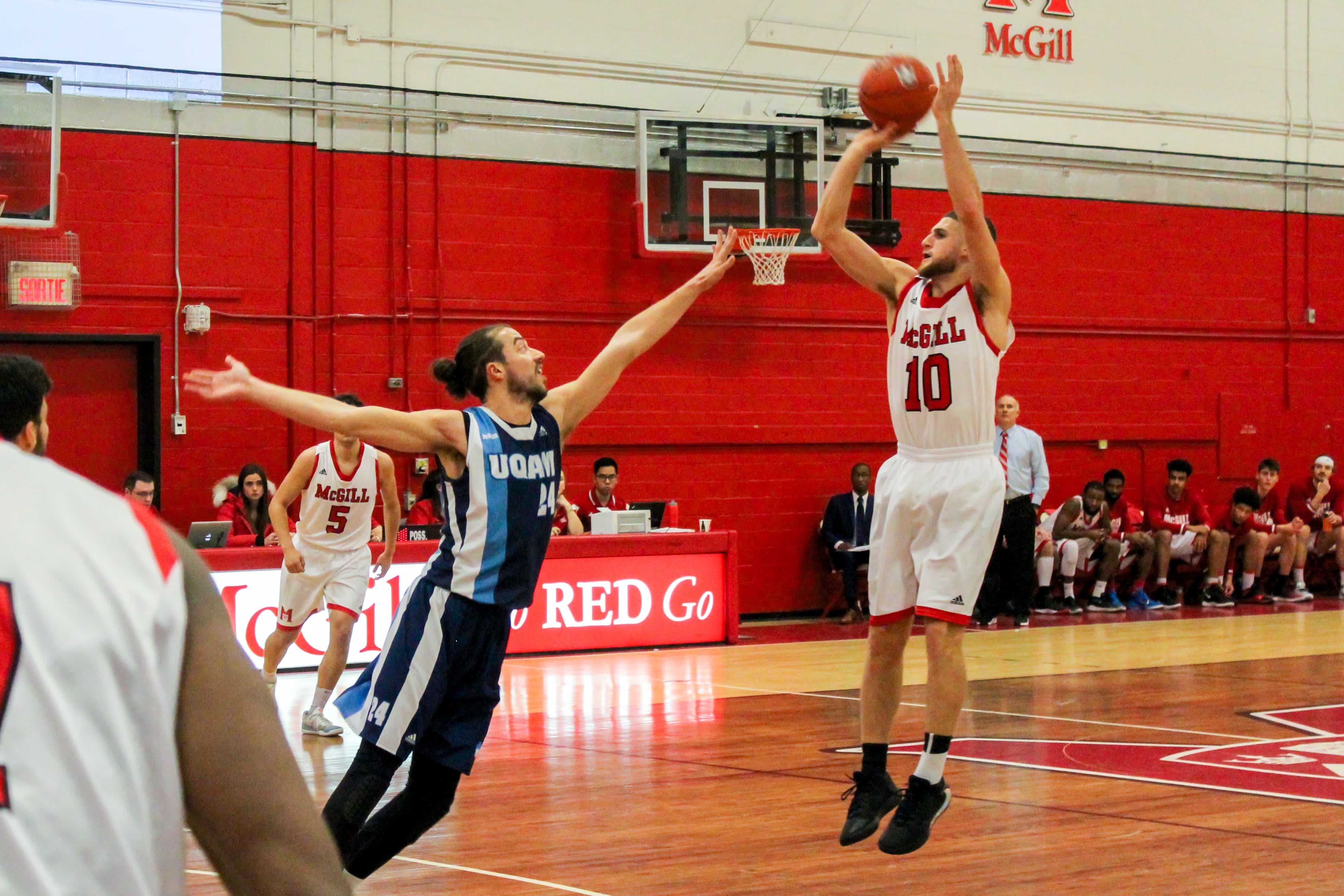
The McGill Men’s Basketball team (8–2) lost in heartbreaking fashion on Jan. 18 in an electrifying home game against the Université du Québec à Montréal (UQÀM) Citadins with a final score of 81–75. This loss did not reflect the heart-wrenching efforts from both sides that led to a thrilling eight lead changes throughout the game. 

Neither team had any offensive momentum at the beginning of the first quarter, as both sides forced turnovers and switched screens exceptionally, making easy baskets hard to come by. Only third-year forward Levi Londole made a significant offensive impact, with an impressive seven of the team’s 16 first quarter points. McGill finished the slow-paced quarter trailing the Citadins, 17–16.

The second quarter saw a significant increase in pace, with both teams hitting their rhythm, increasing ball movement, sinking threes, and energizing an already rowdy crowd of 305 in the process. McGill used ball movement and a fast-paced, screen-centric offence, pushing the team into the lead with 36 points to the Citadins’ 32 at the end of the first half.

McGill’s dominance did not last, however, and sloppy ball handling and missed shots plagued the team in the second half. 

“We didn’t [use] the ball particularly well today,” Head Coach David DeAveiro said. “I think we shot 19.4 per cent from three. It’s tough to win games where you don’t shoot the ball, especially for us. We’re not big, our game is shooting threes. But we turned it over 19 times and got out-rebounded.”

The third quarter saw an improvement for McGill. Londole put up a dominant defensive effort and scored six points, including a crowd-pleasing fast-break dunk. Third-year guard Jamal Mayali ended the quarter decisively with an and-one layup and an off-balance three-pointer in the last minute of the quarter to cut UQÀM’s lead to three, 59–56.

McGill came into the fourth quarter red-hot and overtook UQÀM midway through with a one-point lead, bringing the score to 66–65. But McGill’s luck turned with four minutes left in the quarter: Their defence suddenly fell to a flurry of threes, and careless ball handling led to several turnovers. 

With three minutes remaining, the score was 70–66 UQÀM, and McGill broke under the pressure, fouling and turning the ball over consistently. Several time-outs and free throws later, McGill lost 81–75. 

“I’m really confident, […] we’re still in first place,” third-year point-guard JJ Hamel-Carey said of McGill’s chances in the postseason. “It’s our second loss of the season, so we’re not going to hang our heads. It happens, it’s a small loss.”

McGill hopes to turn their luck around in their coming game against the Concordia Stingers (4–3) on Jan. 23. 


Moment of The Game

With 15 seconds left in the third quarter, third-year guard Jamal Mayali sunk an off-balance three-pointer to bring McGill within three points of UQÀM, energizing the crowd and spiriting the team to come out strong in the fourth quarter.

Quotable 

“They were [hungrier] because they had something to prove because we had just beat them. So we were feeling good about ourselves, and they punched us in the face. We kind of responded, but we could have been better, and at the end of the game, they made a couple key plays that gave them the edge.” – Third-year point guard JJ Hamel-Carey on the mental aspect of the game.

Stat Corner

JJ Hamel-Carey scored a season-high 16 points, going 7–11 for the entire game. He did this with an athletic slash-and-kick style of play that allowed him to drive to the rim effectively.

McGill, News

McGill mourns victims of the plane crash in Iran

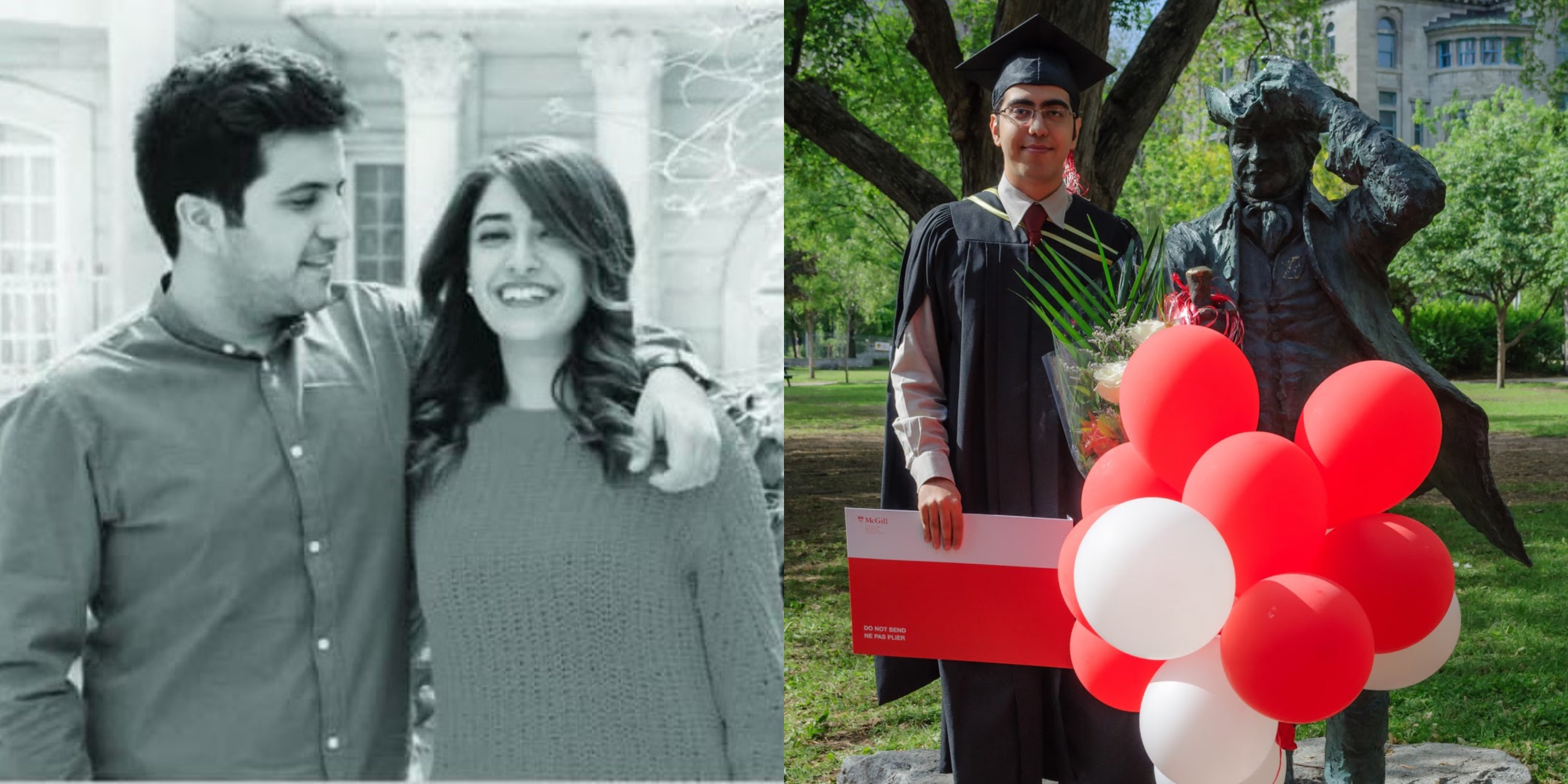
On Jan. 16, McGill held a memorial on the Macdonald campus for Negar Borghei, an Iranian master’s student and a victim of the plane crash near Tehran. The Jan. 8 incident claimed the lives of 176 people on the plane, including two members of the McGill community.

Borghei obtained her first master’s degree in Iran and worked as a dietitian. She hoped to obtain her credentials to practice in Canada, so she enrolled in the human nutrition program at McGill in September 2019 to obtain a second master’s degree, according to Anja Geitmann, Dean of the Faculty of Agricultural and Environmental Sciences.

“Negar’s brother tells me that it has helped the family cope with their loss by seeing how Canada, in general, and McGill in particular share their grief,” Geitmann said. “It is upon the family’s request that we will be taking pictures and video footage today […] in the hope that seeing the footage calms Negar’s family.”

Borghei’s husband, Alvand Sadeghi, was on the plane with her. He was a web developer at ViewFin, a fintech company, and lived in Toronto. Negar travelled back and forth between Montreal and Toronto on the weekends to see him. Also aboard were Alvand’s sister, Sahand, and her young daughter Sophie. During the memorial, Linda Wykes, Director of the School of Human Nutrition recounted her memories of Borghei. 

“She was able to influence people through the brightness of her personality,” Wykes said. “She was a leader, an important colleague and a collaborator in many group projects. Negar was a very bright light and we will always remember her.”

Over 100 people attended the memorial, which prompted the organizers to relocate from the MacDonald-Stewart’s faculty lounge to a lecture hall at the last minute. McGill Principal and Vice-Chancellor Suzanne Fortier offered her condolences to Borghei’s family, friends, and to the McGill’s Iranian community. The attendees of the memorial were touched when a group of Borghei’s classmates tearfully shared their memories about her. Maureen Rose, Dietetics Credentialing Director, remembers the times spent with Borghei. 

 “She was […] always with a friendly, welcoming smile,” Rose said. “And I think that was an output sign of the nature of a soul. She was warm, generous, always helping others, able to be a leader but also willing to be a team player. Negar, you are a bright light, and now you are shining somewhere else, but you will always be here, shining.”

After the speeches, the attendees returned to the faculty lounge, where they signed a condolence book that will be sent to Negar’s family. Music was provided by a chamber trio from the Schulich School of Music.

Maryam Razaghi, a PhD candidate in human nutrition, went to the same undergraduate school as Negar. Razaghi was comforted by McGill’s condolence messages and the memorial, and recalled the last time she saw Borghei.

“I felt that McGill cares about us and that we are like a family,” Razaghi said. “[I last saw her] in December at a Winners store, I saw her from a distance and noticed she [was] buying a lot of stuff. I guessed she must be going to Iran and is buying gifts for her family. I regret that I did not talk to her for the very last time.”

Faraz Falsafi, who received his master’s degree in computer science from McGill in 2015, was another victim of the plane crash. Sajjad Ghaemi, a Research officer at the National Research Council of Canada, met Faraz in a machine learning course.

“He loved to travel and to take photographs,” Ghaemi said. “After his graduation from McGill, he worked in Montreal for some time, then moved to Toronto and started working there. I last spoke to him in October; he told me he is going to Iran for the holidays to attend his sister’s wedding ceremony. I still cannot believe he is gone. I sometimes call him or check whether he has sent me a Whatsapp message.”


Student Life

Supporting student wellness through synergy

The annual Synergy Mental Health conference, hosted by Students in Mind (SiM), continued the discourse on mental wellness with a particular focus on cultivating a community on campus promoting healthy minds. The conference featured various activities, such as a journal writing workshop and a talk on how to navigate the health care system at McGill and beyond. These workshops facilitated conversations about mental health as well as providing students with the necessary tools to care for the wellbeing of themselves and those in their community. Julia Caddy, U2 Arts and President of SiM, explained the group’s multifaceted approach to addressing mental health challenges.

 “[SiM investigates] the dimensions of mental health, we’re not just focussed on [the question] ‘Am I okay?’” Caddy said. “We’ve really focussed on making sure that we connect to all different dimensions so that we are able to create a conference that people are able to customize to their mental health story. We don’t want people to fit our narrative. We want to be fitting theirs.”

This multi-dimensional approach to mental wellness was the inspiration for the theme of this year’s conference: Synergy. With a multitude of speakers and activities catering to all different learning styles and interests, the event was part of SiM’s year-round efforts to offer accessible resources for obstacles to the mental health of students. 

“Initiatives like this one are important because it’s really difficult to be a student,” Johanna Cline, U3 Arts and SiM’s VP Communications, said. “[…] You need support, and I feel like a lot of people lack access or don’t know how to access [those resources].” 

Dr. Erin Barker, a professor of psychology at Concordia University and the conference keynote speaker, discussed this difficulty. Citing data from an American College Health Association study, Barker noted the high levels of stress, anxiety, and depression among university students.

“We see [a] spectrum of distress, stress across large samples of university students,” Barker said. “We need to get over those myths that university students are sort of this privileged healthy class of individuals and start to actually realize that really, […] it can be a distressing experience, and it’s one that large portions of our population are going to have to face.”

With high levels of student stress and inadequate mental health support from the university and the public health care system, SiM hopes to provide students with important resources they may be unable to access elsewhere.  

“It’s the school administration that needs to change its healthcare system, […] but the reality is [that the school’s healthcare is not changing] or [it is] not changing fast enough,” Caddy said. “But our struggle doesn’t just wait […] until policies are passed. What […we can] do is to ensure that everyone has the tools they need at the moment and can equip themselves and their peers to cope as a student and advocate for themselves.” 

To create a community supporting students’ mental wellbeing all year round, SiM holds events throughout each semester such as Mindful meal preps and a Week of Wellness. For Ellie Brehaug, U3 Psychology, this year’s conference was successful in fostering a supportive student body. 

“[Today], I’ve learned that there are other people who are struggling with their mental health,” Brehaug said. “[I discovered] that it’s a common thing to experience in university, which is kind of comforting to know that you’re not alone.” 

Commentary, Opinion

McGill is not an “Antisemitic University”

Over the winter break, I was excited to talk with my family and friends about McGill, but defending the university’s name against accusations of antisemitism was not what I had in mind. Instead of sitting down to the ordinary Shabbat dinner with loved ones, I stumbled into defending a McGill on trial, and I did my best as its attorney: But, it seemed like the case was already closed. The Times of Israel had already published a piece lamenting an “antisemitic” Students’ Society of McGill University (SSMU) resolution, while Bari Weiss, New York Times Opinion Staff Editor, mentioned the incident in a column about the rise of worldwide antisemitism. 

As a Jewish student and representative to SSMU, seeing the issue so misrepresented in the press was jarring to say the least. Instead of a reasoned debate, the dinner table conversation quickly turned into a loud, heated dispute, as my explanations of the nuances of McGill student governance were drowned in a flood of misunderstanding facilitated by journalistic malpractice. The distinction I sought to make to those seated around the table is this: Not everything that is anti-Israel is antisemitic, and the issue is far too complicated to be reduced to “antisemitism” or even anti-Israel bias. Moreover, conflating the two is both damaging to the term “antisemitism” itself and insulting to Jewish people who are critical of Israel and its current leadership. 

The issue at hand is an offer to apply for an all-expenses paid trip to Israel and Palestine, which was pitched by Hillel Montreal to SSMU executives, directors, and other “student leaders.” Hillel extended the invitation through a letter that is worthy of scrutiny, according to student representatives, because it could indicate that the trip presents a conflict of interest. Although SSMU has been plagued by issues that have led to accusations of antisemitism or anti-Israel bias in the past, this situation is hardly identical to the 2017 incident of a councillor being threatened with impeachment for being “pro-Israel.” This time, The McGill Daily exposed councillors who had accepted the invitation, problematizing the unclear motives behind the trip. Debate over the issue culminated in a Nov. 28 resolution to condemn the trip as a conflict of interest for student leaders. The meeting concluded that those concerned should either resign or back away from the trip, lest they will face impeachment. While most councillors and directors renounced their initial acceptances before the resolution was debated, Jordyn Wright, the Science Undergraduate Society (SUS) representative to the SSMU Legislative Council, refused to turn down the offer.

“The distinction I sought to make to those seated around the table is this: Not everything that is anti-Israel is antisemitic, and the issue is far too complicated to be reduced to “antisemitism” or even anti-Israel bias.”

Weiss wrote that SSMU resolved to remove Wright over the trip even though “another student government leader is also going,” concluding that “apparently because that student is not a Jew, no resignation was required.” What Weiss failed to acknowledge is that some councilors argued that, as a director, Wright represents the Legislative Council on the Board of Directors (BoD): Had the resolution to condemn the trip as a conflict of interest passed without requiring her to resign, she would have been in defiance of the Legislative Council at large. The other councillor is not on the BoD, and was not asked to resign because councillors felt that his actions would not have affected further decision making on SSMU. And Wright was hardly “singled out” for being Jewish, considering that an Arts Undergraduate Society (AUS) representative, who is also a member of the BoD, was also named in the resolution until he backed away from the trip. Moreover, he and other non-Jewish councilors going on the trip were asked by the Social Work representative to resign during a Nov. 14 meeting because the councillor perceived the trip as a conflict of interest. Like Weiss, the Times of Israel failed to account for the existence of these circumstances when they quoted Wright, labelling the resolution as “antisemitic”. Without acknowledging these key details, millions of readers of these media outlets, and others that reported on the issue, will conclude that McGill is an antisemitic university, and that impression will be difficult to dislodge. This could cause some parents to think twice about sending their children here, and potential donors might be deterred.  

Students can reasonably question whether or not SSMU is making a fuss over seemingly needless provisions in its governing documents, but to call the resolution “antisemitic” requires more evidence than the opinion of the councilor whose position (and potential free trip to Israel) is jeopardized in the situation. Labels like “antisemitic” must be applied carefully. Jewish people especially must take every step necessary to safeguard the integrity of that condemnation, by ensuring that when it is levied, it is with the utmost gravity and conviction in its justification. The world is becoming increasingly unsafe for Jewish people, but the censure of “antisemitic” loses weight when it is applied carelessly and incorrectly. Calling McGill antisemitic also tarnishes the university’s reputation, which, in turn, devalues every McGill student’s degree. It is deeply troubling that the media has been able to shape public opinion on this matter without having examined the situation thoroughly. Words are powerful, and in the current political climate, where the value of truth has been questioned by those in power and the internet is rife with fake news, it is imperative that the power of terms like “antisemitic” not be reduced through misuse.

Read the latest issue

Read the latest issue