

Latest News

Executive
Editorial, Opinion

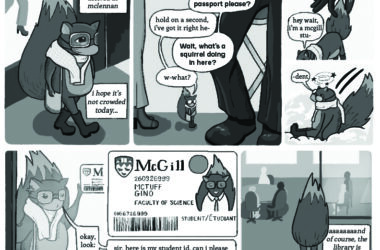
Overworked and underpaid: Executive dysfunction in student government

On Feb. 25, Cody Esterle, Student’s Society of McGill University (SSMU) Vice-President  VP) Student Life announced that they would be taking time off for an indefinite period due to immense emotional and physical burnout. Similarly, VP External Marina Cupido resigned in Sept. 2018 citing mental health concerns while in office. In Dec. 2018, Post Graduate Students’ Society (PGSS) External Affairs Officer Hocine Slimani left his position as well. With executive elections fast approaching, student societies need to confront that burnout is inherent to a flawed structure. Underpaid and overworked executives are physically and emotionally unable to fully carry out all of the tasks in their portfolios or campaign promises—healthier systems of labour will only strengthen the work that SSMU and PGSS are already doing.

Students often underestimate the significant roles that student society executives play on campus. While executives garner unwanted attention during times of controversy, much of their job is mundane. Besides being responsible for facilitating many day-to-day operations, such as the SSMU Daycare and tutoring services, executives often handle multiple large-scale projects at a time. On paper, the job is a 40 hour a week commitment, but, in practice, that number can stretch to anywhere from 60 to 90 hours. For the amount of work executives do, they are grossly underpaid. For instance, as of 2016, SSMU executives are some of the lowest paid in Canada, making roughly $6,000 less than the $35,000 per-year average for Canadian student association executives at the time.

Institutional structures are part of the reason why executives are overworked: A small group of elected representatives come into year-long terms with multi-year goals. These representatives are tasked with handling budgets of over $1 million, running multiple businesses such as SSMU’s MiniCourses, and lobbying governments, all while completing their degrees. PGSS officers juggle additional academic responsibilities, such as holding teaching positions and conducting research.

When it comes to advocating for campus reform, administrative change at McGill often happens too slowly for an executive to see the results of their efforts during their term. What students may see as a failure to achieve campaign promises may be indicative of something more concerning: McGill’s current bureaucratic administrative structure makes achieving their goals almost impossible.

A lack of institutional memory contributes to these structural issues, as well. Previous and newly-elected executives’ terms overlap for a month in May, but this is hardly enough time for new executives to fully grasp all of the responsibilities of their roles. Student societies should consider creating more administrative full-time positions or extending elected terms to have more overlap. Additionally, student societies should hire more students and non-students to aide executives, taking over their more mundane, but time-consuming tasks, such as email correspondences.  

SSMU and PGSS serve indispensable roles on campus by supporting and advocating for students. General Elections are approaching soon, but student engagement and voter turnout continue to be low; in previous years, most candidates ran uncontested. Currently, there are only four candidates running for PGSS’s six executive positions. Assuming a more reasonable workload would likely help address the problem of uncontested executive elections, as well. There has been momentum toward reforming aspects of SSMU through a governance reform committee, and it is crucial that these efforts be sustained. Student societies need good executives to continue, improve upon, and create new tasks and projects: Making their jobs less grueling is a first step to keeping them around.

McGill, News

AUS executive team broke constitution, Secretary General finds

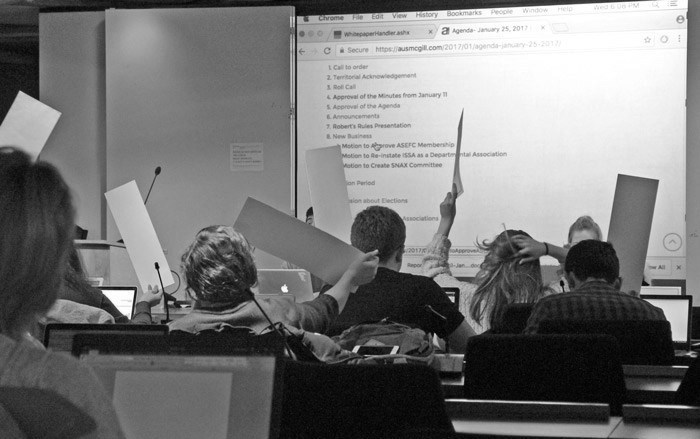
During the Arts Undergraduate Society (AUS) Legislative Council on Feb. 27, representatives unanimously approved two questions for the upcoming AUS referendum concerning the powers of the Executive Committee. One asked whether executives should be restricted from voting on AUS matters digitally and the other whether executives should be allowed to consider matters that the Legislative Council has already voted on. The AUS referendum will take place Mar. 18-21.

Both motions were prompted by the controversial approval of the POLI 339 course fee, which was originally rejected by Legislative Council on Jan. 30 before subsequently being approved by the Executive Committee in a private vote over Facebook. The AUS Secretary-General team had previously suspended the Executive Committee’s decision following allegations that the vote was unconstitutional and, during the meeting, presented the findings of their investigation into the matter.

The report, conducted by AUS Secretary-General Sophie Zhao and Deputy Secretary-General Nathan Mendel, found that all seven members of the Executive Committee had broken the AUS constitution and could therefore be removed from office. The report specifically condemned the actions of AUS President Maria Thomas as well as Arts Representatives Andrew Figueiredo and Ana Paula Sánchez.

“President Thomas did not execute her duty to ensure the Executive Committee’s compliance with the Constitution and By-Laws,” the report reads. “She knowingly allowed the Executive Committee to violate […] the AUS Constitution [….] The actions of Arts Representative Figueiredo and Sánchez contradict their agreement and duties as outlined in […] the Arts Representatives contracts.”

After the Secretary-General team’s presentation, Thomas apologized for her actions and confided that she was considering resigning.

“To be very honest, this meeting has given me a lot to think about,” Thomas said. “I kind of feel like I’ve failed all of you. I will think about it, and, if need be, I will resign, given that I was in charge of the Executive Committee.”

Council members were concerned with Sánchez’s actions and departmental representatives asked for her to apologize in front of the council. Sánchez is the only executive that hasn’t signed on to the public apology.

“I think a lot of the council members are curious about why she’s the only one who hasn’t addressed this issue,” Lily Yu, vice-president external affairs of the African Studies Students’ Association said. “A lot of people were hurt through this process, and she […] has yet to acknowledge it. I’m not trying to attack her, I’m just genuinely curious why.”

Sánchez addressed the council, stating that she had posted an apology on Facebook and had also expressed condolences in an opinion article published by The McGill Tribune.

“I’m very grateful to have had a [meeting] where departmental executives and constituents could express their thoughts and feelings,” Sánchez said. “I tried answering all concerns to the best of my abilities and [am] reiterating my apologies for deficient constitutionality.”

Following the Secretary-General team’s suspension of the POLI 339 vote, Figueiredo resigned from his position on Feb. 20. Representatives from departmental associations also created a petition on Feb. 15 calling for the resignation of the two other Arts Representatives, Sánchez and Garima Karia. 12 of 27 departmental associations have signed the petition, which also calls on the AUS Legislative Council to consider writing future motions that would address the damage of the Executive Committee’s actions.

Errata: A previous version of this article incorrectly misquoted that it was HSA Vice-President External Maeve Botham who was curious about AUS Arts Representatives Ana Paula Sánchez not acknowledging the issue. In fact, it was ASSA Vice-President External Affairs Lily Yu. The Tribune regrets this error.

News, SSMU

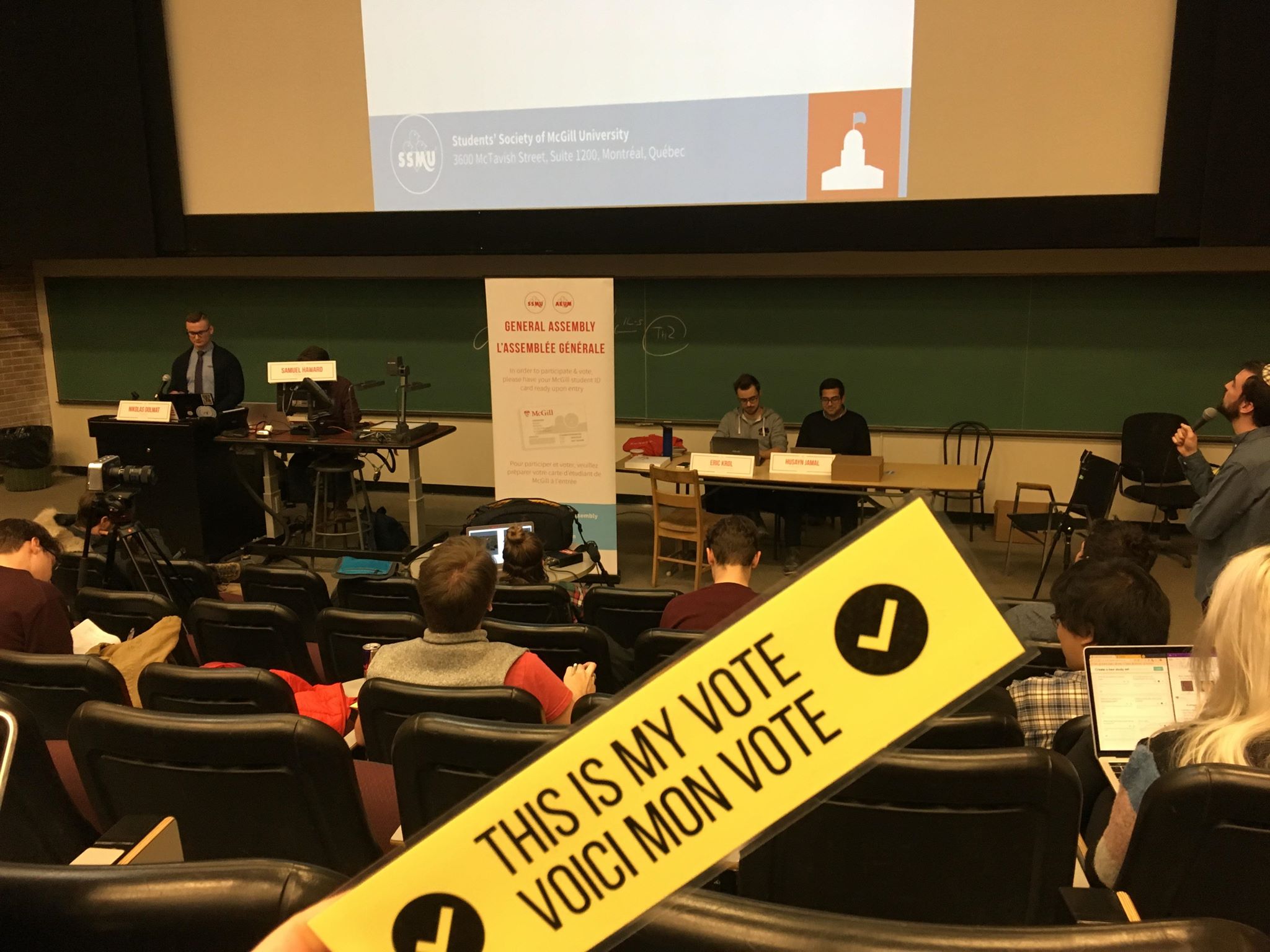
General Assembly fails to meet quorum with 27 attendees

The Students’ Society of McGill University (SSMU) Winter 2019 General Assembly (GA) failed to meet the required 350 students for quorum during its Feb. 25 session, with only 27 voting members in attendance. Nonetheless, the Motion to Endorse the Student Walkout for Climate Justice passed within the limited powers of the consultative forum and the Legislative Council subsequently approved it on Feb. 28.

The motion called for SSMU to publicly declare support for the Mar. 15 climate walkout, which is organized by university students across Montreal as part of an international day of climate protest.

“Be it resolved that the SSMU publish an official public statement endorsing the McGill Student Walkout for Climate Justice on Friday, March 15th to demand governmental and institutional action in line with the [Intergovernmental Panel on Climate Change (IPCC)] report’s recommendation to limit warming to 1.5 degrees celsius,” the motion reads.

The executives passed an amendment asking the SSMU Executive to send a delegation to the McGill Student Walkout under the VP External portfolio. The motion’s representatives, Christina Lau, U1 Management, and Noah Fisher, U2 Arts, spoke to the importance of student engagement.

“McGill University’s institutions don’t always and often cannot represent the interests of the student body, particularly the Board of Governors, [which only] has token representatives from SSMU,” Fisher said.  “As such, we believe that it is very important for SSMU to recognize and to endorse this movement to amplify the voices of students whether it be in divestment or [with] regard to government change or institutional change, that could not necessarily […] be represented in these institutions.”

The GA’s low turnout prompted SSMU President Tre Mansdoerfer to address the issue of attendance, pointing to obstacles posed by the temporary closure of the SSMU building and explaining his proposal for a SSMU public relations department.

“I think we should […] hire someone to do PR specifically,” Mansdoerfer said.  “I think that SSMU should be working on how [to] write certain motions that people might be engaged in. There shouldn’t be a desire for a controversial motion necessarily, but things like [today’s motion]  are very valuable motions that members would be engaged with.”

SSMU VP University Affairs Jacob Shapiro expressed enthusiasm for the proposal, highlighting it as an example of the community-driven innovation that the GA stands for.

“This is, I think, the best of what a General Assembly is,” Shapiro said. “It is members of society bringing forward motions around important issues that, for whatever reason, executives or councillors or other members of SSMU failed to address.”

Arts and Science Senator Bryan Buraga echoed Shapiro’s sentiments.

“We here at SSMU have a long history of fighting for social justice and upholding human rights, and this motion really embodies what we here at SSMU are fighting for,” Buraga said.

The motion represents the latest in SSMU sustainability and climate legislation. In Mar. 2015, the Student Society also passed the Motion Regarding the Adoption of a Climate Change Policy and approved the Motion Regarding the Formal Ratification of the United Nations Sustainable Goals in Feb. 2017. Additionally, SSMU updated its Sustainability Policy in Mar. 2018.

Hockey, Men's Varsity, Private, Sports

Four-goal first period boosts Carleton over McGill in OUA East semifinals

On Feb. 23, McGill men’s hockey (17-7) fell to the Carleton Ravens (18-5) in the second game of the OUA East semifinals at McConnell Arena. After an eventful first period during which Carleton quickly took control, McGill was unable to fight back and ultimately lost by a score of 5-3.

Initially, neither team was able to build any momentum. However, the Ravens finally kicked into gear, testing the McGill defence repeatedly. In turn, McGill third-year goaltender Louis-Philip Guindon made a series of spectacular saves to keep Carleton off of the score sheet. When tempers flared later in the period, McGill found themselves on the penalty kill while the Ravens took advantage of the power play, finding the back of the net to go ahead 1-0. A Carleton slapshot doubled the visitors’ lead just 17 seconds later. The McGill team then left a Carleton winger all alone as a result of a glaring defensive error, and, less than 10 minutes into the period, the score was 3-0 Carleton. The Ravens kept up their pressure and eventually put another past a hapless McGill. With the team now down four, McGill Head Coach Kelly Nobes called a timeout.

“We talked about what we needed to do.” Nobes said. “We needed to get on our feet [and] have a greater sense of urgency.”

McGill picked up the intensity after the timeout. With the pressure mounting and physicality escalating, the Ravens goaltender was forced to make several critical saves, leading to a Carleton penalty for charging. Capitalizing on the advantage, third-year winger Guillaume Gauthier and fourth-year centre Jerome Verrier set up third-year transfer defenceman Nikolas Brouillard for a one-timer that finally put McGill on the board. Following the goal, Carleton’s defence began to falter: A mesmerizing move from Verrier left a Carleton defender helpless and set up second-year forward Antoine Dufort-Plante to score with a wrist shot. With one minute left in the first period, second-year forward Keanu Yamamoto added another shot to pull McGill within one goal of Carleton.

The second period proved to be a drab affair in comparison to the first. Carleton sat back, frustrating the home side. McGill continued to push into the offensive zone, but the well-organized Raven defence was unrelenting. Fourth-year McGill winger Christophe Lalonde had the best chance of helping McGill to inch again when he hit the post with a slapshot, but, at the end of the period, the score remained 4-3 in Carleton’s favour.

McGill put up a fight at the start of the third period, controlling the puck in the offensive zone. The Ravens responded skilfully: They exploited the gaps in McGill’s defence and nearly scored a fifth goal. However, a spectacular triple save from Guindon kept McGill within one.

On the other side of the rink, the Carleton goaltender made a spectacular move to deny first-year forward Nicolas Poulin. The two goaltenders continued to make admirable saves, and the tension continued to rise. With seven minutes of regulation time remaining, Carleton scored a fifth goal, and, despite their best efforts, McGill could not respond.

While disappointed by the loss, Nobes applauded the spirit his team showed in the comeback attempt.

“We started the game four down, but I liked our character in coming back in the first period and closing it to 4-3,” Nobes said. “[But], we weren’t able to get the final goal.”  

The two teams faced off the next day at Carleton’s home rink. Unfortunately, Carleton came out victorious in the overtime affair, ending McGill’s season with a conference semifinal exit.


Moment of the Game

Jerome Verrier deftly maneuvered his way through the Carleton defence before setting up Antoine Dufort-Plante for McGill’s second goal.

Quotable

“I don’t think we were prepared for the storm they brought. But we answered well, we played really well after 10 minutes The game could have gone either way.” – Nikolas Brouillard on the positives the team could take from their performance.

Stat Corner

Third-year goaltender Louis-Philip Guindon made plenty of saves in the third period after a shaky start to the evening; he ended the game having saved 24 out of 29 shots.


Consultation
McGill, News

Mandatory sexual consent and violence training to start Summer 2019

Beginning Summer 2019, McGill University will roll out mandatory online training modules for students, faculty, and staff on sexual violence awareness and consent. At a Feb. 15 information session for the university’s major stakeholders, Dean of Students Christopher Buddle and Associate Provost (Equity and Academic Policy) Angela Campbell revealed that students and staff will have separate modules, and that, due to time restraints, the administration will not hold consultation sessions about the modules prior to their implementation.

The implementation of the interactive modules fulfills the requirements outlined in Bill 151, a provincial act to combat sexual violence in higher education institutions. The training will be 30-60 minutes long and cover topics such as bystander intervention and support for survivors in addition to sexual violence and consent training. The modules for staff will also inform them about the implications of power dynamics, including how to navigate student-staff and staff-staff relationships. Although Concordia University and KnowledgeOne, an eLearning consultation company, produced the modules, Buddle explained that they will be tailored for the McGill community based on advice from relevant sectors including Human Resources, IT Services, and Office for Sexual Violence Response, Support and Education (OSVRSE).

“It’s a big investment of time, energy, and money to develop this, and rather than reinventing [the modules], we can work with Concordia directly so that the McGill perspective can be incorporated,” Buddle said. “There are links to our policies and procedures [integrated into the modules] as well as which offices are appropriate to get support. For example, for students, it could be SACOMSS [Sexual Assault Center of the McGill Students’ Society] or OSVRSE and for staff, it could also be OSVRSE or the Employee and Family Assistance Program.”

Future students will only be able to register for courses after they’ve fulfilled their training requirements, with faculty and returning students undergoing training in Fall 2019, and administrative and support staff beginning their training in Winter 2020. Meanwhile, the completion of the modules will tie into faculty members’ annual merit process. However, Campbell acknowledged the difficulties of enforcing the training and was unsure if McGill can bar uncooperative faculty members from research resources.

“A professor can decide that they don’t want to fill out their annual report, and the consequences of that are that they don’t get their salary adjustment,” Campbell said. “We are wrestling with [a situation where] a professor fills out their report but on the space where it says ‘have you completed the online education modules’, they tick ‘No.’ If the prof is refusing to take the module could you then say ‘no access to graduate students?’ My sense is that’s possible but I’m truly hoping that that sort of situation will not happen.”

Accessed through MyCourses, the modules will not replace any existing workshops or training that educate on sexual assault and consent, such as those for Server Training and Frosh. Engineering Undergraduate Society (EUS) Equity Commissioner Tristan Renondin, who was also Head of Leaders and Orientation Staff for Engineering Frosh in 2018, is hopeful about the modules, but is concerned that differing advice among training on sexual violence prevention would confuse participants. For instance, he referenced how the modules will use the “3 D’s” of bystander intervention while Frosh uses the “4 D’s.”

“We have 800 frosh leaders and O-staff that we train throughout the summer, and then Frosh also has a training program in place for incoming students,” Renondin said. “I think it’s important that the material of this training is communicated properly to Campus Life Engagement because we’ll probably have to modify some of our content. I’m scared that […] differences will build up over time and devalue the content of the McGill-wide] training.”

Buddle and Campbell noted that they will consider publishing the module transcripts before the training becomes available.

McGill, News

Forgotten Freshman forgotten again

After a brief fix in June 2018, first years have reported that they are unable to join McGill community groups. The McGill Facebook community is open to any user with an email linked to a McGill domain—meaning that it ends in ‘mcgill.ca’ or ‘mail.mcgill.ca’—but the resurging glitch blocks some users from joining the community despite linking their McGill emails to their accounts. New students at Bishop’s University, University of Toronto, University of British Columbia, McMaster University, and Concordia University have also voiced the same complaint.

In Oct. 2017, Keating Reid, U1 Arts, made a Facebook group to help new students with the fallout: McGill’s Forgotten Freshmen, was an online community space for those who could not join McGill’s online groups.

Reid was surprised that the glitch had resurfaced again but also felt that the failure to fix it was typical behaviour on the part of Facebook, particularly given that Canadian university students are not the largest cohort of the platform’s users.

“It might have to do with the fact that McGill email addresses don’t end in ‘.edu’ like most American universities’ do,” Reid said. “It comes down to these kinds of bugs being a low priority for Facebook.”

The Forgotten Freshmen group eventually became a catch-all group where students could post events, advertisements for sublets, course-specific questions, and theories about the source of the problem. Some students reported the malfunction to McGill’s IT Services, who were unable to resolve the problem. Students who had reported the issue to Facebook received no assistance aside from a generic thank you message

Paul Estephan, a student on exchange from Australia, orchestrated the previous fix through a friend who worked for Facebook in June 2018. Estephan had his contact allow ‘@mail.mcgill.ca’ as a valid domain name to join the McGill community, which temporarily fixed the problem.

As students were gradually let into McGill’s official Facebook groups, activity in Forgotten Freshman heavily dropped off. Although Reid enjoys the “Free & For Sale” group, he realized he wasn’t actually missing out on that much.

“I was totally surprised at first, and happy, of course,” Reid said. “Then I realized that being in the McGill groups isn’t that great after all […it’s] one of those ‘grass is greener’ situations.”

Now that the glitch has resurfaced, this year’s freshmen have been unable to join McGill community groups such as Free & For Sale and Housing. This year’s new crop of disconnected students affects undergraduate first years and those acquiring more advanced degrees. Larissa Parker, first-year law student and honorary forgotten freshman, feels isolated from the McGill community at large.

“I feel like I can never hear about events or sports-related stuff, or get into my TA groups,” Parker said. IT Services have stated that they were aware of the problem, after receiving approximately 25 phones calls from students at the beginning of Fall 2018 and Winter 2019. Ryan Ortiz, director of IT Services, reiterated that IT has no control over the glitch and therefore cannot fix the problem.

“Facebook is not using McGill systems for authentication purposes,” Ortiz wrote in an email to The McGill Tribune. “It simply sends a verification email to the ‘@mail.mcgill.ca’ address entered by the user, and then waits for the user to click on the link in the email to prove that [they] are the owner of that address. If users are receiving those emails, clicking on the verification link, and still aren’t being given access, there isn’t much McGill can do about this.”

Students like Parker will have to wait for Facebook to solve the issue.

“It’s annoying to hear I’ve missed something,” Parker said. “It feels like I’m not in the know.”

Arts
Commentary, Opinion

Post-POLI 339: Reflections on Calls for Resignation

Editor’s Note: A previous version of this article identified the authors as ‘second-generation students.’ Sanchez is a first-generation student. The authors regret this error.

Last March, we ran for and successfully secured the opportunity to serve as arts representatives to the Students’ Society of McGill University (SSMU). In this role, we are tasked with representing arts students at the SSMU level, sitting on Arts Undergraduate Society (AUS) and SSMU committees, and liaising between SSMU and the AUS Executive.

At AUS Legislative Council on Jan. 30, a motion was brought forward to approve ancillary course fees that would total $1000, including flights and accommodation, for a topics course (POLI 339) at the Hebrew University of Jerusalem. Under Quebec law, student unions approve additional course fees to ensure that universities do not overcharge students. The motion was voted down by one vote at the Legislative Council.

Following the results of the vote at Legislative Council, we were approached by a number of Arts students who were disappointed with the outcome of the vote; Jewish students were notably disappointed because of the historical and contemporary climate of anti-Semitism on campus. Former councillor Figueiredo also notified us of a petition signed by students who supported passing the course fee. In light of this response, the Executive team discussed re-vote options.

At an executive meeting on Feb. 6, Figueiredo also informed us of of by-law 2.2 which, along with the time constraint established by a professor in the department of Political Science, pushed our executive to make a decision ourselves. We were not aware of other additional clauses relating to our decision, such as Frais institutionnels obligatoires (FIO) 2.3, that would necessitate contacting the Political Science Student Association. Karia expressed her disagreement with the second vote taking place solely among the Executive and over Facebook as the procedure was undemocratic, and the medium not conducive to consultation with councillors. Sanchez suggested that abstentions not be allowed in order to ensure that all voices were represented.

During this process, debate arose regarding arts representatives’ ability to vote, and our suggestion to contact the Secretary General about the matter was ignored (p. 56), though other Executive members echoed our advocacy for a statement for transparency.

When the statement about the re-vote was released, both of us were on predetermined leave. Sanchez was away for health reasons, and Karia was away at a United Nations Commission. Both of our absences, which include online engagement, were deemed acceptable before the POLI 339 issue arose. In spite of this, Sanchez received a flurry of accusatory messages and notifications on her personal social media accounts and Karia was pressured into disclosing whether her health concerns were ‘valid.’ The morning following the vote’s release, Representative Sanchez was called a bitch by an individual unknown to her in the McLennan Library, and she had to to watch as someone stared at her with contempt while collecting signatures for our impeachment. We were both accosted and made to listen to accusations that we were whitewashed and selfish made by the same individuals claiming to care about executives receiving pressure or harassment.

We did not intend for our votes to serve as any given stance on the matter of Israel-Palestine relations. Accusations of racism are particularly harmful to the both of us on a personal level, as we are no more racist than the critics of POLI 339 are anti-semitic. As women of colour, we are not saying that we are impervious to making mistakes. What we are saying, is that we do not deserve to be personally targeted and harassed for participating in a vote that we not only contested, but share the responsibility for with the rest of our Executive. The only difference between ourselves and our team is our answer to the question “Do you approve of the course fee of $1000 for POLI 339 as referenced in the motion?”. Our votes were not, and should not be, mobilized in the context of debate outside of the particular context of an ancillary fee approval.

In our past and current involvements at McGill the both of us have worked tirelessly to uphold the rights of minority groups on campus. Representative Sanchez worked as Equity Commissioner in 2017, and her current work has improved family support and advocacy, health insurance for women and gender non-conforming individuals and a campus-wide survey on health care. Representative Karia is a Director on the Student Society’s Board and sits on its finance committee, being one of three women of colour to do so currently. She also works with the Francophone Affairs committee, supported the creation of the People of Colour Commissioner position, and has spearheaded an ongoing TVM project about representation in student government.

We sincerely hope that we may be able to continue in our positions, as throughout this all, we have in good faith dedicated ourselves to the best interests of AUS and its constituents. We are deeply sorry to those whom we have disappointed, whose oppression often works in tandem with other structural inequalities. Resigning would hinder our current efforts to prevent the occurrence of similar issues in the future, which include expanding travel and legal insurance at SSMU, ensuring that students on exchange receive adequate financial support, and proposing amendments to the FIO bylaws. If this issue is really about transparency, accountability, and intent, more of our critics would have taken us up on our offers for dialogue and immediate action, instead of silencing us and pressuring us to resign from our positions.

At the beginning of our term, people kept on telling us we were breaking a glass ceiling in student politics as first-generation (Sanchez), minority, female students. Now, it feels like we have been pushed off of a cliff instead.

Features

“There’s a level of trust that isn’t there”

When I walked out of a meeting with a professor to hyperventilate in the privacy of an empty Arts building bathroom, I knew my situation had become precarious. But it was late March of my third year, the busiest time of my busiest semester, and I had to return to his office. I walked back in and sat down. My professor discretely pushed a box of Kleenex across the desk. I hadn’t realized that I was still crying. We agreed that I would get the first 25 pages of my honours thesis to him by Friday.

Drug-testing
Commentary, Opinion

The case for legalizing all drugs

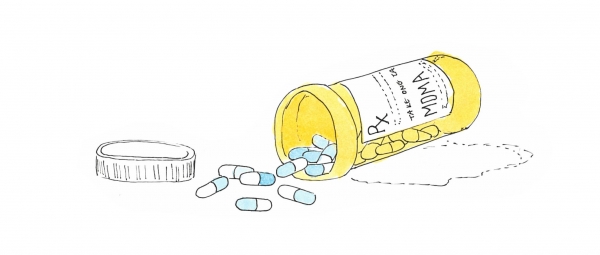
Canadian medical law recognizes an individual’s right to bodily autonomy: They can choose their own birth control options, select treatment options based on personal views, and even refuse treatment entirely. Given this principle of bodily autonomy, it seems reasonable that patients should also have the right to access drugs of their choice—whether their doctor recommends their use or not. This is the argument that University of Richmond associate professor Jessica Flanigan presented to an audience of McGill students on Feb. 18 at her talk, “The Moral Case for Legalizing all Drugs.” While liberal university students may be particularly interested in the boundary-pushing topic, the argument in favour of legalization surpasses the appeal of raves and festivals; ultimately, the debate rests on a moral right to bodily autonomy.

Doctors are the gatekeepers of medicine, and they prescribe drugs based on their presumptions about the course of treatment that best promotes the patient’s overall wellbeing. Under this system, a student looking to access Adderall to help them study, for example, may be denied the drug if the doctor deems its use suboptimal for the student’s health. The issue with this assessment is that wellbeing comprises more than just physical health—it also encompasses a person’s mental state, which can be impacted by a variety of lifestyle factors such as a stressful schedule. In her talk, Flanigan emphasized that, in most cases, the person most qualified to judge a patient’s well-being needs is the patient themself. Mentally-sound persons have the insight to best evaluate how they are feeling and what they need, and allowing people to choose which drugs they use honours this fact.

While the government and medical institutions currently have authority over the substances people put into their bodies, Flanigan considers this approach paternalistic. She contends that, in a case where someone became extremely frustrated with their laptop, or any of their belongings, they would have the right to smash or otherwise wreck it. If people are allowed to ruin their property, there is no reason why they have any less right to harm themselves, as bodies are more fundamentally personal than property.

While bodily autonomy alone gives the argument drug legalization legitimacy, legalization gains even more moral merit because of the advantageous impact it would have for racialized and marginalized communities. Currently, the War on Drugs targets racialized groups. Incarceration rates for possession and distribution reveal that a black person is twice as likely as a white person to face minimum sentencing for the same crime. Legalizing drugs would prevent racial discrimination from furthering and prevent the incarcerations of millions of people of colour.

Skeptics of legalization may raise the concern that addicts would not be able to make a legitimately-autonomous decision when choosing to access drugs. But, Flanigan argues that addicts are more self-governing than many assume. Studies reveal that addicts undergoing withdrawal would forgo a fix given an incentive such as money. However, Flanigan’s argument seems to undermine the reality of mental and physical constraints addicts have on their self-control. One possible solution to this concern is implementing better systems of support for addicts, including a ‘blacklist’ that would allow them to consensually forego their right to access certain drugs.

The debate surrounding drug legalization has a specific pertinence for university students who find themselves experiencing the freedoms of adulthood for the first time and wanting to experiment. Drug use usually begins in a person’s late teenage years and early 20s. If drug use was legalized, university students may be among the demographic of highest use. Therefore, the legalization may seem especially appealing to students looking to experiment with substances. With that said, the debate over drug legalization has more important implications than just satiating youthful curiosity. Prohibiting access to drugs denies people their right to bodily autonomy, and legalization is necessary to honour humans’ right to choose what they do with their bodies.

Read the latest issue

Read the latest issue