


Latest News

Basketball, Men's Varsity, Sports

McGill men’s basketball rough up Rouge et Or

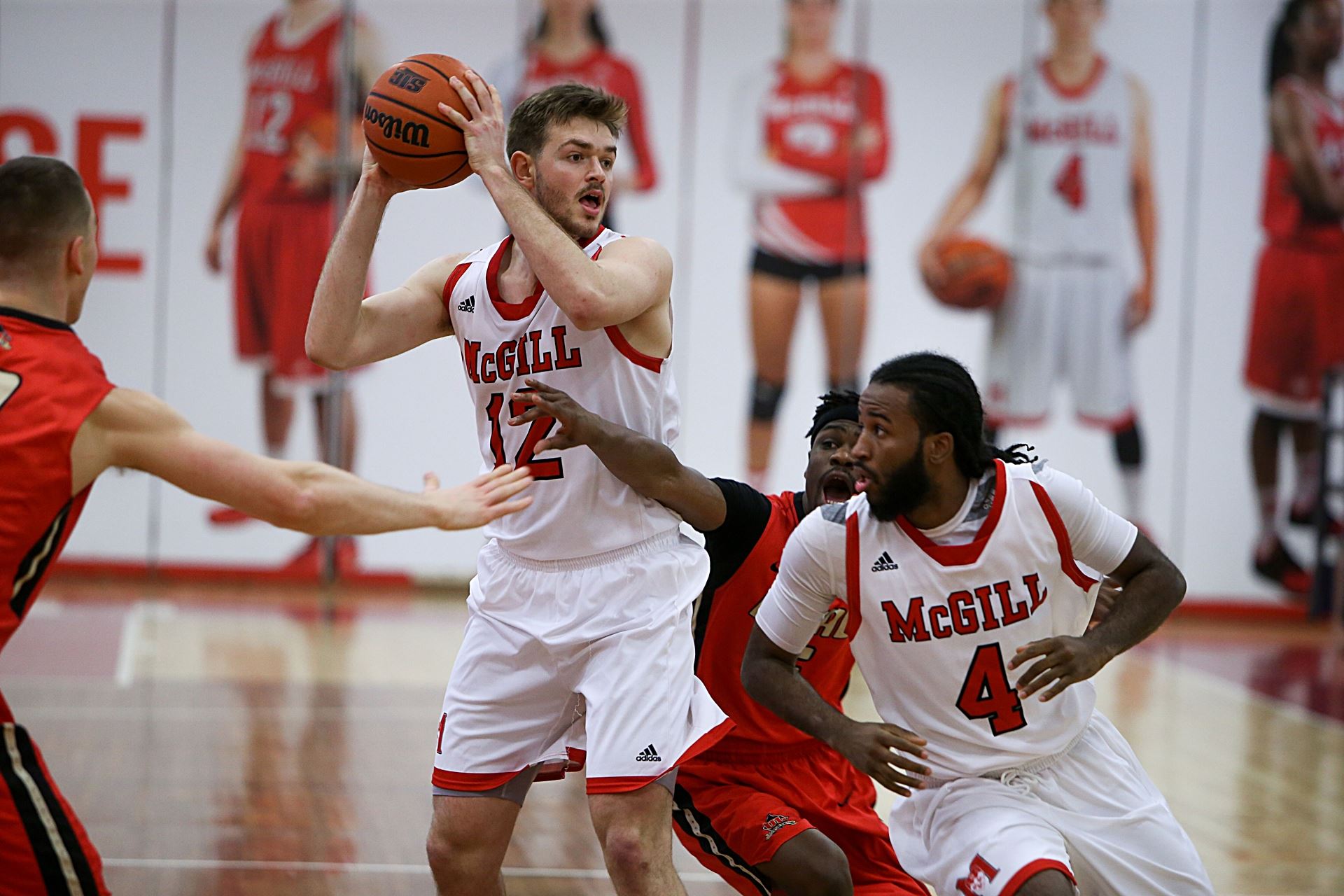
On Feb. 23, the McGill men’s basketball team (9-7) defeated the visiting Laval Rouge et Or (5-11) by a comfortable margin of 91-73. The game marked the end of the regular season, as well as a celebration of Black History Month and Senior Night. The evening began with a pre-game ceremony for its four graduating players: Fifth-year transfer point guard Alex Paquin, fourth-year point guard Isaiah Cummins, fifth-year forward Noah Daoust, and fifth-year guard Avery Cadogan. While Daoust and Cadogan suited up, Paquin and Cummins were sidelined by injuries.

McGill drew first blood with a quick three from first-year guard Quarry Whyne. However, the momentum quickly shifted, and Laval jumped ahead with an early 18-11 lead with some strong three-point shooting of their own.

McGill came out strong in the second quarter, but again, Laval was quick to respond as the teams traded runs throughout the frame. The Rouge et Or, who shot a remarkable 61.1 per cent from three, then went on a 9-2 run, scoring three times from three-point range in quick succession. Still, McGill managed to counter Laval’s hot shooting and ended the second quarter ahead by a score of 43-41.

The second half started just as the first had, with Whyne sinking a three to get McGill’s wheels rolling. The freshman shot 3-6 from three on the night, putting up a 17-point performance.

“I’m a good shooter, you know, so I like to shoot threes,” Whyne said. “First semester, I had a bad start, [but] now I’m getting adjusted, [and] I’m getting in the groove.”

While the rookie’s successful shooting gave McGill fans a hint of the team’s future, the two active seniors showed what talent the team will miss next season. In the third quarter, Daoust, who finished with a game-high 23 points, added a deep three, before Cadogan garnered cheers from the crowd in the packed Love Competition Hall with an emphatic block at the other end of the court. A steal by Whyne and a subsequent layup capped off the third quarter with McGill up by seven.

The fourth quarter played out much like the third with a dominant 17-4 stretch that gave McGill a comfortable lead. Daoust hit a three-pointer in the dying seconds of his final regular-season game, quickly extinguishing Laval’s comeback attempt to give McGill its ninth win of the season.

McGill must now prepare for its first game of the RSEQ playoffs: A Feb. 27 semi-final against the crosstown rival Université du Québec à Montréal (UQAM) Citadins.

“We’re playing a whole different team against UQAM on Wednesday, and they’re a tough team […] because they’re very aggressive,” McGill Head Coach David DeAveiro said. “Sometimes, we struggle with those kinds of teams, but we’ll get two days of preparation, and we’ll be ready to play.”


Moment of the game

Early in the second quarter, second-year point guard JJ Hamel-Carey made a well-executed no-look pass to set up a Daoust layup, bringing the fans to their feet.

Quotable

“My body’s sore, and I’m feeling old. Basketball’s been great to me […], and it’s been an incredible five years, but I think everything eventually runs its course, and I’m happy with the way things have gone.” – Noah Daoust, post-game, on his five years playing McGill basketball.

Stat Corner

First-year guard Anthony Fisiru had a quietly-productive night, recording a double-double with 18 points and 10 rebounds.


Hockey, Martlets, Sports

Comeback win sends Martlet hockey to RSEQ final

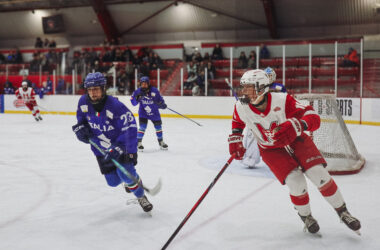
On Feb. 23, the McGill Martlets (14-6) qualified for the RSEQ finals after completing their two-game sweep over the Concordia Stingers (13-4-3). The Martlets scored five unanswered goals, two of which were potted by second-year forward Kellyane Lecours, en route to a 5-3 win over Concordia. This victory sends them to the championship round following their prior 6-2 win over the Stingers in the first game of the series on Feb. 21.

“We’ve been playing some really good hockey,” Head Coach Peter Smith said. “We had some periods tonight where we weren’t quite the same we have been, but, overall, we’ve been playing very well in the last half dozen games. We’re looking forward to [the finals].”

The match was off to a rocky start for the Martlets. Concordia controlled the play for most of the first period, outshooting McGill and hemming them into their own zone. The Stingers opened the scoring approximately 10 minutes into the period and carried a 1-0 lead into the intermission.

The Martlets were no more successful in the beginning of the second period. Early in the period, Concordia received a pair of lucky bounces to set up two goals and a lead of 3-0. Smith then pulled starting goaltender Tricia Deguire from the action, replacing her with backup Amanda Hadwen, and the Martlets started to turn the game around. With five minutes remaining in the second period, second-year forward Stephanie Desjardins put the Martlets on the scoreboard, setting the stage for a masterful comeback.

In the third period, Hadwen accumulated a series of stellar saves to keep the Martlets in the game. Lecours scored her first goal just under five minutes into the final period, bringing the score to 3-2 Concordia, and followed it up 10 minutes later to tie the game at three. Third-year centre Jade Downie-Landry assisted on both goals.

With three minutes remaining, third-year forward Lea Dumais scored the winning goal. An empty-netter from fourth-year defenceman Emilia Cotter clinched the win for the Martlets, securing their spot in the RSEQ championship.

“We showed a lot of character coming back and scoring five unanswered goals after being down 3-0,” Smith said. “We didn’t need to score three goals at once. We needed to score one at a time and beat them on every shift, and I thought we showed a tremendous amount of character in that third period.”

Fourth-year centre Shana Walker was proud of the fight her team put up to earn the win.

“I feel like, in the third period, we really came together as a team, and the energy on the bench was really what pushed us through,” Walker said. “I have been on this team for four years now, and that was one of the best comebacks that I have ever been a part of, so I’m really proud of us.”

This series held special meaning for the Martlets, who were eliminated in the semi-finals last season in a three-game series against the Université de Montréal (UdeM) Carabins. No Martlet wanted a repeat, especially after a strong season in which McGill finished third in the RSEQ standings. The Martlets will get a chance at redemption in the championship round when they face UdeM in a rematch of last year’s semi-finals.

“We’re excited,” fourth-year centre Nicole Howlett said. “We know we have to play together and go shift by shift. We [will] do whatever it takes.”


Moment of the Game

The crowd and McGill bench went wild after Lea Dumais shot the puck into the top shelf for the winning goal.

Quotable

“This was so much fun. The energy we had and the fire within the team [was great]. We just stuck together until the end. [This was] one hundred percent the best game of the season.” – Nicole Howlett on the Martlets’ spirit in the comeback.

Stat Corner

McGill has only two wins this season in games in which they trailed heading into the third period.

Student Life

How to make the most out of reading week

Reading week comes as a much-needed break for students in the midst of a whirlwind of midterms and deadlines. Many students use the break as an opportunity to catch up on readings and assignments, while others strive to use the brief respite from classes to unwind. The McGill Tribune has compiled a list of suggestions for balancing productivity with relaxation and fun during the highly-anticipated week off.

Work on job applications

For the typical procrastinator, applications for summer jobs or internships tend to get pushed to the backburner during midterm season. Throughout the week, students can work on polishing resumes, researching potential job opportunities, or scheduling interviews. For those seeking personalized career advice, McGill Career Planning Service (CaPS) offers advice online to help students find jobs, get headshots, and build their portfolios. Additionally, for those interested in speaking to an advisor, CaPS will remain open during the break.

Get organized

Tidying up might feel like an annoying chore to complete during regular school hours, but reading week is a good opportunity to organize and clean up stress-free. Sorting through junk lying around the house, reorganizing the kitchen, and arranging old papers are all proactive steps students can take to stay on top of their personal lives when classes resume. Starting the week after the break with a clean living space will set a good precedent and mindset for the rest of the semester and help to reduce added stress.

Stay in town and explore the city

Reading week is the ideal time to get outdoors and explore a new part of Montreal, and, luckily, there is never a shortage of fun activities around the city. Make the most of the remaining winter weather by going skiing, sledding, or ice skating on Mont Royal. Montréal en Lumière is also hosting its 20th lights festival until March 3 in the Quartier des spectacles. Festival-goers can visit various shows, gourmet food stands, illuminated outdoor art exhibits, a ferris wheel, a slide, and a zipline. With a variety of exciting activities to offer, Montreal is the ultimate location for taking a staycation.

Take a break

Students deserve some downtime in between busy working weeks, so they shouldn’t feel like they need to maintain a hectic schedule or camp out at the library. Research shows that taking time off ultimately leads to higher levels of productivity, boosted creativity, and improved mental health. Get plenty of sleep, read for pleasure, or catch up on a few of the 2019 Oscar winners. Alternatively, unplugging for a day and leaving electronic devices behind can help to clear the mind. Research has shown that disconnecting from technology can help to improve sleep cycles, enhance personal relationships, and promote overall mental wellbeing.

Science & Technology

Innovating the way we meditate

Stress is a bitter antagonist that affects every student at some point in their studies, some more frequently than others. While a certain degree of stress is normal, over time, chronic stress can impede the immune system, which may contribute to a sleuth of other serious health problems such as heart disease, diabetes, and other illnesses including mental disorders like depression and anxiety.  Even when it is not impairing immune systems, stress can still affect relationships with loved ones, work, and school.

A group of McGill Students, who dub themselves the Make Energy Your Awareness (MEYA) team, recently decided to take on the job of reducing stress by changing the way students meditate. The idea came about during a class with Mark Berlin, ISID professor of practice. Studies have found that regular aerobic exercise as well as mind-body practices of breathing exercises, meditation, and yoga, can help reduce stress. For students in particular, some benefits include improved academic achievement, better focus, and reduction in maladaptive addictions.

“MEYA is an innovative mobile app that goes beyond meditation,” wrote the MEYA student team members Sebastian Mattey, Antoine Nigond, and Christopher Samen, in an email to The McGill Tribune. “ [Our approach] comes down to the combined power of [the] teachings of modern transformational alchemy and life-coaching techniques including hypnosis and NLP [neuro-linguistic programming] [as well as] the power of music technology.”

The MEYA team noticed the positive influence of music on mental wellbeing and incorporated it into the meditation app to make it fun and easy to integrate into everyday routines

“MEYA Music Mind Journeys cover a range of music genres, from techno to deep to shamanic,” the MEYA student team wrote. “MEYA has been developed with the idea that meditation can be practiced much more easily in combination with the power of music. MEYA Music Mind Journeys are meditation [sessions] created with the goal of helping users to control their minds and unleash their full potential.”

The app was created to work in sync with music: MEYA designed the recordings’ frequencies to help bring the user into a meditative and relaxing state.

“Music is recorded in the harmonic frequency of 432Hz, including bi-neural beats to facilitate meditative states both static and dynamic,” the MEYA student team wrote. “The MEYA Music Mind Journeys are pre-recorded, guided sessions covering […] meditations, affirmations, [and] visualization combined with cutting edge music.”

These journeys are aimed at facilitating relaxation and uplifting students’ moods.

“MEYA’s student team has been driving the product development for Music Mind Journeys tailored to students’ needs,” the MEYA student team wrote. “[Its aim is] to increase concentration and ability to focus the mind, manage stress and anxiety, increase motivation, and balance emotional life. MEYA will provide a set of bespoke meditation for relaxation, concentration during exam preparation, and exam taking.”

The MEYA group held an app sampling during Wellness Week at McGill and obtained feedback from 14 attendees.

“Feedback so far suggests users are extremely happy with its effectiveness, [and] also with how easy it has been to integrate into their everyday routines,” the MEYA student team wrote. “MEYA is looking to work with McGill to evaluate the impact of MEYA […] on student performance from both the perspective of exam achievement and their personal mental health. The MEYA app and website is set to launch in March, 2019 [on the Play Store].”

McGill, News

McGill African Students’ Society hosts ‘Africa Speaks’ conference

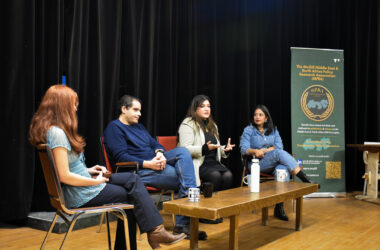
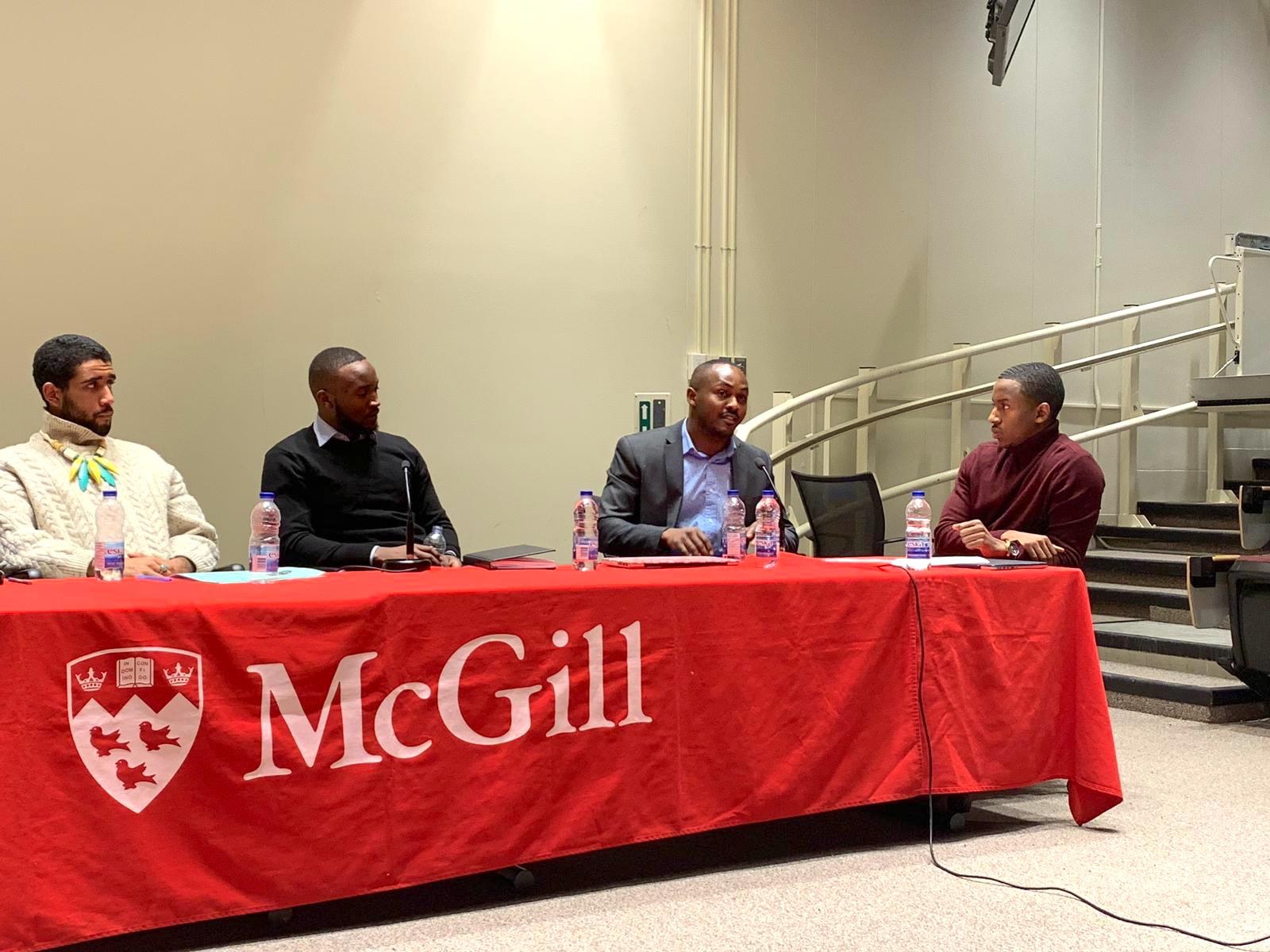
Deputy High Commissioner of the Kenya Mission in Ottawa Jane Kerubo, entrepreneur Idil Essa, and McGill professor Khaled Medani spoke at the McGill African Students Society’s (MASS) first “Africa Speaks” conference, held from Feb. 8 to Feb. 9. Previously known as “The African Development Convention,” MASS decided to rename their conference this year to better reflect their goals and to challenge mainstream conceptions of development.

“This conference was started in 2013 […] to create a space for African-centred discourse [where] Africans are controlling their own narrative,” Andreann Asibey, U4 Arts and president of MASS, said. “We changed the name to ‘Africa Speaks’ to move away from development [discourse, which] is a bit archaic at this point.”  

Past MASS conference themes include “Prisms: Africa in the 21st Century – Reclaiming Reality in all its Forms” in 2015 and “‘Africa’ Interrupted Switching the Channels of Development Discourse” in 2016. Morenike Fashola, U4 Arts and vice-president of MASS, explained how, in contrast to previous themes, this year’s conference looks to the future.

“This year, we wanted to move away from that development idea of always looking to the past, not really focusing on the [present], and what we can bring to the future,” Fashola said.

The two-day conference consisted of three panels, each focusing on a different aspect of modern African society: Living as an African woman, the importance and influence of diaspora, and the effects of neoliberalism.

The first panel was titled “Living as an African Woman in the 21st-century.” For Asibey, it is valuable to highlight the role that African women play in society as well as shed light on the challenges to pre-existing stereotypes in African society.

“We wanted to show that […] women are standing strong in their own truths,” Asibey said. “They are doing what they want to do and disregarding […] how society has pressured them [into] fitting a mold of [the] perfect African woman.”

The second panel, “The Afropolitan: Coming Full Circle,” showcased African identity as the lived experiences of Africans in and outside of the continent. This panel focused on the increasingly-important role of the diaspora to enact positive change on the continent and to discover and engage with African roots. Speakers also discussed the problematic and elitist implications of the term ‘Afropolitan,’ as it only implies the seemingly ‘rich’ diasporic communities.

“Afropolitan means different things to different people, but, to me, [… it means] a citizen of Africa,” Asibey said. “We talked about diaspora and what that means for Africans and Afro-descendants living here [….] I thought it was important to discover how […] identity plays out and how we’re viewed by others and ourselves depending on status […as well as] how people’s ties back to their continent impact themselves, and how [their ties] impact the continent.”

The third and final panel, “After development: Africa in the Neoliberal Age,” centred around neoliberalism and its effects on African society. The panellists defined neoliberalism as an economic ideology based on unregulated capitalism and boundless economic growth, which gained prominence during the late 1980s and still has lasting effects including environmental degradation, insufficient labour laws, and exploitation of resources. For Asibey, the purpose of this panel was to be an informative and historical discussion of the ways that neoliberalism has hurt Africa.

“Africa has been [tricked] into subscribing to an order that is meant to benefit and help them, but […] it’s actually, in my opinion, caused more problems than it’s solved,” Asibey said. “It’s brought about [environmental degradation], and it’s brought a new line of poverty [….] We just wanted to talk about that and see what the solution is in terms of moving forward [….] We are the solution, we need to look inwards rather than seeking [outside help].”

Favour Daka, U1 Arts and first-year representative for MASS, explained that the panels provided holistic and varied discussions on African scholarship, making dense, informative panels accessible for him and many others.

“They were really diverse,” Daka said. “The first [discussion] was very personal, the second was more [diaspora-centric], and [the last] one was the future. I think there are layers to [the panels] that [helped me] relate to most of them.”

Martlets, Men's Varsity, Sports

McGill hosts RSEQ Track and Field Championship

On Feb. 22 and 23, McGill Athletics hosted the RSEQ track and field championships in the Tomlinson Fieldhouse. The meet crowned provincial champions and determined which athletes will advance to Nationals in Winnipeg in March. With over 50 events, the two-day competition provided plenty of thrilling moments. Out of the eight schools in competition, McGill came in third place behind Laval and Sherbrooke. The men won three gold, four silver, and one bronze medal, and the Martlets earned one gold, three silver and two bronze medals.

First-year sprinter Jorden Savoury won the first McGill medal of the competition with a silver in the 60m dash.

At the tail end of three years of accumulated injuries, Savoury came into the meet with modest expectations. She attributed her turnaround victory to her loose and relaxed attitude heading into the race and cited her role model Allyson Felix, an American track star, as a source of inspiration.

“I didn’t think I would be able to get back to my old speed, but, honestly, it just goes to show [that], through determination and persistence, you can get back to what you want to do, and that’s why I’m super, super happy,” Savoury said.

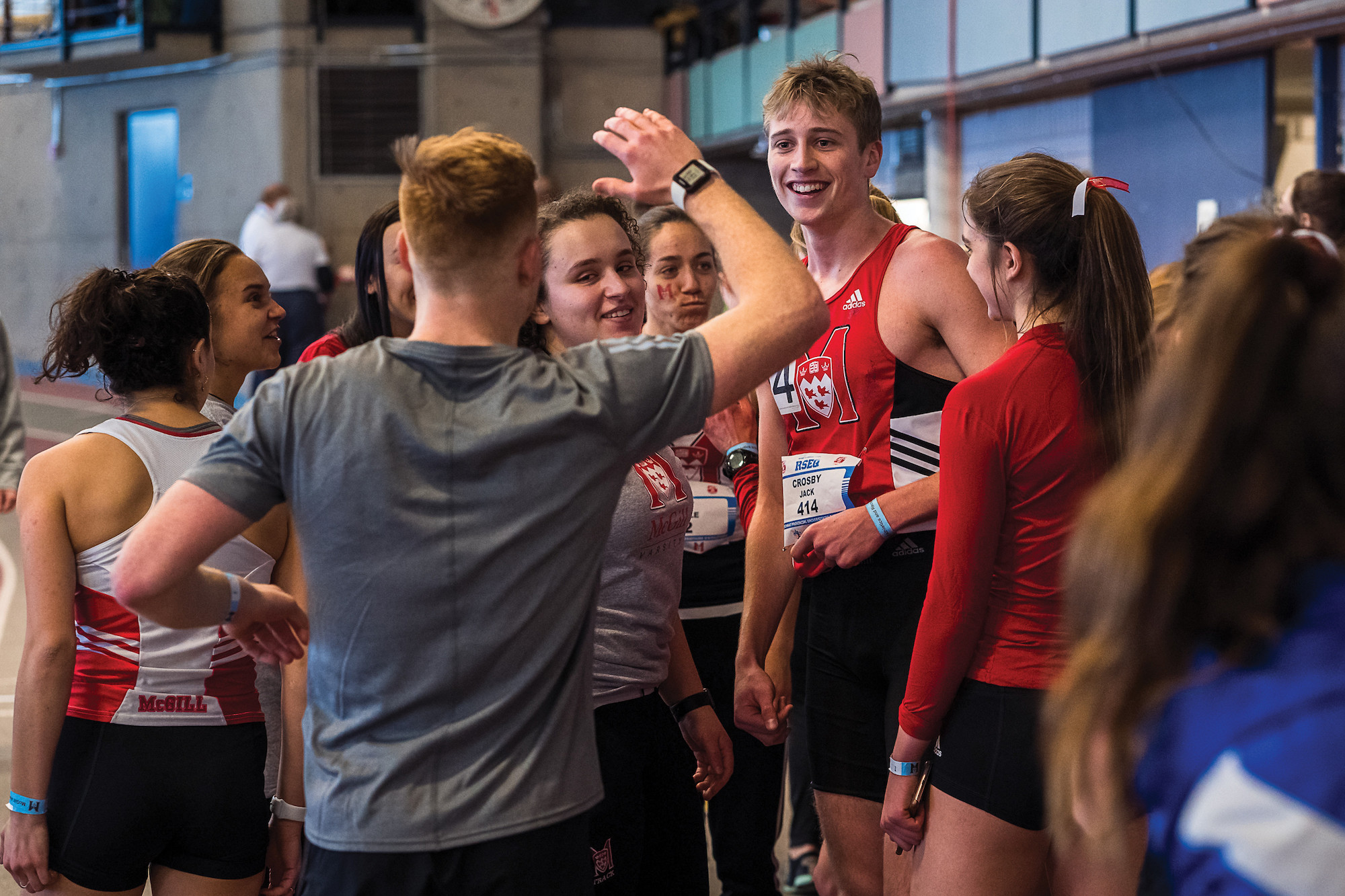
On the men’s side, first-year Jack Crosby, who broke a McGill record in the 600m last week, did not disappoint in his follow-up race. He won two medals this weekend: A gold in the 600m and silver in the 1000m. After coming into the final 600m lap in third place, Crosby ultimately overtook a Sherbrooke University runner in the final five metres to clock in at 1:19:93, good for the gold and recognition as rookie of the year.

After his victory, the crowd and his team erupted into cheers, running in from all directions to congratulate him.

“That was the first time that something like that’s happened,” Crosby said. “I felt euphoric, that’s how I would say it. It was incredible.”

Crosby credited the coaching staff with unlocking his high-level performance.

“Some people think they can half-ass workouts and can get away with it, but the only way to achieve your goals it to go as hard as possible whenever you can,” Crosby said. “I’ve just started to tap into my potential [.…] I used to be undertrained, but the coaching staff here has really helped me.”

McGill’s coaching staff is led by Head Coach Dennis Barrett, who has been with the program for 35 years. In that time, he has always focused on putting together a team of hard-working athletes.  

“We want people that are going to come in and work hard day-in and day-out and stay consistent,” Barrett said.

His team’s performance exemplified their work ethic: Aside from Crosby and Savoury’s finishes, the team earned medals in men’s and women’s triple jump, men’s shot put, men’s 60m hurdles, women’s 4x800m, and women’s 3000m. Half of McGill’s medal winners were first or second years and put forward strong efforts this weekend in their last chance to qualify for the national championships.

“Heading into Nationals, I’m hoping we can have some solid performances, and if we can’t medal, at least get some points on the board for McGill,” Barrett said. “If we can build on this young talent next year, I’m optimistic.”


Moment of the Meet

McGill led the way in the men’s 60m hurdles event. Second-year Matthew Daly topped the podium with a gold-medal time of 8.35 seconds, and first-year Ismail Francillon earned the silver medal with a time of 8.82.   

Quotable

“Winning is something that’s always been ingrained in me. Even as a toddler, I’ve always liked to win. I don’t like settling, I just want to beat people. ” – Jack Crosby on his race mentality.

Stat Corner

First-year heptathlete Alexander Stathis set a new school record in the event, earning 4,555 points to top the previous record of 4,379.


A previous version of this article stated that Jorden Savoury was a thrower. In fact she is a sprinter. The Tribune regrets this error. 


McGill, News

EUS executive candidates debate departmental issues as elections begin

The Engineering Undergraduate Society (EUS) Elections hosted a debate for their upcoming election on Feb. 19 during which candidates running for 2019-20 positions shared their platforms and answered questions. Two candidates are running for the position of president while the rest are uncontested.

Both Jeremy Garneau, candidate for EUS Senator, and Mustafa Fakih, candidate for EUS representative to the Students’ Society of McGill University (SSMU), emphasized the importance of bridging the gap between the EUS and SSMU. Garneau described plans to rekindle the institutions’ relationship by facilitating communication between the two student societies. Fakih explained that a better relationship with SSMU could benefit the EUS.

“You have to keep in mind [that] SSMU isn’t the society for another department,” Fakih said. “It’s the society for all of students at McGill. SSMU has a lot of power and a lot of money. If we just keep staying in the back seat and not wanting to do anything with [SSMU, then] we are not really going to benefit from them at all. So, I do feel if we keep good relations and [engage with] them, we will benefit from them.”

Attendees asked Vice-President Internal candidate Spencer Handfield about allegations that the volunteering positions at Blues Pub, a student-run bar under the EUS, are too stressful for students. Handfield responded that the severity of this issue still needs to be assessed based on the feedback of individual volunteers. He assured that he has plans to work with the Blues Pub managers to address the volunteers’ grievances.

“There is a certain kind of adjustment we should make so Blues Pub is something viewed not as something for a profit, but something we do as a passion and […] care about,” Handfield said. “That is also a solution I cannot do alone. That comes from working strongly with the Blues Pub managers who know the logistics of how it works and how best to implement the solutions the [questioner] brings up in terms of volunteering not being fun.”

Presidential candidates Marion Olivier and Nilou Seraj were asked to address the exclusivity of the Plumbers’ Philharmonic Orchestra (PPO), a group of McGill engineering students who raise money for charity organizations. Both candidates were asked to address the PPO’s place in the EUS.

“I think, as a spirit and charity group, the PPO does have its place in the EUS, and they contribute a lot to the engineering culture, so long as it is inclusive,” Olivier said. “I think, moving forward, a partly application-based model is the only way the PPO can exist in a healthy way in the engineering community.”

Seraj echoed Olivier’s desire to implement an application system, but further emphasized the importance of the PPO’s role in creating a sense of community for engineering students.

“Instead of heaving this image of an exclusive group that you cannot be a part of and is secretive, [the PPO should] focus more on the charity part and more on [being] a group of people who are working on increasing the sense of being part of a community,” Seraj said. “This is one of the reasons [that] the engineering faculty students are very close to each other, because we have a sense of community.”

Members of the EUS will be able to cast their votes online Feb. 24–Mar. 1.

Basketball, Martlets, Sports

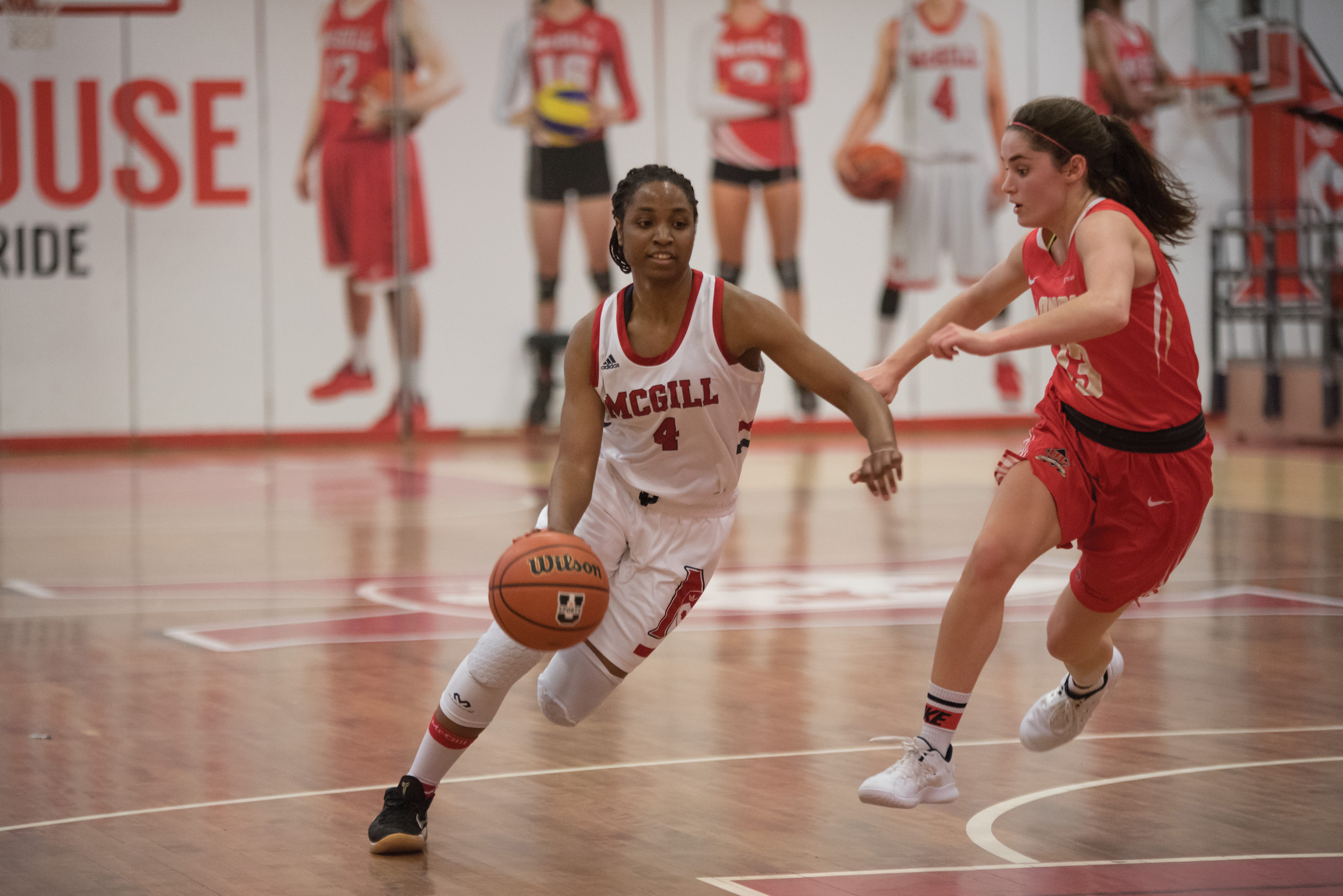
McGill Martlet basketball upsets Rouge et Or in regular-season finale

McGill Martlet basketball (10-6) ended regular season play on a high note, defeating the RSEQ no. 1 seed Laval Rouge et Or (15-1) 53-52 on Feb. 23. Despite a strong defensive effort from Laval, McGill took the win in front of the 212-member crowd. The Martlets had already secured their spot in the RSEQ championship semi-finals, but the victory kept them even in the standings with the Concordia Stingers.

McGill led 18-17 at the end of the first quarter, and the score remained close throughout the game with the Rouge et Or never holding more than a two-point lead. Both teams were strong defensively throughout the game, repeatedly forcing the offence to run down the shot clock.

“We played good defence,” first-year guard Trishia Villedrouin said. “We were helping each other out. That’s what we’ve got to do. We’re playing Concordia next week which will be a tough game, too. We’ll have to stick together again.”

A combination of strong teamwork and individual performances made the win possible for the Martlets. Fourth-year guard Gladys Hakizimana led McGill in scoring, going 4-6 from three with 24 of the Martlets’ 53 total points for the game. Meanwhile, Laval capitalized on free throws and turnovers: They did not miss a single free throw and added 23 points from turnovers. Despite Laval’s success on fast breaks and from the free-throw line, McGill still emerged victorious with a score of 53-52. Laval currently sits at the top of the U Sports national rankings and had not lost a game all season, making this win especially significant for the Martlets.

“I’m so proud of my team,” Villedrouin said. “We’ve never stuck together like this. We beat the number one team in Canada. That says a lot about our team.”

Building team chemistry and improving communication have been important factors in the Martlets’ recent success.

“We’ve had a tough season so far but, through team activities […], we’ve built a chemistry, and we’ve been having lots of discussions as a team which I think has helped a lot,” Villedrouin said. “Now, we’re starting to trust each other. It’s important from quarter one to the last quarter.”

This game also celebrated Black History Month. In a post-game speech, Head Coach Ryan Thorne praised the role of basketball in allowing him to continue his own education. He also used the moment to make a donation for a scholarship to the local organization Montreal United, which provides mentoring through sports.

“We are making new black history because of new opportunities,” Thorne said. “This is my chance to give back to the community and create more opportunities.”

McGill has won six of its last 10 matches. To earn their spot in the U Sports national championships, the Martlets must win the RSEQ championship tournament. They will face the Concordia Stingers (10-6) on Feb. 27 at John Dore Court in the semi-final round of the RSEQ playoffs.


Moment of the Game

At the end of the third quarter, second-year transfer guard Delphine Robitaille sunk a buzzer-beating three-point shot, giving the Martlets the lead heading into the final quarter.

Quotable

“We’ve got to stick together again and play hard. We gave it our all today, and we’ve got to do the same thing next week.” – First-year guard Trishia Villedrouin on the upcoming RSEQ championship semi-finals against Concordia.

Stats Corner

McGill made a total of seven three-point shots throughout the game. Three-pointers accounted for 40 per cent of McGill’s total points scored.

Science & Technology

Survival of the mutated

In his theory of evolution, which dates back to the 1800s, Darwin argues that living organisms evolve over time to promote survival and to produce the fittest offspring. This evolutionary model is based on two concepts: That all life on Earth is interconnected and that its diversity results from certain traits predominating over generations. Usually, these changes take place over thousands, if not millions, of years.

Given the right conditions, evolutionary change can be approximated on much shorter timescales. In a recent study, McGill researchers collaborated with an international team to model natural selection by observing wild mice for 14 months in the Nebraskan desert. Mice with light and dark coloured fur were captured and placed in enclosures with light and dark-coloured soil to investigate their evolution over time.

“My objective was to provide a complete story of adaptation, from mutation to phenotype to fitness, in a single study,” Rowan Barrett, an associate member of McGill’s Department of Biology and lead author on the study, said.

The goal of the study was to succinctly illustrate the process of adaptation, or changes at the genetic level that lead to better survival rates. Adaptations can manifest themselves as behaviours, which may allow for better evasion from predators, or as physically anatomical changes. Such adaptations are the outcome of mutations, or changes in DNA, which are demonstrated by environmentally-sensitive characteristics observable with the naked eye.

While there is a growing number of gene-focused studies that identify the role of  DNA in changing characteristics, Barrett explained that the scientific community knows little about the ecological or genetic factors that prompt the evolutionary changes to begin with. In contrast, his research combined a large-scale field study with laboratory-based tests in order to examine both the ecological and genetic factors that drive adaptation in wild mice.

Throughout the study, both light and dark mice were found to adapt to their new enclosure regardless of whether or not they were originally captured from light or dark regions. Mice placed in darker enclosures overall had a greater survival rate, as did mice placed in enclosures matching their original habitat. Mice placed in light enclosures evolved to have lighter-coloured fur than their ancestors while mice placed in dark enclosures evolved to have fur almost twice as dark.

Researchers found a mutation that deletes part of the Agouti gene decreases pigment molecules, changing fur colour. While the frequency of the deletion seemed to be the same between light and dark mice at the beginning of the experiment, the rate increased for mice in light enclosures and decreased for those in dark enclosures by the end of the study. These findings demonstrate a strong propensity for genetic selection.

Ultimately, the study is an example of evolution in an accelerated time frame. Although the mice are similar, there are variations among them that ensure longevity in a world dictated by the rule that the fittest survive.

The study implemented an experimental setup that effectively imitated the complexities of the evolutionary environment.

“Working outside the lab is difficult because you lose control of a lot of factors,” Barrett said. “You have to adapt to changing circumstances and unexpected problems.”

Science & Technology

The brain in higher resolution

McGill’s new 7T Magnetic Resonance Imaging (MRI) machine, located at the Montreal Neurological Institute (MNI) or ‘the Neuro,’ is the first of its kind in Canada. The T refers to ‘Tesla’, the unit of measurement for the magnetic strength of the machine. At 7T, it outperforms the 3T MRI machine that is the current standard in neuroimaging technology.

“This [7T] scanner has a higher magnetic field than conventional scanners,” Amir Shmuel, an assistant professor in McGill’s Department of Neurology and Neurosurgery and researcher at the MNI, said. “What this allows [is] better resolution […] and improved contrast [….] We cannot see brain columns and layers at 3 Tesla, [which] are small structural and functional units [of the brain]. They are in the range of 0.4 to one mm. In order to be able to observe them and also detect functional signals, we need 7 Tesla.”

Shmuel and his team obtained $18.8M in funding to cover the new machine and various other projects at the Neuro. The 7T MRI project alone reportedly cost approximately $10M in construction and equipment, although it was covered under a research grant from the Canadian Foundation for Innovation.

“At the Neuro, we’ve got a long history of doing what’s called ‘functional MRI’,” Richard Hoge, associate professor in the Department of Neurology and Neurosurgery and the director of the MRI program at the MNI, said. “In functional MRI, psychology and basic neuroscience researchers will have subjects inside the scanner while they are doing different tasks [….] Specific types of imaging techniques can help to localize the brain areas that are involved in performing those tasks. So, the motivation for getting the higher yield, the 7T MRI, as opposed to the 3T MRI that we currently have, is that the system [can detect] much smaller functional changes, and it can also localize brain responses much more precisely.”

Researchers at the MNI are interested in using this new technology to uncover previously-elusive structures in daily functions, such as those associated with vision, as well as to studying neurological diseases with greater clarity. While a 7T MRI was installed in the Robarts Research Institute at the University of Western Ontario in 2009, McGill’s new machine is capable of scanning the full body instead of just the head. This opens the door to studying the role of the spine as part of the central nervous system and its implications in neurological diseases.

“[With this research], we very much hope to significantly improve our capacity to detect and to observe early changes in the brain that are associated with multiple sclerosis, epilepsy, Parkinson’s, and dementia,” Shmuel said. “The scanner will allow us to detect subtle changes in the structure and function in the brain, [which is] part of what we expect with neurological disease.”

The MNI is developing its backend computational capabilities to store and analyze the large sets of data from the 7T MRI, in addition to pushing to better define the ethical standards around how data is collected. In terms of accessibility, the MNI intends to make the data collected from the machine available to the public as part of its commitment to open science.

“The Neuro has been a pioneer in institutionalizing the notion that data collected should be shared on open databases that are accessible to other researchers,’ Hoge said. “[This is] to avoid duplication of human experiments and also allow more researchers access to the data, and, hopefully, have a bigger impact on public health and on basic research.”

Equipped with this brand-new technology, the MNI will be focusing on training researchers in how to best use the machinery and interpret the results, as operating it can be a technical challenge. In the future, researchers hope to train students and continue to purchase the latest imaging technology so as to be on the leading edge of neuroscience research.

Read the latest issue

Read the latest issue