

Latest News

Research Briefs, Science & Technology

Disappearing giants: How warming oceans are suffocating large fish

Since 1981, the mean global ocean temperature has risen at an average rate of 0.18 degrees Celsius per decade. This has had serious impacts on the health of marine species; as oceans warm across the world, fish that are unable to cope with climatic changes, such as cardinalfish, are disappearing at a staggering rate.

A new study conducted by an international team of researchers from McGill, the University of Montana, and Radboud University examines this alarming trend. Published in the Proceedings of the National Academy of Science (PNAS), the study explores how water temperature and oxygen availability affect the metabolism as well as survival fitness of fish. The research team was particularly interested in how rising ocean temperatures impact oxygen consumption.

“We investigate how water temperature and oxygen availability together affect aerobic metabolism (i.e., the rate of oxygen consumption) of fish,” Juan Vicente Gallego Rubalcaba, a postdoctoral fellow in the Department of Biology and author of the study, wrote in an email to The McGill Tribune.

In order to achieve their goals, the researchers developed a model based on the metabolic theory of ecology.

“We build on the equations of [the] metabolic theory of ecology (MTE) to include physical mechanisms of oxygen transfer,” Rubalcaba wrote. “This theory explains how metabolic rate increases with temperature and body mass, but does not account for oxygen uptake or availability.”

Metabolic rate refers to the rate at which an animal burns calories to produce energy. This updated metabolic-based model evaluates how water temperature and body size affect oxygen consumption and diffusion. The model assesses how oxygen is extracted from water and distributed by a fish’s gills throughout its body. 

“We developed a model based on physicochemical mechanisms of gas diffusion to calculate oxygen consumption rates as a function of water temperature, oxygen concentration, gill morphology and fish body size,” Rubalcaba wrote.

The model predicted that oxygen limitation would impose more constraints on the metabolism of larger and more active fish. To support their hypothesis, the scientists compared their predictions against actual measurements of metabolic rates in 286 fish species. The oxygen consumption rates of fish of different body sizes were studied at different water temperatures.

The results of this comparison were consistent with their predictions. Indeed, the researchers found that increased oxygen limitation, tied to the temperature increase caused by climate change, had a greater impact on larger fish.

“Metabolic rate (especially active metabolic rate) increases with temperature to a greater extent in small [fish] than in large fish,” Rubalcaba wrote. “This means that smaller species are able to increase their metabolic demand for oxygen in warmer waters, while larger species may not be able to do so.”

Since larger fish have more difficulty adapting to temperature increases, species already in decline are at greater risk. The Manaaki tuna of New Zealand, for example, experience low oxygen availability due to polluted waters that could be exacerbated by rising temperatures. 

“Constraints may be especially important in large fish, because they have small gills relative to their body size (although this is a much-debated hypothesis),” Rubalcaba wrote.

The decrease in oxygen levels caused by increased ocean temperature has massive impacts on the physiology and behavioural patterns of large fish. Fishes’ inability to extract enough oxygen from warmer water through their gills leads to shifts in body size and changes in reproductive behaviour.

“Water temperature is already rising worldwide as a consequence of climate change and many fish species need to cope with this rapid temperature change, either migrating toward colder regions or adopting different life strategies such as growing smaller to avoid respiratory constraints,” Rubalcaba wrote.

Fortunately, actions such as limiting greenhouse gas emissions and restoring marine and coastal ecosystems can be taken to mitigate oceanic warming. Given that approximately three billion people depend on fish as a primary source of nutrition, protecting fish from warming oceans must be a priority.


McGill, News

Students in Mind visionary event re-imagines mental health beyond the pandemic

The McGill student organization, Students in Mind (SiM) hosted a three-day conference, Forging a New Normal, from Jan. 29 to Jan. 31, focussing on the successes and drawbacks that the COVID-19 pandemic has posed on mental health. The eighth annual student-run conference, conducted via Zoom, consisted of several keynote presentations with topics ranging from mental health in school curriculums to the use of artificial intelligence in depression treatments. The event also featured several interactive workshops, such as “Thriving in the Face of Doom,” in which participants were asked to partner up and reflect on eco-anxiety.

Julia Caddy, U3 Arts and co-president of SiM, explained that a key theme behind this year’s panels was envisioning a path forward in mental health awareness and action beyond the pandemic. 

“As a lot of people are saying these days, […] we can’t go back to the same normal that we had before,” Caddy said. “[…] Forging a new normal really has to do with reflecting on our own experiences over time, but especially in the past year, and looking at what changes […] we want to embrace to move forward to create a […] mentally healthier campus.”

During a panel that discussed the intersection of mental health and race, the moderator asked keynote speakers to share their thoughts on the debates surrounding the annual Bell Let’s Talk campaign. Vinciane de Pape, a director of learning and culture at Versett, a Canadian digital consulting firm, acknowledged the initiative’s broad reach while expressing skepticism towards corporate activism and Bell’s exclusive contract with provincial prisons.

“Although I think it’s a great entry point for many to start the conversation around mental health, there are a lot of problematic aspects to such a major corporation pushing a PR campaign that has shown to be a lot of talk without a whole lot of action,” de Pape said. “So you can argue that it’s a multi-million tax write-off, with largely white, wealthy representation [….] Bell also has a monopoly over telecommunications in prisons, which ends up harming incarcerated people.”

The panel also discussed the failings of mental health institutions in handling intergenerational trauma. Jaime Morse, an Indigenous educator at the National Gallery of Canada, spoke about the fraught relationship between Indigenous people and Canada’s healthcare system and advocated for better-educated, trauma-informed counselling practices. 

“There’s a mistrust [towards counsellors],” Morse said. “In my own experience with going to a counsellor, there was an immediate switch to ‘OK this is a white woman […] she has no idea about the intergenerational effects of residential schools [….] She’s the only one available.’ For two sessions, it was a very expensive way to teach somebody about Indigenous history and culture.”

The second day of the event featured mental health advocates from a number of Canadian universities. Molly Zhang, a third-year neuroscience and mental health student at Carleton University, spoke on the lack of transparency associated with campus resources.

“There’s a lot of resources out there, but a lot of people just don’t know where to find them,” Zhang said. “Some students will never get exposed to our organizations.”

Zhang also called on professors to increase exposure to campus support systems.

“We need to get all profs to care about mental health, and not just those who are prone to be understanding,” Zhang said. “I think one of the easiest ways to make mental health accessible to students is to have professors show that they care as instructors and that the school as an institution cares about their students.”

Jake Frank, a fifth-year biology student at the University of Windsor, expressed optimism that the pandemic might be a watershed moment in mental health awareness, noting that it has helped bring campus mental health support services into more students’ purview.

“There’s definitely more posts, more clubs, more student groups that are focusing on mental health,” Frank said. “And through that, certain resources that were under-utilized in the past have been actually getting their due.”

Hockey, Sports

McGill men’s hockey team celebrates 144th anniversary

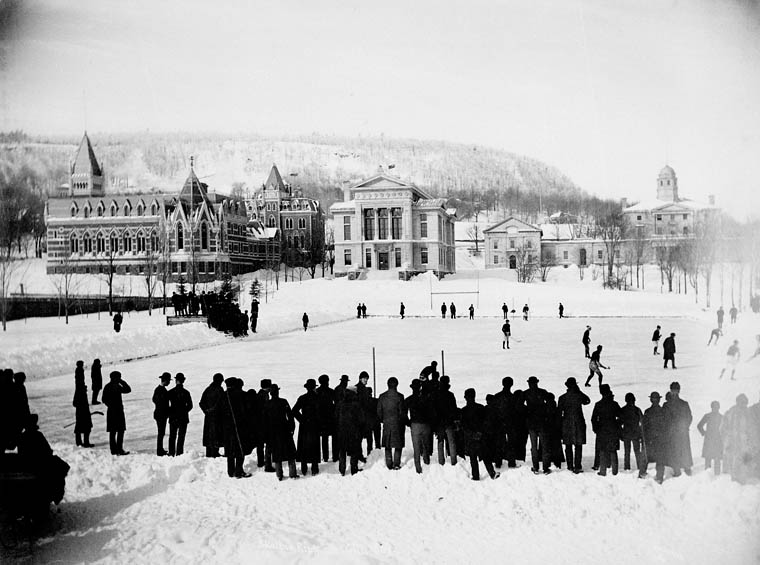
Jan. 31 marked the 144th anniversary of the first McGill men’s hockey game. Not only was this the beginning of McGill’s men’s hockey program, which now boasts 22 championships, it was also a crucial development in hockey itself: McGill men’s hockey is believed to be the first-ever organized hockey team.

In 1877, two years after the first organized indoor game of ice hockey was played at the Victoria Rink in Montreal, McGill students returned to face off against the Victorias, winning 2-1. The seven rules of this game, believed to be the first published ice hockey rules, appeared in the Montreal Gazette a month later.

While Montreal remains fiercely proud of its hockey history, hockey’s birthplace is still widely debated. Simple stick and ball games were played in ancient Greece, China, and Egypt, as well as by Indigenous peoples in North America, most notably the Mi’kmaq. Non-standardized hockey-like games like shinny, shinty, and hurly were played in Scotland and Ireland and brought to the Maritimes in the early 1800s, leading some to believe that Halifax is the birthplace of modern hockey, as these games evolved into the hockey we know today. 

Others believe that these games were too far removed from modern hockey, and the “true origins” of hockey lie in those first games played in Montreal. 

James Creighton, the McGill student who organized the 1875 game, was originally from Halifax, which suggests a mix of the two stories: Creighton may have brought his familiar form of hockey to McGill and refined it with the help of Montrealers.

The 1875 game was the first game in which a wooden puck was used instead of a ball. However, it was still very different from modern hockey games, namely that there were nine players per side instead of six. At the historic 1877 game, the rubber puck was introduced, as well as several other aspects of hockey that are still in place today, such as the offsides, penalties, and the faceoff, then known as the “Bully”. Elements like numbered jerseys, assists, and artificial rinks would not be used until the founding of the Pacific Coast Hockey League in 1911 by brothers and McGill alumni Frank and Lester Patrick. 

Other aspects of the modern NHL game were developed gradually: In 1911, teams shrank to six players. Minor, major, and match penalties were established in 1918although fighting was not made a major penalty until 1976and the expansion of the forward pass between 1927 and 1929 boosted offence. In addition to various evolving regulations about the colour of uniforms and length and curvature of sticks, helmets were made mandatory for players in 1979. Sudden-death overtime was re-established in 1983 after being discontinued in 1942 due to the restrictions on train scheduling during World War II. Finally, ties were eliminated with the introduction of the shootout in 2005.

Years after the first game, Montreal’s Winter Carnival hosted the first hockey tournament in 1883. McGill was victorious, beating the Victorias and tying the Quebec team. The next year, five teams entered the tournament while local and intercollegiate tournaments continued to grow until the first league, the Canadian Amateur Hockey Association, was founded in 1886. The first women’s hockey team at McGill played in 1896, although the existence of intercollegiate women’s hockey leagues and teams such as the Martlets were sparse until 1963.

Today, there are dozens of professional hockey leagues around the world. Thirty-seven men’s teams and 14 women’s teams have participated in Olympic hockey. While it is difficult to pinpoint precisely where and when it all started, there is no denying that McGill hockey kickstarted the sport 144 years ago.

Student Life, The Viewpoint

Reconnecting with myself through recovery

Content warning: The following deals with topics centred around disordered eating.

Between the ages of 16 and 20, I was missing a vital aspect of my health: My menstrual cycle. If this predicament ever came up in conversation, people expressed concern for my well-being, but I was quick to brush it off. 

I used every excuse in the book to explain my strange situation: “I’m an athlete. Many female athletes lose their period,” or “my mother lost her period in university, it’s probably just genetics,” and, worst of all, “I feel great and I’m not planning on having children soon, so what’s the big deal?”

Little did I know, it was a big deal. Missing a menstrual cycle has profound negative impacts on bone density, cardiovascular health, and can increase psychological stress. The medical term for missing a period due to disordered eating, psychological stress, and/or excessive exercise is hypothalamic amenorrhea (HA), and I was its poster child.

When I lost my period, I was deeply entrenched in diet culture. What started in the tenth grade as a bid to lose weight for a vacation turned into a four-year battle with orthorexia. 

Annyck Besso, a registered dietician at Sooma Nutrition Counselling and Therapy Montreal spoke with the Tribune about orthorexia. 

“[Orthorexia] is an obsession with eating healthy, [like] eating natural foods, natural ingredients,” Besso said. “It can present itself [as] a compulsiveness to be healthy and seek health in your eating habits and exercise habits. [Orthorexia] is not officially recognized in the DSM-5 […] but I would say orthorexia is a lot more prevalent [as of the last five years, and we have learned more about it.]”

The pervasiveness of diet culture in the media contributed to my disordered behaviour by pushing the narrative that thinner was always better, regardless of the costs. 

Julia Caddy, the Students’ Society of McGill (SSMU) Mental Health Commissioner, U3 Arts, expressed that media messaging can play a large role in the development of disordered eating habits.

“Eating disorders are so closely tied with perfectionism and […] when you have a society and media that posits losing weight and looking a certain way and eating a certain way as good, and the opposite as bad, and you combine that with perfectionism, it makes sense that people develop eating disorders,” Caddy said.  

For me, losing weight through over-exercising and food restriction became addictive. Each time I stepped on the scale and the number dropped, I breathed a sigh of relief. People in my life began to notice that my desire for control was becoming out of hand. 

According to Besso, this obsession with control is prevalent among people suffering from eating disorders. 

“I would say that eating disorders are typically misunderstood to be superficial disorders, but they really are disorders of control,” Besso said. “Emotions and circumstances are sometimes out of our control […] so if it’s difficult to sit in that discomfort […] focussing on controlling your body does feel really productive.”

In the eleventh grade, I had a harsh encounter with reality when I visited the doctor for a routine check-up. After running some tests, the doctor informed me that my blood pressure and hormone levels were shockingly low. She warned me that if I continued down this road, the consequences would be ugly. 

That year, I started working with a therapist and slowly started to break the food and exercise rules I clung to so religiously. I was fortunate that, by the time I arrived at McGill, my relationship with food and my body had improved. 

Cody Esterle, general coordinator at the SSMU Eating Disorder Resource and Support Centre (EDRSC), explained that the university context can be extremely triggering for many suffering with disordered eating. 

“Part of it is […] having no parental supervision over food […] and the whole concept of the freshman 15, and these pretty toxic ideas about the way your body should look,” Esterle said. “Life is very overwhelming and managing food is an additional thing [….] Students are pretty tight on money [and] the stress and amount of work that McGill puts on us makes it harder to put yourself first and your needs first.”  

Despite the progress I had made in university, I was still over-exercising and my period had not come back. I remained in a state of quasi-recovery for over a year. 

Besso described quasi-recovery as the point when someone starts refeeding and breaking some of their disordered rules, but does not fully commit to recovery. 

“The quasi-recovery is in committing to changing some of your habits, but very much staying grounded in some form of control and eating disorder rules,” Besso said. “You’re still restricting and your body is still malnourished, though it feels like you’re eating a lot more than you were before.”

One of the biggest detriments to my recovery was the external validation I received for my thin appearance. Esterle described how the glorification of thin bodies in the media makes it much harder for certain people to recover.

“It’s seen as an accomplishment [to lose weight, so] the type of eating disorder voice that’s developed in one’s head is harder to fight back against,” Esterle said. “Diet culture makes it a lot easier to get an eating disorder […] fatphobia is a part of diet culture and plays a huge part in eating disorders.” 

It was not until I discovered the book No Period, Now What? by Dr. Nicola J. Rinaldi that things started to shift for me. The book offers a science-based, comprehensive guide for how to recover from HA and anecdotes of other women’s recovery journeys. Reading other women’s success stories inspired me to take action. 

In March 2020, I went “All In” to recover from HA. As described in the book, the All In approach involves eating to complete satiety every day and reducing exercise until one has  three consecutive menstrual cycles. No foods were off limits, and there was no maximum number of calories you could eat per day. 

The experience was extremely challenging, but also liberating. I had the freedom to eat every food I had previously demonized without guilt or shame. 

Letting go of the size I had idealized in my head was difficult, but moving beyond my physical appearance gave me an opportunity to express gratitude for all the things my body did for me. Whether it was keeping my heart beating, helping me hug my family, or allowing me to dance, my body was working for me everyday. 

For Caddy, recovery meant reconnecting with the things she loved again. 

“The true ingredient in recovery was finding my identity again and filling in that gap that used to be filled with the eating disorder,” Caddy said. “For me, the defining feature of recovery is, when I face any opportunity to engage in a behaviour or obsess over certain things, it’s making a decision [….] Am I deciding between being sick again or being myself and living my life with all of these things that I love?”

My work eventually paid off: I regained my period right before my twentieth birthday and it has been regular ever since. 

While I still struggle with my body image from time to time, I have cultivated a relationship of respect and appreciation with my body that has helped me overcome the tough times. 

What I did not expect when I gained weight was that I would also gain confidence, vitality, and happiness. Recovering was the best decision I have ever made because my life is so much richer than when I was confined to such a small box. 

Sooma is a team of registered dieticians and psychologists that specialize in eating disorder treatment and sports nutrition. They can be found on Instagram at  https://www.instagram.com/s.0.0.m.a/


Homelessness
Montreal, News

Advocates argue for more resources after Quebec Superior Court rules to exempt the unhoused from curfew

Following the death of “Napa” Raphael André, an unhoused individual who froze to death on Jan. 16, Quebec Superior Court Justice Chantal Masse ordered on Jan. 26. that unhoused populations be exempt from the province-wide curfew. In Justice Masse’s decision, which came after much public outcry, she stated that the province-wide curfew is discriminatory towards the unhoused.

Quebec Premier Francois Legault introduced the curfew, which is currently in effect between the hours 8:00 p.m. and 5:00 a.m., as a measure to control a record number of COVID-19 cases in the province. After he ordered the curfew, many individuals online were quick to raise their concerns about how this policy would affect the unhoused.

Sophie Hart, U3 Arts, is the director of Meals for Milton-Parc, a community-based group that supports the unhoused population in the Milton-Parc neighbourhood. In an interview with The McGill Tribune, Hart expressed her disappointment in the inaction and delay from government officials.

“The ways in which we had to fight long and hard for the unhoused […] shows how there is no level of care for people who are unhoused or are vulnerable,” Hart said. “People say that there is no simple solution, and I do believe that this issue has many layers, but to some extent, there are ways […] to minimize damages.”

Hart pointed out the disparity between those items considered essential and non-essential by housed and unhoused individuals. Hart explained that some items deemed non essential may be required by unhoused citizens to survive Montreal’s harsh winter conditions.

“The regulation of essential and non-essential items are created by people who are housed and do not need to think about specific survival aspects that many unhoused people face,” Hart said. “Items such as socks and hand warmers are deemed unessential at stores like Dollarama. In winter, [these items] get wet and ruined very quickly and having access to these items is crucial.”

The Clinique Juridique Itinérante (CJI), through the pro bono work of the law firm Trudel Johnston & Lespérance, represented the unhoused in the court challenge. The CJI is a social justice advocacy group that serves disadvantaged and marginalized groups. 

Jeremy Wiener and Anna Gignac-Eddy, 2L Law students, are both volunteers at the CJI. Wiener and Gignac-Eddy reflected on the recent Superior Court decision and explained the curfew’s systemic implications on poverty in an email to the Tribune.

“The curfew contributed to the systemic and long-standing criminalization of poverty and homelessness in Quebec and Canadian society,” Wiener and Gignac-Eddy wrote. “The recent decision brings a wave of relief to the homeless community. [The decision] alone is insufficient. We must do more to protect society’s most vulnerable.”

Contrary to Premier Legault’s claims that “there is enough room available” for the unhoused in Quebec’s shelter infrastructure, shelters throughout the province have experienced notable resource, staff, and room shortages.

Béatrice Genest is a volunteer at Resilience Montreal, a non-profit day shelter that offers food, clean clothes, community support, and temporary housing to those in need. Genest claims that there is a gradual decrease in space available for the unhoused population. 

“As it got closer to winter and COVID-19 cases began to rise, the shelter received fewer donations, and less volunteers,” Genest said. “The shelter was also designed to have a natural area where people could stay, but the pandemic changed the dynamic of the shelter and the way everything was organized [….] We had to give food and clothes away at Cabot Square next to the shelter. The square was a popular spot of refuge for the unhoused, but a part of it now is blocked off because the city has installed an ice rink.”

News, SSMU

SSMU Legislative Council approves motion to support Dollarama workers

The Students’ Society of McGill University (SSMU) Legislative Council assembled on Jan. 28, where they passed several motions and reviewed the Financial Committee’s Investigation into SSMU’s Student Fee Policies (I.S.S.Fee.P). The meeting hosted an organizer from the Immigrant Workers Centre (IWC) who presented on the labor conditions in Dollarama warehouses and attempted to gain the Councils support given McGill’s investments in Dollarama. The Council also passed a motion to approve the Academic Wellness Proposal

Finance Commissioner Sebastien Duckett presented the results of SSMU’s investigation into its existing student fee policies. The report outlined five main issues with how SSMU’s fees are levied and administered, including a lack of due diligence and transparency on the underusage of ancillary fees, the process for fee approval, and information surrounding how fees are spent. Duckett detailed the report’s five recommendations for addressing these issues, which includes consolidating all SSMU fees into the SSMU Membership Fee.

“Just looking at the bill and seeing all the lines of fees, irregardless of how much money it adds up to, that in and of itself seems to be something that has a negative perception among the community […],” Duckett said. “It makes sense to show students how much it actually costs to run our organization and provide the services we do by reflecting that in one simple number.”

Next, Mostafa Henaway of the Immigrant Workers Centre (IWC)  presented on the working conditions of some Dollarama employees to gain SSMU’s support for Dollarama warehouse workers, given that McGill has investments in the chain. Henaway highlighted the importance of spreading awareness of the company’s treatment of its workers among McGill students.

“We’re trying to put pressure on people who have [invested], because if Dollarama is not going to listen to workers or us, maybe they’ll be afraid of other investors,” Henaway said. 

He detailed the IWC’s campaign to help workers, many of whom are racialized immigrants, gain better labour conditions. Currently, workers are not hired by Dollarama directly but by an outsourced temporary placement agency where they do not have union protections. 

Following the presentation, the council voted unanimously to approve the motion, mandating the Office of External Affairs to support student solidarity with Dollarama warehouse workers organizing to demand better working conditions. 

Councillors also passed a motion to condemn the effect of Quebec government’s pandemic response on marginalized communities, with 26 votes in favour and two abstaining. 

The last motion to pass regarded the adoption of an Academic Wellness Proposal. Mental Health Commissioner Julia Caddy spoke on the need for increased support for students’ mental health. The proposed solutions include expanding mental health resources that are paid for by McGill, such as embedding WellnessWorld, a digital wellness platform, into MyCourses. 

“The general idea and focus here is to take the upstream approach to the state of mental health [of] our students,” Caddy said. “[This reflects] studies that continue to show that academic pressures and expectations are the number one cause for distress, and that [this is] being exacerbated amongst the McGill population.” 

Soundbite

“We have encountered a lot of students who, especially for marginalized groups, don’t see their needs met at the Wellness Hub [….] Our hope is by having WellnessWorld embedded within McGill, and if [it is linked] directly on MyCourses so that it is on the forefront of student’s academic life, that they can more easily access the resources that will cater to their specific needs.” 

SSMU VP Student Life Maheen Akter on the need for expanded mental health support regarding the motion to adopt the Academic Wellness Proposal. 

Moment of the meeting:

During the presentation on Dollarama workers, Gaurav Sharma, an IWC organizer and former Dollarama warehouse worker, shared his experience with the council. He detailed the challenges he faced at Dollarama, including sustaining an injury on the job and Dollarama’s lack of medical aid for workers.

Student Life

The small pleasure of the postcard

Every morning, when I wake up, Leonard Cohen stares back at me. So does the Queen of England, a neon pink cat, and a small Tuscan countryside. They are the faces of the many special edition stamps on my postcard wall, a section of my room dedicated entirely to the letters I have received from friends over the years.

A variety of postcards grace the wall, from a photo of the waterfront at Trois-Rivières, to a watercolour painting of various root vegetables with the words “I’m rooting for you” scrawled underneath.

Normally, my postcard wall is a small pleasure, but these days, it has become an especially large one. It seems to quietly insist that there is a wide, expansive world beyond the walls of my Plateau apartment. As it turns out, I’m not alone in my growing appreciation for postcards and letter writing

Alana Dunlop, U3 Arts and Science, also started writing letters to her friend last April, when she moved back to her small hometown in Ontario. For Dunlop, her letter-writing was born entirely from the pandemic.

“It made being stuck at home more bearable,” Dunlop said. “I would check the mail every week to see if there was a letter.” 

Dunlop and her pen-pal also included trinkets in their letters. 

“I would put SpongeBob stickers over the envelope and we would include stuff we found in them,” Dunlop said. “She sent me laptop stickers and this little pamphlet with the Mont Royal cross on it.”

With nearly all of our social interactions taking place online now, it is refreshing to communicate through pen and paper. 

“It’s a lot more exciting to physically open something than to get a text,” Dunlop said. “It’s a great way to practice writing. In letters, there’s a lot more emphasis on writing well.”

Shelly Bahng, U2 Arts, shares a similar experience, having also taken up letter-writing during the pandemic. 

“[Before the pandemic], I would only write letters on special occasions,” Bahng said. “When the pandemic started, I made the decision to start writing more.” 

Bahng explained how she agreed with friends to write letters to one another instead of text. The proposition was born from a desire to eliminate the stress of having to text someone back immediately. Indeed, exchanges through letters can take us away from our screens, where we tend to spend a great deal of time these days.

“There’s so much pressure [with texting],” Bahng said. “I suggested letter writing because there’s a smaller expectation of any reply because we wouldn’t know when we sent it or if the post office was busy.”

Bahng wrote letters to her friend who had moved back to Toronto, sending stickers and any flat object that would fit in an envelope, including a key chain from Korea. For her, letters are valuable because they serve as a record of messages that might otherwise be lost.

“I have often thought about how these days, because everything is online, we don’t really send letters to each other so all of our conversations aren’t being archived [on paper],” Bahng said. “I was reading a lot of authors who had letter correspondences with each other. I wondered [if there] would there be any physical proof of the exchanges between my friends and I.” 

As our time in isolation stretches on, people are sending more and more letters. A headline from CTV News Montreal announced an unprecedented increase in stamp sales over the holidays. It turns out that the 14 Christmas cards I mailed to friends and family this previous holiday season were only a few of the thousands of cards Montrealers were sending. The letter in the mail—no longer a relic of the past—is making its great comeback.

As I drop my Mexico City-bound postcard into the mailbox, I join my fellow Montrealers in our excessive consumption of postage stamps. I gain a final glimpse of that small stamp that appears to have a certain kind of power we do not: Unlike us, it can go anywhere it wants.


Student Life

French at Work seminar series expands students’ linguistic horizons

For students with French as a second, third, or fourth language, navigating Montreal can be challenging. Although McGill is an anglophone university, the ability to speak some French is useful when exploring other parts of the city, since it has been the official language of Quebec since 1969. Gaining sufficient conversational French skills to make the most of living in the city can be difficult, but navigating the Quebec job market is another challenge entirely.

Luckily, the French Language Center (FLC) seeks to help students develop their French language skills so they can navigate Quebec’s job market with ease. The FLC’s Series French at Work – Français au travail seminar series helps students with intermediate to advanced French backgrounds develop their verbal and written French while also connecting them with employers throughout the province. 

The series is organized in collaboration with McGill’s Careers Planning Service (CaPS) and participation in the series appears on students’ official McGill co-curricular records (CCR). Recognition on this document provides both intrinsic and extrinsic motivation for students to attend the seminars.

French Studies lecturer Joannie Proulx is confident that the FLC’s services are meeting a student demand.

“The French professional communication workshops were strongly motivated by concrete needs expressed by our students,” Proulx wrote in an email to The McGill Tribune. “Many of our students want to remain and work in Quebec after their studies, but have expressed not feeling prepared enough to transition into the French workplace.”

Marion Vergues, Faculty of Arts lecturer and the director and academic coordinator of the series, believes that the ability to speak French is invaluable to students seeking a job in Quebec after graduation.

“Being able to work efficiently in a multilingual environment [provides] more confidence in one’s ability to adapt to an ever-changing job market, as well as more opportunities [for] growth,” Vergues wrote. “French plays a major role in this part, of course in Quebec and in all Canadian provinces because of bilingualism requirements, but also in our globalized world.”

The series provides students with the tools necessary to develop a profile, write a CV, and participate in interviews in French. Vergues has enjoyed leading several of the seminars. 

“I find them nurturing,” Vergues wrote. “I have been teaching French for Professional Communication for a while. It allows me to interact with students by teaching French for specific objectives, which is still underrated in language curricula at university level [compared] to literature for example.” 

Like most events, the seminars have had to take a different form since COVID-19 hit in March 2020.

“Since the beginning of the pandemic, the French Language Centre has had to adapt to remote teaching and learning to ensure access to high-quality courses and activities,” Vergues wrote. “It has been both a challenging and rewarding process due to a unique pairing of self-driven and skilled instructors and engaged students.”

Although the “Series French at Work – Français au travail” seminars are geared towards students who already have an intermediate or advanced background in French, the FLC’s offerings are diverse. Proulx helps ensure that there are opportunities for beginners to enjoy being in a bilingual city and become familiar with the French language.

“I coordinate a team of amazing French language assistants (monitrices de langues), who create and facilitate fun pedagogical activities for students learning French, such as field trips in Montreal or Quebec [City] (before Covid), French meetups, a language partnering program, game nights, and a tutoring service,” Proulx wrote.

Both Vergues and Proulx emphasized the importance of engaging in the FLC’s events.

“I would encourage students to try and participate in a French activity, whether it is a game night or the language partnering program,” Proulx wrote. “Since we all shifted to remote […] interactions, I think it’s now more important than ever to connect with people. Why not pick up some French in the process?” 

Vergues described the benefits of student engagement with the FLC.

“Take advantage of all opportunities to engage in activities offered in French on the campus,” Vergues wrote. “Get to know [the] Francophones of McGill. They are proud ambassadors of the French [language], and passionate about it!”

Solin Hall Annex
McGill, News

Students excluded from residences for noncompliance following policy change

In response to increasing COVID-19 cases in Montreal, the McGill administration updated the Residence Handbook, eradicating the three-strike policy for breaking COVID-19 measures. The new policy, implemented on Jan. 13, maintains that a written warning or a disciplinary meeting will follow a first offence, with the possibility of up to a 10 day exclusion from residence, or even a complete lease termination. On Jan. 21, as a result of noncompliance with COVID-19 restrictions, between 15 and 20 students were notified of their exclusion from residence for seven days, and had their student IDs confiscated, preventing them from using their meal plans and accessing McGill facilities. 

Noa Crébassa, a U2 Arts student in Solin Hall, said that she was not surprised about the change in policy.

“I would say the [new] one-strike [policy] makes sense because of all the violations taking place in New [Residence] and Royal Victoria College last semester,” Crébassa said.

Tom*, a U0 Arts student living in Campus 1, expressed his frustrations with the lack of communication between the university and its students.

“[McGill] is not communicating what the rules are,” Tom* said. “Students received emails saying they had to leave by 10 a.m. the following day, giving them less than 24 hours to find places to stay.”

Some of the students who were excluded from their residences had nowhere to go and said that the university had sent them a list of hotel suggestions, but people under the age of 18 are unable to book rooms themselves. 

“Airbnb check-ins are at around 3 or 4 p.m., so students had nowhere to go [at 10 a.m.],” Tom said. “[Students] weren’t allowed to use their meal plans either. They were pretty much stranded until they could find a hotel or an Airbnb.” 

Vikram Nathan, a U0 Science and floor 14 representative of New Residence Hall council, said that the situation sparked anger among many students.

“In one severe case, a student had to spend the night unhoused,” Nathan said. “She spent it at a subway station. Students have to pay out of pocket for their housing [….] This is all just disastrous from a mental health standpoint.”

Tom described students’ frustration due to the lack of communication from the university. 

“I understand that students are breaking COVID guidelines, which I know is not a good thing, but the way that McGill is handling all of this is not right, especially in regards to evicting students with no prior strikes,” Tom said. 

Nathan pointed out the lack of support that McGill is providing students in residences. 

“This all feels very unsympathetic,” Nathan said. “There’s a massive disconnect between what [McGill] thought they could achieve by putting us all in [residence] and what is actually happening,”

McGill Media Relations Officer Frédérique Mazerolle said that the university has always communicated its rules to the students. 

“The safety of our students and staff is our foremost guiding principle,” Mazerolle said. “McGill continues to work hard to create a safe and welcoming experience for all students who have chosen to join us in residence.” 

Mazerolle disagreed that students were not adequately informed of the changes in regulations.

“The university has been very clear that students living in residences are expected to abide by these new rules and regulations,” Mazerolle said. “A number of students have faced short-term measures for non-compliance to public health authorities and McGill’s COVID-19 regulations in residences.”

*Names have been changed to protect the privacy of individuals.

A previous version of this article quoted Crébassa saying that there was no warning before the implementation of the new policy. In fact, she was not surprised about the change in the disciplinary policy. The quote has been updated. The Tribune regrets this error.

content warning ed, McGill, News

EDRSC panel brings attention to misrepresentation of eating disorders in media

CW: Eating disorders

The Students’ Society of McGill University’s (SSMU) Eating Disorder Resource and Support Centre (EDRSC) held a panel discussion on eating disorders and their representation in mainstream media as a part of SSMU’s Mental Health Action Week. Held on Jan. 27, the “Misrepresentations of Eating Disorders in the Media” panel examined the intersections between eating disorders, race, gender, and sexuality. Panellists discussed how these topics are portrayed in popular culture, the effect of stereotypes, and obstacles to obtaining treatment.

Drawing upon personal experiences, panellists discussed how mainstream media tends to portray eating disorders as being the same as experiencing a negative body image—specifically as women trying to comply with heteronormative beauty standards. 

Roselyne Douge-Charles, an educator and professor at Algonquin College, spoke about the representation of eating disorders within the Black community. Douge-Charles highlighted the importance of open discussions—which might validate lived experiences more so than clinical reports—as a tool to bring about change in how we understand and represent eating disorders.

“I don’t know if we need more research,” Douge-Charles said. “Just […] having people [at this panel] and listening to people saying that this is real for them should be enough to be a catalyst to see if we can create some changes in the way individuals are supported around eating disorders [….] Sometimes saying that we need more research is a way to deny what we already know. [It’s] like a cop-out. [We] already know what’s going on [and we] need to fix it”.

The panellists delved into misrepresentations of eating disorders and how a lack of representation in treatment spaces can create barriers to accessing support. The panel focussed on how the treatment process needs to be re-examined, especially as we learn more about how eating disorders affect individuals from different backgrounds. 

Support volunteer for the EDRSC, Liam Fowler, U1 Agriculture and Environmental Sciences, explained how stereotypes and assumptions can be harmful to individuals living with eating disorders.

“One of the things I’m hearing [in this discussion] is the idea of trying to fit into either a diagnosis or trying to fit a physical or mental narrative,” Fowler said. “The consequence of this is that if you are dealing with some of these feelings, conditions, or habits, you might not be able to identify that yourself because it is not the image that’s being portrayed [to you].”

The panellists focussed on how positive forms of treatment, like peer-led discussion groups, can help reduce trauma that can stem from traditional treatment services. Long waitlists, difficulties accessing treatment, and a lack of representation exacerbate a dangerous cycle for those seeking help. Co-founder of the EDRSC, Cody Esterle, BA ‘20, called on universities and other institutions to provide better support for students living with mental illness.

“This is a huge problem in universities that is facing so many students […] and in order to access [resources] a lot of people need to drop out, [putting] their entire life, education and plans on hold,” Esterle said. “It is not a system that is set up for people to survive in the long run [….] There are events like #BellLetsTalk that just populate the entire narrative and conversation, and you’re not talking about the deeper issues, support systems, [or] resources that [are needed].” 

EDRSC is hosting its third annual Eating Disorder Awareness Week from Feb. 1 to 5, with programming offered daily to help raise awareness about disordered eating, provide resources for those struggling, and explore the impact the pandemic has had on eating habits. The centre also offers weekend support groups for those with loved ones struggling with disordered eating and related issues.

Additional information about resources and group support sessions will be posted on the EDRSC’s Instagram and Facebook accounts throughout the week.

Read the latest issue

Read the latest issue