Latest News

McGill, News

Rodents run rampant in McGill residences

At 2:30 a.m. on June 26, Tobias Gurl, a third-year master’s student in the Department of Family Medicine, woke up to the sound of a rat squealing and thrashing, its head stuck in a trap. Unsure what to do, Gurl swept the dying rat onto the fire escape of his one-bedroom unit in the McGill graduate residence, 3643 University. Gurl told The Tribune that this was just one of the multiple rodent-related incidents he has encountered while living in McGill residences.

Gurl moved into 3643 University in January 2024. By late March, he started to hear scuttling noises in his unit and noticed holes in his groceries. At the beginning of April, he contacted Student Housing and Hospitality Services (SHHS), who sent an exterminator to lay traps. Gurl explained that the noises continued, so he notified SHHS again, and they sent another exterminator. This pattern persisted until late July when the university relocated Gurl to Solin Hall at his request. Altogether, Gurl estimates that exterminators visited his 3643 University unit over five times and caught up to nine rats in the span of four months. 

“At the start of July, I started to get really fed up with this,” Gurl said in an interview with The Tribune. “I was losing more and more space in my unit to the rats [….] There were droppings everywhere. The burden was put on me to clean them up, despite the fact that they were a health hazard.”

Amid this, Gurl also explained that he was concerned for the health of himself and his service dog from the prolonged exposure to rodents. On June 27, Gurl sent an email to SHHS requesting relocation per the suggestion of the exterminator who had laid traps earlier that day. SHHS initially offered to relocate Gurl to the basement unit of 3643 University; however, Gurl did not receive further information until July 10 when SHHS notified him that the other unit was no longer available due to a “major water leak.” During this lull in communication, Gurl contacted a reporter from The Montreal Gazette through a friend and a lawyer through the Post-Graduate Students’ Society (PGSS) referral.

“What I needed was verification that I wasn’t losing my mind that something was very wrong here, that it wasn’t reasonable for me to be accepting this many rats in an area, or even one rat,” Gurl said. “I had no sense of what was normal, what was proportionate and I also needed that backup, that when I said something, or when I asked for something, I would have someone with actual enforcement muscles standing behind me.”

Gurl explained to The Tribune that he had advocated to live in McGill residences in the first place due to discrimination he faced in the private market on the basis of having a service dog. For him, McGill residences were the only viable option for accommodation while he finished his degree. Without another option, Gurl hoped the problem would be resolved proactively.

“There was also a frog boiling effect, where at every stage I assumed that this next step they were taking was correct,” Gurl said. “There was no [moment] until July, where it was obvious the problem wasn’t going to be fixed.”

After some negotiation over email, SHHS offered to help move Gurl’s belongings to a one-bedroom apartment in Solin Hall on July 19. On Aug. 22, Gurl reported a mouse in his new unit.

“I started hearing those noises again and little flashes of something along the edges of the walls. I thought I was imagining things at first, that my brain was playing tricks on me,” Gurl said. “There was no possible way I had gone from a place with rats to a place with more rodents.”

On Sept. 13, maintenance sealed a hole suspected as an entry point for rodents in the Solin Hall unit. This temporarily quieted the issue but on Oct. 15, maintenance found another mouse in the apartment. According to McGill’s Media Relations Office (MRO), the university has received five complaints of rodents in residences since the beginning of the academic year—an issue which becomes more salient in the fall as rodents seek shelter and food to survive the cold.

Speaking to The Tribune, Gurl expressed that he felt failed by what he perceived as a lack of a proactive response from McGill.

“I have a lot of sympathy for the position McGill is in,” Gurl said. “They’re not responsible for the rising rat population in the city [….] They don’t have control over the derelict buildings in the block or so where a lot of their housing is. They don’t have full control over trash pickup. But the [thing] I would have wanted from them [was] communication.”

He also felt “siloed” and isolated by McGill’s response to the situation.

“The way McGill presented solutions to me was always focused on things I should be doing,” Gurl said. “The emphasis [was] placed on me cleaning things up, me putting the food away [….] It really communicated this message that I was doing something wrong, I was at fault. And when you send that message to a tenant, it makes them want to hide the problem, because if I’m the only one going through this, if it’s because I’m not clean enough, then I can’t talk about that with other people.”

In an email to The Tribune the MRO explained that McGill’s pest control strategy includes regular inspections and specific complaints are handled on a case-by-case basis.

“This issue is taken very seriously by McGill,” the MRO wrote. “As a landlord, McGill is bound by the requirements of the [Tribunal administratif du logement]. It’s worth noting that tenants also have a responsibility to ensure that there is no food left out in dorm rooms since that can attract and sustain pests.”

PGSS Member Support Commissioner Emily Tetrault explained the The Tribune that while PGSS does not offer direct support to members facing issues with their landlords, it can connect students with services such as the Legal Information Clinic at McGill, and the Legal Protection Program. Tetrault also underscored the vulnerable position international students can be in when dealing with landlord disputes.

“Knowing your rights as a tenant, especially as an international student, is key from the beginning in my opinion. Educaloi is a great website to help people in Quebec understand their rights in relation to various topics but especially renting in Quebec. Unfortunately, many out-of-province and international students don’t know that landlords cannot take a damage deposit, and some landlords take advantage of this,” Tetrault said.

In an email to //The Tribune//, the Syndicat des locataires de Montréal/Montreal Autonomous Tenants’ Union (SLAM/MATU) encouraged students to start a dialogue about their living conditions in and out of McGill residences.

“At the very least, students can make each other aware that they don’t have to take price gouging and neglect from their landlords,” the union wrote. “We highly encourage McGill students to discuss their housing conditions and pricing and to plan actions, and to keep that conversation going even after they leave their dorms.”

For Gurl, refusing to stay silent and advocating for oneself is crucial to advancing change.

“[Landlords] rely on tenants keeping quiet to keep getting away with bullshit, and as soon as your voice becomes impossible to ignore, then they’ll act.”

Chill Thrills, Out on the Town, Student Life

When is the best time to attend Piknic Électronik?

Piknic Électronik is a Sunday ritual for many McGill students and Montreal locals alike, transforming Parc Jean-Drapeau into a pulsing hub of music and good vibes for five months straight. With the festival running weekly outdoor music events from May to October, it runs the full gamut from spring to fall, making us wonder how Piknic’s experiences vary throughout the seasons. 

Starting with the constants: Across all seasons of Piknic Électronik, students from each category generally reported high levels of satisfaction with the price of tickets and food options. 

“$25 CAD [for one entry] was a very good price for the experience,” Nell Casey, U1 Arts, told The Tribune after attending Piknic this past spring. 

The festival also offers a discount for students with their popular “Back-to-school” pass. Priced at 60 CAD, this pass gives festival-goers access to all regular Piknic Electronik events starting Aug. 25, making it especially attractive for those looking to attend at the start of the fall semester.

The outdoor venue’s two main stages showcase different artists throughout the night. Food and drinks are also available making it possible to take breaks and refuel before getting back out in the crowd. “There were many food trucks that had a lot of fast food like hotdogs, poutine and grilled cheese sandwiches,” Juliette Whitecross, U1 Science, said. 

Casey also mentioned that the possibility of attending Piknic at different times during the year allowed students to balance academic priorities and fun events.

 “[I] liked it better in the summer because in the fall I have more classes and work to do, and it would be stressful to attend as many events,” Casey explained.

Zoya Mirza, U1 Arts, who went to Piknic events during both the summer and fall, expressed more enthusiasm towards attending during the spring as a way of letting loose and having fun after the school year comes to an end. 

“The combination of post-exam relief and celebrating the beginning of summer break really topped the experience,” Mirza stated. 

The students we spoke with also observed changes in the festival’s demographics throughout the year; they noticed more McGill and Concordia students at Piknic during September and October, while they found that Montreal locals preferred to attend during the spring and summer months.  

“[I] personally liked Piknic during the summer because of the temperature, but I think it could be more fun during the fall if you want to meet people from McGill or Concordia because in the summer, most of the people there were in their mid-20s,” Whitecross said.

Casey noted the same trend, but she still enjoyed the festival during the summer months. “Even though it was not the regular school year, I still saw a lot of McGill students and had a lot of fun,” she highlighted.

Mirza, who attended Piknic both with and without the bustling crowd of college students, found the early-season festival events to be more enjoyable. “Honestly, it felt so refreshing with fewer McGill students around after exams and the school year ending,” she said.

Factors such as school work, crowds, and the festival’s overall ambiance shaped these students’ enjoyment of their Piknic Electronik 2024 experience across the spring, summer, and fall months. While some preferred a festival crowd full of university students, others enjoyed the differences in attendees and a step away from the McGill bubble. In addition, this iconic Montreal festival’s months-long season made it especially appealing to students who could take part in the event whether school was in session or not. Ultimately, Piknic Électronik stands out as a beloved cultural staple in Montreal, offering a vibrant and flexible festival experience that resonates with both McGill students and locals, regardless of their academic commitments or seasonal preferences.

McGill, News

Oct. 7 student demonstrations dominates discussion at McGill Senate meeting

The McGill Senate convened for its second meeting of the academic year on Oct. 16 to discuss the new Deputy Chancellor, the student demonstrations of Oct. 7, and Bill 74.

First on the agenda were memorial tributes for Professor Emeritus of Surgery Harvey Sigman, Professor Emeritus of Animal Sciences Sherman Touchburn, and Professor Emeritus of French Literature Genevieve Leidelinger. McGill President, Vice-Chancellor, and Senate Chair Deep Saini offered a motion of condolence to the family of each professor.  

Senators then reviewed the Report of the Senate Steering Committee and the Sept. 18 meeting minutes, opening the floor to questions and amendments. Senator Margaret Levey mentioned an inclusion to the section on the discussions between Senate members during an open discussion on evaluating the Statement of Principles on Freedom of Expression and Freedom of Peaceful Assembly.

“In the part of the minutes that reports back on the discussions we had in breakout groups […] I noted that, for instance, two groups both underscored that feeling uncomfortable does not equal feeling unsafe, but that’s nowhere in the minutes, and I think that that’s an important point that should be reflected,” Levey said. 

Saini accepted the amendment. Senator Ipek Türeli also requested they add a note about the purpose of the open debate, and Saini agreed it should be included as a preamble. With that, the motion was carried. The Senate also approved the Meeting Minutes from the Sept. 18 meeting.

Saini began his Chair’s Remarks by recounting that the Board of Governors (BoG) has appointed Governor Emerita Cynthia Price Verreault as the university’s first Deputy Chancellor, who will notably provide strategic advice and support to the Chancellor and President and Vice-Chancellor. He then proceeded to comment on the campus climate during the week of Oct. 7. That Monday, hundreds of protestors rallied in solidarity with Palestine throughout downtown Montreal and McGill’s campus. The protest dispersed when the police used tear gas after individuals smashed windows of the Sylvan Adams Sports Science Institute. McGill sought an injunction against Solidarity for Palestine’s Honour and Resistance (SPHR) at McGill. On Oct. 8, the Superior Court of Québec granted a provisional ten-day injunction, effectively limiting protest activities in and around campus, and preventing “disturbances” of McGill activities and community members.

Saini stated that the university’s actions seek to uphold McGill’s academic mission, and stressed the importance of ensuring staff and students’ rights to freedom of assembly and expression.

He went on to describe McGill’s preparation for the week and the university’s method of determining the course of action. 

“In the weeks leading up to Oct. 7 […] McGill worked with external stakeholders including the city, the [Service de Police de la Ville de Montréal], the provincial government and other universities to determine how best to plan to ensure the stability of our campus,” Saini said. “University leaders also met with community groups internal to McGill who are those most affected by the events of Oct. 7, 2023, and their aftermath.” 

Given the more than 13,600 midterms scheduled for that week and the alleged information the administration received about planned disruptions on campus, Saini expressed that the only reasonable option was to activate the Emergency Operations Centre in accordance with the Emergency Management Policy. He also noted that McGill did not receive information suggesting that the personal safety of community members would be at risk, but he stressed that there was a “clear risk” of property damage and disruption of academic activities.

“Because we were prepared, the damage and injury that did occur was relatively minor compared to what could have, and in my opinion would have, happened,” Saini said.

Saini then turned to the injunction.

“Let me emphasize that the right to expression including protests through peaceful assembly remains,” Saini said. “What is not allowed is intimidating people, damaging property, and/or interfering with student’s right to learn and colleagues’ right to work. Senators will hopefully agree that these boundaries on protests are permissible and indeed necessary.”

He claimed that Oct. 7 also saw many peaceful processions, which occurred in consultation with the McGill administration.

During questioning, Senator Victor Muñiz-Fraticelli asked about the changes in McGill’s mode of instruction implemented on the week of Oct 7. 

“The language of the communications that the faculty received were at best unclear, and from the conversations I have had with colleagues in different faculties, many feel were deliberately misleading, by suggesting at certain points in contradictory language that classes were or were not to be held online,” Muñiz-Fraticelli said. “It seems to me that a change in the method of instruction is within the exclusive purview of Senate, and that Senate should have at least been consulted at the meeting of Sept. 18, where I presume the university was aware that some measures would have to be taken several weeks later.” 

Muñiz-Fraticelli then explained the consequences of McGill’s failure to consult with the Senate or the professoriate. 

“This led to the implementation of measures where students were not able to access classes in many cases, because after being cleared for access to campus […] they were locked out of buildings where classes were held,” Muñiz-Fraticelli said. “All of which could [have been] avoided, both in terms of the rights of Senate but also in terms of implementation, by appropriate consultation of the body that should determine the mode of instruction in the university.” 

Interim Deputy Provost (Student Life & Learning) Angela Campbell responded, arguing that all students with IDs had access to buildings. In regards to mishandled academic instruction during the week, she said that the administration was making “difficult decisions” working with “incomplete and imperfect information” on scheduled protests. She took exception to the notion that communication was deliberately misleading. 

Senator Campbell also noted that she consulted several student groups including Jewish, Muslim, Arab, and Palestinian communities at McGill about Oct. 7, without mentioning any directly, to ask what they had planned for the week and attempt to work together on events. 

“We invited all groups to […] let us know if they were planning anything around the date of Oct. 7 and if so, how we could work with them,” Campbell said. “So some groups did work with us and they had their events and they went off smoothly but there was a lot of worry during the planning period with regard to whether or not events could be carried out safely and even in those conversations for the reasons I outlined earlier it wasn’t clear what the limitations on access to campus would even be.”

Closing his Chair remarks, Saini also touched briefly on Quebec’s tabling of Bill 74, which proposes to give the province new immigration powers to reduce the number of international students. The bill would allow the provincial government to prioritize certain regions, programs and levels of education. Saini reiterated that McGill is analyzing the potential impacts of the bill and will request to participate in future consultations between universities and the government. 

At the end of the public part of the meeting, Research Integrity Officer and Associate Professor of Anatomy and Cell Biology Craig Mandato gave the annual report on the investigation of research misconduct. Mandato began by explaining the process by which complaints of research misconduct are investigated, describing how dossiers are created and pursued. He also explained that the Research Integrity Office reports its findings to several other entities, including McGill’s Office of the Vice-President, Research + Innovation, the Senate, the BoG, and the Secretariat of Responsible Research in Ottawa. 

Mandato also expressed concern over a growing number of anonymous allegations submitted online. He noted that of the seven ongoing investigations of research misconduct at McGill, two came from within the university, two came from external community members, and three were anonymously submitted through PubPeer, an online journal club. 

“Across Canada, research integrity officers are wondering what are we going to do with these online allegations […] regulations say we have to take them,” Mandato said. “We had three in May, and this is just the tip of the iceberg [….] It’s not just me who’s not sure what to do with it, there’s a lot of chatter with other research integrity officers across the country that this will be a real issue in the future.” 

Following Mandato’s report and a brief question period, the public part of the meeting closed.

Moment of the meeting:

While Craig Mandato discussed the research misconduct reports, he stressed the problems in both volume and quality of allegations arriving from PubPeer. He noted that these reports often involve outdated cases, such as one from 20 years ago asking if the author had high-resolution images, which Mandato emphasized was not a proper allegation. With over 40 such reports, received in July, Mandato explained that although some cases may have substantial merit, many are outdated and simply drain resources for research integrity officers across Canada. 

Soundbite: 

“I just wanted to know if central admin is aware of the fact that not all students have ID cards, and that personally, I dealt with many students […] who didn’t have ID cards and who were quite stressed out at not being able to get into the building […] to write their midterm exam. It’s nice that you say that every student could get in, but they couldn’t.” — Senator Levey on the academic issues posed by McGill’s security measures the week of Oct. 7.

McGill, News

Garden planting event cultivates community and biodiversity on campus

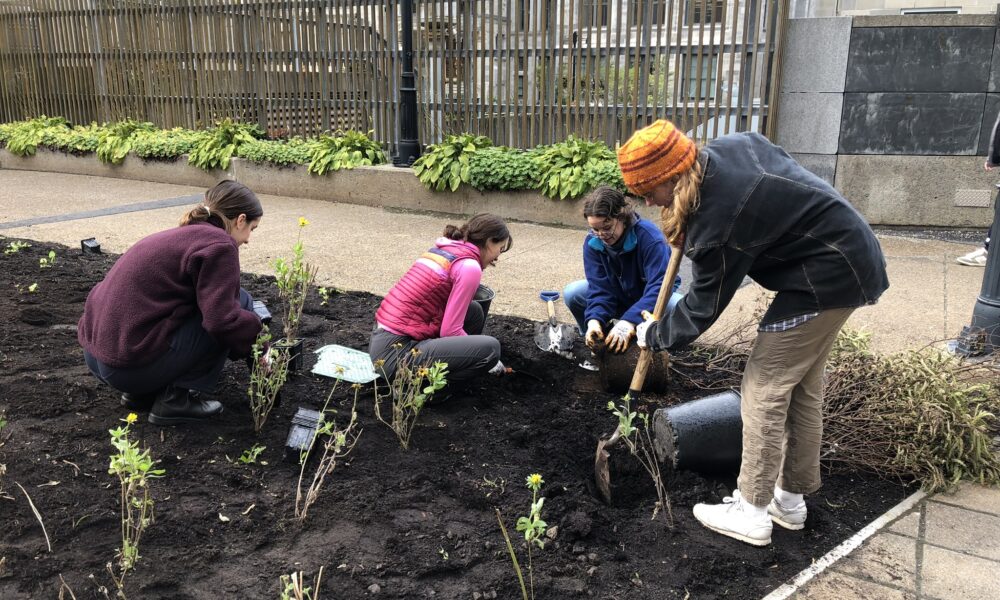
McGill community members, numbering around 10 total, gathered to plant a garden on the terrace of the Otto Maass Building on Oct. 15 as a part of the university’s Biodiversity Plan 2030. McGill adopted the plan in 2023, which commits the university to increasing biodiversity on its campuses by cultivating and supporting native plant and animal species on the land the university occupies. 

The event saw the sowing of about 365 plants, covering an area of 250 square metres on the terrasse of the Otto Maass Building. 95 per cent of the new garden is composed of indigenous species, which will take a few years to reach their mature size.

The biodiversity plan is a part of McGill’s Climate and Sustainability Strategy 2020-2025, which sets the direction for the university’s long-term approach to combating climate change, including its commitment to achieve carbon neutrality by 2040.

Marie-Claude Carignan, Climate and Biodiversity Officer at the McGill Office of Sustainability, organized the community planting event and emphasized its alignment with McGill’s biodiversity plan. 

“We’re focusing, in this case with our garden, on indigenous species, and more broadly we’re trying to see how biodiversity, […] conservation, and restoration can be better ingrained within operations at McGill,” Carignan said in an interview with The Tribune.

Ahead of the United Nations Biodiversity Conference (COP15) hosted in Montreal in December 2022, McGill joined hundreds of universities globally in signing the Nature Positive Pledge, which encourages higher education institutions to restore ecosystems damaged by their presence. This resulted in the development of McGill’s Biodiversity Plan 2030, which is the first plan of its kind implemented at McGill. 

The university’s biodiversity plan consists of six key objectives; to maintain inventories of biodiversity at McGill, analyze the university’s impact on biodiversity, increase engagement with biodiversity-focused activities, embed biodiversity in university operations, increase green spaces on campus, and develop partnerships to meet biodiversity targets.

The community planting event was in line with the plan’s goal of increasing McGillians’ engagement with biodiversity-focused activities and increasing the quality and quantity of green spaces on campus. Organizers provided volunteers with gardening gloves, shovels, and hot chocolate.

Carignan noted that student enthusiasm for the event encouraged the Office of Sustainability to involve the McGill community in future initiatives as much as possible. 

“We’ve had a lot of people requesting [to help out] when we’re doing […] events,” said Carignan. “They actually want to get their hands dirty and actually want to participate and actively be involved in the biodiversity project on campus.”

Sofija Kuzmanovic, U0 Engineering, attended the event, and reflected on the value of direct engagement in community projects. 

“People are looking to make small local efforts to combat issues with pollution and overbuilding,” Kuzmanovic said. “I know McGill is trying to meet certain goals with its biodiversity, and being able to contribute to that and see it in action makes you realize that there really is an impact in something you can do.”

Organizers will label the plants, and install a chronolog photo station, allowing community members to monitor the garden’s development through a publicly-accessible timelapse.

While McGill has long-term sustainability goals, some say the university is not going far enough. Lola Milder, U3 Arts, an organizer with Divest McGill, a climate advocacy group, wrote to The Tribune that she believes the university needs to adopt a more in-depth approach to combating the climate crisis.

“I think that McGill operates on a narrow understanding of ‘sustainability’ that focuses on individualized actions like recycling and biking to work that allow business at McGill to continue as usual,” Milder wrote.

According to Milder, McGill’s size and influence as an institution heightens its obligation to respond to the ongoing climate emergency. 

“It’s exciting that they’re moving forward to divest the university’s direct holdings from fossil fuel corporations,” Milder wrote. “But the endowment is still funding climate destruction through its indirect holdings in fossil fuel corporations, and holdings in many other destructive industries, including weapons manufacturing.”

A previous version of this article stated that McGill’s biodiversity plan was adopted in 2022. In fact it was adopted in 2023. The Tribune regrets this error.

Horoscopes, Student Life

The Tribune Predicts: Fall horoscopes

With sweater weather in full swing and a pumpkin spice latte in hand, it’s time to hunker down in a library until it’s spring again. While you’re hibernating, check out The Tribune’s predictions to round off the end of 2024. In this edition, we’re doing “ins and outs” for each sign.

Aries (Mar. 21 – Apr. 19): Whether your favourite scent is cranberry or maple wood, head to the nearest home goods store before a seasonal cold steals your sense of smell! Self-care is in, and agendas are out! All of your tasks and meetings can float into the void—that peace of mind is the best self-care of them all. In: Warm sheets, baking, scented candles. Out: To-do lists.

Taurus (Apr. 20 – May 20): This season is about relaxation and renewal. Try to take advantage of the nice weather and get some well-needed rest! In: Group texts, evening naps, aimless strolls. Out: Superlatives, cold water, wardrobe meltdowns.

Gemini (May 21 – June 21): With Mercury going into retrograde in November, it’s time to delve into your own identity. In: Personality tests, listening to new music genres, blind dates. Out: Permanent markers, repetition, monologuing.

Cancer (June 22 – Jul. 22): Have you been feeling optimistic lately? Keep that contentment flowing with journaling. This fall and Thanksgiving, list everything you’re grateful for. In: Meditation, follow-up texts after a hangout. Out: Assumptions, “if ykyk.”

Leo (July 23 – Aug. 22): Fall is the perfect time for you to dive into your passion projects. Whether you’re starting something you’ve always thought about doing, or finishing something on the shelf, it will get done before 2025. In: Minimalism, bedroom deep-cleans, screen-time restrictions. Out: Multitasking, Zoom meetings, people pleasing.

Virgo (Aug. 23 – Sept. 22): Your ruling planet will enter the house of relationships this November! Whether you’re in a relationship, seeking one, or just don’t care at all, your connections with others will be reinvigorated. In: Semi-formal, fragrantica.com, manifestation. Out: Ghosting, playing it by ear, instant gratification.

Libra (Sept. 23 – Oct. 23): Happy birthday Libras! This season—and year—don’t be afraid to get a little weird. Indulge in all the strange things that bring you joy, even if that means biking to the US/Canada border for a Carnival scunt. In: Mismatched clothes, spontaneity, fortune cookies. Out: Traditions, nostalgia, soft launch.

Scorpio (Oct. 24 – Nov. 21): It’s time to face some things that may have been bothering you for a while. Before your birthday season is up, tidy all the loose ends and resolve some grudges that are weighing you down. In: Cold calls, little treats, dinner parties. Out: Overthinking, revenge, “do not disturb”.

Sagittarius (Nov. 22 – Dec. 21): This semester is about making new connections. Send those LinkedIn requests to your highschool best friend’s cousin’s boyfriend; everything is on the table. In: Applying for club executive positions, networking events, knowing your neighbour. Out: Bedrotting, celebrity culture, playing hard to get.

Capricorn (Dec. 22 – Jan. 19): A major professional opportunity is around the corner, but you already knew that, didn’t you? Take this opportunity to get some rest. In: Penpals, 10+ picture photo dumps, manifestation. Out: Crying wolf, less than seven hours of sleep, business casual.

Aquarius (Jan. 20 – Feb. 18): Thinking about booking that trip for Christmas break? Wanderlust is fueling you right now, so switch things up and broaden your horizons. In: The unexpected, new shoes, going off-the-grid. Out: Imposter syndrome, hometowns, the word “delulu.”
Pisces (Feb. 19 – Mar. 20): Confide in your friends about the things on your mind, or branch out! You might realize someone you know is more similar to you than meets the eye. In: Double-takes, coffee dates, talking to your TA. Out: “Situationships”, FOMO, keeping up with people you don’t like.

Campus Spotlight, McGill Recommendations, Student Life

McGill Global Brigades is building bridges in global health

McGill is home to many student clubs focused on global issues like sustainability and public health. Among them, McGill Global Brigades stands out as a club that encourages students of all fields and interests to roll up their sleeves and collaborate for public health initiatives. Not only does it create new communities and build networking skills, but it also enacts tangible global change.

With 27 chapters across Canada and over 340 across the world, Global Brigades unites students in promoting sustainable international health initiatives. This non-profit organization works with various communities around the world to promote health and economic goals such as access to clean water and sanitation

At McGill, numerous programs—including medical, dental, business, public health, and engineering—work to advance sustainability initiatives in their respective spheres. The medical subgroup, for example, focuses on health and wellness, while the business program hones in on financial development initiatives. The McGill chapter raises awareness about these global health issues through fundraisers and hygiene drives in support of the organization’s remote clinics in countries around the world. 

While the club mainly holds fundraising events, they also promote academic and non-academic gatherings, such as game nights and a Spanish-language acquisition workshop in preparation for their most recent “brigade”—a trip to Honduras scheduled for May 2024.

Eva Weigle, U2 Arts, is a member of the events subcommittee for McGill’s chapter of Global Brigades. While she joined the club just this year, the chapter has helped her build on her fascination for global health and sustainability initiatives, as she explained in an interview with The Tribune

“I’m an econ major and a bio minor, and I’m really passionate about public health. I like how Global Brigades is kind of like an intersection of all things I’m interested in,” Weigle said. “It’s really focused on helping communities, specifically with global health, but also they do a lot of other things, like micro-financing.”

Global Brigades not only harnesses multi-subject interests among its members, but it also cultivates a strong sense of fulfillment and achievement within the club. 

“I’ve volunteered in vaccination events, and that’s where I feel like I’m actually informing people and helping people,” Weigle added. 

As part of the Global Brigades events subcommittee, Weigle emphasizes the networking and outreach skills she practices in the club, which extend beyond McGill to other communities around Montreal. 

“It’s actually really cool, because I get experience reaching out to local pubs and local bars. And it’s really good because it’s work experience, almost like I’m getting ready for the real world, and it’s fun,” she said.

While the club mainly conducts fundraising and awareness events at McGill itself, its hands-on practice of doing brigade trips allows its members to have real-world work experience in the medical field while seeing their fundraising efforts make an impact. 

“I really am excited to see what we do in person,” Weigle said. “And I’m just kind of excited to help out [in] any way I can.”

The club also provides a great sense of community, as its members are ecstatic and passionate about global health and sustainability efforts. 

“I really liked how I [had] never really heard of Global Brigades before, but everyone in the club is so excited about it that that really drew me in,” Weigle noted.

Weigle highlights the multidimensional aspect of the club and encourages other students to join as representatives or members of their events or design subcommittees

“If you are passionate about global health, or even if not, you’re just passionate about helping people, we do so much,” Weigle said. “If you’re interested in medicine, global health, and economics, we kind of have a little bit of everything.” 

To keep up with Global Brigades’ future events and activities, sign up for their Listserv, take a look at their Linktree and website, or follow them on Facebook and Instagram

Know Your Team, Sports

Know Your Team: McGill Swimming

The McGill Swim Team has dominated the Réseau du sport étudiant du Québec (RSEQ), taking home the championship for the past three years. The team started this season strong at their first meet, where they racked up 1,187.5 points, 477.5 points above the second-place team, the University of Ottawa Gee-Gees. They have also made their mark nationally, when the women’s team came in fourth place and the men placed third at the 2024 U SPORTS championships last spring. Members of the team sat down with The Tribune to discuss the group’s recent successes, their rigorous schedule, and how support from team members can have an impressive effect on an individual sport.  

The team follows an intensive schedule that spans from preseason in August to the U SPORTS championships in March. Swimmers participate in at least seven practices each week, including double sessions twice a week and weight training sessions. This means that on particularly busy days, swimmers can train for up to five hours while balancing their academic commitments. On top of this, the team competes in meets every other week. Women’s Captain Naomie Lo, U3 Engineering, discussed the training schedule in an interview with The Tribune.

“Training that amount of hours on top of school is not an easy pursuit, and that’s where a team is really important, to kind of help motivate each other,” she said. “We’re 50 swimmers, which is a lot, but it’s nice because there’s 50 other people going through the exact same thing as you, and we do a really good job of bringing each other up, especially when we’re down.”  

As Lo explained, it is clear that support from the team is one of the pillars of McGill Swim’s success. The team has bolstered the positive group dynamic outside of practice and meets. 2024 McGill Female Rookie of the Year Maya McGhan credits the team’s trip to Puerto Rico last year as a beneficial team bonding experience.

“From there, so many friendships and connections were built that are super important to me now, and I think that really made me feel welcome on the team and brought us together before nationals,” she said. 

Along with the hours of practice and the supportive team culture, much of the team’s success is attributed to their coaching staff, led by Head Coach Peter Carpenter, who has been the Martlets’ and Redbirds’ coach for 16 years. Carpenter focuses on individualized coaching, saying he moved away from a ‘cookie-cutter’ approach after advancing to the university level. 

“I started focusing a lot more on coaching the person rather than coaching the athlete,” Carpenter said. “The distinction there is looking at each person as an individual and trying to provide what they need in all aspects of their lives to make a more holistic approach.” 

The McGill Swim Team’s future is looking bright. McGhan expressed that some key recruits have joined the team in recent years, and the returning players are excited about their prospects. While some teams might see past successes as added pressure that hinders athletes from performing their best, Men’s Captain Bruno Dehem-Lemelin, U6 Engineering, explained that the swim team views it as a motivating factor that helps them reach their full potential. 

“Especially before the first meet, we are […] never 100 per cent sure of where the other teams are at,” he said in an interview with The Tribune. “Coming into Cup One is always a bit stressful, and then seeing the good result makes us happy and excited about the rest of the year. We’ve won the RSEQ the past four seasons, so we’re hoping [to do it again], and it’s looking good after Cup One, but it’s obviously not done.” 

Hearing from the swimmers themselves, it is clear that McGill Swimming will continue cementing their success in the RSEQ and U SPORTS history books. One can expect to see great things from the team this year and for years to come. 

Arts & Entertainment, Music

Tokyo Police Club says a final “au revoir” to Montreal

On Jan. 23, Canadian indie rock band Tokyo Police Club (TPC) announced their farewell tour, and on Oct. 12, they played for the last time in Montreal, a city with strong ties to their beginnings as a band. The news of their breakup was met with overwhelming support from fans. Hailing from Newmarket, Ontario, high school friends Dave Monks (lead vocals and guitar), Graham Wright (keyboard and guitar), Josh Hook (guitar), and Greg Alsop (percussion) formed TPC in 2005. Nearly 20 years later, the band has released eight albums and captured the hearts of countless fans.

Before TPC could say their goodbyes to Montreal, the Toronto-based indie rock band Born Ruffians opened with an energetic set. Even if they were unfamiliar faces to some audience members, their music still had people moving and singing along with their friends. The longtime friends of TPC celebrated the band’s career, and by their last song, the crowd’s energy was palpable.

People eagerly awaited TPC’s arrival, erupting into raucous applause the moment the band stepped onstage. Kicking off the set with “Argentina (Parts I, II, III),” the band’s passion for performing shone through. When not playing, Wright danced around on stage, having fun with both the audience and his bandmates. Hook and Monks also moved around the stage, making sure to include Alsop in the fun. Their setlist featured songs from all eras of their discography, including their biggest hits and fan-favourites like “End of a Spark” and “Nature of the Experiment.”

Between songs, they celebrated Montreal as their honourary second home and a major part of their origin story. In 2006, they performed at POP Montreal, a not-for-profit music festival. Monks attended McGill at the time, so all four band members crammed into his Gardner Hall dorm room. Shortly after, the band signed with Toronto-based label Paper Bag Records and released their debut record A Lesson In Crime. Both Monks and Alsop dropped out of school to pursue music, and this risky decision has evidently paid off: TPC has performed on Late Night with David Letterman and at festivals like Osheaga and Coachella, making themselves a household name in Canada and beyond.

The band views this tour as a celebration of their career and friendship, and though the show had its fair share of headbanging, the stage’s small standing lights also made for a more intimate atmosphere. Near the end of the set, Monks entered the stage alone to perform “The Harrowing Adventures Of…” and “Ready To Win.” Monks wrote the latter about looking back on mistakes but finding the strength to move forward (the day after turning 30). It includes the lyric, “So turn on the house lights, turn to your left / Shake hands with someone that you’ll probably forget”—and the audience did just that. The lights came up and people who didn’t know each other shook hands before turning back to the stage to enjoy the music they all came to see. This felt especially fitting for a TPC performance, as the band expressed the desire for their music to bring people together.

TPC exited the stage after playing “Tessellate,” but the crowd chanted “Tokyo” until they returned for the encore. During “Cheer It On,” whose lyrics feature the band’s name, the audience joyfully yelled the lyrics back to them. Before closing with “Your English Is Good,” an indie-rock favourite, Monks asked the audience to wave, and the band waved back, saying their final “au revoir” to Montreal. 

Throughout their performance, the band leaned on each other—literally and metaphorically—making sure to tell their fans how much this experience has meant to them. The audience members showed their love for the band with enthusiastic cheers and energetic dancing. It’s clear that even though Tokyo Police Club’s time as a band is coming to an end, their music will still have a place in Montreal, and in the hearts of many fans, both old and new.  

Behind the Bench, Sports

The end of an era: The Oakland A’s relocate to Vegas

On Sept. 26, the Oakland Athletics (A’s) played their final game in the storied yet crumbling Oakland Coliseum ahead of their relocation to Las Vegas, defeating the Texas Rangers 3-2 in a bittersweet victory. Despite the triumph and a sold-out stadium, the Coliseum was filled with a kaleidoscope of emotions, including fans’ feelings of anger and sadness. These are sentiments likely to resonate with Montreal Expos supporters, the last fanbase in Major League Baseball (MLB) to undergo a relocation before the A’s.

The game marked the end of a historic chapter for the A’s. Although Oakland was the A’s third home, after Philadelphia and Kansas City, it became its most decorated. Since their move from Kansas City to Oakland in 1968, the team won four World Series titles, including three consecutive championships from 1972 to 1974. 

The A’s move to Vegas will be the latest departure in a series of team exits from Oakland following the Warriors’ move to San Francisco in 2019 and the Raiders’ relocation to Las Vegas in 2020. 

The A’s departure, while heartbreaking, was not a shock to Oakland fans. The franchise has been burdened with the task of finding a new stadium to replace the historic Coliseum for years and has considered relocation several times. The A’s fanbase overwhelmingly considers the franchise’s relocation to Las Vegas as a direct result of poor management by the team’s owner, John Fisher. Fans have determinedly but unsuccessfully pushed for him to sell the team. Ahead of the A’s final game in Oakland, Fisher released a statement to saddened fans addressing his failure to find the team a new stadium in Oakland. He urged A’s fans to continue supporting the team and consistently highlighted his efforts to keep the team in Oakland. 

Many fans found the letter insincere, including ABC7 Sports Director Larry Beil who ripped up the statement live on air. The disappointment over the A’s departure even caught the attention of U.S. presidential candidate Kamala Harris, a Bay Area native, who lamented the A’s departure from Oakland on the All the Smoke podcast.

To make matters worse for Oakland sports fans, the A’s relocation to Vegas will not be complete until the 2028 season. The A’s will play the next three seasons at Sutter Health Park, the stadium of the Triple-A Sacramento River Cats, as they wait for their new stadium to be built. During this time, the A’s will lack a home city and will simply be known as the Athletics

For Montreal baseball fans, the A’s’ relocation draws reminders of the Expos’ move in 2004, and for some, even shines hopes of the return of an MLB franchise to the city. Montreal has been a candidate city to host a new franchise in the MLB in recent years. A survey conducted by The Athletic in 2022 of over 11,500 subscribers showed that 45.4 per cent of fans would like to see a new franchise in Montreal. While sports franchise relocations always cause sadness and disappointment among fans of the departing team, they can also bring excitement and opportunity to new cities which are desperate to call a major franchise their own.
A’s fans have every reason to be upset with the mismanagement of the team. The franchise’s owners have run the A’s like a business, prioritizing their financial interests over their fans. Pursuing flawed stadium projects in Oakland and managing the lowest payroll in the MLB by a wide margin is not the right strategy if your goal is to win championships. As A’s fans know, sports teams should be run as passion projects, not as financial ventures.

Cross-Country / Track, Sports

A runner’s guide to Montreal

About 27,000 runners participated in either the Montreal Marathon or the Montreal Half this September, showcasing the city’s passion for running. I ran cross-country and distance track in high school, and when I arrived in Montreal, I was thrilled to discover that the city is a paradise for running enthusiasts; it’s a city where early mornings will see the late-night partiers crossing paths with the early-morning runners. Montreal’s thriving running culture is supported by local athletic stores and brands (like Ciele), its fun and inclusive run clubs, and all of the many running routes it offers. Here are some of my personal favourite routes that are great for any Montreal runner.

Mont Royal

Let’s start with the elephant in the room—the fact that there is an entire mountain resting right in the middle of our city makes for several running route options. Mont Royal is covered in miles of trails of varying steepness, and a run to the summit is rewarded with stunning views of the city skyline. Mont Royal’s trails offer Montrealers a nature-based refuge from city life, making them a peaceful and pleasant place to run. It also features Beaver Lake, which has a running and walking path around its perimeter.

Straight shot along Sherbrooke or de Maisonneuve

This one is controversial—I know many people who are repulsed at the thought of running on such a busy street where onlookers could watch their every move, but I personally love the feeling of running through a busy urban area. There is  an abundance of energy around you, and so much to watch and distract yourself with while you run. If you mistime your run and the sun starts to set, there is little risk of being in a dark and isolated area. The frequent crosswalks across busy streets with stop lights also offer beginner runners some breaks. While either direction is enjoyable, I prefer going southwest because it is a gradual uphill on the way out and then a gradual downhill on the way back. As you approach Westmount when running southwest from McGill’s campus, occupy your mind by taking a look at all of the multi-million dollar houses and cute shops scattered throughout the neighbourhood. 

Through the Plateau to Parc La Fontaine

Mont Royal isn’t the only greenspace that is an attractive backdrop for a run; running through Parc La Fontaine and the areas surrounding it is part of my favourite five-kilometre route. It is a great option for people like myself who prefer flatter running routes, and it’s both beautiful and lively. People are always out walking their dogs, playing sports, having picnics, and, of course, running. The park features walking paths and a pond surrounded by a perfect running path. Although it is significantly smaller than Mont Royal, incorporating some of the charming surrounding Plateau streets into your route will enhance the running experience. I particularly recommend doing this route during golden hour, as the tree leaves and the ripples of the pond become illuminated in the most stunning way.

Along the Lachine Canal

Running southeast from McGill’s campus will eventually bring you to the Lachine Canal, which is neighboured by both a bike path and a running trail. From my experience, running by a body of water makes for a more peaceful run. The route will also take you through neighbourhoods outside the typical McGill bubble like Griffintown, Little Burgundy, and St. Henri. Along this route you will also pass Atwater Market—the perfect spot for a mid- or post-run treat.

Bonus: a route to avoid

Straight shot along St. Catherine

The great thing about running along Sherbrooke or Maisonneuve is that you get the city feel while still having room to move around and weave through people. This is not the case with St. Catherine, at least not the part that aligns with McGill’s campus. The few times I made the mistake of running here, I often found myself walking because there was no safe way to pass through the bustling crowds of people. All-in-all, it makes for a frustrating experience and an abhorrent elapsed running time.

Read the latest issue

Read the latest issue