Latest News

Science & Technology

Looking beyond textbooks: Must-go Montreal science events

The break is over…. Gone are the sweet days of relentlessly refreshing Minerva’s transcript page and ignoring our families to reread the entire Percy Jackson series in our confined rooms (just me?). McGill students must now return to their beloved campus, faced with bleak early-morning McMed hikes and the endless McGill Communications emails that they will never actually read. But fret not, dear readers, for The Tribune’s Science and Technology section has prepared a list of upcoming events to reinvigorate your passion for learning—or at least quell your boredom. 

Ocean-Based Urban Development: Speculation, Sand, and Sustainability 

Whether through a pineapple under the sea or news of the human-made Palm Islands surrounding Dubai, you may already be familiar with ocean-based urban development. 

Sarah Moser, associate professor in McGill’s Department of Geography, will host a talk on this topic for the Indian Ocean World Centre Speaker Series on Jan. 17 at 3 p.m.

The seminar, hosted in Peterson Hall, will focus on the significant surge in ocean-based large-scale projects over the last two decades due to real estate investments and neoliberal policies favouring free markets. At a time when artificial islands can serve as the foundation for the construction of entire cities, especially in countries like China and the Maldives, urban planners and policymakers have raised a lot of questions about economic and environmental costs. Moser will also shed light on the use of sand in these projects, specifically in the context of global warming and rising ocean levels. 

Geotop: Dr André Pellerin – Exploring the Extremes: The Mysteries of Lake Untersee in Antarctica

There are not many areas that still hold mystery to humankind, where few can venture back alive: The centre of a volcanic eruption, Snake Island off the coast of Brazil, my apartment the morning after a party, and the deep, frozen lakes of Antarctica. André Pellerin, a postdoctoral scholar in the Department of Geological and Environmental Sciences at Ben-Gurion University of the Negev, will discuss his exploration of the latter for the Geotop seminar series on Jan. 30 at 12:30 p.m.

Taking place at Université du Québec à Montréal’s President Kennedy Pavilion, and on Zoom, Pellerin will recount his expedition to Lake Untersee in East Antarctica, one of the largest freshwater lakes. His focus is on better understanding the evolution of life on Earth billions of years ago. Searching the depths of this 160-metre abyss, Pellerin discovered a unique microscopic world—one where microbial prowess triumphs over multicellular inhabitants, revealing a captivating realm reminiscent of Earth’s most ancient oceans.

The 3rd Annual Cannabis Scientific Symposium: From Plants to People

Okay, so hear me out…. Like every science symposium, the Third Annual Cannabis Scientific Symposium comes with a hefty price tag—starting at $107.83. Nonetheless, for those few aficionados, this symposium may be worth the cost. 

Hosted at the McGill University Health Centre Research Institute on June 3 and 4, this event is dedicated to better understanding the chemical and metabolic nature of cannabis, especially as its legalization in Canada approaches the six-year mark. If you are interested in learning about new research in cannabis agricultural science, post-harvesting processes, medical trials, or new safety policies, you will surely find some answers or gain new questions at this symposium. 

So, McGillians, buckle up for a semester that promises more than just textbook cramming and caffeine-fueled study sessions. Here’s to a semester filled with knowledge, curiosity, and a sprinkle of unexpected fun!

Off the Board, Opinion

Finding myself underwater

When I was three years old, my parents signed me up for my first non-parented swim class at my local recreation centre. They would drag me out of bed, dress me in a pink frilly swimsuit, and sit on the water’s edge watching my class for what felt like hours. Soon enough, my Saturday mornings became synonymous with swimming lessons, and I absolutely hated it. 

Some of my earliest memories are in the pool where I completely refused to do pretty much anything the instructor asked. In Preschool A, I would not put my face in the water. In Preschool B, I would not float on my back. And in Preschool C, I refused to even get in the pool because my instructor kept calling me Abigail instead of Abby. 

When I finally made it to the “swimmer” levels, things did not get any better. My poor instructor Clifton spent nearly two years trying to get me to jump into the shallow end to little avail. I remember standing over the edge of the pool and looking down, absolutely terrified. I couldn’t swim, I thought, so why did he want me to jump in when I would inevitably sink? Was this some sort of plot to kill me? 

A few years later as my swimming skills improved, the water became more inviting. On a family vacation when my dad wanted to go snorkelling, I agreed to go along. Once we got to the coral reef, I realized I had made a grave mistake. For some reason, it hadn’t occurred to me that there would be huge fish in the coral reef. So, I did what any terrified 10-year-old would do: I fled. 

Afraid of the “shark-fish” that haunted the waters, my newfound swimming skills propelled me through the water and onto land. By the time my dad noticed that I was gone, I was halfway back to the beach, and he couldn’t catch up with me. Recognizing my knack for underwater speed, when we got home from our trip, he signed me up for pre-competitive swimming. 

At my first pre-competitive practice, I felt like I was in over my head. Most of the kids were younger than me, faster than me, and all knew how to do flip turns, which I had never even seen before. But I stuck to my guns, tried my best, and, with time, I began looking forward to swim practices.

When I turned 12, I made it onto the competitive team—something that I never could have imagined just two years earlier. Sure, I was pretty much the slowest kid on the team in my first year, but I didn’t let it bother me; I just kept showing up to every practice (even the ones at 5:30 a.m.), tried my best, and had fun. 

My competitive swimming career lasted four years and was filled with ups and downs. The early morning practices were rough and some of the coaches were tough, but I became more resilient and made friends in the process. 

Perhaps most important, swimming served as a key bonding force for me and my brothers as we entered our teenage years. Both of my younger brothers became competitive swimmers, joining the same team I did two and five years later, respectively. Now, one of my brothers is a varsity swimmer at Brock University and the other remains on the same swim team I started at 10 years ago. 

As if this wasn’t enough of a full circle, after I quit my swim team, I finished up my lifeguarding qualifications and became a lifeguard and swim instructor at the same recreation centre where I learned to swim. 

Now, at the end of every school year, I look forward to going back to my teaching job in Ottawa. I get to see the smiles on kids’ faces as they master new skills and develop unique relationships with them and their families. Being a former terrified-of-the-water kid helps me to understand that kids who don’t want to try new things aren’t trying to be annoying—they’re just scared. But sometimes when I get a really, really difficult kid in my class, I wish I could meet Clifton again and apologize for being such a pain in the ass all those years ago.

News, SSMU

SSMU BoD ratifies motion to support UBC Trans Coalition Letter to StudentCare

The Students’ Society of McGill University’s (SSMU) Board of Directors (BoD) met on Jan. 11 to discuss the Executive Committee Report and Nominating Committee Report—tasked with evaluating candidates for the International Student Representative position—as well as a confidential session. 

Chair Jonathan Dong conducted the meeting, bringing attendants through the agenda points, beginning with the Executive Committee Report. SSMU President Alexandre Ashkir introduced the report, explaining that the committee last met on Jan. 9 and approved motions both by email and in-person. Ashkir singled out two motions from the report as being particularly notable, the motion to change the committee’s meeting time to Tuesdays during the day and the motion to add SSMU’s signature to the University of British Columbia’s (UBC) Trans Coalition’s letter to StudentCare. This letter requests better services for trans people covered by StudentCare’s insurance services. 

The other approved motions include the hiring of a food counter attendant, a Gerts barista, three coat check attendants for Gerts, a front desk receptionist, two menstrual hygiene product coordinators, and the contract extensions of the services finance coordinator and the funding commissioner.

After the board ratified the Executive Committee Report, Dong moved the meeting into a confidential session for a period.

Following the confidential session, the meeting turned to the Nominating Committee Report, which was introduced by Dong and read through by Parliamentarian Lisa Pennel. She began by going over the purpose of the Nominating Committee Report, which is tasked with the selection of members appointed to both the BoD and the Judicial Board. This process includes receiving applications, conducting interviews, and presenting recommendations, but the committee does not have final hiring power, which lies with the board. 

The committee report looked at the last application cycle, which was focused on hiring an International Student Representative to the BoD—a non-voting position that is responsible for representing the interests of the international student body to the board. The committee received three applications to the position, all of which were reviewed remotely to come to a recommendation. Pennel recounted a mistake in the application process in which an applicant was initially interviewed for a board member at-large position for which they were ineligible. On Jan. 8, the committee voted on a recommendation through majority preference, although all members came to consensus upon discussion. The committee recommended candidate two and suggested that candidate four be interviewed for a judicial board position. 

Following the run-through of the report, Council Representative Jacob Shannon enquired into the Nominating Committee’s plan for keeping both the BoD and the judicial board staffed. 

Shannon expressed his hesitancy “to send someone to [the judicial board] when [he feels] like [the BoD] really is integral to the function of the SSMU. Whereas, for example, the Policy Against Genocide in Palestine is not even passing by the [judicial board] because they have the appeal.” 

In response, Pennel emphasized that the committee remains focused on hiring for the board.

Pennel affirmed that “we also really want to see people [on the BoD],” and that they “are still prioritizing the board member at-large position.”

General Manager Maya Marcus-Sells also spoke to the importance of the International Student Representative role before asking a follow-up question about the consideration of candidate four for the judicial board.

“Before I get to my question, I would like to respond to Director Shannon, as well, which is to say that while the International Student Representative position is of course an important one, for them to have a position as an officer of the board and to look over the board.” Marcus-Sells said. “It is a non-voting position as only Canadian citizens or permanent residents are eligible to vote on the board of directors.”

The BoD then ratified the report and approved its three motions. Candidate two was nominated to the SSMU BoD as International Student Representative, effective immediately, until Nov. 14, 2024; candidate four was rejected for the position and instead recommended to be considered for judicial board member; and candidates one and three were rejected.

Given that there were no more matters for public discussion, the meeting then entered into a confidential session.

Moment of the meeting:

The meeting ran through both committee reports, effectively ratifying their findings as well as approving the recommended motions. This will facilitate the hiring of several positions as well as allow the committees to move forward in their mandates.

Soundbite: 

“The Nominating Committee is a committee tasked with the selection of members to the board of directors and Judicial Board whenever it’s necessary. So we get applications. From this membership, we interview and present recommendations for each position.” — Pennel explaining the role of the nominating committee

*Liliana Mason is an employee of SSMU, but this did not affect her reporting and she is not involved with any of the SSMU activities discussed in this article.

Know Your Athlete, Sports

Know Your Athlete: Scott Walford

With a number of stitches adorning his nose from a puck to the face in the Redbird’s 4-3 victory against the Windsor Lancers (10–10–0) in which he scored the overtime winner, Scott Walford sat down with The Tribune to chat about his time at McGill

Like many McGill athletes, Walford did not start out as a single sport athlete. However, after six years of balancing both lacrosse and hockey, Walford was guided by his father’s love of the sport. 

“My dad has always been a big [Vancouver] Canucks fan,” Walford explained. “He loved the game so much, and my brother and I picked up our love after him for the game. Whether it was playing road hockey in the backyard or on rollerblades, video games, going to Canucks games, I just started following after my dad’s love game.” 

This passion is in large part what got Walford to where he is today, giving him a leg up on his peers. 

“When I was young, I just loved hockey so much, and I was always playing it,” said Walford. “I’d go in the backyard and imagine playing with the Canucks.” 

In 2014, Walford was drafted 18th overall to the Victoria Royals of the Western Hockey League, commencing a four-year career with the team. Playing as a 16-year-old in a league largely composed of players closer to 20, Walford was faced with a tough transition, but his time in Victoria was more than positive. 

“You grew up a lot in that first year away from home,” Walford said. “It’s a very demanding schedule [….] But I love the city of Victoria. I think it’s the most beautiful city in Canada.” 

Three years into his time with the Royals, Walford was drafted 68th overall by the Montréal Canadiens

“Everything pretty much up until the point that I got drafted, went almost perfect, other than injuries, to the route that you want to take in the [Canadian Hockey League],” Walford explained. 

However, Walford elected not to sign with the Canadiens, ultimately leading him to McGill. The scout who was instrumental to the Canadiens drafting Walford was McGill alumni Ken Morin, who later pushed Walford to come play for the Redbirds. 

“He said, it’s a great place where you meet a lot of special people,” said Walford. “I got to speak to some of the other hockey alumni like Guy Boucher, who’s currently the assistant coach for the Maple Leafs and seeing the history of the program being all this hockey team ever and being out in a great city in Montreal that I’d never lived in [influenced my decision].” 

Like many USPORTS players, the question of whether or not he made the right choice in taking the university route remains in the back of his mind. But Walford explained that with the increasing level of competition and quality of hockey in USPORTS, the chance to pursue a professional hockey career after graduation is by no means out of the question. 

“I’d be lying if I said that I didn’t think about it,” Walford said, lamenting his decision not to go pro right away. “With how my career’s gone at McGill, getting an education, finish[ing] with a degree, I’ve been very, very lucky, and being able to come out on the other side of that and hopefully play pro next year.” 

But more importantly, with a 14–5–2 record and a steady hold on third place in their division, Walford is looking forward to his final USPORTS playoff run and hopefully, a bout at Nationals. 

“To have that coming to an end is a bit bittersweet,” Walford reflected. “There’s a lot of excitement, but at the same time, too, you really want to do everything in your power to push this season as long as you can and hopefully win the national championship because then you’re with your best friends as long as possible.” 

The Redbirds will play next on Jan. 19 against the University of Ottawa Gee Gees (14–6–0).

All Things Academic, Student Life

Befriending the light at the end of the tunnel

Last semester, I found myself entering my final year at McGill with a very foreign feeling. Many of my friends in my program had graduated the previous spring, and the unfamiliarity of the new faces around campus felt confusing and slightly distressing. Returning to school only to feel like a stranger can be a desolate sentiment. 

Senioritis is a silent affliction that creeps up on you when you least expect it. You might confuse it for early-semester jitters, maybe because you’re taking upper-level classes, starting a thesis, or applying to grad school, and all of this is new to you. Here is some friendly advice on how to say no to the final-year blehs

The strangers around campus are your friends

I used to love studying in the Geography Information Centre (GIC). With its carpeted floors and laid-back atmosphere, I could always walk in and find at least a handful of my friends. But times changed, people left, new students arrived. 

It’s strange to walk into a previously familiar space only to feel like an outsider. But you were once a first year too, and you might remember befriending people who were about to graduate. It can feel odd being in their shoes now. 

Joining clubs is a great two-for-one in your final year. It’s an opportunity to meet new people and make friends, but can also fill some of your spare time, especially if you’re a part-time student completing your few remaining credits before graduation. This is why I joined The Tribune. Trying out different activities can also be a way to find a new purpose to your degree. After three years, you might find school to be bleak, and academic burnout is a real thing. Finding joy in your spare time, even if it’s just once a week for a few hours, can brighten the mental spaces that senioritis shades over. 

Take the courses you want

This is your last year at McGill, and by now half of it has gone by. At this point, feeling apathetic toward your studies can take the pleasure out of school. If you have a flexible program with a broad list of complementary courses, or if you just have a lot of electives left, now is the time to make the most of it. The beauty of school lies in its ability to allow you explore your deepest interests, or perhaps even discover new ones. 

Take that class on your niche interest, or the one you’ve been eyeing since your first year. Enjoy learning for the sake of learning, instead of simply fulfilling your credit requirement and completing your degree. It’s your last semester, why not make the most of it? 

You don’t have to apply to grad school 

This is especially necessary to hear if you have friends who finished their degrees and immediately went on to pursue the graduate programs of their dreams. Comparing yourself to them, even unconsciously, might make you feel like you’re behind—I know that I felt this way. Applying to grad school well in advance might be a good idea if you know exactly what you want with conviction in your heart, but putting together applications can be stressful enough without the additional weight of the future’s uncertainty. Grad schools aren’t going anywhere, and the program you’ve been considering with vague interest out of a need to fill the void of an academically free life will still be there in a year. 

Gap years are a refreshing opportunity to figure yourself out. Maybe you want to flesh out your interests, or maybe you just want to take a much-deserved break from academia. Both options are valid! This is your year; do whatever your heart desires. Find a job in your field of study, or try out something entirely different. Travel. The world is your oyster, and it’s time to break it open and find your pearl.

McGill, News

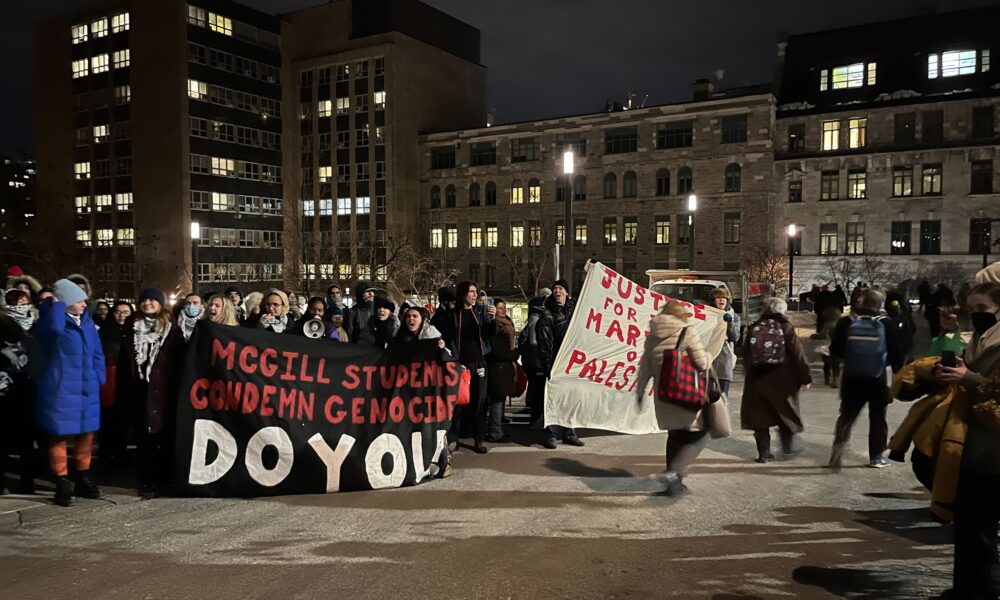
Dozens of students rally, call on McGill to divest from companies supporting the Israeli regime

On Dec. 14, dozens of students gathered in front of the Arts Building and demanded that the university end its investments in companies supporting or operating in the state of Israel, amounting to around 20 million dollars in total. The Divestment From Genocide rally—organized by Solidarity for Palestinian Human Rights (SPHR) McGill*, Independent Jewish Voices (IJV) McGill, and the Association of Graduate Students Employed at McGill (AGSEM)—took place at the same time as the university’s second Board of Governors (BoG) meeting of the semester. 

SPHR McGill has found that, as of June 30, 2023, the university invests in 12 companies that are tied to the monetary or arms funding of the Israeli state. Some of these investments include $1,608,930 in Thales, which manufactures weapons and collaborates with Israeli defense companies, and $1,507,748 in Safran, which provides military technology to the Israeli occupation in the West Bank. 

Organizers started assembling at 4 p.m., chanting “Free Palestine” to warm up a crowd of around sixty protesters. The number of students grew closer to a hundred as the rally moved in front of the James Administration Building, where the BoG was meeting to discuss, among other matters, the university’s investments for the next fiscal quarter. Kareem, a representative from SPHR McGill addressed students, informing them of the BoG’s plans to end the university’s investment in fossil fuels, and claiming this is insufficient.

“You should be angry, because McGill tomorrow will send an email, assuming the divestment vote passes, touting this accomplishment and they will use it to advertise itself as an institution motivated to bring about positive social change,” Kareem said. “We deny this because our university has offered not one word of acknowledgement for the [19,453] innocent Palestinians who have lost their lives.” 

Alice Maitlis, U1 Arts and a representative of IJV McGill, then addressed the crowd and asserted the Jewish community’s support for Palestine. 

“Since October 7, my Jewish peers and I have seen the McGill administration constantly weaponize our identities to justify their support of the genocidal state of Israel,” Maitlis said. “We are here to say not in our name [….] We condemn the blatant attempts to conflate anti-Zionism and antisemitism. We know that to stand against apartheid and genocide is not antisemitic.”

The speech was followed by the crowd chanting “McGill, McGill, you can’t hide, we charge you with genocide.”

In an interview with The Tribune, a representative of the McGill Lebanese Students Association who wished to remain anonymous expressed their solidarity with the Palestinian cause.  

“All of our freedoms are interlinked at the end, so by fighting for the Palestinians, [students] are able to dismantle the system that is oppressing all of the smaller groups and minorities,” they said.  “I hope to see more and more people protesting and speaking up, advocating for divestment, for freedom, and for liberation because it is crucial for everyone to know about what is happening in order for Palestine to be free, and in order for them to be free.”

Protesters’ “Divest now” chants grew louder at around 5:30 p.m., as members of the BoG walked out of the James Administration building, greeted by cries of “Shame.” Members of the administration walked away from the rally without responding. 

In a written statement to The Tribune,  McGill Media Relations Officer Frédérique Mazerolle explained that they do not invest in individual stocks or companies, but rather go through external fund managers who select investment for mandates in segregated accounts and in pooled funds, “the composition of which change continuously.” 

“In July 2022, McGill became a signatory of the United Nations-supported Principles for Responsible Investment (UNPRI), a leading global network for investors who are committed to integrating [environmental, social and governance] (ESG) considerations into their investment practices and ownership policies,” Mazerolle wrote. “As a result, 99 per cent of the [McGill Investment Pool] (MIP) assets are managed by those who follow an ESG Policy or are signatories of the UNPRI.”*At the time of the event, discussion between the McGill administration and SPHR concerning the removal of “McGill” from the group’s name had not yet concluded.

Features

We who ran The McGill Daily

In the summer of 1993, Bajan student Melanie Newton was on break, keen to take up a new post as Culture Editor at //The McGill Daily//. Newton, who studied German and British imperial history after switching majors from French and Spanish, wanted to get more involved in highlighting Black struggle, both in the classroom and across the world. 

Newton knew intimately how white supremacy took shape at McGill. Before running to be an editor, she wrote her first piece for //The Daily// in 1992, “Realism or Racism?” critiquing her psychology professor and his decision to stand by a racist and infantilizing film of Black Americans that he showed to the class. After confronting the professor with some classmates, Newton ran into her friend David Austin who told her to write for //The Daily//. She never looked back.

The politics of Newton, Austin, and the number of Black writers taking the pen would be meteoriccataclysmic. The day that she ran for an editor position, two protests broke out: One at Montreal’s South African consulate after Chris Hani’s assassination, the second from Zionist students angered bydismayed at //The Daily//’s stances.

Fresh off the semester and her successful run for editor, Newton had picked up a copy of Guyanese anticolonial intellectual Walter Rodney’s 1969 //The Groundings with my Brothers//. Rodney’s manifesto recounts the 1968 Congress of Black Writers, held in McGill’s Union Ballroom. Around Thanksgiving, Montreal and Canada very briefly became the centre of Black Power in North America. Yet, the media offered no substantive coverage, reproducing the white imperialist distortion of Black radical thought—with one exception.

“Of course, the white press of Canada did not see fit to talk about those points,” Rodney wrote. “I think I saw it only in //The McGill Daily//.”

Newton learned then that no other paper but the one she and her collaborators worked for had reported on this piece of Black history. Austin, by this time an incoming Features Editor, took it further, poring over bound volumes of //The Daily// to read about the connections between campus journalism and Black radical activism. 

//The Daily//’s reporting in the 1960s, however, was not without its controversies. In a letter two days after the Congress titled “We used to get along so well,” writer Barry Katz compared Stokely Carmichael (Kwame Ture) to Hitler, igniting debate about the role of white liberalism in Black movements. The following day, reporter Ed Horka’s news piece, “Black nationalism has white roots,”covered Robert Hill’s lecture on Frantz Fanon. It concludes, “Ultimately, [Hill] said, the Black man will succeed where the white man has failed.” 

A week after the Congress, //The Daily// covered the Jamaican government’s decision to bar Rodney from returning to his family. Reporter Robert Wallace interviewed Congress co-chair and future Prime Minister of Dominica Rosie Douglas, who said, “We have a crack in the system now. We must do everything possible to widen it not only on the student level but on the mass level.” 

Wallace’s journalism is crucial, but it reveals the limits of an editorial board that waits to report on colonial and racial violence rather than taking a stand against it. How might Black editors and anti-oppressive journalism have changed the story and this history? How did they ‘widen the cracks’ in a white journalistic system? 

Fast forward 25 years to 1993: Black McGillians saw no hope in deliverance by white editorial boards. The 25 years since Rodney praised //The Daily// did not see  Black liberation spurred through the paper’s progressive politics. Unable to take race and culture as foundational to politics, campus papers would not serve Black students, Indigenous students, diasporic students, and students of colour. Alongside massive global uprisings, racial violence in Montreal, the end of the Cold War, and settler colonialism from Kanehsatà:ke (Oka) to South Africa to Palestine, the rediscovery of this piece of //The Daily//’s history emboldened a cohort of Black editors, writers, and contributors to speak truth to power. This brings us to the group of Black McGill students poised to usher in radical change. 

Like Newton, Coordinating News Editor for //The Daily// Cherie Payne was a student of the history of social movements, and was no stranger to making history herself. In 1982, in her hometown of Vancouver, Payne was the first Black person to attend her school.

Ottawa-raised Patricia Harewood felt personally and politically enriched upon coming to McGill, where she joined the Black Students’ Network (BSN) and the Shakti womanisten of colour collective. Her older brother, Adrian Harewood, was a soccer player turned //Daily// contributor. For a short time, he also did the layout for (and recommended Payne to) //The Tribune//. The Harewoods’  parents were educators who regularly wrote for the Black Canadian newspaper //Contrast//

The very friend who encouraged Newton to join, David Austin, had moved between England, Toronto, and Jamaica. A competitive basketball player, he eventually settled on McGill. These were ordinary students who would take extraordinary actions.

Speaking with these five alumni reminded me of the 90s’ uniqueness. The cohort I spoke to all mentioned one another and fondly remembered each other’s work. Each uplifted the bold voices and auras of their many collaborators—Mebrat Beyene, Astrid Jacques, Ahmer Qadeer, Azim Hussain, Rima Banerji, Audrea Golding, Ted Runcie, Chantal Thomas, and Mariame Kaba, among others. These students inherited Rodney’s struggle in Montreal. As I look 30 years ahead to 2023, we still have significant work to do on campus to write for liberation. I joined //The Tribune// in 2020 as the only Black writer and editor. Canadian journalism still has a white supremacy problem, and campus journalism must do everything in its power to combat it. In the aftermath of the Civil Rights and Black Power movements of the 60s, the 90s at McGill show us the need to maintain our history and seize every opportunity for change. But, to practice anti-oppressive student journalism was not so simple, as Culture Editor Patricia Harewood explained to //The Tribune//.

“The hours that were put in to produce what was produced and the fact that it was so constant, right? There was so much copy. And the reason why I say that is the work in and of itself was not easy,” Harewood said. “The issues that we were tackling in the paper were not issues that [were]

 easy, and people read the paper. So there was no consensus on campus [….] You know, people today talk about, ‘oh, we have to be comfortable in our uncomfortable conversations.’ We were way past that, way past. The paper sat in what I would call discomfort and disruption all the time.”

Harewood and Newton were vocal participants inspoke to me about McGill campus politics, especially surrounding the Shakti womanisten of colour collective’s multiracial, feminist coalition politics, student democracy, and tuition hikes. Austin recalled to me the urgency of mobilization from the BSN’s perspective a few years before //The Daily//’s transformation.

“After my first year of being a [BSN] coordinator, we started to feel that the environment that //The Daily// had was not always very welcoming. There was this alternative kind of anarchistic left-speak, but in practice, there was a lack of understanding and appreciation of the issues that were being raised around race and politics. And it was reflected in the data, and also […] everybody was white. And a few of us got together [….] And we showed up through the elections. The same thing happened at CKUT. We had organized under the auspices of the Black Bloc, established by Richard Iton,” Austin said. “So we conspired, it was planned and orchestrated. We had lots of conversations about it. We were in a climate where it would have been difficult […] but it turned out that the face of //The Daily// changed dramatically.”

We must remember how those who preceded us asserted their place, how they infused their content with the hope and possibility of Black life, and how they moved from the page into the world. I have read dozens of issues of //The Daily// from this time. Haiti was a beacon of their content, as were African and Caribbean politics, both here in Montreal and abroad. This broader cohort gathered together, wrote, edited, and organized crucial work, all amid police killing Black Montrealers, rising student debt, questions of Quebec sovereignty, and the antiapartheid struggle. Harewood situated how those issues were on the agenda. 

“To be broader, when I say that there was a desire to have more voices, I don’t mean that in the narrow ‘equity, inclusion, and diversity’ way—I mean, in fundamentally having different worldviews, different ideas, different ways of seeing issues, reflected in the paper, so [it] wasn’t just ‘Okay, let’s, let’s find with somebody who’s from the Caribbean,’ or ‘let’s find a couple of racialized people,’ ” Harewood said in an interview with //The Tribune//. “//The McGill Daily// was a very progressive paper. It was a paper where there was room for discussions around what kind of society we want. Questioning, for example, capitalist ideologies, talking about socialism and incorporating that into articles, and sharing those kinds of ideas. […] [T]he cohort that I’m talking about, not everybody was homogenous, but they would have also been progressive in exploring those issues.”

Campus was in transition during those years. The moment created a horizon, an open future, a blueprint for Black students. As Adrian put it, “it was a time of possibility here, a time of movement […] a Black Renaissance.” Many of the students who wrote overlapped at the BSN, socialized together, cared for one another, and knew each other’s families. 

“The four years [of undergrad] were an amazing time of joy, a feeling that you were really reaching your full potential. And also, just the way you’re 30 years removed from the 90s, we were 30 years removed from the 60s. And so we really felt like, ‘Okay, this is the fruition of all of those civil rights fights.’ They really laid the groundwork, and we are here to capitalize on the foundation that they built,” Payne said.

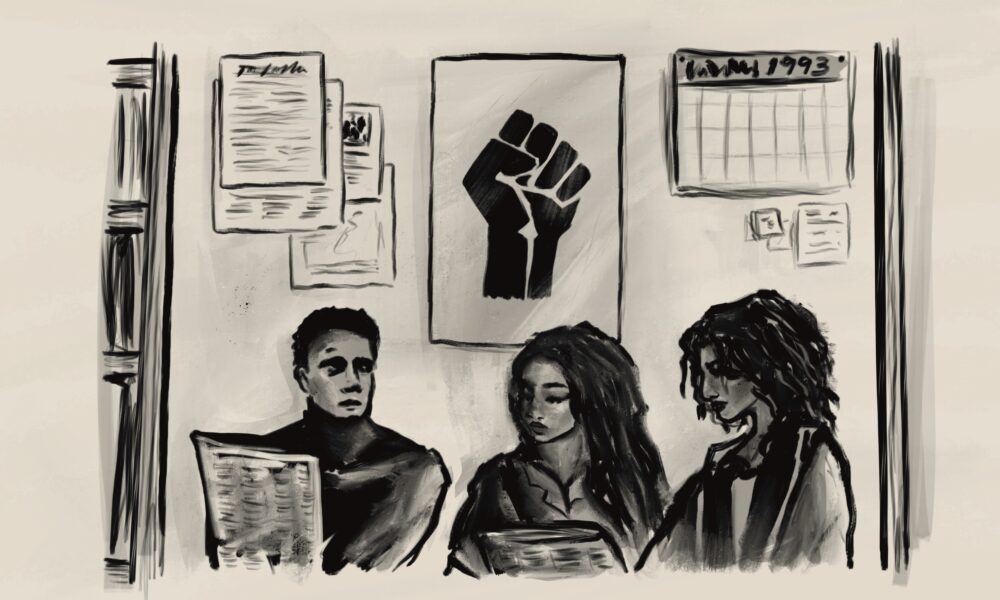
The office was more than just a workspace; it served as a lively centre of deliberation, peace, and planning. Writers like Payne fondly remembered the joy and the music playing as the editorial team handcrafted each daily issue. Austin recalled casual gatherings, and Newton noted how the smoky air from nearby Gerts would occasionally invade the space. The collaborative and interdependent culture was crucial in forming this generation. 

The fight for Black studies and the expansion of African studies raged on campus as Black artists, intellectuals, and thinkers graced both the pages and the experiences of these writers. Patricia discussed her coverage of George Seremba’s play //Come Good Rain// and her interest in the conditions of the Black diaspora, while Austin and Adrian brought up influences like Spike Lee’s //Malcolm X// and Henry Louis Gates Jr.’s and Julius Garvey’s visits to McGill. 

For Austin, this atmosphere required that journalists properly engage with all forms of media and activism. 

“It didn’t feel like work, it felt like we were bringing the world that was outside the walls of McGill into the newspaper that was then going back out there in the world. And I have to tell you this that, you know, we had people that were not students picking up copies of the daily, regularly to read during that time. I don’t mean just the Black History Month issue.” 

History palpably entered the room with these students, who were among the first Black editors at a McGill campus paper. 

“There was really a sense of it being a moment, we were quite aware of that. It was just a couple [of] years after the fall of the Berlin Wall, you know, and it was this moment of transformation. That felt fragile, as well, but also quite extended,” Newton said in an interview with //The Tribune//. “It wasn’t so clear what the world was going to be like. The end of apartheid in South Africa. The Peace Accords in Israel-Palestine, when there was this real sense of a window of possibility that doesn’t feel the same now.”

Payne also sensed this transformative change. Her realization came when Newton, then Coordinating Editor, observed that they might be the first two Black women to run a paper in the country. “That’s when it hit me that, actually, this is quite huge. This is quite huge,” Payne said. “The way it manifested in the paper is that during Black History Month, we would dedicate an entire issue where every single story had to do with Black issues, politics, culture, as a celebration of Black History. But also, we were aware that that was an artificial and […] a little bit insulting sort of segregation. And so we had a lot of Black writers at the paper. And so [we] interspersed stories throughout the year as a natural way to tell stories, because why wouldn’t you? You’re telling human stories, and Black people are part of it.” 

This period, as Patricia described, was marked by fluid engagement with BSN and a harmonious integration of activism in journalism, not just about diversifying content. Newton emphasized embracing activism “in the most capacious ways,” warning against taking progress for granted and stressing the history of struggle and reversal. 

Adrian, who is now a professor at Carleton’s Journalism and Communication school after a 20-year career at the CBC, underscored the sentiment. We should not equate, he explained, advancing a particular position as a journalist with asking questions, making informed journalistic decisions, and framing stories in ways that allow the reader to make up their mind.

“I came to journalism from activism. […] Journalism was about trying to change the discourse. It was about bringing light to dark spaces. [….] It was trying to counter a lot of the misinformation and also disinformation,” Adrian said. “So we entered journalism to disabuse people of certain misconceptions that they might have had about people who look like us or people who talk like us or sounded like us. We were trying to also show that another world is possible, trying to imagine different ways of being […] where, as C. L. R. James would say, every cook can govern, right, that everyone has a place at the table, that regardless of your station, that you have a story to tell.”

Thirty years on, their efforts still resonate—and the work continues. We are not past this history; it is a call to action. These students’ radical imaginations shifted McGill, Montreal, and Canadian journalism. Their collaboration created Black worlds, put anticolonialism on the front page, and indexed activism, community, and change. The responsibility to uphold and advance this legacy is ours. Our campus and future depend on it. 

Editorial, Opinion

Palestinian artists will not be silenced on campus and in liberation

Since the recent escalation of violence in Gaza and the West Bank, artists worldwide are raising their voices in solidarity with Palestine, advocating for a ceasefire amidst dire violations of human rights and mass destruction of Palestinian land. In parallel, a disturbing pattern of censorship and backlash, particularly targeting Palestinian artists, jeopardizes their careers and silences their critical voices. For the Palestinian liberation struggle, art not only expresses beauty and community but also powerfully and politically documents and preserves history. The narratives woven through the strokes of a brush, the verses of poetry, or the frames of a film document the lived experiences of a community grappling with constant mass atrocity. We cannot let them be silenced. 

Within various industries,Palestinian and pro-Palestine artists have been stripped of opportunities to showcase their work. Wanda Nanibush, an Indigenous art curator, left her position at the Art Gallery of Ontario following criticisms of her since-deleted social media posts in support of Palestine.Citing “heightened sensitivities related to the Israel-Hamas conflict,” Toronto’s Royal Ontario Museum (ROM) proposed changes to a Palestinian-Muslim display created by four Palestinian women. The display, part of a travelling art exhibit, depicted Palestinian burial rites. Refusing the alterations, two of the artists, Sameerah Hosam Ahmad and Malak Kanan, engaged in an 18-hour sit-in at the ROM, forcing the museum to walk back its decision and allow the exhibit without any changes. Stepping outside of Canada, Palestinian author Adania Shibli was set to receive a prestigious literary award at the Frankfurt Book Fair for her novel Minor Detail on Oct. 20. LitProm, the German literary association that organizes the prize, publicized that the award ceremony was cancelled “due to the war in Israel.” 

The violent arrests of protesters targeting Indigo, Canada’s largest book retailer, further illustrate this literary censorship. Concerns have been raised regarding Indigo CEO Heather Reisman’s involvement with the Heseg Foundation for Lone Soldiers––an organization that she co-founded to provide scholarships and funding for non-Israeli Jews volunteering to serve in the Israeli Defense Force (IDF). Protesters also interrupted the Scotiabank Giller Prize ceremony, criticizing Scotiabank’s role as the third-biggest shareholder in Elbit Systems––an arms company that supplies weapons to Israel. Police arrested three protesters following the event, prompting more than 1,800 writers and publishers, including Sarah Bernstein––the winner of the Giller prize––to sign a letter calling for the charges to be dropped. With Scotiabank and Indigo having great power in the Canadian literary industry, their ties to the IDF severely threaten authors’ freedom of expression and Canada’s vibrant literary plurality. 

In spite of industry resistance, the artistic community’s responses to these incidents indicate mass collective support. Letters of solidarity for targeted pro-Palestine artists and protesters underscore the crucial need to resist censorship, uphold freedom of expression, and support artists conveying authentic narratives amid genocide. 

The Orientalist gaze reduces the identities of Palestinian and Arab people to stereotypes, echoing patterns seen in the suppression of Palestinian artists. DenyingPalestinians self-representation allows mainstream media to construct dehumanizing narratives devoid of emotion. Palestinian art is a vital form of resistance, offering a crucial avenue for autonomy and self-representation in the face of mass cultural erasure and counteracting sensationalized narratives.

Despite advocating for academic freedom, McGill not only falls short in standing against censorship, but also actively enables it. The suppression of anti-colonial thinkers and the lack of support for Palestinian human rights advocates means that institutions should reevaluate their stance on freedom of expression when it comes to Palestine. In acknowledging the limitations of mainstream discourse, universities must use their resources to ensure a diverse and nuanced understanding of cultural and political conflicts.

Students, staff, and faculty must support Palestinian artists by recognizing the importance of the Palestinian-led Boycott, Divest, and Sanction movement and engaging with Palestinian art on and off campus. The suppression of Palestinian art aims to control and manipulate the historical narrative. By stifling the voices of those who live under the realities of Israeli occupation, censorship seeks to rewrite the history of a people. We must challenge censorship, promote critical engagement, and recognize art’s power to shape narratives and foster empathy. McGill students must make the walls of our university echo with the vibrant hues of artistic resistance, ensuring that no voice is lost to the shadows of erasure. 

Commentary, Opinion

Compassion, inclusivity, and respect is impossible without divestment from genocide

Content Warning: Mentions of antisemitism, Islamophobia, violence, rape and death

On Nov. 9, I spoke on behalf of McGill’s pro-Palestine Jewish students at a rally organized by SPHR McGill in front of the Arts Building. Within hours, I received anonymous threats that included my full name, which I had never shared publicly. This slew of hateful and disturbing messages included “Isaiah supports the r*pe and murder of Jews” and far worse. These words attacking me as a “self-hating Jew” left me fearful of what the in-person consequences could be. In an encounter with several members of on-campus Jewish groups, one pro-Israel student said to me “remember that we know who you are.”

When it comes to feeling unsafe at McGill over pro-Palestine activism, I am in no way  exceptional. For years, students have faced threats, verbal and physical harassment, doxxing, and blacklisting for speaking in support of Palestinian human rights. Yet, rather than responding to these students’ activism and demands, McGill capitalizes on individual students’ experiences of harassment to detract from a much more significant issue: We are currently witnessing a genocide, and our university is complicit.

As of Dec. 4, Israel has killed more than 15,500 people in Gaza according to the Associated Press, and destroyed nearly half of the homes in the region, bombing hospitals, churches, mosques, and schools. Claiming “self-defence” as a response to the Oct. 7 Hamas attacks places this violence in a vacuum. It disregards the forced resettlement and murder of thousands of Palestinians during Israel’s founding in 1948 and the continued settlement and occupation that many major human rights organizations such as Amnesty International designate as apartheid. Pro-Israel activists perpetually weaponize the trauma of the Holocaust to justify unchecked violence against Palestinians, manipulating the growing threat of worldwide, supremacist antisemitism to further Zionist aims––all with continued financial and ideological support from Canadian institutions.


In the face of such unprecedented violence, Principal and Vice-Chancellor Deep Saini and the McGill administration claim that the university’s mandate prevents them from addressing “geopolitical crises.” McGill’s refusal to stand against this obvious affront to human rights is both unconscionable and deeply dishonest, as the university’s endowment includes more than $20 million invested in companies that provide arms and surveillance equipment to Israel and financial support to the violent settlement of the West Bank.  

The McGill administration chooses to focus on “antisemitism and Islamophobia” on campus, framing both activism and harassment as motivated by hate and religious bigotry, rather than as responses to an urgent humanitarian crisis. Stated measures to combat antisemitism and Islamophobia on campus perpetuate both the antisemitic notion that Judaism is intrinsically connected to the actions of the Israeli state and the racist generalization of Arab communities as singularly Muslim and intolerant to other religions. Furthermore, when the administration misconstrues pro-Palestine activism as antisemitic and falsely projects claims of violence onto peaceful student rallies, they encourage the very “tensions” they condemn.

The fixation on local experiences exacerbates a fear for personal safety, purposefully shifting attention from Gazans’ immediate danger to largely unfounded threats of violence in North America. This portrayal directly foments the harassment and intimidation that we see at McGill and other college campuses and has encouraged senseless violence in Canada and the United States. In Burlington, Vermont last weekend, three 20-year-old Palestinian college students were shot while walking down the street wearing keffiyehs. This week, one of the victims bravely reminded those concerned for him that his suffering is part of a much larger story of Palestinian oppression and resistance. 

By now, I am well acquainted with the risks that I, along with many other activists both at McGill and elsewhere, face in our criticism of Israel and our support for the victims of its violence. However, I am also aware that the threats we face pale in comparison to the genocide Israel is perpetrating against Palestinians; their voices and suffering must be the focal point of any activism fighting against the state of Israel. 

Yet, as student safety continues to permeate conversations regarding Israel and Palestine in North America, students cannot expect to feel fully protected while attending an institution that actively funds violence around the world. The reality of activism is that it makes people feel unsafe as it functions with the very goal of threatening the comfort of the status quo. McGill must understand that in a moment where the Israeli government threatens to “eras[e] the Gaza Strip from the face of the earth,” we must be uncomfortable. McGill can try to shut down campus activism and willfully ignore its complicity in Israeli violence, but our university community strongly, clearly, and overwhelmingly stands with the liberation of Palestine.

Arts & Entertainment, Film and TV, Internet, Music, Private

The Tribune presents: THE BEST AND WORST OF 2023

TV Shows

Best

The Bear (Season 2)

(themoviedb.org)

Avoiding the sophomore slump attributed to most sequels (I’m looking at you, Madagascar 2), season 2 of The Bear manages to retain the first season’s hype. The series allows for the exploration and growth of supporting characters: Pastry chef Marcus (Lionel Boyce) travels to Denmark to learn new pastry techniques from Chef Luca (Will Poulter), while Sydney (Ayo Edebiri) confidently steps into her role as the new sous-chef back in Chicago. This season sees Carmy (Jeremy Allan White) with a love interest which—to be honest—he is not prepared to handle, but in a refreshing way that is true to life. Critics are lauding it as one of the best follow-up seasons in a long time, and that’s not just due to Jeremy Allan White’s chokehold on the Internet.

Succession (Season 4)

(themoviedb.org)

Both timely and timeless, modern Shakespearean epic Succession aired its fourth and final season this spring to a rapturous reception. Featuring cutting social commentary on the state of American politics and media, as well as an ensemble cast’s tour-de-force performance, this final season solidifies the show’s place in the pantheon of greatest shows of the 21st century. A heavyweight in today’s water-cooler chatter, discourse on X, formerly known as Twitter, Succession’s conclusion leaves a definite void in the sphere of monoculture television viewing. With multiple Emmys, Screen Actors’ Guild (SAG) awards, and Golden Globes under its belt, this is hopefully not the last time we’ll see the faces of the Roy children and their associates on our screens. 

Worst 

The Idol

(themoviedb.org)

Sam Levinson and The Weeknd’s joint passion project, The Idol, couldn’t quite hit the right notes. It’s visually stunning, but that’s part of the problem. It deals with ugly topics but attempts to make them beautiful—is glamourizing pain ever truly honest? The Idol tried to be too many things at once: A commentary on the toxicity of the music industry, a sordid tale of corruption, an exploration of predators, publicity, pop culture, pop stars, pornography—and it ended up becoming everything it tried to criticize. It’s ultimately hard to tell whether it’s an indictment of how young women are treated in the music industry, or a fantasy that’s a little too real.

Films

Best

Barbie

(themoviedb.org)

Did I learn all of Barbie’s “most profound” revelations in a first-year Gender Studies class? Yes, yes, I did. Just had to get that off my chest. Now that I’ve given my critique of Barbie, let’s dive into why this movie was such a success. Not only was it the highest-grossing movie by a female director at the domestic box office, critics say it elegantly combines mainstream fun-in-the-sun adventure with cutting satire and socially-conscious undertones. Margot Robbie (Barbie) and Ryan Gosling’s (Ken) performances were picture-perfect, and the impressive world-building and attention to detail, especially in the background sets of Barbie world, is cause for applause.

Bottoms

(themoviedb.org)

This knock-out raunchy comedy took the internet by storm as director Emma Seligman and actor Rachel Sennott teamed up for their second collaboration. Bottoms tells the story of two best friends, PJ (Sennott) and Josie (Ayo Edebiri), as they start a fight club to try to lose their virginities to cheerleaders. The cast’s impeccable comedic timing and swoon-worthy chemistry are a perfect match for the hilarious yet surprisingly gory script, making this modern twist on the typical teen comedy format an instant classic of the genre. Seligman and Sennott’s mission of creating queer representation in a space that has long been lacking was a smashing success.

Worst 

Winnie the Pooh: Blood and Honey

(themoviedb.org)

In 2022, Winnie the Pooh entered the public domain. In 2023, he entered Hell. The premise of Winnie the Pooh: Blood and Honey is this: Christopher Robin has left for college, and without the young man around to bring them food, the animals starve—and resort to cannibalism (they eat Eeyore first, but keep his tail to use as a whip). Pooh and Piglet proceed to chloroform young women, run people over with cars, and strangle Christopher Robin’s wife. I don’t consider these spoilers because I doubt anyone is going to watch it (the film’s only redeeming quality is an underlying message about keeping in touch with your childhood friends). Still, it could be a good watch if you don’t like your childhood, and/or hate nature.

Songs

Best 

Rush (Troye Sivan)

(Ted Eytan / Wikimedia Commons / https://creativecommons.org/licenses/by-sa/2.0/deed.en)

It’s giving electro-pop-meets-late-2010s-dance-tracks. It’s giving pounding lights and masses of people, hands in the air, jumping so hard the floor shakes. While “Rush” by Troye Sivan is not in any way revolutionary as a pop track, it does deliver on what it set out to do: Be the biggest party hit of the summer. Nominated for both Best Pop Dance Recording and Best Music Video at the 2023 Grammy Awards, it also won Sivan Best Solo Artist at this year’s ARIA Music Awards. Sivan has cemented himself into the hearts of Gen Z with hits such as “My My My!” and “Youth”; Rush simply continues this trend. 

Not Strong Enough (boygenius)

(Raph_PH / Wikimedia Commons / https://creativecommons.org/licenses/by/2.0/deed.en)

As their most streamed song, “Not Strong Enough” is the stand-out track off of boygenius’ debut studio album the record. The country-pop-inspired track works as a direct response to Sheryl Crow’s 1993 hit “Strong Enough” with the refrain “not strong enough to be your man,” reversing Crow’s hook to profess their uncertainty about love. Bandmates Julien Baker, Phoebe Bridgers, and Lucy Dacus each take a solo verse, showcasing their uniquely impressive vocal stylings while embodying a variation on the anxieties set up in the chorus. With a propulsive guitar melody and lyrics that you can scream on a long drive, “Not Strong Enough” is a perfect piece of sonic catharsis.

Worst

Toxic Gossip Train (Colleen Ballinger)

(123wikiuser / Wikimedia Commons / https://creativecommons.org/licenses/by-sa/4.0/)

In a sea of notes-app celebrity apologies, short videos that feature them sitting on the floor, surrounded by expensive (but neutral-toned) furniture, usually wearing white clothing, pausing to wipe dry tears, talking of shame and accountability and giving videos all-lowercase titles—Colleen Ballinger stands out for making her case through a 10-minute-long ukulele song (entitled “hi.”). “Toxic Gossip Train” was a ham-fisted—albeit creative—way to shirk responsibility for the numerous allegations made against Ballinger (which include sending suggestive messages to underage fans, blackface, and sending unsolicited nude photos of Trisha Paytas to fans). The song includes lines such as “not a groomer, just a loser,” and interjections of something that might be spoken-word poetry. Though, to her credit, she has left the comments section on.

Celeb moments

Best

Cillian Murphy eats cheese to cope with writers’ strike

(themoviedb.org)

While the SAG strike had many actors wishing to get back on press tours or in front of the camera, Cillian Murphy took the opportunity to adopt the habits of a mouse. The Oppenheimer star reportedly spent his strike time lying down on the couch eating cheese. Can we blame him? Between this summer’s “Barbenheimer” frenzy and what is sure to be a long awards campaign, the star did as McGill students do between midterms and finals—completely ignored his work and responsibilities in favour of some much-needed rest and relaxation. 

Josh Hutcherson Whistle edit

(imgflip.com)

The Josh Hutcherson “Whistle” edit, for all those out of the loop, first originated in 2014 and featured a thirst-trap-like photo of Josh Hutcherson with the song “Whistle” performed by Joel Merry (a cover of Flo Rida’s iconic song “Whistle”). In November, the edit resurfaced from the depths of the Internet with the recent release of Five Nights at Freddy’s (dir. Emma Tammi), in which Hutcherson stars. It seems as if the Internet caught on (helped by the new release of The Ballad of Songbirds and Snakes)—yet again—to the beauty that is Peeta the bread boy in The Hunger Games franchise.

Worst

Submarine explosion

(Madelgarius / Wikimedia Commons / https-::creativecommons.org:licenses:by-sa:4.0:deed.en)

This summer, the world held its breath waiting for news of the Titan (the submarine is the celebrity), prompting discussions around submersible safety, social class, memes, the Titanic, memes about the Titanic, an international search, and a larger reflection upon what stories we choose to sensationalize. Experts eventually determined that the submarine imploded, killing everyone on board instantly, and that the trip was, well, quite stupid. But who cares about billionaires—why did it surface over other stories about suffering? At some point, the conversation shifted to how frustrating it was that all anyone could talk about was the stupid submarine while the boatloads of refugees drowning every day failed to get our attention—but of course, that was exactly what we did; we talked about the Titan and moved on.

Read the latest issue

Read the latest issue