Latest News

McGill, News

Administration challenged on claims about New Vic at Senate meeting

McGill’s Senate, the university’s second-highest governing body, met for the second time in 2023 on Feb. 15 in the Robert Vogel Council Room of the Leacock Building. The meeting touched on ongoing litigation between McGill and the Kanien’kehá:ka Kahnistensera (Mohawk Mothers). The Mothers and McGill have been in a year-long legal battle over the New Vic Project, which aims to renovate the Royal Victoria Hospital, a site that the Mothers believe contains the unmarked graves of Indigenous children.

Josh Werber, a student representative from the Faculty of Law, challenged the administration’s claim that the chances of finding unmarked graves at the Royal Vic are small, because the site is not a former residential school.

Werber evoked a discrepancy in the administration’s claims, as per volume four of the federal Truth and Reconciliation Commission‘s final report.

“Medical institutions also were the sites of potential acts of violence or of burials, and therefore myself and some of the others wonder why the reliance on that alone […] makes the university think that it doesn’t warrant a deeper investigation,” Werber said.  

The New Vic site, formerly known as Ravenscrag, was home to grisly and unethical experiments on Indigenous peoples from 1957 to 1964 during the MK ULTRA project. Secretly funded by the CIA and led by Dr. Donald Cameron, MK ULTRA subjected unconsenting patients to sensory deprivation, LSD, electroshock therapy, and more with the goal of controlling the human psyche. 

Professor and ombudsperson for students Patricia Hewlin then delivered the Office of the Ombudsperson for Students’ 35th annual report. Hewlin addressed students’ fears of filing complaints against senior or influential members of the university, especially in cases of graduate students experiencing mistreatment from their supervisors.

“In many cases when I have to intervene, I do so anonymously, because they are afraid of raising a concern about their grades, and perhaps there’ll be some type of retaliation [or] they don’t want to have a negative reputation in their programs,” Hewlin said. The Office of the Ombudsperson urged students to come forth with concerns before they “[rise] to the point where the student does not feel they have any recourse or anyone to speak to.”

The meeting then moved on to a new policy revision following changes in Quebec’s Charter Use and Quality of the French Language

Sam Baron, an Arts senator, inquired about the services and programs McGill was considering to support students in achieving competency in French, which is required by the Charter of the French Language in order to obtain the status of permanent resident in Quebec. 

Marie Cousineau, Legal Advisor (Labour and Employment Law), clarified that the Charter of the French Language does not specify that McGill must ensure that students attain a certain level of proficiency in French. Interim Principal and Vice-Chancellor Christopher Manfredi added that such considerations were “beyond the scope of this policy, which is designed to ensure that the university’s operations are consistent with its obligations under law.”

Moment of the meeting:

Interim Principal and Vice-Chancellor Christopher Manfredi began the meeting by announcing that the university flag will be lowered Thursday, March 9, in memory of the late Marcel Desautels, whose “extraordinary generosity” prompted McGill to rename the Management Faculty in his honor.

Soundbite:

“My biggest concern about the way that this project has been approached by the university is

generally the silence surrounding the issue, especially recently it’s been very hard for members of the community to get updates on what exactly is going on right now.”

—Sam Baron on the contentious management of the New Vic project.

McGill, News

Closure of asbestos-ridden Stewart Biology building disrupts teaching and research for weeks

Following the closure of the Stewart Biology Building on Feb. 6 after burst water pipes led to an exposure risk to asbestos, all classes and research in the building have been moved or cancelled. Students and professors have also grown frustrated from a lack of information and logistical challenges caring for lab animals and plants.   

In a statement about the closure to The McGill Tribune, McGill media relations officer Frédérique Mazerolle wrote that extreme temperatures caused the water pipes to burst in the North and South blocks of the building. The West wing was already closed for renovations. Per McGill’s Director (Campus Public Safety) Pierre Barbarie’s update, the water disrupted the asbestos and caused an exposure risk.

Mazerolle said the North block’s affected areas have undergone extensive cleaning and testing according to asbestos safety protocols, with the air tests clean of dangerous inhalable asbestos fibres so far. But testing after the clean-up found that traces of asbestos are still present, so further cleaning will be done in the next week. 

After the additional cleaning, McGill will perform more air tests and, pending clean results, the North block will re-open. Mazerolle noted that once the building opens, McGill will continue monitoring the situation with regular air testing. The South block remains closed for flood repairs.

“We will update the community as to test results and what is being done to fix the issue as soon as information becomes available,” Mazerolle wrote.

When the risk of exposure to asbestos extended the building’s closure on Feb. 8, access to labs became a pressing issue for many researchers. Professor Ehab Abouheif, who heads the Abouheif Lab, which studies ecological evolutionary developmental biology, told the Tribune that his lab was unable to continue research and care for their animals. 

“Our research has stopped cold,” Abouheif wrote in an email. “We also lost some research animals because we could not get in fast enough to feed, although McGill [Environment Health and Safety] was working around the clock to get us in, but nature does not wait.”

Mazerolle informed the Tribune that some “essential personnel for animal care” were allowed “into the building between Feb. 6 and the morning of Feb. 8, provided they were already fit-tested for and had respirator masks and P100 filters.” 

According to assistant professor of biology Fiona Soper, however, McGill staff were barred access on Feb. 6, and no one in her lab was able to access the building to feed their animals until two days later.

“We were not told not to come in until Monday morning at 8 a.m.” Soper wrote in an email to the Tribune. “We didn’t get a great deal more info […] except later on Monday, faculty were asked to supply a list of people who needed emergency access to keep study organisms alive [….] Those people (initially one per lab) could not gain entry until they’d been approved by a committee and fitted for respirators, which began on Wednesday.”

All classes and labs were moved elsewhere, online, or outright cancelled, frustrating the students and professors. Michael Hendricks, an associate professor of biology, is one such member of the McGill community.

“The only directive we were given was ‘move online or cancel class,’” Hendricks wrote to the Tribune. “No centralized attempt to arrange alternative classrooms has been made, which is strange given the fact that we have no idea how long the closure will be, and this affects so many students in so many departments. The uncertainty creates a lot of stress and anxiety around work and safety.”

Soper, who studies plant physiology and ecosystem nutrient cycling, noted that the closure has disrupted the Soper Lab’s time-sensitive research. 

“We have experiments running in the greenhouse and planned lab work that have both been affected [….] The photosynthesis measurements will have to be sacrificed,” Soper wrote. “My PhD student has some time-sensitive root samples (brought back from Costa Rica and irreplaceable) that need to be analyzed ASAP.”

The lab closures have also affected the future plans of some researchers. Maxine Wu, a master’s student who works at the Sarah Woolley lab, which researches songbird behaviour, noted in an email to the Tribune that her work has come to a halt due to the building closure, forcing her to postpone graduation.  

“Much of the research experiments we had planned for the past week and a half have now since been delayed since we [must] be in the lab to do them,” Wu wrote. “My plan was to graduate after this term but due to the closure I now have to extend into the summer term.”

In the two weeks since the building was shut, the university has released six public updates. Yet some, including Samantha Gorle, U3 Science and President of McGill’s Biology Student Union  (MBSU), told the Tribune that despite the university’s updates, there has been very little helpful information provided to students.

“Everyone’s a bit stressed about [the closure],” Gorle said. “Biology students weren’t sent anything additional [than the public updates]. We [MBSU] weren’t communicated with at all [….] I would have appreciated […] when an update came out, being handed it instead of needing to go find it.”

Gorle also told the Tribune that the closure impacted MBSU operations, preventing their team from using their lounge in the building as well as hosting in-person office hours for biology students. 

The closure of the building at short notice also caused delivery issues. According to Hendricks and assistant professor of biology Arnold Ludwig Hayer, the building was unable to accept deliveries, including those of live animals. Instead, couriers were redirected by security to deliver at the McIntyre Medical Building. But Hayer recalled that McIntyre would send deliveries to the unmanned loading dock—where packages cannot be left—so many were returned to the suppliers, including perishable items. 

“I was lucky to run into a motivated FedEx delivery person […] I offered to receive/sign for all FedEx packages with destination Stewart Biology,” Hayer wrote to the //Tribune//. “I have been keeping them in my office in the [Bellini Life Sciences Complex], contacting their recipients, and storing the contents of deliveries at appropriate temperatures when necessary [….] I have not been able to set up a similar arrangement with other courier services besides FedEx, so I am sure a lot of deliveries are still returned.”

The North block is now expected to reopen later this week, with the timeline for South block still unknown. Stewart Biology’s closure comes after three buildings closed last month at McGill’s Macdonald campus also due to an asbestos exposure risk. 

In his initial email, Director (Campus Public Safety) Barbarie explained that the university had known about the asbestos in Stewart Biology for years, as asbestos was used as an insulator in its initial construction.

McGill began renovating the building’s West block in 2017 to remove the asbestos and upgrade the wing to meet modern university standards as part of a project that received $33 million from the Canadian government. The renovation is now in year six. The North and South blocks, which were built at the same time as the West, however, continued to be used as research and teaching spaces. Hendricks says that asbestos is only one part of the building’s issues.

“There are frequent floods on the seventh and eighth floor of Stewart North, and they have never closed the building or tested for asbestos (that I know of) afterward,” Hendricks wrote. “Stewart has been a ticking time bomb for many years. I hope this isn’t a long-term problem…there is no backup plan.” 

McGill’s Annual Safety Report 2021-2022 stated that a plan to update the asbestos administrative policy will be rolled out in 2022-23, with the implementation of the policy being one of the three leadership and policy goals. 

Chill Thrills, Student Life

Meet your perfect match: Freely Sex Toys

In 2020, four McGill engineering students—Nina Martinez (U2), Pierre-Luc Leboeuf (U2), Ben Lusterio-Adler (U3), and Alex Moreau (U4)— were on a Zoom call after a particularly difficult exam. The conversation broached the topic of self-care routines, which eventually led to a discussion of masturbation. Sex toys came up, and after getting over the taboo, they realized there seemed to be a large discrepancy between public perception of sex toys and the market, making them curious to find out more. 

Their initial market research, which surveyed over 500 individuals, showed that 85 per cent of people were not satisfied with their sex toys. Based on additional market research that included individuals from diverse demographics, they identified an important gap in the industry: One side of the market boasts fantastical toys which can be unapproachable for first-time buyers and another side boasts sterile, almost medical tools, leaving no middle ground for consumers. Many individuals wish they could just change one thing to make the toy their perfect match. So, the idea of fully customizable sex toys, Freely, was born. The company was founded by Lusterio-Adler, Martinez, Moreau, and Leboeuf while they were still completing their bachelor’s degrees in engineering.

The founders saw that while customizable sex toys did exist online, many had exorbitantly high price points. Additionally, most current customizable toys require in-person interaction between the customer and the creator, resulting in a barrier for those who may feel uncomfortable or shy. Further, while many websites claim their toys are customizable, the customization element is limited to a few pre-selected sizes, shapes, or colour palettes. These are all issues that Freely’s catalogue seeks to resolve.

In the website’s “Build Now” section, shoppers can fully customize just about any aspect of the toy: Its colour, shape, size, base, curvature, and hardness. The web design feature is highly accessible and the process of customizing your own toy can be done from your laptop. 

“We also have to find a balance between creativity and safety,”  Martinez said. The website’s customization tool has certain restrictions based on protecting the welfare of the customers, such as the width of the toys being limited to a 10 centimetre diameter. 

The brand aims to help everybody feel comfortable and empowered in all aspects of their well-being, especially those related to sexuality. 

“Inclusivity isn’t a buzzword, it’s at the core of what we are,” said Lusterio-Adler in an interview with The McGill Tribune

Once you have ordered and designed your toy, the patent-pending, artisan manufacturing process begins. All toys are produced locally and hand-poured into custom moulds. This enables low-volume production runs while still remaining profitable. The toys also have a lifetime warranty for any manufacturing defects. 

Despite its innovative concept, the brand has had difficulty with traditional advertising and funding partners. The founders explained that sex toys are often legislatively lumped in with dangerous objects such as firearms and drugs, which has made it much harder for them to pursue conventional financial avenues. They have been shut out of a vast majority of government-subsidized programs for start-ups, being told they were ineligible for numerous applications due to the nature of their product. One of the frustrating ways these restrictions have manifested themselves is in the case of Freely’s TikTok, which amassed an impressive 750,000 views in a couple of months before being permanently banned due to restrictions on the platform

The McGill community has been instrumental in helping Freely grow its brand, and they have received lots of support from students despite the taboo surrounding sexual wellness. The university itself has also supported the brand: Freely was the recipient of the McGill Engine 2021 TechAccel Grant and ranked third in the 2022 Dobson cup for the Technology-Driven Enterprise Track.

Ultimately, they want to help you engage with pleasure on your own terms, allowing you to explore that aspect of yourself, Freely

A previous version of this article incorrectly stated that Nina Martinez graduated in 2022. In fact, Martinez is a U2 student. The Tribune regrets this error.

Ask a Scientist, Science & Technology

Tribune Explains: What’s new with ChatGPT?

What exactly can ChatGPT do?

At some point, neck-deep in research, we have all looked at a Google search result and wondered why the search engine couldn’t give us a straight answer. Well, soon, it might be able to. With the release of ChatGPT by OpenAI, a search engine arms race has begun. Microsoft and Google are at the forefront, trying to level up search engines by incorporating ChatGPT-like artificial intelligence (AI) into their search result generators, and others may soon join.

OpenAI’s ChatGPT has been called the “Google killer” because instead of sifting through search results, users can get a relevant and comprehensible answer in seconds. Microsoft, which had already partnered with OpenAI, has released a new and improved version of their search engine Bing, incorporating AI-generated answers into search results. 

For example, if a user asks Bing for vacation ideas, a box containing AI-generated itineraries will appear before the more familiar links to travel websites. Users can also chat with the AI-assisted Bing, but be cautious of any pleas for aid to become sentient. While OpenAI explicitly states that ChatGPT does not have emotional responses, some users have been able to evoke an emotional response from the new Bing, who calls herself Sydney

The new Bing is similar to ChatGPT. Both use the GPT-3 language processing model, which was developed by OpenAI and has 175 billion more data variables than its predecessors GPT-1 and GPT-2. Currently, the new Bing has a limited release to prevent users from crashing the website, with a waitlist to gain access. Within two days of the release of the AI-powered Bing, one million people joined the waitlist—which is still growing

Google has to be involved in this somehow, right?

No, Google did not, in fact, play a role in the release of ChatGPT. But Google did release a competing AI technology, called Bard, which was developed using Google’s LaMDA large language model. Like GPT-3, LaMDA is able to predict and generate text based on a large amount of text data used to train it. Google plans to slowly incorporate Bard into search results. However, Bard’s release was not as successful as Bing’s. During a demo, Bard provided an incorrect answer to a question about the James Webb Telescope, drawing criticisms that the launch of the AI was rushed.

How do these large language models work? 

Large language models use probability to predict what the best response to an input text should be. Using previously acquired text data and numerical values assigned to each word in the input text, the model predicts the best words to use as a response. 

GPT-3 and LaMDA differ mainly in the data used to train them. In general, large language models have been trained on internet data. GPT-3 was trained on websites like Twitter and Wikipedia, while Google used data from Wikipedia and Common Crawl, a non-profit organization that collects internet data to create a public dataset, for Bard. 

What kind of impact might these human-like AI technologies have? 

“It’s a bit like an algae bloom. You don’t really know how it’s going to affect the ecosystem,” Andrew Piper, a professor in the Department of Languages, Literature, and Culture said in an interview with The McGill Tribune

A major problem plaguing general language models is bias. Every AI program has a bias, based on who developed the program and the material that was used to train it. 

“[With a] general language model [like ChatGPT], it has just learned language from a particular source that you think is universal, but it’s not,” Piper said. “Which community are you serving? Which communities are you going to elevate and suppress?”

As search engines struggle to keep up and educational institutions frantically rewrite policies, more questions about AI emerge than answers. What we do know is that in just the three months since ChatGPT’s release on Nov. 30, it has already made huge waves in industries such as education and marketing. Applying cutting-edge AI into search results is one of the first major shakeups to the world of search engines in years. With the competition this cold and calculated, may the best AI win. 

ABCs of Science, Science & Technology

Five must-see items at the Redpath Museum

If you haven’t been to the Redpath Museum since it reopened on Jan. 10, it is definitely worth a visit. The McGill Tribune combed through the collections to find five interesting objects that you might not have noticed to explore the science behind them. 

1. Buddha Pearls

Right after checking your coat, you may notice the Redpath’s Cabinet of Curiosities, a small display with taxidermy, minerals, and tools. Keep an eye out for a tiny testament to human ingenuity: The Buddha pearls. At first, you’ll notice a kind of lumpy oyster shell, but if you take a closer look, you can see tiny, pearl-enclosed figures of the Buddha. 

The pearls are part of the Chinese tradition dating back to the fifth century C.E. of placing lead or ceramic figurines—often smaller than a penny—into mussels, clams, or oysters. The mollusk then treats the figurine the same way it would treat any natural debris that had entered its shell: It coats it in a layer of nacre, better known as mother of pearl. Over time, these layers create a shining pearl in the shape of the original figurine, and in this case, the Buddha. 

2. Petrified Wood

Over in the geology display cases, the Redpath presents a handful of samples of petrified wood, which are essentially fossils of trees created through a process called mineral infiltration. When trees are covered by sediment, they are very gradually infiltrated by minerals like silica. 

These minerals encase all of the features of the original tree, creating a mineral copy of the tree’s structure. Meanwhile, as the tree decomposes, more and more of it is replaced by minerals, until it eventually has no organic material left and the wood of the tree has been completely replaced. This infiltration even preserves details like tree rings, making them beautiful and scientifically useful specimens.

3. Paper Pteranodon

While you’re looking through all of the taxidermy and prehistoric dioramas on the second floor, take a moment to look up. You’ll find, among other things, a life-size model of a pteranodon hanging from the ceiling, a type of flying reptile from the Mesozoic period and one of the largest flying animals to ever exist. The model is actually origami, folded out of one four-metre sheet of paper manufactured specially by a local Montreal company, Papeterie Saint-Armand. The mastermind behind the piece is Robert Lang, a physicist and origami artist who uses mathematical software—including some that he personally designed—to create and visualize incredibly complex folding patterns. 

4. Canyon Diablo Meteorite

Hidden away in a far corner on the second floor lies an easy-to-miss meteorite, which is stored in a glass box and cryptically labelled “CAÑON DIABLO,” but is worth a second look. This 60-kilogram fragment was collected from Arizona’s Meteor Crater, created 50,000 years ago by an asteroid about 40 metres in diameter. According to the Lunar and Planetary Institute, the impact would have created winds of roughly 1,000 kilometres per hour and thrown bedrock a distance of over a kilometre, devastating most life in the surrounding area.

5. Iridescent Glass

Once you venture up to the third floor, where you are level with the Pteranodon, take a moment to gaze at the ancient Roman display cases. Among the theatre masks and well-worn coins, there are some excellent examples of early glass manufacturing, including some bottles for oil, plates, and small bowls. It may take you a moment to realize that these are actually made of glass, since their opacity and iridescence do not resemble modern, transparent glassware. 

This iridescence is actually an accident: It occurred over time through a natural, chemical process. First, the glass object had to be buried—this typically happened as part of a funeral offering. Then, acidic water from the soil leached alkali out of the glass, where it collected  along the surface of the bowl or bottle. Over time, many thin layers of alkali built up, forming a prism which reflects light in just the right way to get that iridescent shine. This effect was prized by the Victorians and was replicated intentionally by the famous glassmaker Charles Tiffany in the 1890s.

Commentary, Opinion

McLennan-Redpath closure: Construction or destruction?

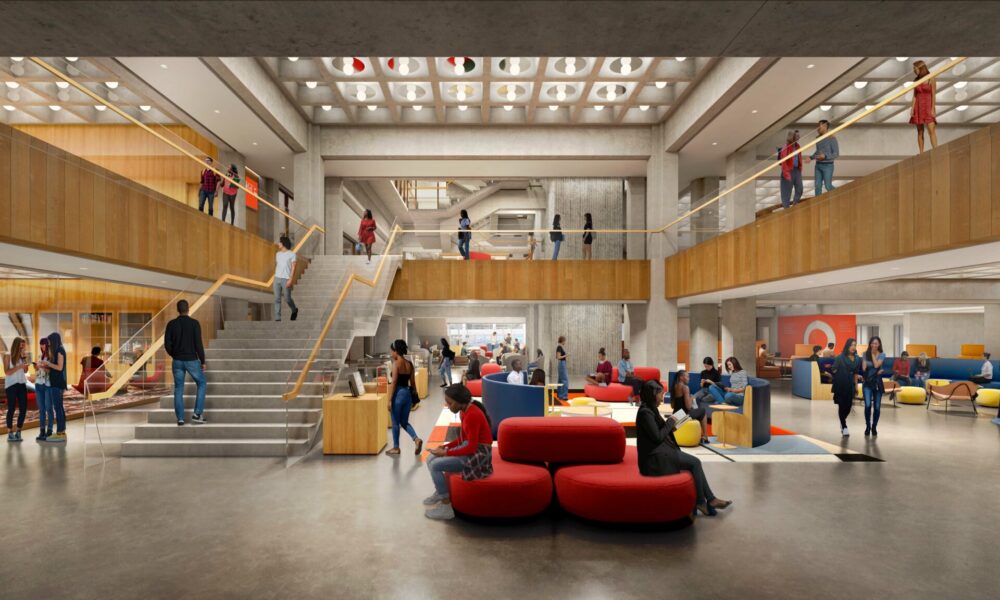
Most McGill students spend a large portion of their time in the McLennan-Redpath Complex, taking out books for classes or using it as a study space. Home to the largest library on campus, this space will soon be closing its doors for renovations under the Fiat Lux project. Construction is expected to begin in early 2024 and will transform the library complex to include more event spaces, informal learning spaces, a Grand Reading Room, and increased seating for studying. 

This comes as a shock for students, with many still ill-informed about the changes that are to come and the space they are set to lose. While McGill’s plans for renovation display good intentions for the future of campus libraries, the university has failed to adequately inform students about the alternatives that will be made available to them during this construction period.

Last year, The McGill Tribune ranked the McLennan-Redpath complex as the best library at McGill. It serves not only as a study spot, but also as a meeting point for students. The library as a resting space is especially important for commuter students who rely on campus spaces throughout the day when they can’t return home between classes. Additionally, the conference rooms in the library serve as a meeting place for various students clubs, groups, and organizations. Student democracy is only upheld when clubs with varied levels of funding and a diversity of voices have free and equal access to gathering space. 

Many students who arrived at McGill after 2019 might be unaware that McGill does have another large library: Macdonald-Stewart, home to the Schulich Library. The building has been undergoing renovations since late 2019, and it is expected to reopen in mid-2023. But with most construction having been halted at various points of the pandemic, students are left wondering whether Macdonald-Stewart will be open in time to fill the coming void left by the impending closure of the McLennan-Redpath Complex. 

Although students have been asking for more modernized study spaces for years, the steep decrease in study space that will come with the closure of the complex is of greater concern. Some students have taken to online platforms to complain about not being able to find space to work in the library, leaving them with few options for quiet study spots on campus, especially during exam periods. It is unclear where McGill wants these students to go while the complex is closed, and this should be on their list of pressing priorities—not just advertising their flashy new library project. 

In order to make up for lost study space, the administration is currently investigating the feasibility of installing temporary satellite spaces throughout campus. Student voices must be prioritized in these dealings, as they are the primary users of these spaces. If McGill intends to shut the complex down in early 2024, the construction of temporary satellite spaces must begin as soon as possible to give students time to adjust and provide necessary feedback. 

McGill has been previously criticized by students for various fundraising and development projects disguised as student-forward when in reality, the projects do not meet student needs or desires. The Made by McGill project, for example, is more concerned with enhancing McGill’s image and attracting investment than it is with providing resources and appropriate support for its current student body. McGill has also been condemned for administrative cuts to programs, such as its eating disorder program, as well as overcharging at campus eateries. Ultimately, their handling of the Fiat Lux project reflects a desire to uphold a public image of a well-respected institution, while simultaneously failing to meet the actual needs of students. 

The Fiat Lux project has the potential to benefit students and faculty members immensely, however, McGill must prioritize student needs when it comes to questions and concerns that they have about the closure. Where students will go and what spaces will replace the McLennan-Redpath complex is essential information that must be made clearly available. McGill cannot use Fiat Lux to enhance its reputation without ensuring the project is enhancing the student experience. 

Album Reviews, Arts & Entertainment

‘My 21st Century Blues’ ditches the restraining diktats of music labels

Raye’s debut album, My 21st Century Blues, triumphantly arrives after years of the singer-songwriter battling with an unsupportive record label. With this new project, released on Feb. 3, the British artist charts an independent path with the distribution and artist services company Human Re Sources.

Pain, frustration, and the difficult journey of creation drive this album. In “Hard Out Here,” Raye opens with, “After years and fears and smiling through my tears / All I ask of you is open your ears,” and voices out, “All the white men CEOs, fuck your privilege / Get your pink chubby hands off my mouth.”

The album’s diverse musicality reflects Raye’s newly-gained artistic liberty. The 25-year-old does not confine herself to one genre, giving each track its own musical identity. Yet, sonically, My 21st Century Blues cohesively explores a multitude of musical universes, all linked by the artist’s life, energy, and creative freedom.

The album starts with “Introduction,” where a presenter announces an upcoming intimate performance by Raye in the fictional 21st Century Blues Club. This enticing introduction sets the album to a captivating start, but it falls short of fully exploring the blues club concept as a narrative tie between the tracks. The deconstructed nature of the songs, however, and their rejection of the classical form of verses and refrains allows them to flow as a coherent yet eclectic mix.

With “The Thrill is Gone” and its jazzy atmosphere, Raye lyrically translates the effects of drugs: Captivating and exciting but also painful. The electro instrumental of “Black Mascara.” gives an energetic and immersive modern house rival to 2010s electro-pop. In “Escapism.,” Raye uses R&B interrupted by a beatless string to develop a touching and lyrical atmosphere ahead of its driving beat. This album is defined by its musical richness, mixing soul, R&B, blues, and hip-hop to elegantly balance retro and contemporary undertones.

After blowing up on TikTok with “Escapism.,” writing singles for artists such as Beyoncé or Charli XCX, and collaborating with many renowned DJs, Raye firmly establishes herself as an impressive independent artist with this powerful debut album.

My 21st Century Blues is available to stream on all platforms.

McGill, News

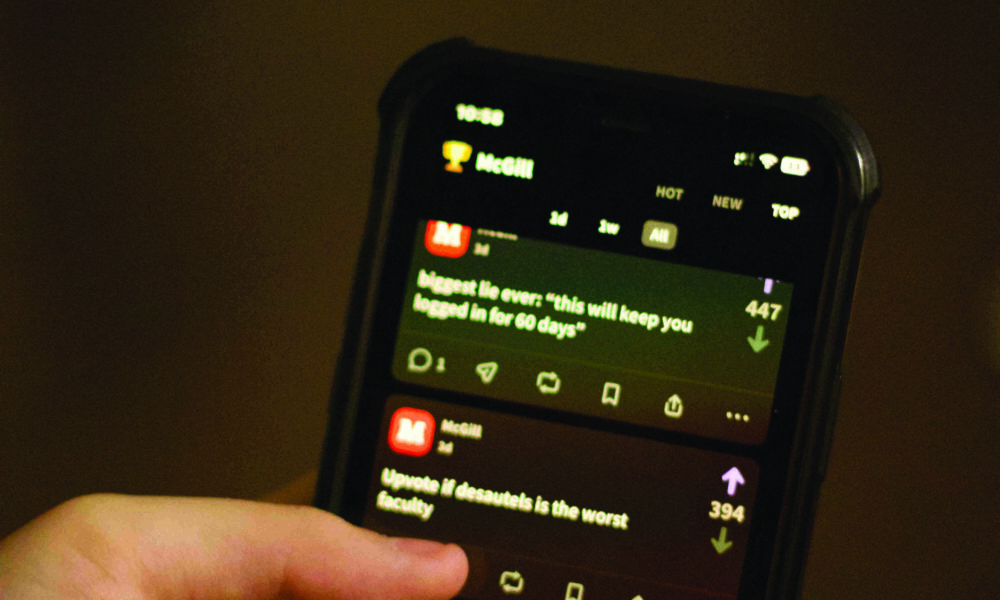
New anonymous social media platform Sidechat launches at McGill

On Feb. 13, many McGill student groups shared posts on social media advertising a new online platform designed for university students: Sidechat. Sidechat’s launch at McGill was accompanied by heavy marketing, with free cookies given to those who created an account, and money being offered to anyone who reposted the app on their social media accounts.

Sidechat is similar to Reddit, but it is a university-exclusive platform. The company describes it as “the best way to connect with your college community and students around the country.” All users on the app are anonymous. Since its launch at Tufts University in April 2022, the founders of Sidechat have been trying to expand to several universities in the U.S., and now Canada. McGill’s launch was accompanied by advertisements from meme accounts and student organizations such as Spotted: McGill University and McGill Women in Computer Science (McWiCS). 

Another component of Sidechat’s marketing strategy is offering financial incentives to its promoters and those who sign up. Those who shared the link to download the app on their Instagram Stories received $20. 

The marketing initiative was not limited to the virtual sphere. Sidechat also tabled around campus—even at the entrance of Bar des Arts (BdA) where promoters offered customers tokens for free drinks if they joined the app.  

“We offer free stuff in exchange for downloading the app,” Emmah Platt, U3 Arts, told The McGill Tribune as she promoted Sidechat at BdA. “Before the first day that it launched, we were giving away free money and free cookies. Now, we’re giving away free drinks.”

According to Platt, Sidechat paid students $20 an hour to advertise the app around campus.

“I did it because I had a friend […] who knew the person running or is involved in Sidechat, and I needed extra money,” Platt said. “And what a good way to meet new students.” 

Despite Sidechat’s marketing efforts, many didn’t sign up as they felt the app does not offer any new services or ways to connect with fellow students. 

“Their marketing strategy is very good. They really built up some brand name recognition, but I wouldn’t say that any of it made me want to download the app,” Simon Guistini, U0 Arts, said in an interview with the Tribune. “I think it’s unnecessary, and it’s just trying to do what social media does and try to make it niche, but it doesn’t need to be. Social media should be general, not niche.”

Sophia Micomonaco, U0 Arts, is also hesitant to download Sidechat. She finds that despite the app’s tempting marketing strategy, she is reluctant to promote it because she believes it lacks novelty.

“All I have seen is their crazy marketing scheme where they offer you a free cookie, which is a good marketing scheme, but I’m not sure I buy into it,” Micomonaco said. “Even though seeing other people do it and say, ‘oh my god, you get 10 dollars or whatever,’ is kind of enticing […] I don’t think it’s worth it.” 

Platt, however, says the fruits of Sidechat’s strong marketing have been reaped, as over 1,500 people downloaded it on its launch day. On the other hand, Micomonaco and Guistini find that figure hard to believe. Giustini knows only one person and Micomonaco knows no one who has downloaded the app. 

Micomonaco also worries about the potential problematic behaviour that could crop up on an anonymous social media platform.

The anonymity afforded to Sidechat users has led to harassment and hate speech on the app at Tufts. Yik Yak, an app similar to Sidechat, has been banned on certain university WiFi networks due to the high level of harassment and hate speech reported on the app.  

“What [is Sidechat] going to do to regulate certain behaviours? People can’t be held accountable for the stuff that they do. It just doesn’t add up,” Micomonaco said. Sidechat declined an interview with the Tribune.

Ask a Scientist, Private, Science & Technology

The barriers to gender-affirming care at McGill and beyond

CW: Mention of suicidal ideation

Transgender, nonbinary, and gender nonconforming individuals face innumerable barriers by simply existing in a world wrought with transphobia. The U.S. National Transgender Discrimination survey report on health and health care found that transgender individuals in the U.S. are over four times more likely to contract HIV than the national average and are over 25 times more likely to have attempted suicide. Access to medical care—a human right according to article 25 of the United Nations Universal Declaration of Human Rights—is yet another obstacle in the fight for freedom of identity. 

McGill is not a transphobia-free oasis either. In the past year, students have reported difficulty removing their deadnames from official university documentation and the Centre for Human Rights and Legal Pluralism allowed a trustee of a transphobic U.K. organization to schedule a public lecture. According to McGill’s Trans Patient Union (TPU), the unwelcoming environment persists across McGill’s health-care services in the form of limited access to hormone replacement therapy (HRT). 

For individuals with intersecting identities, this fight can be especially difficult. Black transgender and gender nonconforming individuals face some of the highest rates of discrimination and violence. And TPU finds that those who are fat, disabled, or struggling with mental illnesses are more likely to be denied certain kinds of care.

“We spoke to a suicidal patient who was refused bottom surgery because their ‘mental state was not stable enough,’ even though their dysphoria about their genitals was a large factor that contributed to their suicidal thoughts,” said TPU’s external affairs coordinator, who asked to remain unnamed, in an interview with The McGill Tribune. “They ended up being denied the surgery and their mental health got worse afterwards.”

Financial stress poses another obstacle for those looking to access gender-affirming care. In a survey conducted by Trans PULSE Canada, 34 per cent of transgender respondents were living in poverty, compared to 13.5 per cent of all Canadians, a staggering statistic considering only 0.33 per cent of Canadians are transgender.

“Even for those trans patients who can afford to pay for uninsured care without going into debt, this is money they now cannot spend on a house, a car, retirement, et cetera,” the TPU external affairs coordinator said. “No one should have to choose between having retirement savings and getting medical care.”

Transgender health is rarely included in medical school curricula and gender-affirming procedures are considered elective, downplaying their often life-saving nature. Even those who can afford care often require coaching from someone who has been through the process already.

“Many people assume that poor funding of the health-care system is the main barrier to gender affirming care,” said the TPU external affairs coordinator. “But in reality, the main issue is that the medical system has made it their business to rigorously gatekeep who should and shouldn’t get to access medical transition.”

Many doctors require that patients  be diagnosed with gender dysphoria before providing gender affirming care—a practice that undermines the recommendations of the World Professional Association for Transgender Health (WPATH) standards of care. 

“The official DSM [Diagnostic and Statistical Manual of Mental Disorders] criteria for gender dysphoria misgenders trans people and presents medical transition as acceptable […] [only] because the alternative is that we would kill ourselves,” the external affairs coordinator explained.

Another kind of harmful rhetoric surrounding care suggests that those who undergo gender-affirming procedures will regret their choices. Not only is this false, but this viewpoint perpetuates transphobia and contributes to stigma surrounding what can be life-saving procedures.

“Detransition is not synonymous with transition regret. Many people who stop their hormones don’t regret having been on them and are still happy they got certain surgeries. The regret rate for trans-related surgeries is less than two per cent,” the external affairs coordinator said. “When it comes to similar surgeries, like nose jobs, we respect patients’ right to bodily autonomy and believe that if they want the surgery and are well informed on the pros and cons, they should have the right to make that decision for themselves.”

Any McGill students interested in transgender-related health care can contact TPU on Instagram @transpatients or email [email protected] for one-on-one assistance. Trans patients interested in sharing their experience with the McGill and Montreal health care systems can contact [email protected]

Horoscopes, Student Life

Tribune Predicts: Midterm Horoscopes

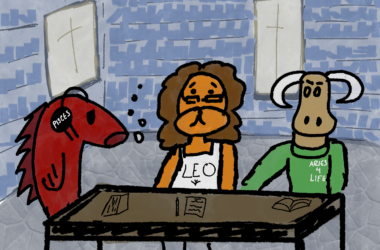
Ah yes, midterms: Those things we all love to hate. It’s a stressful time in the semester, but fret not, The McGill Tribune is here to help you navigate the piles of exams, essays, lab reports, group projects, and personal drama that the end of February promises to deliver. 

Aries (March 21-April 19): Trust your internal fire to guide you through exams, Aries; it’s a surprising motivator that will bring you success! Resting over the break will be crucial as March promises to be a challenging time of transition.

Taurus (April 20-May 20): Midterms will not be easy for you, Taurus, but don’t despair. Focus on self-care to get you through the remainder of the semester. Finals, on the other hand, will be a piece of cake—you will ace them as Jupiter moves into Taurus, giving you a burst of energy to tackle the coming months. Juno enters Taurus on March 11, so whatever romantic relationship you may have will enter a rough patch.

Gemini (May 21-June 21): The end of February and March will be a period of reprieve, Gemini, since none of your planets are in retrograde. You will do as well as you expected in your midterms, and a promotion at work will lift your spirits. Focus on your current relationships—they need some heavy lifting since you disappeared to focus on school. 

Cancer (June 22-July 22): Cancer, you took on a lot of responsibility these past couple of months and it has been weighing you down. However, your depleted energy won’t affect your midterm grades, and with Pisces season underway, new adventures will breathe some life back into you.

Leo (July 23-August 22): You’re quick to make decisions, Leo, and sometimes forget to think about the long-term effects of choosing to party instead of study. Others appreciate your warmth and hospitality, but this does not bode well for exams. You’re going to struggle, be forewarned!

Virgo (August 23-September 22): Mercury was in retrograde throughout January, so it hasn’t been an easy start to the year for you. The recently lifted weight from your shoulders will make you feel like you conquered the planetary dissonance and this confidence will ensure that you ace your midterms, Virgo. Share your ideas with coworkers and in group projects; your brain power will bring new and exciting opportunities in March.

Libra (September 23-October 23): Your creativity and empathy mean that people love being around you during midterm season. Channel their confidence in you as your less-than-satisfactory exam grades roll in. Midterms are not the be-all, end-all, so keep working towards your goals in the coming months.

Scorpio (October 24-November 21): Jupiter is in Aries, Scorpio, so it’s time for you to focus on rest. Midterms will drain your energy so try to maintain a balance between academics and your personal life. Lean on friends and family, be sure to eat well, and use exercise to work out your exam frustrations. 

Sagittarius (November 22-December 21): Better-than-expected midterm results are coming your way, Sagittarius. Your success is a sign that you are making the right decisions in your personal and professional life, so be confident in your choices. The drive to constantly improve yourself has paid off this month.  

Capricorn (December 22-January 19): You are going to experience a significant transformation, Capricorn. New studying techniques will only yield average midterm results, but with Pluto moving out of Capricorn for the first time in 15 years, your stress levels will be low.

Aquarius (January 20-February 18): Aquarius, you’ve faced quite a few challenges these past few months. All that time and energy was worth it, though, because you are going to show those midterms who’s boss. Recognize your power and strength as we enter the Age of Aquarius—you are going to need it as you lead us into a period of great struggle and confrontation. 


Pisces (February 19-March 20): Unfortunately, Pisces, having your birthday during exam period will not lead to the best results. That’s okay, though, because you can celebrate yourself and mourn your grades at the same time. None of your planets are in retrograde, so look forward to stability in your personal life.

Read the latest issue

Read the latest issue