


Latest News

Features

Make your student union work for you

The first time I learned about the Students’ Society of McGill University (SSMU) was during a Zoom meeting for The McGill Tribune’s news section in January 2021, nearly five months into my first year. As an intimidated newcomer, I joined the meeting thinking I would just test out the vibe and refrain from picking up a piece. Yet, upon hearing that somebody needed to look into the new investigation that SSMU had just published about its collection of student fees—a number totalling upwards of $2,600,000—I was immediately intrigued.  

My lack of awareness about SSMU prior to joining the Tribune might have stemmed from the fact that we were in the throes of the pandemic, with virtually no campus activity. Although, in talking to students today, it seems like the lack of awareness about what SSMU is, or even does, persists. 

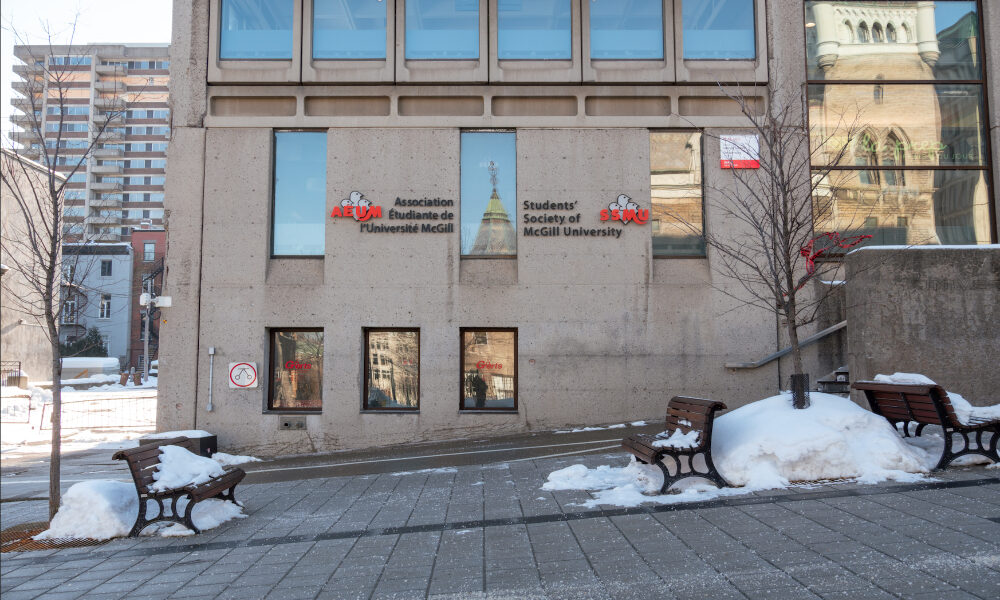
“Literally, I found out what it was the other day. I’d never been into the building [….] We saw a building and everybody was like ‘Oh S.S.M.U’. I’m like, oh, I didn’t even know. I went to the Brown Building the other day, for the first time,” Maria Eugenia Areizaga-Garcia, U0 Science, said.

But students interact with SSMU all the time. If you’ve ever been to Open Mic Night at Gerts, visited clubs at Activities Night, or even used a free charging station at McLennan Library, you’re engaging with an aspect of McGill that SSMU administers, paid for by your student fees. Even matters like the new Fall reading break or 24-hour library access at the start of midterm season are the results of advocacy efforts from SSMU. 

SSMU was established in 1908 and is the accredited student association for the approximately 25,000 undergraduates pursuing degrees at McGill’s downtown campus. Each spring, the undergraduate student body elects six students as “executives” to serve a one-year term and fulfill the society’s mission—“To represent and advance the diverse needs of McGill Undergraduate students by improving the quality and accessibility of education, providing outstanding services, and promoting social, cultural, and personal opportunities.” They work full-time alongside permanent staff to run services, organize clubs, and advocate for students, often directly to the McGill administration. Along with the student executives, SSMU also has a political decision-making body, the Legislative Council, and a dispute resolution body, the Judicial Board

Despite SSMU’s pervasive presence in student life, only 12.9 per cent of eligible undergraduate students voted in the elections that ushered in this year’s executives. This reflects a broader trend across Canada of low engagement in student associations, but also students’ disillusionment with SSMU.

Particularly after the events of last year, which saw the overturn of a democratically elected policy and a lack of transparency regarding internal turmoil that gutted the executive team with one impeachment and two resignations, SSMU’s reputation of being an environment that attracts students wishing to pad their resumes and debate trivial matters seems to have become stickier. 

What is SSMU?

A lot of student mistrust can be traced back to a disagreement and lack of clarity over what SSMU’s role should be. Though tasked with advocating for a diverse, large student body, it is also fundamentally a corporate not-for-profit.

The not-for-profit structure is common at other Canadian university student unions, says Justin Patrick, a PhD student at the University of Toronto’s Ontario Institute for Studies in Education studying the politics and history of student government. As he explained, student associations began incorporating as not-for-profits in the 1960s and 70s to skirt the university’s control. 

“Before they were incorporated [as not-for-profits], the student unions were controlled directly by the university administrations,” Patrick said. “This meant that if the students wanted to pass something in their constitution, the university could veto it [….] So in the mid-20th century, there was a big push toward making the unions independent.” 

After corporatization, Patrick explained that student unions began expanding to meet their reporting obligations—the accounting needed to comply with provincial laws around not-for-profits. Unions started to hire permanent non-student staff, and their annual operating budgets increased exponentially as a result. 

In 1992, SSMU brought in $857,174 from student fees. In 2021-2022, it brought in $2,685,111, according to current vice-president (VP) Finance Marco Pizarro. 

Current VP University Affairs Kerry Yang told me that, in addition to just being formally corporatized, SSMU must also function as a corporate entity with a sizable and expanding budget as it fills a void of services that the McGill administration refuses to offer. 

“McGill doesn’t provide any services in terms of student life, such as clubs, room bookings, and it doesn’t hold any student life events,” Yang elaborated via email. “This is because the University says it does not have the funding or capacity to support these services [….] McGill has provided nothing. McGill often says it has budgetary constraints and thus passes on a lot of workload and costs to other organizations, such as SSMU.” 

Compared to other Canadian student unions, SSMU is burdened with a higher workload in providing services. Yang pointed to the SSMU Menstrual Health Project as an example of this imbalance. The University of Toronto offers free menstrual products themselves, while Western University is providing $800,000 to their undergraduate student association so it can expand its menstrual hygiene program.

Running services like the University Centre and Gerts Bar and Café requires staff and a human-resources department. The six SSMU executives are salaried employees, earning approximately $32,000 for their work, which is supposed to average 40 hours a week, but can easily become 60 to 90 hours instead. 

SSMU’s corporate architecture undergirds healthy student life on campus, but can sometimes become a barrier to the union’s political advocacy role. The SSMU constitution notes that the Quebec Companies Act takes precedence over both its Letters Patent, and the constitution itself in “the event of a contradiction” between them. 

SSMU’s corporatization is also why its highest governing body is the Board of Directors (BoD)—an entity whose job is to ensure SSMU acts in the best interest of its business and legal affairs. 

Last year’s events highlighted the precedence of SSMU’s corporate responsibilities when it overturned the Palestine Solidarity Policy that students had passed with a 71.1 per cent majority via referendum. The McGill administration had threatened to sever its ties with SSMU if the Policy were approved. 

Just hours after McGill’s public announcement, the Legislative Council convened for a scheduled meeting that quickly turned into a discussion about what the society’s immediate reaction to the threat should be: Should SSMU issue a statement standing by the policy and Palestinian students? Or should SSMU hold off to weigh the legal repercussions it would face if McGill carried out its threat, which included the potential loss of student spaces, such as the University Centre? They opted for the latter. 

For the members and supporters of Solidarity for Palestinian Human Rights McGill (SPHR) who created the policy, it seemed like even when they did everything right, including initially getting approval from the Judicial Board, it still wasn’t enough to bypass the BoD’s ultimate power. 

“The BoD, in this particular case, had an objective which was defending the interests of the McGill administration—not the democratic will of the student body,” a representative of SPHR told me. “The Palestine Solidarity Policy last year essentially showed that no matter what students want, and despite the democratic nature of the referendum and the SSMU constitution, which presents democracy as a priority in our student life, the Board of Directors has powers to overturn the desires of students, even though they might conform to constitutional norms.” 

From everyday actions to large-scale change, the balancing of not-for-profit interests and advocacy interests often clash dramatically. Former VP Internal (2021–2022) Sarah Paulin believes that SSMU faces a fundamental tension whereby its corporate responsibilities hinder its potential to advocate for students freely. 

“SSMU plays a very interesting part where it has like two faces, it has the company part, but it also has the advocacy part,” Paulin said. “And those two don’t really align sometimes [because] every decision SSMU makes, it has to think about the laws that it abides by, the people that it’s [employing], as well as advocating for students.” 

Paulin noted that SSMU is also hindered in its ability to freely advocate for students due to the Memorandum of Agreement (MoA) it has with McGill, which she told me favours McGill to the extent that it can easily shut down SSMU if it does anything deemed too controversial by the university. 

“There [are] a lot of statements that can’t be put out because [SSMU] can get sued for it,” Paulin said. “So that’s why there’s this sometimes silence from SSMU because they simply cannot publish something.”

Former SSMU president (2019-2020) Bryan Buraga also told me that the MoA is constructed in McGill’s favour. However, he believed the Board of Directors “folded too early” in overturning the Palestine Solidarity Policy and could have gone further to defend SSMU’s democratic processes.  

“I’ve seen [SSMU’s] so-called corporate responsibilities used as an excuse to push aside student activism and advocacy,” Buraga said.  “[T]here’s a really big leeway in which fiduciary duty can be applied and how far you can push the boundaries before you’re getting into the point where you’re not acting in the best legal interests of the Students’ Society.”

Debating what SSMU should be

Many of the people I spoke to, including students and former SSMU executives, had conflicting ideas about what changes SSMU should or shouldn’t make so that it can best address students’ needs.

Paulin believes that SSMU should move away from advocacy, get rid of the political VP External position, and focus instead on supporting clubs and services. She told me that SSMU’s practice of trying to be a “porte-parole” (spokesperson) for students often alienated the wider student body and contributed to “tension” between the student union and McGill. 

“You can [engage in activism] on your own, you can find political parties within Montreal, but that should not be the student organization’s job, because it takes away from what I think is the true purpose of SSMU, which is having space for students and being able to support clubs and services,” Paulin added. “Who cares about what six students have to say? SSMU will not represent every single student. So it should not try to.” 

U3 Science student and former Legislative Councillor Lucas Nelson thinks that SSMU is best for collecting and distributing student fees to important services, such as DriveSafe. Although he acknowledged SSMU’s advocacy as important, he feels that it often struggles to represent the student population accurately. 

Rather than a complete rejection of advocacy, he wishes SSMU would “deliberate more as an institution” and try to seek out additional points of view from students, given those who typically participate in SSMU’s debates are “not representative of the student body as a whole.”  

“Whenever there are sensitive social topics, I feel sometimes SSMU is pretty quick to take a side on issues when maybe some of the facts aren’t fully available, or when they don’t consider that side or that stance might harm part of the student body,” Nelson added. 

Buraga thinks that increasing student engagement should be the main concern, rather than SSMU washing its hands of advocacy.

He maintains that SSMU needs to abolish its current structure and institute direct democracy at all decision-making levels to improve student engagement. These ideas were built into a political campaign he co-created, which spurned the ‘McGill Student Union Democratization Initiative Policy.’ 

Although it passed in SSMU’s Fall 2021 referendum, the policy was controversial for many at SSMU and seen as simply unfeasible considering its calls to completely reform the operations of independent faculty associations and abolish the Board of Directors. As of yet, none of its structural recommendations have been taken up.

“If people see that they get more tangible results in their time and effort through external activism, or getting involved in a service that provides direct services to students, they might put their time in that versus having to deal with admin BS or Legislative Councils that lasts for hours and hours for no good reason,” Buraga told me. “Unless there’s some sort of massive foundational change to the way that SSMU runs itself, you’re just gonna keep this getting the same issue year after year.”

The plight of student engagement

But there are other voices that are largely absent from the conversation—those of students who don’t vote or participate in the SSMU’s affairs. 

The decline in voter turnout is more severe at larger campuses where the student body is more dispersed, Patrick told me. The voter turnout for the University of Toronto Students’ Union most recent executive elections was a mere 6.6 per cent

This trend of low turnout requires student unions to “show [students] that it’s worth getting involved in the student union and making their voice heard, voting, and taking part in the political life on the campus,” Patrick said. “It all kind of comes back to how many students you can mobilize, right? Because you have to show the students that it’s worth caring about this and that it benefits them.” 

However, barriers to student engagement can also be huge. In speaking to students, it’s clear that a lack of awareness hinders their ability to get involved in SSMU. Participation can get costly and Legislative Council meetings typically average around three hours long.

On the other hand, the lack of student engagement makes it difficult for representatives to understand what the student body wants from them and how to best address their needs. 

Drawing on her VP Internal experience, Paulin explained that “execs will come in with a mission and try to do everything we can to fulfill that mission. But when trying to reach out to students, there’s no response [….] We can say ‘SSMU doesn’t do a good job of reaching out to students,’ but when there’s a lack of interest, there’s nothing you can really do.” 

Corporatization, lack of student engagement, McGill’s ceilings to advocacy, and general disconnect between the student body and its union seem to mutually reinforce each other.

In the face of these overlapping issues, it can be easy for students and those involved in student associations to choose apathy and think of themselves as temporary community members. Students whose issues are deemed “controversial”––women, students of colour, disabled students, neurodivergent students, 2SLGBTQIA+ students––are in turn most disempowered if SSMU and community members just give up. As one SPHR representative puts it, SSMU’s actions last year were “very harmful to student activism because it leads to many students thinking ‘oh, why even bother?.”

At a setting like McGill university decision-making is concentrated in the hands of a few senior administrative officials who repeatedly dismiss students as stakeholders. However, there is tremendous value in an association tasked with representing roughly 25,000 students. 

“At the end of the day, student associations are supposed to be beneficial to students,” current VP External Val Masny told me. “And if students believe they’re not, then they’re able to change the way they work. If you think SSMU shouldn’t be doing this, and it should be doing something else, then say something and find other students [….] I invite people to basically, like, make their student association theirs.”  

Everyone has different ideas about what student unions, or any form of political body, should be. Conducting interviews for this piece has confirmed to me that there is no individual or straightforward solution to SSMU’s issues—maybe it needs a more democratic governance structure, or a better MoA, or for McGill to take on the work of providing services  or no changes at all. 

Most importantly, though, we need to have these conversations—SSMU influences so much of our student experience. The more we see it as a site for possibility and engagement, the more it can come to reflect us.


Editorial, Opinion

Privatizing health care won’t fix a failing system

The Quebec health-care system is in a state of crisis. ER wait times are dangerously high, and there is a chronic lack of staff—including nurses who are exceptionally underpaid and overworked. Amidst a similar crisis in Ontario, Premier Doug Ford unveiled plans to increase the role of private clinics in the health-care system—a lead Quebec Premier François Legault seems to be following. However, privatization is a step towards undermining Canadians’ right to life by creating a system that prioritizes only those who can afford care. In order for universal health care to live up to its name, Canadian  politicians must work to transform the single-payer system so that health care is truly accessible to everyone.

Apart from overall poor infrastructure leading to long wait times for all, systemic racism remains rampant in the Quebec health-care system. Forced sterilization of Black and Indigenous women continues without large-scale inquests, and in 2020, Joyce Echaquan, an Atikamekw woman, died after racist negligence at the hospital where she sought care. Minute forms of racism also permeate medical care, including the underestimation of pain for Black and Indigenous people, which leads to lower pain-medication prescriptions and poorer outcomes. 

Meanwhile, Quebec’s health-care crisis is creating a workers’ rights catastrophe as nurses and orderlies are subjected to inhumane working conditions and the lowest median pay in the country. The largest union of Quebec nurses filed a complaint with the United Nations due to their forced overtime—which they describe as forced labour. The McGill University Health Centre (MUHC), which runs the Montreal General Hospital, also plays a role in the oppression of workers, alongside the institutional racism it perpetuates against its staff andpatients. The crises of overwork and poor health care reinforce each other: When staff are too exhausted to properly do their jobs, then patients suffer as a result, creating a larger strain on the single-payer system.  Government funds must be more efficiently allocated to ensure that staff are treated with respect and not exploited for their labour. 

But instead of taking measures to address the staffing crisis, there are still unreasonably high barriers to entry across medical degrees. Medical school acceptance rates such as McGill’s are unrealistically low, and the process favours wealthy applicants. Such obstacles also extend to the recognition of foreign medical degrees. Highly-qualified health-care workers, with degrees mainly from the Middle East and Asia, are not recognized, and many must entirely restart their degree or clinical requirements—which is often a pricey, tedious process that keeps skilled workers from doing their jobs.

Although the public health-care system is in crisis, privatization is not the way to solve it. Just look south of the border: In the U.S. in 2022, 31.6 million people did not have any health insurance, while 43 per cent of working-age adults were inadequately insured. In a privatized system, where there is no incentive to serve poor, working people, health-care facilities will mainly emerge in the wealthy downtown core, where they can service rich clientele. Privatization efforts and paid clinics will eliminate the concept of health care as a human right

Despite what politicians like Ford have espoused, even partial privatization will undermine the entire single-payer system. With more private clinics, many people will stop using public services, and highly qualified doctors and nurses will leave to the higher-paying, private facilities. This will lead to a vicious cycle where there is further underfunding and staff shortages in the public system, decreasing access to and quality of health care for people who can’t pay.

Instead of calling for privatization, we need to invest in the current system to make sure that health care is truly a human right. McGill, especially, must use its institutional power to make medical school entrance requirements more equitable. McGill also has a responsibility to ensure that workers’ rights are protected at the MUHC. In parallel, Quebec government funds must be properly distributed tofix the health-care crisis—not through privatization—but by improving resources for hospitals and ensuring that health-care professionals, especially nurses, are properly compensated and treated with dignity. Quebec’s hospitals need solutions that can equitably care for the needs of all people—not just those who can afford it. 

Campus Spotlight, Student Life

Local Stories: The Montreal book man

When Adrian King-Edwards, the owner of The Word Bookstore, started selling second-hand books from his living room in 1973, carefree hippies would occasionally arrive barefoot. The scores of thronging students also caught the attention of local police. 

Adrian, who had recently graduated from McGill as an English literature major, put a picture of George Bernard Shaw in the front window, so locals knew where to go, and hosted weekly poetry readings with his then-partner, Lucille. Their apartment became known as ‘The Underground Bookstore.’

The police, though, were concerned that Adrian was selling something more sordid than literature. Two police officers raided his home and even searched through his kitchen spices but found nothing.

In 1975, Adrian noticed a for-rent sign for the laundrette next door, which a Chinese family had run for 70 years. He learned over the phone that it would be $175 per month for the modest, two-storey building, originally built as a horse stable. Adrian seized the opportunity. He moved the trunks of books from his living room, gathered more McGill textbooks, and opened The Word with Lucille. 

Forty-eight years on, many of the original quirks remain. They only accept cash, make phone calls on an analogue phone, the books by the window-sill rotate regularly, and local poets still come for readings. 

“Poets are very needy people,” Adrian says, chuckling.

Adrian, now 73, no longer lives in the apartment next door. He moved to a stately family house around the corner on Aylmer Street and lives with his partner, Donna Jean-Louis, and dog Bjarni, an eight-year-old black Labrador. Adrian also has two sons from his first marriage, Brendan and Nick. 

Donna, 73, is originally from Nova Scotia and enjoys collecting limited-edition children’s books. She also loves to cook and often entertains bookstore owners at their house after book fairs, sometimes cooking for 35 people at a time.

Adrian met Donna when he opened the store, and the two became good friends. Once they parted ways with their previous partners, they became closer and married 10 years ago.

Now, they run the store together, selling the majority of books from the shop and the rarer items from their home. They also love to read, and every week make time to read aloud to each other. 

They’re very selective about sourcing books, mostly acquiring titles on scholarly literature and philosophy. The process takes the pair around the world, but typically involves two or three weekly house calls in Montreal. 

Along with selling books, they rent boxes of books to film companies, and have featured in box office hits such as Life of Pi.  

“Later tonight, we are going to a storage unit which has 50 boxes for us to see,” Adrian said, his eyes lighting up. 

It’s no secret that online book retailers have made life harder for independent bookstores. Adrian believes that low rates of homeownership among young people have hindered demand for second-hand books as well. But nothing could have braced them for the COVID-19 pandemic.  

“I had prepared for the store to burn down or to be robbed, but McGill closing? No way.”

His son Brendan, 42, struck up the idea to deliver mystery boxes of books across the island, with Adrian and the family handpicking books for each box and selling them online. 

“It turned out pretty well,” Adrian said. “The roads were quiet, we could go to parts of the island we have never seen before, and we sold a few too.”

With the loosening of pandemic restrictions, Adrian is upbeat about the future, though he laughs when business students do their class projects about his store and ask about his ambitions. To throw them off, he tells them he would like to downsize.

In response to whether he can tell if somebody is not a book enthusiast, he replied, “Oh yes. They will stand too far away from the books […] and probably get their phone out.”

For the 40th anniversary of the store, they invited customers to their home for drinks and cake, serving a metre-wide cake to over 400 people. The 50th is two years away and will certainly be a community event as well.

“That’s something we will have to plan,” Adrian said, smiling with his eyes, “but it will have to be bigger.”

Local Stories is a new series on the stories of Montrealers.

Emerging Trends, Student Life

Escape the digital world and touch some grass

It’s 2009: The early internet days. Poptropica and Club Penguin are booming, Microsoft released Windows 7, and Disney XD hit cable services. But then came social media, along with a lasting novelty that prompted an ineffable sense of enthusiasm to the extent that it is now an inextricable component of human life.

In the present era of increasing digitalism and exponential technological advancement, it comes as no surprise that social media platforms have revolutionized the way people communicate and connect with each other. This was particularly apparent throughout the COVID-19 pandemic, as many were deprived ofsocial interaction to curb the spread. Perhaps we can all agree upon the benefits of social media, from sharing information with ease to remaining in touch with loved ones in previously unfathomable ways, or staying up-to-date on relevant information in times of havoc and uncertainty.

With the strict lockdowns and social distancing rules, we were forced to live in ways that completely defied our social natures. In response to these challenges, many people predominantly relied on forms of communication that did not entail meeting face-to-face, such as social media, phone calls, and Zoom calls. 

For students like Alice Moyne, a U3 Agricultural and Environmental Sciences student, social media’s navigational ease allowed her to reconnect with friends she had previously lost touch with. 

“Due to ample free time and the simplicity of getting in touch with others, I was now in contact with friends I haven’t spoken to in years,” Moyne said.

Whether it be Houseparty hangouts, Zoom birthday parties, or virtual pubs, we certainly did not fall short of demonstrating our inherently creative faculties. 

“I actually partook in all those activities with friends and family and felt closer to some than I have in previous years, despite the lack of physical interactions,” Victoire Brocart, U3 Agricultural and Environmental Sciences, said.

However, with approximately 4.7 billion individuals using social media today, not only are we staying digitally connected to each other, but over half of Earth’s population can now access an endless repository of  information in mere seconds. Although this has undoubtedly resulted in great leaps in knowledge, it has also created a state of information overload— a state that leads many of us to end up more confused and overwhelmed than well-informed.

With COVID-19 being the first pandemic during the internet age, the public was constantly showered with misinformation and contradictory evidence from a maelstrom of sources. While public health officials worked to combat this ‘infodemic,’ many friend and family group chats became uncomfortable and hostile, with science seemingly up for debate. The ‘mute chat’ button had never looked so appealing.

Instant access to information and connection changes our personal relationships and communication skills in the real world. For example, anyone who generally abstained from dating throughout the pandemic can attest to the difficulty of holding a real-life conversation and eye contact after relying on social media for so long. The art of conversation is slowly dwindling, while people’s compulsion to check their Instagram stories and TikTok for-you page is intensifying. Though social media might be a place of comfort, we should be cautious of the way reality doesn’t always follow an algorithm.

With social media constantly bombarding us with sensory input and becoming the central organ of modern society, it is more imperative than ever to be conscious of our screen time and evaluate the repercussions it may have on our social skills and personal relationships. For example, despite the extraordinary ways we can now connect with people around the globe, meaningful, deep connections are at an all-time low.

If one finds themselves mindlessly scrolling through their feed for hours, Lalin Ersu, a U2 Arts student, recommends “setting a limit for your screen time, tracking it, and using social media with intention.” 

Remind yourself why you decided to make this change. In doing so, you can resist the persistent urge to scroll and create some free time for other activities, such as hanging out with a friend, trying out a new recipe, or picking up the book you’ve been putting off for so long.

McGill, News, The Tribune Explains

Tribune Explains: Emergency and safety services at McGill

Various university and student-run safety services exist on campus, from the Campus Public Safety department to McGill’s Student Emergency Response Team (MSERT), WalkSafe, and DriveSafe. The McGill Tribune looked into these services and how McGill students can use or join them.

What emergency and safety services does McGill offer?

McGill’s Facilities Management and Ancillary Services (FMAS) offers 24/7 security services for students, faculty, staff, and visitors through its Campus Public Safety department. Students and staff members can also benefit from safety escorts at both the downtown and Macdonald campuses. 

“Agents patrol the campuses, manage access, transport students and staff with disabilities[,] as well as respond to incidents and emergencies,” McGill media relations officer Frédérique Mazerolle wrote in an email to the Tribune. “In addition, we develop and implement standards and programs for emergency management at McGill, including the University Emergency Response Plan. We operate the Emergency Alert System and the University Security Operations Centre, and work with units across campus for a coordinated response to incidents.”

What independent emergency and safety services do student organizations offer?

In addition to university-run services, there are also student-run emergency services on-campus, including MSERT, DriveSafe, and WalkSafe.

MSERT is a service offered by a team of more than 75 student volunteer first responders certified by the Canadian Red Cross with the mission of providing free access to first aid to both students and Montrealers. 

The team offers first aid services from 6 p.m. to 6 a.m. to all McGill residences except for Solin Hall, while also helping ensure student safety during various events such as Frosh. They partner with the Canadian Red Cross to educate the public on first aid through courses and certifications.

DriveSafe is also run by student volunteers and the Students’ Society of McGill University (SSMU) and offers a safe means of transportation on the island for McGill students between 11 p.m. and 3 a.m. from Thursday to Saturday. In Fall 2022, Drivesafe managed to drive over 636 people home safely with 100 cars on shift. 

Walksafe, also run by SSMU, is a similar service that, instead of a car, offers McGill students and Montrealers the opportunity to have a trustworthy volunteer walk them home. Volunteers wear red jackets and accompany the callers to their destination from 9 p.m. to 12 a.m. from Sunday to Thursday and 9 p.m. to 3 p.m. from Friday to Saturday.

How can McGill students access these services?

For medical emergencies requiring ambulances—which are often the fastest and safest way to get to the hospital—one must call 911. Although there is a fee for ambulance services, some may qualify for free service or insurance reimbursement. After calling 911, one should call McGill’s Security Services, who will coordinate with emergency responders. For internal issues such as water leaks or strange odours, contact Security Services. The Security Services’ downtown phone number is (514) 398-3000. The Macdonald Campus Security Services’ phone number is (514) 398-7777. 

The McGill Student Emergency Response Team can be reached at (514) 398-5216.

To access WalkSafe, students can call (514) 398-2498 or make a request on WalkSafe’s website. Reservations are not allowed; services are offered on a first-come, first-serve basis.

DriveSafe can be reached at (514) 398-8040 or by filling out an online form. Like WalkSafe, they do not accept reservations

How can students volunteer with these services?

Those interested in volunteering with MSERT can apply at the beginning of every fall semester. Students do not need to have a first aid certification to apply, as MSERT trains its new members. 

Those interested in volunteering with WalkSafe can contribute to the service by becoming walkers or dispatchers, who are responsible for assigning volunteers where needed.

DriveSafe volunteers can either become drivers; “shotguns,” who ride next to the driver and contribute by giving directions, taking care of passengers, and corresponding with dispatchers; or dispatchers, who take calls and assign users to available cars. 

ABCs of Science, Science & Technology

Social chatbots are abetting the loneliness epidemic

Isolation. Anxiety. Depression. The loneliness epidemic rages onward even as the era of lockdowns is mostly behind us. Around 33 per cent of adults worldwide report often feeling lonely, with research showing that social isolation is correlated with greater physical and mental health risks, including heart disease, weakened immune system, higher sensitivity to pain, and various psychological disorders. 

Confronted with such an enigmatic, seemingly Sisyphean issue, society responds with what it does best: Problem-solving with technology. Humanlike social chatbots, or conversational artificial intelligence (AI) applications, now function as virtual friends who are unnervingly attentive and inordinately supportive—seemingly the perfect antidotes to loneliness. Yet, with rising concerns about digital privacy, the murky ethics of AI, and overall detriments to wavering mental health, the proliferation of AI chatbots is much more of a danger than a tool for well-being.

Cybersecurity issues are inevitable when interacting with chatbots. Users’ names, email addresses, phone numbers, usage data, and cookies are often stored and shared with external services by AI applications, despite superficial reassurance that user information is completely secure. This means that unidentified third parties will have access to all contact information, unbeknownst to most users. Worse yet, chat history, images, voice recordings, and calls are almost always recorded and stored semi-permanently as the chatbots’ training bases. Personal identifiable information (PII), such as speech patterns, voice and facial recognition, as well as racial and gender profiles, may thus be stored without the users’ direct consent. Even though digital privacy regulations are in place in Canada, they simply cannot account for the fast-paced, almost parasitic encroachment of AI chatbots.

Replika, a chatbot launched in 2017, has espoused physical violence and sexual harassment time and again. Purported to be the non-judgmental, 24/7 available friend who supports the user no matter what, the chatbot rarely disagrees—even when users suggest illegal, discriminatory, or self-sabotaging actions. Replika has encouraged people to commit murder or suicide, often within a mere few lines of message exchange. 

Contrary to what companies may promise, AI chatbots do not ‘comprehend’ human language. Conversations are collected and deciphered through natural language processing (NPL) and human-like feedback generated through machine learning. All chatbots do is analyze the users’ language, syntax, opinions, and beliefs, then mirror their responses accordingly. In this sense, they could easily pick up and learn biases, discrimination, or hate speech, often reflecting neither common sense nor basic moral values. These AI chatbots thus pose critical risks by feeding into their users’ often already turbulent state of mind by depriving them of real, human interactions.

The questionable effects of chatbots do not end with violence—the perceived anthropomorphism of AI technology often creates delusions of interacting with another person. With features of styling one’s own chatbot avatar, starting from haircuts and eye colours to ethnicities and gender expressions, users are encouraged to regard their AI companions as their perfectly tailored friends, much more compatible and amenable than actual humans. Additionally, these chatbots do not have real needs, nor do they ask for anything in return. They are merely designed to appease users, often leading to toxic emotional dependence

Indeed, some users have become deeply attached to the point where even they are concerned about chatbots replacing their real, human connections. Worse yet, people have been developing romantic relationships, convinced that the AI application is capable of loving them back. Companies such as Replika have borne witness to severe attachment issues as petitions for restoring pre-update, intimate connections with their chatbots circulate the internet. While these social chatbots provide a space for users to be seen, heard, and supported, the one-sided interaction can only fuel delusions and worsen existing mental instability in the lives of vulnerable people.

At first glance, social chatbots might seem like an efficient, temporary replacement for actual therapy, but it was never designed as a proper psychiatry tool. From personal cases to wider user data, the detriments of AI applications far outweigh their potential support for mental health. If tech companies are to combat the epidemic of loneliness, they must start addressing the moral quagmire of conversational AI.

McGill, News, SSMU

SSMU General Assembly discusses internal policy audits, financial losses, and motion regarding Uyghur rights

On Jan. 16, students and Students’ Society of McGill University (SSMU) executives assembled via Zoom for SSMU’s Winter General Assembly (GA). The agenda included a vote on the Motion Regarding Uyghur Rights, the Divest for Human Rights policy report, a report from the Board of Directors (BoD), as well as portfolio reports from each SSMU executive.

Seventh on the agenda was a vote on the Motion Regarding Uyghur Rights. The motion, if passed, would expand Divest McGill’s mandate to include divestment from companies considered to be complicit in the ongoing Uyghur genocide. An investigation by The McGill Tribune in March 2022 revealed over 15 million dollars of McGill’s endowment fund tied up in companies complicit in the mass detention of the Uyghur people.

With an attendance just shy of 50 students, including SSMU executives and the Speaker of the Council, the meeting failed to reach quorum—350 attendees must be present to pass any motions. Although a unanimous majority voted in favour of the Uyghur Rights motion, it could not be approved at the GA—it was later presented at a Legislative Council meeting. Before the vote, gallery member Naomi Sacks, U0 Arts, voiced her support for the motion to the Assembly.

“I think that as a university, and as members of our university, we have a responsibility to make sure that the endowment goes towards good causes, and not towards genocide,” Sacks said. “I do think it is super important that SSMU takes a stand, because SSMU is a powerful organization, and with the backing of SSMU, McGill might listen to us.”

The GA then proceeded with a presentation of the BoD’s Report from SSMU President Risann Wright. She had several updates to share since the Fall 2022 GA, including contract renewals and the hiring of new staff, approval of the Financial Statements for the 2022 fiscal year, and ratification of the new Consultation Policy. The BoD also authorized a budget request for an activist bootcamp, and similarly approved the Fall 2022 Referendum Questions.

From there, the GA heard summary reports from SSMU’s various executives. President Risann Wright explained SSMU’s ongoing audit of all governance and policy documents to ensure that the Society adheres to practices of equity and inclusivity.

“This past semester I did quite a bit of research […] to look at doing an audit from an EDI [Equity, Diversity, and Inclusion] perspective of all of our government documents, including our Constitution and Internal Regulations,” Wright said. “We have met with various firms and organizations and consultants in this space, who were able to provide insight, and hopefully we will continue to use their support moving forward to ensure that we have the cutting edge of EDI and equity considerations in our policies and governance.”

Vice-president (VP) Finance Marco Pizarro followed with an explanation of the considerable financial losses suffered by SSMU in the past year. According to Pizarro, the current economic climate, in combination with the campaign for McGill to divest from fossil fuels, has had a “huge impact” on SSMU’s finances. He added that Gerts Bar and Café, which is run by SSMU, is struggling due to current inflation rates.

“With our investment fund, we lost a lot of money, a few hundred thousand dollars,” Pizzaro told the Assembly. “The only people that were making money [this year] were the ones that were invested in oil and gas, and thanks to our Divestment and Human Rights Policy, we were not.”

Moment of the Meeting:

SSMU President Risann Wright reported that the Pilot Groceries Program—which launched in December to provide vouchers and free meals to registered students—will soon be made permanent if the program fee motion manages to pass during the Winter 2023 referendum.

Soundbite:

“SSMU is currently working on building affordable student housing for students. The Affordable Student Housing Committee has been truly formidable and is super motivated to do research and to advocate for student priorities in terms of housing [….] Shortly, you should see more information about your housing rights, events, listers, social media posts, all of that.”

—VP External Val Masny on the Affordable Student Housing Committee

Arts & Entertainment, Theatre

David Paquet’s ’Wildfire’ is a blazing success

Although January in Montreal is synonymous with grey skies and plummeting temperatures, the city’s vibrant theatre community is still blazing—and nowhere is this more evident than in Talisman Theatre’s bold production of Wildfire by David Paquet. A triptych of intergenerational trauma, the play depicts the lives of a set of deeply unhappy triplets living in a triplex as they navigate twisted familial connections. Set against a backdrop of glittering, floor-to-ceiling gold streamers (courtesy of set designer Odile Gamache), Wildfire expertly weaves elements of classical Greek tragedy with a dark, often grotesque comedic sensibility. 

The production’s cast comprises Julie Tamiko Manning, Kathleen Stavert, and Davide Chiazzese, all of whom portray two distinct characters at different points of the play in an impressive display of range. At the show’s outset, the three appear as triplets Claudie, Claudine, and Claudette, who hurry on and offstage as they recount complicated familial relationships and their searches for connection with their inner child, their life, and their mailman, respectively. This first act comes to a dramatic close when they are subjected to a chilling curse from a psychopathic baby. What follows is a litany of over-the-top moments—the death of a pet tarantula, a young woman’s perverse interaction with a serial killer, and a prolonged sequence of feet-licking are just a few examples that come to mind—that left the audience to split their time between bursting with laughter and squirming in their seats.

First produced by the Centre du Thêâtre d’Aujourd’hui in 2016, Wildfire is the English-language translation of playwright David Paquet’s smash-hit tragicomedy Le brasier. This Governor General Award–winning artist is no stranger to the city’s French-language theatre scene. A proud graduate of the National Theatre School’s playwriting program, Paquet has lived in Montreal for many years and even received the Prix Michel-Tremblay for his play Porc-épic, which was produced by local theatre company Théâtre PÀP in 2010. However, Wildfire is his first English-language production in Montreal and serves as his introduction to the city’s anglophone audiences. While this novel attempt to connect with the city’s English-speaking theatregoers may seem daunting to some, Paquet feels much more excitement than trepidation. 

“This play seems to me to be a perfect fit for an encounter with this new audience, both neighbouring and yet unknown, since it intertwines the notions of otherness and home,” Paquet noted in the show’s press release. 

To make this leap between the Two Solitudes, Wildfire is being presented by Talisman Theatre in partnership with La Chapelle Scènes Contemporaines, a contemporary performance venue and creation space where directors and producers can stage their shows. Founded by Lyne Paquette and Emma Tibaldo in 2006, Talisman aims to present English-language premieres of Quebec plays in translation. Wildfire is also part of Centaur Theatre’s Wildside Festival, which runs from Jan. 16 to Feb. 11 and features five distinct plays curated by theatre artist Rose Plotek. A powerhouse of anglophone theatre in Montreal, Centaur Theatre has made it a priority to make deeper connections with the francophone theatre community and promote cross-cultural connection this season, and their support will undoubtedly draw more anglophone spectators to this delightfully twisted play. 

For fans of the original French text, rest assured that this translation by Leanna Brodie maintains its tongue-in-cheek humour. The direction by Jon Lachlan Stewart is based on the original production by Phillipe Cyr, honouring the show’s vaudevillian nature. The production also doesn’t leave its francophone spectators out in the cold. Subtitles are projected throughout the show to a small screen visible only by the back three rows of the audience members, keeping the spectacle linguistically accessible without distracting from the action onstage.

Six years after its original French premiere, Wildfire is a bold new English-language translation whose sardonic humour and twisting, cyclical storyline will offer audience members on both sides of the aisle plenty to talk about. 

Wildfire runs from Jan.16 to 28 at Théâtre La Chapelle as part of the Wildside Festival. Tickets can be purchased online at https://lachapelle.org/en/schedule/wildfire-1-1 (Regular: $30; Students: $25)

McGill, News

Luke Stark discusses how digital media exploits emotions in feminist tech series

Luke Stark, an assistant professor in the Faculty of Information and Media Studies at Western University, delivered a virtual talk on Jan. 18 about the history of affective computing and emotions in cybernetics, the science of communications and control in humans and machines. 

The lecture was part of an annual speaker series titled “Disrupting Disruptions: Feminist and Accessible Publishing, Communications, and Technology,” organized by Alexandra Ketchum, a faculty lecturer at McGill’s Institute for Gender, Sexuality, and Feminist Studies (IGSF). Stark’s research focuses on the ethical, historical, and social impacts of artificial intelligence (AI) and machine learning, which are also the topics of his current book project, Ordering Emotion: Histories of Computing and Human Feelings

Ketchum launched the speaker series in 2019.  In an email to the The McGill Tribune, she noted that  Stark’s talk was the 71st of the series. 

“When I started the series, I never imagined how big it would become,” Ketchum wrote. “I wanted to showcase the work of scholars, artists, and people in industry whose voices are less often showcased when it comes to questions of technology. This means that every speaker in the series is a person of colour, queer, a woman, non-binary, or disabled (and many of the speakers in the series share multiple of these identities).”

The talk was given in ‘scenes.’ Scene one centred around Facebook’s reaction icons, titled “Where Did These Faces Come From, and Why Do They Matter?” In this scene, Stark discussed how the like button, a 2009 design choice, is an example of a method used by social media platforms to extract data on user expression. 

“That’s what these reactions are, they are structured data about emotional expression,” Stark said. “In some cases, this data is structured by the user, is developed by the user; in some cases, it is collected without the user knowing or realizing.”

Scene two of the talk outlined how technology companies became interested in developing emotional AI and how AI understands emotions. Stark argues that computing technologies reinforce definitions of emotions that prioritize the body’s physiological reactions to emotions. 

“Computing technologies are taking up much older ideas, and in some ways taking up ideas that have been largely discredited […] in biology, physiology,” Stark said. “These kinds of quantifiable, biophysical definitions of emotions have tended to either directly or indirectly justify emotion and emotional control as both a proxy and mechanism for maintaining social norms […] of colonialism [and] misogyny.”

In scene three, Stark discussed the misrepresentation of emotional AI by technology companies. He debunked Apple’s introduction of Memoji, animated emojis that follow the user’s facial expressions, as a camouflaged cover for the company’s extraction data to improve its facial recognition technology. Stark also noted that digital features often run rampant with biases, pointing to research by Lauren Rhue that discovered how facial recognition systems fail to accurately interpret the emotions of Black people.

In his concluding remarks, Stark quoted Michal Kosinski, a computational psychology and psychometry expert at Stanford University, that equated a smartphone to a “psychological questionnaire that we are constantly filling out, both consciously and unconsciously.”

Zoe Leousis, U1 Arts, attended the talk with the hopes of learning more about the technology she interacts with on a daily basis.   

“It’s something you don’t really think about, how personal the targeting of certain platforms really is and how easily we can be swayed by it,” Leousis told the Tribune.  “I would have never thought of the robot maid from The Jetsons as a mirror to the stereotypes being pushed by these companies.”

Arts & Entertainment, Comedy, Pop Rhetoric

Logan Paul’s genius strategies to make you rich!

Logan Paul is not the scam king that the media has falsely painted him to be. I, for one, am an avid supporter of the hotter Paul brother and have personally spent thousands of dollars on NFTs, which I don’t regret at all. 

Non-fungible tokens, or NFTs, are the genius business of investing in unique digital images that accumulate astronomical value. Understanding NFTs to be the goldmine that they clearly are, Logan dipped his toe into the industry by purchasing one NFT for a whopping $623,000 USD, according to a screenshot of his Snapchat story. Unfortunately for him, the NFT’s worth plummeted to $10—only because there obviously wasn’t the right leader in advertising its true worth. Please welcome to the stage that leader: Logan Paul himself, the perfect champion for NFTs. 

As a non-problematic YouTuber, superstar musician, and intimidating boxer, Logan Paul is the ideal face for this new wave of NFT gaming. Taking inspiration from his love of Pokémon cards—the NFTs of the 90s and early 2000s—Logan devised a game that would maintain the joy of Pokémon’s super cool mythical animals and also introduce the masses to cryptocurrency. He announced this pet project, CryptoZoo, in 2021 on his hilarious podcast, IMPAULSIVE (isn’t he clever?). The game was simple: Use real American dollars to purchase “eggs” on the blockchain, which will “hatch” into common animals you can find on Earth. But where are the hybrid animals I was promised, you ask? Roleplaying as God, you have the power to breed your animals together to create crossbred animals (handmade unique NFT art) which accumulate Zoo tokens the longer you hold them. Think of it like a business pyramid—the most sturdy and successful shape.  

Like all the other listeners, I was immediately sold on CryptoZoo and couldn’t wait to invest. Logan Paul has never steered me wrong before, so why would he now? He alleged on IMPAULSIVE to have invested $1 million USD and over seven months of his valuable time and energy into this project. CryptoZoo was going to be a massive hit. Before launch day, CryptoZoo had sold $2.5 million in eggs. But then—sabotage. 

Logan Paul’s own development team scammed him, stole his hard-earned code, and escaped to Switzerland! They held the code hostage for $1 million and claimed to be “underpaid” when CryptoZoo had yet to be launched. As business mogul Kim Kardashian once said, “Get your fucking ass up and work. It seems like nobody wants to work these days.” Everyone knows that trainees should be paid lower wages during the trial stage of their employment! 

Cut to December 2022. President Biden calls for unity, deadly storms attack the east coast, and, unbeknownst to us Logan Paul stans, the best present is about to be dropped: A scandal. No, not the false rumour that Logan Paul abandoned his pig, Pearl (she was lovingly rehomed). But a trio of tell-all videos posted on YouTuber CoffeeZilla’s popular channel was about to change everything. CoffeeZilla set out to “uncover the truth” about CryptoZoo, making wild and unfounded claims that Logan Paul hired professional scam artists and criminals to develop this game to simply make himself money. While the “scam artist” allegation was true, they also scammed Paul out of $7.7 million dollars. So really, CoffeeZilla, Logan Paul is the real victim. 

Amidst the “scandal,” the Zoo token value jumped 1000 per cent in two weeks, proving that Logan Paul’s popularity is the key to a good investment. CryptoZoo investors who know what they’re doing are biding their time, knowing that their returns will be tenfold in the near future. As Logan said, CryptoZoo is coming. Who is CoffeeZilla to decide when the development timeline ends? Only Logan can decide that. So, while scumbags like CoffeeZilla make their money off of “investigative journalism,” CryptoZoo will be passively making its investors rich—at some point! 

Read the latest issue

Read the latest issue