Let me introduce a new term to your gourmet palate: Micro restaurant. As in, a restaurant the size of a stamp, with only a handful of tables, owned and run by the chef. Unlike larger restaurants, micro restaurants allow chefs to try out new recipes in a more intimate, interactive setting. It’s like dining in a chef’s living room.
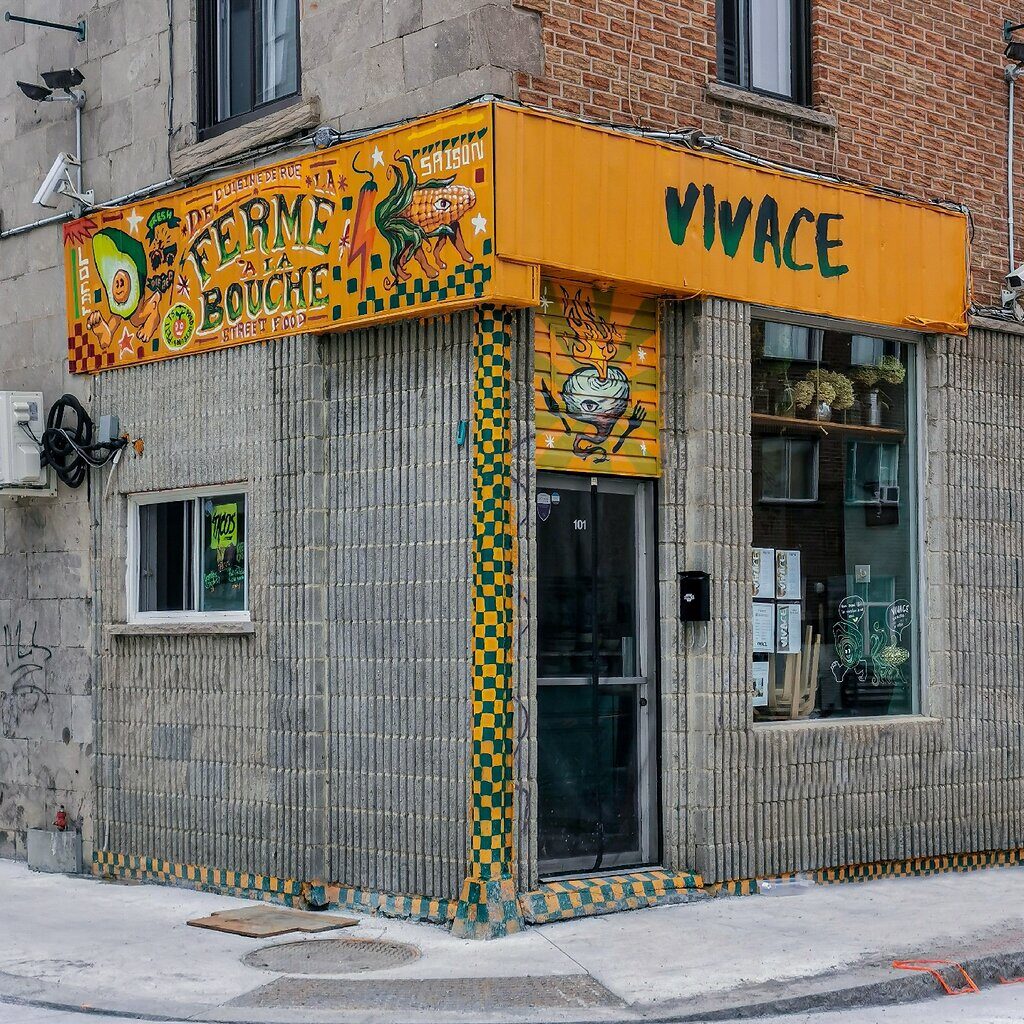
Vivace is a new micro restaurant on the corner of des Pins and Coloniale, which Chef Maurin Arellano opened last summer, replacing the Colombian joint, Mr. Empanada. Arellano sources fresh ingredients from local farms and prepares a different menu every week, cooking in an open-planned kitchen just metres away from her guests. The result? A restaurant that’s poised to thrive in Montreal’s hip Plateau.
I drop by the day before to book a table. Almost straight away, I’m admiring the vibrant-orange mural outside, designed by local community artists. The winking beetroot above the door with fire splintering out of its head is quite the head-turner, as is the corn with legs. The road work on des Pins is also finally finished. Only took them two years.
(Trip Advisor)
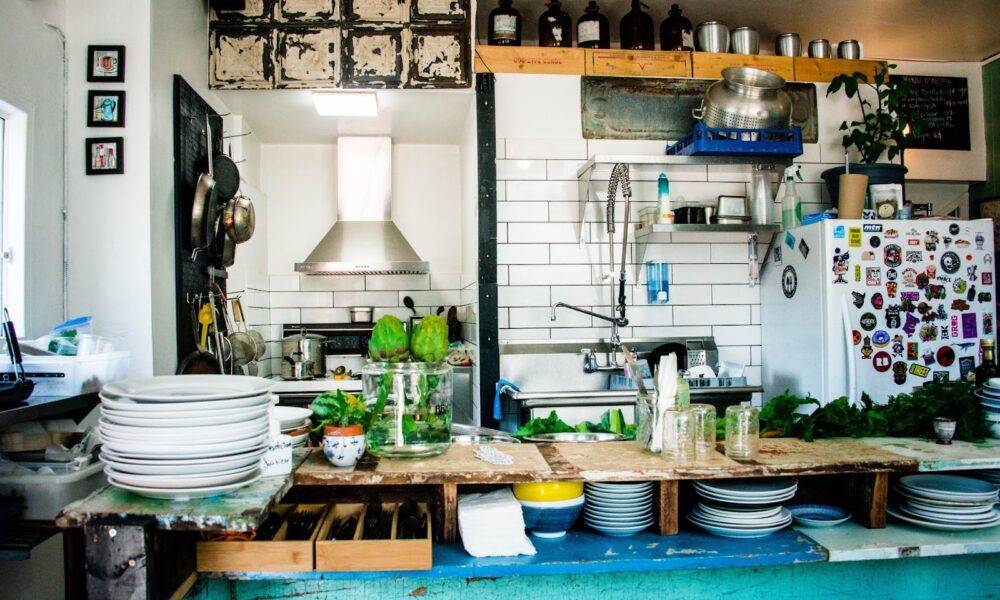
Inside, a cozy, square room with a rustic, light-blue counter and a busy, compact kitchen greets you. Two long unpretentious tables, with booths and short wooden stools, hug the corner. Artwork and postcard-sized drawings dot the walls, but utensils, like plates and cutlery stacked on the counter, and pots and pans dangling from a wall hook, serve as modest decorations, too. Then there’s this extra-large, white fridge that sits haughtily behind the counter covered in enough hippie stickers to beguile a Concordia art student for a week.
Chef Arellano, a 40-something woman originally from Mexico but who moved to Canada over 20 years ago, leaves the pretentious chef’s coat for the pretenders, dressed in an unassuming grey t-shirt and a pinstripe apron. She’s cooking for a lone gentleman in his late forties, commanding the kitchen with a humble but self-assured swagger.
After a few pleasantries, I ask hesitantly, “Do you have a table at 7:45 p.m. tomorrow?”
“Yep,” Arellano replies. “What’s the name?”
I don’t know what comes over me, but in the spur of the moment, I book under a fake name.
“James,” I assert, flinching slightly.
It sounds ridiculous. It is ridiculous. It’s the sort of thing Americans would do. I mean, who do I think I am? A spy? James Bond? Well, not exactly. The name is James, though. James North.
The next day, Allegra, my dining companion for the evening, and I arrive at 7:45 p.m. A couple is sitting by the window table, so we sit at the other table along the wall.
The menu, written in chalk on the wall, consists of a soup, three mains, and a dessert. Arellano tells me there’s no particular food genre—rather, it’s seasonal and changes every week according to the farm’s produce. She also serves local wines and beers.
In larger restaurants, chefs typically prepare your meal behind closed doors, so there’s no telling what happens. Service is also compartmentalized, with each employee doing a different role, whether it’s hosting, bussing, or taking orders. Not here. Maurin is your server-chef-owner and prepares your meal from two metres away—you can even hear the chopping.
To start, we share the vegetable chowder, which is well-seasoned, sweet, and earthy, like a forester’s zest for life. The roasted chicken with arugula pesto, potatoes, broccoli, and a slice of toasted artisan bread comes as a main. A seriously good dish. Tender, fibrous chicken, kicking with zip from the pesto, and juicy, like a good gossip session with the girlies.
Allegra gets the gnocchi, which she enjoys, and for dessert, we share the wheat-based fruit tart, which could do with a sauce or sorbet to ease the graininess. I’m a white bread eater, you see.
The pleasure at Vivace doesn’t end once you’ve finished your meal; the intimate setting serves as an affable place to continue chatting, perhaps with a glass of wine, too. Pricewise, $6 for the soup and $5 for the dessert is reasonable. $25 for the mains stretches it for students, but it’s better value for those who love food and are looking for a down-to-earth, informal setting. It really is like going to your friend’s house for dinner.
How does a piece of media become a classic? Time is certainly a factor. Whether it’s a book, movie, or a particularly captivating ensemble, classics remain relevant and hold up through changing cultural landscapes. One such enchanting “classic” emerged between the pages of The New Yorker in 1938 with the publication of The Addams Family, a series of cartoons created by Charles Addams. These cartoons, and the uncanny family featured within them, have since undergone countless iterations, from TV shows to films to a Broadway musical. And on Nov. 23, Tim Burton’s Wednesday was released on Netflix, offering a dubious addition to the Addams Family collection.
It places Wednesday in a modern setting, uniting old and new characters alike. It’s packed with references to older adaptations of TheAddams Family—like the iconic double-snap of The Addams Family theme song—but doesn’t shy away from uncharted territory, either.
Unlike previous variations, this adaptation centres around the Addams clan’s oldest daughter, Wednesday (Jenna Ortega). The show takes place at Nevermore, a boarding school established for “outcasts,” as the show dubs students with strange or supernatural abilities. Sent by her parents, Wednesday navigates the new school while developing dangerous and unpredictable psychic powers. Ultimately, she is sucked into a sinister mystery at the heart of Nevermore in a slightly tired storyline.
The new directions that the show takes may be entertaining, but they undermine the Addams Family’s trademark charm;Wednesday instills the Addams Family with an awareness of their own peculiarity. They are self-identified “outcasts” which, in many ways, erases the whimsy that made their previous iterations compelling, existing as nutty anomalies in our regular world. Wednesday shatters the old paradigm with a plot centred on the conflict between “outcasts” and “normies,” or, non-magical humans, creating a structured plot at the cost of demystifying the characters to set up social groups for easy storytelling. While this is a good way to appeal to the show’s younger target audience, it’s ultimately disingenuous to core qualities of the source material.
But where Wednesday subverts hallmarks of the Addams Family, it adds nuance to Wednesday’s character. Her previous iterations didn’t need to face significant character progression—she remained static as a reliable comedic background figure. Wednesday imbues her with a distinct character arc that uncovers a darker side to her personality, although it’s not an entirely successful evolution. Lazy attempts to make her relatable bring about the Netflix-ification of Wednesday Addams, plagued by a love triangle and I don’t want to turn out like you! parental conflicts. The show’s attempts to humanize Wednesday with played-out cliches offer no intrigue. Ortega’s impressive performance partially redeems this, capturing Wednesday’s deadpan nihilism and staying true to classic depictions of Wednesday while bringing about new iconic moments—notably, the dance sequence that has recently taken over TikTok. Even in the midst of mediocre writing, Ortega’s performance is consistently captivating and her co-stars pale in comparison.
Admittedly, I dreaded the release of Wednesday. In my eyes, Wednesday Addams is perfect the way she is. That is to say, the way she was in the early 90s films directed by Barry Sonnenfeld. Since the series is so well-loved and established in popular culture, any creative liberties taken by the creators of Wednesday would have almost inevitably faced criticism. Readaptations tend to alienate die-hard fans of the source material, but sometimes they are what continuously breathe life into a story. While I consider the Sonnenfeld films to be classics, others might say that the true classic Addams Family is the animated TV series of the 70s or the sitcom of the 60s.
Wednesday does many things wrong, but it is nonetheless a fun addition to the Addams Family canon. The show marks the timelessness of Charles Addams’ invention and paves the way for future retellings that may also, someday, be upheld as classics. It hasn’t besmirched Wednesday Addams; instead, it’s kept her cold, black heart beating.
After two years of cancelled seasons and uncertainty, the McGill men’s baseball team is finally back, and they did not disappoint. With a roster mainly composed of players in their first year of eligibility, no one quite knew what this season would hold for the Redbirds. Concerns that the team would be unable to keep up with those who played in 2021 arose after the team dropped three straight games in early September. But the Redbirds refused to let that define their season, winning 13 of their next 14. The remarkable record carried over to the Quebec semi-finals where they silenced the Université de Montréal in a double-header before facing off against Concordia (12–10) in the final. The Stingers were no match for the Redbirds as McGill swept the best-of-three series to win the Quebec championship. The impressive season was highlighted by breakout stars all around the diamond. Starting pitcher Arthur “Cinch” Smith went 4–0, leading the team with 30 innings pitched. On the other side of the ball, Jett Jarvis and Chris Bodine carried the team’s offence, slashing .377/.448/.481 and .421/.515/.491 respectively. Overall, the championship, combined with a number of impressive individual seasons, earns the Redbirds’ baseball team an A from us.
Men’s Lacrosse (8–5): A-
What can we say about the men’s lacrosse team? Records were broken, history was made, and fans were more than entertained. After dropping their season opener to the Trent Excalibur (11–1), the Redbirds went on to win their next four games, averaging a goal differential of over five. The team defeated Queen’s (7–4) in a sudden-death playoff game to advance to the Canadian University Field Lacrosse Association (CUFLA) Baggataway Cup Championship Tournament. After defeating Western (10–2) in a remarkable comeback victory in the quarter-finals, McGill faced off against the top-seeded Trent in the semis. Missing their leading scorer Cameron McGinnis due to injury, the Redbirds fell to the Excalibur for the third time this season. Despite a disappointing final outcome, the Redbirds’ first year back after two lost seasons due to the pandemic was marked by impressive individual performances. On Oct. 28, McGinnis scored eight goals, breaking the McGill record for goals in a single game. With two multi-goal games in the playoffs and four in the regular season, Isaiah Cree was named to the Baggataway Cup All-Tournament team. Samuel Macdonald was selected as the team’s lone CUFLA East All-Star, with honourable mentions Chris Parkinson and Logan Glick. With eight graduating seniors, the team is bound to look different but hopefully, the incoming rookies will avenge the ‘Birds next season.
Men’s Rugby (10–2): A+
The 2022-2023 season marked a historic one for Redbirds rugby. The team not only attended Nationals for the second time in the rugby program’s 150 years of existence, but came home with silver medals for the first time. Their 48-5 defeat by the University of British Columbia (10–3) marked their second loss in a strong and exciting season. Fourth-year Zachary Auger was named player of the game for McGill. Meanwhile, three Redbirds were named All-Tournament first-team All-Stars: Fourth-year captain Monty Weatherall, third-year Brad Hunger, and third-year Alexander Armstrong. This comes after these same players, along with three others—Alexandre Laurendeau (also named rookie of the year), Owen Cumming, and Gaspard Poiré—were named RSEQ All-Stars after the RSEQ final. The Nationals final play marked an emotional last game for over a dozen seniors on the team. Redbirds rugby was phenomenal this year, setting an example for varsity athletes both on and off the field while giving fans something to cheer about all season long. For both their play and their overall impact on the McGill community and beyond, with activities such as teaching coding at an elementary school, we award men’s rugby the coveted A+.
Cross Country: Martlets B+/ Redbirds A-
With the women only having enough runners to score as a team in one meet this season, grading the team as a whole is quite difficult. However, Sophie Courville and Ann-Rebecca Drolet stood out on the Martlets’ side as both runners qualified for U Sports Nationals and earned RSEQ all-star status. Second-year Sophie Rashid-Cocker also put up some impressive races throughout the season, finishing second for the Martlets at the McGill Open and placing fourth overall at the Sherbrooke Invitational. While the team is small, they are mighty, and for that The McGill Tribune gives the Martlets Cross Country team a valiant B+.
While the men’s team consistently had enough runners to score, they lacked depth for much of the season. When three of the top runners were taken out of the equation, as was the case at the Rouge et Or Interlocking Meet, the team was no longer competitive. However, four runners earned RSEQ All-Star honours, there were several strong team finishes throughout the season, and an impressive end to the season at Nationals. Therefore, the Redbirds score slightly higher than the Martlets with an A- overall.
Women’s Soccer (7–6–3:) B
With a record just a lick above .500, the Martlets soccer team had a very average season earning them a very average B. There was little to complain about early on as the Martlets opened their preseason with a win over the Atlantic University Sport (AUS) defending champions, Acadia University. With rookie Sophie Guilmette, a transfer student from the NCAA Division I Vanderbilt, between the pipes, all signs pointed to a promising year for the Martlets. After dropping their first RSEQ regular season game to UQÀM, the Martlets bounced back and forth between wins and losses. The squad finally strung together back-to-back wins in late September but was unable to maintain the pace, finishing off the month with a draw. The Martlets headed into the RSEQ semifinals against Laval (10–1–3) with a 2–2–2 record in October. Despite falling 1-0 to the Rouge et Or, many individual Martlets had standout showings. Midfielder Mara Bouchard was named to the RSEQ All-Star first team and U Sports All-Canadian second team, while defender Stephanie Hill was given the RSEQ second-team All-Star honours. As for the rookies, midfielder Chloe Renaud made the U Sports National All-Rookie team, the RSEQ second team, and the RSEQ All-Rookie team alongside defender Giselle De Leon.
Men’s Football (1–7): D
For Redbirds’ football, D stands for do not disturb. As in, do not disturb their two consecutive years of ending the season with a 1–7 record. Keeping in this tradition, we, at The McGill Tribune, also do not want to disturb the D grade they got in last year’s Varsity Report Card. Between their home opener and the end of the season, their only win was a 50-36 finish against Sherbrooke. Despite the team’s overall performance, four stand-out players received All-Star honours from RSEQ: Second-year offensive line Zachary Aboud, third-year receiver Darius Simmons, and first-year defensive back Benjamin Labrosse, first-year quarterback Eloa Latendresse-Regimbald. We look forward to seeing how this team evolves considering their impressive young players like Regimbald, who was named RSEQ most outstanding rookie and RSEQ offensive rookie of the year. As the third-ever McGill player to win the Peter Gorman Trophy, Regimbald has left fans excited for the team’s future. Until then, we wish them a terrific off-season and hope the Redbirds football squad is not getting too comfortable in their current funk.
Japanese-American singer-songwriter Mitski’s sixth studio album, Laurel Hell, comes off the back of her three-year hiatus and is an artful collection of head-bopping pop numbers and slow, narrative ballads. Though veering more toward the mainstream than her previous albums, throughout this record, Mitski tackles her discomfort with her role as an indie-rock icon and the hardships of staying true to oneself in the music industry. Despite critiques that Mitski has become a “mainstream sellout” with her turn to conventional sounds such as bright 80s pop beats, Laurel Hell manages to wow with tracks such as “Heat Lightning” and still impresses self-proclaimed cool kids everywhere.
Kendrick Lamar, Mr. Morale & the Big Steppers – Yash Zodgekar
(latentsrecords.com)
Kendrick Lamar’s latest release finds him at his most confessional, reflecting on themes like fatherhood, sexual addiction, and celebrity worship through the lens of his experiences in therapy. The result is a record of great emotional poignance, once again demonstrating Lamar’s remarkable poetic skill. Sonically, the 18 tracks presented are remarkably diverse, melding jazz samples, trap beats, and orchestral arrangements, sounding like no one else in the process. Mr. Morale & the Big Steppers is an essential record for any hip-hop fan this year.
Harry Styles, Harry’s House – Dana Prather
(russelredrecords.ca)
The May release of Harry Styles’ Harry’s House kicked off a summer of supreme new music, taking listeners on a leisurely stroll through the pop star’s daydreams and reflections on love. Standout track “Late Night Talking” infuses its 80s-inspired beat with the singer’s characteristic charm, while the woefully-neglected B-side, “Satellite,” supplies some of the album’s best sonic moments. While the lyrics can leave something to be desired (looking at you, “Cinema”), the former One Direction star’s much-anticipated third solo album provided enough blissful beats to keep us moving and grooving all year long.
Beyoncé, Renaissance – SuzannaGraham
(nme.com)
Queen Bey reaffirmed her reign on the music industry with her chart-topping seventh studio album Renaissance. The album revives a disco era, encouraging uninhibited sweaty dance party vibes that the Bey-hive was missing during the height of the pandemic. Beyoncé strives for the future, especially in “Alien Superstar,” a utopian track that mixes poetry and singing while oozing confidence. Beyoncé’s bops are better than ever with her raspy vocals, club beats, and self-love lyrics.
Films
Everything Everywhere All at Once – Dana Prather
(imdb.com)
Both a fan-favourite and critical darling, A24’s Everything Everywhere All At Once is a rare piece of media that everyone seems to agree on: This film is a messy, mind-bending masterpiece. Written and directed by Daniel Kwan and Daniel Scheinert (collectively, ‘Daniels’), the film blends sci-fi, action, comedy, and domestic drama to offer a fresh take on the multiverse concept. In a career-best performance, Michelle Yeoh portrays an immigrant mother attempting to do her family business’ taxes while battling bizarre, otherworldly enemies. Everything Everywhere All At Once will make you laugh, cry, and philosophize––sometimes all at once––for its entire 140-minute runtime.
Marcel the Shell with Shoes On – Yash Zodgekar
(cinecenta.com)
Dean Fleischer Camp’s directorial debut tells the story of Marcel (Jenny Slate), an anthropomorphic one-inch-tall shell. When filmmaker Dean discovers Marcel, who has innocuously been looking after his grandmother in an empty Airbnb, he becomes an internet sensation and must confront the wonders and woes of the vast outer world. Presented in a mockumentary format that deftly combines animation and live action, the film is characterized by its whimsicality and tenderness, conveying much about the human condition from the unique outsider perspective of its premise.
Triangle of Sadness – Suzanna Graham
(vanyaland.com)
Ruben Östlund’s film Triangle of Sadness, Cannes’s 2022 Palme d’Or winner, could have been rightfully named The White Floatus. Sigh in frustration at the ultimate will-they-won’t-they (break up) influencer couple Carl (Harris Dickinson) and Yaya (Charlbi Dean), who would rather continuously bicker about who paid on a previous date than enjoy their free tropical vacation. Of course, with the perpetually drunk Captain Thomas (Woody Harrelson) at the helm—who always slays in his chaotic roles—it’s no surprise that the cruise gets derailed. So sit back, relax, and get ready to use your promotional barf bag.
Top Gun: Maverick – Charlotte Hayes
(menshealth.com)
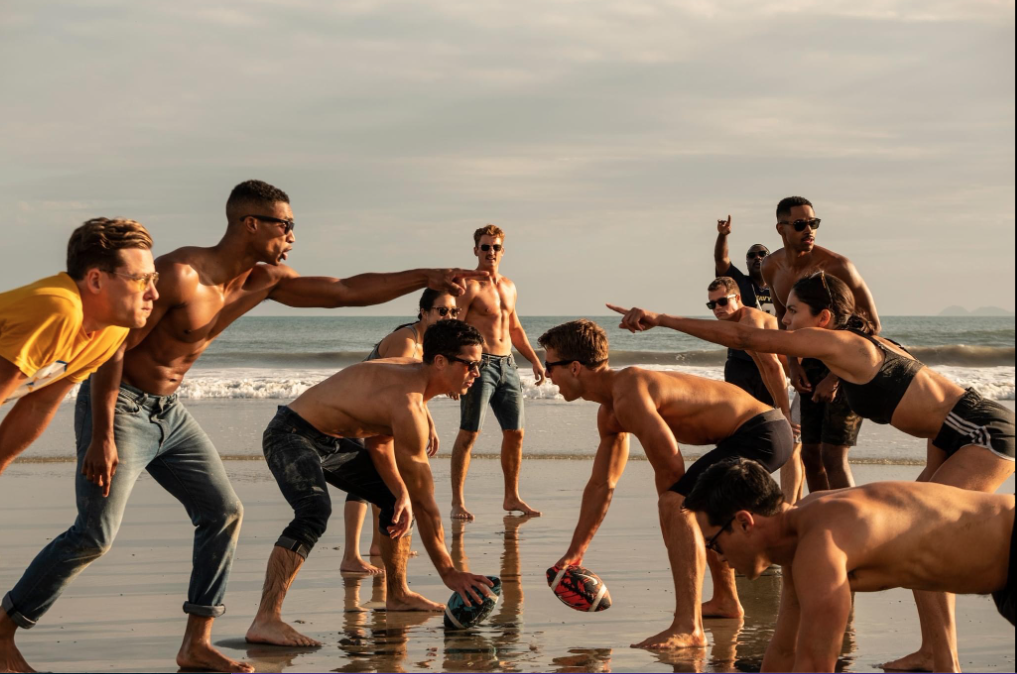
Tom Cruise is back, reprising one of his most iconic roles in this summer’s Top Gun: Maverick. Set 30 years after the original film, the film follows Maverick as he is called back to his alma mater to train a whole new generation of elite fighter pilots. Although returning cast members Cruise and Val Kilmer give commendable performances, the next class of Top Gun pilots, including Glen Powell, Monica Barbaro, and Miles Teller, outshine them in their breakthrough performances. With action-packed training montages, motorcycle rides, and musical callbacks (shout out to Kenny Loggins), the movie walks the line perfectly between nostalgia and a new era.
TV Shows
The White Lotus (Season 2) – Charlotte Hayes
(forbes.com)
Bodies are in the water and theWhite Lotus has opened its doors again—but this time in Sicily! The HBO critical darling is back for its second season with an almost brand-new cast (except for Emmy winner and pop culture icon Jennifer Coolidge) and a gorgeous new locale. Once again, creator Mike White wrote a season with the same electric energy as reality TV while simultaneously delivering some of the most interesting class commentary currently on television. The White Lotus delivers an edgier take on the format we came to know and love last season.
The Bear – Ella Buckingham
(thekitchn.com)
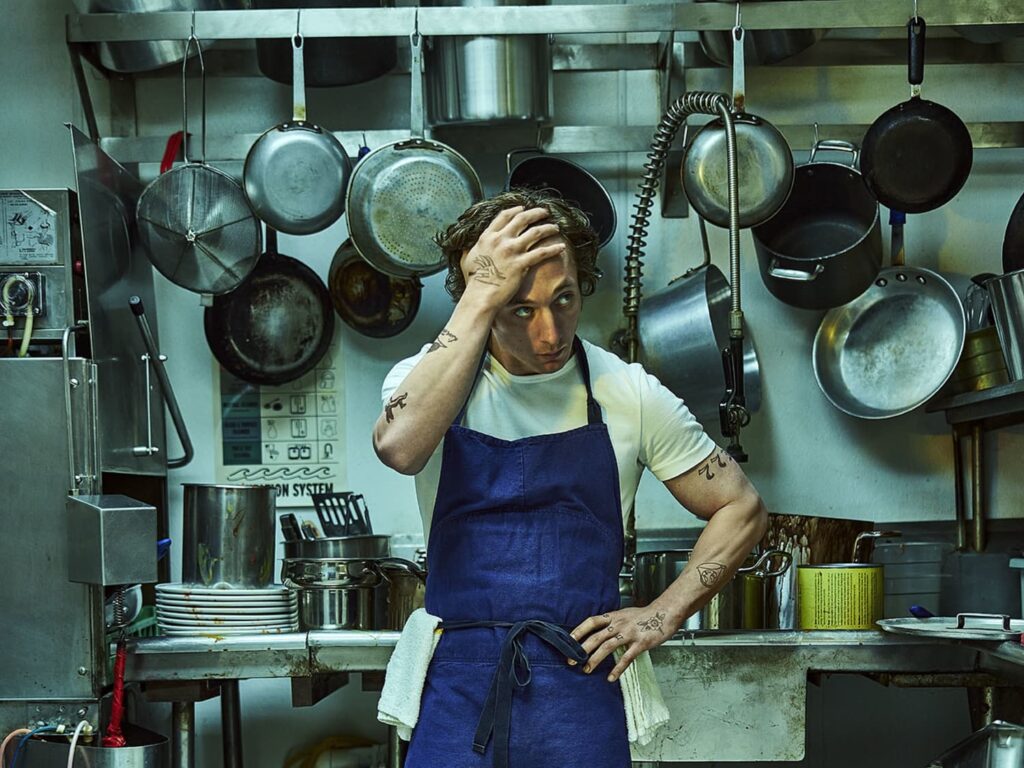
In a lead role that is casting Shameless’ Jeremy Allen White to new celebrity heights, the dramedy The Bear revolves around a young chef (White) who, in the wake of his brother’s death, leaves the coveted world of fine dining to rescue his family’s Italian beef sandwich shop. Raw, sarcastic, and nail-biting at moments, this series takes an unabashed look at the reality of the restaurant business and the struggle to stay afloat—both financially and emotionally—amidst the devastation of loss.
Stranger Things (Season 4)- Yash Zodgekar
(netflix.com)
Stranger Things’ fourth season elevates the show to another scale, boasting gorgeous special effects, feature-length episodes, and settings from California to Russia. What makes this season the best yet are the human relationships at its centre. Showrunners the Duffer Brothers also use Vecna, a new villain with a more complex and nuanced backstory than those of previous seasons, as a means to delve deeper into the nuances of their young protagonists, exploring more mature themes as they enter high school. Season five cannot come soon enough!
Wednesday – Suzanna Graham
(menshealth.com)
Funny, fierce, and a little freaky, Wednesday puts a new spin on the whimsical Addams Family, in which the titular daughter, Wednesday (Jenna Ortega), joins Nevermore Academy to hopefully fit in with her fellow outcasts. The show subverts the expected family-oriented plot, allowing Ortega to shine as a surprisingly complex angsty teen who somehow smiles more than she blinks. With plot lines involving American witch-trial lore and bug-eyed serial killing monsters, Wednesday is Netflix’s newest binge-able hit. And for enjoyers of the iconic movie Addams Family Values, make sure to catch Christina Ricci’s whimsical cameo as Mrs. Thornhill.
WORST OF
Albums
Machine Gun Kelly, mainstream sellout – Ella Buckingham
(loudwire.com)
The McGill Tribune’s Worst Album of 2022 by a whopping 32 per cent vote (oof), this 16-track album by Machine Gun Kelly was unfortunately released 20 years too late. Heavily inspired by early 2000s pop-punk beats and tackling all subjects from sex to drugs to war, this collection is reminiscent of a pissed-off Avril Lavigne, but in a disingenuous, lacklustre way (his track “emo girl (feat. WILLOW)” and “Sk8er Boi” are just a touch too similar). If you’re looking for mindless cliched bangers, however, or want to time-travel back to the release of Mean Girls, then this album fulfills that role scrumptiously.
Films
Don’t Worry Darling – Charlotte Hayes
(people.com)
Don’t Worry Darlingwas one of 2022’s most highly anticipated films but somehow also its biggest flop. With a star-studded cast, high-concept script, and broad anticipation for Olivia Wilde’s sophomore directorial effort, it felt like a surefire recipe for success. Instead, the film delivered some half-baked insights on second-wave feminism packaged in a blatant ripoff of the Stepford Wives. The most interesting thing about this movie was its absolutely chaotic press junket, but even the endless tabloid fodder couldn’t save this trainwreck.
TV Shows
Dahmer – Dana Prather
(bbc.com)
In an age where true crime documentaries, movies, and podcasts have gained rapid but questionable popularity, it’s no surprise that Dahmer – Monster: The Jeffrey Dahmer Story has been a commercial success with mixed critical reception. Indeed, the Netflix limited series, which presents a dramatic retelling of the life and crimes of the infamous serial killer, garnered an astounding 192.6 million watches in its first week alone. Still, it’s important to recognize the very real danger posed by shows like Dahmer: They romanticize abhorrent criminals and retraumatize the families and friends of real-life victims.
Award-winning playwright, novelist, actress, and broadcaster Ann-Marie MacDonald has written her “youngest and most joyful” novel to date. Fayne is set in 19th-century Britain and yet entirely modern in feel. The book is a sprawling, ornately detailed, and genre-defying epic that follows the precocious Charlotte Bell as she grows up on a vast, secluded estate on the borderland moors. Her doting father’s will to keep her isolated from society, owing to her mysterious ‘condition,’ wars with her insatiable curiosity.
The McGill Tribune had the chance to speak with MacDonald about her new novel. A condensed version of our conversation follows:
CS: Fayne is an unapologetically long book [736 pages]. What is the magic of a long book for you?
AMM: Well, I prefer the term big. And I love this saying that’s going around: ‘I love big books and I cannot lie’ [….] So with regard to writing a big book, I write the kind of thing that I love, and I know that readers love to get immersed in a long story.
CS: It’s a defiant choice in a media scene that’s dominated by small bites. Do you think we still have the attention span for them?
AMM: This idea that younger people don’t have an attention span, I think it’s ridiculous. I don’t buy it [….] Yes, we can bemoan the kind of attention that’s being fractured and starved and yet lured over and over again in an addictive framework, but it isn’t new [….] It seems like every decade or so, someone announces the death of the book. It’s never true [….] People love stories.
CS: Fayne is full of characters that are both familiar and not. Can you explain the choice to employ ‘tropes’? What do they help you to achieve?
AMM: For me, as a writer, I go: Oh! Here’s my toy box full of literary devices, what could be more fun? It’s the absolute delicious delight of the Victorian novel, that’s what sustains me. And there’s that familiarity, which is so inviting […] and then within that I can introduce all kinds of unnerving and unfamiliar things [….] There’s nothing like a period piece to tell a very contemporary story.
CS: You manage a very faithful rendering of Charlotte’s intersex identity and avoid exoticizing it. What was it like to write from her perspective?
AMM: The late Victorian time is one of extreme categorization, not unlike our own world where divisions among beliefs and identities are becoming so narrow. So it was crucial to say that Charlotte is normal, it’s the world that has a problem [….] I do immersive research and the history of women and gender and bodily non-conforming people in the medical gaze is something that’s very, very important to me. But the spark comes from within me as knowing from a very young age that I was wrong in the world. And the idea of looking through the eyes of somebody who’s born with an intersex trait has been quite compelling to me for a very long time [….] It’s not an exotic quality. That’s why I’ve decided not to treat it as a “spoiler”. That’s just who she is, that’s her body. That’s normal. It’s the world that has a problem and is going to make it a problem for her.
CS: Threaded throughout Fayne are these symbols of ambiguity. Why was it important to engage in the marginal and nameless?
AMM: Because there’s nothing more queer than nature. Nature flourishes at the margins, it favours blurred lines [….] It is wonderful to put names to the world, but if the goal of naming is just to catch things, pin them, and stick a name on them, then you’re killing everything you’re naming.
Ann-Marie MacDonald is first and foremost an entertainer and her loyalties lie with her readers. In her own words: “I just wrote a big book. If you start reading it, you might wanna get lost in the journey.”
Fayne is available in bookstores in print and in audio-book form, read by the author.
Canadian university athletes’ collegiate careers are short. Under current U Sport eligibility rules, athletes are restricted to only five years of eligibility, providing a challenging timeline for those looking to make an impact on their programs. Individuals are given a year—including the off-season—to take on the mantle of captain or president, to either reform or reinforce structure and values within their teams. The McGill Tribune sat down with Martlets rugby captain Davine Yang, Redbirds hockey captain Taylor Ford, and Redbirds rugby co-president Owen Cumming to discuss their paths to leadership in their respective programs.
For some, such as Ford and Cumming, leadership opportunities came early, as seen through their respective histories within the Halifax Mooseheads and the Shawnigan Lake School rugby program. Others, such as Yang, gradually ascended to their leadership positions due to their experience and seniority.
“I kind of just stepped into it,” Yang told the Tribune. “As the years progressed and everyone else became my rookie […] it kind of transitioned [from] being the baby of the team to being the one that has been around the longest and so everyone kind of looks to you to troubleshoot.”
Becoming the team troubleshooter comes with many challenges—both expected and unexpected. Cumming detailed that the COVID-19 pandemic was a major obstacle to organizing Redbirds rugby, with teammates spread out across the globe. Even outside of navigating a global pandemic, leaders are often faced with the burden of making a direct impact on their programs. Yang recounted the pressure she felt to reform the team this season.
“[With] every captain, there’s pressure to do well,” she admitted. “I think the pressure that I felt was on me this year was to try to start turning us around.”
Yang, Cumming, and Ford all expressed feeling privileged to take on leadership roles. However, in challenging circumstances, like those detailed above, they all emphasized that support from those around them was paramount for growing into their current positions.
“My captain at the time took me under his wing and we had good discussions about what it is to be a leader,” Ford explained. “I do have to give a lot of credit to my past leaders and guys I’ve looked up to [….] It’s definitely kind of like a trickle-down effect from leader to leader.”
“My biggest struggle was learning how to do what’s best for the group and not what I think was best for the group,” Cumming said, emphasizing the importance of his peers and co-president Peter Demers. “When I thought that something went well in my head, [I would use] guys in our leadership group as a sounding board.”
One cannot discuss any team sport without talking about culture. A team goes beyond a group of people who play the same sport; it’s about a community that supports and aims to better its members. This takes on a variety of forms: Giving back to the sport, competing against like-minded opponents, focusing on core values, or just pure love of the game. All of these and more are considered by leaders striving to unite their teams.
“You don’t necessarily need to always get along,” Ford said. “But as long as there’s respect towards each other, that’s when everybody can start going in the same direction.”
“I came into this year hoping that we could reset the culture,” Yang stressed about her aspirations to inspire her team. “Getting players to be less extrinsically motivated, to be more intrinsically motivated, to […] be better than their past selves.”
“It’s thinking about the players that wore the jersey before you, the players that will wear it out for you, and what you can do to move the needle during your time wearing it,” said Cumming. “It’s less what sets the player apart and more what the player wants to offer. I think that that’s what matters.”
“Culture” and “leadership” are often used as buzzwords in sports, but their real-life manifestations instill pride in all members of a program. It is critical that varsity leaders build on the foundations of the strong culture established before them, or work to develop one themselves, because the impact of a strong leader reverberates far beyond their eight-month term. It doesn’t necessarily take having a leader to buy into a culture, but it takes leadership to provide a culture that matters to its members.
The Montreal Underdocumented Languages Linguistics Lab (MULL-Lab) houses linguists from McGill and the wider Montreal community who focus their research on languages that are considered to be at risk of extinction because so few people speak them. For example, MULL has ongoing research on Inuktitut and Tlingit, two Indigenous languages from Nunavut and Alaska, respectively. Underdocumented can also refer to languages with a stable number of speakers but a relatively small amount of academic material written about them. Languages in this category include Igala in Nigeria and a number of Mayan languages spoken throughout Central America.
Regardless of the unique situation of a given language, MULL researchers approach each language with the goal of identifying patterns, understanding the inner workings of its grammar, and untangling nuances that have not been previously identified.
Elicitation is one of the primary ways linguists investigate how a language works. This method allows linguists to formulate hypotheses and questions about the grammar of a language and test them systematically by collecting direct feedback from native speakers.
“It’s basically an interview. We ask [a native speaker], ‘How do you say this? How do you say that?’ and we write it out on the board in chalk. Using that, we trace out the outlines of the grammar,” explained Terrence Gatchalian, a PhD student in linguistics at McGill, in an interview with The McGill Tribune.
But elicitation has its limits. “A speaker’s knowledge of their language is incredibly deep, it’s very far reaching, and at any given point, you’re only going to get a small corner of that linguistic knowledge,” Gatchalian said.
One way to get a broader view of a language is to work with a corpus, which is a collection of speech and writing from native speakers.
“When you’re looking at corpora, you get a good distribution of what kinds of things that a speaker will say if they want to express [some] meaning,” Gatchalian said. “You get the benefit of having very naturalistic data—these are things that someone said.”
McGill’s Department of Linguistics is primarily focused on studying language data in support of theoretical work, but Jessica Coon, a professor in the department, points out that a linguist’s ethical obligations increase when they start working with endangered languages.
“I think there’s an added responsibility when doing theoretical work with underdocumented languages to make sure that the outputs of that work––while they might contribute to linguistic theory and they might also go in journals that are really theoretically oriented––can also be communicated to community members in an accessible way,” Coon said in an interview with the Tribune.
Linguists have not always taken this responsibility seriously, engaging instead in extractive linguistics—the practice of going into a community, studying the language, leaving, and eventually publishing the results in a journal, typically in a manner that’s inaccessible to members of the community who are directly impacted by language extinction.
Over the last few decades, however, linguists have shifted towards a more collaborative approach with communities of speakers. This means valuing the work done by native-speaker linguists, taking community goals into account when designing research projects, and ensuring that any gained linguistic insight is shared with the source community.
“It’s really just like a completely new learning process every single time, because every community is going to have different challenges, every community’s going to have different goals,” Gatchalian said. “As someone who tries to do this work, I think it’s important to be really flexible and open minded.”
Prioritizing the goals and needs of speaker communities is especially important given that many of those communities are in the process of completely losing their language. Of the roughly 7,000 languages spoken globally, over 40 per cent, or more than 2,800, are endangered, and many of these endangered languages are spoken by Indigenous peoples around the world. In response to the crisis, the United Nations Educational, Scientific, and Cultural Organization (UNESCO) has declared the decade from 2022 to 2032 to be the International Decade of Indigenous Languages (IDIL). Through the IDIL and other initiatives, language documentation work around the world is trying to keep pace with the rate of language loss.
“The time is really now to be doing this very important work, because for many languages around the world, they’re in a very critical state where the language is not being passed on to new generations of speakers in the home,” Coon said.
At McGill, MULL is one place where this work is happening, but there is currently no specialized support for those interested in language revitalization. In 2021, $3 million of a larger donation from Gerald Rimer was allocated to establishing the Institute for Indigenous Research and Knowledges at McGill, which will include a lab specifically dedicated to the revitalization of Indigenous languages.
This institute will bring some much-needed focus and structural support to the study of Indigenous languages spoken in and around Montreal, such as Kanien’kéha.
“When you look at the universities that support programs related to Indigenous languages or revitalization or conservation efforts, there aren’t very many of them, even though there are communities whose languages are in need of that kind of support all over the place,” said Willie Myers, a graduate student in McGill’s linguistics department, in an interview with the Tribune.
Language revitalization and conservation is a pressing issue globally, but especially so in Canada, where there are more than 70 languages across 12 language families.
“In many respects, the Indigenous languages of Canada are as different from each other as they are from any other human languages. Because of this, it’s very difficult to generalize about Indigenous languages in this country,” James Crippen, who is Tlingit and a professor in McGill’s Department of Linguistics, wrote in an email to the Tribune. “But we can confidently say one general thing: All Indigenous languages in Canada are endangered or threatened.”
All of the language conservation work being done by native speakers, community members, and outsider linguists raises the question: Why is it important to preserve endangered and threatened languages? In other words, what is lost when a language disappears?
“There are […] fuzzy claims about how the loss of the language takes with it some mysterious connection to the world or to nebulous, often magical ideas that nobody wants to actually explain,” Crippen said. “Although this kind of discourse might be well intended, it’s honestly just as harmful as the rhetoric about how our languages are bizarre.”
Culturally and linguistically, there are compelling reasons to care about language loss. For example, as Crippen explained, fluency in a language is often the only way to appreciate the verbal artistry of a language’s stories or songs. On the linguistics side, documenting as wide a variety of languages as possible is fundamental to making accurate claims about language. One goal of linguistics is to make generalizations about the ways that all languages function and what the underlying patterns are. In order to do this work accurately, it’s imperative that linguists look at diverse languages. But at some point, these lines of reasoning must go beyond the academic.
“First and foremost people use their languages for everyday life,” Crippen wrote. “I tell learners of Indigenous languages that they should learn how to wipe their butt in the language, learn how to pick their nose in the language, learn how to fight in the language, and learn how to love in the language. It’s those ways of describing ordinary lived experience that are the most visceral and the most human.”
Since March 2020, the comings and goings of COVID-19 have altered the structure of our social lives. For nearly two years, people of all ages reduced their in-person activities and turned to an online world of family gatherings, end-of-year parties, and even dating. Some embraced this shift in dating culture to challenge themselves. Others met this change with angst and uncertainty but adjusted to the conditions as the pandemic progressed. Regardless, the pandemic brought forth new ideas and practices surrounding the dating world and changed how people viewed their love lives.
New and creative ways of meeting people
COVID-19 measures restricted meeting at bars, restaurants, clubs, and other social gatherings for extended periods. Ultimately, people had to rethink how they spent time with others.
“Everything was closed, so coming up with dates required a bit more creativity,” Felix Tymoshenko, U1 Management, shared in an interview with The McGill Tribune. What once was a typical dinner-then-drinks outing was reinvented into going on outdoor hikes, getting takeout from a restaurant, or participating in virtual games such as escape rooms.
Many consider the unconventionality of pandemic dates to be a good thing: It allows for change and a way to think outside the box. It’s also, arguably, a better way to get to know someone. While the typical dinner-and-drinks setting is a comfortable option for many, it’s easier to discover someone’s true personality while participating in an engaging activity. It also makes dating more appealing to those who find settings like coffee shops or bars dull and repetitive.
“There are endless possibilities of things to do, many of which I never considered before COVID-19: Hiking, biking, or even swimming,” Émilie Fortier, U1 Arts, said.
Changing attitudes: Higher standards and clearer intentions
Dating coaches and experts have also found ways in which attitudes toward dating have shifted over the last few years: People have set higher standards when it comes to dating. For example, Hinge Director of Relationship Science, Logan Ury, has discussed how alone time spent during COVID-19 isolation allowed individuals to gain insight and clarity on different aspects of their lives. Known as the “Hard Baller” trend, people are more likely to be upfront about their dating intentions as soon as their first or second date with someone.
Meeting romantic partners: Shifting from “in person” to online
Although the pandemic sparked creativity and a better sense of self-understanding, one thing remained a challenge: Meeting people. In-person meetups were limited, which prompted many to turn to dating apps like Tinder, Bumble, or Hinge. Although they might seem like a convenient and accessible way of meeting others, criticisms abound about online dating apps. Their rise in popularity has contributed to looks being an overvalued aspect in current dating culture through the abundance of profiles to look through, almost like a game. The ease with which one can swipe left or right prompts users to dismiss potential partners with whom they might share affinities but who don’t perfectly adhere to contemporary and often Eurocentric beauty standards.
Are online dating and “in-person” dating mutually exclusive?
The dating app user experience invites further questioning of their impacts on users’ day-to-day lives. Many wonder whether staying “safe behind a screen” affects people’s ability to approach someone they find attractive in real life or contributes to negative feelings of self-worth. Does creating a perfectly curated version of one’s life on dating apps make users reluctant to meet people in real life out of fear of exposing the less appealing parts of their personality?
Apps, such as Hinge, offer “prompts”: Open-ended questions that help users enhance their profiles and attract people with similar tastes or interests. This function certainly diversifies dating profiles from their usual content type, which helps divert users’ attention from looks to personality traits. However, it remains unclear if such prompts will help counter the appearance-based focus of modern dating culture. Will online dating prevail in the post-lockdown world? Only time will tell.
As a result of staffing shortages, McGill’s central sexual violence support service, the Office for Sexual Violence, Response, Support, and Education (OSVRSE), was forced to close temporarily during the Fall 2022 semester. All active cases were immediately transferred to the Office of the Dean of Students (ODoS), whose case managers have been trained to provide support to survivors and are prepared to assist both with academic accommodations and priority referrals to the Wellness Hub.
OSVRSE was created in 2016 as the central support service under McGill’s new Policy Against Sexual Violence. Since its inception, however, it has only been staffed by a maximum of three permanent employees at a time. During Summer 2022, after an employee went on leave, OSVRSE was down to one permanent staff member. According to sources interviewed by The McGill Tribune, OSVRSE was forced to close in early fall so the employee could catch up on the paperwork they were legally required to maintain for ongoing sexual assault cases.
Given that the ODoS has a student-centric mandate, Arts Senator Sam Baron is confident in its ability to support survivors in the interim. However, Baron is troubled by the lack of transparency which he believes comes from higher-ups in the senior administration. He told the Tribune that he only realized OSVRSE was closed after seeing that bookings were unavailable for the entire month of October.
“The [senior administration is] very risk-adverse and they don’t want McGill to get bad press regarding its resources for students who have experienced sexual violence, especially because OSVRSE is the primary support mechanism,” Baron said. “But […] I think it’s disingenuous to not tell students when resources have been moved through the university because these resources are so important.”
The Sexual Assault Centre of the McGill Students’ Society (SACOMSS)—a volunteer-run organization that offers support services for survivors—also takes issue with McGill’s lack of communication surrounding the change. A SACOMSS representative told the Tribune that they were only recently informed that OSVSRE responsibilities had been shifted to the ODoS.
“It is our hope that in the future, the McGill administration will proactively inform on-campus resource-referral services and the student body of any changes that may have a significant impact on survivors,” they wrote via email.
Since being notified of OSVRSE’s closure, the Students’ Society of McGill University (SSMU) and SACOMSS have been collaborating with the ODoS to reduce confusion for students seeking support. Maya Willard-Stepan, SSMU’s mental health commissioner, told the Tribune that after she was informed on Nov. 22, representatives from SSMU and SACOMSS met with the Dean of Students, Robin Beech, on Nov. 29, to clarify on OSVRSE’s website that its services had been rerouted to the ODoS. They also advocated for a public announcement to go out to the McGill community, which was sent out on Dec. 4.
While both Willard-Stepan and SSMU vice-president University Affairs Kerry Yang believe communication from the administration could have been improved, they stressed the importance of letting “bygones be bygones” and focusing on ensuring that survivors can continuously access support services.
“We’re trying to make sure the resources are as robust as possible before OSVRSE comes back, then we can transition to a period where OSVRSE can once again provide support at a much better capacity than before,” Yang said in an interview with the Tribune.
Over the coming months, OSVRSE will expand staffing from two to five permanent positions, with hiring currently underway. Although Willard-Stepan wishes OSVRSE was never in a position to close in the first place, she is glad McGill is taking the opportunity to revamp the office.
“I am really looking forward to working on rebuilding that relationship in the future,” Willard-Stepan said. “I’m really looking forward to meeting new caseworkers and ensuring that […] [OSVRSE’s] structure is sustainable enough that this never happens again.”
Those in need of support for sexual violence at McGill can reach out to the Office of the Dean of Students to set up an appointment with a Case Manager by emailing [email protected] or calling 514-398-4990.
As I go through my last few days as a McGill undergrad, I cannot help but look back at my time in university with a sense of incredulity and nostalgia. I am still taken aback when walking by the infamous Leacock 132 lecture hall, struggling to remember any useful piece of information from POLI 200 three years ago. What strikes me most is how normal walking through campus feels, when just a few years ago, this place was so deeply unfamiliar. It took me longer than expected to adapt to university life. The cold, the large classrooms, and the dorms destabilized me. I was used to perfect Mexican weather, classrooms full of friends, and a quiet life with my mom and my dog. Suddenly, I was surrounded by screaming frat boys and empty bottles of Black Flys.
I cruised through the discomfort of my first semester in a half-awake state, and when I had to return home for lockdown, I almost forgot I had left at all. Every post-lockdown semester at McGill felt eerily similar to the first one, but in retrospect, the changes I have gone through are undeniable. I am surrounded by friends, a partner I love, a yapping dachshund, professors that challenge me, and coworkers I admire. All the things I was hoping for when I first got my acceptance letter ended up coming true—though maybe a couple of years later than expected. Before my semester, and my degree, officially end, I am slowing down a little bit and appreciating my growth. These past few years may not have been the best of my life, but they were certainly the most transformative, and that is something to be grateful for.
Chloé Kichenane, Staff Writer
“On this day, two years ago.”
It’s 8 a.m., and my body is sinking back into slumber. Yet, the notification shakes me and I need to know. Who was I two years ago?
As I scroll through the hundreds of pictures flooding my Snapchat memories, an odd feeling hits me. Some people would describe it as looking into a mirror and seeing a past version of yourself looking back. But to me, it feels more like looking into a stranger’s window, into a parallel dimension where I am someone entirely different.
Sometimes, I find myself thinking about home, about who I was before coming here. I think about the people I used to know. I wonder where they are now and where they’re going. As I let my thoughts wander, I realize this past life doesn’t feel real anymore, almost like a very long dream of which I only recall a few glimpses.
Maybe it’s simply the struggle of every university student who leaves home, but being away transformed me—and I get a reminder of it every time I step into my old bedroom, a place that doesn’t feel like mine anymore. It seems like everything from the pictures on the walls to the books on the shelves belonged to someone else. What was once the centrepiece of my life now seems like a still picture, as if I had never actually lived there. So I wondered: Where is ‘home’ if not the very room I grew up in?
For all those for whom going back has caused an existential crisis, here’s a reminder: ‘Home’ is an idea in constant flux. Moving away, I realized that home could be anywhere. It is the wooden staircase of my high school, the cafés my friends and I stayed in for hours, even the street by the train tracks where I’d walk my dog. But home is also 5,000 kilometres away as I sit right here in Montreal, scrolling through pictures from a different time.
Keith Baybayon, Contributor
I moved to Canada from the Philippines over 10 years ago, not knowing English or anyone outside of my immediate family. Coming from a small town, it was challenging to live in a big city such as Toronto. Yet here I am today, living independently in Montreal, learning French, and making new friends. I became someone I would never have imagined.
Transformation is constantly happening around us. The transition from autumn to winter is a prime example. Changes like this can sometimes come fast, like the flipping of a switch that brings light to a room. Some changes, however, can take months or even years.
As someone who is learning French, it takes time to indulge in French culture and speak the language naturally. Moving to Montreal encouraged me to pursue learning French so that I could communicate with my peers and find a job. It takes dedication and ambition to achieve growth like this.
Some may not have seen snow until having moved to Montreal, officially transforming into either a snow-lover or snow-hater. Maybe some took a bird course to achieve a good grade and ended up loving the content and pursuing similar studies; that is a transformation in and of itself. Some people may not notice in the moment, but everyday decisions lay the groundwork for becoming someone new and better.
Uncontrolled events can prompt change, but whether that change is pursued is what matters. I took a big step in my decision to attend McGill as I was the only person from my graduating class to move to Montreal. Each day I spend in this city is another opportunity to figure out who I want to be.
We’re all on a constant journey of improving ourselves. It is that transformation that allows people to reach their highest potential.