
Latest News

McGill, News

McGill files for judicial review against law professors’ union certification

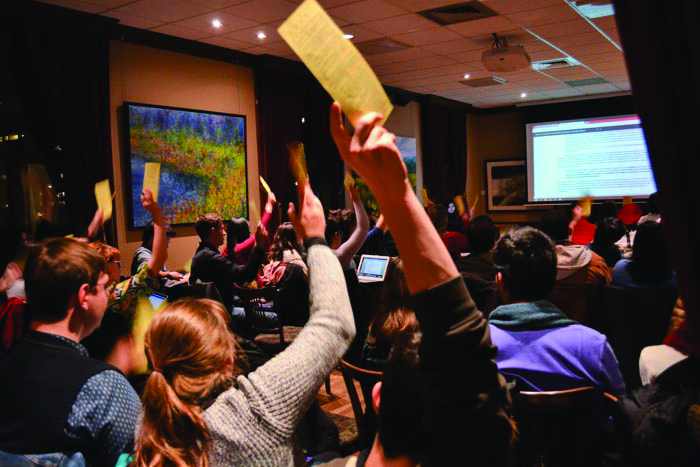
On Dec. 6, McGill filed for a judicial review of the Nov. 8 Tribunal administratif du travail (TAT)’s decision to certify the Association of McGill Professors of Law (AMPL) as a union. The appeal came a day before the case-law deadline to file such an objection: Applications for review must be filed within 30 days of receiving a decision. 

If McGill wins its suit, the previous decision of the TAT judge will be declared invalid. AMPL and the university administration will be sent back to the TAT for a second round of hearings to decide whether or not to keep AMPL certified. 

AMPL President Evan Fox-Decent had previously suggested that McGill might file an appeal. Fox-Decent believes that the appeal will serve as a “bargaining chip” for McGill as negotiations move forward according to schedule. According to Fox-Decent, the possibility of McGill overturning the certification is very slim due to the decisive nature of the 20-page TAT ruling. The union’s view is that the lawsuit is not directed toward AMPL in particular but serves as a warning for other faculties considering unionization. 

“As far as we are concerned, [the lawsuit] is a technicality—McGill has next to no chance of success,” Fox-Decent said in an interview with The McGill Tribune. “We may be able to get the suit declared to be abusive litigation, which would compel McGill to then pay for our legal costs. We would seek to have them [cover our legal fees] only to prevent them from doing this in the future if other professors decide to organize.”

The prolonged litigation imposes a financial burden on both sides but, according to Fox-Decent, the Canadian Association of University Teachers (CAUT) and La Fédération québécoise des professeures et professeurs d’université (FQPPU) support AMPL, both financially and ideologically. 

“I indicated that we would be there to support them in their legal costs and legal battle at this next stage,” CAUT executive director David Robinson told the Tribune. “We’re hopeful that this will be a pretty quick hearing [….] I think one of the reasons why the labour board was so comprehensive was that it was trying to make its decision appeal-proof. It’s hard to see where [McGill’s] argument is really going to come into play, so it’s just an annoyance more than anything.”

Officially, McGill’s reasons for challenging AMPL’s certification have remained the same as those originally used to oppose the union, with the administration citing “vast consequences” for the university if AMPL is granted union status as a faculty-specific association.

“Given the far-reaching impacts of this decision on McGill’s operations as a whole, the [a]dministration has a duty to see this process through to the end to ensure all impacts have been thoroughly considered and that they are, where relevant, incorporated into the application of the correct legal test,” McGill media relations officer Frederique Mazerolle wrote in an email to the Tribune. “While the [u]niversity continues to seek resolution to its concerns about the TAT decision, McGill is fully committed to negotiating with the new union.” 

Fox-Decent speculates that it will take about two years for the challenge to move through the TAT docket and into court. In the meantime, collective agreement negotiations have already begun.  

“As abusive and unnecessary and as wasteful of student funds and donations as the lawsuit […] is, the truth of the matter is, McGill probably isn’t going to get in front of a court for two years,” Fox-Decent said.

The second collective agreement negotiation meeting is scheduled for the third week of February.
McGill, News

McGill introduces optional sustainability module on MyCourses

“Creating a Brighter Future: Sustainability at McGill,” an online learning module focused on sustainability, is now available to students on MyCourses, though its content is subject to change until its official launch on Jan. 26. 

According to the McGill Office of Sustainability (MOOS), the module takes approximately 45 minutes to complete and introduces students to strategies for living more sustainably. Those who complete the module will receive a credit on their Co-Curricular Record, which acknowledges out-of-classroom learning experiences. The McGill Tribune looked into what students think about the release and the effectiveness of online learning modules in teaching about sustainability.

Developed by the MOOS, Teaching and Learning Services, and the Associate Provost of Teaching & Academic Programs in Spring 2021, the new module promotes McGill’s Climate & Sustainability Strategy 2020-2025. According to the MOOS, approximately 100 members of the McGill community, including students, participated in reviewing the MyCourses addition prior to its release. The module is separated into three sections: What is sustainability, sustainability at McGill, and living sustainably. They include videos, interactive animations, images, articles, and questions posted on Slido, an online polling and survey platform. 

Students are introduced to the fundamental aspects of sustainability and different ways of getting involved in sustainability efforts, such as through student groups, courses, and volunteer opportunities. Francois Miller, executive director of the MOOS, is hopeful that the module will inspire students to engage with sustainability in their own ways.

“The purpose of the module is to be a helpful starting point for students interested in incorporating sustainability into their studies, their extracurricular activities, or their day-to-day actions,” Miller said in an interview with the Tribune. “We hope students who complete the module will feel empowered to get involved in the larger sustainability movement happening at McGill.”

Sarah Taciani, U2 Science, is doubtful that “Creating a Brighter Future” will effectively teach students how to implement more environmentally friendly practices. She pointed to McGill’s sexual violence module, “It Takes All of Us,” as an example, and suggested that a mandatory in-person course on sustainability would be more beneficial to get the message across.

“I thought ‘It Takes All of Us’ was long, and while I always pay attention, I have heard stories of people putting it on mute and answering questions quickly,” Taciani explained in an interview with the Tribune. “It’s effective if you want it to be effective. I believe that interactive in-person seminars may be more engaging.”

Oban Lopez-Bassols, U2 Arts and a member of the student-run environmental club Greenpeace McGill, expressed his concern about the module’s optional status for students, especially since “It Takes All of Us” is mandatory.  

“I think this module should be mandatory,” Lopez-Bassols said in an interview with the Tribune. “There are a lot of people who care about sustainability, but few willingly do a 45-minute module unless it is mandatory. It then becomes a question of why one should be mandatory and the other not, as if sustainability is not a priority at McGill.”

Lopez-Bassols is also concerned that the purpose of initiatives like “Creating a Brighter Future” is to create a greener image for McGill so it can rank higher on university sustainability indexes rather than improving environmental practices.

“There has been some back and forth where people are pressuring McGill to divest from fossil fuels, and in the meantime, McGill is trying to highlight all of its green initiatives,” Lopez-Bassols said. “Indexes are very important, especially when comparing institutions. But they become very difficult when a somewhat arbitrary indicator is used to measure something, and the university focuses just on that, and not the actual sustainability.”

The McGill Office of Sustainability will be hosting a Launch Party on Jan. 26 to celebrate the official release of the module.

A previous version of this article incorrectly stated that over a 100 members of the McGill community participated in reviewing the MyCourses module. In fact, approximately 100 members had participated. The Tribune regrets this error. 

Laughing Matters, Opinion

Widespread voter fraud at MILF Fest

Some of you reading this title of this piece are likely having the same reaction I had upon hearing about the Montreal International Laureate Film Festival (MILF Fest): Why haven’t I heard about it before and how do I get to it? 

It’s an independent film festival, but, alas, not for //those// kinds of films. //The Plumber’s Station//, a McGill student filmmaking club, hosted the first annual MILF Fest on Jan. 8 at the prestigious Cabaret Lion d’Or. Some might critique //The Plumber’s Station// for the misleading name of the festival—to put it another way, I had to wipe my search history after buying tickets online—but true film connoisseurs appreciate the genius behind this name. Films from young creators starred in this highly exclusive event. Attendees were presented with four categories: Comedy, Horror, Drama, and Experimental. At the end, guests were invited to vote for the best film in each category and the best film overall—the MILF of the Year. All was going smoothly . . . until mysterious actors rigged the election and the MILF of the Year award was stolen from its rightful winner.

 Cultured cinephiles showed up to the event in their finest attire. Glamorous anthropology majors wearing vintage corduroy jackets sipped pomegranate martinis and discussed the Western capitalist bias of the film industry. Political science kids in turtlenecks and double-breasted overcoats staged photo shoots with their film cameras in the dusky twilight of the ballroom. Hushed conversations speculated about which films would impress and which would fall flat. But none could have possibly foreseen the bald-faced fraud that truly occurred as an illegitimate film stole the election, much like Joe Biden stole the White House in 2020.

Everyone in the crowd held their breath as the announcers began the awards ceremony, which started innocently enough. The films //L’Appartement d’à Côté//, //The Talking Stage//, //Mr. Peanut//, //Après Aujourd’hui//, and //Gobbits// won in the Short Film, Comedy, Horror, Drama, and Experimental categories respectively. But this is when the deep-state actors (Big MILF) enacted their vile plan to interfere in the election: MILF of the Year was awarded to //Duct Tape//, a 15-second experimental film shot on an iPod Touch showing a young fashion diva duct-taped to a wall repeating the phrase “Duct tape is the new cashmere.”

Outrage! The audience was too stunned to speak. The director went up to accept the award and before anyone could put an end to the charade, it was over and the ushers were shooing us out of the ballroom. This blatant display of anti-democratic chicanery, this violent coup d’état, this vile plot to strip the MILF of the Year award from the true best film (//Gobbits//, in my opinion) harkens back to that time when Beijing Biden and his crew of coastal elite Democrats committed massive voter fraud to take the presidency from Donald Trump.

//Gobbits// was a fan-favourite to win MILF of the Year. This ingenious film delved into the void that is the human psyche and examined the meaning of life. In five short scenes, it presented the exploits of surrealist creatures faced with the absurdity of existence: being, knowing, substance, cause, identity, time, and space. The animation was seamless, the music deeply moody, the execution immaculate—a gem. The crowd went wild as // Gobbits //was presented with Best Experimental Film, and the 10-minute standing ovation had to be cut short by the event coordinators, who were probably already busy stuffing the ballot boxes so their candidate could run away with the election. In the last minutes before the results were announced, massive dumps of fraudulent votes were recorded (mostly coming from the sociology and GSFS majors, if you catch my drift) and //Duct Tape// snatched the win from //Gobbits//. //Duct Tape// didn’t even win a category, so how could it have won the whole festival? Riddle me that, liberals.
All in all, the festival was pretty fun. To all the aspiring filmmakers out there, this festival is your chance to shine. I’m considering participating too. I just have to think up the perfect MILF (movie I’d like to film).

Off the Board, Opinion

Escaping into the city

As much as I would like to pretend that I am a Romantic-era poet, lingering in vast fields and haunting pastoral landscapes, I have always been more comfortable in the city. Whether it’s the steady hum of car engines or the distant chatter of people on their daily commute, I find that being in the city and breathing in polluted air is more comforting than walking through acres of silent and mysterious grasslands. 

As someone who is drawn to places where everything feels familiar, I know that this attraction to densely populated spaces filled with strangers is an anomaly. Spurred by a coming-of-age arc that featured several revelations, I could only appreciate my solitude after shedding the need to compare myself to social butterflies and embracing the reassuring presence of busy crosswalks and fluorescent lights.

After spending a lot of time with myself, I have come to realize that Thoreau wasn’t lying about the healing power of solitude—especially for a university student in an urban jungle. While I love what I study, it can be mentally draining to be in class for an entire day and interact with the sheer complexity of comments about the novel that we’re reading that week. Juggling the demands of maintaining social connections with the constant hustle of university life can make even the simplest of interactions harder.

I happened upon the key to gaining some of that lost energy back when I took the longer route home from an evening class and arrived with a sense of renewed ease. As I struck a balance between spending time with people and recharging through routines such as walking home, it became obvious that participating in a social gathering did not have to ruin my day. Decorated by the fast-paced background of the city and its rushed inhabitants, returning to myself became a subtle exercise in slowing down and appreciating fleeting relationships like that between me and the person rushing past me on the sidewalk. 

I learned to welcome the thrill of being part of a crowd without forcing myself to break the wall of anonymity that thrives in the city. The sheer amount of buildings surrounding and separating me from other city dwellers should feel lonely, but instead, I feel like my body would stop its clockwork motions if it were forced into a space where I knew the names of the people who lived above me. Armed with a newfound realization about redefining alone time, I found myself going to markets, cinemas, and malls alone, sinking into namelessness, and becoming another figure in the crowd. More importantly, though, I learned not to feel guilty about my preference for being a people-watching observer and accept that—contrary to the advice of a dozen high school teachers—I do not always have to push myself outside of my comfort zone to gain a valuable experience. 

I admit that this preference for quietness does not always work to my benefit. Sometimes, being alone with my thoughts can lead to all-consuming existentialist spirals rather than pleasant silences. In an effort to counter the occasional breakdown, I search for my favourite distraction, like a song played on repeat or a dance just for the sake of movement, as a source of companionship rather than a way to waste time. As much as I support the occasional desire to spend time alone as an antidote for exhaustion, I would argue that indulging in the company of some healthy escapism goes a long way. Becoming a person who doesn’t dread the idea of navigating a vast city by themselves isn’t easy. Eventually, basking in small moments of silence while walking home from the last class of the day adds up to fulfill that goal, and more.

Commentary, Opinion

McGill’s new library must provide students with better, more affordable food

McGill has a food problem. The provision of affordable campus food is a myth.

But this time next year, one of the main campus food sources and perhaps the epicentre of the problem, Redpath Café, will be torn down along with the McLennan and Redpath libraries to make way for McGill’s new $140 million Fiat Lux Library Project.

And aside from where we will study or what will happen to food provision in the meantime, my question is: How will McGill improve campus food options with this new library?

I occasionally venture down into the sterile underpass that is the café in Redpath library. And when I do, I buy myself a Kit Kat and a Coke (the liquid kind), which comes to about $6. Actually, as my friends may testify, I do this most days. It’s my brunch. 

Why Kit Kats instead of, say, poké bowls? Or sandwiches? Or sushi? Because the price of the Kit Kat at the till doesn’t fill me with an overwhelming sense of dread. 

The fact that Redpath Café, a university caféteria with as much pizzazz as a border-control waiting room, charges similar prices as nearby restaurants is ridiculous.

Sésame, a nearby Montreal poké chain, offers a mini-salmon poké bowl for $9.50, which is basically what you get with Redpath’s salmon poké bowl. Except, Sésame’s after tax and tip will still be on the right side of $16, and Redpath’s won’t. And Sésame’s isn’t bland to the point of being totally regrettable, like Redpath’s.  

Or take the sandwiches. I think we can all agree that Super Sandwich’s taste better, yet Redpath’s are still more expensive.

The other campus food options don’t solve the problems, either. Dispatch Café and Gerts, both as a café and a bar, are also overpriced. And lest I remind everyone, Gerts is student-run by the Students’ Society of McGill University (SSMU). 

The problem of price goes hand in hand with quality, and Redpath Café hasn’t found the salt. 

Let’s imagine if Redpath Café was a high-quality restaurant, “The Grill at Redpath,” if you will. On the menu, beef burgers from Canada’s finest, grass-fed cattle, and vegan burgers that are so good you don’t have to pretend to enjoy them. Maybe—just maybe, I’d think about forking out 16 bucks on lunch. That is, if I didn’t want a Kit Kat.

Unfortunately, this isn’t “The Grill at Redpath,” and we’re not a bunch of bankers looking for an extravagant midday blowout, despite the Desautels kids’ better judgment. We’re students that need a bit of grub in between classes, and McGill’s provision of accessible, affordable food on campus is inadequate. Period.

The new library offers an opportunity to address this. But from the details given so far, I’m skeptical that they will.

Reading through the project proposal online, I couldn’t find a single mention of food, drinks, or cafés. In the most recent feedback from the 97-page 2019 Lib Qual survey, which uses student feedback to analyze the libraries, there’s no mention of food services either. And, to my knowledge, in terms of reaching out to students to find out their needs for a campus café, there’s been zilch.  

This is despite recent calls for more affordable campus food, previous surveys conducted by SSMU, and the highest food inflation in Canada since 1981. 

Of course, improving the provision of affordable campus food is no easy feat. And even with improvements, students will no doubt still complain—I’m afraid that’s just what we’re like. 

But, make no mistake, when this new library opens in 2027, it won’t matter how many new computers, fancy chairs, or great big glass walls there are—if students can’t find a decent bite to eat, the complaints will pile up and pile high. 

Providing affordable food on campus is too important to be forgotten about. It must be prioritized.  

And it starts with asking students two questions. What do you want on the menu? And how much are you willing to pay?

Fact or Fiction, Science & Technology

Fact or Fiction: Do word games really keep your brain healthier?

Over the past few years, word puzzles and brain games have exploded in popularity. Most of us are familiar with the green, yellow, and grey squares of Wordle, acquired by The New York Times in January 2022, or have attempted to organize letters on a Scrabble board to no avail. This increased engagement with word puzzles has not gone unnoticed among scientists. Many now wonder whether the mental gymnastics we do to solve word puzzles have any particular benefits on cognitive ability or overall brain health. 

At first glance, we would expect the answer to be “yes.” Logically, we assume that anything that makes our brains exercise a little harder will be beneficial to our health in the long term. But what does the science say?

Well, there are some conflicting accounts. In 2019, a study was conducted on people between the ages of 50 and 93 to understand what kind of effects online word games had on the cognitive abilities of older people. The researchers found that people who did not play any games consistently performed worse on measures of cognitive ability than those who played regularly. This idea, however, contradicts what researchers say about the drawbacks of spending too much time in front of a screen.

A wide body of research has concluded that increased screen time negatively affects the cognitive development of children and adolescents. In some instances, too much screen time has hindered children’s ability to develop strong psychophysiological resilience, or one’s ability to withstand psychological, physiological, and emotional violence. 

So, maybe word games are good for your brain, but only if you play the ones in a physical newspaper or print out the ones online. Unfortunately, this might mean cutting back on your Wordle time—something The New York Times would not like.

In 2022, the word games market value was estimated at $2.47 billion USD—due in part to the sheer number of such games. There are hundreds of different types: Sexaginta-Quattuorlde is a game where you play 64 Wordle squares at once; SpellTower is a mashup of Tetris and Scrabble where you use adjacent letters to form words; and The Sunday Times regularly publishes a cryptic crossword where you have to decipher a clue to get a second clue that leads you to the word that fits into a traditional crossword grid. 

Most researchers have concluded that whether you play word games online or on paper, the benefits of such mental exercise outweigh the negative effects of too much screen time. Daily mental stimulation through word games, and even other challenging mental tasks, help maintain and improve cognitive abilities such as memory and plasticity. 

There is one more benefit of completing word puzzles—it’s what experts call the “a-ha” moment, and it’s arguably the best part. The “a-ha” moment is that feeling you get right after you have finished a crossword or secured a triple-word score square in Scrabble. When the brain completes a difficult task, it is flooded with endorphins, reducing feelings of stress and pain—mental pain, in this case.

A study conducted in Vienna in 2018 used functional magnetic resonance imaging (fMRI) to evaluate how the human brain reacts when a person completes a mentally challenging puzzle. Scans showed that the nucleus accumbens—an important structure in the brain that helps manage emotions—is activated at the “a-ha” moment. This region is also linked to the dopaminergic reward system, leading researchers to link the “a-ha” moment with positive reinforcement.


While crosswords, the Wordle, and Scrabble may be hard, they are worth dedicating time to. Your brain benefits from the exercise and thanks you for the workout with endorphins. So, fact or fiction: Do word games and puzzles really keep your brain healthy? The McGill Tribune says yes.

Arts & Entertainment, Film and TV

‘Kaleidoscope’ is Netflix’s shiny new toy

Anyone who has ever taken a creative writing class is likely familiar with the lipogram: A piece of writing that entirely omits one or more letters. A poem without es or a vignette with no as, it forces the writer to experiment and to think outside of the box as an exercise in creative restraint. Episodic chronology is the screenwriter’s letter e. Take away the function of an episode, or distort a poet’s alphabet, and you can expect the making of something you’ve never seen before. The new Netflix original Kaleidoscope aims to do just that. 

Released on Jan. 1, Kaleidoscope is an eight-episode heist story spanning the 25 years leading up to the theft of  $70 billion and its aftermath. The appeal of the show is that the episodes can be watched regardless of order. Netflix randomizes the episodes for each viewer, who are dropped into the story unfettered by chronology. As a concept, Kaleidoscope is exciting and promises a new way of consuming stories. But when it comes to the viewing experience, very little is gained from the scrambled viewing order. 

As streaming platforms compete to provide the largest quantity of content possible, quality inevitably takes its leave. Showrunners are now challenged to have their projects stand out amid an ocean of mediocrity. In turn, viewers have seen a recent rise in experimental television that bends the structure of a show to the viewer’s whim. Black Mirror’s choose-your-own-adventure style special, Bandersnatch, premiered on Netflix in 2018 and allowed viewers to alter an episode’s outcome by directly interacting with the plot. Bandersnatch found relative success and certainly tested the boundaries of what television is capable of. Similarly, Kaleidoscope pushes the envelope of narrative structure, specifically with the help of Netflix, which has been facilitating these new ways of consuming stories.

Overall, Kaleidoscope is not a bad show. It’s marginally entertaining, with solid performances from the cast and a snappy script. But I was disillusioned with the show’s experimentalism upon realizing that its only remarkable quality is the mixed-up timeline. To accommodate the lack of intentional episode order, the writers limit themselves significantly. Heist stories typically promise intricate, high-pressure plots, which are mostly relinquished in Kaleidoscope, since each episode needs to wrap up very neatly to avoid confusing the viewer. Character arcs become disjointed as their progression cannot rely on the show’s timeline. In terms of storytelling, these aspects of the show would have been strengthened with a traditional narrative structure. The fatal flaw, however, is that the intrigue of the format falls away almost immediately. I sincerely doubt that any viewer spends all eight episodes musing on how cool it is that they are watching it in a different order than someone else. All this begs the question of why the show even needed to be formatted this way. 

The show’s preview, a 52-second opening clip explaining the concept and previewing the season, answers this almost instantly. The clip boasts the ‘epicness” of the show in a melodramatic tone that is inconsistent with what Kaleidoscope actually delivers. If the creators intended the preview to build anticipation, its effect is something more akin to a light-up applause sign. Right from the start, Netflix eagerly overcompensates for a lack of substance. The non-chronological concept of Kaleidoscope was pitched by creator Eric Garcia before the heist plot even came to be, so it’s no wonder that the story itself falls into the traps of Netflix’s marketing. Such a transparently desperate prelude, urging the viewer to appreciate the ultimately inconsequential format of the show, reveals an overreliance on gimmicks as a marketing tactic. 

The creators of Kaleidoscope sacrifice good storytelling to create a shiny, money-grubbing trinket. They place too much emphasis on a concept that doesn’t hold up over the course of the show, becoming entirely irrelevant as the plot plays out. It’s cool, like a poem without e is cool. But what is cool for a show that is otherwise indiscernible from the mediocrity that already fills Netflix’s catalogue?

News, PGSS, SSMU

PGSS executives report unsustainable workloads

Executives and commissioners working at the Post-Graduate Students’ Society of McGill University (PGSS) have reported an intense workload and excessive hours. On several occasions, executives have had to work nearly double the hours required of their positions without overtime pay. Inadequate graduate funding, staff shortages, and limited  time-frames for recruiting students for governance committee roles have all contributed to executives being overworked.  

In a November 2022 executive report presented to the PGSS Council, PGSS Secretary-General Kristi Kouchakji detailed that between Oct. 12 and Nov. 12, she logged a total of over 80 hours of work. She is paid to work 12 hours per week yet often works 15 to 18 hours, leaving Kouchakji feeling burnt out. She also believes that a culture of overwork has been ingrained at McGill, leading to higher expectations for those filling positions like that of Secretary General.

“Sec-Gens have leaned so hard into doing as much as they can of everything that the structural issues have gone unaddressed, and in the process, it has trained certain university committee chairs and admins to straight up expect Sec-Gens and [University Affairs Officers] to work unlimited hours, to sit on all the committees, and meet every last-minute demand thrown at them, which has made the problem worse,” Kouchakji wrote in an email to The McGill Tribune

According to Kouchakji, McGill’s overall lack of graduate funding has exacerbated labour issues at PGSS. Because many graduate students have to take on additional external employment so that they can afford to live, they have less time to sit on different PGSS committees for no pay. The responsibility for sitting on committees is thus left to PGSS executives. 

“[Graduate students are] understandably more selective about how they do use any small bits of time they might have,” Kouchakji wrote. “You’re not going to take on a bunch of volunteer work for the institution that put you in that position.” 

Hossein Poorhemati, PGSS’s University Affairs Officer, also believes the lack of volunteers is putting more strain on executives. He told the Tribune that the issue is compounded because McGill gives PGSS a narrow window of time to recruit. 

“We need people to represent us, but we don’t have enough students stepping up as volunteers, and we don’t have enough time to recruit. It takes us four to six weeks to process applications, yet often we receive emails from admins announcing a position that needs to be filled in two weeks,” Poorhemati said. “As a result, we have had to look around to see if any of our executives and commissioners can go and attend these meetings. That is where the problem starts.”

Poorhemati feels that earlier notices from the administration about recruiting committee representatives and additional information on what each position entails would help alleviate some of the burden faced by executives.  

Overwork is also a problem at the Students’ Society of McGill University (SSMU). Kerry Yang, SSMU’s vice-president University Affairs, told the Tribune that executives often work overtime. Yang explained that balancing  schoolwork with a full-time job is challenging and often unsustainable in the long run, especially for international students who are required to take a full course load.  

“Executives work from 9 a.m. to 5 p.m., but because many casual staff and students have classes during that time, we often have to schedule meetings or host events outside working hours, which can really stack up the hours,” Yang wrote in an email to the Tribune.

This overwork has taken a significant toll on both the personal and academic lives of SSMU and PGSS executives. According to Kouchakji, PGSS has lost several executives due to the pressures that come with the job and their inability to keep up with coursework and research commitments. 

Science & Technology, Science Rewind

Top five scientific discoveries at McGill in 2022

This past year was a remarkable one in scientific research, especially when you add McGill researchers to the mix. The McGill Tribune is pleased to bring you the impressive advancements in science made at McGill over the past 12 months.

Forging a better treatment path for triple-negative breast cancer 

Every year, approximately 5,500 women pass away from breast cancer, representing 14 per cent of all cancer-related deaths. Triple negative breast cancer (TNBC) is considered one of the worst types of breast cancers because of how quickly it spreads throughout one’s body and how it cannot be detected through the three “entrance” hormones for breast cancer treatment (estrogen, progesterone, and HER2). So, it was encouraging when scientists Dr. Meiou Dai and Dr. Jean-Jacques Lebrun of the Research Institute of the McGill University Health Centre (RI-MUHC) discovered a new targeted combination therapy to combat TNBC.

Both doctors are confident that their gene-editing approach will lead to breakthroughs in human clinical trials, as their team identified 150 types of tumour-inducing genes in prior tests. 

Cooks and scientists aren’t so different after all: Cooking techniques inspire new brain implant

Neural implants are widely used to treat brain diseases such as epilepsy and Parkinson’s. However, such implants trigger the brain’s foreign body response because the implant is more rigid than the surrounding brain tissue. To circumvent this rigidity problem, a team of researchers from the Montreal Neurological-Institute Hospital and McGill’s Biomedical Engineering department devised a solution—using silicon polymers, they created the softest brain implant ever, which goes undetected by the human immune system. The researchers  achieved this by adapting cooking techniques like caramelization and sugar melting to the medical field, as the implant is made out of hardened sugar. Unorthodox inspiration is not an unknown phenomenon, so it is natural to see this tradition persist in the sciences at McGill.

Feeling ugly? There might be a reason for that: McGill researchers discover why plants produce “unattractive” flowers

Cleistogamy is a type of self-fertilization in small, closed flowers that was first noted by Charles Darwin. Although Darwin could not study these flowers in full  due to poor sample size, this changed when biology professor Daniel Schoen, among others, studied what Darwin had first observed.

Schoen gathered over 2,500 species of flowering plants to analyze the cleistogamy phenomenon, finding that bilaterally-symmetric flowers produce half the number of offspring compared to radially-symmetric flowers. The production of both open and closed flowers is favoured in areas where pollination can vary, thus safeguarding reproduction while preventing inbreeding. 

A sustainable way of producing industrial chemicals

Nanocrystals are clusters of particles that are less than one micrometre in size and are widely used in many areas, like the cosmetic or pharmaceutical industries. They are the lifeblood of many devices, from solar panels to semiconductors. Professor Audrey Moores and her team in the Department of Chemistry developed a novel and environmentally-friendly way to produce nanocrystals through a process called high-humidity shaker aging. This method is groundbreaking because it uses fewer resources, is more cost-efficient, does not require solvents, and produces a higher yield of nanocrystals. 

Moores’ work contributes to research about transitioning to solvent-free chemical reactions, as solvents are often toxic and harmful to the environment. In a consumerist world, learning to prevent waste will be instrumental for future generations.

Water pollutants may now be detected at a glance 

Over 70 per cent of the Earth’s surface consists of saltwater oceans, so McGill researchers are right to turn to saltwater to see what it can do for us. Professor Parisa Ariya and her team developed a dynamic technique involving artificial intelligence to detect spills like oil, heavy metals, or other biological agents. The real-time sensor that they developed may eventually be mounted on satellites to detect pollutants in all of Earth’s oceans down to the nanometre level, allowing organizations to act quickly in order to prevent aquatic ecosystem destruction.

Student Life

Resolving forward, for the year, and for more

The leap into the new year brings with it not only the start of the winter semester but the invocation behind your resolution: Ask not what 2023 can do for you, but what you can do for 2023. 

How do we make material promises, and start fresh from the ruins, the grounds of a year prior? 

Resolutions notoriously disappear, becoming ephemeral, fleeting promises we make to ourselves over champagne or a kiss from a loved one at the stroke of midnight. They might fade away quietly, like autumn colours, or slink away like inglorious scrawlings on a post-it note in a dumpster across the city. How do we imagine otherwise? How do you illuminate the hope that you had in your life? The McGill Tribune offers ways to improve your resolutions so you can hold yourself not only accountable but also with love.

Where are you going, where have you been?

A resolution begins and ends with a desire for something outside yourself—a change that might make you into what you could be and should have been. Starting from that core message troubles the stakes of some promises to ourselves. Though jokes about abandoning that healthy diet or that membership at Econofitness pervasively attack any chance to look inward as doomed to fail, do they ring true for you? For example, are you resolving to eat more carefully, work out more often, or change your appearance because you think these are acceptable resolutions or will make you (or someone else) love you more? Instead of critiquing promises that might fail, we should look at what our responses reveal about ourselves. There is no better time than the present for getting real with yourself in a quiet expanse, holding gentle the parts of your experience that require care and softness. Remember that self-love doesn’t come into form with one practice or with more or less on your schedule. 

Ambition and self-transformation

In March, you look back at yourself in January and regret what you thought would be a welcoming space for change in your life. You were going to finally re-learn how to play guitar (you loved learning as a kid!), you were going to be more spontaneous with your friends (you miss the freedom of first year!), you were going to stop when you felt overwhelmed and breathe deeply, with intention. 

You thought you failed. It doesn’t have to be this way. Sure, setting your standards not only high but in a different way may make them harder to achieve, but the only judge lives in your brain. Progress doesn’t work like time, the seemingly silky, causal moves from day to night, month to month. We bend and wade flexibly in times when our past mistakes fold into present mistakes. We get way in over our heads and we deflate, but we still stand. To look at those weeks where you felt isolated, buried by your classes, overwhelmed by your extracurriculars or by the moments that flesh out into what feels like infinity, and say “I don’t want this anymore” can create a path and shift the surface of your life. Beginning with the principle that progress works differently can be ambitious. The traces of a shallow pool, the guardrails, might vanish. Set benchmarks and dates to check in, regroup and rethink. Your year starts when you can.

We should all be resolutionists

We set resolutions at the places we sit. These places cut across lines of difference and touch others. You might want to give back more, you might be longing to practice refusal in your work or in your education. You might be needing to set boundaries with exploitative friends, teachers, bosses, co-workers, or people in your life. Remember to keep asking questions of yourself, and tie your changes to whom and what make you want to transform. Find what distorts your progress and prevents you from making a community, a home for those striving like you. Lift up your voice and others’ too, on this new, difficult, and contested route.

Read the latest issue

Read the latest issue