


Latest News

Features

Rolling the dice on academic freedom

McGill University bears the name of its founder James McGill, but this honorific was a condition tied to James’s large donations that were used to establish the institution. His gift, however, cannot be isolated from the colonial violence which produced it. He was only able to formalize the higher education system in Canada—albeit for white men only—by exploiting and enslaving Black and Indigenous people on stolen land. In addition to casting light on the colonial structures of Canadian universities, McGill’s depraved founding exemplifies an issue that lingers today: The power that donors can exert over campuses. 

Though public funding constitutes the majority of the total revenue for most Canadian universities, the decline in government spending on postsecondary education along with campuses’ increasing operational costs have forced universities to pursue other sources of income. In the 2019-2020 year, more than 70 per cent of  total university revenue was publicly funded in most Canadian provinces and territories, including Quebec. Yet, total public investment in universities has been on a gradual decline across Canada since 2008-2009, decreasing from 67.0 per cent to 54.7 per cent in 2019-2020. Spikes in tuition fees, reliance on international students, and private donations are compensating for this decline. At McGill, the revenue generated by donations and investment interest on endowed gifts for the 2021 fiscal year was approximately $170.2 million of its total revenue of $1.47 billion. 

Derek Cassoff, managing director of communications at McGill’s University Advancement (UA) office, explained that the university accepts two kinds of donations: Direct-spend gifts that are spent all at once, and endowed gifts that establish an investment fund and exist in perpetuity.

“We have gifts at the university that go back to the 19th century donors […] 150 years ago, that are still […] operating today because of [the McGill Endowment Fund],” Cassoff said. “The university’s endowment right now is about $1.8 billion, which is pretty high by Canadian standards, [and] just shows the level of generosity that McGill donors have shown over time.”

As donations compose more and more of universities’ funding landscape, concerns grow for how the interests of third-party funding can cross the line into academic and campus life.

In 2020, the University of Toronto (UofT) rescinded a directorship offer to Valentina Azarova, a human rights lawyer and scholar. The withdrawal had been prompted by a phone call from a tax judge and major donor to the Faculty of Law named David Spiro. In it, Spiro had expressed apprehension about Azarova’s recruitment due to her previous papers on the Israeli occupation of Palestine. Spiro’s controversial intervention in the university’s hiring decision led the Canadian Association of University Teachers (CAUT) to censure the UofT administration in April 2021, a rare and last-resort sanction in which academic staff are asked to decline appointments, speaking engagements, and awards. The censure successfully pressured the university to re-offer the position to Azarova, who declined it the second time around. Experts attributed the infringement of academic freedom at UofT to a reliance on donations in the wake of public funding cuts, arguing that this financial model undermines campus autonomy. 

Azarova’s mistreatment at UofT is not an isolated story. Jennifer Berdahl joined the University of British Columbia (UBC)’s Sauder School of Business in 2014 as the Montalbano Professor of Leadership Studies, a position dedicated to gender equality in the workplace. When Arvind Gupta, UBC’s president and vice-chancellor, resigned only a year into his five-year contract, Berdahl shared a blog post theorizing that Gupta’s sudden departure was due to the toxic “masculinity contest” at the university. John Montalbano, the former chair at UBC’s Board of Governors (BoG), whose $2 million donation funded Sauder’s Montalbano Centre for Responsible Leadership Development and created Berdahl’s professorship, was infuriated by Berdahl’s post. 

“He basically eventually called me up at home on a Sunday morning and just really chewed me a new one and told me my reputation was shit now and […] I would lose my funding,” Berdahl said in an interview with the Tribune. “Later that night, he sent an Associate Dean after me [who] sat me down, and basically told me that I better shut up.”  

The UBC administration took away funding for Berdahl’s professorship, removed her from all committees, and debilitated her from fulfilling her positional duties, research, and outreach. 

“A bunch of women in Vancouver who were executives and high up in […] industry had been on this Board of Advisors for me,” Berdahl said. “They all stopped talking to me and that board got dissolved because they were Montalbano’s connections and friends. Basically, they literally took away my position and the support behind it.”

Berdahl took to her blog once more to publicize this infringement on her academic freedom. “They were going to kill me quietly or they could kill me publicly, and I chose the public killing,” she told me. Following the post, the UBC Faculty Association began an 18-months-long grievance process, after which Berdahl recovered half of her funding. Former British Columbia Supreme Court Justice Lynn Smith conducted an investigation that concluded “Dr. Berdahl reasonably felt reprimanded, silenced and isolated” by the UBC administrators, though Montalbano was not found guilty of violating any of UBC’s policies. While Montalbano stepped down as the chair of the university’s BoG, the scandal shows the murky waters of undue influence that can accompany donations. Berdahl claims that a fundraising employee revealed to her in confidence that there was an implicit understanding between the university and Montalbano that his donation would grant him the BoG chair position. 

“[As] our public universities become increasingly reliant upon donors for funding, donors are playing an outsized role in influencing the direction of universities in ways that they shouldn’t,” Berdahl said. “[T]hat’s really threatening the current state of universities today.”

The rivalry between UofT, UBC, and McGill extends beyond rankings; violating academic freedom seems to be another sport for Canada’s top universities. In 2017, Andrew Potter stepped down as the director of the McGill Institute for the Study of Canada (MISC) three days after publishing an essay in which he characterized Quebec as an “almost pathologically alienated and low-trust society.” Six hundred and eighty-eight pages of internal emails revealed that Potter was pressured to step down by former Principal and Vice-Chancellor Suzanne Fortier, following public backlash and donors threatening to cut funding to the institute. Andrew Potter declined the Tribune’s request for a comment on the matter. 

McGill never admitted to infringing on Potter’s academic freedom. Fortier insisted that academics in managerial and administrative roles at the university should not enjoy the same level of academic freedom as academics outside such positions. Yet, a report by the CAUT concluded that the university had violated the McGill Statement of Academic Freedom and challenged Fortier’s claim, which has since been known as the Fortier Doctrine and was in fact the same argument that UofT used to justify revoking Azarova’s directorship offer. 

Berdahl finds that public underfunding of universities has created a corporate culture of prioritizing fundraising over academic values. 

“If you think about people’s position, [their] ability to please donors and raise money is a huge part of [their] evaluation as a leader now, right? […] And in fact, the Associate Dean, who was probably most invoked in violating my academic freedom, is now the Dean. He was basically rewarded for prioritizing the donor’s feelings over my academic freedom.”

Renee Sieber, the President of the McGill Association of University Teachers (MAUT), also finds that there is a culture at universities to solicit donors for donations that are rarely unconditional. 

“[University Advancements] are very protective of donors, who they nurture throughout the lifetime of the donor,” Sieber told the Tribune. “McGill spends considerable time trying to facilitate that loyalty from people who eventually become donors. The general public might see it as, ‘hello, wealthy person out there, we’re going to go after you for money.’ It usually is, ‘you have an existing connection to the university, because you went there, you sent your kids there.’ And that loyalty is nurtured over time.”

McGill, too, admits that there are “ongoing conversations between the university, its fundraising team, and […] loyal donors,” according to Cassoff, who says that gift negotiations can take up to a decade at times. Universities turn increasingly to donors as an unfortunate survival mechanism. Treating campuses as playgrounds for capitalist exchanges is a quicksand that threatens the very existence and purpose of higher education. David Robinson, executive director at the CAUT, argues that the influx of specific donations creates “a distortion within academic priorities,” where certain programs or initiatives receive more resources than others depending on the desires and interests of private donors. 

“[T]hey’re going to be interested in things that they have a personal interest in, or that [are] aligned with their business interests, [or] profile,” Robinson told the Tribune. “We’re going to see lots of funding for the kind of […] corporate responsibility issues or things that are of interest to the corporate world, but we’re not going to see a lot of donations going to the […] study of child poverty in Canada […] to […] theoretical physics.” ”

McGill’s income from endowed gifts must be used for the specific purposes laid out in the donation contract. Donations can, therefore, dictate the future of a university for decades. Andrew Kirk, a professor in the Department of Electrical and Computer Engineering, served as Interim Dean at the Faculty of Engineering from 2011 to 2013 and was privy to this oft-camouflaged force. According to Kirk, there were century-old legacy donations at the faculty that funded out-of-date research and had to be renegotiated with the successors of the late donor. 

“You’ve really got to steer donors away from locking us into doing something that seems great right now, but it’s so specific that it’s not going to be useful in the future,” Kirk said in an interview with the Tribune. “[We] want to make sure that donations have got as much flexibility as possible so that they can be used to benefit the university for many years to come.”

While external pressures and interventions in university affairs grow with private donations, a larger threat ensues when administrations internalize sycophancy. Robinson believes that universities tend to unconsciously appease donors following large donation sums out of fear that offending them will jeopardize future partnerships and fundraising. 

“If a pharmaceutical company had given money to a health institute and the health institute wanted to put on a series of lectures talking about the harms caused by certain pharmaceutical drugs, would that be something that people might be shy to pursue? It’s certainly possible. And I think that’s more of the kind of subtle influence that the donors have,” Robinson told the Tribune

Robinson’s example is not hypothetical. Almost two decades before the Azarova scandal, UofT had similarly revoked a job offer to psychiatry professor David Healy, who questioned the safety of Prozac and the pharmaceutical company Eli Lilly, a corporate donor to the university. In addition, a Global News investigation revealed that the pharmaceutical industry invests millions of dollars each year in Canadian universities to help shape medical education. At McGill, for instance, pharmaceutical company Merck & Co Inc. donated $4 million to the Faculty of Medicine and Health Sciences in 2013 as part of its five-year project to inject $100 million into biopharmaceutical research and development in Quebec. Environmentally extractive companies have also crept into the university’s administrative skeleton. The Faculty of Engineering actively partners with Suncor Energy Foundation, a fossil fuel company, and the two mining companies Rio Tinto and ArcelorMittal Mining Canada Gross Profit (G.P.). McGill’s BoG hosts members with direct ties to various corporations, such as the pharmaceutical company Knight Therapeutics Inc. or Petro-Canada. As private corporate donors pump money into the university, McGill reciprocates with a sense of duty to protect the interests of its financial supporters over the faculty and students—the neglected beating hearts of the campus. 

The administration’s repeated refusal to divest from fossil fuel companies, despite student and faculty pleas, is a telling example. Greg Mikkelson, a former professor in the School of Environment and the Department of Philosophy, who resigned when the BoG opposed his divestment motion, finds McGill’s obstinacy to be an extension of its priorities. 

“Back when the clique who run the McGill Board [of Governors] were trying to justify their second refusal to divest from fossil fuel, they [demonstrated] what seemed to be greater loyalty to other wealthy donors (i.e., their own peers) than to McGill students, faculty, staff, Quebec society, or even Canadian society, let alone the larger biotic community,”   Mikkelson wrote in a statement to the Tribune

Divest McGill, a climate activism group on campus, also claims that “if your project doesn’t fit the BoG’s agenda, it will not go through.” Yet, Divest has looked to ways to circumvent the university’s favouring of money over student and faculty democracy.  

“One interesting strategy taken by the folks at Fossil Fuel Divest Harvard was to collect donations from alumni in Harvard’s stead that they would then give to Harvard only if they divested,” Divest McGill wrote to the Tribune. “This is an avenue that could be taken at McGill too, and if they still refuse to divest then that money could become a ready-made seed fund for reinvestment projects.”Not only the university’s name, but the titles of several buildings on campus bear the reminder of wealth too often tied to private motivations. Eliminating unwelcome donor influence, however, is an effort not without hope. Leverage campaigns like Divest’s may help achieve short-term results, but cannot solve the root issue. Capitalist dynamics of competition for funds have taken over the university. Increased public funding best serves as a weapon to safeguard academic freedom and student democracy, especially in Quebec, where underfunding universities has been a persistent problem. If the fragile financial state of universities continues due to government negligence, and the university continues to prioritize capital at the expense of students, private interests will monopolize campuses to the point where they will cease to exist as public-serving, intellectual entities.


Laughing Matters, Opinion

Why McGill needs a uniform

There goes one. Oh, and another—and another. Sorry, don’t mind me, I’m just sitting on the benches outside McLennan counting the number of McGill students dressed like extroverted, self-obsessed melons. 

Have you noticed McGill students have this rather psychotic fixation on dressing uniquely? Well, of course you have. The pathway through Redpath is practically a catwalk for Eva B hippie zombies to flaunt their new ‘unique’ look. 

In our fight to stay original, we’re quickly led into the realm of the ridiculous. Wacky adornments, with little actual value, become the new norm. And each week there’s a new one: Oversized jackets? Because who needs clothes that actually fit? Silly hats with fur on the outside? Because the warmth of fur on the inside is so cliche. Woolly leg warmers? These are basically woolly sweaters for your calves. And before you butt in—no, this phase will age like milk. 

Without question, though, the worst I’ve heard was recently in Redpath Café: “T-shirts are the new dresses.” Yep, that will do me. Pour me a drink and bash me over the head with the bottle. 

First off: No, they’re not. Because if they were, they’d be, well, they’d just be dresses, wouldn’t they? And second: If t-shirts are dresses today, what’s next? Skirts as t-shirts tomorrow? Socks as earmuffs the week after? Enough. E-fucking-nuf. This obsession with dressing uniquely has all gone a bit HBO. We need to pack it in. We need a uniform.

What we choose to wear is not just a reflection of who we are, but who we think we are. So, judging by our outfits, we think we’re fucking idiots.

Look, I sympathize with you. I do. The only thing more frustrating than trying to dress uniquely and looking like a total twit is purposefully dressing like one, and then arriving on campus only to find someone else dressed in the exact same twitty outfit. And I admit, I have my moments of inspiration, too. Some days I might even dress like I’m actually happy. But it’s so much effort. 

A school uniform solves these problems. No longer will we have to spend hours in the morning deciding which hat goes with our coat. We won’t have to worry about our parents raising an eyebrow at our latest ‘phase.’ It will make McGill students even more visible to the local community, so our good deeds don’t go unrecognized—if there are any, of course.

School uniforms will let us focus on the more important issues. Instead of showing our uniqueness through accessories, we can show it by distinguishing ourselves through standardized exams. We will also have more time to raise the issues that matter outside of the classroom. God forbid, we could start voicing our opinions and participating in student and local elections! 

It isn’t just about what a school uniform does directly, but also what it represents. Was it not the great Gandhi who said, “College kids in Canada really ought to have a uniform. They’re 7,500 miles away, and they’re still pissing me off!” 

By enforcing conformity, we can take our distracting narcissistic traits out of the equation, at least for now. At least until we stop thinking our calves need sweaters. 

FAQ

Why do you personally want a uniform?

I’m offended by vibrant colors. 

“But my own clothes are more comfortable!!?” 

Do you think Margaret Thatcher wore sweatpants? 

What’s in it for McGill?

A profitable uniform shop. The profits can be reinvested into our community, like buying all the Deans a Porsche so they can get to school faster. 

What would be the new uniform? 

I’m open to all ideas. Maybe something grey. Pitch your ideas!

How much would this new uniform cost?

If you shit money, you should be fine.

McGill, News, SSMU

Students vote to continue financing Daily Publications Society and the Sustainability Projects Fund

The Students’ Society of McGill University (SSMU) held its Fall 2022 Referendum from Nov. 14 to Nov. 18. The two questions on the online ballot were whether McGill’s undergraduate student body was still in favour of funding the Daily Publications Society (DPS) and the Sustainability Projects Fund (SPF). Both motions passed, safeguarding the DPS and SPF’s current operations until the next referendum in five years. 

The DPS is responsible for the publication of the independent student newspapers The McGill Daily and Le Délit, the latter being the only francophone paper on campus. The DPS is entirely funded by student fees, and its existence is dictated by a Memorandum of Agreement (MoA) with McGill. In order to renew its MoA with the DPS, which expires in 2023, the administration requires that a referendum be conducted to prove continued financial support from students.

The SPF, created in 2010, is used to fund sustainability-related projects at the university. It is jointly subsidized by McGill and students, with the school matching what students pay. The SPF student fee is outlined in the MoA between SSMU and the administration.

Noème Fages is the chief elections officer of Elections SSMU, the organization that runs the Society’s referenda. In a statement to The McGill Tribune, Fages described the newly tweaked schedule that was implemented this past election, which was intended to increase discussion and, ultimately, voter turnout among students.

“For this Fall Referendum, we chose to have overlapping campaign and polling periods to maximize student engagement with the referendum and make sure all students know about the referendum and its implications,” Fages wrote.

Last week, 22.6 per cent of eligible voters cast their ballots—the highest turnout achieved in a fall referendum since 2018, which had seven questions compared to this most recent election’s two.

Still, only about 5,000 students out of 23,542 eligible voters cast their ballots. Elliott Kalt, U1 Science, told the Tribune why he ended up not voting.

“I think most students tend to ignore SSMU emails because they send so many of them,” Kalt said. “I really believe that the newspaper[s] should be funded, however I understand that a lot of students might not have the financial ability to [continue paying the DPS fee], so it’s a very hard topic to vote on.”

On the ballot this fall was SPF’s mandatory fee of $0.55 per academic credit, up to 15 credits, which subsidizes the program. The Fund’s Governance Council (GC) distributes its million-dollar annual budget to students, faculty, and staff whose sustainability projects are approved. Shona Watt, a sustainability manager at the McGill Office of Sustainability (MOOS), was excited to see continued support for the SPF from students. 

“[The Fund] is a resource for all McGill community members to launch or grow a sustainability initiative on campus [and] spark positive change in their own learning and work environment,” Watt said. “We are thrilled by the level of enthusiasm reflected in the results of the SSMU referendum.”

Ryan Stainsby, U0 Arts, ultimately voted “Yes” on financing the SPF for the remainder of his time at McGill.

“[The SPF] funds projects that work on making our campus more sustainable, more environmentally friendly [….] I think that’s really phenomenal,” Stainsby said. “I still understand if someone voted no for monetary reasons [….] Every dollar counts, you know.” 

Voters also decided to uphold the DPS’s $6, non-opt-outable fee, which has been charged to all undergraduates once per term since 2010 and is responsible for their nearly $300,000 budget.
Throughout the campaign and polling periods, both DPS papers stressed the importance of their continued existence, releasing editorials chronicling the publications’ work, tabling around campus, and posting testimonials from alumni on social media to encourage students to vote. The editorial boards of both publications thanked students for their support over Instagram after the referendum results were published.

McGill, News

McGill Senate wrangles over ‘academic excellence’, New Vic, and donations

The McGill Senate convened in room 232 of the Leacock Building for the third meeting of the academic year on Nov. 16. Senators delved into reports from the Senate Nominating Committee and Academic Policy Committee, and participated in an open discussion on the university’s evaluation of “academic excellence” among professors. After several Senate committees presented their annual reports, conversation turned to recent donations and McGill’s New Vic Project.

Christopher Manfredi, Interim Principal and Vice-Chancellor, opened the meeting by addressing the recent provincial elections and expressed his wishes for better engagement with the re-elected government. Discussion then broke into tables of senators, who were asked to ponder how the university community conceptualizes “academic excellence for academic staff.” 

Senator Patrick Hansen, an associate professor at the Schulich School of Music, pointed out that measures of “excellence” will be evaluated uniquely in every discipline. Terri Givens, professor of political science and the Provost’s Academic Lead and Advisor on McGill’s Action Plan to Address Anti-Black Racism, elaborated on how traditional measures of “excellence” can work against those in marginalized fields.

“I’ve experienced this personally, when you are working in areas that are considered, you know, on the sidelines of a discipline, it’s often difficult to publish in the top journals,” Givens said. “We have to be very careful about […] how we assess these things like h-scores, [which] don’t necessarily apply. Somebody can be seen as a really top scholar in a field that just doesn’t get a lot of the same traction as other fields.”

Senator Sam Baron, a student representative for the Faculty of Arts, pointed out the importance of centring the student experience by hiring good lecturers, not just good researchers.

“The professors who are going to be here permanently in such a capacity should, of course, be the best of the best at passing their knowledge on to the next generation of students who are coming into the field,” Baron said.

In response, Manfredi admitted that McGill has not yet found the perfect mechanism for evaluating both the research achievements and the teaching prowess of teaching staff. 

The Senate then moved to the Annual Report on University Advancement, which outlined the donations made to McGill during the 2022 fiscal year, over which a total of $241.8 million was raised in gifts and pledges.

“Donors have helped us build the number one student aid program in Canada, allowing us to welcome the second largest proportion of students from lower socio-economic backgrounds in the province of Quebec,” said Vice-Principal (University Advancement) Mark Weinstein. “We also launched, during the pandemic, the student emergency fund, and in the past year we received over $130,000 in gifts from over 1,000 donors for this important cause.” 

David Vaillancourt, a senator representing undergraduates from the Faculty of Engineering, questioned how the university will fundraise for the New Vic Project in the wake of McGill’s recent loss to the Kanien’kehá:ka Kahnistensera in the Superior Court of Quebec.

“It’s obvious to me that fundraising is completely inherent to the university’s continued existence and excellence,” Vaillancourt stated. “But I would caution, specifically with the fundraising of the New Vic, to really read the room and fundraise in ways that are socially appropriate given the situation.”

Moment of the meeting: 

When presenting the Annual Report on the Investigation of Research Misconduct, Dr. Christina Wolfson mentioned a general rise in cases flagged for investigation, with funding now being spared for a Research Integrity Officer. Wolfson described an “increase in the number of anonymous allegations from colleagues,” which was met with nervous laughter amongst many in the Senate.

Soundbite: 

“I would really like to thank the disciplinary officers for their service, this is not a fun job to do.” — Dean of Students and professor Robin Beech, upon presenting his first in-person Annual Report on the Code of Student Conduct

Creative, Video

Fashion at McGill

Multimedia Editors Wendy Lin and Anna Chudakov are joined by Contributor Atta Wongsuchat talk to McGill students about fashion on campus.

McGill, News

McGill Board of Governors and Senate discuss barriers to accessing internships and exchanges

At 4 p.m. on Nov. 10, Chancellor John McCall MacBain kicked off the first in-person joint Board of Governors (BoG)-Senate meeting since 2019. The meeting, which took place at the Faculty Club at 3450 McTavish Street, centred on “experiential learning at the local, national and international levels.” Attendees worked to identify and resolve hurdles that prevent students from accessing internships and foreign exchanges through the university.

Deputy Provost (Student Life and Learning) Fabrice Labeau set the tone for the evening by highlighting the importance of the university’s Enriched Education Opportunities (EEO) while also acknowledging that McGill has not done enough to promote them.

“[EEOs have] academic benefits for students, bringing them closer to the real working world, out of their comfort zone in the classroom,” Labeau said.

Citing the financial, academic, and administrative concerns of students considering EEOs, Labeau added that McGill hopes to provide better financial support to student interns. Labeau also said that the university would expand efforts to advertise foreign exchanges to the student body. 

Three questions were laid out for small-group discussion amongst members: What types of EEOs McGill should fund and promote, what could be done to remove barriers to these new programs, and whether they should focus on local or global opportunities.

Interim Principal and Vice-Chancellor Christopher Manfredi stated that against “the inevitability of rapid change,” McGill students should be prepared with skills suitable for both academic and practical environments. This was a general consensus among members, with McCall MacBain pointing to a need to “create and support bridges to industry.” 

One member of the BoG suggested that the federal government’s recent increase of the number of working hours authorized on international study permits should be seen as a chance to expand opportunities for international students. 

Members of the BoG and Senate also urged the university to take advantage of its network of successful alumni when pairing students with organizations for internships. In the same vein, attendees called for EEOs to count towards course and credit requirements. 

One member of the Senate added that McGill should require all students to submit a resume to the university so as to best pair students with opportunities.

One of the most consistent contributors to the meeting was Students’ Society of McGill University vice-president (VP) University Affairs Kerry Yang. 

Yang believes that both financial costs and the “bureaucratic red tape [surrounding] EEOs” are “putting off students” from taking the opportunities available to them. Not only do internships and exchanges rack up costs in travel and rent, but opportunities outside of Canada are often unpaid, leaving students without an income for an entire summer. He also called for opportunities that were “more than just research in science.”

Yang added that these opportunities should not only be available and affordable, but easily accessible, too—McGill should actively pair opportunities in specific fields with students interested in those fields. 

“It is often the responsibility for students to search for internships themselves rather than have McGill actively work to bring internships to McGill itself for students to choose from,” Yang wrote in an email to The McGill Tribune following the meeting. “I believe there needs to be more resources dedicated towards bringing these opportunities inward rather than having students search outwards.”

Moment of the meeting: While discussing the financial burdens placed on students doing unpaid internships and exchanges, Chancellor John McCall MacBain fielded suggestions from the floor. Following heckling from the tables of Senators and Governors, jokes began on the size of his microphone, with him declaring “mine’s bigger” than the microphones prepared at each table. This was met with laughter from the floor.

Soundbite: “We must begin humbling ourselves and recognizing that other universities have more and better co-op schemes.” —Chancellor John McCall MacBain on McGill’s shortcomings in offering student learning and work opportunities

McGill, News

Dr. H. Deep Saini to become McGill’s next Principal and Vice-Chancellor

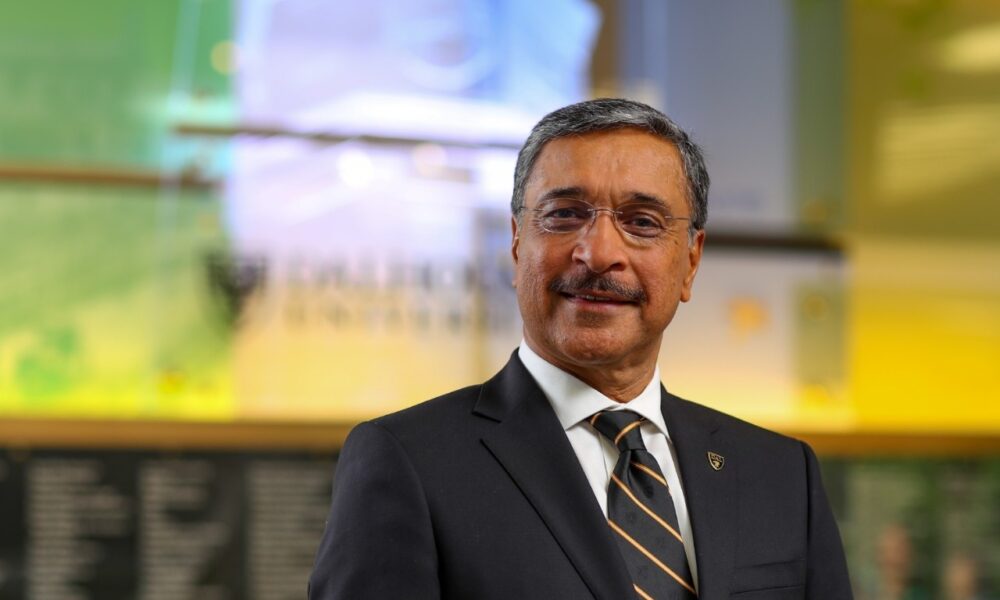
On Nov. 14, McGill announced that Professor H. Deep Saini will be the next Principal and Vice-Chancellor of the university. The Principal is tasked with representing the university on the global stage and helping shape the future of the institution. 

Saini will take over the role from Christopher Manfredi, who has occupied the position of Interim Principal since McGill’s former Principal, Suzanne Fortier, stepped down at the end of August. McGill Principals serve five-year appointments, and Saini will begin his first renewable term on April 1, 2023. 

Saini holds a Master of Science (Honours) in Botany from Punjab Agricultural University in India and a PhD in Plant Physiology from the University of Adelaide in Australia. He is currently serving as Principal and Vice-Chancellor of Dalhousie University, a role he has occupied since January 2020. He will be McGill’s first non-white Principal in its more than 200-year history.

McGill Principals are approved by the Board of Governors (BoG) upon recommendation from the Advisory Committee for the Selection of the Principal and Vice-Chancellor, which was assembled after the university announced in January 2022 that Suzanne Fortier would be departing. In a statement to The McGill Tribune, McGill media relations officer Frédérique Mazerolle elaborated on the role of the Advisory Committee, which is composed of 14 people, including members of the BoG, faculty, students, and outside consultants.

“The Advisory Committee was responsible for defining the role and set of competencies for the position of University Principal and Vice-Chancellor,” Mazerolle wrote. “As part of the Committee’s work, consultation sessions were held with various groups and individuals in the University.”

Richard Gold, a law professor at McGill, sat on the Advisory Committee that unanimously nominated Saini. He is confident that Saini will bring much-needed transparency and trust to McGill.

“There was a hunger for someone who was transformative—that is, someone who would not merely rely on McGill’s past glory but who understood that a contemporary university needed to actively embrace the world and current problems,” Gold wrote in an email to the Tribune

“We heard a strong desire for someone who does not just speak about [Equity, Diversity, and Inclusion] but who embodies it and is committed to it. I believe that Dr. Saini is such a candidate, someone who will strive to repair the broken trust on campus, who will restore collegial governance, and who will engage rather than talk down to us.” 

Kerry Yang, Students’ Society of McGill University (SSMU) vice-president University Affairs, expressed similar optimism about Saini’s leadership. Yang, who also sat on the Advisory Committee, felt great responsibility representing the undergraduate student body, stressing the importance of choosing a leader who would communicate with students and take student advocacy to heart. 

“Even though Suzanne Fortier did a good job, she wasn’t able to really connect with students,” Yang said. “Being able to sort of find a next Principal who is more student-centric, is able to connect with them […]I think was something that I really went on.” 

Karol Kapsa, U3 Arts, hopes the new Principal will work to address the staffing shortage and program cuts they have witnessed during their time at McGill.

“I know like in the English Department and other Arts departments, there’s been a serious lack of just teachers, of like, professors, to the point that a lot of undergraduate courses, and programs are getting slashed because like [Master’s] students take priority,” Kapsa said in an interview with the Tribune. “That’s pretty worrying to see, like the wheels just kind of feel like they’re falling off after COVID.”

According to Gold, a smooth transition of power should be a priority for the McGill administration ahead of Saini’s arrival. .

“As we go through the next few months, I hope that the current administration will start building bridges so that Dr. Saini starts with a strong and united community,” Gold wrote.

Off the Board, Opinion

I’m so tired of being a person of colour

It’s a thought that fills me with unparalleled shame. As soon as it forms, I want to bury it. But as I sit with my friends, at home, at work, I feel the burden of existing as a radical act, as political praxis: The thought creeps back in. How do I stop dwelling on something I will never be? How do I stop imagining my life without this roadblock? How do I accept this relentless stream of oppression as normal?

These days, when I, or those around me, experience racism, all I feel is a resigned exhaustion. As I desperately grasp for the anger I know must be inside me, I can’t help but wish it were different, that I were different. I get lost in the daydream.

I imagine being vocal, loud, and confident in my opinions without being characterized as aggressive. I imagine being allowed to only have a surface-level, condemnatory understanding of racism. Ignorance is a bliss I too often long for and trust me, I’m ashamed of it. A world where all my articles are not somehow related to race, because my life does not revolve around it. Where I don’t give up, smiling like I don’t care, shortening my name to “Sepi” whenever somebody mishears me (no matter how many times I promise myself I’ll stop).

I snap back. Back to the place where people press their arms up against mine, “oh my god, you’re fully Persian? I’m, like, way darker than you though!” The look of pity when I say I’m from Iran is one that I can’t stand. White people tell me that it is so great that I work hard to humanize the people in Iran when all I’ve done is talk about their current struggle. As they leave the conversation, happy with their anti-racism, I am left wondering what they saw in front of them before I was humanized.  

A defining feature of musing with whiteness is the overwhelming need for secrecy. It isolates me. I could never mention the exhaustion of being racialized to non-racialized people because this is not the strength expected of, almost mandated onto, people of colour. When allyship is so fragile, any wrong move can project “allies” into a frenzy rife with racist sentiments. I am not allowed to represent myself. I am a woman of colour, a journalist of colour, an unwillingly elected representative. The consequences of every mistake I make will reverberate on all those I am forced to represent. And it’s scary. 

When I speak with “too much” emotion, when I use the sharp words that come to me too naturally, I play it back in my head a million times. I lay in bed, paralyzed by fear, condemning myself for making mistakes, for being human, for forgetting that I am not allowed to be. Some days I worry my passion will be permanently muted out of fear. Will this silencing come from my surroundings or from me? The question haunts me.

I wish I could present a solution for this exhaustion, but I don’t have anything. I don’t need to have anything yet. All I know is that writing it down helps. That talking to other people of colour helps. I make a home out of people of colour I love, make sure they know that my heart aches for them as I watch them be forced to mince their words the way I work hard to mince mine. As sad as it makes me, not sharing a fake smile or greeting but exchanging an exasperated, defeated, “I’m so exhausted,” acts as solidarity and understanding in a way that I cannot fully describe. And right now, maybe that’s all we’ve got.

Editorial, Opinion

Unionize McGill

On Nov. 8, the Association of McGill Professors of Law (AMPL) became McGill’s first professor’s union. The AMPL, which represents tenured and tenure-track professors, filed to certify their union in November 2021. However, they faced a combative McGill administration that attempted to discredit the AMPL’s attempts every step of the way through aggressive litigation. The university’s attempts to prevent unionization are disappointingly consistent with a history of indifference and hostility towards workers’ rights. Despite this victory for McGill professors, university employee organizations are still fighting for their rights, and the momentum from the AMPL’s unionization must be harnessed to improve workers’ rights for all of McGill. 

The university’s litigation stood on the grounds that law professors were already represented by McGill’s Association of University Teachers (MAUT) and that it would be unfair to prioritize the unionization of law professors over others. This argument, however, conveniently ignores that MAUT cannot represent workers’ rights in the same capacity as a union. The AMPL argued that a faculty-specific union is important to preserve its members’ rights in a highly-centralized university. Despite these arguments, McGill assembled student tuition dollars to fund a litigious union-busting campaign against attempts to receive proper representation from professors at its very own law school. 

Unionization gives workers the power to negotiate with their employers through collective agreements:A framework to defend their rights, avoid exploitative contracts and salaries, and create safer working conditions. In 2020, Quebec had the highest rate of union coverage in all of Canada. Despite this, prior to the faculty’s win, McGill was the only Quebec Labour Tribunal Federation member where no professors benefitted from negotiated employment contracts. This allowed the McGill administration to trample on professors’ rights: They are overworked and baited with the prospect of tenure while the university maintains its prestige. A blatant example of McGill’s disregard for law professors’ rights took place during the COVID-19 pandemic when the administration forced instructors to teach in person and refused to implement a vaccine mandate despite persistent pleas from the faculty. 

The untenable working conditions that law professors endure are consistent with McGill’s treatment of its workers beyond the classroom. In Winter 2022, students at the McGill School of Social Work went on strike after McGill refused to offer online options for students, knowing their in-person placements were a risk to both students’ health and that of the communities they serve. In the past year, two unions representing non-academic employees at McGill, the Association of McGill University Support Employees (AMUSE) and the McGill University Non-Academic Certified Association (MUNACA), went on strike due to abhorrent working conditions and unfair pay. As of Sept. 13, only one of McGill’s 14 labour unions has an updated collective agreement with the university due to internal administrative delays. Collective agreements dictate the wages, hours, and working conditions of unionized members, and because of their delayed renewals, most union workers are being paid outdated salaries that are not adjusted to inflation or minimum-wage increases. 

Although AMPL’s unionization is a big victory, it is important to note that its membership is made up of predominantly white, socioeconomically advantaged men. Meanwhile, non-tenured lecturers and teaching staff, who are more likely to experience precarious working conditions, still do not have an updated collective bargaining agreement. The AMPL has laid the groundwork for the unionization of other faculties at McGill, who must follow the AMPL’s example as soon as possible and take advantage of this ruling’s momentum. This decision, however, must also motivate a renewed push to support the rights of unionized workers, like those represented by MUNACA—who have been in an ongoing fight with the McGill administration to secure a collective agreement and improve their conditions. 

The Faculty of Law’s push for unionization is especially significant as they are educating a future generation of policymakers to understand the importance of the right to collective organization and representation. The security and protection provided by unions will facilitate better teaching from professors, who will be put on equal footing to advocate for their rights to the McGill administration. The AMPL’s work is commendable and sets a historic precedent for all McGill workers. Moving forward, McGill students must encourage professors in positions of leadership to advocate for unionization, and recognize that all workers at McGill should be treated with respect and dignity.

Erratum: A previous version of the article stated that all teaching staff did not benefit from a negotiated employment contract at McGill before this certification. In fact, it is all professors who did not benefit. The Tribune regrets this error.

Commentary, Opinion

On queer space, futurity, and inclusion

It’s Friday night and you’re done with midterms. You leave the heteronormative institution (if you really ever can), text a few friends, pick your favourite club, and dance the night away. You’re listening to queer icons––Cher or Madonna, Gaga or Rihanna, Diana Ross or Gloria Gaynor, Fiona Apple or Kim Petras, take your pick. When Gaga, hitting new heights in “Free Woman,” sings “This is the dance floor / I fought for,” we must remember this place remains a welcome site of refuge, of possibility for queer life. You feel unbound to heteronormativity, you see a new world on the horizon.

A perplexing problem arises when considering the very fact that this night seems universally enjoyable. What’s better than spending the night with some of the best dressed or funniest or most dynamic people you will find? Why wouldn’t straight people want a queer world? On a serious note, for straight women or women who do not label their sexuality, queer spaces can be one of few places where there isn’t the outright threat of predators, protected by patriarchal (or frat) legal systems. This rings true, even despite the fact that intracommunal violence affects lesbian women and queer men can still be aggressive. 

By “queering” our mainstream, public cultures propel rights and advancements––do queer people exist if they are not seen? While understandable, straight people’s increased entrance into queer spaces of gathering should be addressed critically. In fact, this problem, minor yet overplayed, detracts from the ways queer spaces––tending cis, white, male, and gay––currently do not serve or promote the diversity of the community.

Typical points about keeping queer spaces queer rest on dangerous, exclusive premises upheld by interlocking systems of domination. We fall down slippery slopes by insisting everyone must be queer. How does one prove this? Queer people of colour do not have the same, full privileges of disclosure that white queer people often conceal. Your coming out story is valid and important. You are heard. And we also see you. We see the spaces you hold. Thank you for teaching us the word intersectional.

We need queer spaces that centre not on profit, not on drinking cultures exclusively, but on inclusion and listening. For instance, the police regulate Black and Indigenous embodiment and transness––identities so often transcending the limited and repressive Western sense of the binary. They are threats to white supremacy, patriarchy, and heteronormativity. People want to venture into these spaces without suffering a politics of recognition that alienates them. I worry that this surveilling mode, both in its informal approach and its business strategy, of “knowing one’s queerness” legitimates an unjust security apparatus. We have internalized that establishments must know everything about their patrons to manipulate them, and this system works to kill us all and our planet. Alternatives abound.

You might be thinking: “We fought for this very approach!” We can do better. Perhaps our more radical ancestors can help us return to our community, re-vision this contested, uneven ground. It starts from a multitude of communal forms of being with each other that do not rely on sex, alcohol, or drugs, and that do not replicate the chains that bind us. Isolating our queer comrades who do not partake for religious reasons and our queer family members in recovery, we raise a momentary, and even unbeatable, buzz over our shared experiences. This haze blocks other opportunities from materializing, trounces networks of solidarity. The potential of queer libraries, cafés, and bookshops matter, but so do democratic and popular forms beyond institutions. 

In taking these simultaneous options of the specialized bar and public space, and the uninstitutionalized private space with care, we may find pathways to inclusion. If queer culture values constructed spaces above all with no liberatory force, we neglect meaningful transformation, like with the land; we obfuscate queer complicities in the settler colonial project here and abroad. Where we can converse, find joy, love, and hope from one another across our differences, and no longer be alone, is where we can be authentically queer.

Read the latest issue

Read the latest issue