

Latest News

Behind the Bench, Sports

All we need are some private jets: The untapped potential of women’s professional sports

Imagine if Lebron James, Auston Matthews, or Mookie Betts had to work a day job. Imagine if they were not paid unfathomable sums of money or built up to be some of the biggest celebrities in North America. Would they still be held in such high regard? When you ask aspiring young athletes what their dream job is, would their responses stay the same, even without the prospect of a future padded by millions of dollars? 

Young female athletes don’t get to dream about the 12-year, $426.5 million contract that Mike Trout signed. They don’t get to wonder what it would be like to sit on a private jet while smoking a cigar à la Michael Jordan. They don’t get to think about their next mansion, sports car, or yacht. They get to think about what their second job will be if they choose to dedicate their life to sport. 

The conversation surrounding women’s professional sports always seems to be singing the same tune: The pay is too low. There isn’t equal opportunity. There aren’t the same development programs. And although women’s professional sports have made significant progress in terms of pay equity, promotion, and marketing in recent years, there is still one major element missing: The celebrity. The prospects. The dream. 

As Anya Alvarez highlighted in an article for The Guardian, the root of the problem isn’t just what women are getting paid—it is also the lack of foundational infrastructure that they have for capitalizing on their talent. By focussing on equal pay, we overlook the small things that have allowed the men’s sports industry to be so successful. 

Let’s start with marketing at the collegiate level in the U.S. During the week of March 18, many were left wondering why there were so many empty seats at the women’s Frozen Four tournament games. Despite the men’s games having low attendance as well, the $182,000 per year discrepancy in marketing and promotion by the NCAA was a contributing factor to the lack of fans. 

An investigation by Kaplan Hecker & Fink LLP, a legal firm specializing in employment and discrimination matters, revealed that the structure of the NCAA itself is designed to maximize the support for the men’s March Madness tournament as it is the primary source of funding for the NCAA. Not to mention the $13.5-million budget gap in the 2021 tournaments. 

This disparity is felt across all levels of college sport. For Sara Escallon-Sotomayor, a Martlets soccer wingback, the social and financial barriers associated with being a professional female athlete made it difficult for her to fantasize about a future in professional sports. 

“I’ve always noticed that the boys who would play at the same level as me seemed to have such unrealistic ideas of what they could do with soccer after high school,” Escallon-Sotomayor said in a conversation with The McGill Tribune. “A lot of them would just expect that one day it would work out for them. There’s just so much money in men’s soccer, and so much more scouting. It has always been very clear to me that I need a university degree and that I need a job. And soccer would not be enough to support me, because realistically, I’m not the best player in the world, and there are very few women that have lucrative contracts.”

Indeed, the struggle to tear equal pay out of the hands of professional sports has been ongoing for a long time. After 39 years of equal pay advocacy by tennis legends such as Billie Jean King, Martina Navratilova, and Chris Evert, Wimbledon announced that female tennis players would receive equal prize money in 2007. In turn, Venus Williams was awarded her well-deserved $1.4 million for her fourth Wimbledon victory. But even for one of the most decorated tennis champions in the world, Williams’ million-dollar prize did not come without a fight. Following a failed plea to Wimbledon’s governing body for equal pay—and an ultimate tournament victory in 2005—Venus Williams wrote an op-ed essay in the Times of London titled “Wimbledon Has Sent Me a Message: I’m Only a Second Class Champion.”

( Adrian Dennis / Getty Images)

Again, young female athletes are only left to dream of a world where the sport they love so dearly loves them back.

Elizabeth Benn, who was recently hired as the director of Major League operations for the New York Mets—now one of the highest-ranking women in the sphere of professional baseball—knows this feeling all too well. In an interview with the Tribune, Benn discussed the hardships of her unrequited love for baseball. 

“It’s tough because I think I always really loved baseball. I think that the lack of opportunity definitely affected my development, but it did make me more curious about learning the game on a more intellectual level,” Benn said. “When I wasn’t given the opportunities to play competitively and develop well, I ended up watching a lot more baseball, and studying it that way. It did affect my enjoyment. I knew that there wasn’t really a future on the field, to the point where I actually wasn’t even considering a future working in the game.” 

Even in scenarios where there is an opportunity to play at the highest level, female athletes are often brought to centre stage in a negative light. 

Megan Rapinoe, with a bottle of Veuve Clicquot in one hand and the FIFA World Cup trophy in the other, chanted “I deserve this!” and the media immediately berated her as cocky and unbearable. Brittney Griner, one of the highest-paid and most skilled WNBA players, has only begun to garner media attention after her recent arrest in Russia. And Lia Thomas, a transgender woman and NCAA 500m freestyle champion, has recently become the GOP and a sector of cis liberals’ newest obsession in their hell-bent attempt to keep trans people out of sport. 

The world knows how to talk about female athletes—but only if it is to demonize them. This form of notoriety is not so desirable for young athletes dreaming of a professional sports career. 

However, this negativity isn’t the case for all female athletes. For many, like Martlets head basketball coach Rikki Bowles, their love for the sport overshadows the weight of existing barriers. 

“I’ll be honest, when I began playing, it was out of a pure love for the game,” Bowles told the Tribune. “My father built a basketball court in our backyard, and I played out there until the sun went down and I couldn’t see the rim anymore. I guess as a child playing, I wasn’t aware of any burden or even thinking of the difficulties faced by professional female athletes.” 

Even for Benn, as a trailblazer in one of the most male-dominated sports, her love for baseball has never wavered. In fact, during her time working for MLB, she has seen more and more eyes gravitate toward women’s baseball. 
The Breakthrough Series in Texas last October got so much publicity,” Benn said. “There were a ton of former players and agents coming to watch the games because they knew about it from Twitter. People are learning about it. And when they see it, they support it.”

(sagharborexpress.com)

As for Escallon-Sotomayor, she feels lucky to be playing a sport that has seen such rapid growth as of late. The development of the UEFA Women’s Champions League has exploded, with streaming service DAZN guaranteeing coverage of every single match for the upcoming season. Each participating team will earn $464,538, and each game will be available to global audiences in three languages—the language of the home and away teams, and English. 

The untapped excitement and potential surrounding women’s sports is unmatched. The opportunity to build up the infrastructure that has made men’s professional leagues so successful and profitable is sitting right there, waiting. The talent is there. The personality is there. The fans are there. All we need are some private jets.

Science & Technology

New vaccine could lead to the elimination of deadly parasite

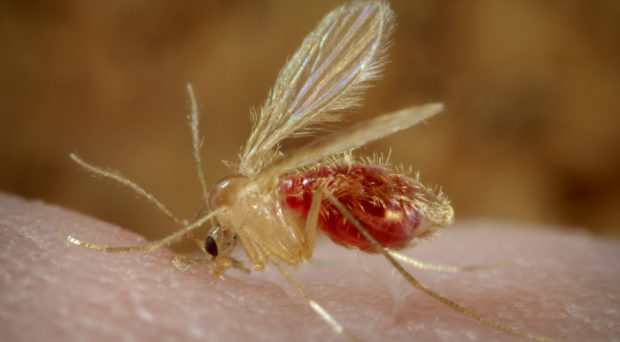
Prevalent in habitats ranging from rainforests in Central and South America to deserts in the Middle East and Africa, a devastating protozoan parasite carried by tiny flies infects over a million people each year.  

This parasite, which belongs to the Leishmania genus, enters the body through the bite of an infected sand fly. Once inside the body, the parasite can cause two types of disease: Visceral or cutaneous leishmaniasis. In the case of visceral leishmaniasis, the parasite breaks down the internal organs, eventually leading to internal bleeding and, if left untreated, death. On the other hand, cutaneous leishmaniasis can cause severe skin lesions, and, at its worst, can even migrate and propagate inside of the nose, leading to the progressive destruction of the face. 

Despite the potentially severe consequences of a Leishmania infection, there is currently no vaccine that protects against it. For centuries, doctors in several countries with high rates of the disease have had to resort to intentionally infecting people with the live parasite on their arm as a means of immunization. The immunity conferred from a Leishmania infection lasts for life, and although this method prevents the infection from occurring at more critical locations such as the face or internal organs, it is considered unethical and no longer practiced. 

In collaboration with researchers from Ohio State University and the U.S. Food and Drug Administration, McGill researchers recently created an attenuated form of the parasite that can be used as a vaccine. They used CRISPR, a gene editing technology, to delete a single gene coding for a protein called centrin, which plays a key role in cell division. Without it, the parasite’s ability to replicate is very limited, and it cannot survive for long inside the body. 

“Using CRISPR, we created a weakened parasite that is still alive but cannot cause disease. It still stimulated the same kind of immune response as the wild type parasite,” said Greg Matlashewski, a professor in the Department of Microbiology and Immunology at McGill who co-led the study, in an interview with The McGill Tribune

The Leishmania genus comprises over 20 different species that cause different types of leishmaniasis— all of which are found in various parts of the world. Leishmania major (L.major) is the parasite that causes cutaneous leishmaniasis primarily in Europe, Asia, and Africa, while Leishmania mexicana (L.mexicana) causes cutaneous leishmaniasis primarily in North, Central, and South America.

Documented in a 2021 study, the first vaccine developed by the team targeted L. major. The safety and efficacy of this vaccine has been confirmed in mice, and human clinical trials are set to start in early 2023. In March 2022, the team published another study documenting the development of a vaccine against L. mexicana, which was also shown to be safe and effective in mice. Clinical trials for the L. mexicana vaccine will likely start in 2024. 

Despite the development of two vaccines, each targeting a different parasite species, the researchers expect that the L. major vaccine will be effective at protecting against all cases of leishmaniasis. 

“We will initially use the L. major vaccine for both cutaneous and visceral leishmaniasis, but if it doesn’t work, we have the L. mexicana one as a backup, which may work better in the [North, Central, and South America],” Matlashewski said. 

The vaccines will be produced in India by the biopharmaceutical company Gennova. The estimated cost of an individual vaccine will be between two and five U.S. dollars. In contrast, a leishmaniasis treatment can cost up to $200 USD, and involves repeated drug injections with very unpleasant side effects. 

Given its low cost, great capacity for production, and that immunity from Leishmania lasts for a lifetime, Matlashewski believes that the vaccine has the potential to have a significant global impact. 

“The vaccine could certainly contribute to the elimination of leishmaniasis as a major public health problem.” 

Arts & Entertainment, Poetry

A penny for your prose

Encapsulating one’s thoughts and emotions into words can be as rewarding as it is daunting. Such rewards are monetary in the case of the bi-annual Montreal International Poetry Prize, a competition for poems of 40 lines or less, where the winning poet receives $20,000 and, along with 54 finalists, gets to be published in an anthology by Véhicule Press. Hosted by McGill’s English Department, the prize is accepting submissions until May 15. Then, a judging committee of 11 local and international poets review the submissions and each pick five favourites. Of the 55 chosen finalists, former Poet Laureate of Jamaica Lorna Goodison, this year’s prize judge, will pick the winning poem.

“[The Montreal International Poetry Prize] was founded in 2010 by Asa Boxer, who was an alumnus of McGill,” Eli MacLaren, prize director and associate English professor at McGill said in an interview with The McGill Tribune, who explained that McGill began managing the prize in 2019. “We’re trying to maintain what Asa Boxer started and rooted institutionally, so it survives for a long time.”

American poet Victoria Korth won the Prize’s last cycle in 2020, with her poem “Harlem Valley Psychiatric Center.” This 40-line freeform piece tells the story of her father’s institutionalization, describing the toll of his mental health on their relationship in hauntingly vivid detail. 

MacLaren explained that Yusef Komunyakaa, the 2020 prize judge, selected the poem in part because of its “authentic voice.” 

“It convinced him that this speaker was writing about something that was really crucial to her, which was essentially the death of her father,” he said.

MacLaren also mentioned that diversity is a key priority for the organizers. “We are trying to get in touch with the international culture of contemporary poetry. And in order to do that, we want to make sure that the prize is open to entrants from all around the world, and also that we have a jury that can judge poetry in diverse ways.”

In addition to the poetry competition, the Prize will host a virtual poetry reading series, Fluid Vessels, a new addition for this iteration of the competition. From January to May, monthly readings from poets across the globe will be held to create a sense of community around the Prize—one that crosses continents while uniting jurors and poets from past and current iterations of the competition.

“We’re going to try to do [the poetry reading series] every year from now on, because it’s been working so well,” MacLaren said.

For example, March’s poetry reading featured Indian poets Nabina Das, Sridala Swami, and Maithreyi Karnoor. Das, one of the 2022 jurors, kicked off the reading with her introspective pieces. Her poem “Thinking Tank,” which was inspired by John Lennon’s “Imagine,” drew heartbreaking contrasts between the terminal consequences of war and the bliss of a world where the only tanks are thinking tanks. 

Next up was Swami, a 2020 juror and recent author of Run for the Shadows. Her shortest and most bittersweet poem, “Meditations,” gave shocking insights into her psyche and anxiety, such as how “disorder shapes the leaves down into my rippling mind.” Also unforgettable was “Annotations,” a citation of her youth that pays homage to the gardens, her private playgrounds, she once explored. 

Karnoor, a 2017 and 2020 finalist for the Prize, concluded the reading, displaying her artistic range through humorous snippets and poems of epic scale. Her breathtaking piece “A Burden of Beasts” traversed the Himalayas, the staggering behemoths which stretch beyond eye’s reach, indifferent to humanity’s whim despite their dependence. Leaving the audience wanting more. 

The Prize remains open for submissions until May 15. Upcoming poetry readings from Canadian, Jamaican, Nigerian, and other poets occur on April 5, April 19, and May 2.

Off the Board, Opinion

Every conflict deserves equal coverage

A month ago, I opened my social media only to be met with a flood of panicked posts. Ranging from tweets to reels and everything in between, the message was the same: How unbelievable it was that our generation was experiencing live coverage of war––a statement with which I did not exactly resonate. My earliest memories of hearing about ongoing war were stories of resistance during the Gaza siege, in particular that of Rachel Corrie, an American student who was crushed by an Israeli bulldozer while peacefully protesting the attempted demolition of a Palestinian family’s home. Even though I remember hearing about this incident at the age of eight, it actually happened five years prior, in 2003––a stark reminder of the decades of conflict and war that have been happening in our lifetime and covered by civilians on social media in the absence of Western coverage. 

Politicians and media figures’ attempts to garner sympathy for Ukrainian people by describing their “blonde hair and blue eyes” dragged many racialized people into the middle of the coverage of a war unrelated to them. This media attention did not portray the conflict in Ukraine as the latest addition in a long list of recent tragic wars and conflicts, but rather tried to emphasize that it was different. 

No one deserves to have their country attacked, to be forced to leave their homes, or to lose their loved ones violently. Yet, many in the media and in politics revealed a racial bias when they attempted to explain why the Ukrainians deserved it even less. 

Elevating Ukrainians above others under similar circumstances of displacement and war by describing them such as “civilized,” “intelligent,” and “educated” has exposed the dangerous, racist tendencies to further marginalize non-Western people. Other statements, however, were overtly ludicrous, with some claiming Ukrainians were less deserving of war because they were “well-dressed,” had access to “Netflix and Instagram,” or had similar “cars.” This dehumanization of people in Africa, Asia, and the Middle East not only normalizes their tragedies but facilitates their continued suffering. The insistence that those in the West are more advanced and educated than those in “developing countries” has been used in the past to justify colonialism and American military invasions of countries such as Afghanistan and Iraq—both of which were justified under the guise of “civilizing” the populations living there.  

Coverage of Ukrainian civilians learning to use guns and creating molotov cocktails depict them as heroes fighting for their country. However, in recent decades, Palestinians and other racialized people worldwide have been dubbed as “terrorists” for doing the same. The simultaneous glorification of white people and condemnation of people of colour who engage in armed resistance reminds us who has the right to defend themselves.

Biases do not just affect our perceptions, they also affect our policies: They dictate who gets to flee a warzone. Consider the African and South Asian students fleeing the Ukrainian crisis, who are struggling to find transportation and being denied entry at the Polish border. This treatment is reminiscent of how racialized refugees and immigrants have been treated—as criminals and “aliens” who threaten Western culture.

Beyond blatant racism comes ignorant and incorrect media coverage. In the early days, people circulated videos of airstrikes in Gaza falsely identifying them as Ukrainian. The claim that we have not been privy to a war or conflict of this scale before serves as nothing more than an erasure of the tragedies suffered by a long list of countries including Yemen, Libya, Ethiopia, and Nigeria. 

No one is immune from the harms of this selective empathy. For Ukrainians, where the conversation should centre their suffering, criticisms of media hypocrisy and comparison with other conflicts have become dominant. 

If there is anything that facing a pandemic together should have taught us, it is compassion. Being apathetic about war and conflicts is a privilege not afforded by all. In one part of the world, children are labelled as terrorists and killed for defending themselves against occupying forces, or have to walk 1,000 kilometers to escape a warzone, while those in another part of the world are making memes about war. With a wealth of information at our fingertips and the biases in media well-known and well-documented, it is inexcusable to be ignorant to human tragedies.

McGill, News, SSMU, The Tribune Explains

Tribune Explains: SSMU and McGill’s Memorandum of Agreement

In an email sent to the student body on March 24, McGill’s Deputy Provost Fabrice Labeau condemned the adoption of the Palestinian Solidarity Policy, a question that was approved in the Students’ Society of McGill University (SSMU) Winter 2022 Referendum with a 71.1 per cent majority. Labeau announced that McGill found the policy to be in violation of SSMU’s constitution and threatened to terminate its Memorandum of Agreement (MoA) with SSMU if the student union’s leadership does not remedy the alleged violation. 

What is the Memorandum of Agreement between McGill and SSMU?

The Memorandum of Agreement between McGill University and SSMU governs the relationship between the two institutions. The majority of the document describes the process by which McGill collects and distributes fees gathered from students to support the SSMU. It also outlines rules guiding the society’s use of the McGill name and the University Centre. Both parties typically renew and update the MoA for necessary changes every five years.

The current MoA was signed in 2019 and is scheduled to end on May 31, 2024. 

What is an ‘event of default’ and what happens after a default occurs?

According to SSMU president Darshan Daryanani, Labeau provided SSMU with a notice of default on March 22. Section 12 of the MoA defines a default as an instance where either party breaches any term of the agreement, or when SSMU violates Quebec law, policies of the university, or its own constitution.

Once a party believes that a default has occurred, it must inform the defaulting party with a written notice and allow them 30 working days to remedy the default. Should the accused party disagree over the existence of the default, either party may submit the dispute to be resolved by a jointly selected arbitrator within 90 calendar days of receiving the default notice. 

If the occurrence of a default is confirmed after the arbitration process, the MoA may be terminated by the accusing party. This would cause all funds intended for the society currently held by McGill to be placed in an interim trust fund. The funds will then be overseen by a committee of two McGill representatives, two SSMU representatives, and a mutually selected chairperson. Currently, the university is in sole possession of the gathered fees until McGill transfers the funds to SSMU on its three scheduled distribution dates. 

Would SSMU cease to exist if the MoA is terminated? 

No. Quebec’s Act respecting the accreditation and financing of students’ associations mandates educational institutions such as McGill to collect fees assessed by an accredited student association, such as SSMU, from students during registration. McGill is also mandated to transfer those funds to SSMU within 30 days after the end of the registration period. While Quebec law protects SSMU’s existence and financing, a termination of the MoA would prompt legal complications in SSMU’s use of McGill’s name. 

Is there precedent for the current dispute?

In 2017, Legislative Council representative Igor Sadikov tweeted “punch a zionist today.” According to anonymous sources who reached out to The McGill Daily, the controversy allegedly led Principal Suzanne Fortier to threaten to terminate the MoA if the SSMU Board of Directors (BoD) did not demand Sadikov’s resignation. Though Sadikov eventually resigned, the university’s actions spurred protests amongst students who viewed the threat of a default as undermining student democracy. 

While the aforementioned notice of default has been the only one publicly known since 2017, SSMU directors and officers have cited approaching decision-making with caution in recent years to avoid confrontation from the administration.

On Feb. 16, 2021, the motion for the adoption of the Divest for Human Rights policy passed at a SSMU General Assembly and Legislative Council. However, the policy’s final ratification by the Board of Directors was postponed on March 4 due to fears of an MoA default. While the BoD eventually approved the motion, hesitations spurred by previous threats of an MoA default overshadowed the process. 

Students continue to protest SSMU’s historical compliance with the administration’s interference in student affairs. Many believe the administration is infringing on SSMU’s democracy and are calling on SSMU to fight back against these challenges to student autonomy.

Album Reviews, Arts & Entertainment, Music

Charli XCX’s ‘CRASH’ yields gems among the generic

If you’ve come to appreciate Charli XCX’s hyper-pop charm, you’ll love CRASH, released on March 18, a collection of dance tracks perfect to bob your head to. However, the fast-paced set lacks the expressionism that has defined Charli’s career so far. Especially following her latest, self-reflexive pandemic album, how i’m feeling now, CRASH deviates from that inward gaze.

Every song on CRASH fits the high energy of nightclub music, but the best tracks find ways to be original: They subvert the often hollow EDM club music style by layering melodies or incorporating elements of classical music. “New Shapes,” featuring the synth-pop vocals of Christine and the Queens, plays with a confident and bubbly ‘80s sound. The upbeat tone juxtaposes regretful lyrics about shying away from commitment, inspiring reflection from the listener about the complications of love and vulnerability. “Beg for You” is another highlight; Charli XCX shines in her lower vocal range over a harp melody, complemented by the more delicate voice of feature Rina Sawayama.

“Every Rule” strays furthest from the self-destructive lyrics and layered synthesized effects that are characteristic of many of the tracks on CRASH. It’s a pop ballad with a slow, gentle beat. Despite the more distinct sound, this love song falls short, lacking Charli XCX’s unique signature apart from unpleasant moaning. The lyrics are out of a high school diary, with lines such as “straight away, we started falling/Conversation never boring.” The ballad is simple, but not pretty—the auto-tune works against the supposed intimacy of a love song.

If there’s one thing Charli XCX excels at, though, it’s fun. For instance, “Baby” is a particularly groovy song, where Charli XCX delights in her allure with provocative lines such as “I’ma put you on the floor/Leave you wanting more.” The lyrics are simple and repetitive, but the dynamic instrumentals keep the track fresh. “Lightning” is another exciting song with some beautiful vocal harmonies, although the vocal splitting can be abrasive. To those devoted to Charli XCX’s characteristic experimental sound, CRASH may come as a disappointment. The album is unashamedly more mainstream than her previous records, which is apt in light of her recent lighthearted jokes about the joy of selling out. Though Charli XCX is not necessarily on a quest for authentic self-reflection in her music, this direction does allow for some more high-energy songs. Whether Charli XCX’s self-awareness saves the songs is up to the listener to decide.

McGill, News, SSMU

McCall MacBain Arts, University Centre, and Leacock buildings vandalized

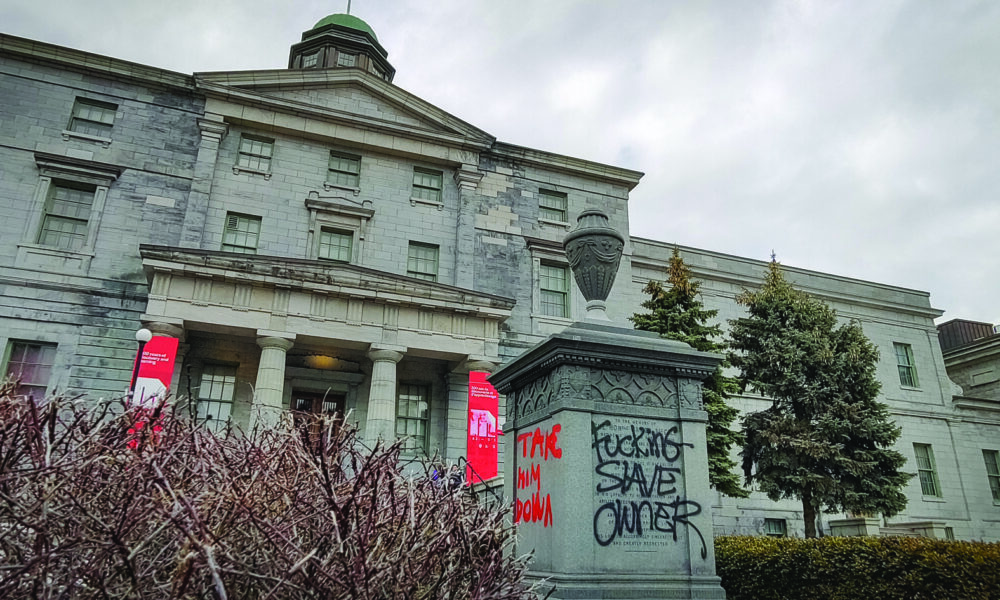
On the morning of March 21, students arrived on campus to find the front of the McCall MacBain Arts Building vandalized. On the banners flanking the main entrance, along the front wall, and on the small statue in front of the building, phrases including “education for liberation,” “fucking slave owner,” “decolonize,” and “the university is a factory” were spray-painted in black and red ink. 

The “slave owner” comment and the call to “take him down” refer to the fact that James McGill enslaved Black and Indigenous people. Students had been calling for the removal of his statue for years before it was eventually removed after being vandalized. Whether the statue will be returned has yet to be determined. 

(Léa Bourget / The McGill Tribune)

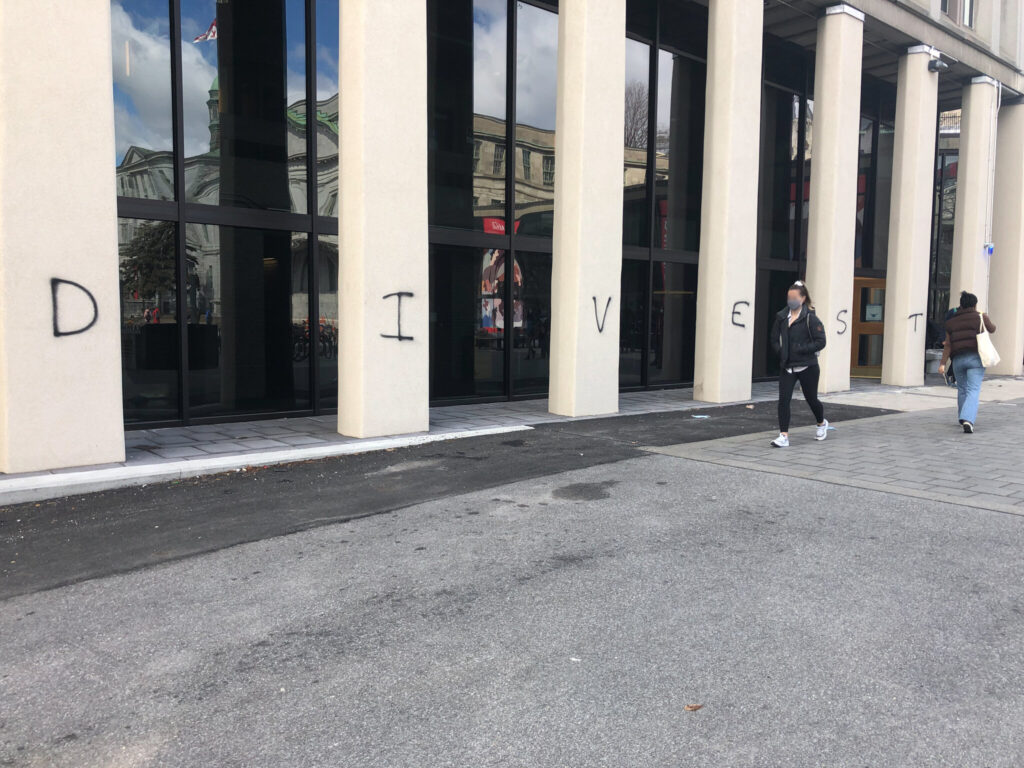
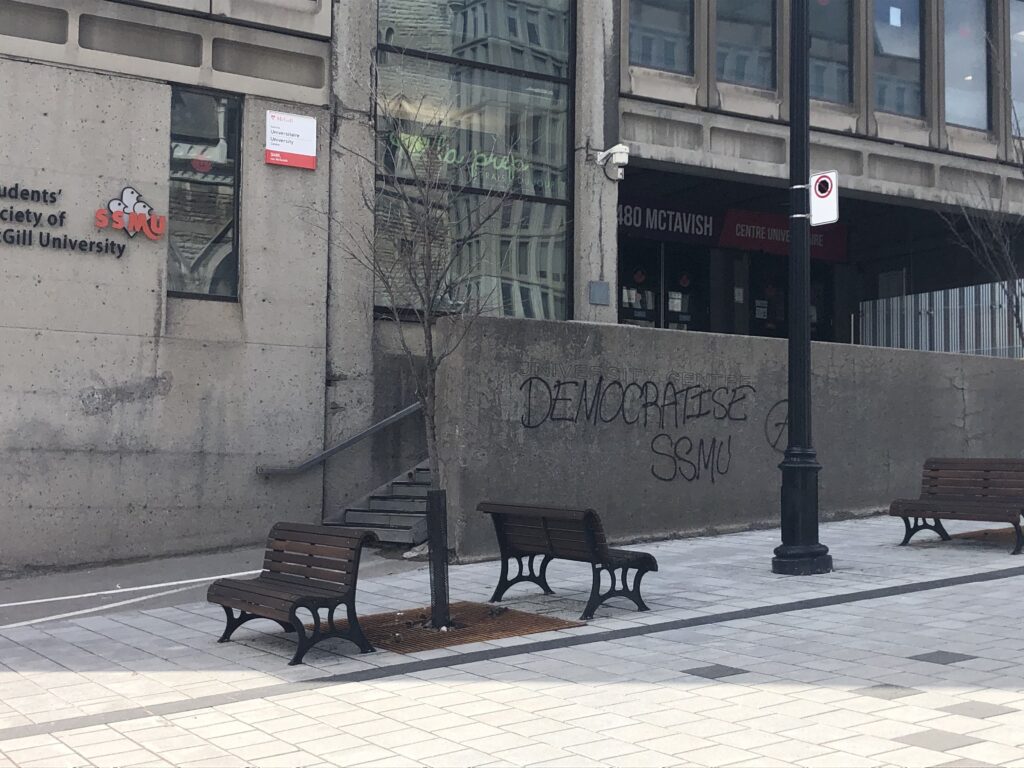
The Arts Building was not the only graffitied site; the pillars on the side of the Leacock Building had “divest” written across them and the front of the Students’ Society of McGill University (SSMU) building, the University Centre, had the words “democratize SSMU” sprayed on. All of the spray paint was cleared by March 23, but not before many students had the opportunity to see the messages. 

(Madison Edward-Wright / The McGill Tribune)

Taylor,* U1 Science, stopped to take photos of the messages scrawled across the front of the Arts and Leacock buildings after a class on March 21. While Taylor says he understands the message behind the graffiti, he disagreed with the methods vandalizers took to deliver it. Taylor believes it undermined student resistance to the McGill administration.

“I think making graffiti on the Leacock building is sort of detrimental to their cause, perhaps not the best way to protest what the university is doing,” Taylor said in an interview with The McGill Tribune. “I think there are more effective and more respectful ways of being in disagreement with certain policies.” 

Chloé Mersereau, U3 Science, spent half an hour sitting outside Arts on March 21, studying and watching other students stop and look at the paint. Mersereau agreed with Taylor, but felt somewhat conflicted.  

“I did not exactly know what it was at first, but I just saw ‘slave owner’ written all over and I was just a little bit shocked,” Mersereau said in an interview with the Tribune. “Graffiti is bad on its own, but I am torn because [James McGill] was a slave owner, so like, am I for this or am I against this?”

(Madison Edward-Wright / The McGill Tribune)

The McGill administration was not pleased when they discovered the state of the Arts building on March 21. In an email statement to The McGill Tribune, McGill media relations officer Frédérique Mazerolle stated that the university supports students’ rights to voice their opinions, but not in an illegal manner. 

“While we recognize the right of every individual to express their views and opinions, we regret that in this case, the manner of expression damaged University property,” Mazerolle wrote.

Science & Technology

From bioink to cryogenics: The rapid acceleration of 3D printing technology

A nozzle squeezes out a stream of molten plastic, ceramic, steel or even cells—layers and layers of which stack up, one after the other. Every layer laid down must wait for the last to dry before the next is begun. Patience is a virtue, and these machines are virtuous. 3D printers can create wildly imaginative works of art and cost-efficient products; they are only limited by the speed of research and the human mind. 

3D printers have taken the world by storm. Once viewed primarily as tools for the production of low-quality prototype parts or casual artistic endeavours, 3D printing is now being used in commercial production, like resin printing for shoe soles. 

Where things get even more interesting is the 3D printing of organic materials such as cells and tissues. Not only is it incredibly difficult to find organ donors, but tissue and organ transplants often fail due to a mismatch between donor and recipient, resulting in transplant rejection. Bioprinting, as this phenomenon is often called, aims to help solve these problems.  In 2018 alone, over 200 people in Canada died while waiting to receive an organ transplant. As bioprinting technology continues to develop, a future without waitlists may be on the horizon. 

Just as in the case of inorganic 3D printing, there are also multiple ways to approach bioprinting. One such example, and the most popular, is extrusion bioprinting

Researchers developed a bioink made from a mixture of materials, including cells, hydrogels, and growth factors—proteins that stimulate the growth of tissues. The mixture is placed into a syringe and the bioprinter is then linked to a computer. The computer guides the movement of the nozzle, creating the desired product by extruding the ink in different shapes and concentrations to mimic different organic tissues.

Hossein Ravanbaksh, a post-doctoral researcher in McGill’s Department of Mechanical Engineering, led a research team to determine how  to best store these materials and extend their shelf lives. Hydrogels, Ravanbaksh explained, are a key element in the bioprinting process. 

 “The hydrogels play exactly the role of a scaffold, to keep the cells in place and to keep all the nutrients in place,” Ravanbaksh said. “On the other hand, the waste materials from the cell can be washed away. The hydrogels will be degraded in the body so that the new regenerated tissue can take the place of the hydrogel after it is degraded.” 

In a way, the hydrogel is the life blood of the bioink: It acts as the body before the cells are put into an actual body. 

A common issue with bioprinting, however, is the shelf life of key materials—the tissue dies very rapidly after production. As most hospitals do not yet have the sophisticated machinery to 3D-print tissues on demand, organs need to be printed at another location before being shipped to where they are needed. This is where Ravanbaksh’s research into cryobioprinting comes in.

Cryobioprinting takes place at temperatures of between -15 to -20 degrees Celsius. The bioink exits the extruder, or nozzle, and touches the surface of a freezing plate, causing the bioink to freeze in a process called cryopreservation.

A primary goal of the study was to find the best cryopreservative that would ensure that the highest number of viable cells are produced and stored. According to Ravanbaksh, the bioinks are highly resistant to low temperatures and can last months in liquid nitrogen—the storage medium for these tissues. The tissues can then be transported to any hospital that needs them and thawed on site.

Much of the innovations in 3D bioprinting are still in early development; cryobioprinting, for example, is purely in its proof-of-concept stage. The possibilities are promising and could be life-changing in the near future. From mechanical Michelangelos to a new-age robotic Hippocrates, 3D printing machines have the ability to radically alter art, medicine, and industry.

Campus Spotlight, Student Life

A conversation with ‘The McGill Nightly,’ the source of satire for McGillians

The history of student publications at McGill goes back nearly 150 years, with the creation of the McGill University Gazette, the first undergraduate-run monthly publication at McGill, in 1874. The 20th century saw the emergence of a different kind of publication: satire publications. These publications prefigured one that today many students know and love: The McGill Nightly. Unlike fake news, which takes advantage of the reader to peddle falsehoods, satirical news plays with the reader by using humour and irony to poke fun or make social commentary at real-world events and social trends.

The McGill Nightly’s team comprises a small inner circle, including two permanent writers, a website developer, and manager––all of whom remain set on maintaining anonymity.  

Though the Nightly covers a wide range of topics, it initially came into being to poke fun at The McGill Daily––apparent in their name, brand design, articles, and tagline. 

“We call ourselves ‘McGill’s Second Least Trusted News Source’ for a reason,” the team said. “[The McGill Daily has] a $260,000 annual budget to write articles that, at best, the vast majority of the student body doesn’t care about, and at worst disagrees with.” 

The Nightly’s claim is factually incorrect, however: The Daily splits its $260,000 DPS budget with Le Délit.

While a few of their articles directly critique the Daily‘s operations, the Nightly is more often writing about the failures of SSMU, the university administration, McGill’s on-campus services (or lack thereof), and online school, among others.

“Whenever shit hits the fan in a major way, we know we’re in for a fun article,” the team said. “It’s always fun to write about a big current event that everyone knows about. It helps make our articles feel relevant and timely and lets us have our say on all the important goings-on at McGill. Those articles also rack up the most views, which is fun too.”

Whether it is online publications like The Onion or The Beaverton, or shows like Last Week Tonight with John Oliver, the use of humour and wit to mock or break down current events is extremely popular—and it’s something that is not lost on The McGill Nightly team.

“We don’t think there is anything that makes McGill politics easy to understand,” the team said. “But we do find humour to be a great way to comment on these often-complicated issues. [We] use our articles to express the opinions and disappointment that McGill students too often feel in these institutions. Humour is a great way to communicate these feelings in a way that people will want to read.”

The McGill Nightly’s satirical perspective on campus events has become a staple part of students’ communal commiseration over the institution’s absurdities, with their articles consistently receiving thousands of views. 

“Thankfully, we didn’t have any friends at the time to tell us we’re not funny, so three years and 60 articles later, here we are,” the team said. “When they’re good enough, we’re always happy to publish guest submissions.” 

Although they don’t have a big budget, this hasn’t stopped the Nightly from continuing to write.  

“Whatever money we do have comes from merch sales and we put all the profits back into the Nightly [website], usually by giving away laptop stickers on our Instagram.”

A previous version of this article incorrectly stated that The McGill Nightly was McGill’s first own satire publication. In fact, McGill has had multiple satire publications throughout its history and the Nightly was not the first. The Tribune regrets this error.

Art, Arts & Entertainment, Fashion

The McCord Museum’s Artist-in-Residence Niap weaves a story of Inuit women through inventive beadwork

The McCord Museum’s newest Artist-in-Residence, Niap, is a Montreal-based multidisciplinary artist from Kuujjuaq, Nunavik. Her sculptures, textiles, and murals are currently displayed in some of Canada’s largest galleries. On March 25, her new exhibit, Piqutiapiit—meaning “precious belongings” in Inuktitut—premiered at the museum, a display of past and present Inuit beading practices that showcases the creative ingenuity of Inuit women. Niap’s collection is a beautiful tribute to the artist’s Inuit identity told through entrancing craftsmanship. The exhibit features photography, crafting tools, and Inuit clothing, including a new beaded tapestry that took Niap six months to complete. The tapestry was inspired by savviqutik—the beaded decorations on the front of Inuit women’s clothing. These decorations are constructed out of suede, cotton, leather, and Caribou hide, but are embellished with ivory, glass, brass, and turquoise beads, as well as freshwater pearls. Niap admitted that although the beads are widely available in Inuit communities, the Caribou hide was tough to source. Even though a savviqutik is typically stitched over the chest of a coat, Niap said she felt inspired to make it into a mural. 

“There are a lot of things that inspired my work,” Niap said in an interview with The McGill Tribune. Pointing to a tapestry on the wall, she explained, “This piece in particular, was inspired by the chest piece that you’ll see on Inuit traditional clothing. There’s the ulu that inspired the wood piece. There are a lot of things that inspire, but most, the intricate work on Inuit clothing.” An ulu is an Inuit hand-held knife, many of which are displayed in the exhibit.

Upon entering the exhibition, one encounters a series of black-and-white photographs of Inuit women dressed in beautifully intricate beaded parkas lining the walls. These forays into the history of Inuit women’s clothing provide a visual history that sheds light upon Niap’s own creations, such as her own hand-beaded chest piece hanging up on the back wall. During a tour of the exhibit, Niap explained that even to this day, the creation of the garments is an activity reserved for the women and girls of the community. Contrast, yet continuity, between grayscale photos and Niap’s vibrantly coloured creations create a timeline of Inuit women’s clothing that culminates in an explosion of colour, marking Niap’s creations as culturally celebrative pieces that speak to both the past and present of Inuit women’s artistry. 

Indeed, Niap recalled the important role beading played in connecting her to family and, particularly, her female relatives: The artist began beading at a young age, with her grandmother and cousins. The entire exhibit exudes a familial air. For instance, a mother’s coat known as an amauti, retrieved from the McCord Museum’s Indigenous Cultures Collection, sits adjacent to Niap’s own creations. Such coats are typically worn by mothers carrying babies, who ride in a snuggly pouch, or an amaut, below the mother’s hood. One can also find examples of such coats in photographs on the walls, worn by the women of Inuit history.

The exhibit also displays an impressive collection of small tools and crafting artifacts that Inuit women use in the beading and sewing of clothing, including items such as thimbles made of Caribou bone and needle cases made of animal hide. These items are also accompanied by a series of small knives, referred to as women’s knives, and a qulliq, a traditional seal oil lamp. Described by the artist as “precious little things,” such tools complete the narrative of Inuit creativity that Piqutiapiit weaves together: Photographs tell a visual history of Inuit garments, while tools represent each stage of such garments’ production—from the cutting of fabric to the stitching of beads. Along with Niap’s savviqutik, the multiple objects of Piqutiapiit come together into a tapestry-like story not just about Niap as a female Inuk designer, but of generations of Inuit women, using small tools, beads, and most importantly, creative innovation, to keep Inuks not just warm, but stylish. 

“I hope [visitors] take away the pure ingenuity and the pure talent that Inuit women had and continue to have today, and the patience and perseverance it takes to make something like the coats and the clothing and the kayak,” Niap said. “I really hope people realize how much time is spent with such little material, all these handmade items.” 

Piqutiapiit remains open until Aug. 21 at the McCord Museum.

Read the latest issue

Read the latest issue