


Latest News

Ask a Scientist, Science & Technology

Exploring the beneficial applications of virtual reality

Facebook recently announced that it would be rebranding itself as Meta. It will become the parent company of its social media platforms—Facebook, WhatsApp and Instagram—and will roll out new ways of experiencing these platforms. Facebook also explained that it would be focussing on developing virtual reality (VR) and augmented reality (AR) technologies—both falling under the umbrella term of extended reality (XR). 

Jeremy Cooperstock, a professor in the Department of Electrical and Computer Engineering at McGill, has been following companies’ movement toward XR technologies, but urges caution about the potential adverse impacts they could have. 

“[Researchers] have long realized [that] VR, AR, and XR are huge markets, so it’s completely understandable that the big tech players want to be investing in these technologies,” Cooperstock wrote in an email to The McGill Tribune.  “However, unlike conventional computing, VR, AR and XR should be viewed as powerful, persuasive technologies, much as social media has demonstrated itself to be, with the associated potential of causing tremendous harm to society.”

Although commercial ventures like Meta are some of the most well-known examples of XR because of their grandeur and sensationalism, many research labs are using XR technology to solve medical problems. In these labs, the users’ well-being are of the utmost concern. 

McGill’s Shared Reality Lab (SRL) is one such endeavour. Led by Cooperstock, the research group aims to use XR technology to improve the way humans interact with each other and with computer interfaces.

One of SRL’s ongoing projects is the development of a technique for applying mixed reality technology to the treatment of psychosis, called avatar therapy. This therapy creates a visual representation of a patient’s hallucinations so that they can interact with them in a controlled environment, to minimize the distress these symptoms can cause.

“Our purpose was to enable therapists to experiment with various parameters to determine what factors are involved in the success of the therapy, such as degree of realism [of the avatar], fidelity to the patient’s hallucinations, and active versus passive involvement of the patient in the creation process [of the avatar],”  Clara Ducher, a research assistant at SRL, wrote in an email to The McGill Tribune. 

Ducher explained that the SRL takes considerations of inherent bias into account as part of the design process well before a project gets off the ground.

“One of the most important things I have learned while working on the avatar therapy project is that our work has ethical aspects that should be discussed from the very early stage of the design, and even after the delivery of the product,” Ducher wrote. “For instance, many character creation interfaces that we can encounter in games are restrictive in the diversity of avatars we can create. This phenomenon does not arise from [the] technical impossibility to make colour or shape variations, but rather from biases inherent to people involved in the design process.”

When considering the benefits that this program could bring to those struggling with mental illness, it is clear that VR has the potential to improve quality of life. But when it comes to commercial ventures such as Facebook, Cooperstock stresses the importance of continual dialogue between companies, researchers, and users.

“As I teach in my Human-Computer Interaction course, for such ‘socially dangerous’ technology, regardless of who is doing the developing, I believe it is critically important that we have active and ongoing conversations to think about risks, policies, and regulations that might be considered,” Cooperstock wrote.

As XR gains popularity in the public consciousness, more products harnessing this technology will become available. Not only will new methods of communication become possible, but new medical treatments may also become more accessible. With the proper priorities in mind—priorities that emphasize well-being, not profit—XR technology has the potential to do a lot of good for humanity.


Know Your Athlete, Sports

Know Your Athlete: Victor Henry

Victor Henry, U2 Science and the second goalkeeper for the McGill men’s soccer team, was born in Washington, D.C. and started playing soccer when he was only four years old. After moving to Paris at the age of five, he continued playing, but struggled to excel—until he tried his hand as a goalkeeper.

“My mother is the one who actually suggested to my coach that I should try out goalkeeping. She thought that is where I should be,” Henry said in an interview with The McGill Tribune. “As soon as I started, I realized that that is where I had true potential. So I have been goalkeeping ever since.”

Henry became a part of the McGill team this season after being unable to play at McGill last year due to a delay in his study permit. After participating in the training camp over the summer, he was selected to join the team.

“It’s impressive how serious and professional the team is, especially in contrast to facilities and teams in France, which are much less valued,” Henry said. “The team gets along extremely well and is hardworking, which adds to the level of professionalism.”

Henry attributes much of his positive experience with the Redbirds to his coaches. Both Michael Palomo, the goalkeeper coach, and Marc Mounicot, the team’s head coach, are consistent with their advice and expectations, which Henry says has helped him fulfill his potential as a keeper.

As a player with lots of experience in several roles on the pitch, Henry feels that being a goalie is a unique position. It does not require the same skill set or aptitudes as other players as the coordination and the endurance needed are not the same.

“As a goalkeeper, my role is quite different than [that] of my teammates,” Henry said. “I have to communicate with my defenders and centerbacks, as I’m the only player who has a view of the whole field. It’s an aspect of my role that I really enjoy.”

The highlight of the season for Henry was undoubtedly the supporters: Nothing fuels an athlete like an enthusiastic crowd. Out of all his supporters, Henry says the best encouragement comes from his parents.

“In terms of supporters, my parents are my biggest fans,” Henry said. “They have attended my games throughout my whole life and even came to Montreal at the beginning of the year to watch me play. They also watch the games on the McGill streaming service.”

Currently pursuing a joint major in mathematics and computer science, Henry hopes to work in software engineering after graduation. With these big dreams, Henry has adapted his schedule around the team’s hours, working in the afternoon before practice and then making time to relax with friends. 

“I think having a good discipline in terms of organization is what allows me to do all these things,” Henry said. “My roommates and I are into basketball, so it’s typical for me to come back from school after having studied and been to practice and just watch an NBA game with them.”

Henry is also a big fan of the French National Team and was delighted when they won the Nations League. His favourite players are goalkeeper Hugo Lloris, N’Golo Kanté, and Karim Benzema. He also supports both Arsenal and Paris Saint-Germain (PSG).

Henry hopes that the men’s soccer team will make it to the playoffs next year, with the aspiration of reaching nationals. He is currently very happy with his position and is looking forward to getting back to training with the team. 

Any soccer fan should keep an eye out for Victor Henry in the following years. If his shutout game against UQAM—where he made seven saves and stopped two penalties—is any indication of his talent, the goalkeeper is set for some impressive performances in the future.

Hockey, Sports

McGill men’s hockey prevails in shootout against Concordia

The McGill men’s hockey team (1–1–0) opened their OUA season on Nov. 3 against the Concordia Stingers (1–1–0), defeating their downtown rivals on the road and disappointing the home crowd. 

The game began with some physicality and emotion that spilled over from the previous match-up, as the final preseason contest finished just over a week prior to the season opener. Tension was elevated further following an early goal from Concordia five minutes into the game, sending the home fans into a frenzy—particularly the Stingers’ student section that sat beside the McGill bench.  

Despite the early deficit, the Redbirds continued to press hard, with solid play from the defencemen and continuous forechecking from the McGill forwards. The consistent pressure yielded positive results for the away squad, as fourth-year forward Jordan Ty-Fournier tipped a slap pass from third-year Blake Hayward past the Concordia netminder, tying the game again and pushing the momentum back in McGill’s favour. 

At the end of the first period, McGill and Concordia got into a brawl as the intensity between the two rivals increased. The scrap resulted in two Redbird penalties and one Stinger penalty, giving Concordia a power play to begin the second period. However, McGill successfully defended the penalty kill and thwarted any possible momentum that might have begun the period. 

After keeping the home team in check, the Redbirds began to press once again and took advantage of their opportunities. Hayward was involved once again, burying a beautiful goal to take a 2-1 McGill lead halfway through the second period. After scoring, Hayward and the rest of the Redbirds on the ice mildly taunted the Concordia fans after some back and forth between the away players and home fans earlier in the game.

Despite the unforgiving rival crowd, fourth-year defenceman Taylor Ford was happy to be back at the Ed Meagher Arena. 

“It was definitely a great feeling to have a rowdy crowd again, even if they were against us. I’ve been around a few years now, so I expected the Concordia crowd to be in our ears all night long,” Ford said in an interview with The McGill Tribune. 

Following the McGill goal, the Redbirds held the momentum for the rest of the second frame, but were unable to capitalize due to costly mistakes. This was exemplified late in the second when the away team took a penalty just three seconds into a powerplay, immediately quashing any man advantage opportunity.

These missed chances would come to hurt the Redbirds: Four minutes into the third period, the Stingers tied the game 2-2 on a point shot from Concordia defenceman Marcus Tesik. The crowd went into a frenzy and was suddenly rejuvenated. Concordia would benefit significantly from this jolt, drawing two McGill penalties with under 10 minutes left in the game.

However, the McGill penalty kill unit proved their might once again, blocking multiple shots and killing over a minute and a half of a 5-on-3 power play. 

Ford was delighted with the penalty kill unit’s performance, commending their defence against all six of Concordia’s power plays.

“Our penalty kill was great,” Ford said. “Our assistant coach spoke to us before the game about the 5-on-3, which helped us come up big when Concordia in fact had that opportunity.”

Additionally, Ford credited goalie Alexis Shank for the team’s success.

“The most important part of any penalty kill is the goalie, and I thought [Alexis] stood on his head, not only for the penalty kill, but for the entire game,” Ford said. 

After regulation, the score remained even, prompting a 3-on-3 overtime. The extra period was extremely fast-paced, with an abundance of odd man rushes for each side. However, neither team could convert over the seven minutes, sending the game into a shootout.

With each team and fanbase anxiously anticipating each shot, the tension in the arena was palpable. With no goals after 17 straight penalty shots, Jordan-Ty Fournier buried the game-winner in the ninth round of the shootout, sending the handful of McGill fans into celebration, and leaving the Concordia faithful disappointed.

McGill plays Carleton University in Ottawa for their next game on Nov. 12. 

Moment of the Game:

Jordan-Ty Fournier scored in the ninth round of the shootout to win the game for McGill.

Quotable:

“The younger guys definitely got a taste of what the Concordia and McGill rivalry is all about. As always, it was a great feeling to beat [Concordia]” — Fourth-Year defenceman Taylor Ford

Stat Corner:

Concordia had six total power plays in the game, compared to just one for the visiting Redbirds.

Research Briefs, Science & Technology

Just one lifetime away: Mapping climate change beyond the year 2100

The year 2100 has frequently served as a benchmark for climate health projections. Yet, more than half a century has passed since 2100 was first used as a horizon, and the year is no longer a marker of an abstract and dystopian future, but rather a time that will be reached by some alive today. 

Christopher Lyon, a postdoctoral researcher at McGill, joined scientists from the University of Leeds as a visiting researcher to help create a new experimental model for a climate warming curve continuing beyond 2100 and into the year 2500.

“We keep saying 2100, and don’t look past 2100,” Lyon said in an interview with The McGill Tribune. “Someone might be forgiven for assuming that whatever is going to happen by 2100 is the stopping point for climate change, but it keeps going after that.”

One of the greatest impacts that climate change may have past 2100 is the substantial warming of the equatorial regions around the globe, which would render places such as the Midwest or the Indian subcontinent too hot for human habitation. Humans could be forced to migrate to the poles and scientists would have to develop new artificial intelligence (AI) technologies in farming to adapt crop production to these high temperatures. 

“If, and it’s a big if, we don’t manage to meet our climate objectives, and the world does get that much hotter, we may have to reprioritize our aims,” Lyon said. “It could be that we end up in a kind of triage politics where we have to think about sustaining [human] life, rather than some of the places and ecosystems we hold valuable now.” 

The crux of climate change negotiations of the future could lie between allocating resources toward either conservation or adaptation. For instance, extensive irrigation and water conservation systems designed to be controlled remotely could benefit areas such as the North American plains, where water could become scarce. There is also a very real possibility that personal protective equipment will be needed to safely venture outside in equatorial regions. 

“If we delay, […] it gets much harder to do,” Lyon said. “The planet will be warmer, there will be more CO2 and other greenhouse gases in the atmosphere, and we will need a much greater level of technological intervention to stop emissions.”

While Lyon’s research is mostly aimed at modelling the climate crisis further into the future, his team nevertheless takes time to highlight the challenges climate change poses to current governments. 

“Maybe we need to think about how we structure our institutions for the kind of decision-making that needs to happen to mitigate climate change,” Lyon said. “[This system is] responsible for producing the emissions […] but it’s also the system we’re trying to solve [climate change] with.”

While a complete restructuring of our political systems might seem daunting, or too large a task to be completed before the Earth warms by two degrees Celsius, Lyon remains optimistic about humanity’s prospects for overcoming these obstacles. 

“We are kind of missing an opportunity right now to do something collectively as a species to address a challenge facing us that could provide a lot of meaning to people’s lives,” Lyon said. “The generations that meet this challenge can tell their grandkids about [it] when [they] might ask ‘What did you do in the climate crisis when it was really bad?’” 

Know Your Athlete, Sports

Know Your Athlete: Matthew Beaudet

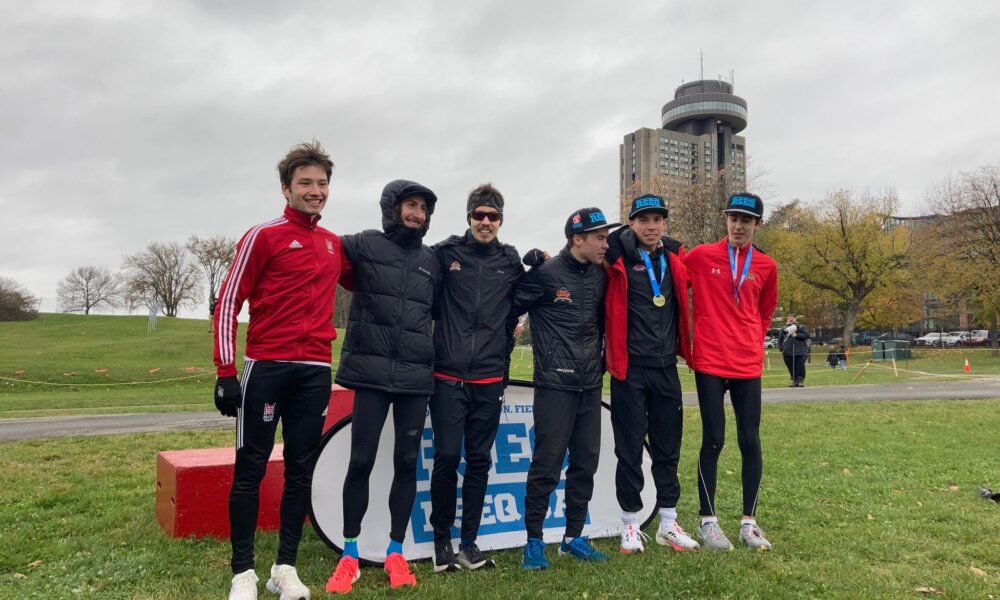
Matthew Beaudet has had a successful cross-country season, to say the least. On top of winning an invitational and being named RSEQ athlete of the week, Beaudet won gold at the RSEQ Championships on Oct. 30 and was named rookie of the year. Although fairly new to competitive running, Beaudet has quickly found his stride on the Redbirds cross-country team.

“In high school, I played more team sports like hockey, football, and soccer, and during the winter we would have speed and agility training. Once I got into my last year of high school, I was enjoying that more than […] going to the gym or playing football,” Beaudet said in an interview with The McGill Tribune. “So I decided that I was going to continue in CEGEP. I started with sprints, but […] I think I have a better aptitude for long-distance, so now I run the 1500 metre [for track] and five kilometre for cross-country.”

With all the running he does, Beaudet finds that listening to artists such as Arlo Parks or Ninho helps the kilometres go by a little easier.

“I know some people say it is better if you don’t, but I find that it is so much easier to get through the run listening to music,” Beaudet said.

Although races can be very difficult, Beaudet uses post-race rewards as motivation. He often stopped at Lemaire, a traditional poutine restaurant, on his way home from races in Quebec City this past summer.

“They make the cheese curds there and it’s fresh and really good,” Beaudet said. “So if the race was good, it is a celebration to get a poutine, and if it was a bad race, to console myself I would also stop to get a poutine.”

As a second-year student studying electrical engineering, Beaudet has a busy schedule. Despite this, he often runs twice a day—before and after a full day of challenging courses. Outside of running, however, Beaudet also finds time to make a difference in his community. After a long-term injury forced him to take a six-month running hiatus, Beaudet started coaching and found the experience extremely gratifying.

 “A lot of kids find running track and field pretty difficult, so it’s nice to see them become more confident,” Beaudet said. “It’s nice to see and to know that you might have played a small part in that.”

In his free time, Beaudet likes to read. One of his favourite books is The Emperor of All Maladies, which looks at the history of cancer from the perspectives of patients, physicians, and government lobbyists. He also enjoys books about spies during the Cold War.

“I read this book recently called Agent Sonya about this USSR agent who was the greatest female spy,” Beaudet said. “Her life was crazy—you couldn’t make it up.”

For anyone looking to start running, Beaudet sees patience and consistency as key to overcoming the initial hurdles of training. 

“You are definitely out of breath on your first runs, but you improve really quickly in the first month and you surprise yourself,” Beaudet said. “Discipline and consistency are the most important things because you are bound to get stuck at some points. But if you keep going, it could be three months, it could be six months, but you are going to break through at a certain point.”

And if you want an extra boost, Beaudet swears by drinking beet juice the week of a race to enhance his performance. 

For now, Beaudet looks forward to the U Sports Nationals, which will take place on Nov. 20 in Quebec City. And one thing is for sure—win or lose, he will be getting poutine after.

Features

The human cost of a warmer future

This summer, I spent most of my time working and hiking. If I wasn’t running around helping a client find something at the pet store I worked at, I was running around the woods with a backpack full of snacks, coffee, and water. I ventured past the city of Montreal to McGill’s Gault Nature Reserve at Mont St-Hilaire or to Mont-Rigaud, close to the Ontario-Quebec border. For the few hours I was in the woods, I left my earphones in the car and shut my phone off so that I could enjoy the sounds of rustling leaves, streams, and the occasional birdsong. 

One Tuesday toward the end of July, I was staring out the window at work planning my next excursion when I noticed how hazy the sky was. In fact, it was more than hazy: It was smoky. I soon realized that it was actual smoke, so much of it that I could not make out the cars on the other side of the parking lot, maybe only 200 metres away from me. When I looked at the sun, I could barely tell where it was in the sky. It was like a fever dream. I stepped outside expecting to see a building on fire, but there were no flames, no buildings on fire—just heavy air, thick with smoke and the scent of fire. When I left that night, the haze had passed, but the moon was glowing a deep orange colour. 

Later that night, my research revealed the source of the apocalyptic scene as the major forest fires raging across Canada. The moon that night was orange because the smoke particles blocked shorter wavelengths of light, like blue and green. This year, Canada experienced 6,224 wildfires between Jan. 1 and Sept. 15. The week of July 20 saw the highest number of active fires recorded in a week in 2021 since the start of Canada’s official fire season on April 28. The week I noticed the smoky sky, there were 738 active fires. In those seven days, 580.6 thousand hectares of land were burned. 

What startled me was that these statistics represented wildfires in Canada in 2021 alone. As I reflected on just how much the natural world is suffering, I was seized by a strong sense of impending dread. That sense of dread made me extremely anxious, depressed even, about what the future of our planet would be.

This anxiety was not entirely new to me. It was something I had felt it for years, but had buried it deep down because I didn’t want to deal with the reality of the ongoing climate crisis. After witnessing the effects of climate change first-hand, however, I understood I could no longer

Rugby, Sports

Redbirds rugby advance to finals, beating Bishop’s in nail-biter game

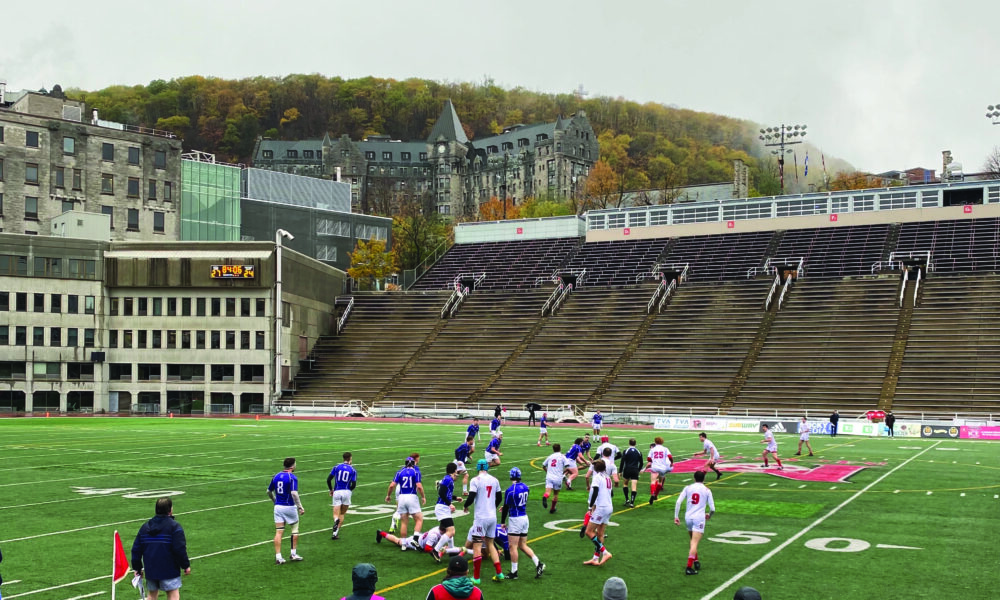
On Oct. 31, McGill Redbirds rugby hosted Bishop’s Gaiters for the RSEQ semifinals, winning 30-27 in a brutally competitive double overtime contest that totalled over 110 minutes of play. Both teams braved the rainy weather and cold winds to vie for the coveted spot in the finals, but McGill brought it home with a penalty kick to break the 27-27 tie in sudden-death overtime.  

Early in the first half, it became clear that the rain would not help with ball handling, as the Gaiters struggled to hold possession long enough to get deep into McGill territory. Despite this and McGill’s fast-paced attacking drives, the Gaiters were the first to open up the scoring on a penalty goal at 14:21 on the clock. 

The Redbirds’ consistent offensive pressure did not culminate in a try until the 38th minute, when prop Jeremy OckoMichalak squeezed past Bishop’s defence to touch down. Not even two minutes later, second-year Brad Hunger scored another try. Scrum-half Owen Cumming successfully converted both despite the tricky angles, bringing the score to 14-3 for McGill at halftime. 

“We defended well and maintained possession of the ball most of the half and didn’t give [Bishop’s] real opportunities to score,” head coach Ian Baillie said in an interview with The McGill Tribune

The second half saw the Gaiters raring to redeem themselves, refining their attacks and scoring three penalty goals in 10 minutes. Despite the extra pressure, the Redbirds added another try, penalty goal, and conversion.

Things took a turn for the worse at the 64-minute mark when Bishop’s brought the score to 24-19. In the very last minute of extra time, McGill was unable to fend off the Gaiters’ onslaught, and they scored a try with no conversion, forcing the match to overtime.

“It was a tale of two different games,” Baillie said. “[Bishop’s] took control of the game [with] a couple of penalty goals and some good retention on the ball. They put us under heaps of pressure and levelled it up to send us into extra time.” 

The drama did not stop there. The first two 10-minute periods of overtime brought physical play and one penalty goal apiece, extending the match past the 100-minute mark into sudden-death overtime. Finally, a steal by second-row Jacob Davidson led to a penalty opportunity directly in front of the goal posts. Cumming stepped up to the plate and the conversion was good—the rain-soaked crowd went mental. 

In a post-game interview, Cumming credited his teammates for their hard work leading to the ultimate win. 

“Rugby’s too much of a team sport to say that [I was the deciding factor], my job is to kick at the end of the day,” Cumming said. “I’m just very lucky to have teammates to get the job done so we can score like that.”

Fullback Benjamin Russell admitted that the Redbirds let their guard down in the second half, but was thrilled with the game’s turnout. 

“We’ve worked so hard for it […] so we’re just so happy,” Russell said. “Obviously, it was a very, very tight game in the end, we kind of let them come back into it, but we closed it out and saw them off. They put up a great fight, so hats off to them.” 

There is only one team standing between the Redbirds and the RSEQ championship: The Concordia Stingers, who shut them out at the semifinals in 2017. 

“We’re looking forward to going up against Con U in the final. Everyone’s excited for it,” Russell said. “As long as we are sticking to our game plan and following it, then we have the personnel and the skills that we […] need to beat them.” 

The Redbirds will host the Stingers on Nov. 6 at Molson Stadium in the RSEQ finals, where they hope to put on a show for McGill fans and to secure a championship title. 

MOMENT OF THE GAME:

Fourth-year scrum-half Owen Cumming nailed the final penalty kick to clinch the win for the Redbirds, sending the crowd into a frenzy after nearly two hours of gruelling, rain-soaked play. 

QUOTABLE:

“I’ve been here four years, [and] we’ve always lost to [Concordia]. It’s a chip on our shoulder that we want to get off, but we just gotta play our game. Today […] we let Bishop’s play to their strengths, we dipped down a bit, [but] we just have to be calm, composed and play our rugby.” —Scrum-half Owen Cumming  

STAT CORNER: 

McGill and Bishop’s fought dirty, with both sides racking up a total of 11 penalty kicks and three yellow cards. 

Arts & Entertainment, Film and TV

There’s something seductively toxic about ‘You’ season three

Warning – Spoilers ahead !

Previous seasons of You have presented all the makings of a modern romantic story: Boy meets girl, boy falls in love with girl, boy would do anything for girl. This time around, however, boy happens to be an obsessive stalker whose love language includes nothing short of murder—that is, until he meets his perfect match, creating a recipe for a perfectly unhinged love story. This sequence is continued in the third season of You, a Netflix original that embraces the villain as the protagonist, ultimately keeping the audience unsure if they should support the brooding-yet-charming Joe Goldberg (Penn Badgley) despite his sociopathic tendencies.

Following the twist ending of the second season, this latest instalment strays from the similar structures established in the first two seasons of the show. With the murderous and psychotic tendencies of the main characters exposed, the episodes follow newlyweds Joe and Love Quinn-Goldberg (Victoria Pedretti) attempting to settle into domestic bliss in the suburbs of Madre Linda. 

Joe and Love navigate the difficulties of marriage and life with their newborn child, Henry, all while trying to integrate into a privileged upper-middle class milieu, suppressing their aversion to their neighbour’s “woke,” status-driven lifestyles.

Though the dark secrets harboured by the new residents risk alienating the couple from their community, the show’s narrative never fails to recognize their privilege as a white, cis-gendered heterosexual couple, whose cushy lifestyle is funded by Love’s family fortune. Neither Joe nor Love would have been able to maintain the illusion of the American dream had it not been for the safety net of wealth and influence provided by Love’s family, which allowed the two to narrowly escape run-ins with the law. The genius of the series lies within the duplicity of their lives as criminals and as blissfully engaged community members. This dynamic creates a vehicle for social commentary, despite the absurdity of the contrast between serial murderers and athleisure-wearing, gossip-hungry yoga moms. Even in such a bizarre setting, the show still uses its protagonists to critique different aspects of society.

Viewers know that Love killing her neighbour in a burst of rage is wrong, but they can’t help but agree with her disgust toward the hypocrisy of the neighbourhood women, who profit off of her victim’s disappearance to gain sympathy from their masses of online followers. In one of her many impulsive homicidal outbursts, Love assaults a fellow Madre Linda resident and locks him in a cage in the basement of her bakery upon hearing about how his anti-vax opinions led to her son’s hospitalization. His child, who hadn’t received the measles vaccine, was around Joe and Love’s son and passed the disease onto him. Despite the condemnable act of violence perpetrated against a fellow parent, the transmission of political messages—in this case, on the importance of vaccines—succeeds by vilifying a character described as the person for whom “World’s Greatest Dad” mugs were created. 

Ultimately, the contrast of the plastic purity of Madre Linda and the gruesome hobbies of their newest residents provides a channel for social commentary of the real world that ultimately ushers in a reckoning of our own morality—by succeeding in making us root for the villain.

Editorial, Opinion

Quebec’s new program takes an ignorant course

On Oct. 24, the Quebec government unveiled a new education program called Culture and Citizenship in Quebec (CCQ). The new course will take the place of the previous Ethics and Religious Culture (ERC) program. Intended to broaden student engagement with Quebec values, the program is currently undergoing a curriculum drafting process for both primary and secondary schools and will be deployed in schools for the 2022-23 school year as a pilot test. The curriculum is slated to be fully implemented by 2023-24. When Quebec Education Minister Jean-François Roberge announced the program, he emphasized that Quebec’s rich cultural legacy should be shared with students but that, at the same time, students could disagree “respectfully.” But instead, the program ends up enforcing an idealized version of Quebec culture that erases  cultural difference and breeds xenophobia. In light of criticisms by Indigenous groups and religious leaders, the Quebec government should halt the CCQ’s drafting process. Only by engaging with the various cultural and religious stakeholders on the land now known as Quebec can the provincial government actualize the program’s goal of dialogue and critical thinking skills.

When the Quebec Liberal Party (QLP) first introduced the Ethics and Religious Culture program  in 2008, the intention was to teach students about the diversity of religions and cultures from an unbiased perspective. Considering how colonial governments used religion to further their imperial projects and how religion often finds itself at the root of global conflict, teaching—rather than proselytizing—religion bridges cultural gaps among students. As the Coalition Avenir Quebec (CAQ) began its secularizing mission—infamously embodied by Bill 21, which  prohibits public servants from wearing religious symbols—they sought out recommendations on how to best secularize the former ERC program. While Quebec’s culture certainly remains influenced by secularism and the legacy of the Quiet Revolution—a period during which the province retreated from the Catholic Church––religion still plays an important part in the lives of many Quebecers. Further, the government should not view religious differences as antithetical to Quebec culture, especially as the province sees rising levels of anti-Semitism and disproportionate violence and discrimination against Muslims. Under both Bill 21 and the CCQ, female Muslim teachers will continue to be stripped of their freedom of expression and identity, and intolerance and hate crimes toward Muslims risk seeing an even greater increase. Even if secularism belongs in education, students will not become citizens of the world, nor will they grasp the full picture of Quebec’s culture, through the total erasure of religion.

A major critique of ERC that provoked its revision was its focus on multiculturalism. A national right-wing promotion of a citizenship “values tests” set the groundwork for a closed-minded approach to Quebec culture. Such an approach has fueled nationalist extremism at the expense of minorities. Similar to comprehensive sexual education, students should be provided space to discuss religion openly. A fear of sharing or expressing one’s religion can create stigma and have disastrous impacts on identity formation. Teachers should be trained to explain religion, ethnicity, identity, and all their complex intersections, to foster a safe and inclusive environment.

The purpose of CCQ itself remains suspect, especially due to the government’s lack of consultation with Indigenous groups to whom the land belongs. Premier François Legault repeatedly denies the presence of systemic racism in the province and the non-Indigenous Minister of Indigenous Affairs Ian Lafrenière claimed that Indigenous groups had been consulted, despite the fact that many groups refute this. Exercises in promoting Quebecois culture and “nation”-building run counter to Indigenous peoples’ sovereignty and well-being. Quebec should move away from settler-colonial pedagogy, and toward championing Indigenous culture. Only then can students, teachers, and the province tap into the tenets of equality, conscience, and self-respect the CCQ aims to realize. 

As it stands, Quebec’s redrafting process signals that freedom of expression in the province is only given to those who submit to CAQ’s narrow doctrine, rules, and guidelines. Legislating a strict, “nationally cohesive” culture through the education system may be a clever political move to harness power from rural and suburban Quebecers detached from the religious diversity of Montreal and Quebec City. However, without proper consultation with Indigenous groups and religious minorities, the program will obscure differences to marginalized groups’ harm and majority groups’ ignorance.

Arts & Entertainment, Film and TV

‘Eternals’ takes forever to almost achieve greatness

After numerous iconic filmmakers such as Martin Scorsese and Denis Villeneuve made disparaging comments about the standards of superhero films, Marvel Studios faced extra public pressure to create innovative and exciting iterations of the familiar genre.

Eternals follows several members of an immortal alien race who secretly lived on Earth for several millennia to protect humanity from the dangerous and predatory Deviants—another group of animalistic alien creatures. Following the aftermath of Avengers: Endgame and the return of half the Earth’s population, the Eternals reunite after Deviants resurface and start hunting down the long-separated group.

The film’s vision clearly comes from the creative sensibilities of writer-director Chloe Zhao, who won multiple Academy Awards this year for her film Nomadland. Zhao brings a more grounded, humble approach to Eternals’ massive scale and stakes. While other TV shows like HBO’s Watchmen and Amazon Prime’s The Boys tell darker stories about super-powered individuals with grittier, more realistic dynamics, Eternals embraces a traditional superhero story without the genre’s usual pomp and circumstance. 

The film’s cinematography is expansive and engaging, with the many geographic settings serving as a calm, yet powerful, backdrop to the adventures of the titular team. There is lots of natural chemistry and diversity amongst the cast, which makes it easier for audiences to believe the sensational fantasy of the plot. The film’s themes of community, destiny, and self-empowerment are potent and inspiring, and are just as present in countless other Marvel films.

At a runtime of 157 minutes, Eternals is a viewing commitment, but for the most part, the film earns its length. The size of the ensemble cast and broad scope of conflict necessitate the duration, providing space to accommodate the characters’ many interwoven stories. It isn’t completely successful, however: The sheer number of characters and plotlines lead to several of them feeling underdeveloped. The ingenuity of Zhao’s direction and the dynamic explorations of human settings, superhuman emotions, and nuanced moral quandaries round out the better aspects of the film. 

Yet, the countless juxtapositions of the film’s intentions and finished product compromise the film’s overall quality. The movie is stuck in a type of fandom limbo—it isn’t extravagant or sensational enough to fit in with the majority of Marvel movies, but it’s not indie enough to please cinephiles either. While these aren’t the only categories of filmgoers, they are the most likely to see a Chloe Zhao-directed Marvel film. In light of Scorsese and Villeneuve’s comments, it is understandable why Zhao would try to break from Marvel films’s traditional format. The final product, however, is bogged down by the more formulaic aspects of the film—the romances between characters and the ending, in particular—making the tone feel inconsistent.

Another frustrating aspect of Eternals is its unconventional approach to common superhero film tropes—rather than subverting them, Zhao subdues them. The diminished tropes work to varying degrees of success: While the lack of melodrama is a fresh take on fantastical storytelling, this humble approach lessens the stakes of conflict. Lacking suspense and anticipatory energy, many moments in the film feel wrongfully constructed and anticlimactic. Some character arcs are both derivative of other Marvel films and only occasionally given dramatic weight, making certain scenes feel out of place. The logic behind these choices make sense, but ultimately lead to the film not living up to its full potential. 

Eternals is a very enjoyable film overall, but its fallacies and contrasting elements prevent it from being truly great. The long runtime is needed to accommodate all of the ensemble cast’s stories and talents, but leaves certain necessary plot points to the muddled imaginations of audiences. It may not become a beloved Marvel classic, but the pieces of Zhao’s vision that are able to shine through make it well worth the eternally rising price of cinema admission. 

Read the latest issue

Read the latest issue