

Latest News

McGill, News

RSN hosts debate on individual versus systemic climate action

On Oct. 19, McGill’s Research and Sustainability Network (RSN) held a virtual debate on the topic of individual versus systemic solutions to the climate crisis. The event featured three McGill professors who research environmental sustainability in their respective fields: Sanjith Gopalakrishnan, assistant professor of operations management in the Desautels Faculty of Management; Dror Etzion, associate professor of strategy and organization, also at Desautels; and Brian Robinson, assistant professor in the Department of Geography. 

Shanaya D’sa, U4 Arts and co-president of the RSN, moderated the discussion. D’sa explained that the group’s mission is to help undergraduates get involved in sustainability-related research.

“The Research and Sustainability Network is a student-founded [SSMU] group that aims to bridge the gap between researchers and undergraduates,” D’sa said. “Through speaker series, panel discussions, and socials, we aim to feature a number of sustainability-related topics in an interdisciplinary environment.”

The panellists were first asked about the difference between individual and systemic climate action and how they believe the burden of action against climate change should be distributed. Gopalakrishnan emphasized that, contrary to popular opinion, change can stem from individual-level action, but that an overall mix of institutional and individual action is needed.

“As individuals, it can often appear that we are sort of powerless in front of much larger players to do anything meaningful, but that is not quite true,” Gopalakrishnan said. “There are several ways in which you can make meaningful impacts. Food choice is one of them, [as is] moderating your consumption, rewarding companies or individuals who make right or ethical choices. All of these things are things that individuals can do and individuals must do.”

Etzion took a slightly different stance, arguing that the individual and institutional levels are inherently interconnected. While he cautioned that their interrelation can be for better and worse, Etzion believes it is possible for individual choices to influence positive systemic change. 

“[There is] very recent work that says […] the way that you can influence solar panels in your neighbourhood is through contagion,” Dror said. “So, if people see solar panels around them, they are going to put solar panels on their buildings as well. If we create clusters of people having solar, then it is going to influence more and more people to have solar.” 

Robinson approached the topic from a totally different angle, stating institutional change is imperative, even if change at the individual level might feel more attainable to some. 

“[W]e have little ability to rely on institutions to actually handle some of the forms of change that we need to see, despite that being where the change needs to happen,” Robinson said. “[Institutions] are the ones that shape some of the choices that we have to make as consumers and as individuals. They need to sort of set the bounds on those.”

The speakers noted that financially disadvantaged, racialized, and other marginalized communities often bear the brunt of the climate crisis. Robinson emphasized the importance of listening to these groups rather than talking over them.

“We cannot let our own institutions and policies of ‘good will’ overcome or overwhelm the autonomy and choice of these communities,” Robinson said. “They need to be part of the solution and they need to be part of the discussion.”

At the tail end of the question and answer period, Amelia Murphy, U3 Arts and Science, asked the panellists a simple question: “Are we screwed?”

Gopalakrishnan answered “no,” optimistic about the amount of attention the climate crisis is currently receiving, but that we must remain diligent. 

“I do not think we are screwed,” Gopalakrishnan said. “There are lots of people working on solutions. We can be optimistic, but not complacent.”

A previous version of this article incorrectly stated that the debate took place on Sept. 19. In fact, the debate took place on Oct. 19.


Chill Thrills, Student Life

McGill-themed Halloween costumes: 2021 Edition

With Halloween just around the corner, The McGill Tribune offers you nine McGill-themed costumes that are sure to set you apart from other party-goers. 

1. Cloudberry

A star of the McGill Reddit thread, this albino squirrel has become somewhat of a mythical creature at McGill, with a sighting guaranteed to bring you good luck. Throw on a long fluffy white jacket to achieve the look. For an eerie take on this costume, opt for some red contact lenses (though it is debatable whether red-eyed albino squirrels are of the same family as the beloved Cloudberry).

2. Vegan hot dog 

Though Hot Dog Mobile sells a variety of hotdogs—from polish sausages to jumbo hot dogs—the vegan hot dog remains a favourite among McGill students. Just hit up your local costume shop and pick up a hot dog costume, but be sure to customize it with the classic toppings we know and love (and if you’re feeling brave, include sauerkraut). Remember to indicate somewhere that you are dressed as a vegan hot dog in order to distinguish yourself from other hot-dog-costume-wearing people whose costumes aren’t as ethically sourced as yours.

3. Dispatch Barista

Known for their iconic hipster, nonchalant style, Dispatch baristas are an excellent source of costume inspiration. Simply grab a beanie, a pair of overalls—the more industrial the better, and holes in the denim are an added bonus— and some ironically hipster glasses, and you’re good to go. Head to a bar and people are sure to think they’ve spotted the sixth member of The Backstreet Boys during their golden age in the ‘90s.

4. Chris Buddle

The legend who got us through a tough time with his speeches and Q&A sessions via Instagram Live certainly deserves to be honoured in costume. Throw on a page boy hat and some wide-rimmed glasses to achieve the look. Bonus: If you have a beard, see if you can groom it as immaculately as Buddle does (Just kidding, we all know it’s impossible to emulate perfectly).

5. Classics Major

No one can top classics majors’ dark academia aesthetic. Pull on a crisp button down and layer it under a sweater vest and you’ll be sure to have people thinking you just stepped out of The Secret History. Remember, when it comes to classics, it’s all about layering. See how many sweaters you can fit on top of one another. For a more traditional route, simply throw on a toga.

6. Desautels Chad

Anyone can pull off the Desautels Chad look if they have enough confidence. Though a suit is an asset, all that is really needed is a passion for the stock market and an enthusiasm for discussing your latest bitcoin purchases. Pro-tip: A Peaky Blinders haircut will also do the trick.

7. Skeleton from Anatomy Lab 

This costume is really a two-in-one. Arts students will think you’re dressed as Phoebe Bridgers, but those in science will know the truth. However, if you ask an anatomy major they’ll likely say that the scariest thing about anatomy labs isn’t the skeletons, but the assignments. 

8. Orange dot on myCourses 

The apple of our eyes, this menacing dot signals ominous futures. Put on a dark orange shirt and beanie to strike fear in onlookers’ eyes. Though you might repel your friends with this costume because of how lame you’ll look, the orange dot works its magic anyways. 

9. The mysterious box on the steps of Arts 

Too soon? If you’re daring, tie two bands of rope onto a box large enough to step inside and become the harbinger of drama on campus. For an added dynamic element to your costume, walk through the streets performing the classic mime act: Stuck in a box. People will be confused, but such is the sign of a successful showing. 

Campus Spotlight, Student Life

‘On the Table Magazine’ paints a vivid portrait of Montreal’s culinary scene

There is no doubt that Montreal has one of the most diverse and exciting culinary scenes in the world. For Evelyne Eng, U4 Arts, the vibrant city served as inspiration for starting her own culinary magazine last summer.

On the Table Magazine is an entirely student-run culinary magazine that aims to highlight the food scene in Montreal for its student readership by sharing recipes, informative blog posts, and articles on restaurants and culinary-related organizations in the city. In an interview with The McGill Tribune, Eng, the publication’s founder and editor-in-chief, described how the magazine came into existence.

“I got into food […] toward the end of high school, and then it sort of grew when I came to Montreal because there are so many restaurants and so many different cuisines to choose from,” Eng explained. “I got really pulled into that scene and then I [thought] it would be so cool to have a food journal.”

With the multitude of diverse restaurants in the city, the writers at On the Table Magazine will never run out of unique culinary stories. Some of Eng’s favourite restaurants in the city include Boulangerie Le Toledo, an artisanal French bakery, Restaurant Manitoba, a restaurant serving New Canadian cuisine inspired by Indigenous ingredients, and Keung Kee, a Chinese seafood restaurant.

“[The culinary scene is] super diverse,” Eng said. “I met somebody […] who’s lived all around the world and she was saying that Montreal is the most exciting place in North America for food right now because of not just the turnover of restaurants, […] but the ideas behind them [….] What’s cool about Montreal is that there’s a mixture of all the new young kids coming in and the institutions that remain.”

Eng has had a passion for food long before she came to Montreal. Since her parents did not tend to cook very much, Eng, motivated to start eating healthier, decided to learn how to cook for herself in high school.

“I just started by looking up recipes [and] watching YouTube videos,” Eng said. “I’ve always had an interest in journalism, so I then got really into reading food magazines.”

Eng’s interest in food magazines later resulted in the birth of On the Table Magazine. In addition to highlighting local restaurants, the magazine also publishes recipes and helpful how-to articles. More serious pieces are mixed and balanced out with more lighthearted ones; they recently posted an article about the diet of various squirrels across the city.

The magazine currently has a team of four editors and several contributors. While other publications on campus have set style guides and rules about how articles should be written, On the Table Magazine strives to give writers more freedom to explore their ideas.

“What I really want to do overall is allow the writers and photographers […] freedom to write what they want about food from their background,” Eng explained. “We have a really diverse range of writers coming from different departments.” 

The magazine’s unique focus on food sets it apart from other publications at McGill. The recipes on the blog and restaurant profiles help newer students escape the McGill bubble and also render the task of cooking for oneself less daunting. Eng suggested that students interested in cooking for themselves should start with basic recipes that they can adapt to suit their budget and taste.

Though they offer students advice about cooking, the On the Table team also aims to highlight McGill specific events.

“[It’s] sort of a beautiful assemblage of quirky little things and more serious [pieces],” Eng said.

In addition to publishing articles on their website, On the Table Magazine will be publishing a biannual print issue at the end of the semester. Find them on Facebook here and follow them on Instagram.

Rugby, Sports

Men’s rugby stuns Sherbrooke to win season title

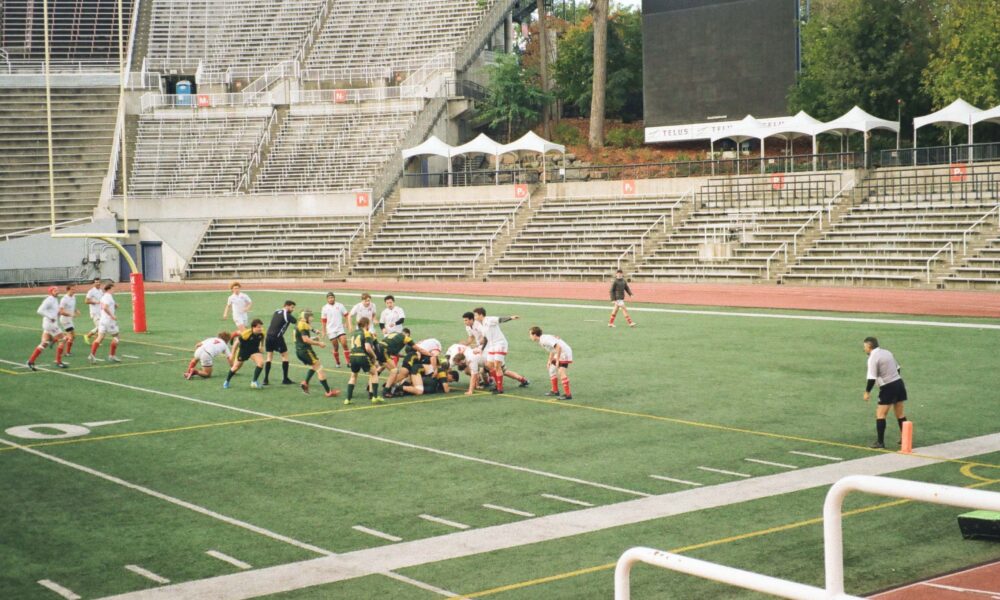
Headed into their Oct. 23 match against Sherbrooke, McGill men’s rugby needed a win and four tries to secure their spot on top of the RSEQ rankings. The Redbirds (5–1) succeeded, scoring six tries in total and defeating the Sherbrooke Vert et Or (0–6) by a score of 36-3 to become the RSEQ regular-season champions. 

Among the top scorers were fullback Benjamin Russell, who tallied 10 points, and Samuel Elrington and Gaspard Poiré, who both scored a try. Quebec natives Ian McDowell and Thomas Richards scored the other majors. 

The Vert et Or brought intensity to the pitch despite their 0–5 record and one-man disadvantage, making the Redbirds work to keep up. Head coach Ian Baillie, who is in his eighth season at McGill, commended the Vert et Or’s effort in a post-game interview with The McGill Tribune

“To [Sherbrooke’s] credit, they came out and put it to us straight away,” Baillie said. “They didn’t allow us to get into our structure, they caused disruption, we couldn’t get any flow in our game going and couldn’t hold possession of the ball really well, and it was because of the pressure they were putting on us.” 

The first half started out slow, with a scoring drought of over 20 minutes before William Couture of Sherbrooke broke the ice with a successful penalty kick. The game’s energy abated in the next minutes, with repetitive back-and-forth kicks over the centre line from both teams. Nearing halftime, however, the Redbirds scored two consecutive tries in five minutes, with scrum-half Owen Cumming picking up a conversion. 

The second half saw a renewed Redbirds squad, quicker at getting the ball out of scrums and moving it up the field, much to Sherbrooke’s chagrin. 

“We got our legs under us in the second half,” Baillie said. “Having a bench to pull guys onto the park that were fresh […] made a big difference and it got us moving forward.” 

Once the momentum shifted to McGill’s side, the team pushed forward incessantly, keeping possession of the ball through physical rucks and sustaining their offensive pressure until the very last moment.

There were few penalties issued during the match, but the clock stopped two minutes early after a Sherbrooke player was knocked out cold and required medical attention. 

Despite the game ending on a sour note, the team’s thrill at winning the title could be felt from the stands. Fourth-year winger Hùng Lorin was pleased with their overall performance, but noted a few things the team could improve upon heading into the post-season.

“We’ve got to watch our hands and focus more on getting the ball straight and running harder lines,” Lorin said in a post-game interview with the Tribune. “We dropped it a couple of times, but the boys all did really great.”

Matthew Zeitouni, third-year flanker, agreed with his teammate’s assessment. 

“[We’ve] just got to reduce those handling errors and stick to what we know best,” Zeitouni said. “We wanted to finish first so that our next game, the semifinal, is on home ground, so we’re quite happy.”

Brad Hunger, first-year second row, emphasized that the team’s harmony played a major role in getting them this far. 

“This is my first year playing rugby with the guys, and I already love each and every one of them like a brother, so, it’s awesome,” Hunger said.

Next Saturday’s sudden-death match against Bishop’s University (3–3) will determine whether or not the Redbirds can make a run at the playoff title. If all goes as planned, the team looks forward to hosting the RSEQ final on home turf and capping the post-season with a championship. 

QUOTABLE

“I’m just happy we were able to pull through with a strong win and finish on top of the league for the season. It’s been a couple of years since we won the RSEQ, so this is definitely a confidence booster. I’m proud of all our guys for the work they’ve put in over the last two months and now’s the time to cash it all in during playoffs.” —Karl Hunger, team captain and second-row.  

MOMENT OF THE GAME

In the thick of the first half, third-year center Theo Bride made a try-saving tackle just before the goal line, giving McGill the spark they needed to find their footing in the game.

STAT CORNER

Scrum-half Owen Cumming made a 2-point conversion, adding to his season tally of a whopping 36 points to solidify his spot as the Redbirds’ leading scorer.

McGill, News

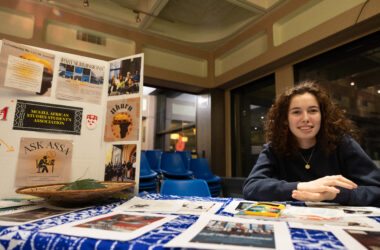
Open researching, publishing, and access on the table at McGill Library’s Open Access Week 2021

The McGill Library is bringing International Open Access (OA) Week 2021 to the university’s scholarly community from Oct. 25 to Oct. 31. This year’s theme is “It Matters How We Open Knowledge: Building Structural Equity.” The planning committee members, such as librarians Jessica Lange, Michael David Miller, Lucy Kiester, and Robin Desmeules, organized several virtual events running throughout the week. Events to note include “The Future is Open: Becoming an Open Researcher” on Oct. 25, “Publishing Data with the McGill Dataverse” Oct. 26, the “ORCID-a-thon” on Oct. 28, and “Open Access Scholarly Books: Demystifying the Publishing Process,” also on Oct. 28. 

The McGill Library defines open access as the practice of making access to research free. In an interview with The McGill Tribune, Jessica Lange, McGill Library coordinator for Scholarly Communications, noted that McGill is able to make scholarly articles and research materials free to students and staff because of the university’s status as a large scholarly institution.

“There has been a lot of discussion now in the Open Access field about […] equity in terms of some institutions like McGill,” Lange said. “We can basically pay large publishers a certain amount of money, [and] negotiate [that] money, so that McGill researchers can publish open access for free in certain journals [….] We have done that with SAGE and a couple other publishers.”

Lange emphasized the importance of this year’s theme, “Building Structural Equity,” pointing out the existing inequities in publishing. For instance, racialized authors are less frequently published within existing OA journals. Lange also noted that smaller institutions are often excluded from the OA framework because they lack access to resources that larger institutions like McGill have. 

“Of course, smaller institutions may not have […] resources to negotiate such agreements, so […] this leads to another structural inequity where researchers at larger institutions might have access to either funds or waivers that people at other institutions do not,” Lange said.

The week features a virtual “ORCID-a-thon,” a workshop that helps students create accounts on ORCID—a platform that displays academics’ profiles. During the workshop, McGill librarians will help members of the McGill community build a comprehensive, self-updating, public Curriculum Vitae (CV) on the ORCID platform. Michael David Miller, associate librarian and liaison librarian for French Literature, Economics, and Gender Studies, spoke with the Tribune about the upcoming event, the first of its kind at McGill.

“[ORCID] is an open and free identifier for researchers,” David Miller said. “There will be three of us [at the ORCID-a-thon]. So, a researcher, grad student, or just anybody who is interested in ORCID [can] come in and we will help them set up their ORCID profile.” 

Robin Desmeules, a cataloguing librarian at McGill and past chair of the Library’s Scholarly Communications Committee, believes having the ability to navigate the research world can have profound impacts on structures beyond educational institutions, such as the economy. 

“It is really interesting to understand how knowledge is disseminated or not, and the economic impacts of that,” Desmeules said in an interview with the Tribune. “And how for-profit publishing, or capitalism in general, […] can interfere with the free circulation of knowledge, and how that impacts scholarship in all of its forms.”

On how McGill organizations can help promote OA in scholarship and research, Lange, Miller, and Desmeules all expressed the importance of issuing statements in support of OA, like in McGill Library’s own statement and the Douglas Research Centre’s new Open Access Policy.

“We are starting to get pockets where you can see that departments are saying ‘this is a priority for us, we’re going to make a statement,’” Lange said. “So hopefully […] we’ll see other [departments] pick up and recognize the relevance.”

McGill, News

McGill Senate presents annual report on Action Plan to Address Anti-Black Racism

The McGill Senate assembled remotely on Oct. 20 to discuss several reports, including the 2020-2021 Annual Report on the Implementation of the Strategic Equity, Diversity, and Inclusion (EDI) Plan, and the 2020-21 Annual Report on the Action Plan to Address Anti-Black Racism. The Senate also approved the 506th Report of the Academic Policy Committee. 

During her welcoming remarks, principal and vice-chancellor Suzanne Fortier was optimistic about the Quebec government’s estimate that 94.9 per cent of the McGill student body is fully vaccinated against COVID-19.

“That is very good news. I think our experts were telling us to aim for 95 per cent, so we are very close to our target. Within the staff community, the latest data are a bit older, it was two weeks ago, and at that point it was 91.2 per cent.” 

Fortier also announced that the administration plans to increase the amount of in-person activities for the winter term. 

“We will continue to be prudent, but are aiming to increase slightly the percentage of activities that will be done in person,” Fortier said. “We do know from our students that they very much want to have their academic activities in person on our campuses.”

Provost and vice-principal (Academic) Christopher Manfredi presented the Report of the Academic Policy Committee, which included revisions to the academic structure for the School of Continuing Studies

“These are revisions to the academic organizational structure of the School of Continuing Studies, which has not changed since 1968,” Manfredi said. “Once every 50 years, whether it needs it or not, I think it is probably a good idea to review [the structure].” 

The report included a motion to relocate the McGill Writing Centre (MWC) from the School of Continuing Studies to the Faculty of Arts. The motion to approve the relocation was passed. 

The Senate appointed Eric Galbraith, professor in the Department of Earth and Planetary Sciences, to the Committee on Student Services, and Annie Chevrier, professor in the Ingram School of Nursing, to the Committee on Student Discipline, at the recommendation of the Senate Nominating Committee.

During associate provost (Equity & Academic Policies) Angela Campbell’s presentation of the Report on the Action Plan to Address Anti-Black Racism, Saku Mantere, professor in the Desautels Faculty of Management, raised concerns about mandating the learning module. 

“I’m a scholar of organizational change myself, and I’m delighted that we’re working on a change of this kind. However, I would object to the implements of how this change is being pursued,” Mantere said. “I found that […] having a mandatory module, [like “It Takes All of Us”], is a form of indoctrination rather than a form of learning.”

In response, Campbell explained that while the plan’s module will be mandatory, the consequences of non-compliance will be lesser than for the “It Takes All of Usmodule, which blocks students’ course registration. 

Moment of the meeting:

Toward the end of the meeting, Edith Zorychta, associate professor in the Faculty of Medicine and Health Sciences, provided highlights of the Report from the Board of Governors to Senate. Of note is the approval of new grant agreements, which will sponsor research on air pollution in cities and on carbon neutral design and architecture. 

Soundbite:

“The notion of hybrid teaching, the idea that an instructor can at once deliver a course both in person and virtually at the same time, is not currently feasible [….] The current infrastructure at the university does not permit that [….] We are not equipped for that, so that is something that I do not think will be entertained.” —Angela Campbell, associate provost (Equity & Academic Policies), on the Ad Hoc Advisory Committee on COVID Academic Planning and Policies’ stance on hybrid teaching.

Basketball, Sports

Martlets fall in Gee-Gee 61-38 shoot-out

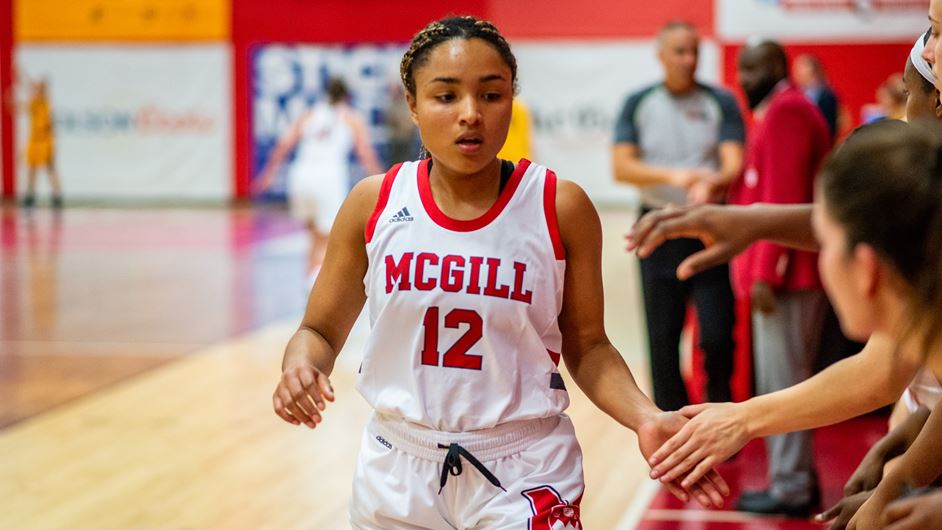
On Oct. 23, the McGill Martlets (0–1) faced off against the University of Ottawa Gee-Gees (2–1) in their second game of the pre-season. Emerging from a loss to the University of Windsor Lancers, the Martlets failed to end their losing streak coming out of the long COVID-19-induced pause of the 2020-2021 athletic season. 

Over 100 fans gathered to attend this tête-à-tête at the Love Competition Hall for what proved to be a poignant loss for McGill fans.

The game opened at a leisurely pace, with both teams playing a hyper-effective full court press, suffocating any attempts at coordinated offensive play. The Martlets only managed 11 points to the Gee-Gees’ 15 in the first quarter, on only 29.4 per cent shooting from the field. 

The second quarter began much the same as the first, with minimal scoring chances for McGill and a never-ending wave of offensive drives to the paint by Ottawa. By the end of the quarter, McGill made only eight of their 38 attempts from three, and weren’t much better from inside the arc. First-year guard Emma-Jane Scotten was a bright spot amidst an otherwise fruitless quarter, making two of three three-pointers and ultimately leading the team to score 13 points, six rebounds, and two steals. 

A quick three-pointer from Scotten and jump shot from Jessica Salanon heartened the largely uneasy McGill crowd for a fleeting moment like a beacon in the distance. But the Gee-Gees were quick to stamp out any spark of McGillian hope with an onslaught of defence and dominance in the paint. For the rest of the quarter, McGill kept pressure high, contesting every shot and guarding with enough tenacity to scrap up six turnovers. Their defensive efforts came up short, however, as the Gee-Gees continued to make shots. Headed into the final quarter of the game, the score stood at 47-27 in favour of the Gee-Gees.

While the 20-point lead seemed insurmountable in the final 10 minutes of play, the Martlets never relented on defence, and even had flashes of greatness from first-year forward Charlotte Guerin, who tallied eight points, seven rebounds, and six steals over the course of the game. In the final moments, Guerin did not let up, getting her final steal with 12 seconds left on the clock. 

While a final score of 61-38 will leave many chalking the loss up to poor play by the Martlets, the developing team is only just spreading its wings. Under the direction of new head coach Rikki Bowles, the rookie-dominant roster has lots of potential to grow as they head into the regular season. While the team shot only 19.4 per cent from behind the arc this week, this won’t always be the case—as soon as the shots start falling, so will McGill’s opponents.

Guerin is optimistic about the future of the team and how they plan to approach their next game against Queen’s University on Oct. 30.

“I think Queen’s is on the same level as Ottawa, and I think that every week we really do get better,” Guerin said. “Every week we’ve played, we’ve gotten better against the next team. Hopefully by the time we get to the regular season we’ll be able to win consistently.”

Stat Corner:

First-year forward Charlotte Guerin earned a game high six steals with a suffocating defensive presence that was felt throughout the game.

Hockey, Sports

McGill men’s hockey drops close contest to Concordia

The McGill men’s hockey team (2–2–1) continued their preseason on Oct. 23 against the Concordia Stingers (2-2), dropping a 1-0 overtime affair. 

The game started at a fast pace, with solid puck movement and strong physicality from both teams. Early in the contest, McGill had multiple opportunities to strike first, after Concordia took two minor penalties in the first 10 minutes. However, Concordia’s penalty kill successfully squashed both chances for the Redbirds, and the game remained scoreless. 

After seizing early momentum with a pressing forecheck, McGill forward Andrew McIntyre took a tripping penalty, swinging energy toward the away team. Thankfully for the Redbirds, this was not an issue, as their penalty kill unit began their game-long dominance with an early shutdown of the Stingers’ power play. 

Following a strong showing at the end of the first period, McGill immediately hurt themselves again at the start of the second period, taking a head contact minor penalty, with an additional ten-minute misconduct given to the offender, Jordan-Ty Fournier. Again, the penalty kill unit stood tall, defending their own end phenomenally for two long minutes.

“I think that our penalty kill played really well. The forwards and defensemen were consistently in great position, especially considering it was a pre-season game and we have so many new players on the team,” first-year goaltender Alexis Shank said. 

Along with the penalty kill unit, a bright spot for the Redbirds was the rookie netminder. Shank stopped 41 shots, standing on his head at many points in the game, particularly during the second and third period when he faced 30 shots over 40 minutes.

Speaking to his fantastic performance, Shank remained humble, crediting his teammates for the success.

“I think my teammates have helped my confidence both on and off the ice,” Shank said. “They limited many chances throughout the game last night, and have made me feel comfortable as a young rookie on the squad.”

Following a scoreless second period that concluded with serious tension between the benches of the rival teams, it was evident that the first team to put the puck past the outstanding netminders would win the contest. 

In the third period, both teams had excellent opportunities in their offensive zone. The Redbirds continued their strong defensive play, exemplified by a crucial sliding block by first-year forward William Poirier to prevent an attempt on goal. 

After a tense final two minutes, in which McGill successfully killed the majority of yet another Concordia power play, the two downtown rivals were off to overtime to find a winner in the extremely defensive contest.

Just a few minutes into the electric, back-and-forth 3-on-3 overtime, Concordia buried a top corner goal on an odd man rush, winning the game for the Stingers. Despite the unfortunate result, the Redbirds played solid defence and have much to build on as the team heads into the regular season.

McGill begins their OUA season at Concordia on Nov. 3, followed by a “Friends of McGill Hockey Homecoming” match up against 2019-2020 national finalists, the Ottawa Gee-Gees.

Moment of the Game:

First-year netminder Alexis Shank makes a fantastic set of saves late in the third period to maintain a shutout during regulation time.

Stat Corner:Alexis Shank saved 41 of 42 shots, the highest season total of any McGill netminder this year.

Creative

McGill’s Lettuce Club: The Inaugural Meeting

Multimedia Editor Noah Vaton documents the thrilling inaugural McGill Lettuce Club Meeting. He outlines a complete history of how the event came to be, the excitement surrounding the event amongst McGill students, footage live from the event, and post-meeting interviews with both the original founder and this years winner, the ‘Head of Lettuce’.

Science & Technology

Reading for meaning: A new intervention for children with hyperlexia

Children diagnosed with autism spectrum disorder often have difficulty thriving in a modern education system that is not designed for their needs. Developing language skills, in particular, can be challenging for these children. 

Between 6 to 21 per cent of children with autism have a syndrome called hyperlexia, where they demonstrate a strong interest in letters and words from a very young age and learn to decode what they are reading very quickly—but generally have trouble associating words with their meanings. Children with hyperlexia also have a harder time developing certain literacy skills—specifically reading comprehension—compared to neurotypical children.

Reading comprehension development typically relies on certain precursors such as phonological awareness, the ability to identify and manipulate sounds, and phoneme-grapheme correspondence, the ability to understand the relationship between letters and sounds. Dianne Macdonald, a lecturer at Concordia University and speech-language pathologist, seeks to investigate the importance of these precursors for children with autism.

“These kids are not taking the same route as typically developing kids, they are following their own pathway,” Macdonald said in an interview with The McGill Tribune. “They don’t need those precursors in order to read words like typically developing kids.”

Despite displaying a below-average ability in tasks related to common pre-reading skills, children with autism, both with and without hyperlexia, showed advanced word-reading abilities. Contrary to neurotypical children, these precursor abilities were not necessary for them to decode and read words.

According to the Simple View of Reading, a widely accepted theory in literacy research, reading comprehension results from a combination of decoding skills and language comprehension. Although children with hyperlexia display very strong decoding skills, they lack essential language comprehension skills—essentially, they need practice understanding what they can already read.

In a follow-up study, Macdonald and her team designed a tablet app intended to help bridge this comprehension gap. Based on the dual coding theory of literacy, the app pairs written words with their corresponding images. The key idea was to expose children to the concept that the words represented the accompanying pictures, to help them practice assigning meaning to words.

Children with autism, both with and without hyperlexia, as well as a control group of neurotypical children all showed increased listening comprehension following time with the app. In addition, those in the hyperlexic group showed a significant increase in reading comprehension. Although expressive language skills did not see improvement, Macdonald remains optimistic, noting that hyperlexic children’s receptive fluency improved, a skill that precedes expressive fluency.

“If we can start focussing on reading comprehension really early for them then […] they get into school potentially better prepared language-wise,” Macdonald said.

The results show promise for the efficacy of such early-age interventions. Many participating children actively enjoyed using the app, and some parents requested to have their child continue using it after the completion of the study. 

Macdonald emphasizes that significant progress can be achieved by focussing on children’s strengths while tailoring interventions to fit their needs. By taking into account the skills and interests of children with autism, educators and parents can help them learn and grow in a positive environment.

“If we can find that sweet spot where we are incorporating the real talents [of kids with exceptionalities] and their interests and their strengths to support their challenges, I think that we can make really great gains,” Macdonald said.
Macdonald has made a web-based version of the app freely available online, and hopes parents and children will make use of the resource. She is currently looking to make the app open-source to allow other people to contribute and help tailor the app to more children’s needs.

Read the latest issue

Read the latest issue