

Latest News

McGill, News

McGill adjusts teaching guidelines as second online semester begins

After collecting feedback from both students and teaching staff about the Fall 2020 semester, the McGill administration has updated its teaching guidelines with the hopes of improving the educational experience for staff and students while continuing to operate remotely.

Last semester, to avoid over-burdening students during a global pandemic with heavily weighted assessments, professors were encouraged to assign several low-weighted assessments to their classes resulting in testing on a more frequent basis. However, many students reported feeling overworked as they were constantly being assessed. 

In an email to The McGill Tribune, McGill Media Relations Officer Frédérique Mazerolle described the changes made in the new Guidelines for the Remote Teaching Context W2021 and how the McGill administration hopes these adapted guidelines will impact students and staff in Winter 2021 semester. 

“We fully acknowledge that many in our community have felt overwhelmed and overworked during the Fall 2020 semester,” Mazerolle wrote. “There has been close collaboration with Faculties in their preparation of the on-going semester and special attention has been being paid to the well-being of students, faculty, and staff. This includes looking at how to adapt course workloads to help students balance learning responsibilities with their personal lives.”

Another update to assessments this semester will limit the “no review testing” method, a form of testing that prevents students from moving backwards on MyCourses quiz pages. Additionally, a new “no penalty late period” will allow for the submission for final assessments after the last day of classes, but not exceeding the end of the final exam period, without any form of penalty.

Brendon Gillon, a professor in the Department of Linguistics, discussed how he adapted his teaching style for this semester by implementing changes in everything from class interaction with students to grading schemes.  

“When it comes to teaching, there have been a few small advantages and some substantial disadvantages,” Gillon said. “One important disadvantage is that [it is challenging to] interact with students personally. Another [challenge] is grading. Grading papers online takes more time, at least with the software we have. Indeed, in the large class I am about to teach, I am going to try to make as much [material] as possible machine gradable so as to lighten the work of the TAs.”

Despite experiencing setbacks, Gillion acknowledged the ways in which this unprecedented time for professors and students can be seen as an opportunity to expand his knowledge and skills as a professor.

“I have been forced to learn more about online teaching,” Gillion said. “That is good in the sense that it broadens my perspective and compels me to see new ways of doing things. If I end up finding some of these tools useful and adopting them, that will be [for] the good.”

Auston Sinclair, U3 Arts, told The McGill Tribune that online education has challenged his routine as a student. 

“For me, online learning has been an exercise in building and adhering to a routine without any outside structure,” Sinclair said. “Being constantly at home has meant being entirely in control of how I spend my time, in a way that I have found more daunting than liberating.”

Despite these challenges, Sinclair says that he is hopeful the online school experience will change for the better during the Winter 2021 semester.

“I hope to regain the sense of productivity and accomplishment that I felt I was missing in the fall semester,” Sinclair said. “Hopefully, that exercise of self-control and discipline is something that I can take with me moving forward, because I now know how idle I can feel when I don’t make the effort.”

Consultation
McGill, News

McGill Senate approves creation of a Global Engineering program

The McGill Senate held their monthly meeting on Jan. 20, presenting two motions that were passed as well as an update on the ongoing Fiat Lux project

McGill Provost and Vice-Principal (Academic) Christopher Manfredi began the meeting by presenting a motion to create a Joint B.Eng. program in Global Engineering with CentraleSupélec France. Students who elect to take the four-year program will spend the first two years in France and finish the final two years at McGill. The program will begin in the Fall 2023 semester at the earliest and aims to accept approximately 70 students, with each student afforded the opportunity to specialize in one of nine streams. 

“The aim of this new Bachelor of Engineering [program] is to train engineers who will be able to work in collaborative and interdisciplinary teams, in global settings,” Manfredi said.

Although the Senate approved the motion, the program still needs to be approved by the Bureau de Coopération Interuniversitaire (BCI), a private organization that acts as a coordination forum for all Quebec universities.

Manfredi brought forward another motion to rename the Department of Civil Engineering and Applied Mechanics to the Department of Civil Engineering. He explained that the new name would more accurately represent the scope of teaching and research done in many Civil Engineering sub-disciplines, such as Environmental or Structural Engineering. Manfredi hopes that the change will alleviate confusion, as it will better align with the actual title of the undergraduate degreeB.Eng. in Civil Engineering. The motion was approved and will soon be considered by the McGill Board of Governors.

Associate Provost (Teaching and Academic Programs) Chris Buddle presented an update on behalf of the Committee on Libraries concerning library usage during the pandemic and the progression of the Fiat Lux project. The Fiat Lux project will redesign and rebuild the McLennan-Redpath Library Complex and is proceeding as planned, with the storage building that will house Rare Books and Special Collections scheduled to finish by Fall 2022. The phased renovation program is scheduled to start in the winter of 2023. 

Buddle discussed the Committee on Libraries Annual Report and how library usage during the pandemic has remained the same and been an important resource for students during the remote semesters.  

“This report doesn’t capture […] the very important role that the libraries have played during the pandemic,” Buddle said. “Both in terms of the availability of resources for researchers and students […] and the way the libraries have been used as study hubs and [are] ongoing in that way.”

The Fiat Lux project will place emphasis on creating more space for students and unique study spaces.

Sound Bite

“Minister of higher education Madame [Danielle] McCann is hopeful that the [COVID-19] situation will improve, particularly if we can accelerate the vaccinations of the vulnerable part of our [Quebec] populations. [The government is] looking for at least some light at the end of the tunnel. Apart from […] ensuring the health of the population and ensuring that we are all able to stay healthy, the government is very worried about the mental health of the population and particularly of students [….] For these reasons, we are very strongly encouraged by the minister and the premier to increase the opportunities for our students to be present in-person on our university campuses.”

-Suzanne Fortier, McGill Principal and Vice-Chancellor of McGill University

Moment of the meeting

At the beginning of the meeting, Senator David Eidelman and Senator Jim Engle-Warnick presented touching memorials for Dr. Clifford Kirk Osterland, from the Faculty of Medicine, and Dr. Barbara Nichols, from the Faculty of Social Work, respectively. Both Osterland and Nichols who passed away in 2020 were notable McGill professors who paved the way for future generations through their research and teaching.

Arts & Entertainment, Film and TV

‘Pretend It’s a City’ is a New Yorker’s New York

Oftentimes the quality of a work can be judged by the ease with which viewers consume it. This is certainly the case with Martin Scorsese’s new Netflix documentary series, Pretend It’s a City, featuring his longtime friend, author Fran Lebowitz. The 30-minute episodes of Pretend It’s a City fly by with the same poise as Scorsese’s best feature films. Lebowtiz’s magnetic, acerbic, and cut-to-the-bone wit comes through the screen, and by the end of the series, you cannot help but feel you’ve made a dear friend. 

Named after her personal manifesto, Pretend It’s a City is seven episodes of Lebowitz complaining about every topic imaginable. For those unfamiliar with Lebowitz or why a legendary director such as Scorcese would document her, consider that she’s been called the modern-day Dorothy Parker. Parker, part of New York’s Algonquin Round Table writer’s group of the 1920s, broke ground for women writers and was known for her elegant prose and killer wit. Lebowitz got her start at age 20, when she moved in the ‘70s from her hometown of Morristown, New Jersey to Manhattan, and landed a job as a columnist at Andy Warhol’s Interview magazine. Lebowitz went on to pen two critically acclaimed books, Metropolitan Life and Social Studies, until a serious case of writer’s block transformed her from professional writer to professional talker. Lebowitz’s opinions are eloquent, razor-sharp, and frank—all on glorious display in Pretend It’s a City

Every episode stitches together illuminating bits of conversations between Scorsese and Lebowtiz, as well as interviews with Spike Lee, David Letterman, Alec Baldwin, and Olivia Wilde from over the years. The conversations unfold as Lebowitz walks through the streets of New York City—her disapproving glances at her fellow man worth a thousand words—and at The Players social club in Manhattan. 

One quintessential New Yorker to the other, Scorsese prompts Lebowitz to discuss topics as serious as the #MeToo movement or as mundane as her distaste for former mayor Michael Bloomberg’s choice of street furniture. When Lebowitz turns to #MeToo, she explains why she will always believe the woman, as would anyone who was a young woman; Lebowitz relates how she was unable to get a job as a waitress in New York during her 20s because she wouldn’t sleep with the manager. Lebowitz’s takes on the reality of job-hunting as a woman and sexual harassment stem from her personal experiences, though they are as relevant in 2021 as they were in the ‘70s. 

Lebowitz’s thoughts on the #MeToo movement are about as heavy as Pretend It’s a City gets. For much of the series, you’ll catch yourself laughing uncontrollably like Scorsese, who is often guffawing at what comes out of Lebowitz’s mouth. So does Lee, who badgers Lebowitz in the fifth episode on why she hates sports. Lebowitz does not apologize to Lee, a sports fanatic. Lee continues to interrogate her, but if Pretend It’s a City teaches us one thing, it’s that Fran Lebowitz does not change her mind. When asked what she does on Super Bowl Sunday, Lebowitz tells Lee that it’s a very good day to go to a restaurant. She confesses that she went to the famed first Muhammad Ali vs. Joe Frazier fight, and when Lee asks why, she describes the event as a  wonderful fashion and cultural event—completely on brand for Lebowitz. 

Engaging, clever, and one-of-a kind, Lebowitz’s charm and curmudgeonly wit will draw you to Pretend It’s A City. Finishing an episode is like finishing a New York hot dog—you wish there was more. Pretend It’s A City is documentary filmmaking in its prime, where viewers simply fall through episodes, owing to their brilliant editing and scene framing—and most importantly, the delightful presence of its subject.

Hockey, Sports

NHL season preview: The Canadiens off to a strong start

The NHL season began on Jan. 13 under very different circumstances due to the ongoing pandemic. The league has been split up into the North division, encompassing all Canadian teams, and the East, West, and Central Divisions splitting the eastern, western, and central United States. The season will also be much shorter than previous seasons, with 56 games instead of 82. 

Going into the season, the favourites in the North Division were the Toronto Maple Leafs. However, with Joe Thorton and Nick Robertson currently injured, the season could take a very different turn. In the East Division, the Boston Bruins, Philadelphia Flyers, and Washington Capitals all have promising Stanley Cup prospects. 

The New York Rangers are not favoured to make it far in the playoffs this season, despite their first overall selection of Alexis Lafrenière in the 2020 draft. After much anticipation of his premier season in the NHL, Lafrenière has yet to tally any points in the four games he has played with the New York Rangers. Although he has been given plenty of time on the ice and has even played on the Rangers’ first line, he is facing an issue uncommon for most star hockey players: Passing too much. Lafrenière has made a mere five shots in his first four games, and while he is known for his playmaking ability, the Rangers current 1-2-1 record could definitely benefit from some more shots on net. 

In the Central Division, the reigning Stanley Cup champions, the Tampa Bay Lightning, are favoured to repeat their success. Finally, in the West, the Vegas Golden Knights and the Colorado Avalanche are teams to keep an eye on. 

When staffers made their Stanley Cup predictions on the NHL website, 12 of the 15 believed the Avalanche would be the champions. After five games, the Avalanche have a 3-2-0 record, ranking them in the middle of their division. However, there are still over 50 games left in the season, and plenty is bound to change. The Avalanche are a skilled team led by superstar Nathan MacKinnon and other high performers like Nazim Kadri and Mikko Rantanen. Their team is significantly deeper than last season, making them a force to be reckoned with.

Although the Montreal Canadiens are not favourites to win the Stanley Cup this season, they have had a strong start. With an impressive 29 goals-for and 18 goals-against, the best goal differential in the league right now, and with 10 points, they are currently ranked first in their division and the league. 

However impressive their early performances, the Canadiens are known to start the season strong and fade as it progresses. With the shortened season, the Canadiens may be able to hold onto their momentum long enough to be in a good seed for the playoffs.

The Canadiens have added some power to both their offensive and defensive lines. Tyler Toffoli, traded from the Vancouver Canucks, has boasted five goals and eight points in six games, including two goals in a 7-3 victory against his former team. The Canadiens have also acquired Corey Perry from the Dallas Stars. In his debut in a Habs’ uniform on Jan. 23, he scored a goal and had four shots on net. 

In terms of defence, it appears that the Canadiens may have finally found a trustworthy backup goalie in Jake Allen. Allen, who has started in two of the six games so far, has won both games with four total goals-against. Allen was a starting goaltender for the Saint Louis Blues until the 2018-2019 season when Jordan Binnington took over the position, helping the Blues to their first-ever Stanley Cup victory. While Allen may have lost the spotlight, he has not lost any of his talent. Allen finished last season second in the NHL for his goals-against average of 2.15 and fourth for save percentage with .927. Ideally, Allen will be able to give goalie Carey Price the ability to rest without worrying about the fate of the team without him.

Features

To shred or not to shred

When I reached the ripe age of three, my dad plopped me into my first pair of skis. As I slipped and slid down the bunny hills, there was no way of knowing that skiing, and later snowboarding, would become my only hobby.

Growing up in Ontario, winters were an unavoidable yearly occurrence. Even bundled in snow pants and three different scarves, I dreaded the cold. I greatly preferred summer to winter and counted the weeks until the temperature reached double digits. But, when I was eight years old, I made the switch from skiing to snowboarding. Suddenly, my enjoyment of winter increased, and I had something to look forward to during the cold months.

Every year, my family went on ski trips to New England. The mountains were big, and the snow was plentiful, allowing my younger self to learn and perfect her snowboarding. After many falls and a few near-death experiences, I became surer on my feet (or rather, one long foot). My standing-to-falling ratio steadily increased while my passion for the sport grew. I was finally on par with my older brother’s skiing speed and I started looking forward to the weeks spent on the mountain surrounded by snow.

With everyone in my family skiing in different comfort zones, I was often left to face the slopes alone. However, snowboarding on my own did not hinder the times I spent carving down hills. The current pandemic has put a long pause on many sports, especially team sports, but snowboarding has remained a source of solace and consistent bliss, even as the rest of my world continues to change every day.

Winter sports are a privilege I was lucky enough to have. Moving to Montreal, I learned about the numerous skiing and snowboarding communities at McGill and throughout Quebec. Student groups, like the McGill Outdoors Club and the Students’ Society of McGill University (SSMU) Ski and Snowboard Club, also offer discounts to offset the costs of these activities. Even if skill levels vary between every person, the love and enjoyment of winter sports is something we can all share.

News, SSMU

Divest McGill presents progress on Metro Inc. boycott at SSMU Legislative Council

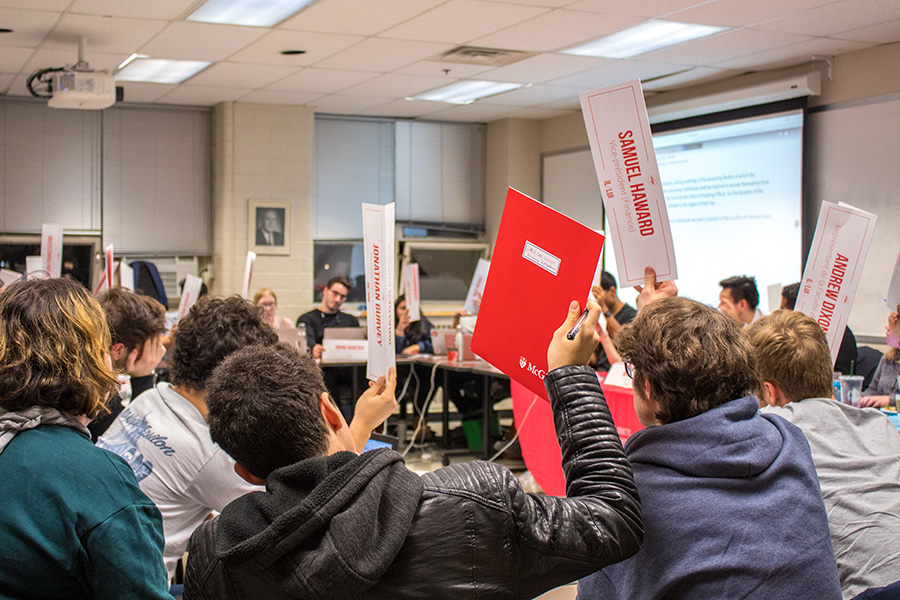
Three student groups presented the missions of their respective organizations at the Jan. 14 Students’ Society of McGill University’s (SSMU) Legislative Council meeting. Divest McGill shared their ongoing boycott campaign to pressure McGill’s Board of Governors (BoG) to divest from the top 200 fossil fuel companies, McGill Students for Peace and Disarmament (SPD) presented a new research policy, and McGill Student Transport (MUST) put forward an application to become an official Independent Student Group (ISG).   

Samuel Helguero, 2L Law and representative of Divest McGill, explained the organization’s boycott of Metro Inc. and its various affiliated chains in Montreal. He clarified the relationship between McGill University, Metro Inc., and divestment.

“Divest is engaging in a boycott of Metro over its dissatisfaction [with] the McGill Board of Governors’ inability to pass a motion to [divest from] the fossil fuel industry,” Helguero said. “On the Board of Governors sits Vice-Chair Maryse Bertrand, who also earns a retainer of $120,000 and $500,000 in shares on the corporate board of Metro Inc. We are attempting to target […] her financial and professional interests in order to pressure her into supporting divestment.” 

Helguero was optimistic about the boycott’s effectiveness.

“We have two possible [results in mind],” Helguero said. “[Bertrand] can either reconsider her stance on McGill’s investments, or she can step down from the Board of Governors. I think both would be very fruitful in terms of promoting divestment at the university, as both would show members of the BoG that there are consequences to [fossil fuel investments].”

Divest McGill will present a motion to the SSMU Legislative Council later in January to encourage the student body to participate in boycott efforts.

SPD then presented a policy proposal that would require professors and departments at McGill to declare the potential applications of research to military weapons technology. Lia Holla, U2 Arts and Science and SPD representative, explained the policy’s potential impact and its goals.

“The SPD is developing this policy so that the McGill community can continue to make strides towards ethical research, not away from it,” Holla said. “[It is our goal] to advocate for transparent and ethical research on campus, in addition to creating a space for educational discussion about peace and disarmament.”

Alexis Zhou, U3 Arts and Coordinator for MUST, shared the organization’s proposal and their application to become an official SSMU ISG. This status would grant them financial resources toward their mandate of providing regional student transport that is cost-effective and environmentally friendly.

“After the pandemic, we hope to have direct bus routes to Toronto, New York, Boston, and [other areas of] Quebec,” Zhou said. “This service […] is a valuable tool for our students to be able to attend job interviews, search for job opportunities and internships, [and] empower our students to reach their potential.”

Zhou acknowledged that MUST would require student fees, and cited their plan’s 85.7 per cent approval rating in the Fall 2020 Referendum as evidence of student support.

“What we are proposing is a $3.50 student fee levy,” Zhou said. “That is the same amount as a single trip metro or bus pass with the STM [Société de transport de Montréal], and what we can get in exchange is unlimited weekend travel to surrounding regions for as little as $19 dollars each way for our students.”

Pending approval, MUST will become an official student body organization and provide regional transport services at low prices to the McGill student body.

Soundbite: “The [proposed] student fee levy will be opt-outable. We believe that every student at McGill should have the freedom to choose, and they should be able to decide whether to pay for this service or not. Everyone has the right to do so, and we respect the right of students to opt out.”—Alexis Zhou regarding MUST’s student fee, 

Moment of the Meeting: A motion for the renewal of the previous term’s Indigenous Solidarity Policy was unanimously approved by the Legislative Council.

McGill, News

Muslim Students Association hosts panel discussing Uyghur Crisis

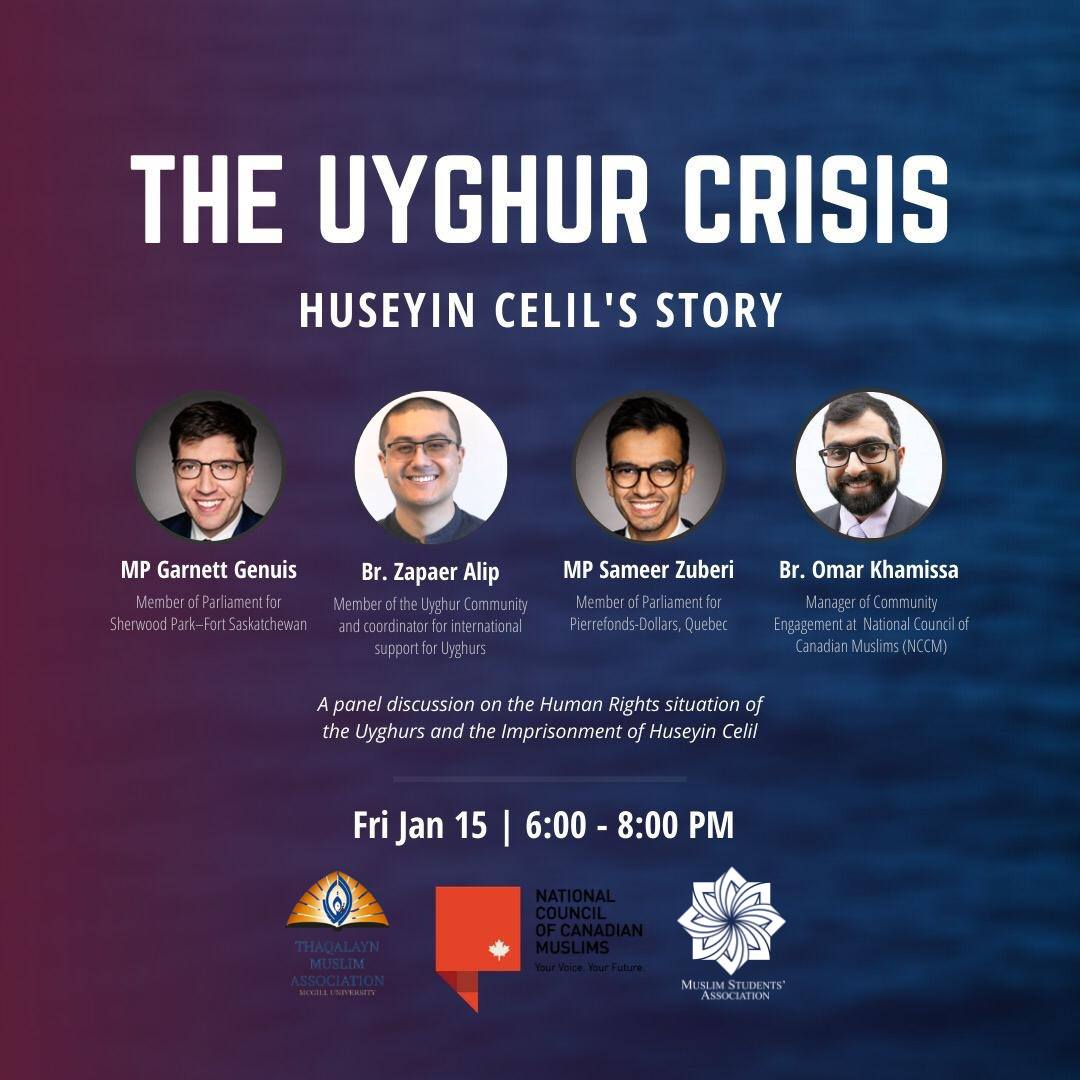
The McGill Muslim Students Association (MSA), McGill Thaqalayn Muslim Association (TMA), and the National Council of Canadian Muslims (NCCM) held a virtual panel on Jan. 15 to discuss the Uyghur genocide. Omar Khamissa, NCCM community engagement manager, moderated the panel, which was composed of Member of Parliament (MP) Garnett Genuis, MP Sameer Zuberi, and former McGill student Zapaer Alip, B.Eng ‘13. The three panelists discussed the ongoing persecution of Uyghur Muslims in the Xinjiang autonomous region in northwest China, and described potential actions that Canadians can take to mitigate the crisis. 

Zapaer Alip, who is a Uyghur-Canadian coordinator at the advocacy group International Support for Uyghurs, detailed the lives of Uyghurs living both in and outside of modern concentration camps, noting the Chinese government’s effort to erase the customs, language, and livelihoods of their people.

“It wasn’t easy being a Uyghur in East Turkestan,” Alip said. “The oppression started to amplify gradually [….] First, you had to learn Mandarin. You couldn’t speak Uyghur, you couldn’t attend a Uyghur school, you couldn’t get ahead in life, if you didn’t speak Mandarin [….] It was impossible to teach or practice religion. People could report you for practicing religion [….] You were encouraged to become a member of the Communist Party.”

After moving to Germany to escape the conditions back home, Alip’s family eventually moved to Canada for fear of being deported to China as he did not have German citizenship. But even after becoming permanent residents of Canada, Alip’s family faced issues contacting their family in Xinjiang.

“People might ask, ‘why aren’t you reaching out to [your family]’?” Alip said. “Why wouldn’t you call them everyday? Why wouldn’t [you] do whatever it takes to get a hold of them? Well, the issue is, as we later found out, that one of the reasons why you could end up in a concentration camp is actually having somebody live abroad.”

Genuis, the MP for Sherwood Park–Fort Saskatchewan in Alberta, said that ever since his election in 2015, he has been an outspoken advocate for human rights and religious freedom. Genuis is pushing for accountability mechanisms that will pressure the Canadian federal government to designate the persecution as a genocide and impose sanctions on China. He encouraged Canadians to voice their concerns and contact their elected officials.

“[Elected representatives] need to champion these issues and speak out clearly on them and seek policy changes,” Genuis said. “There needs to be real sanctions targeting individuals responsible, recognition of the crimes that are taking place, and meaningful trade measures.”

The panel then described what students could do on campus and within their communities to raise awareness about the Uyghur genocide. All three speakers encouraged students to educate themselves and others about the crisis, challenge professors to use their platforms to educate students and peers, get involved in student government, and host events on campus to bring attention to the crisis. 

As a member of the parliamentary committee on the Uyghur genocide, Zuberi gave insight into China’s misuse of Canadian research and surveillance technologies. Several Canadian universities, including McGill University, University of Toronto, and University of Waterloo, collaborated with Chinese researchers, who later developed technologies that have been used to surveil Uyghur people. Academic exchange between scholars occurred largely in the fields of artificial intelligence (AI), robotics, and engineering. Zuberi encouraged students to think more critically about research practices on their respective campuses.

“Create spaces on campus where you can speak about these issues,” Zuberi said. “There is a real concern here. We know that Canadian technology is being used to surveil Uyghur people in the region. There are cameras on every corner and monitoring is happening constantly. Canadian technology in part is furthering that, alongside technologies from many other countries. There needs to be [more] awareness around that.”

Creative, Podcasts

The T: Know Your Tenant Rights, Jan. 22

News Editor Sequoia Kim provides a weekly roundup of McGill news. Listen here through SoundCloud, or search for the title on Apple Podcasts and Spotify.

This week on the show:

An Investigative feature brought to you by Nina Russell, Managing Editor: Floor fellows speak out on their experiences from Fall 2020

Divest McGill responds to McGill’s new Sustainability Strategy

Student governance meetings: SSMU Legislative Council & PGSS Council

Webinar of the Week: “How to not get screwed over by your landlord”

Episode links:

Floor fellows cite lack of support during Fall 2020 semester, by Nina Russell,
Managing Editor

McGill’s new Climate and Sustainability Strategy receives mixed reactions, by
Respina Rostamifar, Staff Writer

SSMU hosts presentation on tenant rights and gentrification, by Ella Fitzhugh,
Staff Writer

PGSS Legislative Council votes to restructure Health and Wellness
Committee, by Leyla Moy, Student Life Editor

Host: Sequoia Kim, News Editor
Podcast Producers: Multimedia Editors Sarah Ford & Alexandre Hinton, Creative Director Aidan Martin, Editor-in-Chief Helen Wu
Artwork: Design Editor Chloe Rodriguez

Extra thanks to Nina Russell, for helping script part of the podcast.

Science & Technology

2020 Rewind: SciTech discoveries of the year

2020 was a year characterized by uncertainty, despair, and drastic change. However, several scientific and technological achievements provide hope for the future.

Google stakes its claim on quantum supremacy

Google’s quantum computer, Sycamore, is the first instance of such a device outcompeting a classical computer. While a classical computer reads information as ‘bits’ valued at 0 or 1, a quantum computer’s “qubits” can exist as both 0 and 1 at the same time, allowing for more data processing. Google announced that Sycamore performed a calculation in three minutes and 20 seconds that would otherwise have taken the most advanced classical computer 10,000 years. The applications of quantum computing are limitless, ranging from drug development to accurate weather forecasts to identifying which exoplanets likely harbour life. Although we may be five to 10 years away from having quantum computers that are useful for applications like these, Google’s achievement is proof that such a future is possible. 

Cave excavations push back arrival of first humans in the Americas by 15,000 years

New research published in Nature shows that humans may have arrived in the Americas as early as 30,000 years ago—15,000 years earlier than current estimates. After painstaking excavations of the Chiquihuite Cave in Mexico, archaeologists uncovered nearly 2,000 stone tools and charcoal bits dating back 30,000 years. Further DNA analysis of the cave sediment, composed of plant and animal remains, corroborates these findings. The discovery challenges the commonly held theory that the Clovis people were the first inhabitants of the Americas 15,000 years ago. However, identifying factors of these mysterious early inhabitants, such as human DNA, were not found, suggesting they did not stay in the cave for long. 

CRISPR-Cas9 edits genes in the human body

Doctors performed the first gene editing project in the human body using CRISPR-Cas9, a genome editing tool that can remove, add, or change parts of an organism’s DNA sequence. The CRISPR method is based on a natural mechanism bacteria use to protect themselves from viral infections. Previous methods involved editing the genome after extracting DNA from the body. The treatment was administered to a patient with Leber’s Congenital Amaurosis, an inherited form of blindness caused by a genetic mutation. Scientists deleted the harmful mutation by making two cuts on either side of the gene and allowing the ends of the DNA to reconnect. Although the patient’s vision showed some improvement, scientists are hopeful that further research into gene editing technologies will allow a permanent fix. This is one of many development efforts to use CRISPR-Cas9 technology to treat different diseases.

Anti-aging drugs: Senolytics

Growing old is a fight that many of us resist, but cannot win. Anti-aging drugs called senolytics could potentially delay aging and treat a number of associated diseases, although they do not prolong one’s life. In the body, cells that are damaged beyond repair enter a senescence phase in which they stop dividing and begin programmed death. However, sometimes senescent cells resist their fate, build up in our bodies as we age, and seriously harm surrounding cells. Scientists believe that they are linked to diseases caused by aging and that targeting these cells using senolytics could be the solution. Anti-aging drugs entered human trials in 2020 and are predicted to become available in less than five years.

Virti: Training surgeons and front-line workers using virtual reality

Virti is an immersive video platform that allows users to visualize a high-stress situation in virtual reality in order to train one’s decision-making skills under pressure and access real-time feedback. As part of efforts to mitigate the spread of COVID-19 this year and help train clinicians while avoiding in-person contact, Vitri designed an AI-powered “virtual patient” that can role play life-like scenarios. Their COVID-19 modules also teach frontline workers how to put on personal protective equipment, administer treatments, and ventilate patients. A company study by Virti found that their approaches increase knowledge retention by 230 per cent compared to training in person.

Read the latest issue

Read the latest issue