


Latest News

Student Life

Global Health Night fosters discussions for a better future

The McGill Global Health Program’s (GHP) 12th annual Global Health Night, held on Nov. 2, brought together students and faculty members for an evening celebration, recognizing McGill’s involvement in international health-related fields. The night’s programming highlighted student research and featured keynote speaker professor Senait Fisseha, the Director of Global Programs at the Susan Thompson Buffett Foundation as well as the Chief Advisor to the Director-General of the World Health Organization

As with previous years, the night began with a poster fair. Since this year’s event was moved to an online platform, attendees were able to join virtual breakout rooms where McGill students, residents, and postdoctoral fellows presented their research. There were over 50 simultaneous breakout poster sessions that covered a variety of global health topics such as COVID-19, HIV/AIDS, and malnutrition. The poster session illustrated the interdisciplinary nature of the global health field, as presenters tied together a variety of topics, such as medicine, public health, economics, and political science.

After the poster fair, Fisseha gave a relevant and timely lecture addressing the vast asymmetry of power and privilege that permeates every aspect of global health. In her speech, Fisseha emphasized how the COVID-19 pandemic, coupled with worldwide racial injustice, has sharpened the focus on the intersectional disparities in global health. Key issues included racial inequalities and exclusion based on citizenship, gender, and other identities. Fisseha addressed McGill students, urging them to find ways to use their positions of power and privilege to change the oppressive structures that currently shape the field.

“We are at a pivotal and urgent moment of uprising and reckoning,” Fisseha said. “How will you use your power to call out single stories, dismantle harmful norms, and reconcile the colonial history in global health? [Right] now, we have a very unique and historic opportunity to accelerate transformation [….] I urge you to seize this moment and to challenge the system in which you live and work.”

In an interview with The McGill Tribune, GHP’s Senior Administrative Coordinator Stéphanie Laroche-Pierre, Interim Director Dr. Charles Larson, and Global Health Program Manager Kevin O’Neill explained how Global Health Night has evolved throughout the years by becoming more inclusive to the entire McGill community.

“[In the beginning], Global Health Night was an opportunity to reach out to students, [and it] was an event focussed on curriculum, development, and educating medical students and health personnel students,” Larson said. “Now, it is much more than that. It’s a campus wide event where we want to reach out and create a sense of community at McGill among those who are interested in global health.”

With the event being held virtually this year, the coordinators had to adapt their strategies to create an engaging online experience, which has informed a new vision for future Global Health Nights.

“The aim [of Global Health Night] is to create awareness of the fantastic work that students are doing […] and display it to the rest of the McGill community,” Larson said. “[In the future], we are planning on a hybrid event, both in-person and virtual.”

With over 450 participants from around the world, Global Health Night successfully highlighted the important work of McGill’s students and staff. Additionally, it allowed for a moment of reckoning, calling on both students and faculty to acknowledge the sensitive issues permeating the field of global health. 

A recording of Global Health Night is now available online here. It will be available up until the end of this week. If you are interested in future Global Health events, you can sign up for their newsletter here.


McGill, News

McGill plans on enhancing in-person teaching activities for the Winter 2021 semester

In an email sent on Nov. 4, McGill’s Associate Provost (Teaching & Academic Programs) Christopher Buddle and Deputy Provost (Student Life & Learning) Fabrice Lebeau announced plans to increase in-person teaching activities for the Winter 2021 semester. As stated in September, remote learning will still remain the primary delivery method for courses. 

McGill’s administration outlined the two tiers of academic activities for Winter 2021. The first tier, for which in-person attendance will be mandatory, includes courses and learning activities that are difficult to deliver remotely, such as critical laboratories, clinical activities, and project courses. Second-tier classes will provide students with the option to be on campus or use remote alternatives, and include seminar courses, tutorials, conferences, laboratories, and some lectures.

Prior to the Nov. 4 announcement, McGill emailed department chairs and professors on Oct. 30 explaining their plans. Those internal emails requested that department chairs compile a list of courses that can potentially be taught in person. 

These plans to hold some in-person classes have received backlash from members of the McGill community. At a Town Hall on Oct. 30, members of McGill’s Biology Graduate Students’ Association discussed various concerns about the safety and feasibility of the transition to in-person learning. In an interview with The McGill Tribune, Travis Chen, a chief delegate for the Association of Graduate Students Employed at McGill (AGSEM), explained how many teaching assistants (TA) were caught off guard by McGill’s announcement.

“The safety of TAs is a main concern,” Chen said. “The ventilation [of classrooms] would not be up to standard […], McGill is not requiring students to wear masks, [and] TAs and professors are not allowed to enforce masks [usage] themselves [….] McGill’s plans do not line up with the scientific consensus on how to limit [the spread of COVID-19].”

Beyond safety concerns, Chen is concerned that in-person teaching will place additional strain and extra work hours on TAs. 

“There is no other way to look at this, [as] it is going to hurt the quality of teaching,” Chen said. “[TAs] will be more stressed, they will have more work to do, and they’re not going to be paid more even though they’re working more hours and working harder.”

Shannon Dunphy, president of the Biology Graduate Student Association (BGSA), said that the McGill administration has been unresponsive to the BGSA’s complaints. Dunphy is concerned that the university’s plans might create an unlevel playing field for students.

“I imagine students will feel pressured [to attend the on-campus activities],” Dunphy said. “McGill will essentially be creating two ‘tiers’ or ‘classes’ of students, but with both groups expected to perform at the same calibre.”

In an email to the Tribune, Provost and Vice-Principal Christopher Manfredi stated that student feedback helped inform the decision to provide the option for in-person classes.

“We have heard from students that they are seeking connection to McGill,” Manfredi wrote. “[Many] instructors and administrative and support staff are also missing opportunities to connect with students in person.”

On Oct. 30, the same day the email went out, La Presse published an article signed by Suzanne Fortier, Principal and Vice-Chancellor of McGill, and seven other university administrators across Montreal. In it, they explained how Montreal’s revival is dependent on the thousands of students, both domestic and international, who attend the city’s universities.

Chen recognizes that many TAs and students may enjoy in-person teaching more than online delivery, but does not believe that it was the main reason McGill has made its new plans. Chen believes a probable drop in enrollment is at the root of the issue.

“The student survey said that students missed in-class teaching, but that ignores the idea that students [might not] want to go to class during a pandemic, [and that] they just miss the in-class aspect,” Chen said. “They’re worried about funding and their source of income. The implication at the town hall is that this must be done to keep the undergraduate experience.” 

For more information on online and in person courses, visit McGill’s FAQ page for the Winter 2021 semester.

Football, Sports

Ninety-nine years ago this week: The first forward pass in Canada

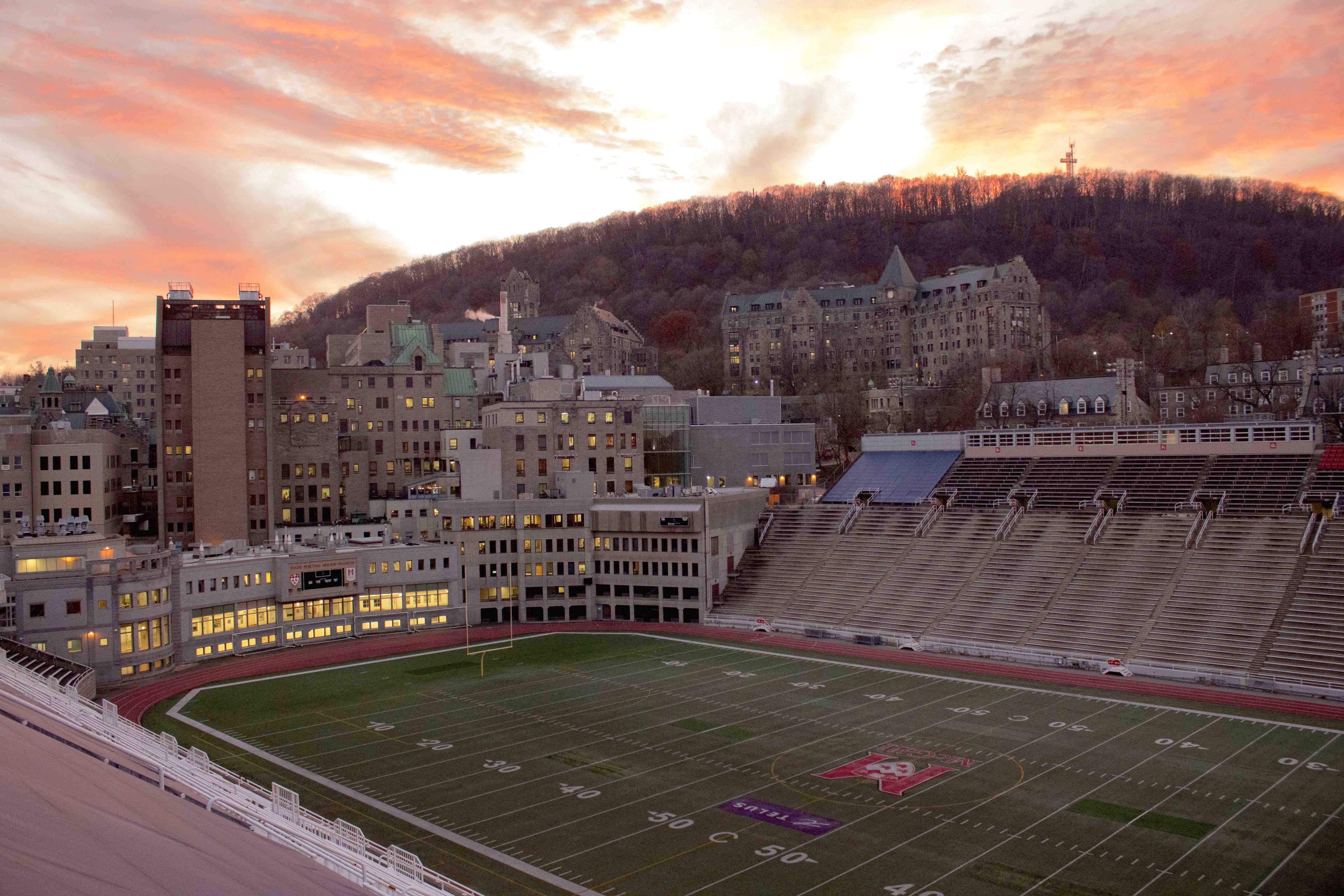
On Nov. 5, 1921, a Syracuse football player completed the first forward pass in Canada at McGill’s Percival Molson Memorial field. The forward pass was a monumental step in the development of modern-day North American football, which originally resembled rugby. 

Many fans are unaware of the origins of American football: It was first developed in Canada, specifically at McGill University. In 1874, almost 40 years prior to the historic forward pass, McGill competed against Harvard University in a two-game series that comprised the first intercollegiate football games. The games drew around 500 spectators, mostly students, who each paid a $0.50 USD admittance fee, equivalent to roughly $13 CAD in 2020. While Princeton and Rutgers University had already faced off in 1869 in what some may consider the first collegiate football game, that match was more similar to soccer, as only kicking the ball was allowed. The McGill-Harvard games, which had comparable rules to English rugby, allowed both carrying and kicking in what was the start of the now multi-billion dollar industry of North American football. Harvard had different rules, known as “Boston rules,” where players could only kick the ball, which was round. In their first game of the two-game series, the teams played with Boston rules, and Harvard won 3–0. In the second game, they played with McGill’s rugby-style rules, and the game ended in a scoreless tie. Harvard liked the rugby style of play much better, and in their next meeting a few months later, Harvard decided to permanently adopt McGill’s rules. While McGill proceeded to score no points that season, the mark they made in history has lasted for almost 150 years.

As the game increased in popularity, more and more schools formed teams. While many of them started playing the soccer-like style popularized by Princeton and Rutgers, all universities eventually shifted towards McGill’s rules. The game continued to evolve in Montreal, and teams from the United States loved playing the new version. Schools from the U.S. would come to Montreal with their own spin to the rules that included features like blocking and the forward pass. In a 1921 game against McGill, Syracuse University completed the first forward pass in Canada, a key stepping stone in the transition from traditional rugby rules to those of the new American version. 

At the time, many Canadians did not appreciate the American transformation of their game. They believed the English rugby version of the game was better than this new American form. The Montreal Gazette expressed their disdain for these American innovations in an article published in November 1921.

“Recent rule changes had made backfield play in Canadian football much more sparkling,” the article read. “[But] if the Canadian game was still not good enough, better to retreat toward the rules of English rugby than to go for the American version.” 

While Canadians may not have appreciated the style at the time, its popularity grew, especially in the United States. Today, football is one of the most popular sports in North America, with events like the NFL Superbowl drawing tens of millions of viewers every year. 

The development of the forward pass was a step in the creation of the modern game of football, and its completion in Montreal was a testament to the role McGill played in the development of the game.

News, PGSS

PGSS Council discusses McGill’s plans for in-person learning in Winter 2021

At the Post-Graduate Students’ Society (PGSS) Council virtual council meeting on Nov. 4, councillors approved a motion to oppose new changes to the Graduate Mobility Award (GMA) and discussed McGill’s recently announced plans to move some classes in the Faculty of Science to in person for the Winter 2021 semester.

With the outbreak of the COVID-19 pandemic, the provincial government has restricted university-related travel, narrowing the GMA eligibility requirements. Before the pandemic, the GMA students who received the award would pursue research abroad, often allowing international students to do research in their home countries. The recent GMA limitations have suspended international travel for research, leaving some international students with setbacks in pursuit of their studies.

University Affairs Commissioner and Ph.D student in Communication Studies Kristi Kouchakji pointed to the miscommunications between McGill and the Quebec government and explained that the new motion will attempt to provide more clarity. 

“This motion for me really is about making sure that going forward, for students who won’t be able to travel before April 2022, that McGill is using its platform and using the position that it has with the Quebec government to advocate for a more inclusive understanding of what it is to do graduate research in Quebec,” Kouchakji said.

After some discussion, the councillors unanimously approved the motion.

Next on the agenda was an announcement from the Biology Graduate Student Association (BGSA) concerning McGill’s plans to roll out some in-person, on-campus teaching activities starting in January 2021. An email sent on Oct. 30 to the Department of Biology asked the department chairs to submit a list of teachables by the first week of November. Shannon Dunphy, president of the BGSA, explained her opposition to McGill’s proposed plans regarding in-person classes for the Winter 2021 semester. 

“We’ve recently written a statement in opposition to increase presence of in-person classes for January 2021,” Dunphy said. “[The statement is] primarily focussing on Faculty of Science BGSAs [….] TAs and grad students have not been consulted on this issue, and so we’ve written a statement and we’d like to invite other BGSAs to co-sign it.”

Dunphy expressed that McGill’s failure to consult TAs and graduate students was a significant issue, because TAs will be susceptible to all the health risks associated with being present on campus. 

“They’re also not requiring undergraduate students to wear masks on campus in classrooms either,” Dunphy said.

During the discussion period, Ana Moga, Ph.D candidate in the School of Physical & Occupational Therapy and member of the Graduate Rehabilitation Science Society, questioned whether students are able to reap the same educational outcomes from remote learning.

Dunphy explained that although certain courses benefit from having an in-person format, McGill’s statement for in-person classes should be reconsidered because it includes in-person classes for courses that can remain in an online format. 

Moment of the meeting

At the beginning of the meeting, Council Speaker Adrienne Tessier noted that there was a palpable sense of stress in the air. Despite this, Tessier still found a moment to laugh at the end of the meeting, entertaining a motion for adjournment that was met with silence. She amicably joked, “I was about to say I’m flattered that no one wants to leave.”

Sound bite

“Dialogue is very similar to Keep.meSAFE that we have except for instead of mental health services, which is what Keep.meSAFE is for, Dialogue is for physical health [….] The cost of the plan is $4.25 per student per month […] which obviously if you compare it to how much a student would pay if they go to a clinic it’s still cheaper than a single visit [….] It can be fully opt-outable.”

—Dakota Rogers, Member Services Officer, outlining the initial stages of potentially implementing a new service called “Dialogue.”

News, SSMU

SSMU President reveals five-year plan to support future growth of student services

The Students’ Society of McGill University (SSMU) held its fifth Legislative Council meeting of the Fall 2020 semester on Nov. 5, where SSMU representatives discussed President Jemark Earle’s five-year plan which aims to further improve the student union. The council also passed two new motions: The first concerned the implementation of an equity triage within SSMU’s Equity Policy, and the second amended the standing rules for the 2020-2021 Legislative Council.

SSMU President Jemark Earle, who campaigned on creating a long-term plan which would allow for the Society to expand their services, introduced his five-year plan to Council for consultation. The proposal hopes to make SSMU’s staff, operations, clubs, services, finance, and advocacy departments more robust and to support their continual growth in the coming years. Earle suggested several ways that SSMU can improve the quality of its services in order to maintain their development over the next few years.

“Executive turnover is extremely high […] and executive teams [act] on impulsive one-year decisions,” Earle said. “[This is] the bane of [the] student union and results in ineffectiveness [….] This plan will create a subcommittee of the Legislative Council, which will include members at large, councillors, directors, executives, and full-time staff, to ensure that it gets carried through from year to year.”

Notable recommendations in the five-year plan include renovations to the SSMU building’s second-floor cafeteria and student bar, strategies to better integrate clubs into campus life, and calls to increase SSMU staffing support by 2026. Earle explained that the goal of the plan was to prioritize services, clubs, and operations and to make the Society’s building a more welcoming hub for student life. 

“In three years time, I think we would be able to renovate the [cafeteria] because there is a lot of under-utilized space which could be turned into quite a nice student lounge,” Earle said. “In my opinion, we could also look at getting some food options there, but I think there is a general need for a hangout space on campus.”

After Earle’s presentation, the council moved to approve two motions. Only the motion regarding the implementation of an equity triage process to the Society’s Equity Policy generated debate during the meeting. Moved by Vice-President Student Life Maheen Akter, the motion addresses the long-standing pattern of equity groups facing delays in many of SSMU’s operations. Akter explained that the equity triage process would prioritize marginalized groups when dealing with the society’s operations, communications, IT, human resources, and accounting departments.

“It is absolutely our priority to […] put processes [like this] in place to prioritize equity-seeking groups and to [also] serve all student groups,” Akter said. “As we put these [motions] forward, we are also constantly thinking of ways that we can improve all these systems and […] about why there are backlogs in some areas of our services, and figuring out ways to fix them.”

Moment of the meeting:

During his five-year plan presentation to the Legislative Council, President Earle discussed various initiatives that could garner more student engagement with SSMU, including finishing Gerts’ renovations, bringing back the yearbook, and opening a SSMU tax clinic. Acknowledging it as an ambitious idea, President Earle also put forward the possibility of the Society owning its own therapy dogs as a potential service by 2026 and spoke with great excitement as he described this idea to the council. 

Soundbite:

“The fact that we need a triage is not ideal [….] As the President outlined in the generative discussion on the five-year plan, we are understaffed [and] we do have a very limited capacity compared to the services we are trying to offer and the student body that we have to serve. The capacity just isn’t always there to do it in a timely manner. If anything, this amendment is trying to reduce the impact of that lack of capacity on equity-seeking groups that are already disadvantaged in a number of other ways.” – Brooklyn Fizzle, VP University Affairs.

McGill, Montreal, News

‘The Politics of Representation’ panel discusses accountability in Canadian politics

McGill’s Women in House program hosted “The Politics of Representation: Fostering Accountability and Integrity in Governance” on Nov. 5 to explore the significance and value of female participation in Canadian government institutions. The panel, conducted via Zoom, featured McGill Political Science Professor Kelly Gordon, L1 Law student Chloe Kemeni, and Women in House founder Chi Nguyen. They underscored the potential challenges women embarking on careers in politics may face.

The event marks the first panel discussion of the academic year organized by Women in House, a shadowing program that aims to give female-identifying McGill students the opportunity to pair up with Members of Parliament and Senators. In an interview with //The McGill Tribune//, Iyanu Soyege, U3 Arts, the panel’s moderator and a coordinator of Women in House, explained that she sought to ground the discussion of female representation in the network of social movements burgeoning across Canada. 

“With the people of the Wet’suwet’en territory fighting for sovereignty over their land [and with] Black Lives Matter, we are trying to view government institutions as avenues for change,” Soyege said. “We’re asking what can happen when women do get into government, and what we can do to ensure that our communities are transformed.”

The panelists began their discussion of representation by distinguishing between two kinds of representation: Descriptive and substantive. The former is defined by the number of women in an institution, and the latter occurs when women-friendly policies are actually enacted. In doing so, Kemeni examined the different uses of identity politics in a liberal society.

“We need to critically assess what it means to be within our identity and intentionally understand it,” Kemeni said. “[…] We often talk about how we need more women, more racialized folks, and more folks from different backgrounds, and so they are [brought] to the table, and it’s almost as if they’re just there to […] not say anything. So when we talk about reclaiming identity politics within its feminist understanding, this means using your identity, and the teachings that come with who you are, your ancestors, […] what they taught you, and bringing that to the table.”

The panel then discussed the informal means through which women can exercise leadership and foreground local communities.

“Think about all of the parent councils, all of the activation that happens in communities by women,” Nguyen said. “Right after COVID-19, who was setting up mutual aid societies? Who was setting up these networks? It was driven by women’s leadership, and there’s an undervaluing of that care work.”

The speakers also addressed the barriers female politicians who pursue substantive change face. Professor Gordon mentioned the case of Jody Wilson-Raybould, a woman who resigned from the Trudeau cabinet in 2019 amid the SNC-Lavalin affair.

“What emerges is this pattern where although women are welcomed into the organization […], we also see people like Jody Wilson-Raybould doing […] what her community asked her to do, which is envisioning and [doing] things [in] a different way, and the party then ignores, denies, or blames [women like] her,” Gordon said.

Following a question that asked how the panelists have remained optimistic while navigating often-destabilizing political careers, the speakers imparted advice to the audience in their concluding remarks.

“For me, I’ve been able to find my tribe,” Nguyen said. “It should be feeding your soul, and if it’s not, you need to step back, reassess, and keep trying things on for size.”

Alex Byrne, U1 Arts, attended the event and praised the panelists for their candidness, while also emphasizing the need to continue engaging in nuanced conversations about representation. 

“I feel like so much of our talk about female representation is this liberal [idea] that women should be ambitious, and we need to empower women to have seats, but we rarely talk about the process it takes to get there,” Byrne said. “It was eye-opening to hear that spoken about in a way that was so blunt and open.”

Montreal, News

McGill student Coalition Against Bill 21 calls for repeal of secularism law

McGill University students gathered to sit-in against Quebec’s Bill 21 outside the Montreal courthouse on Nov. 2. Organized by Non à la Loi 21, the McGill Muslim Law Students’ Association, RadLaw McGill, and the Muslim Student Association at McGill, the peaceful demonstrations took place at 8:00 a.m., promptly before the Bill was to be challenged by plaintiffs at the courthouse. In addition to the sit-in, the student coalition, which is a collective of clubs at McGill who denounce Bill 21, composed an open letter to repeal the Bill.

In 2019, the centre-right Coalition Action Démocratique (CAQ) party, led by Quebec premier François Legault, introduced Bill 21, An Act respecting the Laicity of the State, by invoking section 33 of the Charter of Rights and Freedoms. Known as the notwithstanding clause, section 33 enables legislation to bypass essential rights as defined in the Charter. The Bill describes a list of civil servant positions and governmental occupations—including legislators, police officers, prosecutors, and teachers—who are banned from wearing religious symbols while working. Since its introduction, Bill 21 has been largely opposed due to its disproportionate effects on minorities.

Irfan Tahiri, L3 Law and organizer with the Coalition Against Bill 21, expressed the motivation behind the protests and the forming of the Coalition.

“The law forces religious people […] to compromise their dignity and conscience in order to work for the provincial government,” Tahiri said. “It is unreasonable to impose such a harsh burden to promote a secularism that was never under threat. Indeed, in the climate of growing Islamophobia, anti-Semitism, racism, and xenophobia within Quebec, Bill 21 moves Quebec backwards towards a society marked by fear and division as opposed to harmony and unity.

In regards to the actions of the student coalition, Gillian Aldridge, U3 Arts and one of NDP McGill’s co-presidents, spoke on behalf of  NDP McGill and stated that they stand in solidarity with the Coalition Against Bill 21.

“NDP McGill recognizes the intrinsic value of pluralism and inclusion both in the McGill community and in Quebec as a whole, and are deeply concerned by the implications of Bill 21 for religious minorities,” Aldridge said. “We stand unequivocally in support of the efforts of  the Coalition Against Bill 21 [….] We once again urge the Government of Quebec to reverse this law and to reaffirm this fundamental right of all Canadians.”

Khadija Ahmed, L2 Law and co-president of the Muslim Law Students’ Association, was a participant at the protest. Ahmed spoke to the Tribune/and reflected upon her experience.

“I’m proud of our sit-in on Monday,” Ahmed said. “We received a lot of support and coverage. The dean of our law school was also present at the sit-in [….] We were a large group of mostly law students standing in solidarity with the plaintiffs and standing against this discriminatory law. We showed that we cared very much about this law and the people fighting it. Many of the people who came were my classmates who are not directly impacted by this law. I’m proud and grateful for my allies, especially.”

Ahmed expressed her sentiments towards the fundamental inconsistencies of Bill 21 and the way in which they inordinately impact minorities, like herself, who work in the public sphere.

“[Bill 21] places an additional glass ceiling for some students who identify as women and are also racialized that is unfair,” Ahmed said. “[The Bill] is discriminatory and the government is curtailing this allegation by invoking section 33 of the Charter, but it doesn’t change its discriminatory effect and its violation of fundamental freedom [….] If the majority of people in Quebec want secularism, we can ensure religious neutrality through other means like through individuals’ actions, behaviours and conduct, not by superficially cleansing the public sphere from religious symbols.”

Student Life

Staying healthy and keeping active with McGill Recreation

Despite the COVID-19 pandemic, the McGill Fitness Center is adapting to provide students with as many activities and services as they can. Students living in Montreal can still reserve spots to play tennis, badminton, basketball (at one person per basket), run on the track, and swim laps. McGill Athletics and Recreation is tackling the issue of a geographically dispersed student body and remains committed to providing all members of the McGill community, wherever they may be located, with the resources they need to stay physically active. 

Among the individuals working to provide in-person and remote activities are Perry Karnofsky, manager of the Recreation Program, and Sarah Canzer, Head of Communications and Engagement.

“We wanted to make sure that—even if remotely—we were still able to contribute to the overall health of our students,” Karnofsky and Canzer wrote in an email to The McGill Tribune. “The science behind the correlation between physical and mental health continues to pour in, and we want to make sure that outlets to relieve stress and stay healthy remain readily available to our students.” 

In response to restrictions on in-person events, McGill Athletics and Recreation now offers fitness classes via Zoom. These classes are designed so that minimal equipment and space are required, increasing accessibility for students in small residence rooms or apartments.  Adjustment to the online format has presented instructors with some challenges. Leena Struzina, a second-year chemical engineering master’s student, went from teaching Hatha yoga twice a week to leading a yoga powerflow class once a week.

“The online format was a hard adjustment at first as you aren’t able to see the students and make modifications to the class based on their level of yoga,” Struzina wrote in an email to the Tribune. “I’ve gotten used to going in depth on the explanations of each pose to make sure that everyone can follow along with class.”

Each week’s schedule offers a variety of classes to keep students engaged and adventurous in their physical health. From yoga and pilates to tabata, a form of high intensity interval training, and boot camps, the wide variety of classes offered is a testament to the diversity of the instructors’ backgrounds. 

“As someone who never did yoga in the past, it is a wonderful workout and has proven to be a great way to de-stress for 45 minutes,” Karnofsky wrote.

Approximately 15 classes are offered each week, from Mondays through Thursdays. For those who live in other time zones or are unable to attend the live session, videos are organized into playlists and uploaded to the McGill Athletics YouTube channel.

Many on-campus services used trial and error to find a remote system that works, and McGill Athletics and Recreation is no exception. 

“Being our first venture into the virtual domain, the learning curve regarding the technical aspects has been steep,” Karnofsky and Canzer wrote. “As with all of our programs, we try to deliver the best product possible for the McGill community. We are constantly looking to improve—whether it be the video, the sound, or the instruction.” 

McGill Athletics and Recreation believes that a healthy body leads to a healthy mind. The way in which staff are working tirelessly to continue supporting student well-being during these tumultuous times speaks to the strength of the department. The improvements since the beginning of the pandemic have not gone unnoticed by instructors.

“McGill Athletics has really improved the quality of the classes by adding a music extension to the Zoom classes,” Struzina wrote. “They also added a video camera attached to the laptop which improves audio/video quality and allows the teachers to see themselves and other students on screen. This helps in giving corrections to students who may have their camera on.” 


Student Life

McGill students react to the U.S. presidential election

McGill students watched alongside the world as the hostile fight between Democratic candidate and former Vice President Joseph Biden and Republican incumbent President Donald Trump concluded with the announcement of Biden as president-elect

Chelsea Finstad, U2 Arts, lived in the United States for eight years but has Canadian citizenship. Finstad was shocked to see some politicians abandon their party affiliations during this election.

“I’ve been surprised at how different this election has been from previous ones,” Finstad said. “This election is so important that it has even caused faithful Republicans to cross party lines and endorse a Democrat. I’ve seen how polarized the [United States] has been and seeing this change was a bit unexpected.”

Many Canadian students at McGill were invested in the results of the election. Mominah Malik, U0 Arts, is Canadian, but believes that the United States’ election outcome will reverberate across the world.

“[The United States] is a major country, economically and socially and in many other different ways,” Malik said. “So the politics within the country [are] extremely important and will impact future relations between the [United States] and other countries, which [in turn] will affect how other countries go on.”

In the Fall 2020 semester, McGill welcomed 2,210 international students from the United States. Rachel Kalmanovich, U3 Arts and president of Democrats Abroad at McGill, helped many American McGill students send in their ballots from Montreal.

“I think that this election is one of the most important of our time,” Kalmanovich said. “The next president will not only be overseeing a worldwide pandemic, but also the post-pandemic economic recovery. In addition, they will likely be charged with choosing at least one Supreme Court justice.”

Lily Mackey, U0 Arts and a dual Canadian-American citizen, was also involved with the election, interning with Andy Kim’s congressional campaign in New Jersey’s third district. She believes that U.S. citizens underestimate the impact of the election on the rest of the world.

“Having citizenship elsewhere, I am fully aware that any election in America is not just affecting America,” Mackey said. “In the [United States], a lot of people have the mentality that their choices and what happens within the American government [are] just relevant to them, but that is just so far from the truth.”

Other American McGill students were not actively involved in campaigns, but were still invested in the results. Jackson Hejtmanek, U0 Sciences, is an American citizen living in Montreal who missed eligibility to vote by one day due to his birthday. 

“I barely noticed that I was in Canada because everyone was still interested [in the election],” Hejtmanek said. “I feel like I should have done something other than the occasional Instagram story though, and I feel slightly guilty about that.”

Nathaniel Saad, U1 Management, is Canadian but has family living in the United States. On Nov. 2 he spoke about the election on CBC Radio’s “Let’s Go” with Sabrina Marandola and predicted that there would be a lot of unrest in the wake of results being declared.

“I think no matter who wins, we can expect some chaos in the days following the results,” Saad said in an interview with The McGill Tribune. “Canada will be affected by this outcome whether it’s in the forms of tariffs, international security, or simply human rights.”

Despite warnings that the nation might not know the winner until mid-December, most major news outlets announced Biden as president-elect on Nov. 7. For many students, this was a relief.

“I just feel more satisfied with the world now that it’s official and excited to see what comes next,” Hejtmanek said. “I would consider myself fairly left[-leaning politically], but I’m still optimistic about his time in office.”


Campus Spotlight, Student Life

Syrian Students’ Association to host art auction for COVID-19 relief

Already devastated by war, recovering from massive forest fires, and facing an economic crisis, Syria is now preparing for a second wave of COVID-19. To support Syria, the McGill Syrian Students’ Association (SSA) is hosting Peace of Art for COVID on Nov. 14, a virtual art auction to raise money to purchase basic necessities and medical supplies. Resources will be delivered in collaboration with Saeed Society, a non-profit organization working in Syrian provinces to deliver aid to those in need. The auction will be conducted via Facebook Live and will feature a wide range of artwork by artists from Syria and Montreal. 

In the Syrian capital, Damascus, estimates show that only one in 80 deaths caused by COVID-19 have been reported. Due to limited testing capacity, the true extent of transmission has been obscured by unreliable statistics. Sarah Al Ani, U4 Education and SSA President, explained the Association’s objective to inform people of the realities Syrians are experiencing. 

“One of our main goals is to raise awareness of the pandemic in Syria and how people can help,” Al Ani said. “[Syria] is facing an economic crisis and basic necessities are unavailable, but I don’t see much coverage on the pandemic in the Middle East.” 

The money raised will support the efforts of Saaed Society, who are providing Syrian communities with medical supplies including oxygen concentrators and masks. Because of the ongoing civil conflict, northwest Syria lacks access to clean water, hygiene, and sanitation—fundamental resources for the prevention of COVID-19. In addition, the country’s authorities are failing to protect health workers in hospitals filled beyond capacity and facing shortages of personal protective equipment (PPE). Further, the distribution of PPE and supplies is often discriminatory.

Due to the risk of inequitable distribution, the SSA team was careful in selecting the organization to collaborate with. Al Ani explained that the SSA valued Saeed’s Society integrity. 

“We wanted to work with an NGO who works on the ground in Syria,” Al Ani said. “We care about transparency in the process and really wanted to have a personal connection with the organization.” 

For the SSA, art also plays an essential role in their mission to garner support for Syria. Drawing on her personal experience in teaching, Al Ani discussed art’s power in creating empathy and understanding.

“I think art is a form of expression,” Al Ani said. “I’m an education student, and I was trying to teach my fourth-year students about the Syrian War but the resources we have are often very graphic [….] It’s hard for someone who can’t relate to it. With art, you can tell a story of [issues] that are difficult to articulate.” 

The artists donating their works encompass a wide range of experiences and mediums, from poetry to resin. Many are professional artists and are members of the Association pour la Promotion de l’Art Contemporain Syrien, an organization working to boost the influence of the Syrian art scene internationally. Other artists donating works are local Montrealers and students. Khaled Youssef, a French Syrian photographer and poet, explained that his work revolves around presenting an alternate view of the world, capturing it through the lens of bubbles and poetry. Randa Hijazi’s canvases and art furniture explore the loss of empathy through colourful expressions, while Frédéric Daty uses metal and light to create sculptures conveying constant evolvement. 

What unites multiple artists are the diverse stories they tell of Syrian culture, war, and displacement; together, their work deepens the public’s understanding of the country. 

“Many people associate Syria with the war, but there’s so much culture that isn’t seen,” Al Ani said. “Many of our artists show the beauty of Syria before the war. It helps change the narrative. Syria is more than just the war, it’s a country with rich culture and history.” 

Peace of Art for Covid will take place on Nov. 14 over Facebook Live. SSA will also be accepting donations through FundRazr.

Read the latest issue

Read the latest issue