


Latest News

Science & Technology

Takeaways from the 20th annual Trottier Public Science Symposium

Oct. 26 marked the second day of the 20th annual Trottier Public Science Symposium, hosted by the McGill Office for Science and Society (OSS). Scientists presented talks on a variety of topics of public interest, all within the scope of this year’s theme: “In Whom Do We Trust?” 

How we know what we know—and what to do when we don’t

Wendy Zukerman is a science journalist and the host of the Science Vs podcast. She researches and reports on scientific topics ranging from orgasms to nuclear war, providing her listeners with a nuanced take on how science affects the daily lives of people. 

Like many academic scientists, Zukerman has faith in the peer-review process, the system of anonymous review used to assess the quality of a manuscript before it is published. 

“This is your gold standard of science,” Zukerman said. “I love peer-reviewed research […] because it not only has the stamp of approval of the team of researchers who actually did the paper, but it’s got these other independent researchers saying ‘yeah, this is good.’”

Yet, the peer-review process has a much harder time keeping up with the work of researchers when the dissemination of information can mean life or death. In a time of crisis, such as the COVID-19 pandemic, there is not always enough time to wait for peer-reviewed studies to become available. In these circumstances, Zukerman turns to pre-prints for her research, papers that have yet to be officially reviewed and are published in their manuscript form. 

Throughout the pandemic, many scientists have been sharing their research as quickly as possible, which allows for the efficient communication of information as it is discovered. However, this onslaught of new research leads to the inevitable retraction of many studies.

“The absence of evidence is not evidence of absence, which is all to say that not having really any evidence […] just literally means we don’t know,” Zukerman said.

Overall, Zukerman believes that science is trustworthy, but it often requires time to come to concrete conclusions.

“While science is working out the facts, […] we need to be honest with our audience and tell them that we don’t know,” Zukerman said. “Science takes time.”

Anthony Warner’s beef with ‘biased’ diets

Anthony Warner is a chef and food writer known by the moniker “The Angry Chef.” He investigates how people choose what food to eat and how and why this decision-making process can go awry. Warner contends that the three main causes for ignoring scientific evidence when it comes to dieting are related to what he calls complexity, tribalism, and the appeal to antiquity. These biases can affect everything from someone’s choice of breakfast to their opinions on the widespread environmental impact of agriculture.

Humans tend to reject complexity in favour of simple, easily understood explanations—and food is no exception. For example, some vegans often decry the North American and European tendency to eat an excessive amount of meat. However, raising animals can be useful in working toward a circular agriculture system, where waste is seen as a raw material to cultivate new valuable products, and the practice is essential to the livelihoods of many farmers. Moreover, meat consumption plays a large role in improving the nutritional status of people suffering from malnutrition. 

What Warner refers to as “tribalism” leads people to strongly identify as part of a group based on criteria that are often arbitrary. When it comes to nutrition, people often tie their trendy new diet to their identity and invest themselves in the surrounding online communities. This conflation of identity and diet can prevent them from rejecting preconceived notions when presented with contradictory evidence. 

Finally, the appeal to antiquity glorifies the dietary past, despite the fact that previous centuries often saw a very poor quality of life and nutrition for most individuals.

“We need to actually challenge some of the deeply held assumptions that underpin our systems of food production, and the way we consume food, and our culture of eating, which [are] going to be very difficult transitions to make,” Warner said.


Sports

Covering the odds and ends of sports in 2020

When the COVID-19 pandemic brought sports leagues across the world to a screeching halt in March 2020, many sports journalists were faced with job losses, while those who remained employed were left scrambling for content. Broadcasters and writers continued reporting on current developments in sports, such as leagues’ responses to the pandemic and the reactions from within the world of professional and collegiate sports. Without new games and events to report, however, sports journalists quickly ran out of new material to analyze. 

With spots to fill in print and programming, sports journalists were forced to get creative. While fans certainly missed seeing their favourite teams and leagues in action, the pandemic presented a unique opportunity for alternative content. In March 2020, The Guardian began releasing retrospective pieces in a series titled “My favourite game,” in which writers reflected on their most cherished memories of matchups from across a variety of sports. The series highlighted the value of something often overlooked in sports journalism: Hindsight. In a regular season, multiple games need to be covered and broken down in a single week, leaving little time for discussion and reflection on anything outside of ongoing games, trades, and injuries. “My favourite game” is an illustration of experiences that most sports fans have had; it is a collection of instances that remind readers and writers alike why they love the sports and teams that they do. It is also a series that would likely have never been published in a regular season. 

Alongside reflections on the past, some reporters began writing stories about the more obscure elements of their favourite leagues, and media outlets gave attention to sports that rarely receive mainstream coverage. Sports Illustrated’s Jake Fischer released a story on NBA halftime performer Red Panda, highlighting the work that goes into the spectacle that is modern sports viewing. ESPN offered airtime to the American Cornhole League, moving the league up from ESPN3 where the games were first broadcast in 2016. Again, the pandemic offered an unusual opportunity to delve deeper into the stories that make up modern sports as we know them, but that often remain forgotten, unknown, or are simply taken for granted. 

In some cases, the pandemic has allowed the business model of sports media to be completely rethought. When the entire staff of Deadspin quit in October 2019 after interim Editor-in-Chief Barry Petchesky was dismissed for refusing to “stick to sports,” they began brainstorming new ways to bring their coverage and work back to the public. They wanted a platform that would provide them with the editorial freedom that they sought, so they began the process of creating their own site. However, the pandemic’s effects on the economy led major investors to pause negotiations on deals with the former staff of Deadspin. With traditional funding paths and business models no longer viable, the idea of a co-operative mutually-owned organization that would hopefully not fail its employees in the way that other media outlets had was put on the table. In July 2020, 18 of the 20 staffers who had left Deadspin launched Defector Media, bringing politics, sports, and all of the quirky stories that are intertwined in those worlds to their new blog. 

The negative impacts of the COVID-19 pandemic on jobs and lives both within the sports industry and elsewhere are undeniable and should certainly receive media coverage. However, the temporary absence of live sports did not hinder the sports journalism and storytelling that continued. A global crisis has forced writers, reporters, broadcasters, publishers, and fans to adopt a new lens for enjoying sports, allowing for more diverse stories from across the sporting landscape to be showcased. 

Sports

Behind the mask: Marty the Martlet

As McGill University’s mascot, Marty the Martlet holds a prominent position in the eyes of the school’s student body. Not only is Marty seen around campus and at sports games in its kilt, it is also prominently featured in numerous McGill-centric meme pages and accounts. 

With all its notoriety, it is hard to remember that there’s somebody inside that giant vest-wearing bird costume. In an exclusive interview with The McGill Tribune, the performer behind the Marty mask answers questions about what it is like to don that costume, and shares tips on becoming a successful mascot.

Marty began mascotting after an open house at their high school, when they had the opportunity to don a full costume for the first time.

“I got picked for it first when all the people were there,” Marty said. “I honestly had a stupid amount of fun, just […] walking around, high-fiving [….] I could be as goofy as I wanted to. It was perfectly acceptable, if not expected of me. Being able to do that for an hour was awesome.”

After that experience, there was no looking back for Marty. They immediately signed up to be their high school’s mascot and eventually earned their spot as Marty the Martlet when they arrived at McGill. As a seasoned mascot, Marty notes that it takes a particular type of energy to get into this line of crowd-work.

“I’d say to get into mascotting, you need a lot of energy,” Marty said. “You can have introverts who like to be able to be part of a crowd and like not to be recognized. You can have extroverts who like being the center of attention […] and just making people happy [by] taking photos. It’s a good outlet to let loose very goofy, extroverted sorts of energy, and all sorts of different people can have that within themselves.”

On the surface, it appears that Marty’s job is easy, but considering the ground that they have to cover and the social situations they have to navigate, mascotting is a lot more than smiling and taking pictures.

“Time management is a very important part of what I do,” Marty said. “I have to think about questions like ‘When I am going to find a chance to go to this side of the stadium?’ and ‘When am I going to interact with these people?’ In a football game when the ball is in between downs, I might, like, scoot to one side, wave to a bunch of people, give some high fives, and maybe take a picture. And then 30 seconds later, when the game’s back on, I have to find a place to sit down without blocking anybody’s view.”

Marty said that mascots have a certain mystique surrounding their presence that makes for interesting reactions from the crowd.

“A lot of people are very unsure of how to act around you because you can’t speak,” Marty said. “But, at the same time, there’s a type of allure of like, ‘Oh, it’s a mascot.’ It’s like the physical manifestation of what our school and its spirit and essence is supposed to be. So there’s something cool about just getting a picture with that.”

Since McGill sports stopped in March, Marty has been out of work and has not been able to take pictures, offer high-fives, or dance. They look forward to the resumption of in-person sports matches, no matter how long it takes for games to come back.

“Being Marty was probably the most fun thing I did at McGill,” Marty said. “Sports games are something that so many different types of people come to to purely have a good time. To have the opportunity to be the person who stands out in front of the crowd and is there to entertain everybody is a very enticing idea to me and I miss it a lot.”

Off the Board, Opinion

On the ‘university experience’

Like many other students at McGill, I’ve lived in Montreal my whole life. In fact, I haven’t left my West Island suburb for more than a few weeks at a time since my last year of elementary school. Before the pandemic struck the city in March, I would spend at least three hours every day taking the train to and from McGill, as would other commuter students. 

For the bulk of the first two years of my degree, this commute was the most obvious manifestation of my frustration with the fact that I stayed in Montreal for school. I was jealous watching students from outside Montreal make new friends, explore a new city, and make what seemed like quintessential university memories. Living at home, I’ve always felt like I’ve missed out on these experiences. While I recognize that being a Quebec student has its financial perks and privileges, I often felt like I was missing out on a stereotypical “university experience.” 

There is a lot of pressure on students’ first year to be characterized by total independence, living with friends, and partying. I assume that a lot of this stems from the media we consume when leading up to starting university, which tends to paint college as a universally transformative and thrilling experience. So, when I got to McGill and experienced something that did not fulfill my expectations, I felt resentful. University can be isolating at the best of times, and my sense of isolation was made worse by being a commuter. 

The COVID-19 pandemic has put students’ lives on pause, but for good reason. In a way, this pause has exacerbated the feeling that any hope of the university experience I once pictured is now nearly out of the question. But on the other hand, it has allowed me to reflect on how things may still be different when life goes back to “normal,” whatever that may look like. 

In retrospect, I realized that I have taken many aspects of living in the same city my whole life for granted. Having never experienced a period of major change, you start to assume—even if subconsciouslythat things will always remain the same. However, I have one year left until I graduate and will move on from McGill before I know it, likely leaving most of what I have ever known behind. 

This is not only true for me. My three best friends, whom I’ve known since high school, are also all nearing graduation. When we all do, we’ll be separated for the first time, with most of us planning on moving to different places for graduate school. This realization really struck me during the pandemic, especially when we had to spend so much time apart in the spring. Missing their company made me realize that they have made my high school, CEGEP, and university experiences what they are and that I began to wish things won’t have to change. 

As young people, it can be easy to wish away formative periods in our lives, thinking that things would fall into place if one factor were different. But if the pandemic has taught me anything, it’s that life will not always work out how you may have pictured it—and that that’s not always a bad thing. Rather than being frustrated with what I may have lost out on due to the pandemic, or spending my time wishing I could time-travel forward, I am trying my hardest to see this as an opportunity to cherish my newfound appreciation for my own unique university experience.  

Now, I hope more than anything that I can meet my friends on the train at 7:00 a.m. again before the end of our degrees. While I might still complain, I’ll be more grateful than ever for the time that I do get to spend with them.

governance
Commentary, Opinion

Better engagement with students can prevent another failed SSMU referendum

The Students’ Society of McGill University (SSMU) recently held its Fall 2020 Special Referendum to ratify changes made to the SSMU constitution. One of the key proposals would have renamed SSMU’s Judicial Board (J-Board) to the “SSMU Appellate Committee.” The name change would reflect SSMU’s new vision for the J-Board’s legalistic procedures, and was intended to convey a more honest and accurate representation of the scope of the Board’s decision making powers, which are below those of the democratically elected SSMU Board of Directors (BoD). Although ratifying the name change would have been a step towards creating a more transparent and accessible SSMU, it failed because of an alarmingly low 10.6 per cent voter turnout, which meant that SSMU did not meet the 15 per cent quorum needed to enact these changes. The referendum’s failure indicates that SSMU must make a better effort to provide students with adequate context to understand the importance of participating in student government.

Low voter turnout in SSMU elections is not a new issue. For some students, voting is only worthwhile when proposed changes include adding a fall reading week to the academic calendar. For many students, however, the decision to opt-out of voting stems from deeper resentment or skepticism towards a body that they perceive as secretive and elitist by nature. Past scandals have left a bad impression on those who believe that elected student representatives, and the body through which they operate, continuously fall short when it comes to upholding the pillars of transparency and accountability on which they claim to be built. 

Realistically, making the J-Board an “Appellate” committee would in no way erase SSMU’s affiliation with scandal, elitism, or misrepresentation. However, the proposed name change was more than just an outward, surface-level expression; it represented practical, internal revision to the J-Board’s operations and SSMU’s portrayal of these operations to students. The question implemented various framework adjustments to reduce accessibility issues, and openly acknowledged that the democratically elected Board of Directors has ultimate authority over legal matters. This indicates that SSMU was prepared to take a step towards mitigating the confusion and skepticism surrounding its division of powers and the capacity of elected representatives. The name change, in many ways, symbolized a step towards addressing some of the issues of transparency and accessibility that have failed to engage the student body. Despite the name change acknowledging that authoritative power over SSMU’s legal matters is held by democratically elected BoD representatives, and not a committee of seven students, voter turnout was the lowest SSMU has seen in five years. This turnout rate emphasizes how little students actually know about the importance of voting in the first place. 

It would be a mistake to assume that the issue here is the McGill electorate. Students who are otherwise politically active would not belittle an election, even for a student society, if they had any idea that their vote could lead to substantial improvements in SSMU’s decision making processes. Outlining the meaning behind proposed changes only after students log on to vote is counter-intuitive: It pushes the burden of informed voting onto students who are occupied with other issues. That SSMU is unable to get students to the polls, even when the changes at hand will address the very areas in which students have been hoping to see progress, begs the question of whether SSMU is actually as committed to accessibility as the proposed name change suggested. 

It is encouraging to see that SSMU is working to improve the transparency of its power structure and student accessibility to its services. However, if the Society wants to reach the students who have been repelled by its overly bureaucratic nature, it must find a way to show them, prior to voting, that it is not just slapping on a new name tag on the same old body, but amending the system that operates behind the name tag. 

Arts & Entertainment

‘Virtual Voice and Verse’ treats attendees to the gift of poetry

On Oct. 29, McGill’s McSWAY Poetry Collective resumed their open mic series with “Virtual Voice and Verse.” While their open mics are usually held on campus, the warmth and invitation of the performers’ lyrical and unique poetry nevertheless fostered its own virtual community. Featuring Lucia de Luca, B.Ed ’20, a McSWAY alum and emerging spoken word artist, the event’s stellar lineup vouched for the McGill community’s creative spirit, often numbed by the rigours of academia. Through the open mic, McSWAY treated its guests with a gift—one of collective experience, a simultaneous awe and desire to discover more.

“Virtual Voice and Verse” welcomed a group of McGill poets of different backgrounds and styles, ranging from undergraduates and first-time members to graduate students and McSWAY executives. Within this range came a striking variety—no poem was exactly like the other, and each one had a distinct story to tell. Topics like love and protection, Canada’s diverse ecology, life’s horrors, nostalgic music, reflections on the past, home, and belonging were avenues through which the performers could share their experiences and ideas with the audience. To conclude the event, de Luca shared personal and powerful pieces “Ciao” and “Fiadone,” which retrospectively mapped her life.

In an interview with The McGill Tribune, Amanda Ventrudo, U2 Arts and McSWAY’s Vice-President of Communications, spoke about the vital services McSWAY offers to McGill students looking to develop their poetic voices. In her three years as a member and executive, Ventrudo has found that the process of sharing her work has been daunting at times, but a fulfilling and cathartic experience nonetheless. 

“Having a space to share runs parallel to developing as a poet and further expressing yourself,” Ventrudo said. “Going to our events, no matter how formal, is an excuse to polish your work, to practice, to edit.”

The need for creative spaces is a sentiment felt by many performers, and encouragement from the crowd often alleviates some of the anxiety that comes with performing. In person, this validation would be in the form of loud claps, cheers, and snaps, while on Zoom, the chat box fills with positive messages. Ventrudo noted that during the pandemic, fostering a sense of community remains a priority for McSWAY, and that one benefit of online spaces is their accessibility. McSWAY maintained a safe and inclusive atmosphere by having community representatives assist with content warnings, provide feedback to the open-mic’s performers, and give a land acknowledgement that called for audience members to support Indigenous artists. 

“Accessibility is vital in any expressive space,” Ventrudo said. “Knowing that you’re safe is important to us, as it removes that sense of doubt.” 

As more poets join McSWAY’s events, the seemingly formal boundaries of poetry vary and change.

“There is an exclusive reputation of poetry […] of the cheesy Notes app poems, […] of the left/right brain myth, […] but in sharing, it’s clear that all poetry has merit,” Ventrudo said.

As an executive, Ventrudo works on collaborating with different groups and students on campus.  One notable collaboration was their June 2020 virtual open mic co-hosted with Queer McGill. Collaboration increases awareness and allows McSWAY’s events to intersect with the shared experiences of McGill students.

“McGill has a broad student body and community, and there’s no specific niche, no perfect subset to poetry or creativity,” Ventrudo said.

McSWAY’s reach is extensive, stretching past the McGill community due in part to its continuous programming that provides access to dedicated writing spaces. In fact, because of Zoom’s capacity for worldwide connectivity, McSWAY’s summer open mic had performers based in Australia and Chicago.

During the pandemic and beyond, McSWAY allows for its members to connect over a shared practice and appreciation of the spoken word. The club offers an accessible outlet for creativity, and a much-needed collective experience for our socially-distanced reality.

McSWAY’s upcoming events include the next open mic in November, their annual “Heartbreak Museum,” and their slam competition in March.


Art, Arts & Entertainment

Pelin Karaaslan’s ‘This Means You Remember’ showcases self-exploration

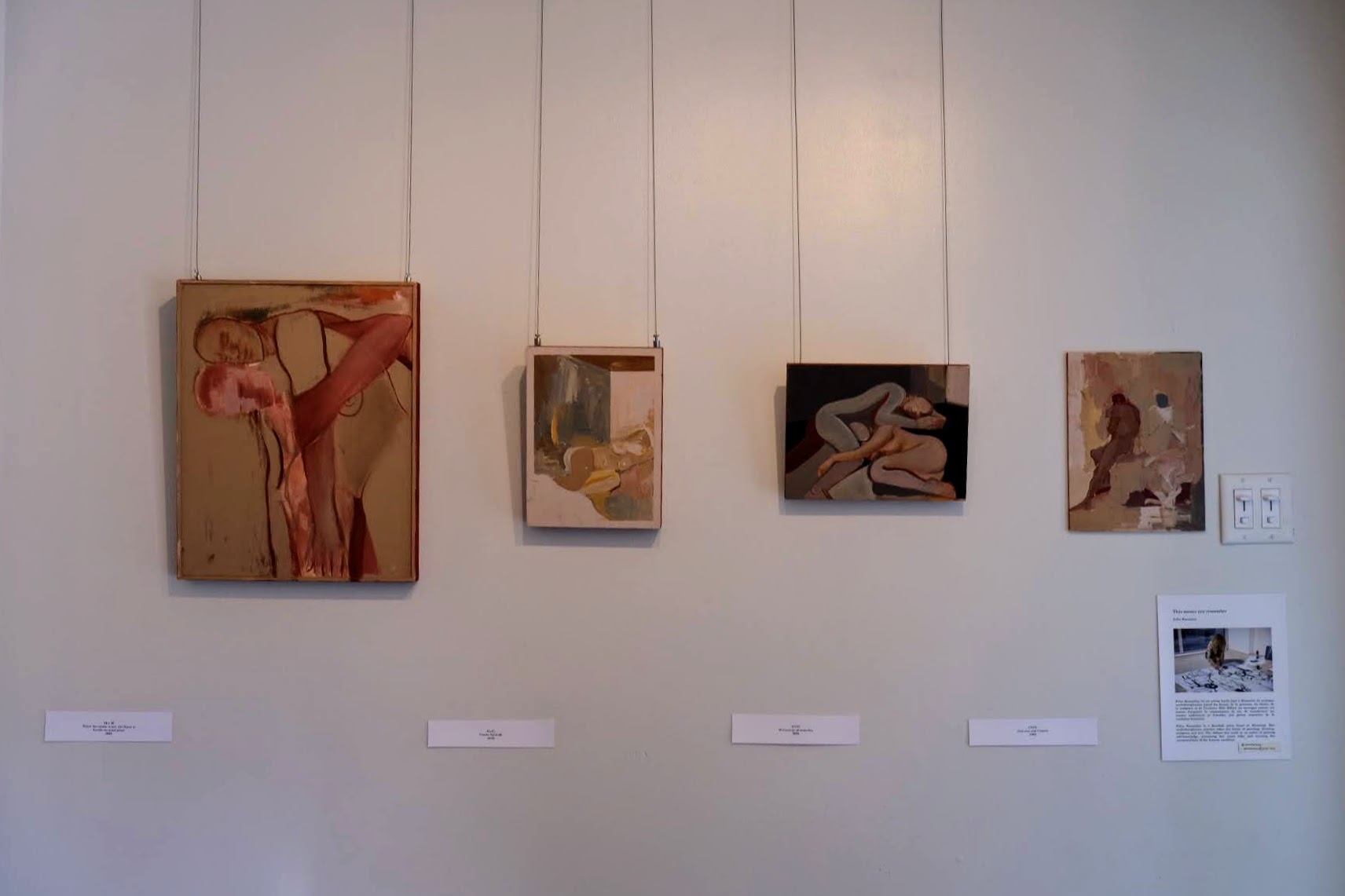
For as long as she can remember, Pelin Karaaslan, B.A. ‘17, has been a painter. Her exhibition This Means You Remember, currently on display in the Plateau café LA MAISON OFLORE,  dives into a memory-based exploration of solitude, relationships, and intimacy. Karaaslan’s work is figurative and anecdotal; her use of acrylic and oils on wood panels creates soft lines and colour block brushstrokes of earthy brown, warm beige, and tender mauve which blend effortlessly to craft an intimate atmosphere. In her paintings’ small, warm vignettes, the viewer peers into rooms where women sleep and lovers hold one another tenderly as their bodies meld, and faces, eyes, mouths, and hands dissolve into their supple surroundings.

Karaaslan grew up in Istanbul and came to Montreal when she was 18 years old to study at McGill. Graduating in 2017 with a double major in Political Science and Economics and a minor in Philosophy, Karaaslan developed many of the tools in university that she now uses to approach her artwork. In her political philosophy classes, she studied the fundamental questions about the human condition and what it means to be a person existing in the world—a theme she explores in her work today. She also learned about the academic research process, a technique she applies to her paintings as well. 

“My classes [taught me] a lot about research, how to formulate a question, and I realized that painting as a practice [is] always […] research,” Karaaslan said. “You create a new body of work. It all begins for me with a concept, and then you research based on that concept. You form […] questions, […] gather resources, and then you translate your research into the form of painting.”

Karaaslan had many inspirations while creating her work for This Means You Remember, one of which was her upbringing in Istanbul. Karaaslan spoke fondly about the memories she has of her father providing her painting supplies when she was a child, sharing that she even slept in the room where she painted, the air smelling of oils and paint thinner. 

Outside of her personal life, Karaaslan is influenced by the work of painters Tala Madani, Cheyenne Julien, Ambera Wellmann, and the writings of Khalil Gibran, Jiddu Krishnamurti, and James Baldwin. Baldwin’s writings about the creative process and the artist’s role in society were especially formative for her.

Karaaslan notes a phrase in Baldwin’s 1962 essay The Creative Process that particularly resonated with her:

“Societies never know it, but the war of an artist with his society is a lover’s war, and he does, at his best, what lovers do, which is to reveal the beloved to himself and, with that revelation, to make freedom real.”

Tying her work together to Baldwin’s thoughts, Karaaslan hopes that through her art, she can explore her truest self by depicting her relationships with others. Consequently, she wants to understand the essentials of what it means to exist in a relationship, in a body, and in a soul.

“I try to depict the fundamentals when painting, closer to the essence, no add-on elements like clothes,” Karaaslan said. “[The paintings are] raw, […] exploring the wilderness of myself, understanding my inner tides, and translating the process into a new tongue [….] In doing this, I hope [to] create a platform, a portal for others to compare their own introspective processes and to understand the commonalities of each experience.”

Pelin Karaaslan’s paintings are exhibiting until December at LA MAISON OFLORE, 511 Duluth Ave E, Montreal, Quebec H2L 1A8.

Commentary, Opinion

New international students need more support on immigration procedures

On Sept. 15, I, along with many other international students, received an automated email from McGill Legal Services notifying me that I was at risk of deregistration due to missing immigration documents. Although I applied for my documents over the summer, the Quebec documents uploading system did not correctly upload my files to Minerva. By the time I realized the issue and followed up on it, the semester had already started and the deadline by which I was supposed to have applied had passed. Bewildered, I wished that McGill had provided more support and clearly communicated with me earlier.

The email suggested that I submit proof of application for Quebec’s Certificate of Acceptance of Québec (CAQ) by Nov. 1 to avoid being deregistered. I had thought that I was staying ahead of the curve by submitting the required document to McGill by Oct. 1. Instead, McGill asked me to send additional proof of application for my Canadian Study Permit and told me that this would merely help prevent these measures, offering no concrete assurance that the university would not deregister me. When my CAQ was denied due to the deadline issue, I panicked. 

It is reasonable that Quebec and Canada insist that McGill must have immigration paperwork filed for all students to legally study at the university. However, the pandemic has made it much more difficult for students not currently in Montreal to obtain these documents. Given that the government is nonetheless requiring that international students have them, McGill needs to provide extra support to international students by connecting them to the appropriate resources since there are processing delays.  

When my permit was denied, I did not know who to consult. The resources regarding legal documentation on the McGill Enrolment Services website do not offer immigration advice, and neither does Arts Advising nor Student Housing and Hospitality Services. After several days of trying to figure out what my next steps should be, McGill Legal Documentation told me that McGill International Student Services (ISS) could assist me with immigration issues. It should not be such a bureaucratic maze to find out about and access services like ISS, which does valuable work for students like me. Despite having to pay an extra $110 to re-file a new application, the ISS provided advice that assured I could get my CAQ approved. Had I been connected with the ISS earlier, I may have gotten my approval earlier.

Though returning McGill students may have a better understanding of what services and resources the university provides, many first-year students are adjusting to how McGill works during an exceptionally stressful and overwhelming time. Ironically, I chose to attend McGill in part due to its early communication about remote course delivery for Fall 2020. 

After receiving another intimidating email from McGill, and having once again requested some assurance about my status, Enrolment Services told me that I will not be deregistered for Fall 2020 and implied that I would not be for Winter 2021 either. Thankfully, I received an approval for my second CAQ application on Oct. 30. However, this issue illustrates broader problems with navigating McGill’s bureaucratic services. Eventually, international students currently living in their home countries will be able to come back to Montreal, and all students will need these documents to be registered for classes at the university. In order for this to happen, McGill has a responsibility to help its students navigate the bureaucratic issues posed by these extraordinary circumstances. Though the situation is not the university’s fault, it is often the only resource incoming international students have to help deal with these incredibly stressful issues. 

Arts & Entertainment, Theatre

Players’ Theatre confidently adapts to a virtual format

Theatre at McGill looks a little different this year. Rather than traditional live productions, which are no longer possible due to public health restrictions, Players’ Theatre went virtual. This is a Play and Life is a Dream were presented through Zoom, running from Oct. 29-31. The McGill Tribune attended each show to find out how Players’ programming has adapted to the challenges of the pandemic.

This is a Play 

Noma Mirny

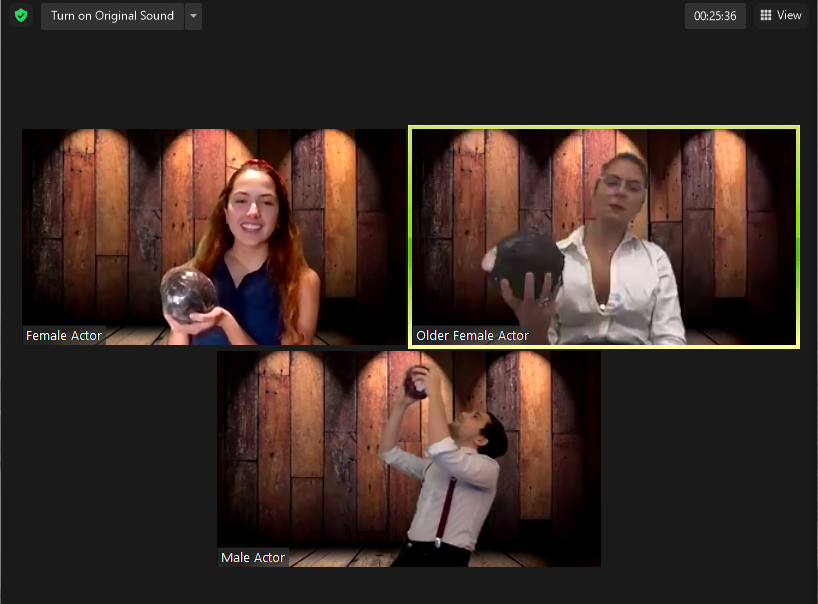
Written by Canadian playwright Daniel MacIvor and directed by Thia McDowell, U3 Arts, the self-referential dramedy This Is A Play examines the lives of three flat characters: Female Actor (Maya Charky, U1 Science), Male Actor (Cédrick Mulcair,  Law ‘19), and Older Female Actor (Caroline Lauf, U2 Arts), as they wander around their undisclosed plotless storyline, thinking aloud as actors inside another play.

Starting in a Zoom room, the audience was greeted with doltish Male Actor in suspenders, sardonic Older Female Actor sipping on wine, and ditsy Female Actor flouncing in a blue dress. Throughout the play, the self-aware Actors speak their introspective thoughts on the play, crew, and their relationships to one another. In one moment, the Male Actor starts to grotesquely feign tears about his brother as part of a scene. Male Actor then slyly reveals to the audience how he’s producing such tears: He’s thinking about a cat named Mr. Whiskers. 

McDowell’s adaptation of the play to Zoom was excellent and allowed the characters to equally attend to and interact with their virtual context—the Older Female Actor pulls out an off-screen bottle of wine; the Composer (Jordan Prentice, U2 Law) stands up to reveal he is wearing boxers below his suit-jacket. Through a series of clever hints, McDowell suggests that a production is nothing but a farce and that behind every cohesive play is a group of confused, uncoordinated, exhausted people. 

In this sharp one-act, McDowell shrewdly reveals that the complex people behind the costumes are as much a part of the production as their scripts, and sometimes even more than the characters themselves.

Life is a Dream

Erika MacKenzie

Director Emma Victoria, U3, adapted Golden Age Spanish Play Life is a Dream by Pedro Calderón de la Barca into a radio play. The story follows Prince Segismundo (Cessy Weber, M.A. Political Science), who has been imprisoned in a tower by his mother, Queen Basillo (Prarthna Isha Mahtani, B.A. ‘19), due to her fear of a prophecy that her son will bring  destruction to the kingdom. Segismundo is briefly released, but the prince then embarks on a violent rampage and destroys his land, thus fulfilling the prophecy. 

The play explores the themes of fate and free will, reality and delusion, as well as respect and exploitation of the earth. Players’ revamped the centuries-old play to reflect the current environmental crisis: At the end of the play, Segusmundo is forced to confront the fact that he has caused great harm to the earth and the animals, and he must restore the broken relationships between the land and his people. 

One of the challenges actors face in a radio play is expressing their character’s emotions in the absence of body language and physical acting. Without the use of video, the actors in Life is a Dream did an excellent job of varying the energy, intonation, and volume of their voices to showcase their character’s state of mind. However, it was occasionally difficult to distinguish who was speaking due to the lack of visual or auditory cues to differentiate the characters. 

Sound effects and visual imagery were intermittently used to transition between scenes in the radio play. The brief visuals provided the audience with a clear setting for the action while the sound effects added to the intensity of the scenes. In one scene, Segusmundo storms the kingdom, with sounds of explosions emulating environmental destruction. 

Victoria did an excellent job adapting to the circumstances and creating an engaging radio play. Life is a Dream evoked the dissociative feeling of being in a dream and being unable to distinguish reality from illusions—a feeling that continues to be extremely relevant today. 

McGill, News

MISC panel reviews Quebec’s landmark 1995 independence referendum

The McGill Institute for the Study of Canada (MISC) hosted an online panel titled The Quebec Referendum, 25 years later on Oct. 29. The discussion, moderated by Canada’s Commissioner of Official Languages and former McGill visiting lecturer, Graham Fraser, featured four speakers: Louise Beaudoin and Éric Bédard, who supported Quebec’s separation from Canada, and Eddie Goldenberg and John Parisella, who were against it. Panellists reflected on their personal experiences during the election and explained their positions. 

On Oct. 30, 1995, Quebec held a referendum to determine whether it would separate from Canada. In the previous referendum concerning Quebec’s sovereignty in 1980, 60 per cent of Quebecers voted to stay in Canada. The 1995 election, however, was more unpredictable: The “No” coalition, which was opposed to Quebec separatism, won, capturing 50.58 per cent of the vote. 

The panelists described their preparations leading up to election day in 1995, along with their views of the question posed to voters and how their respective sides reacted the day after the results were released. Each speaker detailed their personal experience with the 1995 referendum and how it differed from the one in 1980.

In the 1990s, the separatists were gaining support under the guidance of Jacques Parizeau, a prominent Quebecois sovereigntist. He had realized that a more united front was necessary to avoid the previous referendum’s defeat, which entailed ceding more authority to federal Quebecois politicians like Lucien Bouchard. 

“It’s true he had a different approach,” Beaudoin said. “He understood very well that we had to ally ourselves [with the federal government]. The large coalition with the Bloc Québécois and Lucien Bouchard […] was the big surprise. I want to say this about Parizeau, for whom independence was a life goal. He knew if we wanted to win, Lucien Bouchard was needed.”

Goldenberg said that the side opposing separation also observed changes from 1980. He explained that, with Pierre Elliot Trudeau no longer spearheading the federalist position, numerous factions on the “remain” front gained greater influence in the coalition. 

“The referendum in 1980 […] was shortly after Pierre Elliott Trudeau came back into office with a very strong mandate from the people of Quebec,” Goldberg said. “In 1995, Prime Minister Chrétien was in a far weaker position in the province of Quebec [….] That affected how we could frame the campaign. We depended more on the provincial Liberals to take the lead in the campaign than [Trudeau] did in 1980. That was the fundamental difference.”

The panelists described the moments leading up to the referendum. Both coalitions faced internal conflicts as the movement progressed and more diverse interests emerged. Parisella explained that the federalists clashed over whether they could amend the constitution to give Quebec more autonomy and recognize Quebec as distinct in order to ease separatist sentiments. This move, however, was rejected by Chrétien.

“There was an incident where Mr. Johnson, leader of the [federalists], spoke about the eventual constitutional change when Quebec [and] its distinct character would be recognized,” Parisella said. “Mr. Chrétien said basically this is not time to talk about constitutional change or negotiations, [and that the sovereigntists] want to break up the country, so let’s stay focused on that.”

In concluding the discussion, both sides of the vote acknowledged that, despite their opposing opinions about what is in the best interest of Quebec, unity among the citizens is most necessary to maintain a well-functioning society.

“Where we’re going in the future […] we do it in a way that is respectful,” Goldenberg said. “We went through a very polarized time, and nobody liked it. A polarized society is the last thing we need.”  

Read the latest issue

Read the latest issue