Latest News

Creative

McGill Explained: Philanthropy

In the first episode of McGill Explained, Multimedia Editor Alex Hinton dives into the reasons that cause people to make such large donations to universities, and highlights some of the stories behind the names of McGill buildings that have become part of everyday vocabulary.

Features

Super Marché Brito, the last dep on earth

In the summer before my third year of university, the nearest dépanneur to my apartment was Super Marché Brito. One summer’s day, my roommates and I approached the owner, Tim Maherpour, asking him if he was going to be open on Canada Day (in case we needed to get more beer and charcoal for our grill).

Research Briefs, Science & Technology

Detecting tiny cracks can reveal the potential of new technologies

The properties of materials, from the plastic in water bottles to the metal beams of skyscrapers, are determined by their microscopic structure. However, most substances are not perfectly uniform and rather contain a significant number of minuscule defects. These imperfections play a large role in determining the physical properties of the material, including its strength and durability.

These faults can be extremely difficult to discern, particularly with regards to optical technologies that function using light to observe nanoscopic surfaces. To retrieve relevant information on these interactions, it is necessary to visualize the microscopic structure of materials on the scale of femtoseconds and nanometers. A nanometer is a billionth of a meter, and a femtosecond is a millionth of a billionth of a second.

Peter Grutter, chair of the Department of Physics at McGill, directs the Grutter research group, which focusses on developing cutting-edge microscopes that harness the interaction of light and matter to visualize the nanoscopic surface of materials. Although observing physical defects is essential to ensuring the quality of a wide range of technologies, such as cameras and fibre optics, Grutter is particularly interested in its potential to improve solar cells

“It’s not only by using less energy that we’re going to have a more sustainable society, […] there is a need in society to generate energy.” Grutter said in an interview with The McGill Tribune.

One visualization method involves the combination of two different advanced technologies: Atomic force microscopy (AFM) and ultrafast light. Developed in collaboration with the Cooke THz lab at McGill, this technique allows more powerful visualization than other leading techniques. AFM is a form of extremely high resolution scanning that uses a physical probe to examine the microscopic surface of a material. The AFM tip, the “finger” of the microscope, scans a sample similarly to how one could use their actual finger to feel a rock for cracks. 

To achieve both the time and size accuracy required to detect these cracks, the group incorporated the use of ultrafast lasers. In this method, a laser pulse is directed toward the sample, which causes the electrons in the material to oscillate in what is known as optical stimulation. This generates an electric polarization, where the positive and negative charges of the material separate. These charge separations are then detected by the AFM tip without the need to make physical contact with the substance, ultimately allowing researchers to image its substructure.

Grutter’s current work focusses on nonlinear materials, those which polarize unevenly in response to high light intensities. The group’s most recent paper concerns the imaging of a specific material called lithium niobate, which is frequently used in cell phone components. In the future, the research group aims to expand the technology’s use to a wide range of common materials.

A major potential application of the new method is solar cell technology. Solar cells use organic compounds, molecules that contain bonds between carbon and hydrogen atoms, that can receive or donate an electron to generate electricity. Modern chemistry techniques can create synthetic organic molecules, which have a wide range of structures and properties. Unfortunately, theoretical modeling of such synthetic substances is still imperfect, and fully understanding their properties requires them to actually exist. Grutter aims to move past that need all together.

“If you understand, it essentially means you can actually predict stuff quantitatively [and] correctly,” Grutter said.

Grutter hopes that the ability to fully visualize the structure of existing organic molecules in all their imperfections will allow for models with enhanced predictive power. This would allow chemists to better understand a theoretical material’s properties without even having to create it, greatly accelerating the discovery of new substances. 

“I think there’s an ethical responsibility to somehow, in the long-term at least, have some sort of return on investment [on resources put into research],” Grutter said. “In the long-term, I think it’s actually important that we contribute to society.”

Martlets, Men's Varsity, Sports

RSEQ cancels fall seasons, athletes and staff wait await news on winter sports

On Sept. 14. the RSEQ announced the cancellation of all university sports in Quebec, adding to the June 8 U SPORTS announcement of the cancellation of all national championships in the Fall 2020 season. No RSEQ-sanctioned competitions will take place until at least Dec. 31. The league was originally scheduled to make an announcement about the potential fall season on Aug. 31, but decided to push it back by two weeks in order to monitor the effects of students returning to Montreal. Stéphane Boudreau, Deputy Director-General of the RSEQ, had previously emphasized the fluidity of the situation. 

“As of today, they’re supposed to be able to play on [Sept.] 14, but everything could change the Friday before,” Boudreau told The Montreal Gazette in an article published on Sept.1.

With many students returning to Montreal from different provinces and countries, the risk of a spike in COVID-19 cases is high. According to CBC News, Montreal has already seen a rise in cases, and on Sept. 11, Quebec reported 244 cases, the highest number of daily cases in over three months. RSEQ decision-makers delayed an announcement in order to evaluate the full effect of students returning to school before making a definite decision on the fate of the Fall 2020 season. 

The Sept. 14 decision explained the reasoning behind the cancellation, as well as the scope.

“After having analyzed all possible scenarios, members of the university sector of the RSEQ announce the cancellation of sanctioned sports programming until December 31, 2020,” the statement said. “This difficult decision made by members of the RSEQ university sector is based primarily on the regional alert system, which may limit the participation of universities, even if said institutions effectively manage health-and-safety best practices.”

The announcement, however, did leave exceptions for lower-risk sports activities.

“To keep student-athletes engaged, members of the RSEQ university sector will permit activities involving at least two different teams in the following sports: Cross-country, golf, and soccer—thus giving universities the flexibility to evolve at their own pace and with their own realities. However, due to universities’ level of risk management, no inter-team activities will be permitted in football and rugby,” the statement said.

Staff and athletes are now waiting for an announcement by the RSEQ regarding the winter sports’ seasons, which is anticipated to be released on Oct. 15.

Third-year track and field sprinter Stephanie Susinski looks forward to returning to practice, but does not want to get her hopes up with so much uncertainty regarding a return date for competition.

“I’m excited for practices to start up again,” Susinski said in an interview with the The McGill Tribune. “I’m trying to take things one step at a time because, as we’ve all been too familiar with recently, plans are subject to change [on] short notice, so nobody can really say how the season will play out.” 

With nearly all fall sports cancelled, spectators and athletes alike will miss out on events such as homecoming and playoff competition. Athletes and coaches will continue to wait out the hiatus and train on their own times to maintain momentum heading into a tentative winter season. If the winter season goes forward, it will be drastically different than prior years, as all teams must continue to follow government health directives and adjust to the continually changing public health situation. As much as athletes want to return to competing, health and safety remains the top priority.

Editorial, Opinion

Zoom University threatens to leave students behind

During the last two weeks, students were welcomed back to a McGill that no one had ever seen before. Across time zones throughout Canada and around the world, frantic searching for class locations was replaced with anxious scrambling for Zoom links as students and academic staff struggled to adapt to the realities of remote course delivery. Despite the notable efforts of many professors, teaching assistants, and other instructors to prepare for the online semester, students have experienced issues that should alarm educational staff. Inconsistencies in regulations on course delivery methods have sowed widespread frustration and confusion. From onerous assessment procedures to unusual departures from normal class scheduling, these inconveniences caused by remote delivery are rapidly mutating into an accessibility issue. McGill must act now to address these concerns and work to ensure that its policies are more equitable, responsive, and accessible to students.

Aside from a handful of Zoom town halls, students have been left to make sense of the vague descriptions contained in emails sent via Deputy Provost (Student Life & Learning) Fabrice Labeau’s listserv alone. Assessment policies vary widely at the departmental level, and with different conference and lab facilitation formats, scheduling has become a nightmare for some students who have had to account for these discrepancies in their planning. Moreover, many professors have been uploading lecture recordings outside of scheduled course times, further complicating matters. Some have also exceeded the allotted time for their lectures while others have uploaded lectures as little as half as long as a normal one. 

Such inconsistencies have only added further confusion and stress to the already strained circumstances of remote learning. Some professors have mandated—or structured their courses as to nearly necessitate—attendance in conferences, notwithstanding McGill’s policies designed to accommodate students living in different time zones. Professors are not to blame for these problems, however: They stem from misunderstandings resulting from poor communication between faculty, administrators, and other academic staff. Clear articulation to students and staff alike of the policies currently in effect is evidently necessary.

It is imperative that students no longer be left in the dark, especially as plans for the winter semester are finalized. Whether online or in person, McGill is paid for in great part by student tuition dollars. In fact, considering that McGill has not reduced tuition this year, despite the online format, and that international students’ tuition has actually increased, consulting students and clearly communicating operations ought to be the bare minimum. 

Broader accessibility concerns are even more prohibitive. Students who require accommodations through the Office for Students with Disabilities (OSD), for example, are particularly vulnerable to falling behind with coursework. Consequently, services such as those provided by OSD Note Takers are more critical than ever. Students were calling for McGill to compensate note-takers fairly before the pandemic. For McGill to continue to ignore their demands now, when their work is so obviously essential, would be careless and disgraceful. 

Of course, internet inaccessibility and distracting or unstable home environments remain equally formidable barriers to students this semester. Instructors must be cognizant of these obstacles and accommodate students experiencing such difficulties. But the onus is on faculty administrations to responsibly guide their students and staff. And while clear communication of policies and plans is important, it alone is not a solution. Nor is hiring students to help facilitate remote instruction, though this may be helpful, because many of these problems extend beyond technical difficulties. McGill should consider reinstating the Satisfactory/Unsatisfactory (S/U) option for all courses, as was done at the end of the Winter 2020 semester. Above all, McGill must make an effort to prevent misunderstandings by coordinating departmental guidelines and enforcing scheduling structures.

At the same time, students must recognize professors and staff who are taking measures to combat these problems. McGill’s librarians, for instance, should be commended for using software such as HathiTrust to make print resources available to students around the world. Through mutual compassion and diligent communication, the McGill community can navigate the online semester. A return to any semblance of McGill as we once knew it can only be assured through effective solutions to the problems already apparent from the last two weeks, and the entire McGill community should be united with this goal in mind.

Commentary, Opinion

Quebec’s businesses and linguistic minorities need protection during COVID-19

Since gaining a majority government in the 2018 election, the Coalition Avenir Québec (CAQ)  has advanced a nationalistic agenda for the province, with one of their principal initiatives being the reinforcement of the primacy of the French language. Most recently, a report found that 40 per cent of Quebec businesses prefer employees who are fluent in English, agitating party officials such as French Language Minister Simon Jolin-Barrette. In response, he pledged to implement a series of stringent measures to protect the French language, particularly in Montreal, where the rate of companies that prefer English fluency stands at 63 per cent. Among these proposed measures is Bill 104, a measure that compels government bodies and crown corporations to deliver written communications exclusively in French. However, it is clear that such policies would harm businesses and minority populations, especially during the COVID-19 pandemic.

It is difficult to believe that the French language could be under threat in a province where nearly 95 per cent of people speak the language fluently. Jolin-Barrette argued that stronger measures are necessary to maintain French as Quebec’s official language of business, but the statistics that he cited to illustrate this need were misleading. He created a false equivalence between a business requiring a knowledge of English as opposed to merely preferring it. The survey found that only nine per cent of Quebec businesses turned down a candidate because they could not speak English. Although these studies are reminders that bilingualism is an asset for employees in a globalized economy, they are not sufficient evidence to suggest that French is at risk of being replaced as the primary language of business in the province.

The legislation that Jolin-Barrette is suggesting would be detrimental to a provincial economy that has already been devastated by COVID-19. Quebec was hit harder than any other province by the pandemic, causing a record deficit in the provincial government’s budget. With the economic situation still so dire, the CAQ should instead focus its attention on rebuilding businesses, not hampering them with bureaucratic measures such as legislating which languages they communicate or advertise in.

Moreover, the CAQ’s policy of cutting English services to promote the French language could have serious consequences for McGill students. Restricting these services to historic anglophone communities, which Premier François Legault defined as individuals whose parents attended English schools in Quebec, would exclude many members of McGill’s English-speaking community. This could make it difficult for them to understand notices from government agencies such as Hydro-Québec or health services. 

Indeed, the CAQ’s language politics have already had serious consequences during the pandemic. Despite promising that historic anglophone communities could continue to receive English services, certain COVID-19 information pamphlets were distributed exclusively in French throughout the province, putting those who do not have access to online information at risk. 

The policy of denying many English speakers access to English services markedly differs from the treatment of linguistic minority populations in other parts of the country. Consider Ontario’s French Language Services Act, which protects the right of citizens to receive government services in French. The Act applies to counties and districts with francophone populations of at least 10 per cent, as well as any cities with a population of five thousand or more francophones. This means that native francophones in Toronto can receive services in French even though they comprise only 1.3 per cent of the city’s population. By contrast, 13 per cent of Montrealers speak English as a first language, yet not all of them can be counted as part of the historic anglophone community that is to be exempted from the CAQ’s measures.

Bill 101 has already ensured the primacy of the French language in Quebec. Ignoring demographic realities, hampering economic growth, and reducing English services is unfair and dangerous, especially during this current time of crisis. The French language is already protected and the CAQ must shift its priorities to protecting all of its citizens and their livelihoods. 

Science & Technology

The McGill Scientific Writing Initiative introduces students to science writing

There exists a common stereotype that people in science, technology, engineering, and math (STEM) departments do not like to write. Even though students in STEM fields conduct groundbreaking research, many have no idea how to present their findings in a clear and concise manner, let alone an interesting one. The McGill Scientific Writing Initiative (MSWI) aims to support science students in developing their writing skills. 

MSWI is a new student-run initiative, started in the summer of 2020. It was co-founded and is led by Marina Nysten and Joyce Wu, both U3 Science students. As universities shifted to online classes in April 2020, many science courses replaced multiple choice final exams with end-of-term papers. This was a difficult transition for some science students, many of whom were never required to take writing-intensive courses at McGill and thus lacked experience in scientific writing. Observing these challenges that their peers faced, Wu and Nysten began to brainstorm ideas on how to bridge this knowledge gap.

Last April, we both noticed a lack of science communication resources at McGill,” Wu and Nysten wrote in an email to The McGill Tribune. “MSWI’s purpose is to act as a supplementary resource to support students and professors, especially considering the transition to writing-centric assessments this semester.”  

Throughout the upcoming academic year, MSWI will be organizing workshops on a variety of topics, from how to expertly read research articles to presenting scientific material and communicating science to the public. MSWI will also provide comprehensive online resources on its website, including a concise ebook on scientific writing that Nysten and Wu penned over the summer in collaboration with faculty members, TAs, and students.

According to Nysten and Wu, the club’s main goal is to become a “hub” for science communication at McGill. One of the ways they hope to achieve this is by supporting as many students as possible through their partnerships with faculty members and other student organizations. 

Some student clubs and organizations such as the Student Research Initiative and McGill Science Undergraduate Research Journal have missions that broadly align with that of MSWI, creating a cohesive network of writing-centric student support opportunities. Whether as a part of their personal research or as a result of the increased writing requirements in many online classes, Nysten and Wu predict that students from across disciplines will benefit from MSWI’s services. 

“We hope to offer unique services and resources that fill in the gaps that currently exist at McGill,” Nysten and Wu wrote. “An essential factor in this goal is to listen to what students are looking for, which we achieve by conducting surveys and creating online feedback forms.” 

There are plenty of opportunities for students to get involved with MSWI, such as attending monthly workshops, contributing a blog post to the MSWI website, or by helping to create learning resources in a subject they have experience in. 

Their first workshop, entitled “Reading Research Articles,” is on Sept. 24 and will be co-hosted by Tommy Markopoulos, a graduate student in the Integrated Program in Neuroscience.

One of the biggest events that MSWI planned for this year is the first annual MSWI Science “CommunicaScion” Case Competition set to be held in the winter semester. With this competition, Nysten and Wu aim to challenge students to effectively communicate a scientific topic to three different ages and educational backgrounds. This year’s theme remains a secret, but will be revealed in the coming months.

If you are interested in learning more about the MSWI and what they offer, you can stay updated on future events and resources by following their social media and subscribing to their newsletter.

Art, Arts & Entertainment

MMFA’s post-impressionist exhibit leaves mixed impressions

From July 4 to Nov. 15, the Montreal Museum of Fine Arts (MMFA) is showcasing—in person—its most extensive exhibit on the post-impressionists yet, Paris in the Days of Post-Impressionism: Signac and the Indépendants. The exhibit boasts an impressive, sweeping collection of over 500 works from France’s leading post-impressionists, spanning Paris’ late 19th-century heyday to its final, tense years preceding the First World War. 

The period was an artistic and culturally ripe one for the French capital, and the MMFA displays it unsparingly in all its messy efflorescence: Neo-impressionists, Fauvists, Symbolists, Nabis, Expressionists, Cubists, and just enough Picasso to brag about in the brochures. Most of the exhibit’s focus, however, is on Paul Signac, for both his pointillist paintings and his immense influence on French visual art during la belle époque. In 1884, he founded the Salon des Indépendants, an annual exhibition that catalyzed a generation of creative misfits until 1914, the start of World War I. Many of the paintings on display at the MMFA exhibit had their first glimmer of fame at the Salon.

Aside from Signac’s curatorial genius, his collection of paintings is the exhibit’s low point. Rainbow (Venice) is a decadent mess, melding garish, Candy Land-type colours with an ill-fitting, boxy-like pointillist style that looks eerily like a collection of Minecraft blocks. Here, Venice loses its medieval charm, and its gondolas and spires are transplanted in what looks like the Emerald City of Oz.

Throughout his collection of pastel pink-and-blue fantasies, Signac struggles to recreate the natural effervescence of, say, George Seurat’s pointillist masterpiece, A Sunday Afternoon on the Island of La Grande Jatte. Instead, most of his paintings come off as laboured and artificial, even gimmicky. Signac’s pointillist style encumbers, rather than enables, his creative visions.

Following the inconsistent selection of neo-impressionists, the early 20th century print collection is refreshing and distinct. A movement that fully utilized the era’s innovative print technologies and benefitted from the growing consumerist thirst, the Art Nouveau style completely freed itself from the shackles of the impressionist period. The posters’ bold black fonts and vivid primary colours are beautiful, even if they were only trying to sell you the latest dishwasher soap. While many of these prints are instantly recognizable and have been reprinted to near-ubiquity (Théophile Steinlen’s Le Chat Noir probably hangs in your roommate’s bedroom), it is exhilarating to see them in their proper historical context. The revolutionary ways in which these prints redefined the artistic world becomes immediately apparent at the exhibit. 

Among the collection’s other non-oil-on-canvas works, Swiss printmaker Félix Vallotton is a true revelation. His black-and-white woodcuts are caricature-like in style, yet somehow radiate an emotional and energetic purity. In The Brawl, or Café Scene, one of his more detailed woodcuts, four tuxedo-clad men clash over a white table in a posh café as onlookers gawk; although the black of their suits overlap without demarcation lines, the men’s discombobulated shapes lose none of their intensity. Valloton’s austere textures and his characters’ raw emotions are fitting for the exhibit’s latter half: As the late 19th century’s debaucheries subsided, the grim thought of an incoming world conflict haunted artists’ psyches.

The MMFA’s lively post-impressionist exhibit is ill-fitting for these dark, pandemic-burdened times. But there is a joy—however escapist it may be—in physically visiting the museum, and embedding one’s self in the world of a long lost, more playful and innocent past.

Paris in the Days of Post-Impressionism: Signac and the Indépendants is on display at the Montreal Museum of Fine Arts until Nov. 15. For more information and ticket prices, visit their website.

Commentary, Opinion

BIPOC voices will no longer be silenced

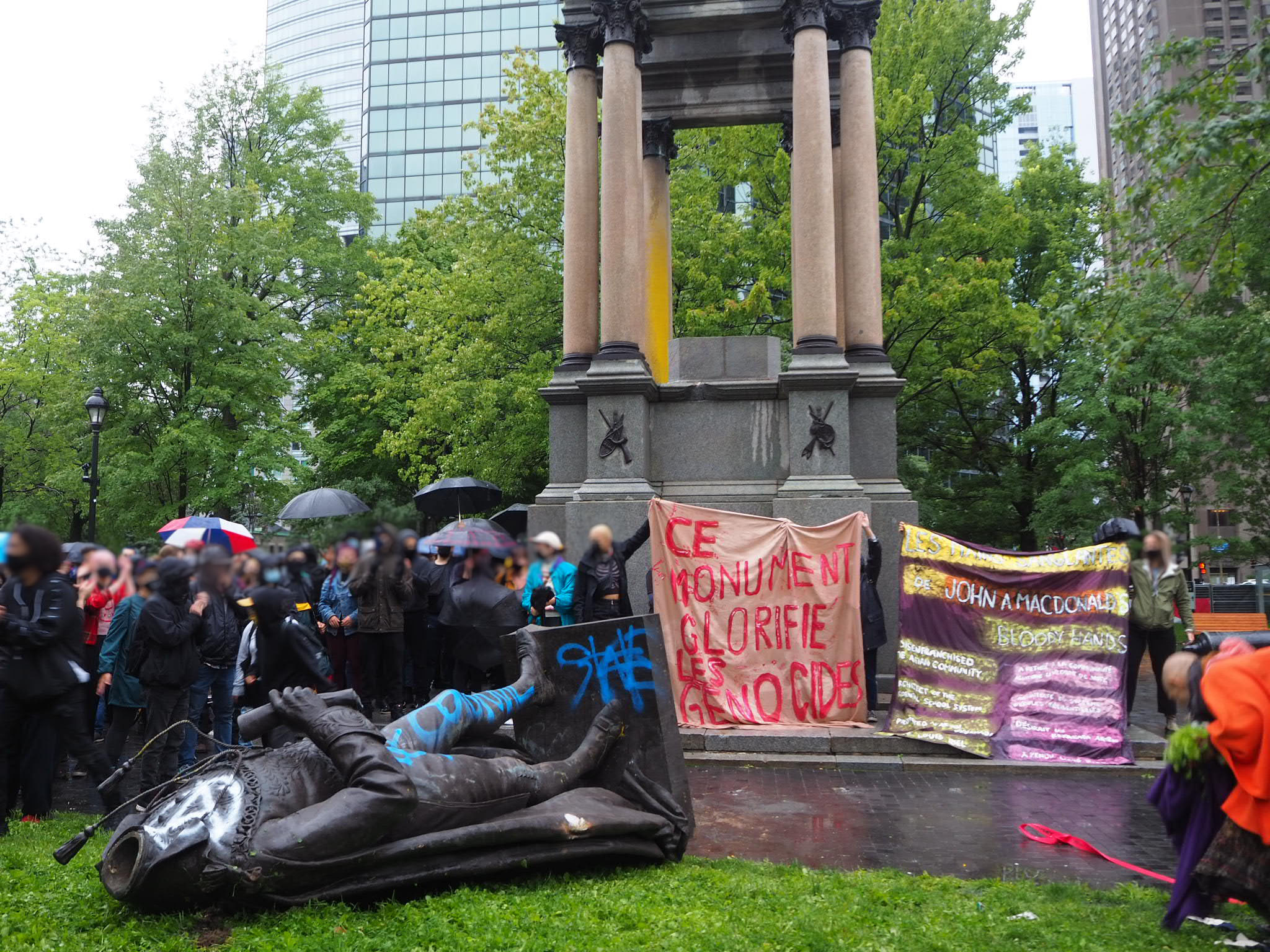
On Aug. 29, protestors toppled a statue of John A. Macdonald in Montreal. Besides serving as Canada’s first prime minister, Macdonald is infamously known as the creator of the residential school system and as someone who starved Indigenous groups to forcibly relocate them. Macdonald’s treatment of Indigenous Peoples was reconsitiuted as cultural genocide by the Canadian government in 2015, due to the work of Indigenous activists. The distress caused by statues of those who contributed to the marginalization of minority groups is not new. On McGill’s campus, there is a growing movement demanding the removal of the statue of James McGill. The calls to remove statues honouring Canada’s colonial legacy is a direct result of the inaction of those in positions of power to denounce the harmful acts of those before them. Silencing minority voices and ignoring their labour to build a more equitable society will no longer be tolerated by BIPOC and their allies.

The conversation surrounding harmful commemoration is not unique to Montreal; rather, it is one being held all over Canada. In 2018, the City Council of Victoria, British Columbia, voted to remove their statue of Macdonald. Those who want statues of racist historical figures to remain often argue that removing them is equivalent to erasing history, insisting that there is no middle ground between commemoration and erasure. This argument fails to acknowledge that many Black and Indigenous people face the harmful legacies of residential schools and slavery in their everyday lives. One cannot celebrate the societal contributions of men like Macdonald and McGill without considering the harm that they have also perpetuated and acknowledging the fact that their success came at the expense of Black and Indigenous peoples.

There may have been alternative solutions to the removal of these statues when concerns first arose, but the government’s reluctance to acknowledge its racist past has led protesters with no other choice than to force change. Montreal activists have been asking for the removal of Macdonald’s iconography through petitions and peaceful demonstrations but they have been ignored by those able to authorize its removal. The tearing down of the Macdonald statue demonstrates a shift: Marginalized voices are tired of inaction and are now taking matters into their own hands. BIPOC are no longer waiting for white men to make the right decisions.

Politicians have been largely ignoring the protestors but have spoken out about the statue’s fall, insisting that it was not their own inaction that led to the toppling of the statue. Prime Minister Justin Trudeau condemned the protestors’ actions, arguing that vandalism does not pave the way for progress or addressing injustice in Canada. Previously, Trudeau has apologized to Indigenous groups for Macdonald’s actions but the Prime Minister’s acknowledgement of Macdonald’s legacy as important only highlights his unwillingness to listen to Indigenous groups’ need for justice—the bare minimum of which would be to stop honouring Macdonald’s racist legacy. Both Trudeau and Quebec Premier François Legault argue that removing a part of our history is not productive, but their tactics to ignore marginalized voices demanding change is also stalling progress. The government’s neglect of the needs of BIPOC and their unconcerned attitude while making decisions that harm Indigenous groups, such as approving the Trans Mountain pipeline, emphasizes the performative activism in their response to Black Lives Matter and other such social justice movements. 

McGill’s administration has added a statement acknowledging their namesake’s role in enslaving Black and Indigenous people, but still has yet to mention that they were Black and Indigenous. The university has had more than enough time to listen to BIPOC students’ needs in regards to McGill’s racist legacy but as time passes, students are getting tired of waiting. The administration is blatantly disregarding Black students’ demands for equity. Other than an emailed statement about the Black Lives Matter movement, the university has yet to comment on the statue of James McGill. McGill’s lack of tangible action is reminiscent of the Canadian government making blanket statements and ignoring their active role in perpetuating the marginalization of people of colour. 

McGill students are losing patience. The administration’s inaction is leaving many students of colour uncomfortable with the institution that they attend and questioning the values that it holds. Protesters should not have needed to tear Macdonald down; the government should have listened to the people that his legacy has harmed and cooperated to remove the statue peacefully. It is now time for McGill to take action. Passivity only leads to escalation, and there is nothing to say that the James McGill statue will not be next. 

Arts & Entertainment, Film and TV

The Royalmount Drive-In offers a nostalgic escape during uncertain times

It’s a familiar scene in popular culture: Groups of teenagers and families packed in their cars, radio dials tuned to FM signals, billowing cigarette smoke forming clouds in the projector light. Such was the magic of the drive-in cinema, with its eclectic blend of innocence and rebellion, sociability and privacy. With its rebirth during the COVID-19 pandemic, moviegoers can experience this magic for themselves. The Royalmount Drive-In Event Theatre, Montreal’s first multipurpose drive-in, has succeeded in emulating this beloved past, providing audiences with a safe outlet to enjoy the big screen.

With the fate of cinema and live performance uncertain, the Royalmount Drive-In, which opened on June 21, has come at an opportune time. By its very nature, the drive-in adheres to physical distancing requirements: Viewers can watch films from the comfort of their cars or seated right outside of them, within demarcations that ensure moviegoers remain at safe distances from one another. In addition to movies, the venue hosts comedy shows, charity and fundraising events, and live music.

Drive-in theatres have resonated with audiences since their inception for a variety of reasons. Cultural Studies professor Ned Schantz explained that drive-ins were symptomatic of mid-20th century car culture.

“[People would be] looking for any reason to be in [their] car because it was so important,” Schantz said. “Cars [were] so deeply tied to peoples’ identities. They were essential status symbols, and just loved in all sorts of ways.”  

The drive-in emerged in part because of white flight, the postwar movement during which many white Americans left urban centres that were becoming more ethnically diverse.

“With the new suburb, it [was] cheaper to just throw up a screen [at] a dirt lot at the outskirts of town,” Schantz said. “Largely because of the antitrust legislation of the late ’40s […] there [was] suddenly a lot more money in making cheap B-movies [….] The other thing going [was that] drive-ins thrived wherever there [was] cheap land. The three places with the biggest drive-in cultures are the U.S., Canada, and Australia, countries with more land than people.”

With the resurgence of drive-ins across North America, it’s clear that the enthusiasm for the summertime custom remains undiminished. Those seeking out new avenues for social interaction have increased traffic for drive-ins. Whispers and laughter amongst friends and families, some seated inside their cars with their windows rolled down, others lounging outside on folding chairs, all delighting in a shared movie experience, gives the Royalmount Drive-In a refreshing community atmosphere. 

Further, the drive-in offers a genuine, immersive movie experience, with its 50-foot LED screen and premium sound quality. This gives viewers two ways of approaching the event—either as a means of consuming cinema, contemporary and old alike, or as an authentic and nostalgic social experience. Drive-in staples, such as concessions  delivered right to your car door, and screenings of throwback films, from Casablanca (1942) to Grease (1978), bolster the Royalmount Drive-In’s sentimental spirit, transporting spectators back to simpler times. 

The Royalmount Drive-In Event Theatre brings the golden age of the drive-in cinema to our present, fostering togetherness and connection. In the age of social distancing, the drive-in cinema provides a breath of fresh air, bringing strangers together through a continued tradition of movie-watching.

The Royalmount Drive-In Event Theatre will continue to run films and live events until the end of October. Tickets can be purchased online through driveinmtl.com.


Read the latest issue

Read the latest issue