


Latest News

Album Reviews, Arts & Entertainment

‘Collector’ is just fine

“Plugged in, something’s wrong,” sings Disq frontman Isaac DeBroux-Slone on “D19,” the fourth track off of the alt-indie band’s debut album Collector. Against the backdrop of a trebly acoustic rhythm guitar, DeBroux-Slone’s aching vocals sound wistful as he sings of a brief but torrid affair with a faulty D19 microphone. “D19 could have been my queen/ Prettiest mic I’d ever seen,” he howls during the  chorus, while the instrumentals swell behind him in an appropriately maudlin fashion.

Released on March 6, to Saddle Creek records, Collector was received by a small but loyal fanbase who had eagerly awaited the Wisconsin natives’ first LP. Adapted from a handful of demos written by all five members of the band over the course of several years, the songs are eclectic yet cohesive as a collection. Working within a long-established and much revered tradition of quirky, midwestern, DIY, folk-rock, Disq’s sound feels classic. The album has inspired comparisons to many of the 23-35 year-old white, male, guitar-based indie musicians that came to define the genre in the early 2000s—early Beck or late Stephen Malkmus, to name a couple.

Lyrically, however, the band have updated  familiar songwriting tropes to suit the current decade. On “Daily Routine,” DeBroux-Slone sings of a technological ennui, brought on by hours of scrolling and staring at screens—a familiar breed of melancholy for many a modern listener. To their credit, as well, the band seems quick to poke fun at their own doldrums. “Drum in my head/ Fill up on bread/ What do I need/ To make it complete?” goes the second verse of “Drum In.” Indeed, those artists who deign to write guitar-based music about nothing much at all in the year 2020 should all take a page out of Disq’s book and approach their craft with a sense of humour. 

Ask a Scientist, Science & Technology

In conversation with Laura Pavelka

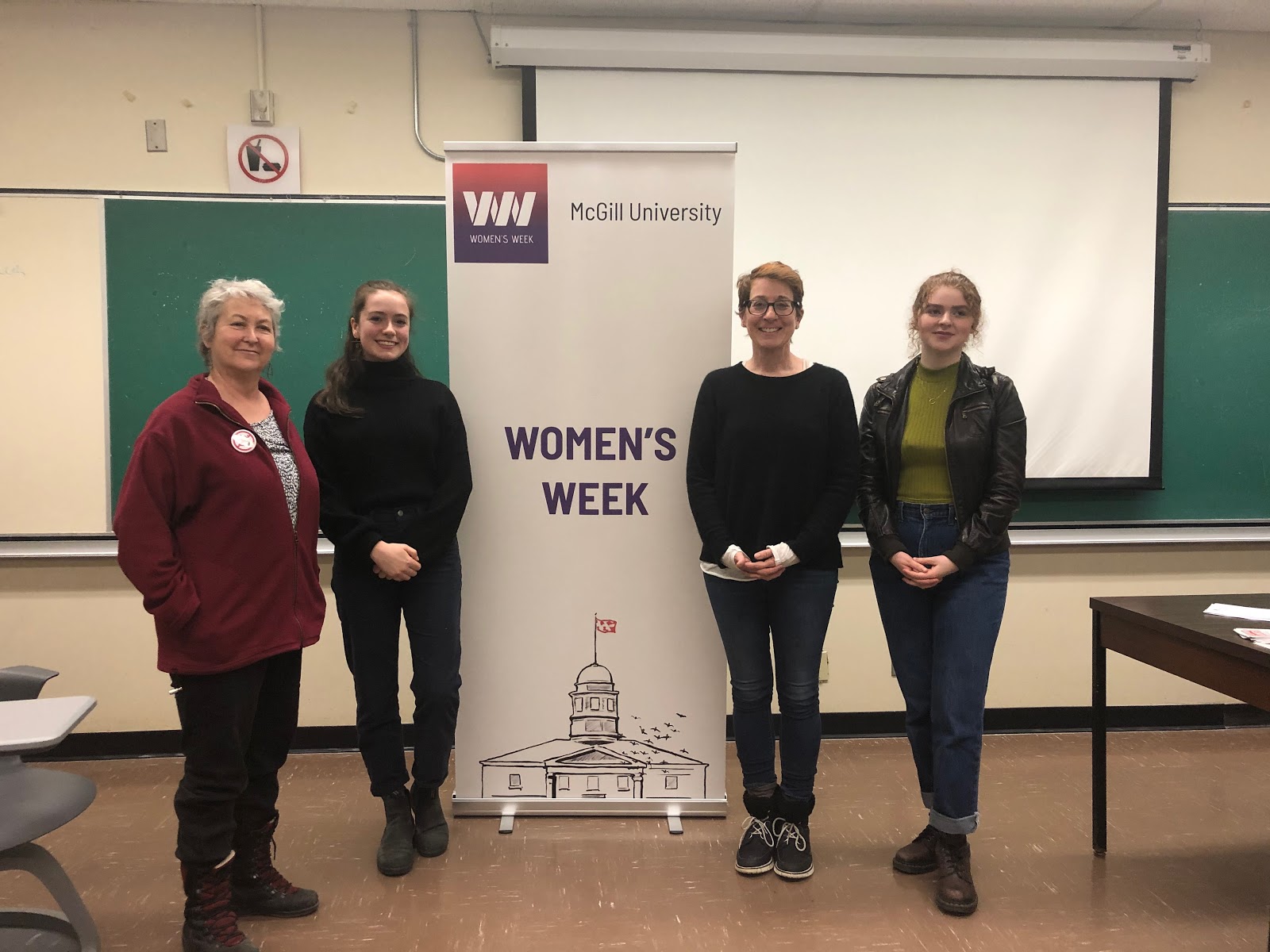
International Women’s Day on March 8 recognizes the accomplishments of women in various fields all over the world. The International Women’s Day website describes the day as an opportunity to “[celebrate] the social, economic, cultural and political achievements of women.” While all of these are important pursuits that should be celebrated, there is a strange and frustratingly common omission of the word ‘scientific’ from the list. At McGill, female scientists like Laura Pavelka, a faculty lecturer in the Department of Chemistry, are proving that International Women’s Day should not overlook the scientific endeavours and successes of women in science.

Pavelka discussed CHEM 110 and other chemistry courses she teaches, her career in academia, and how her perspective has shifted as she has transitioned from student to professor in an interview with The McGill Tribune. As a teaching professor, Pavelka focusses on communicating her courses’ materials in an exciting and informative way. 

“Definitely at McGill, we have really talented undergrads who will get bored if you are not challenging them enough, no matter how interesting you make it,” Pavelka said. “It is a line that I am constantly playing with.” 

The difficulty of a course, particularly CHEM 110, can be a foundational moment for students’ appreciation of the subject. For Pavelka, the largest classes of her undergraduate experience were the most intimidating, and she hopes to change that for her students. She remembers when professors took time to answer questions during office hours or after class and values this kind of attention for her students. She cites her passion for chemistry as a major component to her continued success as a teaching professor.

“I was not a 10-year-old who had a chemistry set,” Pavelka said. “When I got my first chance to work at a lab in my undergrad, that’s when I first fell in love with chemistry.” 

From there, it was easy for Pavelka to take the leap to graduate school. During her PhD at Western University, Pavelka met Kim Baines, her biggest professional influence and supervisor.

“She did everything,” Pavelka said. “She was one of these people who just seemed to be able to do research, family, teaching. She juggled everything seemingly effortlessly. I know that I learned so much from her during my PhD, and she just happened to be female. For me, it was like, okay, this is possible, […] you can do it all.” 

The underrepresentation of women in science, technology, engineering, and mathematics-related fields (STEM) is well documented starting at the undergraduate level. Statistics Canada published a study last year that found that, out of the undergraduate cohort of 130,000 students entering their first year in 2010, 44 per cent of first-year undergraduate students in STEM programs identify as female. Importantly, the study found that 17 per cent of women left a STEM field of study after their first year. Compared to men, women were more likely to leave earlier on, although if they did stay, they persisted in the field longer.  

During Pavelka’s PhD, only two out of the 35 faculty were women. Since then, the numbers have gotten a bit better: At McGill, Pavelka is one of 12 women in a faculty of 35. Despite her increasing accomplishments in the academic world, she did not imagine herself becoming a professor until she got a job offer at McGill, admitting that her younger self would still be surprised to see her teaching several hundred students at once. 

Taking these experiences to heart, Pavelka has advice for any young undergraduate reaching their first major hurdle. 

“Regardless of gender, your path is not going to be a straight line,” Pavelka said. “Stick with what you are doing at the time. Take opportunities as they come. Maintain some level of challenge and see where it leads you.”

Out on the Town, Student Life

District Bagel opens a second branch in the heart of the Mile End

There is nothing as satisfying as taking the first bite into warm, fresh bread. District Bagel is a bakery that aims to blend this experience with a welcoming hangout spot. With a vast menu of bagels, coffees, and other comfort foods, such as pizza, lasagna, and paninis, the place offers fresh, kosher options for all to enjoy. With the second branch of this 12-year-old bakery opening on Parc Avenue by the corner of Bernard Avenue, customers can now enjoy their meal with the scenery of the iconic Mile End neighbourhood.

“We have a very nice seating area, […] we have wifi [and] a [variety] of food to enjoy,” Samuel Itzkowitz, the general manager of the branch, said. “You can come over with friends, have a conversation, or just come to study with a view of Parc Avenue. It’s just a very cozy place.” 

The interior design of the new District Bagel location differs from other bakeries in the area in that they have a place that bears similarity to a welcoming living room. Patrons can enjoy the bakery’s goods as a complement to their break from busy life, or as a pick-me-up while they get their work done. With widely-spaced furniture and large wooden tables reminiscent of a living room, people can sit for hours in comfort and enjoy its cozy ambience.

Another reason to stop by District Bagel is the quality of their food. While the shop is not a traditional restaurant per se, they offer a wide variety of meals and other à-la-carte options that cater to a wide variety of palates, all of which are freshly made. Itzkowitz discussed the high standards that the chain upholds to deliver quality bagels.

“[The bagels are] made every day […] in the morning,” Itzkowitz said. “They’re shipped here not [lukewarm], but hot [and] are made in a brick oven. The bakers bake until one o’clock, and then […] they start making the dough for the next day.”  

The bakery serves a cornucopia of bagels, with a variety of flavours that are a must-try for those looking for a slight twist on the beloved pastry. 

“We produce kosher bagels, [and] we have all kinds,” Itzkowitz said. “We have regular, sesame, whole wheat, multi-grain, jalapeno, cinnamon, all kinds of flavours.”

Being a kosher catering business, the bakery takes these restrictions seriously. Their decision to open a branch in the heart of the Mile End reflects their desire to serve the Jewish communities of the neighbourhood. For Itzikowitz, growing up in an area of trendy restaurants in Brooklyn, as well as his experiences working with another kosher joint, was key to creating a hip and inclusive bakery-hangout spot.

“I’m from a neighbourhood called Williamsburg, [where] my grandfather actually worked in a restaurant [there],” Itzkowitz said. “Then, I got married to a girl in Montreal, so I [moved] here [and] I  worked at Deli 365 on Bernard, [which] is the second [oldest] kosher deli in Montreal.”

For Itzikowitz, the switch from working at a deli to a bakery was a no brainer.

“Kosher food [doesn’t allow us to] mix meat and dairy,” Itzikowitz said. “We are strictly a dairy place, and over [at Deli 365] they are strictly meat […. so when] I got an offer from District Bagel. […] I [knew that I] love bagels more than meat so I took it, and I’m very happy.” 

So whether you are looking for a place to hang out with friends over paninis or are finding a delicious restaurant that places a strong emphasis on kosher restrictions, District Bagel is definitely a place to try. 

Student Life, The Viewpoint

The battle for a “clean enough” apartment

Festoons of random papers and crumpled piles of clothing peppered my apartment. A precarious wasteland of dishes inhabited my sink and a whole nest of wild dust bunnies roamed about in the dark corners of my apartment. Although I was perfectly content to live in utter disorganization, I came to the realization that I could not, for the life of me, keep my apartment clean for more than two days. I cycled through a process of one giant monthly cleaning spree, but inevitably, my apartment would revert to its previous state. Over the course of a month, the place would become an unrecognizable shamble again. 

While it was time consuming to do massive cleaning purges, having a messy apartment also affected my productivity. It is more difficult to study and do homework when I have to fish around a mountain of disarrayed stuff to find a textbook or papers. Finding clothes takes longer, too. In general, I found that a disorganized apartment made me feel cluttered and stressed. It made me feel trapped. My apartment was a living, breathing ecosystem in which my mess and I coexisted. The time between cleanings became feeding periods for my mess. The more I sustained this monster, the more it grew and became harder to tame. However, I always, in the knick of time, reeled it back in before it swallowed me whole. 

I was growing weary of this terrible house pet. I thought about the popular professional organizer Marie Kondo. She implements a simple system to declutter one’s space. Individuals sort all their items into categories, starting with general characteristics such as clothing and books, then breaking those groupings into further subcategories. One by one, they take an item out in each category and see if it ‘sparks joy.’ If it does not, they thank the item for everything it has done and give it away. I decided tackling my clutter issue with her ‘KonMari method’ would not work since it seemed rather time consuming. I begrudgingly acknowledged I would easily fall prey to starting something and leaving it unfinished. I could not just pull out all of my clothes and sort through them in the middle of a semester and give up halfway.  

So instead, I divided my apartment into four main danger zones of disaster: Bathroom, dishes, floor, and clothing. I chose these four zones because they were the areas that got out of hand the quickest and had the most impact on my life when unregulated. I focussed on putting time away each day to keep these areas tidy. I did this by putting things away right after I used them. For the bathroom, I wiped down the sink and tub before I would sleep. I did the dishes at the end of the day if I didn’t have time to wash them right after I used them. I swept my floors at the end of each day, and during the weekend, I vacuumed my carpet. Finally, I resisted the urge to fling my clothing onto ‘that chair’ and instead tossed them into the hamper or folded them. It sounds very simple to take the initiative and clean little by little each day, and once I actually internalized this practice, my apartment has never deteriorated to a super messy state again. 

I can’t say I don’t l have those days when I don’t feel like cleaning, but now I keep my apartment relatively orderly. I round up the dust bunnies and guide them into my dustbin. I no longer allow skyscrapers to be built in my sink. And my papers and clothing are no longer strewn about my apartment, but instead lie in neat stacks in my dresser or desk. Plus, I get along quite well now that my housepet-sized mess is manageable. 

Student Life

Life as an 1.5 generation migrant

Everyone seems to have labels for each other, often used as a means to define every characteristic of an individual. One universal label, “immigrant”, is used to define someone who comes to live permanently in a foreign country. This categorization can follow a family years after their ancestors migrated and is often broken down into three categories: First-, second-, and third-generation immigrants. The first generation was born outside Canada and moved here as adults; the second is the Canadian-born children of the first generation; and the third is their grandchildren. However, these terms often fail to include the experiences of those who were not old enough when they moved here to be classified as first-generation immigrants nor young enough to be considered part of the second generation. An instance that shows this unique circumstance for individuals in the middle comes when they are asked the question, “Where are you from?” For those in the first-generation and the second-generation, this often refers to the country they were born in; while for those in the middle, like me, the answer is more complicated. 

To shed light on the experiences of those who migrate before or during their early teenage years, American sociologist Ruben Rumbaut coined the term ‘1.5 generation’ in the 1960s. He developed this distinction to refer to individuals like himself, who he saw as “stuck in-between” cultures as they were not quite first or second generation migrants. 1.5 generation immigrants bring with them characteristics of their country of origin while still assimilating to their new home more than their parents. These individuals have a unique perspective of migration—one that is often not recognized.  

The 1.5 generation’s early start to dramatic changes can have its benefits. For instance, facing various school systems can be a daunting experience. However, the stress of dealing with such a huge shift early on in life can prove, in the long run, to serve as an advantage for 1.5 generation children. Across the globe, many students struggle with the transition from living at home with family to university life on their own, but the 1.5 generation who have experienced drastic changes earlier in life may find themselves having an easier time adapting than their peers. Rachel Habrih, U3 Arts, described how emigrating from France to Canada as a child helped her transition to life away from home and how it further enriched her identity as a immigrant. 

“Going to university was a transition that I was very much used to,” Habrih said. “I never related to the rhetoric that university was uniquely difficult or daunting [….] The only thing that I find very different from all the other transitions I’ve experienced is that, in university, I know that there is such variety in experiences. There is always someone who can relate to you in some way.”

Although university provides a space in which students can find peers who share their experiences, this outlet does not always exist in one’s early years as an immigrant. In the first few years post-migration, these individuals may have trouble fitting into a new environment while still trying to maintain the traces of their birth country held by their parents. Dealing with this duality has its challenges, but witnessing your parent’s journey as migrants and adapting to a new culture as a family can be a rewarding experience. In understanding each other’s struggles, the process can bring a family closer together. For Juliana Schneider, U3 Arts, her background as a migrant has helped her better understand that her parents made multiple  sacrifices when they decided to move to a foreign land. 

“For my parents, the transition was much harder because they had spent their whole lives in one part of the world,”  Schneider said. “There are so many intricate details you have to learn when it comes to transitioning […] and integrating into a new culture, I can’t imagine how challenging this must have been for them.” 

Although adaptation can be easier as a child, being in the 1.5 generation does not come without its challenges. For immigrants like Habrih, integrating into a new culture, making new friends, and learning a new language can lead to feelings of separation and marginalization that can impact an individual’s overall cultural identity.   

“I think being a 1.5 generation kid, for me, means balancing multiple cultures, not just two, and oftentimes having these cultures conflict with each other,” Habrih said.

This deeper identity struggle can further present itself within the most tumultuous shifts in life, such as the transition to university where one must find a new place of belonging. They often have to determine how they relate to two groups; one being their diaspora who may be more integrated into their heritage and the other being Westernized students who may hold conflicting values and traditions. The process of overcoming this barrier is the task of the individual as they experience these moments and find a sense of belonging between their two homes. As time passes, individuals learn to balance life “in-between” by either embracing both aspects of their two homes or leaving one behind entirely. Lynn Lee, U2 Arts, learned to love her experiences as a migrant and credits it with helping to shape her overall self confidence. 

“I think being a 1.5 gen [person] has certainly contributed a lot to my identity,” Lee said. “As a kid, I hated the fact that I would say I was Korean in Canada, and then when I went to visit relatives in Korea, I was labelled the Canadian. Now, I’m a lot more comfortable with the fact that I’m both, and although a lot of other things make up someone’s identity, to me these dual experiences are very important.” 

Despite the extra challenges with the often constant tug-of-war between the two cultures, the 1.5 generation has the unique benefit of seeing the dynamics of both first and second generation cultural norms firsthand. This experience allows them to navigate cultural fluidity through learning to embrace both their old and new heritage. Schneider observed that these differing perspectives from her 1.5 generation status helped when meeting new people. 

“It’s amazing to be able to connect with other people not only through different languages, but you also know and understand the mentalities of different cultures,” Schneider said. 

For many, the adaptation of the term “1.5 generation” has helped them find their identity as an immigrant. Learning this term has helped me comprehend my place as a migrant in this unspoken middle ground. The experience of my sister and me seemed insignificant in comparison to our parents, and it seemed unfair to place ourselves in the same categories as them. Having a distinction of my own helps to put my story growing up in a foreign land into perspective and understand that I am not alone with my journey as a young immigrant. The 1.5 generation is often overlooked, but in reality, we have a lot to offer as our stories demonstrate perseverance, adaptability, and an ability to overcome challenges while embracing new experiences. So, when I am asked, “Where are you from?”; I know it means where my home is. As a 1.5 generation migrant, home is not necessarily one place and coming upon this realization about this core aspect of myself is liberating.

Sports

10 things: The best nicknames in sports history

A March 4 Jeopardy contestant hilariously, and incorrectly, guessed that the nickname of Philadelphia 76ers All-Star Joel Embiid was “Do a 180.” In honour of this mixup, The McGill Tribune sports section compiled a list of some of our favourite sports nicknames of all time.


Shaquille O’Neal: The Big ____

It is challenging to think of an athlete with more nicknames than Shaquille O’Neal, known universally as ‘Shaq.’ The NBA centre, widely considered one of the most dominant players of all time, was a nickname goldmine. The floodgates opened when a young Shaq told reporters to call him “The Big Aristotle” in reference to the Greek philosopher’s belief that excellence was a habit. Next came “The Big Deporter,” after two players retired to Europe following defeats by Shaq in the 2000 playoffs. “The Big Felon” came to Shaq after a game-sealing steal against his former team, the Orlando Magic. And of course, he dubbed himself both “The Big Cactus” and “The Big Agave” upon joining the Phoenix Suns in 2008. At his peak, Shaq declared he was the MDE (Most Dominant Ever), which is still up for debate. But, he does stand head and shoulders above the rest as the most prolific nicknamer in sports history.

Maurice and Henri Richard: The Rocket and The Pocket Rocket

Quebecers and Montreal Canadiens Maurice “Rocket” and Henri “Pocket Rocket” Richard are two of the most legendary brothers in NHL history. The Rocket’s speed earned him his nickname in 1939, and the Pocket Rocket, three inches shorter, got his nickname when he entered the league 16 years later. Henri holds the record for most Stanley Cup wins by a player with 11 titles, five of which he won with his brother. The Maurice “Rocket” Richard Trophy, awarded to the NHL’s regular season top goal scorer, bears the name of the Montreal native. Maurice died in 2000 and Henri passed away days ago on March 6, 2020, but the Rocket and Pocket Rocket will be revered by the hockey world for a long, long time.

Florence Griffith-Joyner: Flo-Jo

American sprinter Florence Griffith-Joyner, commonly referred to as “Flo-Jo,” still holds the 100 and 200 metre world records that she set in 1988. Joyner also holds the second- and third-fastest times for the 100 metre and the second fastest time in the 200 metre. While her records may be shrouded in suspicion of drug use, there is nothing mysterious about how cool her nickname and personal style were. Known for racing in flamboyant outfits, featuring everything from a one-legged suit to long and colourful nails, Flo-Jo’s status as a household name was well-deserved. There is no question: Flo-Jo and her name remain iconic. 

Early 1900s baseball players

Baseball players of the first half of the 20th century almost always had fun nicknames. From catcher Charles “Gabby” Hartnett—ironically nicknamed for his quiet nature, and also later “Old Tomato Face” for his aging complexion––to his contemporaries like utilityman Socks Seybold, the early 20th century was a great time for nicknames in baseball. Pitchers Cannonball Titcomb and Pop-boy Smith, as well as the aptly named third baseman Home Run Baker were classics too. A childhood friend nicknamed shortstop Rabbit Maranville for his bouncy nature. Pitchers Mysterious Walker and Slim Love threw a handful of innings for their teams over the years. Even Shakespeare had his influence: Pitcher Charles Lear became forever known as King Lear.

Wayne Gretzky: The Great One

A hockey legend and Canadian hero, Wayne Gretzky earned his title of “The Great One” from a local newspaper when he scored 400 goals at just 10 years old. Gretzky is widely considered to be the greatest hockey player of all time: At just 19, he became the youngest player to score 50 goals in a single NHL season, and he remains the NHL’s all-time leading goal scorer 20 years after his retirement. To list all of Gretzky’s records and accomplishments is a futile endeavour, but ask any Canadian, and they will confirm that “The Great One” is an epithet that he is certainly worthy of. 

Alex Morgan: Baby Horse 

In the early 2010s, Alex Morgan was one of the youngest members of the American women’s soccer team which explains the “Baby” part of “Baby Horse.” The second half of the nickname, so the story goes, is a reference to her long, gallop-like strides as she makes the runs that have distinguished her as one of the best offensive players in women’s soccer. A 15-second video posted to the US Soccer YouTube channel in 2011 shows Morgan feeding what appears to be grass to a small horse. When athletes lean into their nicknames they cement those names, and themselves, as true classics in both the sporting and nicknaming worlds. 

Fitz Hall: One Size 

Fitz Hall’s career in the English Premier League was not particularly illustrious, with no big awards or championships to boast of. But what Hall lacks in sporting glory he makes up for with one of the greatest nicknames the soccer world has ever known: One Size Fitz Hall. The nickname is fairly self-explanatory; it doesn’t require background information about Hall, his life, or his soccer career. Hall is, in fact, better known for his nickname than his soccer, and that is the sign of a truly great moniker. 

Earvin Johnson: Magic

For many casual sports fans, the name Earvin Johnson may not carry any meaning. But this was the name of a Los Angeles Lakers great long before he won five NBA championships and three MVP awards for the purple and gold. As a 15-year-old athlete at Everett High School in Lansing, Michigan, Johnson earned the nickname “Magic” from a sports reporter after he carried his team to a 30-point victory over the league’s presumptive favourite. Johnson tallied an astounding 38 points, 20 rebounds, and 19 assists in that game. The nickname brilliantly captured all that made Magic who he was: A beaming smile, jovial personality, and, above all else, unparalleled passing ability. The nickname stuck, following Johnson to the NBA and effectively supplanting the name “Earvin” for all time. 

René Lacoste: The Crocodile 

For the past century, Lacoste has sponsored an impressive roster of tennis players from around the world. The brand’s namesake, seven-time Grand Slam champion and world number one René Lacoste, was known as “The Crocodile.”  The name originated from a 1927 bet where Lacoste requested the alligator skin prize suitcase from the French Captain of the Davis Cup if he won. Once victorious, he was dubbed “The Alligator” by the American press and was later embraced as Le Crocodile by French fans back home. Lacoste then had a logo of the reptile embroidered on his blazer. Tennis whites were once restrictive, but The Crocodile changed the tennis uniform forever.

Gabby Douglas: The Flying Squirrel

Gabby Douglas was only 17-years-old when she won the All-Around Olympic gold medal at the 2012 games. The only member of Team USA to compete in all four disciplines of artistic gymnastics, Douglas also won a gold medal for uneven bars. The incredible height Douglas reached on the jumps of this routine earned her the nickname the “Flying Squirrel.” Additionally, her five-member US squad was given a nickname of its own: The “Fierce Five.” Team USA won the team gold medal, making Douglas the first US gymnast to ever win both individual and team events at the same Olympics. Douglas kept flying, helping Team USA repeat victory at the 2016 games. 

McGill, News

Bar des Arts faces persistent administrative roadblocks in re-opening attempts

While construction projects across campus have disrupted the activities and plans of student clubs and associations, the Arts Undergraduate Society’s (AUS) Arts Lounge, home of the Bar des Arts (BdA), has been hit particularly hard. Normally McGill’s busiest student bar, BdA has been forced out of its space in the Leacock basement since Summer 2019. Only the bar’s glowing neon sign remains by the entrance.

BdA and AUS executives were originally informed by the administration that the space would be closed for renovations during the summer of 2019. But, according to BdA publicity manager Grace Jumbo who peeked over construction placards, work had barely been started by late Aug. 2019. Six months later, in Feb. 2020, photos suggest that visible progress was yet to be made.

BdA and AUS executives spent months attempting to cooperate with the McGill administration in finding alternative sites for the Arts Lounge, but these efforts have proven futile. As a result, by mid-February, BdA executives resolved to send an open letter to the McGill administration expressing their frustration and demanding action.

“Despite attempting to work with the McGill administration to resolve this issue, consult on alternative options, or simply inquire about the work being done in the Arts Lounge and its tentative timeline, we have continuously been met with dead ends and reluctance to find alternative venues,” the letter stated. 

 The letter garnered over 800 signatures from students across several faculties. Within a week of sending the letter, Deputy Provost of Student Life & Learning (DPSLL) Fabrice Labeau met with AUS executives, guaranteeing a construction end date of April 30 for the Arts Lounge.

AUS VP Social Affairs Kim Yang noted that the open letter served only as a last resort to express frustration regarding the administration’s lack of transparency.

“[We were] really trying to get as many resources and as many answers as possible,” Yang said. “And the problem is that we were just not getting any answers from the McGill administration.”

In an email to The McGill Tribune, Labeau described the ongoing construction in Leacock.

“The overall project includes renovation to the structure of the building due to water damages and degradation of concrete and rebar that have occurred over time,” Labeau wrote. “These damages were advanced, and if left unattended could endanger the integrity of the building. In some places, including in the Arts lounge, the underlying structure within the reinforced concrete had begun to show through and was rusting.”

BdA co-chair Ethan Casey expressed exasperation towards the administration. According to Casey, McGill provided vague updates about the state of the construction and only informed the BdA staff about electrical wiring work.

 Despite the administration asserting that the construction project in Leacock has been proceeding on schedule, photos taken by BdA executives between Oct. 2019 and Feb. 2020 suggest that little work has been completed. Yang believes that this apparent lack of advancement is due to the nature of the construction process. 

 “[The construction company doesn’t] really care about the order things are done, as long as all projects are completed by [a certain] deadline,” Yang said. “When we realized that, we went back to the school and [noted] that in that case, it’s very obvious that the Arts Lounge in Leacock is near the bottom of that list.”

Jumbo claimed that the administration gave limited information about the status of the Arts Lounge or of its priorities.

“[There was a lack of] transparency [from the administration],” Jumbo said. “We have no idea what the construction even is or when it’s going to end.”

 Yang shared the discontent of the BdA team, claiming that different people involved with the construction project gave inconsistent explanations for the delays in the Arts Lounge.

“I don’t know who’s lying and who’s not, because I’ve heard one story from the Leacock building porter, another story from the head of construction, another story from the DPSLL, and [finally] another story from the Dean [of Arts],” Yang said. “It’s just all over the place. It just seems like everyone was saying ‘The construction is going to be done now, the construction is going to affect all these areas.’ [But] when you use your actual eyes to go and look, for one, construction is obviously not done and two, there is no construction.”

As a result of the sluggish rennovation pace in Leacock, the BdA executives proposed multiple alternatives to the administration for the temporary relocation of the Arts Lounge. The options supported by McGill, however, were consistently problematic. One proposal recommended that the AUS rent out space in La Citadelle residence, which would have been impossible since the BdA is a non-profit student organization. Another alternative involved moving into the McConnell Engineering building—where the BdA hosted one event in Oct. 2019—but the building’s location outside of the Faculty of Arts created administrative problems with the Engineering Undergraduate Society (EUS). The most feasible option of relocating the BdA to the Faculty of Arts’ Ferrier building became implausible after the administration offered the use of a computer lab, where expensive electronics would be at risk of damage.

Associate Dean (Academic) of Arts Michael Fronda, who worked with the BdA executives on relocating the Arts Lounge, claims spatial constraints limited the administration to a smattering of imperfect options.

“To move the student lounge into the AUS computer lab was not ideal, [but] it was the best we could do [although] that compromises the computer lab and […] the space in the lab,” Fronda said.

Fronda believes that the struggle to find a space for BdA is symptomatic of a broader problem which are disruptions from campus construction projects.

“I share the [AUS’s] frustration,” Fronda said. “The reality is that we are in a serious space crisis […] across all faculties. We are short of classrooms, of offices for instructors [and] support staff, [and] of rooms or spaces for students [.…] Arts is being particularly hit hard right now.”

Labeau explained that relocating spaces such as the Arts Lounge poses its own set of challenges.

“One of the spaces that [is] the most difficult to find [is] a replacement for the Arts Lounge,” Labeau wrote. “This type of space, open space that can be used for social events, is among the rarest on campus.”

Yang, however, believes that the administration lacked consistency and initiative in addressing the problem.

“The administration [would say] one thing, and then a few months later when we actually [went] back and [showed] interest in learning more, they [would say] ‘No, actually this is not happening,’” Yang said.

The extended closure of the BdA has prompted AUS executives to wonder why the administration has not been more proactive in re-opening McGill’s most popular student bar. BdA co-chair Mercedes Labels thinks the reason is simple.

“We obviously [ran] a bar in Leacock every Thursday,” Labels said. “I guess it’s a lot easier for them to just be content with the fact that there is no bar [which] makes their life easier. They don’t have to worry [about] any problems that could result.”

BdA employees and AUS executives believe that the administration did not understand the full impact of the Arts Lounge closure on the student population. Casey hopes that BdA remains a staple of student life for years to come, despite this year’s setbacks.

“Even if it doesn’t happen this year, we can get the AUS lounge back for next year,” Casey said. “Our main goal now is for it to never die. We don’t want it to be forgotten.”

Off the Board, Opinion

Learning to dim my brightness

Little dots flicker in and out of my sight. Pixels form a half moon of undulating zigzags in the corner of my vision. My fingers start to feel thick and tingly. A light throb begins in the right side of my forehead. My senses are heightened. I know this feeling all too well: It is yet another migraine. 

 Having a headache and popping an Advil or two in the library is becoming increasingly normalized, even glamorized, by the ‘busy culture’ pervasive at universities. Taking pain killers, however, is only one of the measures I use, as a chronic migraineur, to make the pulsing in my head stop. Making me temporarily unable to engage in daily tasks, migraines force me to take a few hours of the day off to lie down in a dark room, something that is not always practical with my endless to-do list. At the same time, they serve as a positive reminder to pace myself from time to time. 

Migraines are recognized by the World Health Organization (WHO) as a primary headache disorder, yet the word gets thrown around, overlooking the trauma of experiencing these disabling episodes. Furthermore, despite having been recognized as a disorder, it is very difficult to get a doctor’s note for a migraine and be excused from assignments and deadlines, as they show no exterior symptoms and there is little societal recognition for their debilitating effects. 

Migraines occur in my head, but they affect my entire body. They make me think I’m losing my mind and even my sight. At times, they’ve made me feel like I’m hungover or high. When I experience a migraine, it feels like the right-side of my forehead is being attacked from the inside, impairing my ability to fully function. However, from the outside, I just look lost in my thoughts or dazed. 

The fact that migraines are invisible is why they felt so scary and isolating to me when I first started having them at the onset of puberty. They were a lot more intense back then, but experiencing them as a young adult is no less isolating. Having to remove myself from social situations, when I was enjoying myself only minutes earlier, is never fun. 

There is no convenient time to get a migraine, but they always seem to show up when I least want them to. I have been stuck with a migraine at inopportune times, including in the middle of a midterm; while walking on Saint-Laurent at night; at dinner with family and friends; while at a coffee shop studying; the day before an exam; and while watching a movie on my laptop. 

Yet, over the last eight years, I’ve learned to cope with my migraines and the unique pixel filter they place over my vision a few times per month. I’ve also started to relate to them differently, seeing them more as a symptom of my lifestyle, than a problem, per se. My migraines don’t occur in a vacuum. They usually paralyze my overstimulated brain after having had little sleep for a couple of nights and having stared at a screen for more hours than recommended, usually in preparation for a midterm or after writing a research paper.

 It is very difficult in this digital age not to have my migraines triggered when a friend shows me a meme on their extremely bright phone, when my professor turns off all the lights without warning to show us a video, or when the sunrays hit my computer screen and reflect into my eyes, but I have learned to appreciate migraines as a somewhat welcome break from my busy life as a McGill student. 

 While I rarely experience migraines at opportune times in my day or schedule, living with them has taught me to slow down, even if it means dimming my own brightness once in a while so I can recharge and delay the next episode as much as possible.


Features

(Re)claiming our space

McGill is known for having a large community of international students and frequently cites this fact as a badge of diversity and inclusivity. However, for many, McGill can be an isolating environment. Students of colour, immigrants, and marginalized identities are still forced to bear the burden of building infrastructures of safety on campus, or find it elsewhere, all while risking tokenization by their white peers.

Read the latest issue

Read the latest issue