

Latest News

Arts & Entertainment, Books

Finding the right place to read

A university lecture or a book club: By way of discussion, both bring the personal act of reading into an academic or social realm. However, these cultural spaces don’t necessarily motivate the same types of discussion. Barring other factors, like contextual formality or accessibility, an individual moves through these spaces carrying their own reading habits. In having to tailor their individual practices to a group setting, the question remains as to how a given setting influences the reader, and whether or not the reader feels satisfied by its literary provisions.

From a young age, Emily Matuska, U1 Arts, has always loved reading, and she came to McGill to pursue her passion.

“I’m just drawn to the ethereal beauty of language,” Matuska said. “Genuinely, as an art form, I think [that] I resonated with words and language more than anything else.”

Studying English literature at McGill, however, has so far been a double-edged sword for her. On the one hand, Matuska cherishes her classroom for situating her with like-minded students, all as eager to engage in thoughtful discussions about novels and poetry as she is. On the other hand, Matuska notes that the rigour of McGill’s academic atmosphere has demanded most of her readerly attention, often in ways opposite to how she engages with literature in her personal reading life. 

“There is a really huge focus on, ‘Why do you study literature, why is it important, why is it useful for society, how has it affected the world around you?’” Matuska said. “But that doesn’t have much bearing on why I would want to study literature. For me, and I think, for a lot of other literature students, you read because you love to read. […] I kind of get a little fed up with the emphasis [on] making it so didactic.”

In Matuska’s eyes, ascribing value to a text by virtue of its association to scholarly theories and traditions sterilizes literature as an artform. She worries that university, in part, depersonalizes the act of reading; in the classroom, discussions often weigh the importance of a text based on its impact in the canon, not by its capacity to deeply connect with someone, even if only on a personal level. 

Nevertheless, Matuska acknowledged that the serious study of literature requires concentrated discussions on canonized texts. This is especially the case at McGill, which has a highly traditional curriculum.

“You know [that] you miss things [when] just sticking to the canon but then you have to ask, how do you study time periods of literature if you don’t have a canon? How do you gain a certain knowledge of a vast expanse of time?” Matuska said. “I don’t think you really can.”

For those readers who seek community and intellectual stimulation outside of the classroom, the question remains as to where readers can find more diverse, informal spaces to share their love of literature. Librairie Drawn & Quarterly (D+Q), a staple of independent bookstores in Montreal since 2008, provides a possible solution to academic stiffling. 

Though the concept of a book club is certainly not exclusive to Librairie D+Q, the bookstore is unique to Montreal because of its sustained commitment to engaging communal literacy. Every month, in addition to author talks and book launches, Librairie D+Q hosts several different public book clubs in the Mile End. With clubs focusing on Indigeneous literature, science fiction, graphic novels, and children’s literature—among many others—each one highlights a diverse selection of contemporary authors across multiple media and genres. 

For Luke Langille, Librairie D+Q’s manager, the bookstore’s strengths come from its hybrid status, both in terms of the cohort of readers it draws in, and of the types of discussions it promotes. 

“The way I like to make my pitch […] to members of the public who have yet come to one of our book clubs is that it’s pretty laid back as an environment,” Langille said. “But it’s also somewhat similar to a studious discussion because of the fact that we have so many smart people who show up and talk about books. It’s really lively and informative. It’s stimulating enough […] but definitely a departure from an academic setting.”

While students do attend the book discussions, D+Q’s accessibility welcomes readers of all walks of life. Without the pressures of specific schools of thought for discussions to adhere to, the book club mediates conversations where opinions stem from personal insights in as much as they do academic ones. Without an evaluative or formal spirit, anecdotes related to the text’s plot bring as much to the conversation as comments about its creative use of form. What often motivates a lively discussion at D+Q, is therefore, a text’s relevance to the lives of the readers discussing it. That a reader can choose which books to read—thus curating their own syllabus for discussion—only adds to the possibility for genuine connection to a text, which often leads to impassioned discussion.

What book clubs have to contend with, and what universities tend to avoid, is the overriding conception that the most productive book discussions occur only within dedicated academic contexts. Taken to an extreme, value judgments about a reader’s connection to a text, improperly assumed based on the context in which they read that text, create a hierarchy of literacy. The notion of “proper reading” dismisses anything that doesn’t align with an institutionally established version of literacy as inferior. It renders the fundamentally democratic act of reading insulated, reserved for an imagined elite. 

Still, many educators recognize the value of less traditional forms of analysis. In an interview with //The McGill Tribune//, Professor Alexander Manshel, who teaches 20th Century and Contemporary American Literature at McGill, spoke about why the segmentation of reading is a fallacy. Invested readers hold an inherent bias to quality, no matter what they read. Rather than a ladder on which different types of readers or genres can be ranked, Manshel contended that all readers generally seek to be rewarded for the attention they devote to a text. 

“Whether you study the pinnacle of a canon […] or you study pulp fiction and best-sellers, both of which you can do in a classroom, close reading undergirds both of those practices,” Manshel said. “But I don’t think the university, while it does emphasize close reading, has a monopoly on close reading. […] It may not sound the same, it may not use the same terms, but close attention to detail is something that committed readers, whether inside the university or outside, employ in different ways.”

Different contexts value different kinds of reading, but that does not need to be seen as limiting to a reader’s connection with a text. It is inevitable that different contexts will stress different priorities as regards literature. Though the way in which discussions manifest may differ from place to place, close readerly attention—across all genres and contexts—will always deepen a reader’s connection with that text. The variety of contexts and genres that a reader will encounter, and the variety of discussions to participate in, are ultimately differences to be treasured.

Off the Board, Opinion

Reflecting on my “Mamma Mia” Years

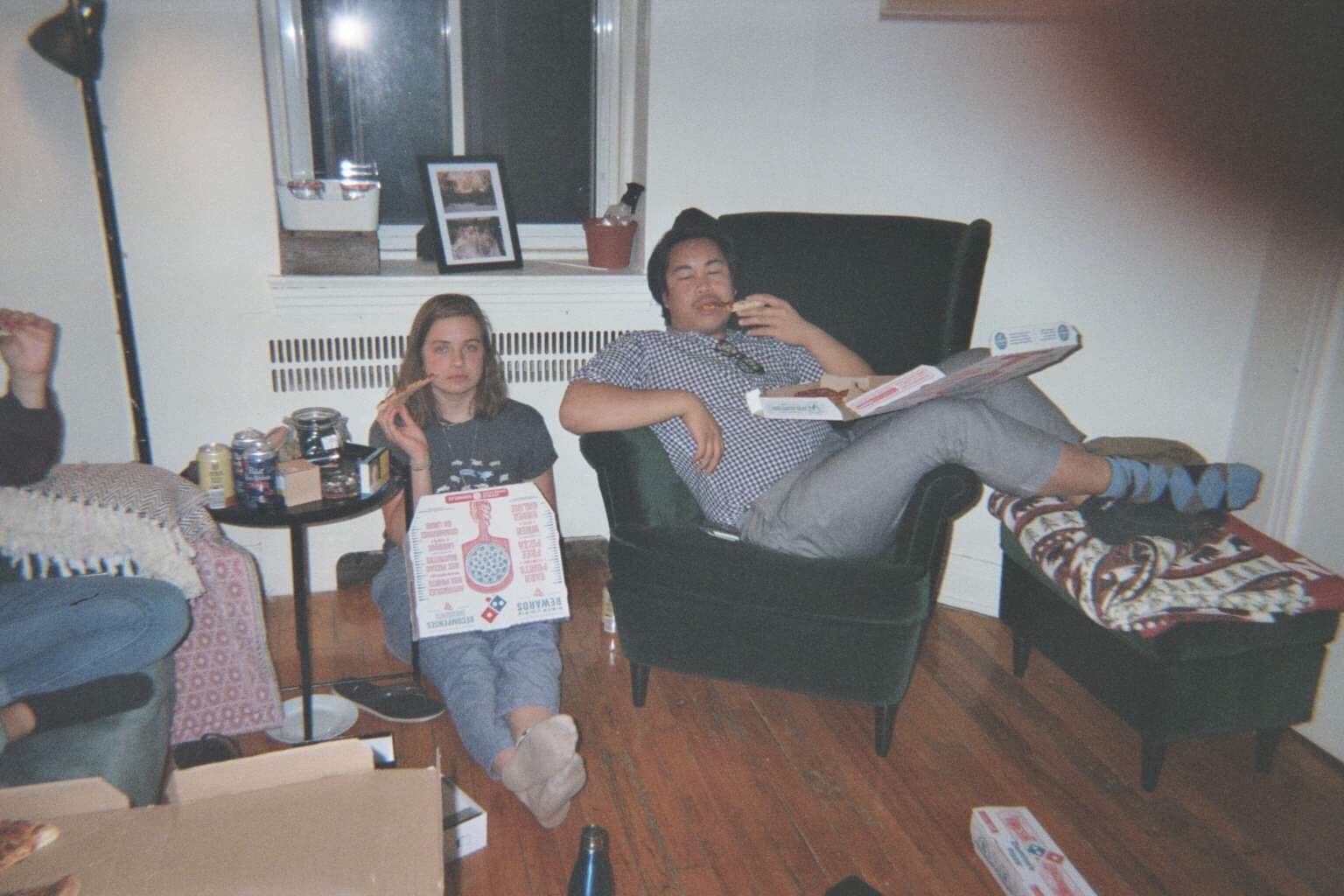
I grew up hearing that university would be the best years of my life, where I would figure everything out. I would come out the other end with a better understanding of myself and the world, and after graduating, my friends and I would look back on these years fondly. Now, in my final semester at McGill, I am realizing that while my university experience has not always been smooth sailing, this may well be the time of my life so far.  My time in university is not done yet, but I already find myself missing it. 

Nostalgia is odd: I can’t really find another word to describe the bittersweetness of reminiscing over good memories. Nostalgia for the present, for something that is not finished yet, is even stranger. There is something unsettling about being acutely aware of the fact that the present moment is temporary, making it both beautiful and heartbreaking. I know that I will, in all likelihood, never again have as much freedom as I do now. The ability to work different jobs throughout the year, to take any of the classes I want, and to crash on my friend’s couch when I accidentally stay past the last metro’s run will not last forever. 

A good friend of mine coined the term “Mamma Mia years” to describe this chapter of our lives. Although it started out as a joking reference to the young and carefree attitudes of the characters in the 2018 movie Mamma Mia 2: Here We Go Again, I have come to find that the term perfectly encapsulates how I feel about my time at university. It is easy to mock––and I do––the naïveté that comes with being 20-years-old. We devote hours and hours each week to activities like improv theatre and hackathons. Though they may one day seem inconsequential, there is also something special about the genuine thrill of watching your friends do everything from performing in an adaptation of Medea, to organizing campus labour unions, and climate protests, and knowing that, right now, at 21 years old, all of these things do matter immensely. It is the people that I have surrounded myself with, and the opportunity to see them grow and prosper, that will make this part of my life so hard to leave behind. 

I have done my best to experience the past three years as they happened, but I still find myself obsessing over remembering every detail of a night spent at a birthday party or summer walks up Mont Royal. Pages upon pages of journal entries detail the exact chronological order of events from nights spent watching movies and playing Jenga with people I may never again see after graduation. The awareness of the temporary nature of young adulthood has made me both more appreciative of all of the joyful moments, and more anxious about the change that comes with next steps. I don’t know if I will ever find a resolution to this duality, but I am also learning that maybe it does not need to be resolved. Nostalgia for the present can give an experience an extra layer of significance that I have come to appreciate. 

“The awareness of the temporary nature of young adulthood has made me both more appreciative of all of the joyful moments, and more anxious about the change that comes with next steps.”

With all of this in mind, it is important to remember that my own university experiences, as well as those of many other students, have not always been easy. McGill makes seeking and receiving mental health care difficult and inaccessible, balancing jobs and school is a reality for plenty of us, and institutional barriers to accommodations are something that many marginalized students have to navigate their way around. I believe my “Mamma Mia years” have been in spite of the university, not because of it. 

I have accepted that this may be as good as it gets, but that doesn’t necessarily bother me anymore. I know that the next chapter of my life can still bring me joy, even with the inevitable changes. 

“Standing clearly at the crossroads, no desire to run. There’s no hurry anymore, when all is said and done.” —Andersson, Ulvaeus.


Arts & Entertainment, Music

Where do I begin?: Vaporwave

Sounds and images from the era of Windows 95 and peak mall culture manipulated to a degree that is both recognizable of its past roots yet remarkably separate from its source material; this is the spirit of the internet-born subculture, vaporwave.  The aesthetics of vaporwave revolve mainly around the popular technologies and media from the late 70s to the early 00s. The genre allows for an anti-consumerist or a nostalgic interpretation of its music through its distortion, which makes it worth a listen. Here are some albums from four subgenres of vaporwave that capture different aspects of their ‘aesthetic.’

Greek Busts and Dolphins  – Classic Vaporwave

Floral Shoppe – Macintosh Plus (2011), Chuck Person – Eccojams Vol. 1 (2010)

Eccojams Vol. 1 (2010) by Chuck Person (a pseudonym of American experimental musician Daniel Lopatin) is allegedly the first vaporwave album. The ‘ecco’ is a double entendre on two aspects of the album that play a defining role in the vaporwave aesthetic: The echo effect that comes from the glitching of 80s mainstream pop songs, and the use of “Ecco the Dolphin,” a video game character from the 90s, who is featured in the album’s surrealist cover art. 

 Eccojams became a major influence for 2011’s  Floral Shoppe  by Macintosh Plus, the alias of American music producer Ramona Xavier. This album would eventually popularize vaporwave, with the track “Lisa Frank 420 / Modern Computing,” becoming arguably the most well-known song of the genre. Chuck Person is not completely forgotten in this iconic album with Xavier including the song, ‘Chill Divin’ with ECCO’, an homage to Eccojams and the aforementioned dolphin. 

Sailor Moon and Japanese Pop – Future funk

MACROSS 82-99 – SAILORWAVE (2013)

Future funk is the most accessible strain of vaporwave. With heavy influences from 80s Japanese city pop, future funk follows the vaporwave’s nostalgic aesthetic and critique of consumerism from material derided as cheesy and commercial in its time. 2013’s Sailorwave by Macross 82-99, a pseudonym for a Mexican producer known only by their first name, ‘Gerald,’ is a staple of the subgenre, with tracks filled with catchy melodies at a high tempo. Furthermore, the title Sailorwave references the iconic anime character Sailor Moon, emphasizing vaporwave’s fixation of the era. 

Department Stores and Food Courts – Mall Soft

Cat System Corp – Palm Mall (2014), North Shore Memory Gardens – The Orchards (2019)

Focussing on the mall as a defining symbol of consumerism emblematic of the past, mall soft contrasts the energetic nature of future funk. The most well-known album from this subgenre is 2014’s Palm Mall by Dutch vaporwave producer Jornt Elzinga under the alias Cat System Corp. The main piece is its opening 22-minute track, ‘Palm Mall’, which simulates a walk through a mall complete with samples of announcements from department stores and faint conversations to emulate passersby. A more recent addition is The Orchards by North Shore Memory Gardens. The Orchards also samples sound elements of a mall, such as arcade noises and people talking, but forgoes simulation for a more casual electronic and jazz sound; this distances it from the ‘background music’ feel found within Palm Mall

Commercials and Weather Channels  – Signalwave / Broken Transmission

New Dreams Unlimited – Fuji Grid TV EX (2011), Blizzard 96 – Blizzard 96 (2019)

Probably one of the most abstract subgenres of vaporwave, Broken Transmission is characterized by the splicing of random and often contrasting samples from retro television—breaking each other’s ‘transmission’—to create the sound that comes from flipping through channels on a television. The hallmark album of this subgenre is Fuji Grid TV EX from 2011, a project by pioneering producer Ramona Xavier under the pseudonym New Dreams Unlimited. Xavier leans into the anti-consumerist philosophy through the album’s heavy use of jarring and haunting distortion of ad tunes that are continuously spliced together. The final product emulates the feeling of an uninterrupted bombardment of commercials. Another approach to Broken Transmission is Blizzard 96’s self-titled project released last year. This album slows down and distorts recordings from the Weather Channel during a monumental blizzard that affected the Northeast in January 1996. As explained in the artist’s bandcamp, this album represents a special childhood memory that can be captured as nostalgia through the distortions of vaporwave.

Out on the Town, Student Life

Café Bloc reaches a new peak of climbing and coffee

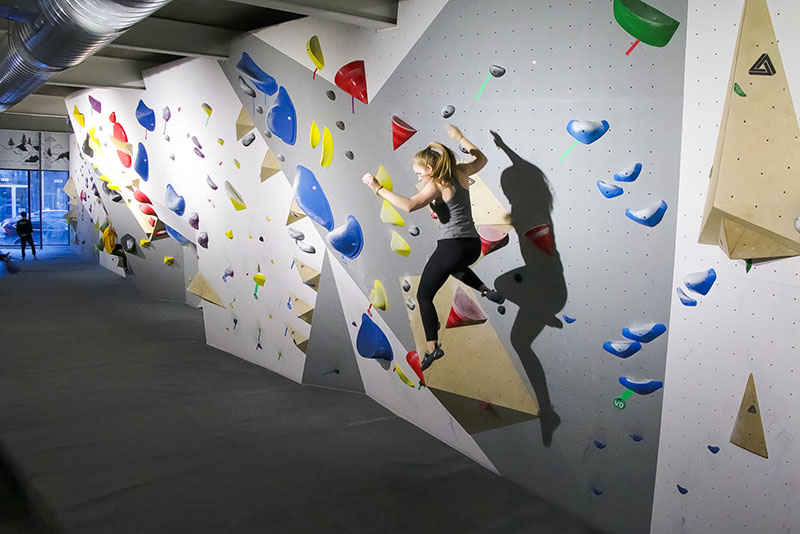
Café Bloc opened its doors on Feb. 11, bringing together the warmth and sociability of a café with the fun and creative exercise of a climbing hall. Located at 1209-1211 Boul. Saint-Laurent, this unique space was the brainchild of co-founders Sébastien Aubé and Jean-François Gravel, whose new business has been met with a favourable reception from the local community.

“We feel very grateful [that] we have [received] so many nice comments from our friends, family, and climbers from other gyms,” Aubé said. “Everyone has said […] that the location is nice, the gym is pretty, […that] they love the coffee, [that] they love the food, [and that] the staff are very nice.”

The founders made sure to focus on not only the rock climbing aspect of their business, but also on creating a positive atmosphere and experience for customers.

“I like our vibe,” Aubé said. “We put a lot [into] creating a space where people wouldn’t just climb and leave.”

Having only been open for two weeks, Aubé believes that their goal for the space is being realized.

“So far, it’s really succeeded because I see some people here that stay longer than my staff,” Aubé said. “They arrive at eight or nine in the morning […] they climb, [they] get a coffee and work, they go back to a bit of climbing, they eat, they chill, they go for a sauna. It’s just really nice.”

For Aubé, starting a space for rock climbing allows him to invest more into his personal interest.

“We were very excited with […] the lifestyle of owning a [climbing] gym,” Aubé said. “Our biggest passion [is] climbing, so it’s just so exciting to come in the gym, have a coffee, [see] some friends, talk about climbing, show them around. […] It’s just really fun.”

As long-time rock climbing enthusiasts, the two founders used their experience in climbing to influence the design of their new business.

“I’ve been climbing myself for around 10 years, and [Gravel] for around 15 [years]. It’s our biggest passion,” Aubé said. “We wanted to have some […] good quality climbing, because we wanted to have the place of our dreams.”

Café Bloc is not only a climbing gym for experienced climbers, it’s also welcoming to newcomers to the activity. 

“There’s a lot of beginners and new climbers, [the space] is very [beginner] friendly here,” Aubé said. “[And] even if you’re very [experienced], there’s some nice stuff for you here [too].”

Only a short walk from the Saint-Laurent metro station, the downtown location of the climbing hall is an important part of making this gym accessible during the day.

 “We’re […] close by, so people who study in the universities nearby or work downtown [. . .] can [travel] one metro station or walk, and they can get to our gym, so it’s very accessible,” Aubé said.

The climbing gym itself took around six months to build, but more construction lies ahead for Café Bloc. The owners plan to develop the terrace space on the roof of the building in order to be used during the warmer months.

“As soon as the snow melts, we want to start right away with the construction of the terrasse to have it [ready] as soon as it’s sunny outside,” Aubé said. “We are going to have a 30 or 40 foot wall outside. It’s going to be sick.”

This space provides students, new or experienced, with the opportunity to try a unique activity and become a part of a budding community of rock climbers within the city.

“I think that if they would like to experience a new community that’s very enthusiastic and motivating and [if] they like to practice a new exercise, you should definitely come and give it a go,” Aubé said.

Student Life

Prepping for meal prep

Amidst all of the assignments and midterms, students don’t always have the time—or energy—to put together satisfying, homemade meals. Meal prep, however makes cooking quick and easy with the benefits of being a cheaper and more environmentally-friendly option than buying food on or around campus for lunch every day. Furthermore, preparing simple meals for weekly lunches offers students the opportunity to gain confidence in the kitchen while also engaging in a non-academic yet productive task. Here are a few basics to get into the healthy habit of meal prepping.

Pots, pans, and perseverance

A lot of meal prep recipes online require the use of equipment, like a slow cooker or a food processor, that aren’t items found in a typical student’s kitchen. Such equipment is unnecessary: A pot, a pan, a bowl, a cutting board, some knives, and a good attitude are totally sufficient. Even for adventurous meal prep endeavours like roasted chicken or meatballs, just add a cheap sheet pan to your pantry.   

Veggie tales

Vegetables are an important part of our daily nutrition, but getting the right amount, or even eating any at all can seem difficult. In reality, many vegetables are easy to prepare. Some, like carrots and bell peppers, need no cooking, just slicing and packing, while other vegetables like broccoli and asparagus only require some boiling. They can be flavoured differently by topping them with sauces or seasoning, but make for the perfect snack when they’re plain. Vegetables are also ideal for packing into small plastic or glass reusable containers for easy transport to campus. For an extra challenge, drizzle your favourite veggies with some olive oil, salt, and pepper and roast them in the oven.

Starting from starch (and some protein)

A straightforward way to assemble a complete meal is to pair a starch, like rice or potatoes, with a protein, such as meat, beans, or tofu. There are a million types of rice, such as white, jasmine, and wild, and many ways to cook potatoes, including boiling, roasting, and mashing, so the options for the starch component are nearly endless. While there are more complicated ways to prepare protein, there are simple methods that result in delicious taste. Chicken or tofu cut up into bite-size pieces and sautéd quickly with some salt, pepper, and a mix of spices to season deliver a delicious source of protein in only a few steps. Alternatively, a dish like a pasta salad or a casserole is relatively quick to assemble and satisfies your serving of proteins and vegetables all in one. A more time consuming yet worthwhile dish, is a curry or a stir fry, which may take some practice to get right but once you get a hang of it, can be very flexible dishes that will undoubtedly impress your friends. 

Looking for a snack

Snacks are essential to maintain focus and energy throughout a long day of work. Granola bars, dried fruit, and crackers are all effective power bites to bring to campus. However, homemade muffins can take your snacking to the next level. Muffins are a relatively forgiving baked good, as mistakes in the baking process often don’t ruin a batch, which makes them the ideal starting point for beginning bakers. Plus, they are pretty versatile so you can personalize them with your favourite flavours such as banana chocolate chip or blueberry oat.

No-brainer containers

A bonus of meal prepping is saving the Earth from the single-use containers that come with daily take-out lunches. Plastic or glass reusable containers are cheap and available at a variety of stores, including supermarkets, pharmacies, and the dollar store. You can also reuse yogurt containers, pasta sauce jars, and similar food containers from the grocery store to bring your prepped meals and snacks to campus. 

Meal prepping may seem like a daunting task, but in reality, it is quite simple. An extra half an hour on the weekend to cook your meals for the week is the perfect opportunity to start saving money and eating healthier, and you might even find that you have a knack for it. Happy prepping!


Basketball, Martlets, Sports

Martlets fall short against Citadins at Senior Night

The Martlets (7–9) faced off against the UQÀM Citadins (7–8) on Feb. 20, with the hopes of securing a third place finish in the RSEQ. The game ended in a loss for McGill, with a final score of 58–55. 

At the end of the first quarter, UQÀM led, 17–14. There was a scary moment when, with four minutes left in the quarter, a Citadins player pushed McGill’s Sirah Diarra into teammate Kamsi Ogbudibe. Both players remained on the ground for a few minutes before they were escorted to the locker room. Fortunately, both returned in the second half. McGill bounced back to gain a nine-point lead in the second quarter, but UQÀM responded, and by halftime, the Citadins once again had the advantage with a 30–28 lead. 

Despite six free throws off of UQÀM’s eight fouls in the third quarter and a three-pointer from fifth-year guard Geraldine Cabillo-Abante, the Martlets never regained the lead. They entered the final quarter trailing 49–43.

The battle remained close throughout the game. McGill remained behind by one with six minutes left in the final quarter. With one minute left, the home side was down 58–52, but a three-point shot from Cabillo-Abante gave the Martlets some momentum. UQÀM remained strong, however, and although McGill outscored them 12–9 in the final quarter, UQÀM held on, defeating the Martlets 58–55. 

Both Head Coach Ryan Thorne and second-year guard Delphine Robitaille agreed that there was not much to say after the loss. 

“When you [lose] a game, you just don’t want to talk about it,” Robitaille said. 

Thorne emphasized that the team needed to improve their focus moving into the playoffs. The Martlets had 20 turnovers and 12 fouls, which cost them valuable points throughout the game. 

“We [were not] disciplined, and the little mistakes that we made cost us,” Thorne said. “Today’s game came down to fight, came down to effort, came down to discipline, and we didn’t have those. I think tonight’s game was an important one, because we could have either ended up in third or finished in fourth, so it’s not like we were playing for nothing [….] Given that we were playing for something and that was the effort we came out with, that’s kind of disappointing.”

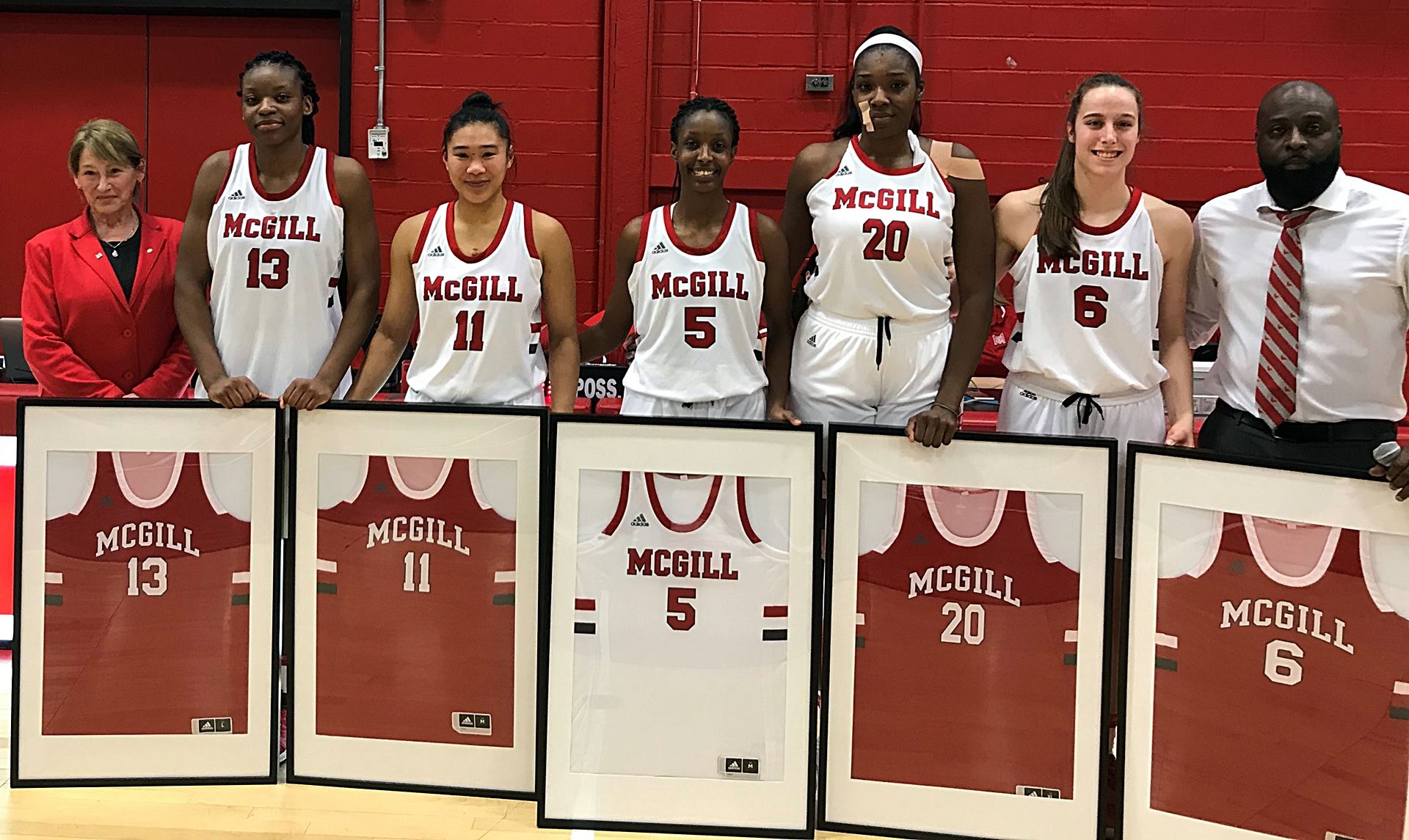
The Senior Night ceremony took place immediately after the game. McGill honoured Diarra, Cabillo-Abante, guard Gladys Hakizimana, forward Ruth Tshikudi-Tshila, and guard Stephanie Mondou. Each graduating player was presented with their framed jersey and flowers. 

During the ceremony, Thorne discussed the impact that the seniors had on the program and the numerous obstacles each had overcome. For example, fifth-year guard Hakizimana endured two hip surgeries.

“Being a senior means that I have a leadership role on the team,” Hakizimana said. “I have to lead by example and [with] communication. It’s my last year to give everything I have to the program.”  

When speaking about the impact the seniors had, Robitaille teared up. 

“The seniors really mean a lot,” Robitaille said. “This is only my second year with them, but I feel bad. I know it’s only a game, but it’s Senior Night, and I think we didn’t play as well as we [could have].”

The Martlets face the first-place Laval in the RSEQ semifinal on Feb. 26 in Laval. Robitaille is excited for the challenge. 

“We have four days to [prepare] for Laval,” Robitaille said. “They are number one, and it is going to be a really good game. We have to follow the game plan and [know] what we are going to do defensively and offensively, and just be ready.”

A semifinal win will move the Martlets on to the RSEQ Final on Feb. 29.


Moment of the Game

With less than four minutes left in the game, fifth-year transfer centre Sirah Diarra made a crucial block on UQÀM’s Inga Aleksaite to keep the game close, down 52–50. 

Quotable

“It’s my last year to give everything I have to the program and the team that I love, in order to not regret anything” – Gladys Hakizimana, on what being a senior on the Martlets means to her.

Stat Corner

Fifth-year guard Geraldine Cabillo-Abante led the Martlets with 11 points. She made three three-pointers, had three rebounds, and three steals in her 32 minutes on the court.

McGill, News

The Africa Speaks conference looks to the future of “Africa in the ‘Z’ Age”

On Feb. 21, the McGill African Students’ Society (MASS), in collaboration with the African Studies Students’ Association of McGill (ASSA), opened their annual two-day Africa Speaks conference with a panel called “Wathint’Abafazi, Wathint’Imbokodo,” focusing on the feminist movement across the African continent. 

Sukoluhle Bhebhe, ASSA co-president, introduced the panel by explaining the meaning behind its name. 

“Wathint’Abafazi, Wathint’Imbokodo is a Zulu phrase that means, ‘When you strike a woman, you strike a rock,’” Bhebhe explained. “It symbolizes the power and agency that South African women [resisting apartheid] had [….] The involvement of women within [anti-apartheid] struggle is often overlooked, so I felt that it was necessary to title this panel with this phrase.” 

The panel featured speakers Chloe Kemeni, U4 Arts, Ommu-Kulsoom J. Abdul-Rahman, BA’19 and President of My Voice Matters, and Djamilla Toure, founder of SAYASPORA

The panel began with all three panelists defining what feminism meant to them. In Kemeni’s view, feminism is still a very white movement. 

“Feminism, as a whole, is very white, and there are caveats, like Black feminism, where we inject other people’s experiences but, […] as a whole, it has harmed more people than it benefited,” Kemeni said. “Feminism still centres itself [on] white experiences [….] The way to combat [white feminism] is to embody teachings that are more [inclusive] to my experiences and those of the women I’m surrounded by.” 

Each panelist brought up the ways in which African feminism differed from white feminism. Toure cited white feminism’s main failure as the attempt to funnel feminism through a one-dimensional lens. 

“I don’t think that we will ever all be on the same page,” Toure said. “We’re all different as women, we all have different versions of what success, wellbeing, and wellness means to us, as well as what we want to stand for and against. We will not always be on the same page.” 

Abdul-Rahman referenced her Muslim identity to highlight how one’s experiences can influence their focuses as activists. 

“The issue that comes with feminism is when we all try to be on the same page,” Abdul-Rahman said. “Your lived experiences and the things that inform your feminism differ based on who you are. Difference should make us stronger.”

MASS and ASSA continued the conference with a panel on the next day to discuss present political and economic shifts in Africa. 

The panelists encouraged Generation Z, those born between 1995 and 2010, to embrace the history of the continent while striving for a more united future. 

Dr. Khalid Medani, Chair of the African Studies Program at McGill, began the conversation contextualizing the recent challenges faced by the continent. Medani urged Generation Z to seek further unity between African states.

“It is crucial to defend against a new form of imperialism and limiting economic sovereignty,” Medani said. “[This] requires unity. [This] requires cooperation.” 

In 2013, the African Union adopted Agenda 2063, which outlined a set of specific goals to help grow Africa’s influence and solidarity. Panelists were asked for their thoughts on how Agenda 2063 can be most effectively implemented. Dr. Nii Addy, Assistant Professor at the Institute for the Study of International Development (ISID), responded by referring to the crucial relationship between youth and elders. 

“The elders have experiences, and there are certain things they have gone through,” Addy said. “If [Generation Z] does not know [these experiences], they will make the same mistakes again.” 

For Dr. Wendell Nii Laryea Adjetey, Assistant Professor of Post-Reconstruction US History, Africa’s aspirations for global recognition and equality have remained the same for over a century. Adjetey cautions against blind optimism, but places hope in Generation Z moving forward. 

“Agenda 2063 won’t mean anything if the most important thing doesn’t happen, which is an incredible, revolutionary paradigm shift,” Adjetey said. “And the great thing about [Generation Z] is that [they are] amenable to change. [They are] optimistic and hopeful.” 

Adjetey finished his thoughts by reflecting on the urgency of mass societal change. 

“[There are] little boys or little girls on the streets of Nairobi […] who are [selling] bubble gum when they should be in school learning,” Adjetey said. “Do you know how much talent we have on this continent that is never realized?”

Arts & Entertainment

Soviet life on Mars

For as long as humans have looked to the stars, we have wondered what lies beyond the scope of our stratosphere. This wonder particularly piqued the imagination of artists and writers in Soviet Russia. On Feb. 20, a crowd gathered in the Canadian Centre for Architecture (CCA) to hear Asif Siddiqi discuss this cosmic enthusiasm in Bolshevik Russia. Siddiqi, a history professor at Fordham University, painted a picture of a 1920s Soviet Union (USSR) enraptured by the concept of galactic travel. 

The talk was a part of the CCA’s lecture series, Search for a New World. The series explores Russian sci-fi throughout the 20th century, focussing particularly on how the genre was influenced by existing technology and inspired many to think about utopianism and new societal organization. The series is a counterpart to the CCA’s exhibition Building a new New World: Amerikanizm in Russian Architecture, which considers Russia’s relationship to modernity and the United States though its architecture.

From literature, to modern art, and films, the endless possibilities of the cosmos inspired creatives and captivated the general public. Space travel offered a chance for the USSR to carve out its place in space and history, symbolizing the seemingly endless limits of human invention and exploration in the age of modernity.

North American audiences are most likely familiar with the USSR’s major role in the 1960s space race,  though the countries advancements in space travel were the result of more than just a simple competition. Siddiqi explained that, starting in 1917, Russian popular culture drastically shifted its attention towards the heavens, inspired by Soviet utopianism and the Marxist fascination with technology. The ‘space fad’ of the 1920s was a massive phenomenon that pervaded all aspects of culture, and Siddiqi’s research traced the theme of the cosmic throughout fiction, film and art, along with the public’s reception.

To show the pervasiveness of the sci-fi genre, Siddiqi noted that one-fifth of all books published at the time were science-related. Siddiqi pointed to Alexei Tolstoy’s Aelita as an example of Bolshevik-era science fiction. The successful novel follows a young man who travels to Mars and starts a proletariat uprising against the planet’s elite. Its adaptation was the first Russian sci-fi movie, a silent film, sold out theatres on opening night in 1924—extremely rare for the time. In the world of contemporary art, Kazimir Malevich and Boris Ender experimented with abstract and geometric styles to represent imaginary space stations and theoretical concepts like infinity. 

“[These artists believed that] art should mirror technological advancements, mechanically and abstractly,” Siddiqi said. “They were crafting a universe without a reference point.”

Not only were creatives producing copious amounts of space content, but the public loved every minute of it. Lectures on space travel were so popular that police were frequently called to quell the massive mobs attempting to push their way into the auditoriums.  Before there were “Trekkies” and “Whovians,” there were Russian space enthusiasts making up their own intergalactic languages and space names. Space clubs hosted exhibitions that featured rocket models and hypothetical maps of Mars. One exhibition showcased a blueprint for a rocket that would melt its own wings to provide fuel for the engine, to which Siqqidi commented that we certainly haven’t reached that level of technological advancement yet. Later on in the 1930s, the popular preoccupation with space travel died down and shifted towards the more realistic aspiration of aviation, but the Soviet Union continued to produce sci-fi works beyond the initial craze. 

Search for a new New world continues on March 5 with Sergei Kapterev on Soviet Sci-Fi Cinema of the 1950s–1960s. The exhibition Building a new New World runs until April 5 at the Canadian Centre for Architecture.

Student Life

From spinning to swimming

Between studying for midterms, participating in extracurriculars, and maintaining a social life, it can be difficult for students to squeeze exercise into their schedules despite the many health benefits it provides. For some, just climbing up to the McGill fitness centre is enough of a workout. These alternative workout spaces are close by and affordable, making them a great option for any student looking to get their sweat on. 

Éconofitness (625 Ste-Catherine Street West)

Located five minutes away from McGill, Éconofitness is the perfect place for exercise without all the frivolous features of fitness clubs. The chain also hosts 25 other establishments throughout the island of Montreal, so many students can find an Éconofitness near their home. The company also runs gyms that are only open to women, providing a safe space for students who feel more comfortable exercising around their own gender. For $4.99 bi-weekly, members have access to the gym, group fitness classes, and training programs. 

Spin Energie (3483 Parc Avenue)

While all spin classes are within a higher pricing range, Spin Energie, located on Parc Avenue offers the most affordable spin classes near McGill. For $45, students can buy an unlimited week of introductory spinning or for those who would like to less commitment, Spin Energie offers an affordable trial class for $10. Students also get a 15 per cent discount on all regular series of classes if they present their student card at the studio. 

Association Recreative Milton-Parc (3555 Rue St-Urbain)

Another way to get your heart pumping is within the heart of the Milton-Parc neighbourhood at the Centre multiethnique Saint-Louis. With a starting membership fee of $10, the not-for-profit organization Association Recreative Milton-Parc offers a variety of activities from badminton to Zumba, for a small price. The collective allows for people of various commitment levels in any sport, with prices ranging from $6 for drop-ins to $70 for a season pass.

Innocere Yoga (160 Prince Arthur Street East)

A new addition to the yoga scene in Montreal, Innocere Yoga offers great intro prices for new members. With a variety of classes, from beginner Yin and Restorative classes to higher level Flow classes, Innocere Yoga has something for those fascinated with the art of yoga. For $30, members can get one unlimited month of yoga. Innocere also offers discounts for students, so long as they bring their student ID when purchasing classes.  

McGill Memorial Pool (475 Pine Ave West)

For those who aren’t fans of weight benches and yoga mats but are still looking for a way to get in shape, consider the McGill Memorial Pool. Recreational swimming hours—known as Lap Swimming times—are offered every day. As students pay for Athletics fees as part of their tuition, they have access to all the other sports complexes—including the gymnasium, indoor and outdoor track, tennis courts, squash courts, and swimming pool—for free. Day passes ranging from $8.70 to $13.04 are also available for non-McGill students. 

L’École de Danse Swing Cat’s Corner (3451 St Laurent Blvd)

If moving to the beat is your type of groove, Cat’s Corner is the fitness studio for you. Offering swing dances, blues dances, and tap dance, this studio is sure to sweep you off your feet. To get the most affordable prices, make sure to attend their drop-in classes on Monday to Thursday from 6 to 7 p.m. for only $10 per class. For those looking for a deal, a drop-in card for $50 gets six classes for the price of five. 

Regardless of the kind of exercise you like to do, Montreal offers something that caters to everyone’s interests and budget. Now get up, put on your sneakers, and get moving!

Creative, Podcasts

In Conversation with: Lilah Fear

In October 2019 Sports Editors Kaja Surborg and Ender McDuff sat down with British ice dance champion Lilah Fear to talk life in Montreal, studying psychology at McGill, and training with the best figure skaters in the world.

Read the latest issue

Read the latest issue