

Latest News

McGill, News

Independent Jewish Voices celebrates Sukkot while standing in solidarity with Palestine

The McGill chapter of Independent Jewish Voices (IJV), a grassroots, anti-Zionist, Jewish organization, held an event on Oct. 6 on McGill’s Lower Field to celebrate the Jewish holiday of Sukkot and show their solidarity with Palestinians enduring Israel’s ongoing genocide. Sukkot is a seven-day festival of thanksgiving for the fall harvest, where observers build makeshift huts, known as ‘sukkah.’ The holiday also commemorates the 40 years that the Jewish people spent wandering after their Exodus from Egypt, during which they lived in huts. The IJV event was quickly met with heavy presence from the Service de police de la Ville de Montréal (SPVM). 

At 4:00 p.m., members of McGill’s and Montreal’s Jewish communities began building the sukkah on the Lower Field using a pop-up tent. Nearly 50 individuals gathered and made speeches, said prayers, sang, and waved four species of plants—citron, myrtle, palm, and willow—as well as banners reading, “Jews against Genocide/Free Palestine,” “Liberate Judaism from Zionism,” and “L’chaim Intifada”.

In an interview with The Tribune, an attendee who wished to remain anonymous described the significance of the sukkah-building as a demonstration of support for Palestine.

“[A sukkah is] a temporary structure […] [that] you share […] community experiences in,” they said. “We wanted to bring that here today, to be in solidarity with Palestine, [and] to show that we can make the choice to build a temporary structure like this. [….] The people of Gaza, whose homes have been destroyed, they have to live in structures like this. [….] They don’t have the choice.”

Another attendee who wished to remain unnamed explained why they felt it was important to differentiate Judaism from Zionism in times of Palestinian oppression.

“It’s very clear to me that if there is this injustice, it must be addressed, not just because it is a Jewish thing to do, but because it is the human thing,” they stated in an interview with The Tribune. “And […] in that process, we are actually addressing antisemitism, because we are showing a positive version of what Judaism can look like when people have only been exposed to Zionism.”

IJV McGill was one of the bodies who supported the Students’ Society of McGill University’s Legislative Council’s decision to adopt the Policy against Antisemitism in April 2025, which distinguishes between anti-Zionism and antisemitism. Many pro-Israel groups on campus were opposed to its adoption. The attendee spoke to this disagreement. 

“[The policy] cites […] historical precedent, […] [and] legal summaries endorsed by a lot of law professors [internationally],” the attendee explained. “I really think that this narrative of the Jewish community [being] so divided, [is] disingenuous and […] misleading. Partially because they’re like every community, […] in a state of trying to figure itself out. We’re doing everything we can to engage in this conversation.”

 “I [grew up in] a Zionist perspective,” the attendee continued. “Change is possible. [….] I do think that it is also kind of a mitzvah, a kind of important obligation to try to help people on their journey to having a more open mind.”

Meanwhile, between 4:30 p.m. and 5:00 p.m., approximately 25 SPVM officers arrived at the sukkah. Around ten SPVM Specialized Support and Intervention Section police, or riot police, stood 20 meters away from the gathering. 

In an interview with The Tribune, a community member who interacted with the SPVM described how one of the police officers was “mocking” the religious ceremony.

“One police officer explicitly said that he didn’t think this was a religious tent. He was like, ‘It’s just a gazebo,’” the attendee, who wished to remain unnamed, recounted. “[His comments were] pretty demeaning, derogatory, […] borderline antisemitic. [….] [He was] insisting that we don’t have a right to mark this religious service in the way that our faith requires that we do.”

According to the community member, around 5:30 p.m., the SPVM officers threatened to physically intervene in the gathering, claiming the structure had been illegally erected on McGill’s private property.

Though attendees took down the pop-up tent, they gathered to form the sukkah once more using their banners as walls, their bodies as pillars, and the branches in their stretched-out arms as the roof.

Commentary, Opinion

Canadian gun advocates make a fair point—and it doesn’t matter

Earlier this month, demonstrators gathered on the lawn of the Myles F. Burke Police Headquarters in Cape Breton, Nova Scotia, to protest the federal government’s new gun buyback program. 250 strong and adorned in an assortment of flannel, sunglasses, and baseball caps, the rally-goers held bold text protest signs with references to the Bible and “wasted tax dollars.” Guest speakers, including local Conservative MPs, bemoaned government overreach and encroachment on “good gun-abiding people.” And they made a fair point.

If one considers the merits of the Government of Canada’s gun buyback, broad design flaws quickly become apparent, namely its cost and failure to target illegal firearm owners, the main perpetrators of gun violence in Canada. Although it is easy to criticize the ill-targeted excesses of Liberal gun policy, backlash from gun-owning communities and Conservative politicians ultimately fails to address the merits of the gun buyback program itself in the context of the country’s relatively low rates of gun ownership. 

In May 2020, weeks after a mass shooting in Nova Scotia that killed 22 people, Prime Minister Justin Trudeau announced a ban on over 1,500 models of ‘assault-style’ fire-arms, and instated a transition period during which the government would undertake a national gun-buyback program and shield owners of prohibited firearms from criminal liability. 

Most available statistics indicate that gun crimes in Canada primarily occur through black market weapons smuggled into the country from the United States. No clear correlation between legal gun purchases and crime has been established; in fact, firearms licence-holders have a 10 per cent lower murder rate compared to the Canadian average. Even the Nova Scotia mass shooter who prompted the gun ban used smuggled American guns

The program’s compensation of gun owners alone will cost an estimated total of $756 million CAD, leaving some critics to wonder if those funds could be allocated towards something more useful. Others claim the specific gun models listed within the ban itself are somewhat arbitrary, with similar guns to those banned still available for purchase.

Essentially, the government is targeting law-abiding Canadians who purchased their weapons legally at great expense to the Canadian tax payer, for virtually zero benefit. 

Any Conservative politician worth their salt will bang their chest in solidarity with gun-owners. It is easy to see why. Reckless spending in order to create a pointless bureaucracy designed to oppress individual rights, plagued by administrative incompetence and arbitrary decision making? It’s practically a slam-dunk. The Liberal gun buyback regime is, as much as it may hurt for some to admit, stupid.

But who cares? If one told the average Canadian that the federal government was spending a miniscule fraction of our federal budget to remove about 100,000 ‘assault-style’ weapons from the hands of the public, would they be upset? The vast majority of Canadians—92.9 per cent—do not possess firearms, and the cultural inertia that underpins firearm rights in the US does not exist here. On the contrary, most Canadians, while they may not grasp the minutia of the issue, support increased firearm restrictions

Self-defense law in Canada does not allow for the use of firearms in the protection of one’s property, rendering guns almost exclusively used for target-shooting and hunting. In other words, gun ownership in Canada is just another equipment-centric outdoor hobby, like kayaking or dirt-biking. What is the difference between guns and hypothetical onerous over-regulation of, say, jet-skis? If certain models of jet-skis suddenly faced sweeping government bans—with proportionate compensation for jet-ski owners, mind you, would anybody shed a tear? The major difference being, of course, that jet-skis cannot be used to conduct a mass shooting. 

Gun advocates have a point in criticizing this specific program, but this argument is senseless in the context of Canada’s political and cultural understanding of gun ownership. There was no counterprotest to the gathering outside the police station in Cape Breton. Besides gun-owners and those that stood to gain politically from their outrage, nobody showed up. I’m not even sure if the police looked out the window.

Montreal, News

Quebec halts free COVID-19 vaccine program for most residents

Quebec’s health ministry has announced that starting this fall, coronavirus (COVID-19) vaccines will no longer be universally free to the public. Instead, free vaccines will only be available to residents who are 65 and older, those who are immunocompromised or have chronic illnesses, residents of long-term care or private seniors’ homes, health care workers, adults in remote regions, and pregnant individuals. Those who do not qualify for a free vaccine will have to pay between $150 CAD and $180 CAD at a pharmacy in order to receive a COVID-19 shot.

McGill’s Media Relations Office (MRO) clarified that McGill’s Student Wellness Hub does not provide COVID-19 vaccines—free or paid—to students, in a written statement to The Tribune.

“While the Hub does not administer COVID-19 vaccines to the general student population, we recommend accessing vaccines through local pharmacies or public/private health clinics,” the MRO wrote. “Supporting students in staying up to date with their vaccinations and helping them navigate off-campus resources is a key part of the Hub healthcare professionals’ mandate.”

The SSMU Studentcare health insurance plan generally does not cover unprescribed COVID-19 vaccines, as these costs are not considered an eligible expense by provider Desjardins Insurance. However, Studentcare emphasized that this may not always be the case in a written statement to The Tribune

“If the vaccine is prescribed by a physician and dispensed by a pharmacist, students may submit the claim to Desjardins Insurance for review, subject to standard plan limitations,” a Member Services Agent with Studentcare wrote.

In an interview with The Tribune, Dr. Anne Gatignol, a virology and molecular biology professor in McGill’s Department of Medicine, described the current risks and realities of COVID-19 on the university’s campus.

“By now, most adults have had COVID, and we have reached some kind of collective immunity,” Gatignol stated. “[Vaccines are] important for elderly or immunocompromised persons, people with chronic diseases, [and] health care workers. [….] For all others, the risk is much lower. [….] The Quebec health authorities have probably evaluated the costs [and] benefits in their decision. Nevertheless, I encourage those who want and can afford it to get the vaccine. They will protect themselves and will contribute to protecting others.”

Kasidy Xu, a final-year Nursing student at McGill, provided similar advice to Dr. Gatignol’s to university students concerned about COVID-19 vaccination in an interview with The Tribune. 

“For the most part, [as] university students […] are mostly young in age, […] [they] are not as [susceptible to COVID-19] as older adults or immunocompromised people,” Xu explained. “They were [more at] risk [in] the beginning of the COVID-19 pandemic [due to] the close proximity they were [in] with [other] students [and] people. [However], it is important for everyone [to] get the COVID vaccine if they can, [as] the COVID strains are changing so much [that] even if you get [immunised] now, the strains will change within a year and you will need to receive a new vaccination in order to be protected.”

Quebec’s new policy to pull back universal access to free COVID-19 vaccines follows a decision Alberta Health Services made in June 2025 to start charging Albertans who are not elderly, immunocompromised, or health care workers for COVID-19 shots. Alberta’s provincial government cited the high costs and vaccine waste keeping COVID-19 shots free incurred, after the federal Public Health Agency of Canada transferred responsibility for procuring the vaccines to provincial health bodies in January 2025. Quebec made their decision along similar lines of reasoning, citing cost efficiency after Quebec’s immunisation committee, the Institut national de santé publique du Québec, recommended prioritising vaccination for people aged 75 and older.

COVID-19 and flu vaccines can be booked together through Quebec’s online health booking platform, Clic Santé, or by calling 1-877-644-4545. Coronavirus vaccines will remain available in Quebec at pharmacies, local community services centres, and through other healthcare providers.

Rugby, Sports

Youth give rugby a “try” through Redbirds Rugby-CRARR partnership for community safety

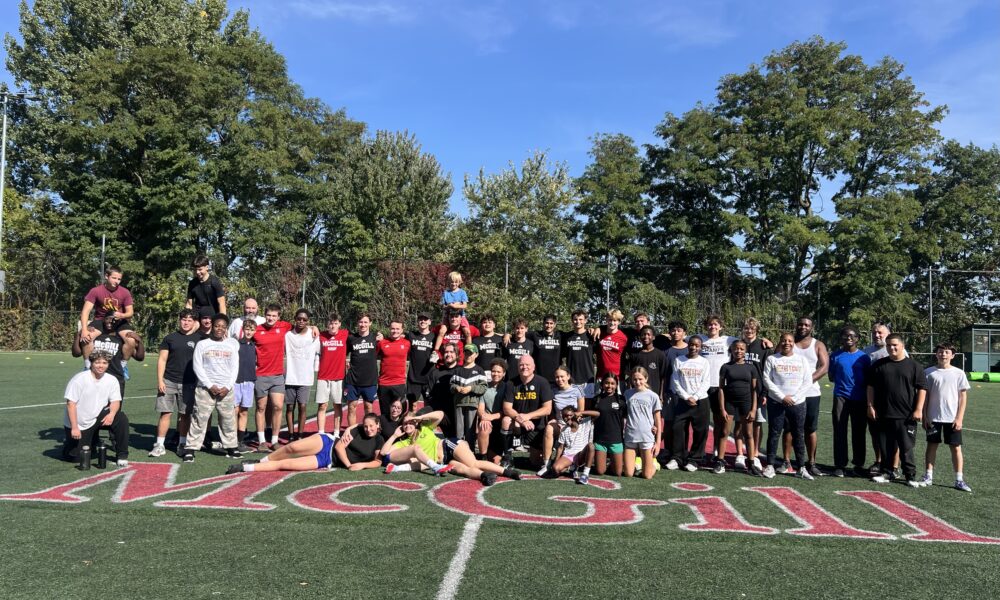
On Oct. 4, approximately 50 youth from the Greater Montreal Area ran sprints, played touch rugby, and learned the fundamentals of the sport, coached by varsity athletes from McGill’s Redbirds Rugby Team, on Forbes Field. The training event was the second half of an initiative led by Montreal’s Center for Research-Action on Race Relations (CRARR) this year—the first, a press conference and information session on Sept. 4—as part of their Rugby for Community Safety initiative, in partnership with the Redbirds and the Jamaica Association of Montreal.

The Rugby for Community Safety series is a part of CRARR’s broader Together Against Violence project, which uses sport to unite and empower youth from diverse areas of Montreal to engage with their communities, meet potential mentors, and build skills that act as emotional outlets to help mitigate violence. CRARR commenced the project in 2023 with support from the City of Montreal and other major sponsors such as the Société de transport de Montréal, running a range of sports-focused events such as basketball skill sessions. 

In an interview with The Tribune, CRARR Project Coordinator Nicole Machlout affirmed that the ongoing collaboration between the Center and the Redbirds represents much more than the sport itself. 

“We [aim] to bring together people from marginalized communities, kids who normally don’t have as many opportunities to learn about new sports, with the goal of hopefully getting them off of the streets, or to [safely and productively] prevent them from being involved in crime,” she explained.

Machlout dove further into how sports sessions like those in the Rugby for Community Safety series have lasting impact.

“We want to inspire kids that are at risk. Specifically with sport, the goal is to teach discipline for them to have a sense of growth,” she said. “It’s a great way to kind of instill self care, because they’re doing something that makes them feel good […] and also [is] extremely healthy. [….] If [youth are] able to have access to the sport [and thus] able to meet mentors, […] that will also build a network and create connection. So if they want to pursue this on, let’s say, a varsity level, […] it’s giving them access to that.”

Starting at 9:45 a.m, the youth in attendance—aged 12 to 20—began by listening to presentations on the connection between sports and youth violence prevention, and were introduced to the CRARR affiliates and Redbirds Rugby players running the session. After participants practiced the fundamentals and played in a round-robin tournament, the event concluded around 1:00 p.m. Participants were then offered refreshments, and invited to attend the ensuing Martlets Rugby game—the final match of the regular season—at Percival Molson Stadium. The Martlets ultimately came back from a 21-point deficit to beat the Bishop’s University Gaiters 38-35.   

The Rugby for Community Safety session foregrounded interactive and hands-on learning about the sport, with the Redbirds demonstrating fundamental rugby skills such as catching, kicking, passing, and tackling. The Redbirds also prioritized camaraderie, promoting a lighthearted, supportive environment that made trying something new as approachable as possible for attendees.

In an interview with The Tribune, scrum-half, club president of McGill Rugby, and third-year Engineering student Ashton Wright expressed how giving back to the Montreal community simultaneously gives back to the Redbirds varsity program.

“We really are growing our presence within the community and growing the effect that we can have, the positive impact we can have,” Wright said. “This collaboration [is] hopefully going to be revisited in the future. It’s definitely something we enjoy doing, getting the boys out and spreading the game of rugby.”

First-year Arts student and second row Redbird Nikolas Begic echoed Wright’s sentiments in an interview with The Tribune.

“I think it’s really important that, as a school, as a team, we give back to the community and come out here,” Begic said. “I love spreading the game, a game that builds teamwork and community. [….] [I] really feel privileged to be in the position I am [to] teach.”

Sports Staff Writer Zain Ahmed is a member of the Redbirds Rugby team and was a lead organizer of this event. He was not involved in the publication of this story.

Science & Technology

When cells collide: Understanding the effects of red blood cell collisions

The field of biomedical engineering is complex, to say the least. Out of all the sciences, it is one of the hardest to understand, as it centres around understanding and altering the millions of interactions occurring in our bodies everyday.

In a recent study published in Scientific Reports, McGill Alumni Hristo Valtchanov and his colleagues analyzed the intricacies of the human body, specifically blood flow, to determine if red blood cells (RBC) are negatively affected by intercellular collisions, where two or more cells come into direct contact with each other. Because of the density of our red blood cells and how small our blood vessels are in width, red blood cells frequently collide with each other when being pumped through our bodies.

Valtchanov believes that researchers have overlooked RBC collisions in the modeling of blood rheology—the science of blood flow—despite overall advances in said technology. 

“In the biosciences, model representation is extremely important,” Valtchanov said in an interview with The Tribune. “It’s also important to challenge the assumptions people have on said models.” 

He also argues that previous studies downplayed the importance of RBC collisions, suggesting they had a minimal impact on hemolysis—the destruction of RBCs. High levels of hemolysis is dangerous for the human body and can eventually lead to organ failure. 

“It’s actually quite difficult to incorporate the effect of intercellular collisions, but no one had actually tried to quantify the effect, so we did a study doing just that,” Valtchanov said. 

Thus, the researchers used viscoelastic simulations, measuring the RBC membranes’ responses to constant force or deformation to analyze how much strain intercellular collisions put on these membranes. They specifically analyzed this strain at different shear rates, which measure how fast layers of liquid move past one another.

“Basically, we made a simulation, and smashed the red blood cells together so that we could directly measure the effect of collisions on the strain experienced by the red blood cell membrane, and thus on hemolysis,” Valtchanov said. “We did this in simulation because the distribution of strain on the RBC membrane is exceedingly difficult to examine, particularly during a dynamic event like a collision.”

Their results showcased that overall, intercellular collision increased RBC membrane strain. In fact, they found that intercellular collisions were the main cause for membrane strain in RBC.

The importance of RBC collisions is made abundantly clear when considering what Valtchanov and colleagues had been examining beforehand. 

“We began this study while we were trying to develop constitutive models for hemolysis. We use hemolysis modeling to try to predict the amount of damage to red blood cells when a medical device is implanted into a patient,” Vatlchanov explained.

These findings could help create new and improved biomedical devices, such as blood pumps, that are less likely to cause hemolysis, which could save lives as a result. 

“A high degree of hemolysis is called ‘lethal hemolysis’ because it causes kidney failure and death. Lower doses have all sorts of other complications. It will slowly damage all of your other organs, and your kidneys will eventually give out.” Valtchanov said.

Ultimately, this study could help broaden current knowledge in modelling blood damage and creating biomedical devices.

 “As engineers, our main challenge is to predict things,” Valtchanov added. “If you can predict something, you can control it, and design solutions to stop it from happening.” 

Despite the progress that the researchers have made in this field, the work is far from over.

“The amount of knowledge you need to advance any science is a lot, to be frank,” Valtchanov said. “In general, there is so much work that needs to be done to improve our understanding of how the body works, to model the biomechanical processes that lead to diseases. The future of medicine is preventative, and harnesses data to take into account each individual person’s unique physiology.”

Art, Arts & Entertainment, Fashion

The ‘Africa Fashion’ exhibit stitches together stories of agency and innovation

The Africa Fashion exhibition at the McCord Stewart Museum tells a story that spans six decades, 20 countries, and boundless artistry. On display from Sept. 25 to Feb. 1, 2026, the show marks the only Canadian stop on an international tour organized by London’s Victoria and Albert Museum. It presents 100 garments and accessories, as well as textiles, photographs, and videos from 45 designers that foreground individual perspectives on the vitality of African fashion. Rather than attempting to showcase every textile tradition across the continent, Africa Fashion spotlights selected designers whose work captures the eclectic nature of the continent’s fashion as a self-defining art form.

At its core, the exhibition explores the concept of agency—the ability of African designers and wearers to define themselves in their own terms. The narrative begins in 1960, when 17 African nations gained independence, turning fashion into a language of liberation. It became a strategic political act as nations asserted their cultural identities, using art as a powerful force of post-colonial self-expression and global innovation.

This generation of pioneers bridged tradition and modernity with ingenuity. Nigerian designer Shade Thomas-Fahm revolutionized everyday wear for the modern woman by opening Maison Shade in 1960, the year of Nigeria’s independence. She added zippers to traditionally wrapped ìró skirts and created pre-tied gèlè headwraps that allowed busy, cosmopolitan women to embrace Nigerian fabrics without sacrificing convenience. Malian designer Chris Seydou reimagined traditional textiles through a contemporary lens, while Ghanaian artist Kofi Ansah combined indigo-dyed Adire cloth with Japanese denim jacquard fabric. Their work embodied how fashion became a tool for decolonizing minds—expressing freedom through reimagined tradition. 

Authentic representation and celebration of African beauty is woven into every element of Africa Fashion, embodied even by the mannequins themselves. Rejecting the Eurocentric figures that dominate the fashion industry, the Victoria and Albert Museum collaborated with South Sudanese model Adhel Bol to create mannequins that emulated the beauty of African models, spanning four different skin tones and three hairstyles, including Irun Didi braids and Bantu knots. The result is an exhibition where the presentation method serves as an extension of the curatorial narrative, centring African beauty and the visual culture of its fashion creatives.

The Politics and Poetics of Cloth section examines how textiles themselves became strategic political declarations during independence movements. Indigenous clothes that had been devalued under colonialism were reclaimed as symbols of pride and resistance. The exhibition features commemorative cloth made in the early 1990s celebrating Nelson Mandela’s release from prison, traditional kente fabric from Ghana, Nigerian àdìrẹ, and Malian bògòlanfini—pieces that gesture toward the continent’s thousands of textile techniques and traditions.

The contemporary section of the exhibition demonstrates how today’s generation of designers continue to push boundaries while honouring heritage. South African designer Thebe Magugu’s Alchemy collection, created in collaboration with traditional healer Noentla Khumalo, centres on African spirituality and ancestral relationships. Kenyan brand IAMISIGO, founded by Bubu Ogisi, references ancient West African masquerade costumes and performance art traditions. Rwandan fashion house Moshions reimagines traditional Rwandan forms and cultural motifs into contemporary pieces that reference ceremonial attire historically worn by royalty. Djiboutian costume designer and photographer Gouled Ahmed creates self portraits that combine textured garments with contemporary materials to represent multifaceted identities. Nigerian company DAKALA CLOTH by NKWO explores ways of using waste denim to create new textiles while preserving traditional craft skills, exemplifying how innovation can honour ancestral techniques.

Africa Fashion ultimately demonstrates that fashion is never just about clothing; it is storytelling, cultural preservation, and resistance encoded in fabric and form. What visitors witness is not the emergence of African fashion onto the global stage, but rather a long-overdue reframing of who gets to tell these stories. As the exhibition affirms, African designers have been charting their own course for decades: Revolutionizing adornment into an assertion of identity, a reclamation of heritage, and an uncompromising vision of the future.

McGill, Montreal, News

Milton-Parc residents suffer from a lack of accessible healthcare

Milton-Parc, which contains residents ranging from McGill students to senior citizens, lacks a walk-in clinic, local community services centre (CLSC), or any other form of accessible healthcare, leading to it being dubbed a ‘medical desert.’ A recent report by La communauté Milton-Parc found that six out of ten residents of Milton-Parc who were surveyed lack a family doctor, and many are unaware of the alternate healthcare options available to them. 

Despite being in the heart of Montreal, Milton-Parc residents must travel farther to access healthcare than those living in surrounding areas. Most residents of the Plateau-Mont-Royal area, which contains Milton-Parc, have access to healthcare through service from the CIUSSS du Centre-Sud. Milton-Parc, however, falls under the CIUSSS du Centre-Ouest-de-l’Île-de-Montréal, which comprises a network of hospitals outside of their neighbourhood. 

In an interview with The Tribune, Milton Park Citizens’ Committee President and McGill course lecturer Garrfield Du Couturier-Nichol explained that the medical crisis in Milton-Parc began six years ago, when the neighbourhood’s local clinic closed in 2019.

“There used to be a CLSC clinic in the [Air Transat Tower],” Du Couturier-Nichol stated. “That closed down, and since then, there’s been a problem because Milton-Parc is part of the Jeanne-Mance Plateau-Mont-Royal area. So we’re basically split between two CIUSSS authorities. [….] It basically goes by your postal code. For a lot of people, especially seniors, that’s very confusing.” 

The bureaucratic division of the Centre-Sud and Centre-Ouest authorities, coupled with the sheer distance from the nearest clinic, leaves elderly, often technology-illiterate residents unsure of where to go for medical attention, Du Couturier-Nichol told The Tribune.

“I’m almost 83, and I have a bit of a mobility problem, but I’m still able to get around. So I can use public transport when it’s working to get to the CLSC,” he said. “But a lot of seniors in my age group have problems with mobility, so it’s difficult for them. They don’t know whether they belong in CIUSSS Centre-Sud, or CIUSSS Centre-Ouest, because it’s a very confusing thing for a lot of people. A lot of people are not computer-literate. And most of this [navigation] is done online, so it creates a problem. Since 2019 when [the local CLSC clinic] closed, a lot of seniors have basically just given up.”

While the lack of accessible healthcare falls hardest on seniors, many McGill students living in Milton-Parc also feel the strain when they need medical care. One resident, Annika Arya, U1 Arts, spoke in an interview with The Tribune about her experience accessing healthcare. When she fell ill this month, the lack of clinics in Milton-Parc forced her to either use Uber or walk 30 minutes to the nearest emergency room. 

Arya also discussed her experiences attempting to seek services at McGill’s Student Wellness Hub. She called for more accessible healthcare options throughout McGill’s campus and residential areas.

“I [have gotten] two appointments out of maybe the 10 times that I’ve called [the Wellness Hub],” Arya reported. “I think that McGill needs to make it a priority to implement more health clinic facilities throughout campus, including [in] Milton-Parc and the residence areas.”

The McGill Media Relations Office (MRO) stated in a written response to The Tribune that they are taking steps to address the wider issue of healthcare accessibility, and ensure McGill students can find the support they need.

“We are […] actively working to mitigate the impact of broader systemic challenges in the provincial healthcare system—such as limited access to primary care and mental health services—by expanding our interdisciplinary care model, improving pathways and increasing our capacity to timely appointments, and strengthening partnerships with local organizations,” the MRO wrote.

Du Couturier-Nichol suggested the establishment of a mobile clinic would be a positive step to remedying Milton-Parc’s medical challenges, before introducing a more permanent solution.

“The first step would be to have at least a mobile clinic once or twice a week in the Milton-Parc area to start looking at the problem and understanding the number of seniors who may have medication or health-related problems or need social work. And then progress from there,” he stated. “Look for a location that’s fairly central in Milton-Parc to establish a permanent clinic.”

Commentary, Opinion

McGill Global, Montreal forgotten

On September 17, McGill President and Vice-Chancellor Deep Saini announced ‘McGill Global,’ a $185 million CAD plan to establish ‘satellite campuses’ abroad—branch campuses operated by McGill outside of Montreal. The announcement comes at a time of financial crisis at McGill, triggered by Quebec’s tuition hikes for out-of-province and international students. By investing in McGill Global in a time of financial insecurity, the university signals that it prioritizes global prestige over supporting its staff and students, the backbone of the Montreal campuses.

The Quebec provincial government, run by Premier François Legault, has recently doubled out-of-province tuition for English universities from approximately $9,000 CAD to $17,000 CAD in an attempt to protect the French language. Consequently, many prospective out-of-province students will likely be deterred from McGill, as the university’s tuition is no longer able to compete with that of other Canadian universities. For example, the tuition fee for the Faculty of Arts and Science for non-Ontario residents at the University of Toronto is $7,250 CAD, less than half of the current McGill equivalent. Enrollment of out-of-province and international students—whose minimum tuition is now set at $20,000 CADis expected to decrease dramatically as McGill becomes increasingly unaffordable. This will result in a net financial deficit for the university. McGill has announced its plan to cut $45 million from the 2025-2026 budget by laying off staff to reduce the workforce by 350-500 people, imposing a hiring freeze, and discontinuing student services, such as the Faculty of Medicine’s DEI office

In the midst of mass layoffs and termination of critical services for students studying at the Montreal campus, Saini maintains that satellite campuses will “expand opportunities for [McGill] students and faculty, grow [the] talent pool and amplify [McGill’s] impact.” By funding this project, the McGill brand can further its reputation and attract talent from regions where its outreach has previously been limited. However, this comes at the cost of essential services, resources, and jobs. While satellite campuses may add to a projected appearance of prestige, they inevitably neglect local McGillians, as their expensive tuition fees are used for McGill Global, a program that does not serve their needs. 

The tension between Saini’s push to broaden McGill’s international reach and the need to rebalance budgets following declines in international and out-of-province enrollment is a direct manifestation of a deeply entrenched conflict between the provincial government and anglophone universities: Language. McGill’s student body is exceptionally diverse, with approximately 25 per cent of incoming undergraduate students coming from other Canadian provinces and around 30 per cent coming from outside Canada. Still, students from Quebec consistently comprise 40-50 per cent of the annual incoming class, and about one in five McGill students have declared French to be their primary language

While policy solutions like tuition hikes for out-of-province students are a means through which to preserve Quebec’s French heritage, the provincial government’s hostility towards English speakers in Montreal reveals a cultural rigidity and a refusal to adapt. In pursuing the satellite campus project—likely in regions where French is not as culturally relevant—McGill is moving away from Quebec’s linguistic demands. Ironically, despite Legault’s insistence that he wants McGill to stay anchored in Quebec, the very policies meant to protect the French language may be driving McGill away from Quebec, rather than securing its future within it.


In trying to regain prestige and escape Quebec’s restrictive language laws through international expansion, McGill’s administration has prioritized its image over the well-being of students and staff. These price hikes burden students the most: On the one hand, tuition increases price out aspiring students, and on the other hand, university-sanctioned cuts to critical programs lead to a lower quality of education. If McGill is to be deserving of calling itself “a locally anchored, globally pre-eminent university,” it needs to uphold its responsibility to the students, staff, and city that built its reputation.

Basketball, Behind the Bench, Rugby, Sports

Kelsey Mitchell’s collapse sparks reflection on what happens when “The Fever” burns too hot

In the third quarter of Game 5 of the Women’s National Basketball Association (WNBA) semi-finals against the Las Vegas Aces, Kelsey Mitchell’s legs locked mid-stride. The Indiana Fever guard suddenly slowed, freezing in pain as her body began to betray her. In an instant, a highly-anticipated playoff game became a medical emergency, and Mitchell’s season hit a terrifying breaking point.

“My muscles stopped producing [energy after reaching] maximum capacity,” she later explained in a written social media post. “I went into a sense of numbness/paralyzing feeling with no movement from my lower extremities for up to 5 to 7 seconds.”

As Mitchell’s body crumpled, the game’s referee stepped forward instinctively, catching her before she hit the hardwood. Mitchell’s teammates rushed in, surrounding her with towels to block cameras. The arena fell silent. She was carried off the court and taken to the hospital for treatment. What had looked like a simple cramp was quickly identified as something far more serious: Rhabdomyolysis, a dangerous condition that can be triggered by extreme physical exertion, dehydration, and heat exposure.

Rhabdomyolysis occurs when skeletal muscle breaks down faster than the body can repair, causing the tissue to disintegrate and die. As this happens, toxic proteins flood the bloodstream. Normally, the kidneys filter these substances out, but when overwhelmed, they cannot keep up. Symptoms can include muscle pain, weakness, dark urine, nausea, or fatigue. The condition may also lead to kidney failure. 

Though rhabdomyolysis is rare, with only 26,000 people developing the condition annually in the United States, athletes like Mitchell are at high risk as rhabdomyolysis’s effects can be easily mistaken for ordinary gametime exhaustion. 

For a player who carried her team through a season defined by adversity, the moment was especially haunting. The Fever had already lost five players to injuries, including star point guard Caitlin Clark. In her seventh WNBA season, Mitchell remained the team’s anchor. She was averaging 20.2 points per game and was a 2025 WNBA MVP finalist. On that September night in Las Vegas, she had already scored 15 points before her injury sent her off the court. 

Mitchell’s teammate Sophie Cunningham described the moment vividly on her podcast Show Me Something. “She just got a full body cramp. Imagine having a charley horse, but times 100,” Cunningham said. “She was a little sick, super dehydrated, but really the doctor just said […] she played till her wheels came off.”

The Fever lost in overtime to the Aces, 107-98, which capped off their fairytale playoff run after a hard-fought season. But Mitchell’s collapse raised a question that reverberates far beyond professional basketball: How close can athletes come to their limits before crossing into danger?

‘No pain, no gain’ is a common refrain, but research from University of California Los Angeles Health highlights the dangers of equating the two. Overtraining disrupts hormones like cortisol and testosterone, impairs recovery, and strains mental health. Fatigue, persistent soreness, and decreased performance are warning signs that an athlete needs rest. Hydration, sleep, and rest days are therefore not optional, but critical to performance and safety.

Thankfully, Mitchell is expected to make a full recovery. But her experience is more than a cautionary tale: It is a call to action. Professional athletes like Mitchell are trained to push boundaries, but they should not have to gamble with their health to prove their worth or win a championship. The WNBA and its teams need to examine how a culture of constant performance may blur the line between dedication and danger. With longer seasons, grueling travel, and ever-intensifying competition brought on by the league’s expansion, player welfare must not be an afterthought.

For athletes, rest and recovery are not a luxury, but a necessity. WNBA coaching staff and medical teams must better monitor athletes and encourage open communication about fatigue so players can speak up before they break down. 

Mitchell’s collapse serves as a vivid reminder that winning should never come at the expense of well-being. Even the strongest athletes are still human, and true strength means knowing when to stop.

(Kate Sianos / The Tribune)
Arts & Entertainment, Books

What we liked reading this fall break

The Sirens of Titan by Kurt Vonnegut – Jeremy Zelken, Contributor

If you are anything like me, you probably read Kurt Vonnegut’s Slaughterhouse Five about three times in high school. While I had always insisted it was his best work, I have to admit—I was humbly mistaken. The Sirens of Titan, a book I couldn’t put down this break, completely eclipsed it.

Written in Vonnegut’s signature deadpan humour and cosmic cynicism, the book follows Malachi Constant, Earth’s richest and most corrupt man, as he is swept into a wild interplanetary journey with the eccentric and unwilling Beatrice Rumfoord. Along the way, they encounter extraterrestrial beings, a Martian army, and bizarre religions, all culminating in a story that questions the purpose of it all. Each moment of absurdity and anomaly is delivered with equal sincerity and pensiveness. Even at its most surreal, the emotional undertone is surprisingly human—more so than in any of his other novels. Vonnegut somehow finds meaning in the meaningless.

It’s always a pleasure to read something that makes you feel every emotion at once. If you enjoy laughing at misfortune, questioning your existence, and finding comfort in confusion, this book is for you.

The Rachel Incident by Caroline O’Donoghue – Anna Roberts, Contributor 

Caroline O’Donoghue’s charming coming-of-age, The Rachel Incident is addictive. After fervently reading this across long train rides and at every spare moment of my break, I can easily say it is one of the most electric books I’ve read in months. Set in Cork, Ireland in the 2010s, during the economic recession and tension over abortion laws, the novel explores the messy life of a girl in her early twenties as she makes a series of many questionable decisions. 

After settling in London, Rachel hears that her old college professor is in a coma, spurring her to reflect back on her final year of university in Cork. In this flashback, she meets her soon-to-be best friend and flatmate, James, who encourages her to pursue an illicit relationship with her older, married professor. When this attempted affair fails in an unexpected way, Rachel launches into an unsteady relationship with another man while overburned with duties at an internship under her professor’s wife. During this period, she is forced to grapple with the culture in Ireland at the time, her intense relationships, and her desperate desire for a career in publishing. 

The novel is deeply tender, yet witty; O’Donoghue masterfully moves between humour and seriousness, weaving together plotlines and creating complex relationships. The heart of the novel is the platonic love between Rachel and James; while they fall in and out of love with other men, their bond remains at the centre of their story.

Cult Classic by Sloane Crosley – Dylan Hing, Contributor

Imagine if, one day, all your exes started appearing out of nowhere, and your cult-like friends became obsessed with what comes next. It’s everyone’s dream, isn’t it? Cult Classic, comedy writer Sloane Crosley’s second novel, inquires whether our choices are really our own and what it means to decide to love.

Lola, an editor at a New York City magazine, finally gets engaged—but then begins running into her exes. Under these circumstances, she’s roped up in a conspiracy that questions the very idea of free will—are we making our own choices, or are we subject to the subliminal effects of the world around us? Through these constant appearances of exes, both Lola and the reader are left to wonder whether she is really happy with her fiancé, or whether she simply settled for lack of a better option.

Despite the unsettling actions of some of the characters, Crosley manages to endear the reader to the strange but mostly unremarkable cast of her novel. Her background in nonfiction humour strengthens her writing; the comedy is mainly descriptive, because this novel is meant to reflect questions of reality. So, if you’re interested, give it a try. I’m sure it’ll be a cult classic.

Read the latest issue

Read the latest issue