

Latest News

Commentary, Opinion

Bill 97 bulldozes Indigenous livelihoods

Quebec’s government is moving toward securing unbarred executive control over 8 million hectares of the province’s forests for the forestry industry’s industrial logging agenda. This legislation—Bill 97—pads the pockets of industrial logging companies, while bulldozing constitutional and humanitarian obligations to the Indigenous communities who steward much of the targeted land.  

Bill 97 proposes splitting Quebec’s forests into a “triad” of zones: Conservation zones, which are protected from logging; multi-purpose zones, which incorporate both development and conservation; and ‘priority forest development zones.’ The third category gives the forest industry complete executive control of 30 per cent of Quebec’s forests, regardless of environmental damage or intrusion on Indigenous communities and cultural practices

The bill was tabled on April 23 by Quebec’s Minister of Natural Resources and Forests Maïté Blanchette Vézina, but faces continued protest from Indigenous leaders for excluding Indigenous voices in the drafting process and for neglecting Indigenous rights. 

Almost half the land allotted as a ‘development zone’ in Bill 97 is unceded Indigenous territory.  Indigenous groups on unceded territory are granted right of Aboriginal Title and inherent rights to self-governance under the 1982 Constitution Act, as well as internationally-recognized protections under the United Nations Declaration on the Rights of Indigenous Peoples (UNDRIP). By appropriating this land, Bill 97 violates Canada’s most fundamental Indigenous land rights.

Given these constitutional and international guarantees, non-Indigenous entities such as governments or corporations must obtain approval before occupying or using unceded land over which Indigenous peoples have governing authority. Bill 97 unlawfully bypassed this obligation to acquire Indigenous consent by excluding Indigenous leaders in the drafting of the bill, and allotting unchecked power to industrial forestry projects in the designated ‘priority development’ zones. In these areas, opposition parties and environmental guidelines hold no legal authority to restrict intense logging activities—dismantling the rules of ecosystem management that previously governed activities in all of Quebec’s forests.

After the bill was tabled, representatives from the Assembly of First Nations Quebec-Labrador (AFNQL) sent a formal letter of rejection to Vézina, emphasizing that Indigenous priorities had been not simply ignored, but explicitly undermined in the final version of the bill. AFNQL Chief Francis Verreault-Paul added that Indigenous futures are “inextricably linked” to the territories this bill seeks to exploit, and that Bill 97 ignores Indigenous expertise while projecting irreversible damage to those territories.

Not only do the contents of Bill 97 allocate enormous portions of unceded Indigenous land to industrial deforestation, but its proposed commitment to consult and collaborate with Indigenous communities extends almost no substantial decision-making power to Indigenous leaders. Bill 97 promises to include an “Indigenous community consultation policy” regarding the extent and limits of land use, but this policy is to be drafted by the Minister of Natural Resources and Forests—not by Indigenous communities. Its stated aim may be “harmonizing” Indigenous activities with forest development plans, but harmony is an empty promise when only one party is allowed to sing its part. 

Such blatant disregard for Indigenous authority, natural ecosystems, cultural specificity, and constitutional rights is criminal on its own, but when that disregard is coming directly from the government, it is truly unconscionable. Dozens of Indigenous groups have made it clear that Bill 97 is a threat to their most fundamental rights and to the basic sanctity of their homes. But instead of addressing these pleas with discussion, compromise, or—ideally—priority, the Quebec government has turned its back on Indigenous communities, choosing only to face them armed with tractors, saws, and bulldozers.


Vézina has paused discussion of the bill for the summer, while promising to make “significant amendments in collaboration with First Nations.” Though Vézina has agreed to informal discussion with AFNQL leaders, she has still not given them any formal role in the decision process. If Bill 97 gets passed, it will impoverish democracy in Quebec and stand as another instance in a long line of systematic environmental racism, marginalization, and disregard directed towards Indigenous communities.


Student Life

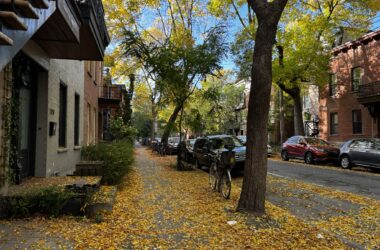
Four eco-friendly practices for Montreal apartment living

(Ruby Reimer / The Tribune)

As summer winds down and a new academic year approaches, many students are moving into—or back into—their Montreal apartments for the fall semester. Whether you’re settling into your first off-campus space or returning to a familiar rental, it’s the perfect time to establish habits that are good for the planet and your wallet. Luckily, making more sustainable choices doesn’t have to mean overhauling your life or spending a fortune; some of the best eco-friendly changes are also the simplest.

At The Tribune, we’ve rounded up four small swaps you can make to live smarter, greener, and more intentionally this school year.

Ditch paper towels for dish cloths

Paper towels may be convenient, but their environmental impact adds up fast. A 2012 study from MIT found that two paper towel rolls produce 15 grams of CO2 emissions. With daily use in the kitchen, bathroom, and beyond, these seemingly insignificant emissions  have a substantial environmental impact. Instead, switch to reusable dish cloths or rags, which can be washed hundreds of times. This simple swap cuts back on landfill waste and the emissions associated with manufacturing and transporting single-use products. 

Master the secondhand marketplace 

Moving into your apartment often means stocking up on furniture, kitchenware, and home decor. But before you make a beeline to IKEA, consider buying secondhand. After all, the purchase of pre-owned pieces keeps usable items out of landfills. Montreal is a goldmine for pre-loved home essentials. From the thriving thrift store scene to vintage shops and community-driven platforms, there are plenty of options to furnish your space without generating more waste. Local thrift shops like Renaissance offer not just clothing, but also dishes, lamps, small appliances, and quirky decor pieces that add character to your space. Éco Dépôt is another fantastic option for sourcing vintage furniture. Lastly, Facebook Marketplace can become your go-to for affordable, local finds. Make sure to search for your desired pieces in both English and French to double your chances of finding what you need—try swapping “coffee table” for “table basse,” or “dresser” for “commode.”

Clean green

Commercial cleaning products end up polluting the environment when they evaporate or travel through drains. According to the U.S. Environmental Protection Agency (EPA), cleaning products contain certain chemicals such as alkylphenol ethoxylates that may be detrimental to aquatic habitats. One way to reduce the release of pollutants is to make your cleaning products at home. You can complete most cleaning tasks around your apartment with a combination of three ingredients you probably already have: Water, white vinegar, and lemon juice. Mix them in equal parts, then pour the mixture into a reusable spray bottle for a versatile all-purpose cleaner. This simple solution can tackle almost every surface in your apartment—from the stove top to the bathroom tiles—without harming the planet.

Air it out

In the average Canadian household, appliances account for 13.6 per cent of total energy use. According to the non-profit Green America, households that opt to air-dry clothes can reduce their carbon footprint by 2,400 pounds a year. Air-drying doesn’t just benefit the planet: The high heat and tumbling of dryers can weaken fabrics, cause shrinkage, and fade colours over time. When you hang your clothes to dry, they last longer, allowing you to replace them less often. Sure, Montreal winters and rainy days aren’t always conducive to outdoor drying, but that doesn’t mean you need to rely on your dryer year-round. A collapsible drying rack can hold an entire load of laundry without taking up space in your apartment between washes. Plus, in dry winter months, indoor air-drying can even add a bit of humidity back into your home.

Behind the Bench, Sports

The blurry lines between poor sportsmanship and racism in women’s professional tennis

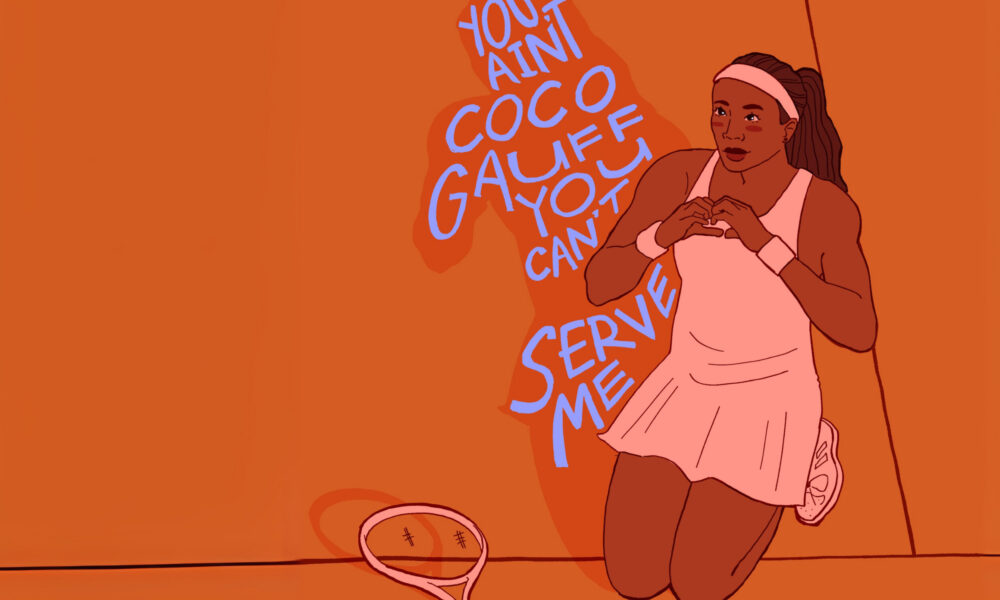
On June 7, American tennis star Coco Gauff fell to the ground in pure emotion upon winning the 2025 Roland-Garros (French Open) final. The 21-year-old shone in the match’s second and third sets to beat renowned Belarusian player Aryna Sabalenka, currently ranked number one in the world by the Women’s Tennis Association, 6-7 (5), 6-2, 6-4. Gauff’s victory makes her the first American singles champion at the French Open since Serena Williams, who took home the trophy a decade prior.

After Gauff’s wonderful Roland-Garros performance, she immediately acknowledged Sabalenka’s strength as a player, and congratulated Sabalenka and her team, in her post-match speech. However, Sabalenka did not extend the same courtesy to her competitor, choosing to blame her definitive loss on the day’s windy conditions. Sabalenka also claimed in a post-tournament press conference that her 70 unforced errors throughout the game’s three sets meant she was able to “give those wins” to Gauff.

“It felt like a joke honestly, like someone from above was just staying there laughing and like, ‘Let’s see if you can handle this’ […] and I couldn’t today,” Sabalenka proclaimed, crying. “I think [Gauff] won the match not because she played incredible, just because I made all of those mistakes [….] She simply was better in these conditions than me.”

Sabalenka continued by speculating that, if she had not beat the 2022, 2023, and 2024 French Open champion Iga Świątek in the 2025 semifinal match, Świątek would have taken the title from Gauff in this year’s Roland-Garros final.

Rightly, viewers around the world criticized Sabalenka for being a sore loser. But for Sabalenka to frame the French Open final as her—and even Świątek’s—losses, rather than as Gauff’s win, goes beyond poor manners: It reflects a persistent desire in tennis to minimize and villainize Black women’s accomplishments. Black women’s tennis successes are frequently framed as a result of their ability to “intimidate” their opponents with their “extreme physicality,” or as the result of luck. Rather than admire or acknowledge the pure skill and determination Black women—just like all other professional athletes—bring to elite tennis, white players and the media reduce them to racist caricatures, commenting on their Blackness above all. And when Black women lose, their frustrations are demonized, while white runners-up go uncriticized for their tears and outbursts. Whether Black women in tennis are winning or losing, professional tennis culture clearly treats their excellence as on the line every time these athletes step on the court.

Unfortunately, this year’s French Open is not the only instance of Sabalenka making underhanded remarks towards Gauff’s success. When Gauff defeated Sabalenka2-6, 6-3, 6-2—in the 2023 US Open final, Sabalenka attributed her loss to “overthinking” in the presence of a roaring American crowd who were eager to see Gauff take the win on home soil. In a press conference following the match, Sabalenka stated, “The good news is that it’s me against me. The bad [news] is that I’m still having these issues playing against myself [….] But it’s okay. I’ll work harder so next time, I’m not going to get even a little bit tired on court, and so I’ll be better.”

Sabalenka treating Gauff’s wins as dependent on her own focus and energy levels is clearly a pattern of attempting to undermine Gauff’s tactical, exciting, and world champion-worthy playing style. By repeatedly centering the outcome of a match on her personal abilities, Sabalenka has tried to erase Gauff’s success from the scoreboard, time and again.

When white opponents undermine Black winners in this way, they enable and condone racist tennis coverage that aims to further dehumanize Black women in the sport. Black women in tennis are frequently painted as inhumanely strong: In a 2013 Rolling Stone profile piece, a white journalist described Serena Williams as “‘built like one of those monster trucks that crushes Volkswagens at sports arenas.’” In 2014, the President of the Russian Tennis Federation, Shamil Tarpischev, called Williams and her sister Venus the “‘Williams brothers,’’ perpetuating the masculinization of Black women to devalue the sisters’ Grand Slam dominance of the time. And when not likening Black women to men, the media attempts to whitewash them, with one of player Naomi Osaka’s own sponsors depicting her with lighter skin in a 2019 advertisement. Women’s tennis coverage therefore either amplifies or conceals its athletes’ Blackness, treating them as exceptional for the completely wrong reasons.

In response to Sabalenka’s remarks that Świątek could have taken the French Open win, Gauff stated to the same press contingent, “I don’t agree with that [….] Last time I played, no shade to Iga or anything, but I played her and I won in straight sets. So, yeah, I don’t think that’s a fair thing to say [….] The way Aryna was playing the last few weeks, she was the favorite to win. So I think she was the best person I could have played in the final, her being number one in the world. So I think I got the hardest matchup.” 

Gauff could have gotten more specific and pointed out that she, in fact, crushed Świątek—6-1, 6-1 in 64 minutes—in May’s Madrid Open. Gauff also could have declined the private and public apologies Sabalenka offered her after receiving widespread internet criticism for her conduct. But Gauff rose above, openly forgiving Sabalenka and repeatedly praising her tennis. The two athletes even made a lighthearted TikTok video together at Wimbledon on June 27. 

“I’m gonna give [Sabalenka] the benefit of the doubt,” Gauff stated on Good Morning America, in one of many interviews where she was asked to respond to Sabalenka’s comments. “I’m sure it was just an emotional day, emotional match [for her].”

Gauff’s grace and class in response to Sabalenka are commendable. But it is disappointing that a major focus of Gauff’s post-win press has been Sabalenka’s actions, rather than Gauff’s successes. The onus has been placed on Gauff to handle Sabalenka’s outburst, and thus to justify and defend her own win. This skewed coverage diverts from public admiration of Gauff’s status as the highest-paid women athlete globally of 2024, or of her now-two Grand Slam titles, all earned by the age of 21. Rather than celebrate Gauff’s stardom, the press has tainted coverage of Gauff’s Roland-Garros win by instead giving attention to a player on her way to the unwanted list.

The professional tennis community and media circuit must start recognizing and celebrating Black women unconditionally, instead of doubting these athletes and trying to efface Black winners from their own wins. Gauff herself touched on doubt in her post-Open speech, referencing the Tyler, The Creator lyric, “I ain’t never had a doubt inside me, / and if I ever told you that I did I’m f*cking lying.” While she was referring to her own anxieties coming into Roland-Garros, Gauff’s words against doubt must be taken by the wider sports community as a call to challenge their racist invalidations of Black women on the court. Questioning Black excellence in women’s professional tennis constitutes a major lie: One which Gauff’s amazing style of play will continue to prove false in the years of her career to come.

(Antoine Larocque / The Tribune)
Research Briefs, Science & Technology

Back to the roots: Investigating how soil influences root traits

Plant roots may be out of sight, but they are not out of mind for McGill researchers. While it is known that fine roots—those less than two mm in diametre—possess highly variable physiological and morphological properties, the reasons behind this variation remain unknown. 

Caroline Dallstream, a PhD student in McGill’s Department of Biology, hypothesized that the heterogeneous nature of soil was a key driver of fine-root trait variation at small spatial scales. To test this, Dallstream and her collaborators investigated the potential drivers of fine root variation of the Handroanthus ochraceus tree across spatial scales—from individual roots to entire forest sites more than 10 km apart from one another in Costa Rica’s dry tropical forests.

Dallstream measured a number of soil variables, including magnesium, ammonium, and nitrate levels. She compared these against different fine root traits, such as the roots’ overall morphology, nitrogen concentration, arbuscular mycorrhizal fungi (AMF) colonization—symbiotic fungi that enhance nutrient uptake—and phosphatase activity—an enzyme that removes phosphate groups from molecules.

Although the research focused on a single tree species, Dallstream and her collaborators collected a wide range of root trait data from the same sample. This approach allowed them to find correlations between several different traits simultaneously: A key strength of the study. Dallstream also noted that later research could apply their experimental approach to other species, which could allow scientists to generalize the findings to better understand how soil influences fine roots.

When discussing their findings, she explained how fine root traits interact in complex ways across different scales.

“[The studied] fine root traits tend to coordinate and trade off in complex ways, and these trade-offs arise across many scales,” Dallstream said in an interview with The Tribune. “But we saw that within [Handroanthus ochraceus], […] the two dominant finite trait coordinations and trade-offs were both driven by soil, but at different spatial scales.”  

In other words, different soil properties influenced different root traits.

“Fine root respiration and morphology were being driven by soil nitrogen, and fine root arbuscular mycorrhizal colonization and enzyme activity for organic phosphorus were being driven by soil magnesium and bulk density,” Dallstream explained.

The former data points varied at the individual root level, as soil nitrogen was highly variable within sampling sites. In contrast, AMF colonization and phosphatase activity varied across a larger spatial scale, reflecting large-scale heterogeneity in soil magnesium and bulk density among sites.

Dallstream was surprised to find a correlation between root phosphatase activity and AMF colonization.

“It is possible that the [AMFs] are producing that enzyme, which means that they could be contributing to plant nutrient uptake even more substantially than we already think that they are, because the prevailing idea is that they mostly just absorb [nutrients that are] already available, rather than breaking down more complex compounds for plant uptake,” Dallstream said.

These findings may help scientists find a new perspective on how plants and their roots interact with soil nutrients.

Since magnesium seemed to influence AMF colonization, Dallstream suggested that future studies on plant-soil interactions focus on a wider array of essential plant nutrients. Currently, most studies concentrate on nitrogen and phosphorus, which are thought to be the most limiting nutrients in temperate and tropical areas, respectively.

Dallstream was intrigued by the positive correlation she found between soil magnesium content and AMF colonization; this discovery has since inspired her ongoing work.

“I am currently doing a greenhouse experiment with some tropical tree species to look at how magnesium influences [AMF] colonization and testing a few of the potential mechanisms that could be underlying it,” Dallstream elaborated.

One mechanism she hypothesizes could explain this relationship is that magnesium—a key component of chlorophyll that activates carbon fixation in plants—may increase photosynthesis, allowing plants to send extra carbon to their AMFs to help them acquire even more nutrients.

For Dallstream, the motivation for this research goes beyond academic curiosity.

“I think this research is important because plants literally underlie all life on Earth, and despite that, we still know very little about their basic biology,” Dallstream said.

Looking at the bigger picture, Dallstream’s findings help to better understand ecology in the tropics, addressing a gap in plant literature. Further, they inform how plants coordinate their nutrient acquisition, which usually consists of the fundamental limitation of plant growth, and, therefore, carbon sequestration. These findings could thus allow scientists to improve ecosystem models used to predict ecosystems’ response to climate change.

Arts & Entertainment, Film and TV

The Bear is back and breaking cycles, not plates

I worked as a server in high school, and I can attest to the chaos that takes place within a restaurant kitchen. Notorious melting pots of large personalities, kitchens are often home to screaming matches and shattered plates. This conflict remains hidden from customers, tucked away behind the facade of crisp napkins and classy service.

However, we don’t always crave this polished front. Sometimes, we prefer to experience reality, no matter how harsh, rather than accept the illusion of perfection. Consider the popularity of celebrity chefs, from Anthony Bourdain to Guy Fieri, Julia Child to Gordon Ramsay. We want the drama, the yelling. Let us smell the cigarette smoke, feel the hot oil splash onto our hands. We want a peek behind the curtain.

Hulu’s smash hit The Bear has been lauded as a painfully accurate depiction of restaurant culture. It tells the story of Carmen “Carmy” Berzatto (Jeremy Allen White), a world-class chef who returns to Chicago to take over his brother’s restaurant after his passing. In the first season, Carmy struggles to find his place among a mismatched cast of employees, but gradually gains their respect when he starts to appreciate each chef’s individuality rather than expecting them to conform. 2023 brought with it the show’s second season, in which Carmy and Sydney (Ayo Edibiri) transform the chaotic Italian sandwich shop into the show’s eponymous fine-dining restaurant. Season three further develops the tensions of trying to succeed in the restaurant business. 

The latest season, which premiered on June 25, raises the stakes: The restaurant has two months to start bringing in a profit and make it out of the red, or else The Bear will be forced to close its doors—forever.

Circles are a key motif in this season. Scallops. Kitchen timers. Plates, bowls. Cycles—whether they be of abuse or forgiveness, progress or hurt. Carmy struggles with repetition as his daily life begins to feel cyclical. In an early scene, he wakes to the muted dialogue of Groundhog Day playing on the television: “What would you do, if you were stuck in one place?” Like the film’s protagonist, Carmy is trapped—he’s entangled in a web of anger and grief, stuck between the pain he has endured and the harm he continues to inflict on those around him. As the episodes progress, however, it becomes clear that Carmy isn’t content with tracing the same circles. He learns to apologize, to atone, to take a deep breath rather than lashing out. It’s satisfying to witness; after hurting everyone around him, Carmy is well overdue for some good old-fashioned grovelling. 

Jeremy Allen White’s performance as Carmy is multifaceted and moving. However, the true standout actor of this season is Ayo Edibiri (also known for her roles in Gen Z cult classics Bottoms and Theatre Camp). Witnessing Edibiri’s rise to fame feels like watching a childhood friend become a celebrity; when she acts, she evokes an immediate sense of closeness, of personal connection. Every time she comes on screen, I feel the need to whisper “I know her” to whoever is beside me. As Sydney, Edibiri is unfailingly authentic, whether stumbling through conversations with near strangers at a wedding or trying to bond with her cousin’s 11-year-old daughter. In one heart-wrenching scene, Edibiri depicts the stuttering sobs of a long-overdue breakdown with stunning accuracy, proving her place in today’s top class of young actors.

Upon the release of its third season, viewers were dismayed to see that The Bear appeared to be caught in the cycle of once-great television shows that decline in quality over time. It struggled to keep up with the frantic page established in previous seasons, choosing to highlight long montages and artistic shots over plot or character development. Thankfully, like Carmy, The Bear is breaking free from its cycle. 

While the fourth season doesn’t return to the quick tempo of the first two seasons, it also strays from the aimless self-indulgence of the third, instead finding a sweet spot between the two extremes. Now, complex framing and artfully selected needle drops are paired with plot progression and emotional growth. Standout scenes are both beautiful and narratively compelling. Sydney cooks bathed in a rich violet in the third episode’s dream-like intro, inventing a key dish under the layered falsetto of St. Vincent’s “Slow Disco.” Lit in deep blue, Camy and Richie sit in Wes Anderson-esque symmetry as tensions simmer.

The Bear isn’t the same heart-pounding, stress-inducing show it once was. Over four seasons, it has transformed into something slower, taking its time and allowing its viewers to grow along with its characters. Ask me a year ago and I might have hesitated, but after watching the newest season, I believe The Bear is one of the best shows currently streaming. While I love eating popcorn on the couch while Carmy and Sydney bicker amid shots of mouth-watering meals, I don’t want to step foot in a restaurant kitchen again for a long time.

Creative, News

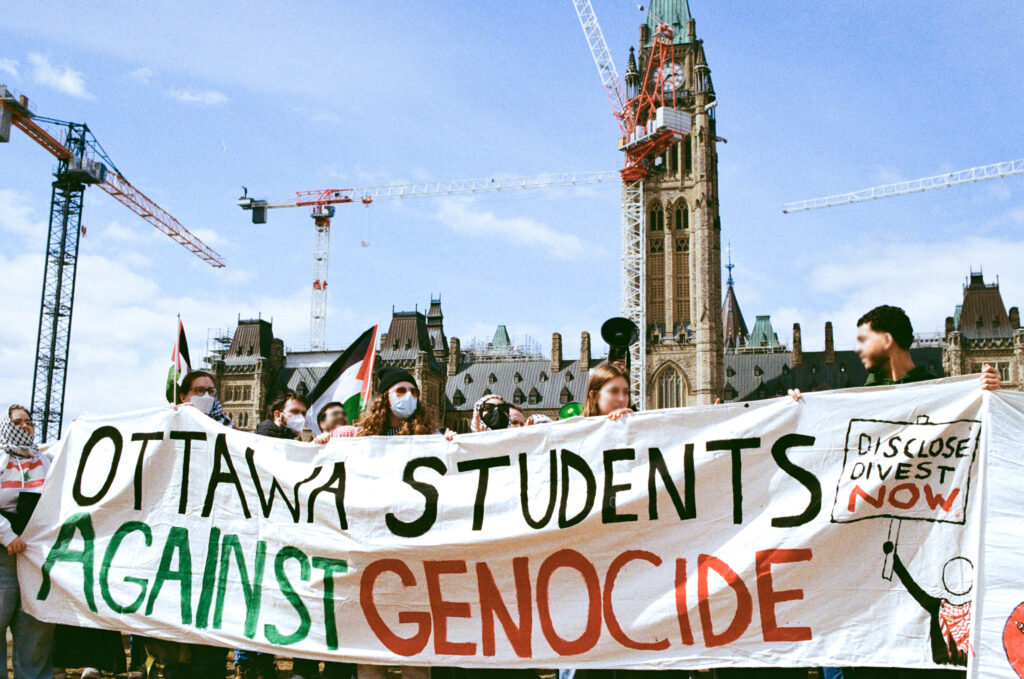
Students protest for Palestine at Parliament, in photos 

~DIGITAL~

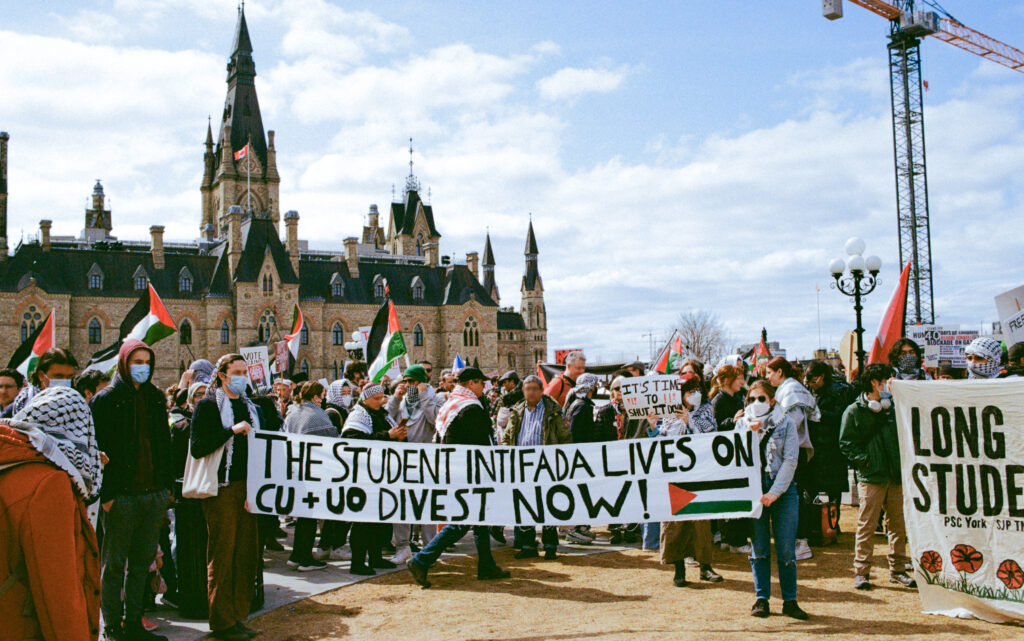
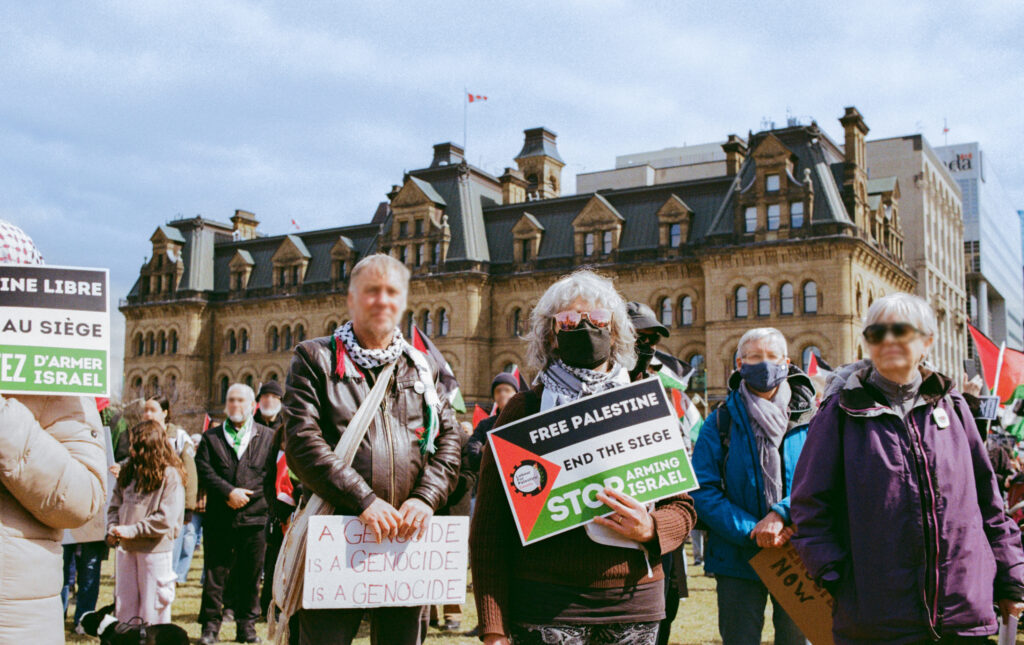
Thousands of protestors from across Canada gathered for a rally on Parliament Hill in support of Palestinian liberation on April 12. The central message of the Palestinian Youth Movement (PYM), one of the organizers of the rally, was that “Canada must end its complicity [in the genocide] by demanding a ceasefire, the lift of the siege on Gaza, the flow of humanitarian aid and imposing a full two-way arms embargo.”
Protestors demand an arms embargo. A March 26 report released by Project Ploughshares revealed that the Canadian government had broken its commitment to suspend arms exports and indirect transfers through the US to Israel. 
Protestors denounce the killing of Palestinian journalists in Gaza. As of May 26, 2025, Israeli forces have killed 180 journalists and media workers since the Oct. 7 attacks, according to a report by The Committee to Protect Journalists.
In a social media post published on the day of the rally and march, PYM estimated the event’s attendance to surpass 30,000 people.
Protestors stand in front of Indigo Books & Music Inc., a Canadian business whose head executives, Heather Reisman and Gerry Schwartz, founded the HESEG foundation. The foundation provides scholarships and grants for individuals who move to Israel and join the Israeil Defence Forces. After the rally, thousands marched through the streets of Ottawa calling for boycotts of businesses affiliated with the state of Israel. 

~FILM~

Student organizations from multiple Canadian universities rallied on April 12. Students from Montreal, Québec City, Toronto, Ottawa, Hamilton and other cities in Canada gathered at the nation’s capital to support the cause.
The rally took place 3 days after McGill’s Interim Deputy Provost (Student Life and Learning), Angela Campbell, announced the university’s intent to terminate its Memorandum of Agreement with the Students’ Society of McGill University (SSMU), condemning the SSMU’s strike for Palestine
Protestors demand an end to Israel’s renewed blockade of Gaza, which has been in place since early March. As of May 20, 2025, 930,000 children are at risk of famine according to a UN-backed Integrated Food Security Phase Classification (IPC) assessment.
Students from the University of Ottawa call for the university to divest from companies complicit in Israeli military offences. Together, McGill University and the University of Ottawa have invested millions in weapons manufacturing companies, such as Airbus SE, that contribute to the Palestinian genocide.     
This past semester, student unions from Canadian universities such as the University of British Columbia and McGill University have voted to go on strike in solidarity with Palestine.

Art, Arts & Entertainment

Faith in art over profit with ‘Berthe Weill: Art Dealer of the Parisian Avant-Garde’

In a corner of the exhibition’s second room, Émilie Charmy’s Still Life with Pomegranates sits beside Jacqueline Marval’s self-portrait Minerva. The scenes in oil are classical: Persephone, the daughter of Demeter, condemned to the underworld for six months for eating six pomegranate seeds, resurfacing in the spring only to descend six months later back into hell, becomes stained in rich red on Charmy’s canvas, where six open pomegranates spill onto a white platter. Marval’s Minerva stands in the woods holding a spear; the artist’s name emblazoned in large red letters across the bottom of her breastplate. Marval trained as a seamstress and signed her name on her image’s clothing as if embroidered onto the armour’s scales. The scenes are reimaginings, but ones that are true to the myths they spring from—women painting themselves into the past, not to insert themselves into history, but to tell the stories where they’ve existed all along.

We don’t know if Minerva hung in Berthe Weill’s gallery—documentation surrounding the painting is limited and scholarly work to unearth Weill’s life is ongoing. She was, routinely and repeatedly, by both historians and her contemporaries, written out of the story of the Parisian Avant-Garde and modern art as a whole.

Weill, a lifelong Parisian, grew up in an Alsatian Jewish family. Though she was raised without money and often struggled to stay afloat throughout her career, she displayed a categorical indifference to profit. She believed in her artists and the art they produced, did not charge them to exhibit their work (as her contemporaries did), and refused to exhibit art for its monetary value.

As Weill writes in her memoir, Pow! Right in the Eye!, “I would rather eat bricks.”

Berthe Weill, Art Dealer of the Parisian Avant-Garde is a joint force between Montreal, New York, and Paris, curated by Anne Grace, Curator of Modern Art at the MMFA; Marianne Le Morvan, founder of the Berthe Weill Archives; Lynn Gumpert, former Director of the Grey Art Museum at New York University; and Sophie Eloy, Attaché to the Collection at the Musée de l’Orangerie.

“We were able to draw attention to artists that certain museums have in their collection that they were not even very conscious of,” Anne Grace said in an interview with The Tribune.

The exhibition—centered around an art dealer as opposed to an artist—produces a polyvocal picture of Belle-Époque Paris: The story of artists who came and went, works Weill sold, and those she championed against the grain. 

The resulting recreation compresses time and extrapolates space. Forty years spanning the first half of the 20th century in a small Montmartre space are transformed into a major exhibition spread across several rooms in Montreal. Modigliani, Picasso, Cézanne, and Chagall are displayed amongst invitations to costume balls at the gallery, bulletins, and courtroom sketches. Weill’s spectacles lie lens-less and unlabelled in a glass case beside an ink portrait of the dealer by Édouard Goerg.

Weill did not train in an art gallery, but in an antique shop. It belonged to her cousin, Salvatore Mayer, and upon his death, Weill opened her own antique shop alongside her brother. The shop transformed into a gallery of her own, carefully named so as not to reveal the dealer’s gender. Galerie B. Weill opened in 1901.

She lined her gallery with paintings, but also prints, pendants, pottery, sculptures, and jewelry. 

“She, in general, had this openness and complete disregard for hierarchies [….]  She probably finished school around the age of 10, when public education for girls stopped. So she wouldn’t have necessarily had this ingrained notion of hierarchies in medium or subject matter,” Grace said.

When Weill met Amedeo Modigliani, he was drunk in her gallery; two years later, in 1917, she became the first—and only—dealer to organize a solo exhibition of Modigliani’s works during his lifetime. The exhibition was later shut down by order of the police commissioner. The nudes had pubic hair. This overwhelmed many viewers. The commissioner took Weill into the local precinct for questioning: “Those disgust-” he exclaimed to Weill. “They…they… h-h-h-have hair!” No works were sold, save for those that Weill purchased for herself.

Weill wanted to exhibit young artists, the unknown names—a group she affectionately referred to as “les Jeunes”—and championed émigré artists in Paris. The vibrant world of 20th century art is spread out across the exhibition. In the first room, there’s The Wretched, a mass of intertwined bodies in bronze by Meta Vaux Warrick Fuller—an African-American sculptor who would train with Rodin in Paris before returning to the U.S. to sculpt the Harlem Renaissance. There’s The Bird Cage by Marc Chagall, a Jewish Russian-French modernist, featuring an anthropomorphic rooster-man in purple pants playing a fiddle. There’s Marie Laurencin’s Woman Holding Flowers, a gossamer scene in oil (the label recounts the story of Laurencin, a queer cubist painter, bursting into Weill’s gallery and declaring, “I want to meet a lesbian!”).

Suzanne Valadon’s Nude with a Striped Blanket, or Gilberte in the Nude Seated on a Bed shows her niece, nude, sitting with her legs swung onto the floor at the foot of her bed. She’s slightly slouched. Her form is not contorted for show: Not spread, not bent, not splayed. I recognize her body’s configuration—how she stretches her legs, how she leans, how she reads, the creases and folds on her stomach—it’s how I sit.

Valadon painted women who exist as they are, without a voyeur. It’s a nude form that doesn’t exist to produce desire.

The movements that Weill championed—Fauvism, Cubism—are those that took reality and refused to canalize it into something empiric or straightforward. They mirror the approach that Weill herself took in her indifference to profit: She desired something beautiful and intangible that focused on the heart of the art itself, as opposed to trying to turn it into something material and marketable. In her lack of education, lack of money, lack of opportunities, Weill reached inward to find what art moved her, and in looking outwards, advocated for art that subverted the language of production that she herself had never desired to speak. 

A vision of the body that doesn’t exist to yield desire. Art that doesn’t exist to yield money. 

In 1940, the Nazis invaded Paris. Le Cahier jaune—an antisemitic French periodical—published a virulent attack on Weill, writing that she was greedy, caring only for money and not for art. Weill went into hiding, transferring her gallery to a non-Jewish friend in an attempt to save it. A year later, Galerie B. Weill closed forever.

Weill survived the war. Details of her life under occupation are obscure, made more difficult to pin down because Weill had to make herself hard to find in order to have a chance at survival. Two of her artists, Otto Freundlich and Sophie Blum-Lazarus, died in concentration camps. 

Photographs of Weill from any period are hard to come by. Portraits of her are limited, and those that exist and survive, namely Émilie Charmy’s Portrait of Berthe Weill, show her standing upright, unsmiling, her five-foot frame swallowed by a large black coat buttoned up to the neck, her left sleeve rolled up to reveal a wristwatch.

“She really focused her attention on the artists themselves, and not herself. So the self effacing aspect, I think, is revealed in both her physical appearance, the way she dressed and the lack of portraits, whether they be painted or photographic portraits,” said Grace.

Contrary to the lack of images of Weill, she is thought to be the first art dealer to write and publish her memoirs during her lifetime (she beat out the publication of her rival dealer Ambroise Vollard’s autobiography by a year).

Berthe Weill died in 1951. She was blind. Weill—who had never married, and used her dowry to fund the gallery in its early days—was left destitute in the wake of the war. In her last years, as her health declined, the artists Weill had championed early in their careers, when no one else would, organized an art auction to raise money for her care. Chagall, Picasso, Metzinger, and other prominent artists and gallerists raised 1.5 million francs for the woman they called Mère Weill—a homophone with “merveille,” “wonder” in French—and supported her until the end of her life, as she had once supported them.

Berthe Weill: Art Dealer of the Parisian Avant-Garde will run until Sept. 7, 2025. Tickets are available online or in-person at the Montreal Museum of Fine Arts. 
Weill’s memoir Pow! Right in the Eye! Thirty Years behind the Scenes of Modern French Painting is available in print and as an ebook through the McGill Library.

McGill, News

SPHR commemorates student movement victories, including PAGIP’s ratification, one year after Palestine Solidarity Encampment

On May 4, Students for Palestine’s Honour and Resistance (SPHR) at McGill hosted a community gathering and fundraiser for Gaza on McGill’s Lower Field. These eight hours of programming marked the anniversary of the Palestinian Solidarity Encampment, established by student protestors on the Lower Field one year prior. 

In an interview with The Tribune, a representative of SPHR at McGill who wished to remain unnamed explained how the gathering reaffirmed the encampment’s project of solidarity with the broader global movement for Palestine.

“We’re seeing students again gather on Lower Field […] to bring the [city-wide] community, and the student base, together again,” they said. “To again take up space on our campus, reclaim our campus, but also engage in these cultural and political activities that should be making up our education.”

A Concordia student attending the gathering who wished to remain anonymous echoed the impact the encampment had beyond McGill’s campus.

“Concordia students have their own demands towards Concordia,” the student said in an interview with The Tribune. “Many actions have been at Concordia, and it’s actually thanks to the encampment. The encampment really sparked that student protest.”

Along with creating solidarity across different pro-Palestine activist groups, the encampment strove to push McGill to disclose and divest from all companies complicit in the genocide in Palestine, to drop disciplinary charges against student protestors for Palestine, and to publicly denounce the genocide. The encampment stood for 75 days, despite facing repeated legal contestation, before McGill-employed private security and police forces ultimately dismantled it on July 10, 2024. 

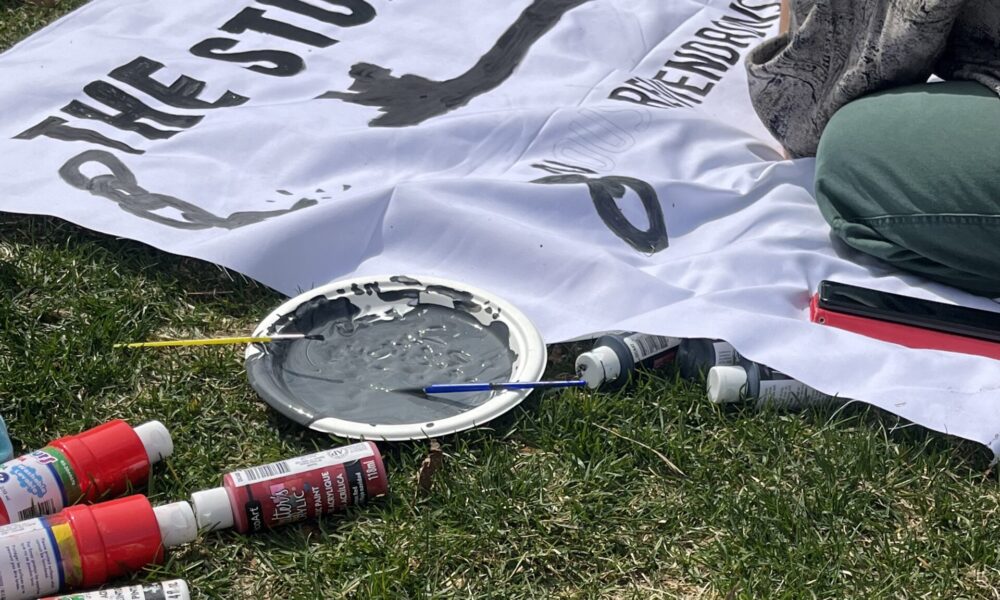
The SPHR fundraiser marking the encampment’s anniversary began with an art build, during which attendees helped paint a banner for an upcoming Palestinian Youth Movement Montreal demonstration. The day’s programming, designed similarly to educational events held during the encampment, also included letter writing to Palestinians killed in the genocide, a film screening of The Time That Remains, and a tatreez—Palestinian embroidery—circle. 

The SPHR representative told The Tribune how the gathering also intended to commemorate the ongoing fight for Palestine that the encampment has inspired, citing recent Students’ Society of McGill University (SSMU) victories—such as its strike for Palestine and its ratification of the Policy Against Genocide in Palestine (PAGIP)—as examples of its effect.

“Of course, it’s hard to celebrate anything when there’s an ongoing genocide, but it’s incredible to see how much our movement has been able to achieve,” the SPHR representative said. “We’ve been really able to show since the encampment how steadfast the students have been.”

The PAGIP was approved by 78.7 per cent of non-abstaining student voters well before the encampment’s inception, in the SSMU Fall 2023 Referendum. Once ratified, the PAGIP would require SSMU to lobby McGill to denounce Israel’s siege on Gaza, divest from companies complicit in the genocide, and cut academic ties with Israeli universities. 

However, the Policy was suspended via injunction on Nov. 21, 2023, as an anonymous student plaintiff, with the support of B’nai Brith Canada, argued to the Superior Court of Quebec that PAGIP posed a threat to Jewish students on campus. On May 22, 2024, the Superior Court again granted a demand for an injunction against PAGIP’s ratification. SSMU’s legal team has sought to appeal the injunction since.

On April 17, the Court of Appeal of Quebec unanimously overturned the injunction against PAGIP, noting that it is not the role of courts to resolve political debates within a student association. SSMU officially ratified PAGIP on April 22 through May 1, 2028. 

In a press conference outside the University Centre on April 25, SSMU Vice-President External Hugo-Victor Solomon alleged that McGill committed a “sustained campaign of repression” against student organizers for Palestine leading up to the Court of Appeal’s decision.

“Nearly 80 per cent of 8,000 student voters supported this policy,” Solomon reported during the conference. “That’s not fringe. That’s not exceptional. That’s not controversial. That is the outcome of democracy [….] This victory belongs to every student, Jewish, Palestinian, Muslim, Arab, and allied, who stood firm in the face of repression, [and] who refused to let silence be the price of their education.”

Solomon also directly affirmed SSMU’s commitment to upholding their obligations under PAGIP.

“On behalf of the 25,000 members of the SSMU, and pursuant to Section 2.4 of the Policy, I unequivocally condemn the ongoing genocide, war crimes, and human rights violations endured by the steadfast people of Gaza,” Solomon stated. “We affirm, once and for all, that the Students’ Society of McGill University stands in unambiguous solidarity with our Palestinian and Arab peers.”

At the fundraiser, the SPHR representative commented on PAGIP’s historic adoption by SSMU.

“Our student union has for the first time […] condemned the genocide in Gaza and finally taken a political stance that the student body has continuously reiterated,” they said. “Next year, we don’t know what things will look like, but our student union now has ratified a policy that ensures it’s taking a stance for the Palestinian struggle and for divestment, and so we’ll hopefully see SSMU represent the demands of the student body.”

McGill, News

Mohawk Mothers accuse McGill of concealing new evidence of human remains at the New Vic site

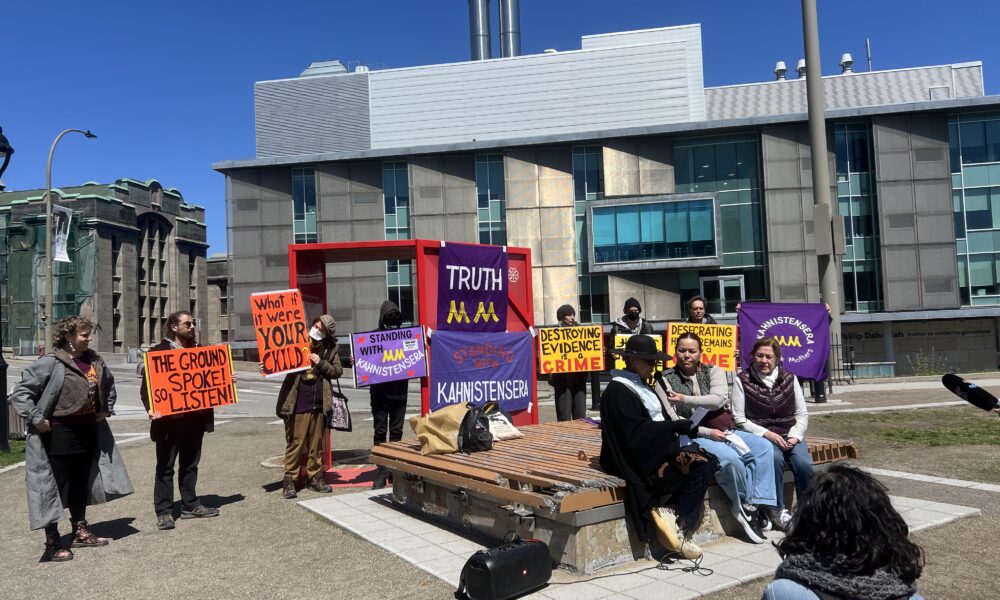
At a press conference on April 30, the Kanien’kehá:ka Kahnistensera (Mohawk Mothers) alleged that McGill University and the Société québécoise des infrastructures (SQI) found new evidence of human remains earlier this month at the site of the New Vic Project, where an ongoing investigation into possible unmarked graves is underway. The Mothers claim that McGill did not share its latest findings report with them, despite their previous settlement agreement requiring transparent communication between the two parties.
The Mohawk Mothers have been in a legal battle with McGill since 2015 over the construction of the New Vic Project, an $870 million CAD development which the Mothers claim is the site of unmarked Indigenous graves. The site hosts the former Allan Memorial Institute, where parts of the CIA’s MK-Ultra program—an unethical mind-control experiment conducted in the 1950s and 60s—were carried out. 

On April 6, 2023, the Mothers reached a historic settlement agreement with McGill, SQI, the Royal Victoria Hospital, the City of Montreal, and the Attorney General of Canada, mandating a comprehensive investigation into the site and a jointly appointed archaeologist panel to oversee work on the site. When the panel disbanded in August 2023, the Mothers turned to the Superior Court of Quebec, which ordered McGill to reinstate it. McGill successfully appealed, and the Supreme Court of Canada later declined to hear the Mothers’ appeal. As a result, the panel remains inactive.

During the press conference, the Mothers detailed the potential evidence found on the site following their agreement with McGill: Hundreds of small bone fragments of unknown origin, fragments of two children’s shoes from the early 20th century, and alerts from historic human remains detection dogs (HHRDDs). The Mothers cited a study indicating that there is only a 0.06 per cent chance of two HHRDDs falsely identifying remains at a site—three separate dogs indicated the presence of possible remains at the New Vic site. 

The new report allegedly suggests the presence of remains at the site based on the culmination of evidence from three separate remote sensing technologies in the past two years: Ground penetrating radar, human remains detection dogs, and most recently, an S4 Subterra Grey probe, which is specially designed to detect unmarked graves. 
In an interview with The Tribune, Mohawk Mother Kwetiio described her conflicting emotions surrounding their discovery of the report.

“It’s very bittersweet because you would like to think that there’s nothing there,” Kwetiio told The Tribune. “I didn’t want anything to be there, and yet I wanted them to be found [….] It just brings back all of the trauma.” 

In a written statement to The Tribune, McGill’s Media Relations Office (MRO) wrote that the most recent report on the presence of remains was commissioned by the SQI, not by McGill, as the land in question falls under the SQI’s purview. The MRO also denied the Mothers’ claims that human remains are on the site. 

“Since work on the New Vic project has been launched, no human remains, or unmarked grave indicators of any sort have been found,” the MRO wrote. “McGill has respected the spirit and the [settlement agreement] since its inception.”  

In light of these developments, Mohawk Mother Kahentinetha told  The Tribune that the Mothers sent a letter the morning of April 30 to the Assistant Chief Coroner of Quebec, Géhane Kamel, requesting that she intervene to prevent McGill’s further excavation of the site, which could damage potential evidence. 

“We […] asked the coroner to work with Indigenous experts, a Mohawk medical pathologist, and a Mohawk archaeologist alongside cultural monitors to ensure a credible, transparent and impartial investigation,” Kahentinetha said.

Phillippe Blouin, an anthropologist and associate of the Mothers, elaborated on the importance of McGill’s collaboration with Indigenous Peoples themselves. 

“All this talk about reconciliation has to lead to meaningful action with the [Indigenous] people actually existing here,” Blouin said. “There are people all around, many are in Kahnawà:ke, and they have specific demands.”

Despite their efforts, Kahentinetha highlighted the ongoing challenge the Mothers face in establishing productive communication with McGill. While they have attempted to engage in direct dialogue with the institution, they claim that the response has been largely unresponsive.

“You know what I would like to do, and I tried to do, is […] talk to them and tell them about us, tell them how we feel, who we are, understand us, what our role is, and let’s talk together about it,” Kahentinetha said. “We’ve tried to do that, but it hasn’t worked. I hope it will.”

Letters to the Editor, Opinion

Letter to the Editor: The symbolic student voice

At McGill, the main conduit for student input in decision-making is committees, working groups, advisory councils, and other bodies that meet and deliberate. When decisions that impact students are made, students must have a role, as provided by both Quebec’s Act respecting the accreditation and financing of student associations and McGill’s own Charter of Student Rights.

The theory is nice, but all infrastructure with students incorporated is decaying. Governing bodies are quietly retired or transformed to exclude students. Remaining committees meet increasingly rarely. Agendas are written behind-the-scenes and dictate every moment of a meeting. McGill handpicks its own student membership. These shifts in power rely on the Students’ Society of McGill University’s (SSMU) lack of institutional memory and the fact that student leaders are unaware that things were once different. 

Some portions of governance are always being recycled. Governance upkeep is time-consuming and often underappreciated, in any setting. You might ask, is it notable that some committees are changing, or losing relevance? Not necessarily, if we consider one committee at a time. But my one year here has generated an extensive list of eroded governance processes involving students.  It is actually rarer to find a well-working committee than one in the process of being transformed to circumvent student input. Even reading good faith into the university, the result is the same: students, where they still exist on these bodies, are powerless. Claims of student apathy are used to justify this lapse in accountability.

The Student Achievement and Accessibility (SAA) Advisory Committee was discontinued this year, based on low student engagement. I found out only after emailing the SAA, having selected four student members. I spoke to a previous member who had good attendance, but found that the meetings were ineffective, and feedback was met with defensiveness. I asked to meet with the SAA in a town-hall setting, but they were unwilling to extend a meeting invitation to students beyond those who initially expressed interest in the advisory committee. 

The International Student Services Advisory Committee didn’t meet for the first half of the year because they were waiting for one representative to confirm their presence. The students that I assigned to the committee were never told. Their first meeting was in February.

The Committee on Student Services scheduled only four meetings; one was cancelled, and one was a training session. 

The University Health and Safety Committee cancelled three of their four monthly meetings during Fall 2024 due to a lack of agenda items. Their one meeting that semester was 10 minutes. 

Student members on the Committee on Student Grievances and the Appeal Committee for Student Discipline and Grievances were meant to get in-person training. This training was postponed multiple times and finally cancelled. Instead, they were given asynchronous training. 

The Equity, Diversity and Inclusion Committee (EDIC) has rejected every addition to the agenda requested by Subcommittee chairs, only allowing strictly defined governance items to be discussed. Only the Deputy Provost (Student Life and Learning) Angela Campbell was able to bring an item to the attention of EDIC that was unrelated to large-picture governance. 

The Universal Access Capital Projects Working Group (mentioned in this earlier blog post about the degradation of committees with student members) was also discontinued—I only learned of this when I asked at a meeting with McGill’s Director of Equity Tynan Jarrett. During that time, funding for at least one project, gender neutral bathrooms, was significantly cut. No students were alerted. 

When I went to attend meetings at the James Administration Building, I wasn’t on their list of visitors the first few times. I had to wait 5 to 10 minutes each time for the receptionist to call someone at the meeting room. 

I have submitted two requests for review to the Advisory Council on the Charter of Student Rights. As per the Charter, I should have heard back within 30 days. This didn’t happen either time, and I had to escalate the issue to McGill’s secretariat department to get a response. The second time, I was told the committee works on only one request at a time, the first of which has taken over six months.

I’m running applications for the 2025/2026 committee representatives, and the exercise seems insulting. I hate the idea that I’ll look through and filter hopeful students, and I’ll send their names off into the void, for them never to be contacted again. 

These lapses are especially relevant in a time when McGill is defining acceptable and unacceptable avenues for student voices. We are pointed to the institutional mechanisms, but how? Committees are being scrubbed from McGill websites. Student representatives are left in the dark. And when there are sufficient barriers to participation, and no students left, these committee leaders can say, “there’s no interest!” and return to their work without the inconvenience of consultation. 

Read the latest issue

Read the latest issue