
Latest News

Basketball, Know Your Athlete, Martlets, Sports

Know Your Athlete: Alex Kiss-Rusk

The 6’4” Arts fourth-year starting centre of the Martlet basketball squad bounds into the room eager to talk about her team. Though a bona fide Canadian collegiate basketball superstar in her own right, Alex Kiss-Rusk is one of the least individualistic, most team-oriented athletes on campus. As she begins what could be her final semester with the Martlets, she reflects on her years at McGill and how she has grown into the leader of the Martlets, both on and off the court.

“I’m captain this year,” Kiss-Rusk said. “We lost three key leaders off the court […] last year […] so that was different. I’ve been here for four years and I never had to worry about anything other than showing up to practices and games. [This year,] it’s been different, but it’s been fun.”

Former captain Miriam Sylla graduated last spring, leading Kiss-Rusk to play an expanded role this year.

“[Sylla] was obviously an amazing player and also a big personality,” Kiss-Rusk said. “We share the responsibility a lot more [now with Sylla gone], but certainly, because I’m the post, it definitely falls on me a lot more.”

Kiss-Rusk doesn’t shy away from the extra responsibility. Despite being a Beaconsfield, Quebec native, She played her first year at Virginia Tech and knows how tough it can be for young players living away from home for the first time to balance an academic workload, athletics, and a new lifestyle. Her experience places her in a position to assist the next generation of Martlets trying to adjust to McGill.

“It’s a bit of a shellshock in terms of school load and basketball and all these things, especially if you’re moving away from home,” Kiss-Rusk said. “We got into that on our team a bit too, where some girls didn’t know how to handle it.”

For Kiss-Rusk, leaving the NCAA to become a Martlet could have been an intimidating experience considering both her parents played basketball at McGill. Instead, she enjoys playing near home and having her parents in the stands each game.

“It’s no pressure,” Kiss-Rusk said. “I think the biggest difference playing here is that my parents can come to all my games [.…] Having them here able to support me […] because they live 10 minutes away, is really fun.”

Combining responsibility with fun is Kiss-Rusk’s mandate. In her final year, she has become more aware on the court and a liaison off the court between her teammates and the coaching staff.

“[As a leader] you have to deal with the things that you thought happened by themselves,” Kiss-Rusk said. “They don’t happen by themselves. There’s a lot going on behind the scenes, a lot of conversations, a lot of video. It has opened my eyes.”

The extra time put into her sport has manifested itself in Kiss-Rusk’s stellar performance this season, leading the team with 12.4 points and 8.5 rebounds per game. Nationally, she is one of the most dominant post players in the country. Her success has had a major impact on the team and has the Martlets consistently ranked among Canada’s elite women’s basketball programs. She has thrived while playing for McGill and whether or not she graduates from the team next year–she does have one more year of eligibility–she is hoping to keep a foot rooted in the game.

“Being involved in basketball […] is going to be important to me when I move on,” Kiss-Rusk said. “Just staying involved in team things.”


Who’s your favourite Redmen basketball player?

Dele Ogundokun


Most bingeable show on Netflix?

Breaking Bad. I’ve seen it three times.


Favourite restaurant in Montreal?

It would have been Altos! But that feels tragic to say.


Best class you’ve taken at McGill?

Developmental psychopathology.

Chill Thrills, Out on the Town, Private, Student Life

La Petite Floride: The magic school bus in the Mile End

Hidden away deep in the Mile End, at the corner of Rue Bernard and Avenue de Gaspé, sits a quaint school bus, a glowing skating rink, and, sitting outside the bus, is what seems to be a bar more fitting for tropical Hawaii than wintry Montreal. The café-bar’s name is written in bold black letters along the side of the bus: La Petite Floride.

This place is a bright spot compared to the dreary warehouses that surround it. Upon entering the bus, one is greeted by thumping dance music and groups of happy people hanging out with friends and strangers alike by either the fireplace outside or inside the bus itself. This bizarre idea of turning a bus into a café-bar came from the minds of a local non-profit organization called La Pépinière, whose mission is to convert unused urban spaces into creative hubs for the community. 

“It was a nice way for us to put winter in a […] place which is warm [and] can have a café. A place we can chill and hang out,” Elisa Schneuwly, one of the designers of La Petite Floride, said. 

The connection between the elements of the café-bar—campfires, skating rinks, and school buses—and Florida, a state that is home to alligators, palm trees, and Disney World, seems tenuous. However, to Schneuwly, the Florida-esque elements of the café-bar serve as a respite from the winter.

(Alex Gardiner / The McGill Tribune)

“[The name] is kind of a joke,” Schneuwly said. “It was because a lot of people from Quebec and Canada go to Florida for the winter and we were like, ‘Why don’t we think of a place where you can […] have fun and hang out? It’s an escape [from] winter for people who have to stay in Montreal.”

La Petite Floride is not a café-bar in its most literal definition, but rather a public space made for and by the community in the Mile End and Rosemont. Its creation was the result of  a collaborative project between Schneuwly’s team and La Pépinière, along with the neighbourhood of Plateau Mont-Royal and Les Amis du Champs des Possibles, to develop an unused piece of land called Agora des Possibles. 

“It’s a meeting place, a cheap place for people to meet from Mile End and Rosemont [….],” Schneuwly said. “We’re doing this project for people in the neighbourhood mostly. But also, people everywhere from Montreal [….] This is a design for the community.”

La Petite Floride was open in December 2016 and will be open until the end of March, a season in which most Montrealers would rather stay home than face brutal -30 degree celsius weather.

“There is a lack of animation and of things happening in the winter. Except huge projects like Igloofest [and] things at Quartier-des-Spectacles,” Schneuwly said. “At Mile End and Rosemont, there’s nothing really going on. So, we wanted to do something here in the winter, cause we see [other neighbourhoods] in Montreal do something there in the winter.”

The bus at La Petite Floride is a tight space, and this limits the size of their menu. Even so, they excel within their limited means. They have made this unconventional and narrow space very hospitable—every customer is greeted by friendly staff. Their small menu, including gooey grilled cheese and craft beer, is a great complement to a weekend get-together with friends and is definitely worth the short bus ride on the 55. 

A previous version of this article incorrectly stated that the owner's and staff have a dog called Duda who greets customers. 

Album Reviews, Arts & Entertainment

Album Review: I See You – The xx

The xx’s 2009 self-titled debut was a watershed album for indie rock, one that effortlessly fused after-midnight R&B with pop sensibilities. Eight years later, much has changed. World-shifting indie rock records like The xx’s debut now seem few and far between. The band itself has splintered off in different directions; Jamie xx’s emergence as a top-tier solo producer last year has raised the stakes for I See You even more. However, the band largely retreats into familiar territory with this new album. The xx seem too comfortable for their own good here, content to play to their individual strengths as musicians and songwriters. 

I See You started off promising. Album opener “Dangerous” begins with a boisterous blare of horns before settling into a menacing groove. It’s the most danceable song they’ve ever written by a mile—a bold new direction for the band. Romy Madley Croft and Oliver Sim’s central refrain of “you sound dangerous but I don’t care,” rings as true as anything they’ve written before. On previous albums, The xx were buoyed by the delicateness of their arrangements and the emotional power of their songs. “Dangerous” shows glimpses of a band that has sacrificed the former for a new kinetic energy, a shift that makes for thrilling listening.

Their winning streak continues on the next track, “Say Something Loving,” which demonstrates the band’s ability to communicate complex emotions simply and directly, something that has always been their strength. It’s a sparkling, effusive ballad, boasting a quiet confidence that shows that the band has had time to hone their talents.  Two songs in, I See You felt like the record listeners wanted from The xx—one that dares to push the envelope without sacrificing the qualities that made the band great in the first place.

If the album’s first act was bold, new, and full of energy, its second feels weighed down, derivative, and at its worst, drab. At times it sounds like The xx by numbers, with the token reverb-soaked guitar on “Performance” and ham-fisted dual vocals on “On Hold” sounding like tossed-off retreads of the band’s previous work. There’s a safety that pervades the back half of this record, a feeling of a creative risk that was contemplated, but not taken.

On Jamie xx’s standout track “Loud Places,” guest singer Croft described going to “loud places to search for someone to be quiet with.” On I See You,  The xx are faced with the opposite predicament—trying, for the most part in vain, to express intense emotions in spaces that are altogether too subdued.


Arts & Entertainment, Theatre

TNC’s “Be Tween” presents pubescent nostalgia

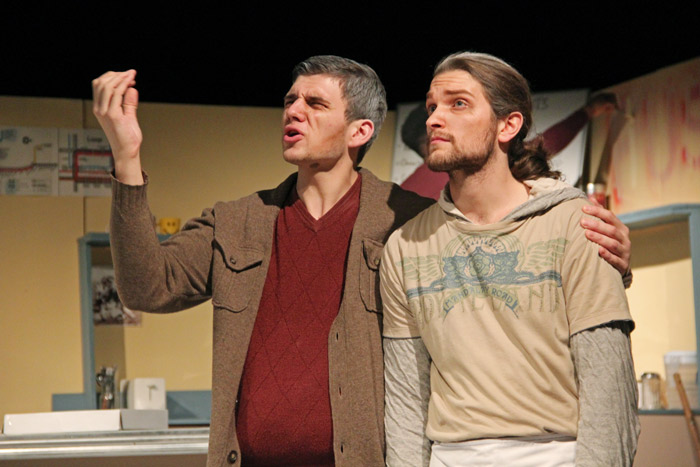
Tuesday Night Cafe (TNC) Theatre latest production, Be Tween, depicts the honesty the ephemeral and profound experience of undergoing puberty with charming honesty. Written and directed by Concordia student Phoebe Fregoli, the play begins with middle-schooler Gemma (Michaela Snoyer) waiting at a bus stop for her best friend Julie (Claire Morse). Here, she becomes acquaintances with Harriet (Hannah Silver), a grubby girl who is not afraid to talk about penises. What follows is a romantic, exhilarating unfolding of a day that transforms the lives of the principal characters. 

Be Tween began as a part of TNC’s 24-hour playwriting competition in which Fregoli composed a 10-minute play. The current production is an expansion of this original work, yet the single act retains the focus of its source material. The narrative is tonally focused and well-paced, with the success of the production resting on a small but strong cast of six characters. As the play follows the ensemble of middle-schoolers through a single day in their lives, its timeline is inevitably compressed. Fregoli’s masterful writing shines; she strikes the balance between expedited pace and nuanced character development. 

Fregoli’s use of space on the stage to mirror the dynamics of relationships between characters is also noteworthy. When Gemma and Harriet wait at the bus stop in the opening scene, the characters stand far apart, at the extreme ends of the stage. As their conversation blossoms, the characters gravitate towards each other. Fregoli uses distance to physically represent the initial wariness of the characters. This meticulous blocking is also noticeable when a character, jealous of the closeness between two other characters, steps between them, literally forcing the pair to separate. 

Other aspects of the production, most notably its set and sound design, complement the direction in making the characters come to life. 

The set, designed by Holly Hilts and Yasmine Dabbous, is unembellished yet artistic. The look of each scene is highly immersive: Two lockers flank the stage, decorated with cut-out photographs of actors from Harry Potter and Lizzie McGuire; multicoloured pennant flags hanging in the background subtly reminding the audience of the narrative’s middle school setting.


The score, curated by Lo Kecaj, is ambient, featuring iconic pop music from the late 1990s and early 2000s—including The Pussycat Dolls’ “Buttons” in a choreographed number, and Lil Mama’s “Lipgloss” in the school dance scene. Catchy and easily recognizable, the tunes lend the production a dimension of nostalgia, since the target audience was all but raised on these songs. In a similar vein, sounds that trigger transitions between scenes are archetypal of ‘90s visual media, but the success of their integration in the production is debatable; at times, the sound effects are forced and jarring, undercutting moments that otherwise had comedic potential. In general, however, the sound design is highly appropriate to the setting of the narrative and assists in making the production deeply engaging. 

Be Tween provides a rich commentary on adolescent lives by scrutinizing the mind of the tween, executed through creative demonstrations of the fantasies of its principal characters. Lighting, designed and operated by Margot Drukker, is critical in quickly transforming the mood onstage. The brilliant use of dimmed red lighting as a character hurriedly constructs a fake account of their first kiss is one notable example of effective set design.

Be Tween is a heartfelt and relatable story: To a tween, middle school feels endless; who partners with whom at the school dance seems capable of changing the course of one’s life. The production’s realistic portrayal of adolescent ignorance is complemented by its sympathetic treatment of the characters, allowing the audience to find meaning in humour, and sincerity in hyperbole.  


Science & Technology

McGill-led company, Carbicrete, designs carbon neutral concrete

The process of manufacturing cement—the primary material used in the production of concrete—accounts for five per cent of the world’s carbon dioxide emissions. The emissions from cement production are unsustainable at the planet’s current rate of development. However, Carbicrete, a McGill-led technology company, has developed patented technology that not only eliminates carbon dioxide emissions from this process, but sequesters carbon as well.

The Carbicrete team is composed of four members: Mehrdad Mahoutian, a research associate in the Department of Civil Engineering and Applied Mechanics at McGill; Chris Stern, a Mechanical Engineering graduate; Yuri Mytko, an MBA-holder who serves as the company’s CMO; and Mario Vendetti, a Mechanical Engineering graduate.

Mahoutian initially developed the idea for Carbicrete while working as a PhD student at McGill.

We were inspired by the fact that cement production is energy intensive and accelerates global warming,” Mahoutian said. “Our effort was to eliminate this dirty material as one of the raw materials of concrete and at the same time, utilize the waste materials of steel-making factories that mostly end up in landfills, resulting in [further] environmental issues.”

The team formulated a method to produce more durable, sustainable, and cost-effective concrete. While traditional concrete uses Portland cement as the primary binding agent, Carbicrete uses steel slag. Using steel slag is already a significant step towards sustainability, as it reuses a by-product of steel production that would have otherwise been labelled as waste. Additionally, steel slag is beneficial because the team is able to utilize a process called ‘carbonation activation,’ which allows for carbon sequestration. This process occurs after the concrete is first extracted from its mold. Carbon dioxide is then injected into the concrete while it is still fresh and malleable.

The fresh concrete is first placed inside a pressurized chamber, into which carbon dioxide is injected. Over a few hours, a reaction takes place between the slag and the carbon dioxide that develops the strength of the concrete, making it more durable than conventional concrete. The permanent sequestration of carbon dioxide within the material results in carbon-negative concrete.

“Compared to the conventional [concrete] block, Carbicrete is more resistant when subject to freeze and thaw cycles,” Mahoutian explained. “These durability properties may be beneficial for outdoor application, especially in Canada.”

The Carbicrete team has advanced to the semi-finals in the NRG COSIA Carbon XPRIZE competition, thanks to their unique design. Teams from six different countries have developed innovative technologies that aim to convert carbon dioxide into valuable products. For example, another semi-finalist has found a method to form toothpaste from carbon dioxide. The competition began in 2015 and will last four-and-a-half years in total. Semi-finalists will demonstrate their products in a location of their choosing and will be evaluated based on levels of carbon conversion and the net value of their technologies. Teams advancing to the finals must demonstrate the application of their carbon negative products in real coal or natural gas power plants. If Carbicrete wins, they hope to use the $20 million prize to grow the company.

Carbicrete’s current market is limited to Canada, but the company plans to expand to other countries, including the United States and China. Mahoutian does not promise that the expansion will occur overnight, but Carbicrete has already gained traction with local partners and support from the McGill School of Architecture. Within a few years, Carbicrete may be used to pave roads and sidewalks near you.

Out on the Town, Student Life

An afternoon at The Word: The history behind the Milton-Parc gem

Over the course of their time at McGill, a large portion of students become familiar with The Word—a quaint bookstore located on Rue Milton. Even during its busiest hours, there is a special sense of serenity that emanates throughout the shop. A calm, coordinated silence embraces the room, and a warm light illuminates its dynamic window display. It is an ideal environment for patrons to explore its vast treasures: Hundreds and thousands of neatly lined books form an organized procession of the preserved works of Steinbeck, Frost, Locke, and countless other great minds.

The peaceful, homey feeling of the store traces back to its origins: The Word was officially founded by Adrian King-Edwards and Lucille Friesen in 1975. Before the establishment opened, the duo ran a bookstore out of their home.

“In 1973 to 1974, I lived […] in an apartment next door, it was a four and a half apartment,” King-Edwards recalled. “All the doors along the street looked the same. [Friesen and I] were running an underground bookstore in our living room, so we put a picture of George Bernard Shaw in the window, so people would know that’s [what we were doing]. The door would be unlocked and students from McGill would walk in and buy books out of our living room.”

The two ran the hidden bookstore for approximately a year and a half, also hosting activities, such as poetry readings for their visitors. During that time, King-Edwards and Friesen were looking for a place to expand the business.

“One morning I came out to walk the dog, and this place [which] was a Chinese laundry for 70 years, there was a sign on the door [of the building] saying ‘For Rent,’” King-Edwards said. “It was so obvious [what I should do], you didn’t even need to think about it. It’s a beautiful building, it’s perfect.”

[metaslider id=49897]


Today, the store is owned by King-Edwards and managed by his son Brendan King-Edwards. King-Edwards’ wife, Donna Jean-Louis, has worked at The Word for several years, and their assistant Scott Moodie has worked there for 25 years. In over 40 years of existence, the layout and look of the store has not changed much.

“I’ve seen someone come in here with a letter from a friend in Europe saying, ‘Go to The Word and get me a copy of Marshall McLuhan,’ and [the letter] had the directions for where it was,” elder King-Edwards said. “The [sender] had not been in the store in five years, but the person with the letter goes […] and finds [the book right away].”

The comforting consistency of the store’s organization also applies to its business model, which has remained constant. As a second-hand bookstore, it is able to provide a large selection of works from various time periods at a low price. Almost all of the books in the store sell for $10 or less. The store also buys and sells textbooks for McGill classes, with some professors exclusively ordering and selling their course books through the establishment. 

The Word maintains a focus on collecting and selling works of classic literature, art, history, philosophy, and poetry. The owners take pride in how the collection is curated.

“Every single book has been chosen by us,” the elder King-Edwards said.  “When people phone me to go to their homes to buy books and I go in and they have maybe 2,000 books, I only choose the ones that I absolutely need that are the best in that library. So I take maybe 200 to 300 books. Usually, we are also very fussy about condition.”

Perhaps more important than the items it carries is the role the store plays in the lives of the people of the Milton-Parc community, including students and professors at McGill. As a small, intimate setting, The Word provides a cosy space for its visitors in a way that larger bookstores typically do not.

“It’s kind of a refuge for [some of our customers],” younger King-Edwards said. “People will often pass by and visit, even once a day and they are stressed, maybe they are a professor at McGill [….] They know that they can come in here and […] that it will be relatively quiet and […] they can have a little bit of reprieve from their day.”

Confirming the younger King-Edwards’s view of the store, there is a grey armchair in the centre of the store, where some visitors will spend hours, seeking solace in a world of words. The setup enhances the reader’s ability to engage in his or her book and escape his or her life for a while. It is this intimate aspect of the store that helps the storekeepers to form a closer relationship with their patrons, which is a large factor that keeps people coming back.

“There’s all kinds of book collectors […] and a lot of our regular customers will come by at least once a week because they know every week we will have new books,” the elder King-Edwards said. “[People return to our store] because they like books [and because] we’ve developed a friendship with them, and we get to know them, and when you know someone for 30 or 40 years, there’s usually a close relationship.”

These interactions between the owners of The Word and its patrons extends beyond the physical store. Brendan King-Edward sends out a monthly newsletter, which customers sign up for online. The newsletter contains lists of the best books the store has acquired over the month, and announces community events, such as the Christmas party they hold in the store annually. 

“One of my favourite parts about working at the store is sending out the newsletters,” the younger King-Edwards said. “I have a lot of fun interacting with people online, whether it is through the newsletters [or] on Facebook [and] Instagram. There is a huge community that starts here and I connect with them outside the store.” 

Much like the classic works housed there, the store’s sense of community is geographically boundless and timeless. The Word prides itself in the welcoming environment it provides for customers.

“The relationships you build are amazing,” the elder King-Edwards said. “If I walk down a street in New York or London, I will always see someone I know [from the store.] In over 40 years, I [have met] hundreds and thousands of people.” 

The Word is an irreplaceable piece of the Milton-Parc area, anchored by people’s passion for reading. For students on a budget, it is a place to buy paperbacks for cheap. For collectors, it is the ultimate destination of a long journey to find a rare edition of their favourite work. For others, it is a sanctuary to spend a relaxing afternoon in good company. But ultimately, for all lovers of books, The Word is simply paradise. 

Montreal, News

Former Canadian High Commissioner James Wright speaks at round table event in Montreal

On Jan. 18, former Canadian high commissioner to the UK James Wright spoke at the University Club of Montreal at the “Brexit’s Fallout on International Security” event jointly organised by the North Atlantic Treaty Organization (NATO) Association of Canada and the Montreal Press Club. The discussion centred on the consequences of Brexit on NATO, the European Union (EU), and Russia.

Since the Brexit referendum in June 2016, in which a majority of British voters chose to leave the EU, the conversation has turned to the terms under which the UK will depart the union. UK Prime Minister Theresa May's announcement of a ‘hard Brexit'—the complete withdrawal of the UK from the EU single market—on Jan. 17 was one of the relevant topics discussed at the event.

The discussion began with Wright providing his insight into last year’s Brexit vote. He explained why the referendum was held and his personal views regarding the campaign.

"It was not pretty to watch, it was not a sophisticated debate," Wright said. "Within the Brexit campaign, especially in the last few weeks, the disinformation and the misunderstandings of the implications of Brexit were profound."

Wright followed up with concerns about the economic ramifications of Brexit, saying that the latest announcements by Prime Minister May were worrying.

"Forty-four per cent of British exports go to the [EU], fifty-four per cent of British imports come from the [EU], so this is completely changing the economic and trade model on the part of Britain," Wright said.

Despite the fears expressed during the campaign and the hard line professed by May last week, Wright was hopeful that an understanding could still be reached between the UK and the EU.

"I am keeping my fingers crossed that reason will prevail and that a fair trade and customs deal will emerge between the UK and Brussels,” Wright said. “It will be in everyone’s interest that it works [….This is] especially true from a security perspective."

Wright’s views were echoed by McGill Political Science Professor Leonardo Baccini. In an email, Baccini told the //Tribune// that he sees the economic priorities of the UK moving further away from the EU.

"Theresa May threatened to make the UK a tax-haven country. That’s another way of saying, ‘If you guys are too tough with me, I'm going to get the help of investments from non-EU countries,’" Baccini said in an email. "We will see the UK getting closer to the U.S. [and] economically closer to Far East Asia for economic interests than compared to the [EU].”

McGill History Professor Brian Lewis sees the negative repercussions of Brexit extending well beyond the economy. Lewis said that he expects to see a detrimental effect on UK universities and research institutions as a consequence of Prime MInister’s May’s latest announcement.

"I think the UK universities are panicking right now. Not only have they lost students and student revenue, but it's also the loss of collaborative research grants funded by the [EU]," Lewis said.

At the talk, Wright shared his views regarding the potential future for NATO in light of the Brexit vote.

"Brexit does not change NATO, but it may change, and I hope it doesn't, some of the attitudes of European leaders to each other and I hope that doesn't colour or sour the environment within NATO," Wright said.

Wright ended his talk by addressing the pressing issue of Russia and its relation to Europe and the U.S. He said that NATO must continue to be vigilant.

"If [Russian President Vladimir Putin] is unhappy with the way in which some of the Russian minorities are treated in the countries of the former Soviet Union, then I would say that Mr. Putin is an old-style Russian leader and we cannot be naïve," Wright said. "NATO needs to be firm in its resolve and its support for its members, especially of the Baltic countries and it also needs to keep a close eye on what is happening on the ground in Ukraine."

News, SSMU

AVEQ criticizes government consultation efforts on sexual violence

Government consultation efforts

On Jan. 12, the Association for the Voice of Education in Quebec (AVEQ) released a statement in collaboration with the Association pour un Solidarité Syndicale Étudiante (ASSÉ) in response to government consultations regarding sexual violence. Kristen Perry, AVEQ coordinator of Mobilization and Associative Development/English language media relations, said that AVEQ decided to release the statement after receiving an invitation to attend a discussion on sexual violence hosted by Minister Hélène David. Perry said that invitations much like the one received by AVEQ have been sent out to various groups including student associations and university administrations.

According to Perry, one vital component that was lacking is consultation with survivors of sexual violence.

“The thing [that is] very important when talking about sexual violence is that we’re listening to the people who have been most affected by [these assaults] and have the experience with which to advise how we can move forward with the processes that we have at our universities,” Perry said.

Possible affiliation with AVEQ

In the Winter 2016 referendum period, the Students’ Society of McGill University (SSMU) put forward a motion to affiliate with AVEQ. The motion, which proposed the creation of a $3.50 non-opt-outable per-student per-semester fee, passed council with 17 votes, five opposed and two abstentions, but the referendum question failed to be approved by the student body. SSMU has continued to sit-in at AVEQ meetings despite the motion’s failure and is still considering affiliation with AVEQ, according to Vice-President (VP) University Affairs Erin Sobat.

“AVEQ is a bottom-up federation that takes direction from its member associations, via regular members' assemblies,” Sobat said. “Decisions are largely based on consensus and SSMU is not bound by the positions of AVEQ.”

2015-2016 Arts and Science representative to SSMU Matthew Satterthwaite was opposed to joining AVEQ. Satterthwaite currently represents Graduate Neuroscience students in the McGill Post-Graduate Students’ Society (PGSS) and continues to speak out against AVEQ.

“AVEQ isn’t doing so well right now,” Satterthwaite said. “Members of SSMU decided against joining AVEQ last year and the same thing happened with PGSS [….] This has left AVEQ struggling both financially and with their influence. It’s hard to be taken seriously by the government or any other group you try to lobby when you represent so few students [and] schools.”

According to Satterthwaite, joining AVEQ would be costly for students and have little effect on SSMU members. However, Sobat believes that affiliating with AVEQ is still a worthwhile investment for SSMU members.

“While McGill students chose not to affiliate last year, AVEQ has matured extensively since that time and I think it is shaping up to be an extremely promising opportunity for provincial representation,” Sobat said.

Perry explained that AVEQ takes a more feminist approach to matters of sexual violence and strongly believes that this kind of perspective is needed, given the sexual assault policy implemented at McGill and other university campuses. Perry emphasized that including and empowering survivors is crucial.

“The point of this release […] was to make sure that we could push for the inclusion and the support for the inclusion of sexual violence survivors, so that their voices can be brought to the forefront,” Perry said.

A previous version of this article incorrectly stated that the SSMU motion regarding affiliation with AVEQ failed at its Feb. 11 2016 Council session. In fact the motion passed with 17 votes in favour, five opposed, and two abstentions, and so the question on affiliation proceeded to the Winter 2016 referendum period, where it failed to be approved by the student body. Further, the previous version included a quote that said that Concordia and the Université de Montréal had not affiliated in AVEQ. In fact, Concordia students voted to affiliate with AVEQ in its November 2015 by-election and the Université de Montréal has had no association with AVEQ. 

Science & Technology

Canadian universities team up to track down rare radio signals in space

Space. The first image that comes to mind is probably the night sky, a tranquil blanket of empty blackness dotted with twinkling stars, but this image is deceiving. Not only are stars much more sparse in the universe than the sky may lead one to believe, but the vast voids of space that lie between them are neither empty nor quiet. Cosmic objects like stars, pulsars, and supernovae all emit electromagnetic radiation—ranging from gamma waves to radio waves—that travel at the speed of light in every direction. Modern astronomers know the causes of most of these phenomena, but some remain mysteries.

One of these unresolved types of radiation are fast radio bursts (FRBs), which are extremely short but intense pulses of radio waves. FRBs are of great interest, according to Director of the McGill Space Institute and professor of physics Victoria Kaspi, because of their unusual and still mysterious characteristics.

“They appear to be ubiquitous, […] but they haven’t been predicted and [they] weren’t expected, and so we really don’t know what they are,” Kaspi said.

Only 18 different FRBs have ever been detected by astronomers, although Kaspi estimates that around 1,000 hit the Earth every day.

Earlier this month, astronomers identified, for the first time, the galaxy from which one of these FRBs originates, marking a breakthrough in the subject. The discovery was only possible due to previous work done in 2015 by Paul Scholz, a McGill PhD student. Scholz found a recurring, albeit unpredictable, pattern of a particular FRB. Scholz’s discovery allowed a team led by Dr. Shriharsh Tendulkar, one of Kaspi’s postdoctorate students, to search for the FRB with a higher-precision radio telescope. The signal’s origin was identified to be a dwarf galaxy about three billion light years away from the Milky Way, providing key information for further discovery.

“If you see something that seems bright, it could be intrinsically faint but really close to us, but if it’s really far away, then it’s intrinsically incredibly bright and some physical process has to be able to produce a huge amount of energy,” Kaspi explained. “We’ve suspected for a long time that [FRBs are coming] from very, very large distances, which would imply that they have very high energies [….] We were able to measure the distance to this galaxy [from which the FRB originated] and that was the proof that we were looking for.”

Not much else is known about this galaxy, although Kaspi expects to soon see images from the Hubble telescope that would offer more information.

The next step in the quest to understand FRBs will likely involve the Canadian Hydrogen Intensity Mapping Experiment (CHIME), a new radio telescope being built in British Columbia as a collaboration between the University of British Columbia, McGill University, and the University of Toronto. Kaspi is a senior member of the team developing CHIME, which is expected to be complete by the end of 2017. CHIME will be Canada’s largest radio telescope, and its 1,024 antennae spread across four cylindrical reflectors will handle as much data every day as the global cellphone network does. CHIME will be capable of collecting data from a large section of the sky, which, according to Kaspi, may allow it to detect dozens of FRBs every day.

“I feel like Canada should know that we’re doing this,” Kaspi said, as she showed pictures of the telescope. “It’s a really amazing thing. It’s unique in the world.”

If all goes well, CHIME will position Canadian researchers at the forefront of the study of FRBs over the coming years and provide astronomers with the information they need to fully understand the cause of these mysterious signals.

Off the Board, Opinion

Reflections from the Women’s March on Washington

On the afternoon of Jan. 20, I dredged through Jeanne Mance Park, making an effort to step in the footprints of those before me, grasping large pieces of cardboard. I was running late to class, but that wasn’t my main priority. I was focused on getting to campus to meet four other friends, so we could quickly depart Montreal in a rental car and make our way to Washington, D.C. for the Women’s March on Washington.

For the duration of that evening, my friends and I made our way down the East Coast, a drive that takes around 12 hours. We arrived at the house at which we were staying at 2:30 a.m. Several hours later we awoke to head to the march, along with over a half a million other people.

And that was the march on Washington alone. Activists gathered for Women’s Marches around the world, including New York, Montreal, Paris, Sydney, and even Antarctica. The sheer quantity of marchers turning out to support equal rights across the globe was a feat in and of itself, and served as a beacon of hope for those feeling crestfallen after the inauguration of Donald Trump. The turnout at the march, and the energy among the masses, served as a reminder that, while some may suffer in more tangible ways than others, none of us are alone in handling the repercussions of what threatens to be a painful four years for many marginalized individuals. I am white, cisgender, and come from an upper-middle class background, meaning that I am protected from many of these repurcussions. But at the march, I wanted to stand in solidarity with those for whom the future is less safe. This was the most vital takeaway from the Women’s March on Washington—not just resistance to Trump, but the voices and values that this resistance fights for. 

The quantity of marchers that attended the March on Washington was enough to slow down the march itself; groups of impassioned protesters were occasionally brought to a halt. Though comforting to know that these lulls in energy resulted from the sheer size of the event, they also stemmed from the lack of communication and clear leadership of our ranks. This collective uncertainty served as a powerful metaphor for the apprehension that many marchers feel about their lacking political representation in the months to follow Trump’s election.


This was the most vital takeaway from the Women’s March on Washington—not just resistance to Trump, but the voices and values that this resistance fights for.

As a technically non-partisan event, the march garnered a large number of signs and cheers for issues larger than the recent election. Supporters donned signs that carried messages like “Love is love is love,” and “The future is female.” But for each of these signs voicing positive messages—calls to hope, affirmations, and positively-phrased statements of value—there was another sign held referring to Donald Trump in degrading terms, calling out his fake tan or his comb-over.

Cheers that spread through the crowds over the course of the march followed the same themes. For every minute-long chant of ‘This is what democracy looks like!’ or ‘We are the popular vote!’ there was one insulting Trump for characteristics that had little to do with his ideology, such as ‘Can’t build wall, hands too small,’ or ‘We need a leader, not a creepy tweeter.’

The latter calls are cathartic for many protesters, and they are certainly amusing; however, I found myself more impassioned when chanting the more hopeful and more productive messages. Anti-Trump chants place him at the centre of protesters’ attention, and sideline the ideals that motivated them to take a stand. Whether it praises or condemns, exposure is empowering. During his campaign trail, Trump garnered the most media attention among his competitors, which—despite a vast portion of this coverage being negative—ultimately contributed to his success. The same remains today: Chanting our oppositions to Trump himself, rather than his harmful ideas, only diverts attention from the issues we stand for and gives him more power—at least symbolically.

It’s important that the March serves as a catalyst for future protests and activist work in the coming four years and beyond. By framing our ideas in terms of the values we stand for, rather than the people we oppose, the popular voters have the chance to make their voices heard.


Audrey Carleton is a Student Living Editor at The McGill Tribune. She is a U3 student double majoring in Sociology and Environment. She enjoys running, and podcasts, and has a soft spot for the autobiographies of female comedians.


Read the latest issue

Read the latest issue