Latest News

Arts & Entertainment, Music

First Impressions: Drake’s latest tracks

"Fake Love"

Apple Music’s description of “Fake Love” says that the song is, “A brutally honest look at fame and friendship.” This is a seriously bold note to start on, and it seems somehow ominous. What am I about to hear? Drake’s usual emotional/nonsensical banter, or something much darker?

These lyrics are no joke. Drake calls all the fakes the fuck OUT. Jealousy, backstabbing, social climbing, and fake love—I guess Drake has had enough.

“I’ve been down so long they look like up to me, they look up to me/ straight up to my face.” When were you “down,” Drake? Last I saw you were on top of Toronto's CN tower.

I like the layered percussion and plucked string chords. This sound is unexpected and definitely recognizably Drake, although the sparse instrumentation makes him seem more lonely than usual. The beat seems to be taken almost directly from Hotline Bling. Actually, it almost feels like I’m listening to the same song, although it’s not as catchy, and definitely sadder.

This song was super repetitive. I don’t know if I should criticize Drake too hard on this point, though; it’s pretty common to have repetitive rap music. But, does “Fake Love” deserve a spot on Pitchfork’s Best New Tracks? No! This song is boring as hell! I guess it’s interesting that Drake is being vulnerable about his relationships. Yet the song somehow still feels subtly braggadocios, like Drake is the only real one in the game. Is he, though? IS HE?

Evelyn Goessling, Arts & Entertainment Editor


“Two Birds, One Stone” 

The song opens with some cool, chipmunk, Bon Iver/Kanye distortion. A nice dripping beat, simple bongo drums. The track is busy, kind of noisy.

“More time with family and friends, more life,” Aubrey says, tapping into a very cute concept. The cover art is an image of his Dad at his parents wedding. This track/EP’s central theme seems to be family.

“More blessings for Sandy [Drake’s mom] and him [Drake’s dad, Dennis], more life.” That’s a very nice thought! His parents are clearly at the heart of this song.

The lyrical content is a scattered thought, jumping from family, to fame, to rappers who call him out for not being hood enough. It is a freestyle—from what I can tell.

In that way, the song reminds me of Drake’s triumphant “6PM in New York,” but less clever and a little more bitter and depressing.

For example: “Fuck the rap game, it's all lies and it's all filthy / two per cent of us rich and the rest of these [expletives] all milk it.”

Like, damn! That sucks.

—April Barrett, Managing Editor


“Sneakin’” 

Sounds like Stranger Things meets sad Drake.

The beat sounds like basic garage band shit.

Still very catchy.

“I don’t need love I’m a goat.” Excuse me?

—Selin Altuntur, Arts & Entertainment Editor


Arts & Entertainment, Books

“Queers Were Here:” Canada’s LGBTQ+ community

In Robin Ganev and RJ Gilmour’s collection of thirteen essays Queers Were Here, Canada’s queer community is put at the forefront. The essays explore the stories of the figures who shaped gay culture and identity across the country. The book ultimately demonstrates that queer people have always existed in Canada and that, despite years of adversity, the queer community’s experience has been rich, vibrant and full of a diversity of perspectives.

Contemporary members of the Canadian LGBTQ community tell stories of their personal heroes, demonstrating the power of community. The book offers a look into the alternative spaces carved out by seminal queer figures, such as Nancy Jo Cullen and Gordon Bowness. This collection serves to honour these figures, who mentored some of the leading voices of today’s gay community. These stories remind the reader that the human rights we enjoy today, specifically those of the LGBTQ+ community, were hard-fought for.

While the book isn’t always engaging—certain essays have slow moments of long-winded prose, detail, and inaction—Queers Were Here is consistently worthwhile for the sheer sake of the cultural importance of its subjects. The subjects include figures like Carole Pope, a provocative singer who was one of the first lesbian entertainers to break into the Canadian mainstream. This book brings to light some of what has been forgotten about these figures such as these, either through the passage of time or the simple truth that it was never properly exposed in the first place.

There is a different essay for every reader. Some are first-hand accounts of the political processes of Canada’s biggest steps towards equality, such as the decriminalization of homosexuality in 1969. Others are poignant stories about first love, or reflections about the role of queerness in shaping an individual’s identity. In particular, Karleen Pendleton-Jiménez’s essay about her relationship with the activist Tim MacCaskell and Alec Butler’s piece on writer Marie-Claire Blais should not be missed. These brief essays are poetic, insightful, and touching at once.

Queers Were Here introduces the reader to heroes and icons of gay Canadian history who too often go unrecognized and unhonoured: Scott Thompson, an iconic member of the comedy sketch comedy group The Kids in the Hall, who provided one of the first positive portrayals of gay men on Canadian television; Marie-Claire Blais, the Quebecois writer who wrote fiction about the queer experience that went far beyond tokenizing, and many more icons, champions of social justice, and everyday queer Canadians who changed lives by providing others with the tools and encouragement to be proud of their own identities.

The prose is generally easily digestible, but the depth of historical detail and queer theory in certain essays makes it interesting for critical reading as well as personal pleasure. Essays from Maurice Vellekoop and Steve MacIsaac are in fact told through comics, which provides relief from the dense prose of some other essays.

It would have been even more powerful, however, if there were more diversity among the creators of this collection. While writers like Karleen Pendleton-Jimenez and Alec Butler write from the perspectives of a Latina lesbian woman and transgender man, respectively, half of the collection’s fourteen contributors are gay white men. While this doesn’t take away from the validity or merit of their work, the collection lacks representation of certain voices that are often doubly marginalized, even within the LGBTQ+ community.

Queers Were Here is a collaborative exploration of the heroes and icons of Canada’s queer history, retold with emotion and heart by the people who loved them, knew them, or were inspired by them. In its retellings, the collection celebrates the achievements made towards equality, and highlights some of what still needs to be done. All in all, this is a socially important book that explores some of the most overlooked, underrepresented, and important parts of Canadian history.

Arts & Entertainment, Private

Montreal’s oldest beer is rediscovered at “L’Affaire Hart”

The Museum of Jewish Montreal (MJM), Montreal’s keeper of Jewish history and culture,  provided a unique opportunity to not just learn about Quebec's Jewish history, but to experience it with their event ‘L'Affaire Hart,’ named after a newly-rediscovered beer recipe. With the help of Réservoir Artisanal Brewery and the Hart family, the MJM recreated one of Canada's oldest beers—light amber in colour, rich in flavour and history.

The history of the beer began in Trois-Rivières in 1796. The Harts, the first Jewish family to settle in Quebec and known for their political and social justice work, opened a malt house and brewery. More than 200 years later, the recipe was discovered in an online database by full time lawyer and beer loving blogger Gary Gilman.

Gary Gilman practices corporate commercial law, and runs the blog Beer et Seq. on the history, economy, science, and culture of beer. It was his blog post written in February of this year that sparked the interest of one of the museums researchers, Magdalene Klassen.

The event took place on the corner of St. Laurent and St. Denis, in Fletcher’s Espace Culinaire, a Jewish café run by the MJM. According to their Facebook page, the restaurant aims to "reawaken traditions, reimagine the classics, and reconnect community," a sentiment that echoes throughout all of MJM’s endeavors. Rows and rows of excited visitors filled the venue, whose minimalist industrial style sets the perfect backdrop for their colourful and complex dishes. Fletcher’s was effortlessly cool, from the clean industrial design of the space, to the youthful, well dressed museum employees.

The first speaker at the event was Denis Vaugeois, a historian and author, who told the story of the Hart family. Among many political and social accomplishments, they opened the first synagogue in Canada. Gilman then spoke about the historical and technical aspects of the beer, detailing the traditional English brew techniques, that are archaic in comparison to today's methods. Nathan McNutt, the master brewer from Réservoir, and the man behind the Hart beer's revival, discussed the techniques used to create the most authentic version of the 18th century beer. In order to get the closest possible result, McNutt tried to stick to the original recipe as close as possible, making alterations here and there to counteract the effects of today's technology.

After hearing from Vaugeois, Gilman, and McNutt, guests and coordinators ventured out field trip style to Réservoir’s neighbourhood brewpub, where the second floor and terasse had been reserved. There the bartenders and brewers served the guests complimentary glasses of the 8.6 per cent beer.

Beer brewing technology have both come a long way since the 18th century. Beer is no longer brewed in wood barrels using hot stones, caramelized by the dregs of previous batches. The technology of the production has changed, and so have the tastes of the consumers. The alcohol percentage of beer has gone down, along with the strength of taste. L'affaire Hart is not a trendy IPA or a university classic like Pabst Blue Ribbon. It has an unique flavour that perhaps even some of today's biggest beer fans won't enjoy. Many guests held a genuine appreciation for the historical aspects of the beer and the passion that went into recreating it, but were unable to handle the taste of the traditional English brew.

The name of the reimagined beer, and the event itself, commemorates the triumph and hardship of Ezekiel Hart, whose successful election into the Legislative Assembly of Lower Canada was met with controversy and antisemitism. According to the McCord Museum, despite winning the votes, he was unable to take his seat because he could not take what was at the time the customary oath “on the true faith of a Christian.” From creating the first Jewish beer in Quebec, to opening the first synagogue in Canada, and all the political and social work in between, the Hart family has been an extremely influential part of Quebec’s history. MJM and Réservoir celebrated the history of the Hart family, bringing people from all age groups and backgrounds together over a glass of beer and tales of social justice.

McGill, News

McGill Senate approves Policy against Sexual Violence

Policy against Sexual Violence

On Nov. 23, the McGill Senate unanimously approved the Policy against Sexual Violence. With the Senate’s approval, the Policy will now proceed to the Board of Governors for approval on Dec. 1. Student staff and administration representatives will form a committee for the implementation of the Policy. It also calls for the creation of a physical office for students and staff to report incidents of sexual violence to the administration.

The Sexual Assault Policy Proposal group (SAPP), which was formed in 2013 following allegations of sexual assault against numerous McGill Redmen football players, had its own draft of the sexual assault policy rejected in April 2016. On Sept. 12, the university released its Draft Policy against Sexual Violence.

The Policy defines sexual violence as a sexual act or acts targeting a person’s sexuality, gender identity, or gender expression without the person’s consent. It is survivor-focused and will tackle sexual violence on campus through education, survivor support, and effectively responding to sexual violence disclosure and reports through the creation of the Office for Sexual Violence Response, Support and Education. Olliver Dyens, deputy provost (Student Life and Learning), spoke strongly in favour of the Policy to the Senate.

“This Policy does everything that needs to be done,” Dyens said. “The next step is [committing] to addressing this issue. [….] The Policy provides everything we need to [move] forward.”

Victor Frankel, secretary-general of the Post-Graduate Students’ Society (PGSS), highlighted the time and effort involved in the creation of this Policy.

“Having this [Policy] be the product of significant consultation is something that we can all be proud of, and use this as a model for other ways in which we can integrate campus input,” Frankel said.

The administration met with over 30 interest groups, collected online feedback from the McGill community, and worked with a consulting firm, Parker P Consulting, while developing the Policy. Its approval adds a number of items to the Senate’s agenda. An ad hoc panel will form within four months to study sexual violence at McGill and determine the university's jurisdiction in responding to reports of incidents. In the coming months, appointments to the Office for Sexual Violence will be made and consultations will be held with campus groups, including the Students’ Society of McGill University (SSMU) and the Sexual Assault Centre of the McGill Students’ Society (SACOMSS). The procedure for responding to reports of sexual violence will be revised as the implementation plan is further developed.

Christopher Manfredi, provost and vice-principal (Academic), emphasized that addressing sexual violence on campus will be an ongoing process.

“The Policy has built into it a very robust review process,” Manfredi said. “It will allow this to be an iterative process, a continuous improvement of the Policy as we go forward and see how it works on the ground.”

According to the final draft presented to Senate, the Office for Sexual Violence will bring together qualified staff to effectively respond to all reports of sexual violence. It will also create a confidential monitoring framework in order to develop a statistical analysis of incidences of assault at the university.

Report on sustainability

Senate also discussed a report on Nov. 10’s Joint Board-Senate meeting, which focused primarily on sustainability initiatives. Principal Suzanne Fortier spoke about McGill’s sustainability rating by the Association for the Advancement of Sustainability in Higher Education (AASHE).

“Where we get our lowest and a terrible, terrible mark, is on water [intake],” Fortier said. “[We’re] taking it for granted that we have good water readily accessible to us and we’re wasting it.”

The report collected senators’ ideas for immediate, medium, and long-term actions to make McGill a more sustainable campus, including conducting energy usage audits, making McGill’s campus disposable water-bottle free, and creating a Sustainability Task Force.

“We’ve put aside $10 million for the next five years for our initiatives in sustainability sciences,” Manfredi said.

This piece was last updated on Nov. 28.

Montreal, News

Journalists and legal experts discuss the state of free press in Quebec

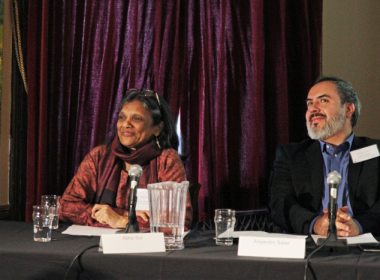
On Nov. 10, the McGill Institute for the Study of Canada (MISC) hosted four experts with media and legal background at the McGill Faculty Club to discuss the aftermath of the Patrick Lagacé case. Montreal police had been collecting metadata—information that indicates the time, date, and location you called someone, for example—from La Presse columnist Lagacé’s phone to determine who was leaking information in an internal investigation of one of it’s officers. The event was organized and moderated by Andrew Potter, director of MISC.

The panelists spoke about how the media reacted to the revelation of the police tapping journalists in Quebec and the legal implications of police surveillance. The Senior Director of Continuous Improvement at La Presse, Yann Pineau, considered the spying of journalists to be a wake-up call.

“We [journalists] were naive because we never thought police would go to that extent,” Pineau said.

Pineau added that journalists in Quebec now need more training to protect their sources and themselves and must learn to use digital tools to encrypt metadata.

Executive Director of the Professional Federation of Quebec Journalists (FPJQ) Caroline Locher further denounced Lagacé’s tapping, as well as three Radio-Canada journalists. “Quebec is similar to a police state,” Locher said.

Locher gave numerous examples of attacks on journalism, such as the Charlie Hebdo attacks and Trump’s threats to sue journalists, but praised some jurisdictions for extensively protecting journalists’ rights and their sources’ anonymity.

“In Belgium, it is illegal to spy on journalists unless there is an immediate threat of terrorism or death,” Locher said.

Locher noted that since the revelation of police surveillance of the media, sources will likely be more hesitant about speaking to journalists.

“The journalists are able to tell the truth about what happens because the sources trust them […] This is not about journalists, it is about the public who will not get information, who will be left in the dark,” Locher said.

McGill Law Professor Fabien Gelina cautioned the audience not to jump to conclusions because the evidence presented by the police to the Justice of Peace (JP) has not yet been made public. The JPs are officials appointed by the lieutenant governors of Canada's provinces, and by the commissioners of Canada's territories. They supervise the legality of police activities, such as accepting or rejecting police’s warrant requests. In the Lagacé case, it was the JP who authorized the Montreal police to collect the journalist’s metadata.

“It is hard to make a judgement on an investigation without all the facts,” Gelinas said.

Furthermore, it would be difficult to legally further the informers’ right to anonymity. According to media lawyer Mark Bantey, there are three ways of doing so: As a privilege, as class-based–similar to lawyer-client confidentiality–and as a case-by-case analysis. The former two would formally protect the anonymity of informers and by extension, there would be less leeway for JPs to grant warrants.

“Currently, the warrants are given on a case-by-case basis by the Justice of Peace, who balances public interest and law enforcement,” Bantey said. “The JP decides to recognize the sources’ right to anonymity or not”.

Bantey also noted that it is hard to draw a clear definition as to who is and isn’t a journalist. Therefore, the constitutional court refused to acknowledge the protection of sources by privilege or class-based relations, thus keeping the JP’s authority to individually assess warrant requests.

“To throw a constitutional immunity around such a heterogeneous and ill-defined group […] and whatever sources they want to protect would blow a giant hole in law enforcement and other basic rights,” Bantey said, quoting the court’s decision.

Pineau took the opportunity to denounce not only a legal problem, but an institutional one.

“[Prime Minister] Trudeau’s reaction was very timid […] the police asked for a warrant without really questioning themselves,” he said. “However, a lot of police officers were ashamed by what happened”.

Football, Sports

To Romo or not to Romo? The Cowboys are sticking with Dak Prescott

The Dallas Cowboys’ fourth-round rookie Dak Prescott has taken the NFL by storm in his 10 starts this season. Originally brought in to support the Cowboys’ oft-injured quarterback Tony Romo, Prescott has now surpassed all expectations to replace the potential Hall of Fame player as a starter on a playoff-bound Dallas team.

With Romo at the helm at the start of the 2015-2016 season, hopes were high. He was the reigning Offensive Player of the Year and the Cowboys were Super Bowl contenders. But after a 2-0 start to the season, Romo suffered a fractured clavicle, removing him for the rest of the year. Dallas then finished 2015-16 with a paltry 4-12 record behind their backup quarterbacks. The disastrous results showed just how lost the Cowboys were without their quarterback. As Romo had not played a full season since 2012, eccentric team owner and General Manager Jerry Jones learned he could no longer rely on Romo’s failing body. The organization would need a suitable insurance policy.

In this year’s NFL Draft, the Cowboys selected Ezekiel Elliott, an immensely talented running back from The Ohio State University with the fourth overall pick. By drafting a running back, the Cowboys hoped to take the pressure off their fragile quarterback with a strong ground game. But the organization’s plans were derailed when Romo was injured again in a preseason game against Seattle. With backup quarterback Kellen Moore also injured, the Cowboys were forced to hand the starting quarterback role to their untested fourth-round pick from Mississippi State, Dak Prescott.

Going into the draft, most experts believed Prescott had bad mechanics, inaccurate deep passing, and was unreliable under pressure. Additionally, a DUI charge only weeks before the NFL Draft made teams questions Prescott’s character. It didn’t matter that he was acquitted of the charge; the damage had already been done. The Cowboys even dropped Prescott by a round in their draft boards, but decided to take a chance on him after Head Coach Jason Garrett drilled him about the DUI in pre-draft interviews.

Prescott turned out to be exactly what the franchise needed. His play was exceptional during the preseason and he seemed like a bonafide star in the making. But, still, no one expected Prescott to be so successful as a rookie quarterback. The Cowboys now had a problem when Romo returned to full fitness in week 11; when healthy, he is one of the best quarterbacks in the league. However, Prescott has led this team to a 9-1 record. The organization does not want to mess with a working formula. As the old saying goes, if it ain't broke, dont fix it. This situation put Jones and Garrett into a precarious position. They needed to decide who would be the team's starter going forward, the rising Dak Prescott or established Tony Romo.

The Cowboys eventually decided to stick with Prescott. The rookie has found ways to win week in and week out and brings aspects to the offence that Romo cannot. Prescott breaks outside the pocket, runs for extra yards, and constantly makes tacklers miss. He dominated talented Baltimore Ravens and Cincinnati Bengals defences to lead Dallas to an 8-1 record.

Yes, running back Ezekiel Elliott, the NFL’s best offensive line, and a talented group of pass-catchers have taken some of the pressure off the young quarterback’s shoulders. But Prescott has equally galvanized the Cowboys in return and has formed fantastic chemistry with the established stars on the team. From day one, Prescott has been a leader in the locker room and the entire team plays hard with him on the field. If he continues his top-notch play, Prescott’s season will become the gold standard for all rookie quarterbacks in the NFL. Akin to Tom Brady supplanting Drew Bledsoe as the New England Patriots’ starting quarterback in 2001, Prescott has made the Cowboys great again.

Commentary, Opinion

The future of birth control must include all genders

The results of a trial for male birth control, published in the Journal of Endocrinology and Metabolism, have sparked outrage and frustration. After 20 of 320 men dropped out of the study due to adverse side effects, the trials were discontinued. Altogether, the men participating in the trial reported 1,491 adverse symptoms, including mood disorders and severe acne. The cessation of the trials was not unjustified. The developers were forced to conclude that the risks outweighed the benefits. However, the trial represents a stark contrast with the development of the female birth control pill. It reinforces what the history of the pill tells us: The bodies of women are burdened with more responsibility than the bodies of men. This does not mean that society should demand that men experience the suffering women have. Instead, this moment is an opportunity to remember what women have been through in pursuit of the pill and to call for a future where everyone, regardless of gender, can expect fair treatment from medical research and health care professionals.

A history of the birth control pill must acknowledge the women who—often unknowingly—participated in unethical experiments to test the drug. The fact that these women were not consenting participants points to an unfortunate medical reality for women: Their bodies have historically been misused, devalued, and neglected by a medical field that caters to men.

But, it is impossible not to contrast the sensitivity with which the men in the study were treated with the unethical treatment women have suffered in the development of the pill, and the continued devaluing of their symptoms of well-being today.

In an interview with the National Public Radio, Jonathan Eig, author of The Birth of the Pill, claims it’s ironic that medical professionals have “treated [women] like lab animals so that [they] may find a form of birth control that frees them.” But, the fact that the pill’s developers took unethical routes by necessity does not erase the pain of the women who were mistreated as test subjects. In his book, Eig explains that beginning in the 1950s, several female birth control trials were held at the Puerto Rico Medical School. When participants began to drop out due to side effects, the head scientist sought out women who would have no choice but to participate, in order to continue the trials. Puerto Rican medical students were forced to comply under penalty of expulsion. Women in an asylum in Worcester, Massachusetts were used as test subjects because they were unable to say no. Admittedly, the situation was complex: Birth control was heavily regulated and test subjects were hard to find. However, the end does not justify the means when the means is the mistreatment of unconsenting women.

The dismissal of women’s pain still exists today, although it is more subtle: Women have a higher chance of being misdiagnosed when they exhibit symptoms of everything from heart attacks to ADHD. Their complaints are often minimized by healthcare professionals, and, sometimes—as has been documented in one Atlantic article—their pain is ignored. In terms of hormonal birth control, University of Copenhagen professor Øjvind Lidegaard told CNN that doctors have known “for decades” about the side effects of hormonal birth control, including mood disorders. Women, it seems, are expected to live with pain—if their pain is acknowledged at all.

The facilitators of the male birth control study were right to shut it down, as the rate of adverse side effects was higher than that of women who typically use hormonal contraceptives. But, it is impossible not to contrast the sensitivity with which the men in the study were treated with the unethical treatment women have suffered in the development of the pill, and the continued devaluing of their symptoms of well-being today. There is no way to erase the injustices of the past. In order to heal this disparity in the future, society must recognize the history of the pill and the pain that women continually undertake to exercise their reproductive rights. Men can demand continued research on male birth control, thereby lessening the reproductive burden on women. By speaking out about the pain that women have faced in the past, and about the pain that they still face today, we can look forward to a world where healthcare is synonymous with equality.

Editorial, Opinion

Streamlining of McGill Counselling and Mental Health Services leaves gaps in medical notes procedures

As part of the integration of McGill Mental Health and Counselling Services (MHCMS), medical notes are no longer available for students who use drop-in appointments unless their case falls under the criteria for the newly designated “Safety Appointment.”

Although the change prioritizes support for students who urgently need it in order to be safe, questions remain as to what students are supposed to do if they do not qualify for a Safety Appointment, but need a medical note due to mental health reasons. While such growing pains are no doubt a side effect of the ongoing integration process, measures must be put in place to resolve this gap in services that adversely affects students now. Going forward, McGill must better disseminate information on what this change means, what support is still available to students, and how it will accommodate those who do not fall under urgent cases, but nevertheless require medical notes.

The new Safety Appointments are reserved for urgent cases, such as if a student is at risk of harming themselves, has recently overdosed or been hospitalized in a psychiatric ward, or has recently been physically assaulted. Medical notes still remain available to those who already have an assigned mental health professional.

Although the change prioritizes support for students who urgently need it in order to be safe, questions remain as to what students are supposed to do if they do not qualify for a Safety Appointment, but need a medical note due to mental health reasons.

MCMHS is overburdened and understaffed relative to demand. Serving a student population of over 39,000 while grappling with budget constraints is no easy task. The integration of services is a positive step that improves efficiency and streamlines the care model, as students no longer need to determine in advance whether they need psychiatric care or counselling. The single point of entry will reduce confusion in this sense; however, the effect of the integration on medical notes shows that gaps remain.

Any policy change—no matter how temporary—must recognize that mental health experiences vary between individual situations and that the criteria for a safety appointment are not the only criteria by which a student would require a medical note. Mental health and wellness cannot be predictably planned for, making it imperative that MCMHS develops a procedure whereby those in need, but not in such need as specified by the Safety Appointment criteria, may receive a medical note. This is not to say that all students who attend drop-in sessions unconditionally require a deferral or extension; that decision ultimately rests with the clinician. But, restricting access to medical notes to a certain category of students leaves those who do not fit the category unsure of their options. At the moment, students must wait two weeks for an appointment if they are not mentally well enough to take an exam or complete a project, and cannot acquire a medical note in time.

It is essential the MCMHS is able to provide medical notes to any student in need on a timely basis, as students may have no other options off campus. For instance, private physicians can be expensive, as visits are not fully covered by SSMU’s Health Coverage plan.

In the interim, students may resort to methods outside MCMHS in order to get more immediate support. Student-run services—such as the Peer Support Centre, the Sexual Assault Centre of the McGill Students’ Society (SACOMSS), and the McGill Students’ Nightline—all provide support for both mental health and physical safety concerns. These services can also advise students on how to best approach their professors if they need an exam deferral. Additionally, as part of a transition towards a university environment that is more accommodating of mental health, the Students’ Society of McGill University’s (SSMU) newly-implemented Mental Health 101 training may help raise the necessary awareness and understanding among professors about the diverse range of mental health situations students may find themselves in. All of these student-led initiatives are essential to filling the gaps and to helping reduce the strain on MCMHS; however, crucially, these services do not have the power to provide medical notes. Going forward, McGill should consider whether academic advising should play a greater role in helping students prepare for their course load and informing them of how best to acquire a deferral or extension.

MCMHS is looking into solutions to provide more equal access to medical notes, such as creating a case manager role; however, the immediate implementation of the integration without informing students of what it entails, and without having a contingency plan to avoid such gaps, seems short-sighted. As yet, students have not been formally notified of this particular effect of the integration, and many may not be aware that drop-in appointments with an intake clinician are still available to all students. While this may have been a necessary change in the care model, this oversight is disruptive and detrimental to students—especially with the Fall 2016 final exam period looming—who find themselves with mental health concerns and unable to get a medical note from MCMHS in time to have an exam deferred. 

McGill Redpath Museum
Off the Board, Opinion

Quality vs quantity: Questioning workload at McGill

It seems like no matter what you study at McGill—English, Finance, Physics, or Nursing—you often find yourself with an infeasible volume of readings, practice exercises, pre-labs, or online quizzes. It’s hard to imagine that the professors assigning the work really believe that their students will be able to finish it all on time. I’ve walked into multiple lectures, sat down, looked around the classroom, and thought to myself, “Who actually finished the readings?” My friends in Science have complained to me that the sheer amount of lab reports, quizzes, and problem sets compounded across all of their courses quickly becomes overwhelming. While being able to read quickly is certainly a worthwhile skill, and repetition and practice may make perfect, the brute-force, volume approach cannot really be the most conducive for learning in university. It should not be natural for McGill students to be constantly drowning in assignments.

Our classes and our professors should certainly challenge us and push our limits as scholars. We all signed up to come to McGill for its promise of a rigorous education. But, rigour does not necessitate colossal volumes of work. Plowing through hundreds of pages of readings or suffering through hours of busywork every night arguably does not promote understanding; it only encourages the student to work towards completion, not real comprehension. The result is a loss of depth, merely for the sake of volume.


While being able to read quickly is certainly a worthwhile skill, and repetition and practice may make perfect, the brute-force, volume approach cannot really be the most conducive for learning in university.

Students complaining about their workload at McGill should thoughtfully question the purpose and goals of their assignments, as overburdening could seriously affect quality of education. Never-ending, repetitive, or mindless assignments that must be completed simply to earn participation points discourage real learning—in the form of lasting and applicable understanding—and add more stress and exhaustion, physical and mental health problems, and a lack of balance to students’ lives. Professors should be able to make clear when designing their courses the purpose and benefit of each reading, lab, or paper assigned—and students have the right to know. If the question, “Will I ever use this again?” cannot be answered affirmatively, question the assignment. If a reading is meant to be a starting point for a thoughtful discussion in class, make sure the professor gives time to read and to synthesize the content.

Short of banning all assignments outside of class—an unrealistic and counterproductive fix—there is no blanket solution to McGill students’ excessive workloads. The problem is specific to each student, each course, and each semester. In order to voice their objections to excessive workloads, students must complete their course evaluations, and bring up the topic with their individual professors and TAs in a candid and thoughtful way during the semester. When a particular assignment appears utterly pointless or a set of readings feels especially unreasonable in its length, students should not hesitate to speak up. Professors seem to forget that their students are enrolled in other courses, engage in extracurricular activities, and still need to find time for their friends and families.

Though it may not seem so at times, professors are human, too, and can be understanding, especially when the discussion is about making their students actually learn better. The first step comes from us as students: We must invest ourselves in not just working more or harder, but in communicating with our instructors to shift the focus from quantity to quality for the sake of learning.


Nicholas Jasinski is a managing editor at The McGill Tribune and is studying economics and finance.


Read the latest issue

Read the latest issue