


Latest News

Commentary, Opinion

President Deep Saini owes McGill students more than his own partisan renditions

McGill President and Vice-Chancellor Deep Saini’s recent messaging surrounding the on-campus pro-Palestine protests against investments and ties to Israel have repeatedly characterized those involved as violent and vandalizing, leaving little mention of the intent behind their actions. His language does not merely criticize the breaking of windows—to me, it paints the protestors as threats to order itself, erasing the political urgency that led to their demonstration.

This fear-mongering language—referencing mob rule, cacophony, and terror—functions to spread antagonism towards the protestors’ destruction of property, both on the night of Feb. 5, when protestors smashed the windows of various McGill buildings, and prior. Saini’s brief mention of the university’s resolute stance on Boycott, Divest, and Sanction (BDS) regarding the State of Israel hints that the property damage stood for more than vandalism; however, his critical language suggests the contrary.

These evident biases in the frequent messages to the McGill community beg the question of the president’s obligations. On the one hand, he speaks on behalf of the administration, representing those at whom the damages were directed. However, he is also addressing the McGill community directly, and therefore owes his audience a comprehensive and nonpartisan truth that avoids the demonizing language he employs. In the latter regard, Saini’s rhetoric strays far from the mark.

Given the growing antagonism between the administration and the protestor body, Saini’s rhetoric only fosters further division, rather than bridging the divide. His duty, rather than offering his own vision of the protestors, should be to service the broader McGill community with information and resources such that individuals may draw their own conclusions. His position as President of McGill means that his language does not merely inform the McGill community—it actively influences their perception. When such communication is dismissive of the central motivation behind the political activism it condemns, Saini’s audience must contend with the blurred lines between fact and presidential opinion. Saini thus fails his presidential duty to the McGill community, which notably demands a leadership role in promoting McGill’s broad well-being. In assuming such a role, he obligates himself to each constituency of the university—the administration, the faculty, and the student body—in equal part. As such, his commitment to community well-being calls for constituents who are, if not in agreement, then in decorum; Saini’s harsh rhetoric definitively harms this presidential ideal.  

This is not to say that Saini ought to promote the protestors’ actions as noble or well-meaning. On the contrary, doing so would fail his imperative in equal measure to his reductive condemnations. Rather, the notices Saini issues to the McGill community are obliged to fact and incontrovertible truth—or as close to this as such a memo can manage. That is, it is his imperative to present the community not with an argument, but the firm basis on which his audience may construct one, be it for or against those in question. The president’s current language, describing the Feb. 5 protestors as violent vandals, disrupting peace and education, serves no purpose but to curate the information reaching his audience, and thus influence student-held views; or perhaps it only serves to alienate the student body. His rhetoric reminds me of what I saw in the mainstream media, demonizing pro-Palestinian protestors rather than truly listening to their demands, engaging with their arguments, and walking a moderate line between the parties in dispute. 

This being said, it is crucial that students turn their attention to the motives behind Saini’s presentation of student protest. As it stands, Saini presents the McGill community with a highly curated and reductive view of events focused on the physical destruction of property while ignoring the pressing message behind the protests. This stands firmly against the McGill community’s right to unambiguous, axiomatic truth on which to form its own decisive opinion. As such, his imagery and language deserve at once criticism and skepticism. Indeed, Saini’s communications—while riddled with notions of antagonism and presumption in line with the administration’s ongoing use of disparaging language surrounding the BDS goals—are not to be completely neglected. However, they cannot be taken as a source, nor even a cross-section, of truth. Rather, Deep Saini’s words are best regarded as they are: Another divisive, albeit reputed, man’s opinion.

Local Stories, Student Life

Flipping the lens: A look at the influencers of McGill University

The number of social media influencers has ballooned in recent years, with TikTok alone reporting over a million creators. But which McGillians are joining the trend? Who among the student body documents campus construction, fieldhouse exams, and library crash-outs? The Tribune interviewed three students who post their daily lives—and more—online, getting to the heart of what compels them to share their stories with the world. 

Sheng Qi, U4 Engineering, known online as The Potential Dropout, began his page as a way to cope with the struggles of being a STEM student. He started posting day-in-the-life videos and comedic content in Fall 2021, during his first semester at McGill. In an interview with The Tribune, he explained how his first video sparked his career online.

“I was filming my calculus final and having a mental breakdown,” Qi said. “The next day, the video had half a million views.”

Similarly, Anna Bistour, U2 Arts, garnered unexpected success overnight.

“I started posting [on TikTok] during COVID and doing short videos on YouTube,” Bistour said. “When I went to the U.S. [on exchange], I thought it would be cool if people were interested in what I do. I was sitting in the airport, [and] when I arrived in the U.S., a video I posted reached 500k views.”

Bistour—who came to Canada from France—makes content sharing her daily life in North America with her inquisitive French followers. However, she emphasizes that her overall goal is to uplift students worldwide.

“I aspire to make relatable videos, so I answer a lot of questions and show people what they want to see about North America—then America, now Canada—so that they can have a closer idea of what life is [like] as an international student,” she said.

Amanda Round, a first-year Master of Science student, who became known for her educational videos on different university programs in Canada, expressed a similar goal.

“I was super type A as a student so when I was looking at programs I went out and talked to alumni and professors and I had all this random knowledge and I wanted to fill that gap,” she shared.

While Qi started with relatable content, he has also dabbled in more educational videos, including chemistry tutorials on YouTube. He also launched his own tutoring and events start-up, which is currently in the hiring phase. In his interview with The Tribune, he mentioned Khan Academy as one of his dream collaborations. 

Bistour was also interested in pursuing collaborations.

“I’ve always been into studying and school […], so my dream collaboration would be with an organization like UNESCO,” Bistour said. “School takes up a big part of my life, so I want to show people that it’s cooler than it sounds.”

Round spoke about her upcoming side account, where she plans to explain pertinent science topics to the Canadian public.

“I’m trying to do content related to scientific literacy and trying to make these topics, which are important to the Canadian public, accessible,” Round said.

When asked to share some wisdom for anyone interested in starting a public media account, Bistour warned that TikTok can often be a black hole of endless scrolling. However, she appreciates the platform for the community she’s made on it, and the impact you can make on others by using the app.

“Social media is a tight-knit group. I’ve met a lot of people on it,” Bistour said. “Especially people from France [who] have become interested in McGill. One girl told me that she got here because of me, so it’s very rewarding. I know I’m not the only one who does that, but it’s really cool to connect and have shared experiences.”

Round gave a few words of encouragement for anyone aspiring to share their perspectives online.

“I encourage you to get on social media and create content,” Round said. “Only you can communicate in your own way. If you have something to say, you should do it.”

News, SSMU

SSMU BoD approves motions seeking to increase UGE funding, change executive roles

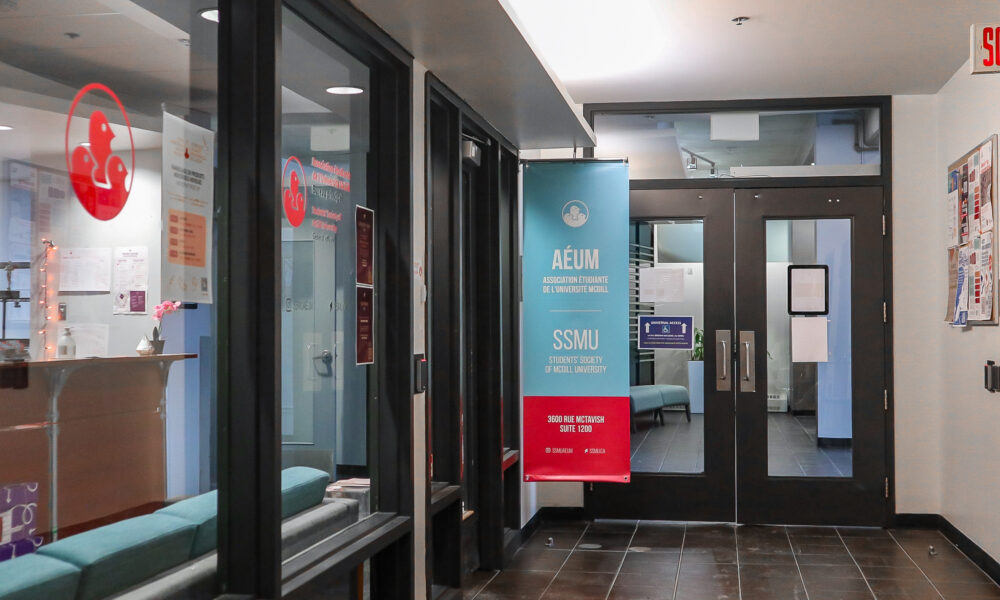
The Students’ Society of McGill University (SSMU)’s Board of Directors (BoD) debated fee increases for the Union for Gender Empowerment (UGE), purchasing access to a grammar service, Antidote, for more students, and proposed changes to the executive committee roles at their Feb. 18 meeting. 

The meeting began with a public report from Parliamentarian Jessica Bakar regarding the hiring for the Nominating Committee’s Alumni Representative position. 

Following the report, Director of Clubs and Services Hamza Abu Alkhair presented the Motion Regarding the Increase of the Referral Services Fee—an opt-outable semesterly fee split among the UGE and four other SSMU services. This change would increase the total referral services fee from $6.03 CAD per semester to $7.28 CAD, with the UGE’s share raising from $0.75 CAD to $2.00 CAD. The UGE expects this would result in a $45,000 CAD increase in revenue, allowing the group to offer a broader variety of products and keep up with rising costs. 

Director and Arts Undergraduate Society President Sofia Garofolo asked why the UGE fee was going up when the Menstrual Health Project fee was also being increased. Keith Bellec-Warrick, a post-graduate member of UGE in the Faculty of Education, responded, explaining the difference between the two services.

“There are a couple differences that are fundamental to our functioning that differentiate what the UGE offers as services and supplies versus what the Menstrual Health [Project] does,” Bellec-Warrick said. 

While the Menstrual Health Project focuses exclusively on providing menstrual health products, the UGE also provides gender-affirming products, safe sex supplies, workshops, and educational resources. Bellec-Warrick also called attention to the rising cost of menstrual health products since 2020, further justifying the fee increase.

General Manager Maya Marcus-Sells voiced her support for the motion, as well as her concern that it could be too late to include it in the Winter 2025 referendum. SSMU President Dymetri Taylor noted that there was “no guarantee” that the motion would meet the deadline even if approved.

Abu Alkhair motioned to approve the motion and send it to McGill “expeditiously.” The motion did not, however, appear in the Winter 2025 referendum.  

The meeting also saw the approval of the purchase of an additional 800 subscriptions to the French version of Antidote—a bilingual grammar software. Taylor reported that SSMU had hit the cap on the number of seats in this service, leaving about 1,600 students who had registered for Antidote barred from access. 

Taylor thus proposed buying the remaining 800 additional seats for a total cost of $22,400 CAD, pulled from student support fees. Abu Alkhair added further support for the purchase.

“It’s especially worth noting that Antidote was founded and headquartered in Montreal, so it’s a Canadian company, and it always feels good to support local tech.”

The motion passed unanimously. 

VP External Hugo-Victor Solomon then brought forward a two-part motion from the Legislative Council. This motion would reduce the Executive Committee from seven positions to six by assigning the duties of the VP Operations and Sustainability to the VP Internal, and make the role of VP Finance a hired position as opposed to an elected one. 

Solomon clarified that even if the VP Finance role was appointed, the candidate would have to be selected by a hiring committee and approved by students through a referendum. Director Fawaz Halloum said that he had reservations about making the VP Finance position an appointed role, citing the difficulty in finding a sufficiently qualified candidate. The motion to add this question to the Winter 2025 referendum passed.

Moment of the meeting:

The BoD also approved the addition of the SSMU Musicians Collective (MUSCO) fee increase for the Winter 2025 referendum ballot. Abu Alkhair noted that this fee increase would also go towards subsidizing instrument rentals to make instruments more accessible. This motion ultimately did not appear on the referendum ballot.

Soundbite

“To have someone who’s already familiar with accounting principles, you’re looking for someone who’s in their third or fourth year, and it’s just going to be a very narrow slice of students, and we already struggled to have people run.” — Director Fawaz Halloum regarding the process of finding a qualified candidate for the VP Finance position.

Arts & Entertainment, Theatre

Fairies square off against lords in ‘Iolanthe’

From Feb. 14-22, the McGill Savoy Society brought Gilbert and Sullivan’s 1882 comic opera, Iolanthe, to life at Theatre Plaza. The show follows young shepherd Strephon (Matthew Erskine, BA 2022), and his beloved Phyllis (Aniela Stanek, U0 Arts). After he joyfully announces their engagement, a few wrinkles become apparent: She is a ward of the state, and he is just a lowly shepherd (even if he is secretly a fairy). When the engagement is rejected by parliament, he does what any half-fey suitor would do, and calls in his mother’s company of fairies. The company—that apparently is the collective noun for fairies—in turn does what any company of fairies would do, and infiltrates the British House of Peers.

“What makes Iolanthe special is its magic,” Erskine told The Tribune. “It’s a show about fairies, half-fairy, half-mortal shepherds, and sneering peers. It’s just imbued with such magic and wonders.”

The story unravels from there, by turns tragic and comic, chronicling the rising and falling fortunes of our star-crossed lovers. 

“Iolanthe is a really amazing operetta because it threads that line between a really great comedy and also some dark and tragic bits that you don’t see in a lot of comic operas,” Michael Quinsey, BA 2022 and Stage Director of the production, commented. “You have some nice dark music that’s a lot of fun to work with, and on top of that, there’s some huge energetic ensembles that are just so much fun to put together on stage.”

Unfortunately for Strephon, while he is scheming how to gain permission for the engagement, Phyllis spots him with his fairy mother—who looks much younger than she really is—and assumes that he is flirting with her. 

“She’s a girl’s girl. I feel like she’s very in love with both herself and Strephon,” Stanek said about her character. “She’s in her own little world, […] but by the end of the show, she’s become a lot more accepting of other people.”

A particularly energetic turning point comes towards the end of the first act, as Strephon is inducted into the House of Peers, as part of the fairies’ master plan. In an eerily current turn of events, our hero is suddenly vested with complete control to both make and approve laws. But fear not! Rather than slashing foreign aid budgets, he directs his unbridled executive power towards the noble aims of more lenient sentencing for criminals and support for the poor. 

Unfortunately, even the satisfaction of a well-implemented social welfare policy is not enough to fill the woman-sized hole in Strephon’s heart, and he pines after Phyllis hopelessly.

As it turns out, Strephon is not the only one pining away—the Lord Chancellor (Samuel Valentim-Gervais) also has eyes for Phyllis. When she rejects him (and all of her other suitors, for that matter), the Chancellor spirals into despair, delivering a truly impressive patter song on a timeless theme: Bedrot. Reassuringly, it seems that even the Victorians couldn’t get out of bed, as he bemoans his unrequited love with his faithful teddy bear. 

The second act culminates with an aria from Strephon’s fairy mother, Iolanthe, strikingly moving after the comedic first act, in which she sacrifices her own life in a selfless plea for her son’s marriage rights. Luckily for the characters, her tragic sacrifice is brief, and the Fairy Queen (Ashley Bissonnette) collaborates with the House of Peers to revise all necessary rules in order to save Iolanthe’s life, approve the marriage between Strephon and Phyllis, and pair up all the rest of the fairies with parliamentarian partners. 

With all of the conflicts simultaneously resolved by the Fairy Queen, whose bouncy incompetence is a perfect equal and opposite to the pomp and circumstance of the Lords, they all dance off stage in a fittingly whimsical finale for a thoroughly whimsical production. 

Iolanthe was onstage at Theatre Plaza from Feb. 14-22.

Science & Technology

CogSURF connects minds, empowering the next generation of cognitive scientists

The Cognitive Science Undergraduate Research Forum (CogSURF), Montreal’s first undergraduate-led conference of its kind, will host its inaugural event on Feb. 27 at the University Centre. This event aims to showcase undergraduate talent and break down the barriers to open science for undergraduate students across Montreal. With over 340 registrations, CogSURF will offer a day filled with presentations, networking opportunities, and showcases of research disciplines across the cognitive sciences.

Le Thuy Duong Nguyen, a U3 student in McGill’s Honours in Cognitive Science program and executive chair of CogSURF, began developing the conference in July 2024, where she assembled an executive board of undergraduate students from McGill.

“I personally found my passion for science and research through going to open conferences,” Nguyen said in an interview with The Tribune. “This was really a big mission of mine—to create something that would be accessible to all levels, universities, and disciplines to converge at one big event.”

Maria Lagakos, CogSURF’s executive co-director of partnerships and fellow U3 Honours in Cognitive Science student, explained some of the difficulties in the early stages of developing CogSURF.

“We really did this from the ground up,” Lagakos said in an interview with The Tribune. “As undergraduate students, we’ve had limited experience with conferences [….] It’s a little bit harder usually for undergrads to get involved in these large-scale conferences.”

Nguyen also discussed the development of CogSURF’s slogan: Connecting Minds, Making Waves.

“It’s been a really fun experience coming up with our slogan, which is really integral to our mission,” Nguyen said. “The logo itself has been a long process in the making. We went through so many iterations, and converged on this one where different waves represent different disciplines that are converging at this one conference.”

The event will open with a speech by Nguyen, followed by a presentation from keynote speaker Nancy Kanwisher, a professor of Brain and Cognitive Sciences at MIT.

“[Kanwisher] is my absolute role model and scientific hero,” Nguyen expressed, reflecting on how Kanwisher presented at one of the very first conferences Nguyen attended, sparking her interest in cognitive science research.

Afterward, there will be a flash talk session, where undergraduate students showcase their research in three-minute thesis-style presentations. Following lunch, CogSURF will hold a poster presentation session where 30 committee-selected undergraduate students will present their innovations, after which another flash talk session will take place. The day will also include a panel discussion featuring experts from a wide range of disciplines and institutions, including Ian Gold, Karim Jerbi, Doina Precup, Stevan Harnad, and Charles Reiss.

“I think we have top-notch speakers. This is my ideal panel scenario, and I’m really excited for it,” Nguyen said.

The closing ceremony will then announce the award recipients, and to commemorate the evening, CogSURF will host a ‘5 à 7’ networking event at the McGill Faculty Club.

Benjamin Lévesque-Kinder, a third-year undergraduate student in McGill’s Neuroscience program and executive co-director of partnerships at CogSURF, spoke about the future of the organization.

“Right now we’re hosting [CogSURF] at McGill, but we would really love to see it hosted by UdeM, Concordia, and UQÀM, in a way that most conferences do, where they jump around [locations],” Levesque-Kinder said in an interview with The Tribune. “The host institution brings their own perspective and intellectual background into it.”

The executives emphasized the importance of inter-university collaborations, which they believe is essential for CogSURF to become an annual conference attracting students from across Canada and beyond. CogSURF serves as an important step for undergraduate students to get involved in open science research, increasing accessibility and transparency in the cognitive sciences field.

Hockey, Sports

The Tribune’s sports highlights of the week

International: Canada clinches the 4 Nations Trophy 

In a finish that perfectly encapsulated the spirit of international hockey, Team Canada secured a pulsating 3-2 overtime victory over Team USA on the back of a show-stopping finish from number 97, centre Connor McDavid. In the stands and across the country, the crowd went wild. 

Carving their route to the final, Canada defeated Finland 5-3 and Sweden 4-3 in two back-and-forth showstopping games, but fell short 3-1 to Team USA in their last preliminary fixture. Within nine seconds of the opening buzzer, both Brady and Matthew Tkachuk—brothers from the U.S.—as well as Brandon Hagel of Canada saw the sin bin for dropping their gloves and letting the fireworks rip. Canada could not come away with victory—that is, until the final. 

Canada centre Nathan MacKinnon kicked off the scoring in the first period with a nifty wrist shot that nestled into the back of the net. Shortly after, though, USA enforcer Brady Tkachuk tapped in the puck to level the score. The back-and-forth affair saw momentum swings that kept fans on the edge of their seats, with neither team able to establish more than a one-goal advantage throughout regulation time. Midway through the second period, defenseman Jake Sanderson hurled the puck at goal, and it flew in off a slight deflection for a 2-1 lead for the USA. Every shot and every save seemed to echo with championship implications. And that is exactly how it went, with USA centre Sam Bennett shelving an assist from right winger Mitchell Marner to tie the game up in the latter stage of period two. 

In the end, it took sudden death overtime to separate the evenly matched sides, with Canada finding that extra gear when it mattered most. With the clock creeping down, at the eight-minute mark of overtime, Team Canada found a moment of brilliance. Fans had their hearts in their mouths as McDavid screamed up the ice to get in position in front of the net. Marner’s hard work in the left corner of the USA defensive area culminated in a smooth flick pass back into the middle of the ice to McDavid, who controlled the puck, pulled back, and released his shot. Everything seemed to move in slow motion. The puck crashed into the net, and Canadians all around the world unleashed a collective cheer. 

After a tumultuous month for Canadians in the political sphere following threats from U.S. President Donald Trump, this win was momentous, with Prime Minister Justin Trudeau remarking to the U.S.: “You can’t take our country—and you can’t take our game.”

McGill: Redbirds hockey wrestle a win in the quarter-finals 

In a tense quarter-final matchup, the fourth-place McGill Redbirds Hockey secured a crucial 2-1 victory over the fifth-ranked Université du Québec à Trois-Rivières (UQTR) Patriotes in Laval on Wednesday night. Right winger Charles-Antoine Dumont emerged as the hero, netting the game-winning shot with just over three minutes remaining in regulation. 

The game, which started 40 minutes late due to a shattered glass pane during warm-ups, showcased McGill’s defensive prowess as they nullified the UQTR attack through each period. Although neither team scored within the first period, forward Alexandre Gagnon opened the scoring midway through the second period, asserting his dominance and swinging momentum in McGill’s favour. 

Away days always come with a bit more than what meets the eye, and this game was no smooth skating. UQTR’s forward, Felix Lafrance, evened the score on a power play late in the second, and after a serious battle in the UQTR defensive end, Dumont’s clutch goal off a rebound from centre Xavier Fortin sealed the win for the Redbirds. Goaltender Alexis Shank stood strong with 21 saves, giving McGill their fifth win in six meetings with UQTR this season.The Redbirds proceeded to capitalize on their lead with a dominant 5-2 victory away at Trois-Rivières, sweeping the series and skating proudly into a league semi-final series against Concordia Stingers starting on Feb. 26. Earlier this season, the Redbirds lost to the Stingers 1-3 in a regular season faceoff and 3-7 in the Corey Cup. A high-stakes week lies ahead as the team hopes for redemption and a shot at the final. Fly Birds!

Science & Technology

How simulation learning is shaping inclusive healthcare

Simulations are becoming a more and more common training method for medical students. In a typical simulation, students resolve a medical case presented by an actor, and then participate in debriefing sessions led by a supervisor to analyze and critically review their experience and performance. This process commonly follows the “Promoting Excellence And Reflective Learning in Simulation” (PEARLS) framework, developed by Adam Cheng and Walter Eppich in 2015. While this protocol has been effective in safely preparing medical students for interactions with real patients, work remains to be done on incorporating diversity, equity, and inclusion into the trainings. 

In a recent paper published in the journal Advances in Simulation, Niki Soilis, a doctoral student at McGill’s Institute of Health Sciences Education, presents an altered version of the PEARLS protocol which examines the impact of social structures on healthcare and explores ways to mitigate systemic inequalities.

Soilis, now completing her doctoral studies, previously worked as the education manager at McGill’s Steinberg Centre for Simulation and Interactive Learning at the Faculty of Medicine and Health Sciences for eight years. During that time, she noticed a significant underrepresentation of marginalized communities in medical training—an issue she is now tackling through her research.

“That became kind of the driver of, ‘How do we, as a program, start to integrate more inclusive and diverse perspectives in our curriculum?’ I started to look at the ways we can go more mainstream and make it into the culture of our programs,” Soilis said in an interview with The Tribune.

To address this gap, Soilis collaborated with other professionals to incorporate the Community Links Evidence to Action Research (CLEAR) toolkit into medical simulations. Developed at McGill, the CLEAR toolkit helps healthcare practitioners integrate advocacy and awareness of social determinants of health into their daily practice. 

Initially tested by frontline healthcare workers who attested to its efficacy, the toolkit was subsequently integrated into the PEARLS approach to debriefing, ultimately leading to the creation of the PEARLS Debriefing for Social Justice and Equity (DSJE) tool. Implementing the PEARLS DSJE tool is more cost-effective as compared to creating separate simulations programs specifically for diversity and inclusion.

“So we kind of merged two worlds, hoping that they would be more accessible,” Soilis said. “It was a way of allowing people to really have dialogue on a consistent basis, rather than making programs that are just dedicated to that. Simulation is one of the most expensive educational modalities—it’s known as highly effective, but it’s much more expensive than classroom-based teaching—so this became a way of making [diversity, equity, and inclusion] more incorporated.”

The PEARLS protocol underwent further refinement after consultations with Cheng and Eppich, its original creators. One of the key additions was an “Activism” phase, which encourages discussions on how systemic inequalities affect patient care and how practitioners can address these barriers.

This phase prompts medical trainees to consider how follow-up care should be handled while recognizing the complex intersectional realities of medical treatment.

“My research is specifically in [houselessness], and one of the interventions that we’ve discussed in groups is, when a person comes in, doing an analysis of their psychosocial profile and understanding their context,” Soilis said. “Where do they get to sleep? Are they on a substance? So sometimes it’s not these grand changes: It’s just having an awareness of a bigger picture, not just the person.” 

Another key update to the PEARLS DSJE framework is its emphasis on community engagement. In practice, this means incorporating discussions about systemic inequalities within healthcare, the marginalization of certain communities, and strategies for fostering a more supportive and inclusive medical environment.

Soilis and her team hope that by implementing this new version of the framework, healthcare professionals can actively work towards reducing harmful biases in medical practice.

“It shouldn’t be the only way. It should still [be part of] a better-integrated curriculum, but this is one way, and we’re hoping that through our experience in implementing it, others will see its value,” Soilis said.

Soilis offered some advice for current and future medical students at McGill. “Just stay open, in practice, to reflecting on [yourself] continuously,” Soilis said. “Look at why we are the way we are, with a nonjudgmental stance, and reflect on how it affects how we deliver care.”

News, SSMU

SSMU Executive candidates talk transparency between students and admin at debate

The Students’ Society of McGill University (SSMU)’s candidates’ debate for the Winter 2025 election took place on Feb. 18, with eight of 10 listed candidates for the Executive Committee in attendance. The virtual event comes ahead of the election, which will take place from Feb. 21 to March 7. Each applicant independently answered questions submitted by current executives, student unions on campus, and undergraduate attendees before engaging in debate with their opponent. 

The Vice-President (VP) Finance candidates were the first slotted to debate, but as neither Dylan Seiler nor John Vogel was present, the debate moved on to the role of VP University Affairs.

As Susan Aloudat is running for the position unopposed, the debate portion of her presentation was skipped. Aloudat explained she intends to mediate issues between the student body and McGill administration by encouraging student participation in SSMU elections and referendums. The result of these votes, she said, creates empirical evidence of what undergraduates want, which she believes is the best tool to compel the administration to support student initiatives. 

The current VP Internal Zeena Zahidah is running for re-election unopposed. She explained that she intends to navigate moments of turmoil for SSMU by prioritizing transparency between students and the Board of Directors. Zahidah remarked that turmoil arises when student newspapers write what she claimed to be misleading headlines and articles about the student union. She cited that this could be a result of issues in SSMU’s transparency regarding their internal proceedings. 

The night then turned to candidate debates as VP External hopefuls, Seraphina Crema Black and Jaanashee Punjabi, began their introductions. 

Black stated that as a student senator and a Legislative Council member, she has experience advocating for students to university administration. If elected, she intends to strengthen McGill’s relationship with other universities across Canada and Quebec to form a united front against tuition hikes. She also intends to advocate for all student activist groups across campus equally, disregarding any personal preferences or biases she herself may hold. 

Punjabi said her experience as a Sustainability Commissioner and a member of the Legislative Council has given her insight into SSMU’s potential to create change on campus. As VP External, she claimed she would promote collaboration between governing bodies and advocacy groups so that SSMU may better represent students’ voices on campus and beyond.

A student submitted a question online asking how both plan to represent activist and community groups on campus to McGill administration. 

“I’m very dedicated to remaining impartial, leaving my own positionality behind, and really listening to the student body,” Black said. “Whatever I believe has nothing to do with that. It is my duty to represent their opinions and their needs best.”

“I believe that communication and transparency is the most important,” Punjabi said. “Furthermore, making sure to take note of what needs to be represented at different organizational levels […] and making sure everyone is equally heard and demands and expectations are met. It’s part of my platform, and one of the main reasons, the biggest reason, I’m running.” 

Next, the two candidates for VP Student Life, Hamza Abu Alkhair and Raihaana Adira, introduced their platforms. 

Abu Alkhair stated that his three goals as the VP Student Life would be to increase visibility and collaboration among clubs on campus, as well as simplify their logistics. He also noted that as the current Director of Clubs and Services—a role which took on the bulk of the VP Student Life portfolio amidst the position’s ongoing vacancy—he is already familiar with the responsibilities of the position.

“I’m ensuring that I’m interacting a lot with the constituents, the clubs themselves, and the people who want to apply for those clubs,” Abu Alkhair said. “I created a rubric as well that assesses the finances [and] alignment with campus policies and a few other things which do make the [club status approval] process faster for both me and the club.”

Adira’s platform is focused on improving undergraduates’ mental health by supporting student groups and grassroots organizations which provide resources and assistance on campus. 

“I want to really focus on mental health supports and advertising resources like the Peer Support Center, because if students are struggling with their mental health, they can’t engage in other SSMU-related activities,” Adira said. 

Kareem El-Hosini, who is running unopposed for VP Sustainability and Operations, then presented his platform, drawing attention to wasted spaces in university buildings and unaffordable food options on campus. This is El-Hosini’s second bid for the role as the results of his first run in the November by-election were nullified due to a lack of voter engagement.

The debate concluded with a presentation from current SSMU President Dymetri Taylor, who is currently running for re-election unopposed. His former opponent, Sarah Abdulkarim, was disqualified from the race due to a lack of administrative approval allowing her to extend her degree beyond 120 academic credits. Taylor stated that he has three main goals for next year, should he be elected: Improving governance by working with a consultant, increasing student solidarity, and creating more efficient processes for conducting business between the society and its clubs and services.

Throughout the debate, 10 students were in the audience. Taylor acknowledged this low attendance, and the low voter turn-out of past SSMU elections, in a written statement to The Tribune

“I think students who vote will already participate. The issue is that there is more general student disinterest in the electoral process,” Taylor wrote. “For example, 1,000 students have unsubscribed from receiving the simply voting emails, which is equivalent to signing away one’s right to have their voice heard. It’s, frankly, quite worrisome.”

Arts & Entertainment, Theatre

Players’ Theatre’s ‘Do You Feel Anger?’ is a sardonic satire of human fallibility

It’s easy enough to show empathy to those who deserve it. But how on earth do you feel empathetic when you’re in a crappy little office, with your autocratic boss breathing in your ear that he doesn’t “only love piss charts” but also his niece? 

Do You Feel Anger? by Mara Nelson-Greenberg chronicles an empathy coach’s fruitless attempts to inspire compassion in an office of debt collectors convinced that empathy is a type of bird. The cast of Players’ Theatre’s Winter 2025 production of the piece (dir. Emma Qian), showcased juvenile anger, misogyny, and outright insanity through astonishing control of facial and physical comedy. The show transported audiences back into the aforementioned conference room where Sophia (Ellie Mota, U3 Arts) struggles to be empathetic towards everyone without endorsing the poor behaviour that is perpetuating the misogynistic status quo. Rapidly delivered dialogue rich with impassioned intonation punctuates the scene, revealing to the audience the complex emotions behind the characters’ words.

From lights up to curtain, audiences were immersed into a world so close to reality it was a little discomforting. Seven chairs, two tables, a file cabinet, day-old coffee, and a baseball bat were nearly all that made up the simple set, yet the actors’ interactions with them brought them vividly to life. The prop bird that soared over the office, still mistaken as literally being empathy, showcased the crew’s design creativity. Qian revealed in an interview with The Tribune that the laborious ideation of this effect began with chucking a stuffed bird across the stage. 

Not only did the actors deliver strong performances in the drab office, but—with help from the stage crew—they managed to pull off a seamless quick-change that turned the stage from a crappy office into a crappy bathroom. All aspects displayed clever design, from the functional stall doors to the misogynistic hangman graffiti on the walls. In an interview, Stage Manager Juliette Levy-Gay, U1 Arts,  told The Tribune that this setting bears an alarmingly realistic message in being the only space in the office where the women’s true feelings could be expressed without sexualization. 

Each costume reflected the characters’ essences, from Eva (Gabrielle Germain, U3 Arts)’s puffed-sleeved innocence to Howie (Maya Kanitkar, U4 Science)’s “daddy’s yacht” quarter-zip sweater. Sophia’s costume change from slacks to a hyper-sexualized skirt punctuated her building estrangement from her values. 

The actors built off the setting and costuming groundwork to turn the office into a maelstrom of mid-life crisis and shameless emotional misconduct. Mota navigated a slow decline from patient placation to a break into self-destruction, her soft-spoken voice interrupted by comparatively jarring outbursts of frustration that climaxed with a terrifying wielding of a baseball bat. 

Germain took full advantage of microexpressions to convey her character’s complexity. Although her breathless, frantic way of speaking, nearly never finishing her sentences evoked X,  the highlights of her performance were the silent reactions of her countenance to the misdeeds around her. The tears glimmering but never quite falling from her eyes, the stiff upper lip of someone struggling not to break, and a jittery leg under the table externalized her inner distress beyond the power of words. 

Darcy Blaik, U1 Education, as Jon, mastered the subtle mannerisms of a sleazy boss that are never quite fireable but just enough to make everyone uncomfortable. His ever-present Cheshire grin, tendency to lean into every woman he speaks to, and strange habit of laying himself across the table—very “draw me like one of your French girls”-style—undoubtedly made everyone in the audience feel the anger. 

Kanitkar was a hurricane and an audience favourite. Their commitment to physical comedy sold their performance, from kicking a chair so hard that it 360’d in the air to—what I imagine was improv—biting into a prop apple and ripping it fully in half with such vigour that nearly everyone in the scene broke to join the audience in laughter. 

A special mention to Elias Luz (U0 Arts), as Old Man, who despite only being onstage for five minutes, had the entire audience doubled over with his raspy but somehow screeching monologue about being left on the playground. 

This Players’ Theatre performance had audiences feeling everything but anger. Although unfortunately, Howie never did discover that empathy was in fact not a bird, Do You Feel Anger? implored audiences to question how they exhibit empathy, and the consequences of taking it away. 

Do You Feel Anger? played from February 18 to February 21 at Players’ Theatre.

Science & Technology

The unspoken crisis: How fears of aging are expressed in news reporting

With the prevalence of cosmetic procedures, skincare products, and diets aimed at reducing the effects of aging, and with tech entrepreneurs spending millions annually in the hopes of reversing the process, aging is often seen as something to be feared and prevented at all costs. Five years ago, when the first wave of the COVID-19 pandemic made its way to Canada, it disproportionately struck older adults, specifically those in long-term care homes: Around 80 per cent of COVID-19 deaths occurred in adults aged 65 and older. Although mainstream media heavily reported on the deaths of older individuals, their portrayal reflects our society’s underlying negative sentiment towards older adults and aging. 

In a recent paper published in Ageing & Society, Oluwagbemiga Oyinlola, medical social worker and doctoral candidate at McGill’s School of Social Work, and his colleagues examined how the media’s portrayal of COVID-19 deaths in long-term care homes often employed a tragedy narrative that elicited a sense of pity for older adults while simultaneously trivializing their deaths. 

Examining news outlets’ portrayals of older adults during the pandemic provides deeper insight into societal attitudes toward this age group. Media coverage often depicted older adults as vulnerable and helpless, reflecting society’s tendency to view older people as a burden. This portrayal not only reinforced pre-existing negative stereotypes regarding older adults but also shaped public perception, in turn influencing the public health response. 

“[Articles] were written within the lens of a humanitarian crisis and tragedy rather than through the lens of action and really supporting older adults to grow and thrive in long-term care,” Oyinlola said in an interview with The Tribune.

To analyze media reporting, Oyinlola and his colleague, postdoctoral researcher Sabrina Lessard, independently reviewed 74 articles on long-term care home residents during the pandemic, with the sample drawing from both Ontario and Quebec. Their analysis, in collaboration with their supervisor Professor Tamara Sussman, helped uncover insights into societal attitudes towards older adults as reflected in the media. 

“The [sources in the] reporting mostly came from government officials and those working in long-term care. Although the main focus was older adults, they were totally excluded when it came to hearing their own experience,” Oyinlola added. 

The fact that reporting on older individuals relied almost completely on the perspectives of workers and family members, rather than the individuals themselves, speaks volumes on how older adults are viewed as an “othered” group that requires pity instead of as integral members of society. 

“Excluding older adults as a separate entity is a tragedy and form of ageism in itself and stigmatizes them as a separate group which needs humanitarian [support],” Oyinlola said. 

Additionally, media coverage primarily focused on those living in long-term care homes, despite only four per cent of older individuals residing in these facilities. This focus, portraying the deaths within these centres as a spectacle and tragedy, overshadowed the broader issues facing older adults during the pandemic. 

“COVID-19 taught us very explicitly that ageism is a highly embedded and internalized feeling about aging and being old,” Sussman remarked. “The fear is so high for all of us that we are willing to do everything we can to ‘other’ and [exclude] older adults as a way of reassuring ourselves from our own anxiety towards aging.” 

By framing these events as an inevitable tragedy rather than addressing the situation as one that requires protective action from both governments and the general public, older adults were effectively alienated from the wider community. 

The next stage of Oyinlola’s research aims to explore the first-hand experiences of older adults during the pandemic. To properly address the issues facing older adults in Canada moving forward, we must unpack our negative perceptions of aging and reconsider our obsession with youth.

Read the latest issue

Read the latest issue