Latest News

a, Martlets, Sports

McGill bounces back from tough loss, blows out Ravens


McGill Martlets
7


Carleton Ravens
2


The Martlets (12-4) ended an emotionally draining weekend by dominating the Carleton Ravens (3-12) 7-2. McGill responded to a 5-0 loss in its previous outing to the CIS No. 1 ranked Montréal Carabins with a complete performance. Junior forward Gabrielle Davidson, who has enjoyed success against the Ravens before, let fly a school-record 22 shots on goal on the way to her second hat trick against Carleton this season. She now has an impressive 15 goals in just 16 games.

The Martlets were able to bounce back from an uncharacteristic blowout loss in typical fashion with stout defence and a rabid offensive effort.

“I would not say that there were structural adjustments made to our game,” Martlets Head Coach Peter Smith said. “Before the game, we talked about things that we needed to do [differently] [….] Our defensive zone coverage was way better today; our offensive zone was terrific. [With 68] shots on goal, you cannot complain.”

At the end of the first period McGill had 17 shots on goal and Carleton had just two in total. McGill’s skating and passing game was excellent as always, with Davidson frequently gliding past the Ravens’ defenders. Nine minutes into the game, star forward Katia Clement-Heydra provided a neat assist to Davidson to tie things at 1-1. The Martlets dominated in the shot column and in the neutral zone.

The scoreboard, somehow, read 2-1 in favour of Carleton at the end of the frame, with sloppy defending by the home squad allowing the Ravens to make the most of their lone shots on net. McGill’s play appeared lethargic early on, as the players were perhaps still feeling the demoralizing effects from their 5-0 loss the day before. The Martlets were caught twice on turnovers, resulting in easy Carleton goals.

“I did not think we had great puck support,” Smith said. “We did not have great transition in the first period. I thought in the second period we had better support on the puck and better transition on the puck.”

The lethargy may have also been, in part, a result of Carleton’s game plan. The Ravens never committed too many players when they had the puck, while McGill’s forwards forechecked relentlessly.

The Ravens continued to frustrate McGill into the second period, but the Martlets didn’t appear panicked. McGill was rewarded with two goals in quick succession to bring the score to 3-2. The Martlets’ momentum continued into the third period, and four minutes into the final frame, Davidson cut through the Ravens’ defence to pot her second goal of the game. Three minutes later, forward Jordan McDonnell scored a stunner from the top Carleton’s zone to put McGill up 5-2.

5’3” forward Pamela Psihgios and Davidson each contributed another goal, capping off a four-goal third period to complete the rout.

The game, however, ended on an unfortunate note when Ravens’ player Laura-Marie Bianconi slammed Martlet defender Kelsie Moffat into the boards with just seconds left on the clock. The display was representative of Carleton’s frustration with the game’s outcome. McGill, however, was not without its own issues.

“I think that the players have a lot of regrets over the game [against the Carabins],” Smith said. “We made some mistakes that we do not normally make. We need to tighten that up. Overall the weekend was a good learning experience. Today we played a four-line game. We had everybody going. There were no passengers in the game today. That is what we need to have when we play against a team like Montreal.”

The Martlets will now have just under a week to rest before playing the Concordia Stingers (6-6-3) Feb. 7.

a, McGill, News

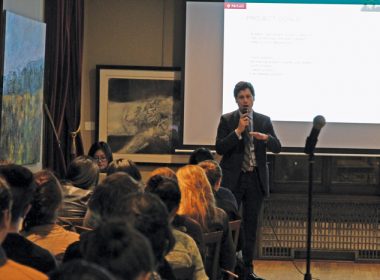
Amnesty International Canada delivers address on global struggle against torture

Secretary General of Amnesty International Canada Alex Neve spoke on campus on Wednesday in an address on the the complicated nature of torture as a human rights issue and its continued use despite being banned by international law. In his speech, he called upon attendees to stand in solidarity with Raif Badawi, a journalist who was publicly lashed by the Saudi government due to issuing allegedly derogatory statements about clerics. 

Neve began his talk by quoting a line from Article 5 of the Universal Declaration of Human Rights.

“No one shall be subjected to torture […] and no exceptional circumstance whatsoever may be invoked as a justification for torture,” he quoted.

Neve then directed attention to torture taking place in Canada. He explained that the federal and provincial governments in Canada use the term ‘administrative segregation’ to denote solitary confinement, which was declared as torture by the United Nations (UN) in 2012. According to Neve, solitary confinement has contributed to the deaths of prisoners such as Ashley Smith, a 19-year-old girl who committed suicide after she was isolated for long periods in correction centers, and Edward Christopher Snowshoe, a federal convict who committed suicide after 162 days in solitary confinement.

“Ashley Smith’s […] death in custody was the subject of a coroner’s inquest in Ontario and there’s no question that the excessive, prolonged, punitive use of solitary confinement in her case killed her,” Neve explained. 

Special Rapporteur on Terror Ben Emerson, an expert appointed by the UN Commission on Human Rights, spoke to the detrimental effects of solitary confinement to a UN general committee in 2011.

“Being confined in isolation produces severe and sometimes irreversible psychological and physical effects including anxiety, depression […] paranoia, self-mutilation, and suicide,” Emerson said.

Neve also stated in his speech that the Canadian government accepts intelligence obtained through torture and also shares that information with other intelligence agencies. He highlighted that the UN committee against torture has called on Canada to revise these policies previously. 

“Rather than adopt and enforce […the recommendations], the ministerial directions go in the exact opposite direction, authorizing what should instead be unconditionally forbidden,“ Neve said. “Last year, the government responded to the committee politely, saying they are content with the directions and [that] there will be no change.” 

Attendee Illa Carrillo-Rodriguez, an Arts postdoctoral fellow, asked if there was an internationally-recognized definition of terrorism, and whether it was being used at the national level in Canada or elsewhere to justify torture.

In response, Neve said that a universal definition of terrorism did not exist on an international level. 

“The one notion of having a treaty-based universally endorsed definition of terrorism [isn’t true],” Neve said. “One person’s freedom fighter is another person’s terrorist, and so how do you possibly craft legal definitions [of terrorism]?” 

Attendee Fazal Khan, a U2 Engineering student, spoke to the importance of understanding torture and its connection to human rights.

“I think it is great to reflect and check yourself on the things which are destroying the moral fabric of this society and how we can stop those,” Khan said. “As big as the issue of global torture and torture in Canada is, I think it is more important to understand that torture destroys the essence of human dignity and integrity […] and we need to stop it no matter who is subjected to it.”

a, Features

Should you stay or should you go

For the majority of incoming, out-of-province McGill students, the choice to study at McGill over other universities is a fairly easy one. Between the school’s renowned academic reputation, diverse student body, extracurricular and research opportunities, and outstanding football program (gotcha), there’s already enough to attract most prospective students to  McGill—and that’s all before considering its exceptional location.

Living in downtown Montreal, McGill students are afforded the rare opportunity of being steps away from a barrage of nightlife, artistic activity, unique neighbourhoods, and wide-ranging food options—not to mention the fact that there’s a mountain in the middle of the city. It’s the type of urban environment that young adults around the world jump at for the chance to live in, and for many McGill graduates, it is the perfect place to get their professional feet wet in for the first time. 

Despite the attractions of working in Montreal, there is a very real apprehension among Anglophone students about doing so, and it may be holding them back from a post-graduation future in a city in which they’ve already invested several years.  

To a certain degree, that fear is warranted. Before young graduates can start thinking about a Montreal life that doesn’t involve midterms or all-nighters in libraries, they need to find a job—which is where the worries begin. While Montreal is a bilingual city, it’s no secret that tensions over the use of the English language are prevalent—at both the municipal and provincial levels—and, as the past few decades have shown us, this uncertainty can carry occupational ramifications.

For many years, Montreal was Canada’s largest city in terms of both population and economic activity; however, over the course of the 20th century, Toronto surpassed it on both counts. The gap between the two municipalities widened dramatically after the then recently formed Parti Québécois (PQ) was elected in 1976 with a separatist agenda. In the ensuing decade, a significant number of anglophones left Montreal, many migrating to Toronto for the comparative stability it offered. Tensions hardly settled down in Quebec, which underwent two separate referenda—spearheaded by the PQ—in 1980 and 1995 that would have resulted in the province seceding from Canada had they passed. Although Quebec never separated, Montreal’s economy never returned to its former levels of national competitiveness. Research conducted by the Conference Board of Canada and École des Hautes Études commerciales de Montréal (HEC Montréal) found that if Montreal had experienced the average rate of economic growth in Canada over the past 25 years, per capita income in the city would be $2,780 higher than it is now.

Even during the short period of time that most of this year’s graduating class has spent at McGill, there has been no shortage of political drama affecting the Montreal workplace. The most famous example is the Quebec Charter of Values, which was proposed in fall 2013 by Pauline Marois’ PQ government and called for the banning of religious symbols (except for the cross, which is “culturally significant” to Quebec) in the workplace. Such a movement would have alienated much of Montreal’s workforce had it been adopted. Prior to meddling with public religious expression, the PQ was vigorously increasing the use of French in public services—many students may remember when ‘Pastagate’ broke out in early 2013 after a government food inspector sent a warning to the restaurant Buonanotte on Boulevard Saint-Laurent near Milton, demanding that they change the names of Italian food items on their menu to their French equivalents. 

With this type of recent history in the city, it can certainly seem as if the deck is stacked against any anglophone student hoping to find success by staying in Montreal. Even though the political landscape has shifted—Marois’ PQ minority was replaced by a Liberal majority government last April—there’s no recent evidence to suggest that the overall economic one has improved at all. Still, favourable conditions do not always guarantee success, and unfavourable conditions certainly don’t guarantee failure—it all comes down to an individuals’ ability to use their skills to their advantage or to adapt to what’s out there. In spite of the city’s circumstances, many recent graduates have found viable ways of staying in Montreal. For some, that involves continuing on the path that they started on at McGill; for others, like Suzanne Dergacheva (BMus 2007), it means finding an entirely different niche in the professional world.

“I knew that I wanted to do something different and I didn’t want to start off with an entry-level job, like I think a lot of music graduates end up doing,” Dergacheva said. “The idea of starting a business really appealed to me, and my boyfriend suggested we start a web developing company together. I didn’t know anything about web development, so I started to teach myself the basics in my last semester at McGill.”

The two of them co-founded Evolving Web shortly after graduating, and in the seven and a half years since, Dergacheva has implemented websites for McGill, Travelocity, A&E Television, and the Government of Canada—an impressive feat for someone who graduated with minimal computer science experience.

Her success, though, is representative of Montreal’s active tech industry, according to fellow McGill graduate Marina Byezhanova (BComm 2004). Byezhanova works for Pronexia, an Outremont headhunting company looking to “refute old-school recruiting practices” and help job candidates in specific ways that are tailored to the modern generation.

“We deal a lot with tech companies and the start-up scene, and Quebec is great [in] supporting those companies,” Byezhanova explained. “There are amazing investors, really nice venture capitalist firms that support these businesses, and there’s [assistance] from the government [for] technology credits and supporting them as well, so that helps. Even if we were comparing to Toronto, where salaries might be a bit higher, we get really nice technical talent thanks to that.”

Another organization that pays careful attention to the Montreal job landscape is McGill’s Career Planning Service (CaPS), which helps students determine their career paths and find jobs, hosting over 300 career-related events throughout the year. In her recent experience, CaPS director Darlene Hnatchuk has identified several other fields that are especially encouraging for anglophone students who want to work in Montreal right now.

“Typically the sectors that are recruiting more heavily would be aerospace, IT, health and social services, consulting, non-profits, education, [and] finance,” Hnatchuk said.

And, as Dergacheva added, there’s an important job pool that tends to fly under the radar.

“It gets overlooked but [there are] a lot of jobs at McGill and at the MUHC (McGill University Health Centre), the English hospital network,” she said. “Most of those are English jobs.”

Hnatchuk, in her position, has also had the chance to observe the broader ways in which the city’s economy has shifted over time.

“Probably one of the biggest trends we’ve seen is the decrease in the manufacturing sector and the increase in the services sector,” she noted. “Services is very, very large. We’re talking about professional and technical services, we’re not just talking about retail, which people often associate with services.”

One thing that has stayed consistent over the years in Montreal is its vibrant artistic community. Few cities in the world can compete with Montreal in terms of fostering an environment that encourages the creation and consumption of art and other cultural activities. Even in a city like Montreal, though, making a living off one’s artistic talent alone can be a daunting prospect. Like Dergacheva, many McGill arts students and enthusiasts will go on to pursue other professional avenues; Nova Scotia native Andrew Boudreau is another graduate from McGill’s Schulich School of Music (BMus 2013) who remained in Montreal, but he stayed specifically to find music-related work.

“It became more apparent as I kept studying [at McGill] that I really loved Montreal and the music scene, so it was definitely a place that I wanted to be in after finishing school,” said Boudreau.

To set himself up for that transition, Boudreau capitalized on the connections he could build during his time at McGill and also began teaching on the side—a steady job that has helped him balance out the challenge earning income by performing consistently.

“I had already been performing a little bit while I was in school and also teaching a little bit,” Boudreau recalled. “I teach privately—[not] through an institution—so I had a couple of students when I was still at McGill, and once I finished I had a better chance to expand my teaching studio and the same thing for performing [….] One of the things that really helped, obviously, would be all the people I knew from studying at McGill. There were a couple professors I had the chance to play with while I was studying, and I continued to play with a few of them after I was done studying as well.”

One of the realities of having an English-speaking university in a bilingual city is that anglophone students from out of town develop a strong attachment to the city, but never learn to speak French fluently; as such, they feel pressured to leave. There are certainly many jobs to be had in Montreal that either do not require French, or are only looking for employees to have a basic, functional understanding of it. However, it’s hard for any workplace to fully escape the spectre of the French language.

“I would say that one of the challenges of living in Montreal is the bilingualism—[or] more a company’s fear of what bilingual expectations and metrics they should be meeting,” Byezhanova explained. “There are quite a few companies in Montreal that are anglophone [where] you don’t need much French to operate [….] But we noticed, prior to the most recent provincial elections, a few of these companies started getting nervous and focusing not on hiring people based on skill, but hiring people who would be fluent in French, just to make sure that they would be protecting themselves should there be a government investigation.”

Although it appears that those ‘Pastagate’-like types of worries have died down in Montreal for the foreseeable future, learning French is still a worthwhile investment—both in terms of improving job prospects and getting more out of the city. McGill offers many undergraduate courses in French instruction, but students often cannot take those courses because of other academic requirements or an unwillingness to take on a new language when they’re focused so intensely on other areas of study. Fortunately, there are several accessible options available for Montrealers who want to learn French but are not in school. These include certain government-sponsored programs and classes with private organizations such as the Commission Scolaire de Montreal, Youth Employment Services Montreal, and CLC Montreal.

Finding desirable work in Montreal may prove to be more challenging for anglophone graduates than it would be in other North American cities, but for those who do, there’s a real reward—the chance to experience an incredible city in a completely different way, removed from student life and immersed in the city. Still, especially for those whose primary university friends have moved away, it doesn’t hurt to move into that phase of life with a large network of fellow graduates, which is something that the McGill Young Alumni (MYA) organization—led by its current president, Dergacheva—has built.

“We organize events in Montreal for students [who]  have graduated in the last 10 years, specifically to help them connect with other young alumni,” Dergacheva explained. “We have events that are purely social [….] We do some sports events—like every summer we have a volleyball event— [and] we go snowshoeing up the mountain. [There are]  pub nights [and we]  also have career oriented events like networking and mentoring workshops [….] We’ll have 60 to 80 people come out to an event usually, and we have at least one event every month.”

In terms of living situations, young graduates tend to move to neighbourhoods that the more adventurous McGill students enjoy branching out to.

“A lot of people end up [in the Plateau and Mile End], [which are] just great [places] to live,” Dergacheva said. “It’s also getting more expensive, so [there are]  people moving out now to the Atwater area, around the [Lachine] Canal, and even St. Henri, which is a little bit further, and then up by the Jean Talon market. There [are] people going up there—maybe not quite as much just when they’re graduating university, maybe a few years later.”

It’s that fantastic balance of community and culture that, in spite of the obstacles and challenges which can arise for out-of-town graduates, has drawn Boudreau and others to stay in Montreal after their time at McGill came to a close. Regardless of whether or not one’s end goal involves settling down in Montreal, it’s hard to argue against holding onto the city for a little bit longer.

“I’m certainly still thinking about [staying here long-term],” Boudreau said. “I’m really happy to be here right now, and I have the opportunity to be a part of some really great projects, so I’m definitely not bored and I’m not itching to get out of Montreal [….]But I kind of have the feeling that if I did move, I would be thinking about Montreal pretty regularly, because it’s a pretty great spot to be.”


a, McGill, News

McGill Law Journal hosts symposium addressing federal Senate reform

On Friday, the McGill Law Journal hosted “Democracy, Federalism, and the Rule of Law: The Implications of the Senate Reference,” a symposium that saw presenters from law faculties across Canada and the United States discuss the role of the Supreme Court of Canada in deciding how amendments could be made to the Canadian Constitution. 

The panel was held in response to the Supreme Court of Canada’s April 2014 ruling that constitutional amendments on elections and term limits would only be valid if provinces signed their agreement to the amendment procedure. The discussion was hosted by Emmett Macfarlane, professor of political science at the University of Waterloo, and Alexander Pless, a litigator for the Attorney General of Canada at the Department of Justice and a McGill lecturer.

The ruling was made in response to the Harper government’s attempt to reform the Senate. 

“The Court […] emphasized the Senate’s role as a complementary rather than competitive body and noted that any changes that altered this role should be subject to provincial consent,” Macfarlane said. 

Patrick Baud, a first year law student attending the event, explained the impact of the decision on Canadian citizens.

“This decision matters so much […because] it’s the first time the Supreme Court has really comprehensively interpreted the rules in our constitution for how we change our institutions,” Baud said. “So if we ever wanted to change the way the prime minister gets to advise the Governor General about how to do things, or change the way that the House of Commons is structured, or make any of the kinds of changes to national institutions which people have talked about for many years in Canada, this decision is about the rules that would apply to that.”

Pless defined the concept of constitutional architecture and contrasted it with that of the living tree doctrine, explaining that the wider scope of constitutional architecture could make it more difficult to change amending procedures. 

“This new notion that [the Supreme Court] introduced is an idea that the constitution has an architecture that can’t be changed without a constitutional amendment,” Pless said. “It [states that the] constitution is not a static document, but an instrument capable of adapting with the times by way of evolutionary interpretation within the natural limits of the text, which accommodates and addresses the realities of modern life.”

Macfarlane identified two primary issues with the ruling, both related to the concept of constitutional architecture. He argued that the Court’s approach introduced unnecessary ambiguity into its elaboration of the various amending procedures in Part 5 of the Constitution. He also criticized the amendment procedures’ potential for interpretation. 

Ultimately, Macfarlane’s concern was the effect of the ruling on the constitution’s clarity and its capacity for evolution. 

“[The ruling] means that the Court has arguably worsened the constitutional stasis that Canada finds itself in, and the Court’s reliance on constitutional architecture obscures rather than clarifies the dividing line between the various amending procedures,” Macfarlane said.

a, News, PGSS

PGSS secretary-general resigns, cites personal issues

Post-Graduate Students’ Society (PGSS) Secretary-General Juan Camilo Pinto submitted a letter of resignation on Jan. 20 to the PGSS Board of Directors (BoD). If Pinto’s resignation is approved by the next PGSS Council on Feb. 3, he will step down from his position on Feb. 16. A nomination period for an interim secretary-general will run until Feb. 9.  A voting period for a special election would be scheduled to run from Feb. 18 to 24.

“I regret to inform you that I am resigning from my position as Secretary-General of the PGSS for personal reasons [….] Although it sadness[sic] me to leave, I deeply appreciate the assistance and support you provided me during my tenure,” Pinto’s resignation letter reads.

The PGSS BoD placed a motion of censure on Pinto on Nov. 13, stripping him of his human resources (HR) responsibilities. According to the report of PGSS Council Director Régine Debrosse at the Dec. 3 Council meeting, the BoD’s decision was motivated by several complaints about Pinto’s behaviour from PGSS staff members, including a complaint regarding Pinto’s conduct towards staff at the PGSS Halloween party.

According to PGSS Financial Affairs Officer Nikki Meadows, the censure motion was not solely a result of the incident at the PGSS Halloween party.

“The censure was based on conduct unbecoming of that member,” Meadows said. “There were also issues with staff. The Halloween issue was one staff member, but there were also other complaints from staff members about treatment and behaviour and how things were going, so it wasn’t simply a one incident thing that led to that censure.”

On Dec. 10, the PGSS executive team voted “No” during a vote of confidence regarding Pinto’s capabilities as Secretary-General. According to Meadows, The vote of confidence aimed to express the executives’ sentiment regarding Pinto after he had been given time to improve following his censure.

“Our bylaws don’t have a prescription for what happens for a vote of confidence,” she explained. “It’s something that the Board of Directors felt was necessary, so they asked us to take it. I think the board wanted to see where the executive committee was after giving the secretary-general some time to try to fix some of the issues that had been brought forward.”

Pinto states that his resignation was not motivated by the vote of no-confidence or the censure.

“When the censure passed, I accepted my responsibility [for] the things that I was responsible for [and] I continue my work—proof of that is the CFS referendum,” he said, referring to the recent PGSS referendum that passed with a majority vote to disaffiliate from the Canadian Federation of Students (CFS). “The reality is that my research as a whole was suffering [….] It’s in rare cases that you have someone managing a research team plus being the president of an association, plus doing a PhD, plus doing sports. It’s a big combination that I had, so I had to pick something [to drop] and sadly it was PGSS.”

Meadows cited communication difficulties as a main issue for the PGSS executives during Pinto’s term as Secretary-General.

“If you read our bylaws, you see that one of the main hubs of communication is the Secretary-General,” she said. “When that role is not functioning at optimum level, there’s going to be communication issues.”

Pinto explained that he initially had a different conception of the secretary-general’s responsibilities.

“[In Colombia…] we approach things very directly,” he said. “It took me a long time to realize that I’m in a position where the [secretary-general] is not technically president—it’s a person who’s in charge of communicating [….] It was for me a new thing to try and figure that out.”

Going forward, Meadows stated that she is confident that the PGSS executive team will be able to continue their work as usual.

“I’m hopeful, I think we have a team that can work with anyone,” Meadows said. “I think that with [the] uncertainty lifted [on] what’s going to happen with our internal conflicts […] in some ways it makes it easier for everybody [….] We’re still making achievements on our portfolios, we’re still holding lots of events and doing lots of things, so in the end, the work still continues.”

Pinto stated that he feels he is leaving his position on a positive note.

“I’m very happy I had the opportunity to do this, I made an impact on the graduate committee, which was my purpose when I ran for secretary-general,” he said. “I leave on a happy note, I really like my job […] and I wish I could do it more.”

He explained that he hopes future members of the PGSS executive will prepare thoroughly before running for office.

“Institutions like this, they not only need leaders, they need good people,” Pinto said. “They need people who are willing to follow the rules […] who are thinking about the institution and not thinking about themselves [….] I will also say that a part of it is very taxing and people should study before doing this […] I would advise people […to] read the bylaws, and [to] understand the job very well.”

This article was updated Friday, Jan. 30, 2015.

a, Student Life

Round Table Tours


Montreal provides an incredible culinary experience that reveals and excels in an array of cultural eats and customs. One way to fully experience the city is through food, of which Montreal has no shortage. However, Mélissa Simard, founder of Montreal’s Round Table Tours, does not think visiting individual restaurants is enough, because each restaurant is only one piece in the city’s puzzle. The diversity of Montreal’s cultural scene and the promise that it brought to the culinary stage therefore prompted the beginnings of the Round Table Tours.

Simard, a 32-year old McGill alumnus, has worked in the restaurant industry for six years before starting her blog “4 Coins de la table,” which covers topics ranging from group cleanses to the various food personalities she meets. This prompted her to conduct cooking workshops for just over three years before starting her food tour initiative in 2012.

Round Table Tours aims to expose participants to the intricate food industry network, as well as the stories and the cultures that both motivate and unite the different food personalities of the city. Each tour is a storytelling experience, using food to showcase the dedication behind each meal made every day. Simard is especially devoted to properly telling these stories because her connections with the industry are not simply business-related. 

“It is a definite balance between personal and business connections with each of the stops on the tours,” Simard said.

Currently, there are four tours running: The Iberian tour, the “Summit of Wellbeing” tour, the Food Truck Montreal tour, and the Montreal Jewish Food tour. Simard hopes to add two supplementary tours to the repertoire by the end of this year, perhaps even extending outside of the downtown core.

The Iberian tour explores Montreal’s Little Portugal on foot through a series of tapas. This tour normally runs at $160.00 per person, which may be outside the reach of most student budgets. The least expensive tour is the Jewish food tour, which costs $75.00 per person. Although these prices may seem steep, it is a worthwhile experience. Not only did the Iberian tour expose several fantastic restaurants situated among the plentiful clubs on Saint- Laurent, it also emphasized the Portuguese presence and its history in Montreal. 

Simard’s presence is a great help, and the tour attracts tourists and newcomers alike as a secret entrance into the core of Montreal’s culture. According to Gabriel Sirois, who recently moved to Montreal from Toronto, this tour provided an opportunity to learn more about the culture in Montreal. 

“[My favourite part of the tour] was actually getting to know the city,” Sirois said. “As a newcomer, it was a really good opportunity to learn some things you wouldn’t learn. It’s nice because it’s easy to browse on the Internet and get information, but actually talking to people creates two-way conversations. Ideas spring up and you get recommendations you wouldn’t find otherwise.”

For students moving to a new city like Montreal, it is difficult to discover the hearts of the different cultures and lifestyles within the city. Backgrounds provided by Simard at each stop on the tour were not only informative, but gave life to what were just four walls with a kitchen mere minutes before. This tour emphasizes the life of the family behind each restaurant scene—moving the business forward while maintaining the authenticity of the food they serve.

Simard believes that the culture of food within a city plays a large part in defining the identity of the large-scale community. Milkyway Sirois, Sirois’ wife, agreed with this sentiment.

“There are a lot more cultural restaurants here, which definitely says a lot about the population,” she said. “I expected there to be more of a French influence, but the amount of ethnic restaurants shows that there are definitely lots of different populations living in the city.”

Overall, Simard succeeds in uncovering the stories behind the food at each of her stops. It is clear she has a passion for the Montreal food industry and the people working hard to maintain its vibrancy. Her tours connect the food suppliers to the retailers and to the restaurants themselves, revealing the true cycle of hard work and determination behind Montreal’s world-renowned culture of food.


  • Librarie Espagnole/ Épicerie Gourmet, 3811 Blvd Saint-Laurent

    This location is the start of the Iberian Tour, a historic landmark that opened in 1964 to a large number of immigrants from Portugal and Spain who settled in what is now known as Montreal’s Little Portugal. Originally a bookstore where patrons could find their favourite imported magazine or newspaper from home, Librarie Espagnole has expanded to a full-sized specialty grocer, importing a variety of items from Spain, Argentina, and Uruguay.


  • Chouriçôr Inc., 4031 Rue de Bullion

    The next stop of the Iberian Tour was a small, white-walled grocery store on the corner of de Bullion and Duluth. The foods in the store were ranged from imported cooking oils to wines. The centrepiece of the store, though, was meeting the butcher in the back room, to which Simard’s tours are granted access. The participants also receive a firsthand run-through of the powerful machines. Each participant also got their own spicy sausage to take home.


  • Casa Tapas, 266 Rue Rachel Est

    Though it was a bit of a hike, getting to try the food at the legendary Casa Tapas was worth it. The waiters and owners were hospitable and kind, all glad to see Simard. Upon being seated, participants received a glass of very sweet white wine that perfectly complemented the spiced shrimp, stuffed eggplant, and baked asparagus placed in front of us. Simard used to work at Casa Tapas, and she explained that the restaurant opened in 1993 as one of Montreal’s premier tapas spots. True to her word, by 6:00 p.m., the restaurant quickly filled up.


  • Pintxo, 256 Rue Roy Est

    Pronounced “pincho,” the name of this restaurant refers to a small snack popular in Spain. Pintxo aims to provide flavour bursts in small doses, so that the consumer doesn’t get bored with just one flavour. Simard explained that when individuals eat, they are really only impressed by the first two or three bites because the brain gets easily distracted. Thus, Pintxo seeks to keep everyone as thrilled as they were with the first bite—they did not disappoint when they wowed participants with seasoned clams and prawns, amongst other dishes. The masterminds at Pintxo perfectly paired their tapas with a full, oaky red wine.


  • Boca Iberica, 12 Rue Rachel Ouest

    At the final stop of the Iberian Tour, Simard took participants to experience tapas, complemented with traditional Portuguese blood sausage. The food was not only great, but the atmosphere was simultaneously warm and modern. With light hardwood floors, dimly lit hanging lights, and wooden tables, the mood at Iberica was definitely memorable. This stop served the most meat, which was tender and cooked to perfection. For dessert, they served a moist pumpkin cake, which found the perfect combination between sweet and nutty, a fantastic way to end the tour.

a, Arts & Entertainment

Album Review: The High Dials – In the A.M. Wilds

The fifth and latest studio album by The High Dials, a Montreal-based indie band, explores familiar territory by mixing pop and electronica with folk inspired melodies. The album successfully creates a distinct atmosphere while providing more traditional listeners with grounded and catchy melodies, despite suffering from a few subpar tracks.

Adopting low-key vocals and computerized beats, the album bears a marked stylistic resemblance to The Strokes, with the occasional sprinkling of MGMT for when the tracks take a more psychedelic turn. Most of the songs find their strength in the distinct melodies, which gradually vitalize their more stylistic elements. It is also impressive to see how well many of the tracks meld together conceptually as the album leaps from more pop-centered tracks like “Yestergraves” to acoustic focused songs like “Flower on the Vines.”

This is not to say that the album is without its faults. Some of the tracks leave a lot to be desired, particularly the dreary “Evil Twin,” which, despite a somewhat pleasant guitar riff, is plagued by bored sounding vocals and lazy, subpar lyrics.

That being said, on the whole In the A.M. Wilds constitutes a solid musical experience that has gained The High Dials at least one new fan.

a, Arts & Entertainment, Music

Peer Review: Cult Classic

When listening to the complex, polished, and innovative sounds of Cult Classic’s latest singles, one could be easily forgiven for mistaking the dramatic and trancelike music of self-described “creampop” Montreal band Cult Classic for that of a band with years more experience together. Despite forming just over a year ago, they have the charismatic swagger and experimental nature of a band established in the scene for many years.

“We’re for people who expect something different more than anything,” said vocalist and guitarist Chris Steward. “We try to be as unpredictable as possible with our music.”

‘Unpredictable’ is an apt choice of words when describing the unique tone the band has established—their distinctive sound can be hard to pin down with the folk singer-songwriter influences of vocalist/keyboardist Rosie Long Decter and the groovy jazz background of drummer Austin Pine. This diversity forms a striking yet engaging complement to the band’s quintessential dreampop and shoegaze sound. Their predominantly collaborative songwriting style allows the essence of each member’s unique backgrounds to shine throughout their catalogue.

The members of Cult Classic have made a substantial name for themselves in the local scene. Their focus has taken them from rough practices in the basement of Gardner Hall to playing high-profile shows with Fleece and Arkells within the span of months, and they show no signs of slowing down as they head into the studio in the upcoming weeks to begin the recording of their debut EP. It promises to be their most carefully produced and calculated recording work yet.

In the past, the band has entirely self-produced its releases, often working long distance on projects to record and mix singles.

“We recorded a song over the summer from like four or five different countries, just sending it back and forth on Facebook,” said Long Decter.

For their newest sessions, they will be consulting a recording engineer for assistance, upgrading their recording technology, and working every step of the way together as one.

“It’s kind of opening up a new dimension to the way people have heard the songs live,” says Steward. “Every time we go into the producing of a song, we think of a billion ideas [….] It’s going to be a bit more cohesive than our previous work.”

That type of cohesion is not only a focus of their upcoming EP, but of their sound as a whole. While the incorporation of smooth, flowing transitions between songs to generate a unified tone has been a central focus of their recording efforts for some time, they intend to step it up by working to generate a more atmospheric live show as well, generating a feel and sound that more closely parallels their recorded work.

“A lot of what we’ve been trying to do is to bring as many of our recorded aspects of a song [as possible] into the live show, and make them sound good as well, which is a challenge,” Steward explained. “I want to get to a point where everything is electronically connected [….] We want to keep the human live aspect of it, but at the same time we want everything to sound as polished and as good on stage as possible.”

Their swift rise has not been without difficulties. They found that the local music scene was more challenging to enter than they had expected.

“Montreal is definitely unique in terms of its music scene, but it’s a matter of finding your way into it,” says Long Decter.

The lineup has seen extensive changes even within the band’s short history—most recently the addition of bassist Tom Gould. While changes in lineup can often cause struggle in the creative output and unity of a group, the members of Cult Classic said that they are genuinely excited about the new directions and perspectives Gould brings to the band’s catalogue.

“Chris will show me a cool bass line, and I’ll just Kim Deal-ify it,” Steward quipped.

Cult Classic has proven itself in a strong way in its first year of existence. If the past is any indication, we can expect truly big things from the bands upcoming EP and future performances. Without a doubt, Cult Classic is a band to keep a close eye on in the coming months.

This article was corrected Feb. 6, 2015.

a, Arts & Entertainment, Film and TV

Serpent’s Lullaby adds eerie beauty to Medusa myth

Serpent’s Lullaby, a 2014 short film that has been garnering buzz on the festival circuit and recently made its Canadian premiere in Toronto, is a deeply disturbing and undeniably fascinating take on the myth of Medusa in a modern setting. Its eerie motifs—arguably on par with those of American Horror Story—combined with a heartbreaking performance by Montreal’s own Jenimay Walker and superb directing by award-winning filmmaker Patricia Chica makes Serpent’s Lullaby an enchanting watch. 

The film depicts a mysterious woman living reclusively in a mansion with her newborn baby, when tragedy strikes one night. The woman withdraws into a deep depression, with only her art collection and ‘pet’ snakes to keep her company. Slowly, the audience realizes that the newborn was not her first. In fact, when a necropolis of undersized skulls appears in her backyard, the viewer becomes less sympathetic and highly suspicious of the woman in apparent grief. The audience’s ensuing belief that the protagonist will prove to be the monster we suspect drives the story forward. 

With short films, it’s critical how the filmmaker makes use of the limited time, and one weakness of Serpent’s Lullaby is that it moves slowly in certain scenes. Important plot points could have been made more efficiently and less emphasis been placed on setting the tone. However, one cannot help but admire Chica’s ability to captivate the audience and examine a broad range of emotions in less than 13 minutes. Credit also goes to Sean O’Bryan Smith’s excellent music selection and score, which truly inspires a sense of dread and unnerve. One of the greatest moments occurs when the viewer has grown accustomed to the rattling of a serpent in the background, when suddenly, the sound becomes the rattling of a baby’s toy instead—the mixture of surprise and horror is tremendously enjoyable. 

An interesting parallel can be drawn between Angelina Jolie’s Maleficent and Walker’s Medusa—both are traditional villains, but perhaps with a more human and sympathetic story that is worth exploring. Like Maleficent, Medusa lives alone in a state of perpetual mourning, having lost what she values most. Both Maleficent and Medusa are victims of their own demons—although in this short film, the fate of Medusa is decidedly more tragic. 

Chica discovered the screenplay by Charles Hall as she was submitting it for the second installment of the ABCs of Death anthology. Having watched the atrocious first anthology, Hall had good judgment in giving it to Chica instead. The short is well-shot, catching all the right angles for the most sinister effects and fully utilizing the excellent contrast between Walker’s Medusa and the cookie-cutter role of the soccer mom played by Annabella Hart. 

Equally disturbing and compassionate with a beautifully haunting ending, Serpent’s Lullaby does not disappoint. The team behind the short film, led by Chica, has managed to create an unexpected and emotional story. Serpent’s Lullaby is an excellent choice for anyone who enjoys the thrills and chills of the horror genre. 

a, Editorial, Opinion

Editorial: Tuition deregulation necessary, transparency paramount

At a Senate meeting held on Jan. 21, Provost Anthony Masi stated that McGill is pursuing deregulation of student fees for international students in the remainder of the regulated faculties. The Faculties of Engineering, Management, Science, and Law have already been deregulated, and, as a result, have seen international student tuition increased by an average of nearly $20,000 per student. The proposed deregulation of the remaining faculties could help McGill to recover from continuing rounds of budget cuts administered by the provincial government. Although the tuition increases that would result from deregulation might drive away some international students in the short term, deregulating all faculties is a necessary step towards upholding McGill’s prominent standing in the long run.

If McGill does deregulate, students must be consulted and made aware of the future prices of tuition and how the additional revenue will be spent. This requires both a structured plan and transparency on the part of the administration, who must make it clear how the added tuition will benefit both current and prospective students. In his response at the Senate meeting, Masi stated that the amount of tuition increases depends on careful market assessments and on the implications that deregulation would have on McGill’s position as Canada’s most international university. Details about the actual tuition increase and its implementation are still absent from the discussion. If the university decides to move forward with deregulation, information regarding the amount of tuition increases and the plans for its allocation within the university’s budget should be made widely available to students.

Although deregulation might drive away some international students in the short term, it is a necessary step towards upholding McGill’s standing in the long run.

Under a regulated system, the government determines the amount of supplemental tuition charged to international students. The provincial government then accumulates this surplus and redistributes it among all of the province’s public universities in the form of grants. McGill is harmed by this system, which reallocates funds from internaional student tuitions based on overall student population, and results in most of the money going back to larger Quebec universities. With deregulation, McGill is given the right to determine international students’ supplemental tuition, and the university is able to keep this surplus instead of funneling it back to the government and receiving only a fraction in return. Deregulation therefore has the potential to benefit McGill more than any other university, since McGill has the largest proportion of international students.

While McGill’s significant international student population means that it could benefit greatly from deregulation, it also means that McGill has the most to lose. Substantial increases in tuition could deter international students from applying, which would in turn harm McGill’s reputation as a diverse and international university.

Should the remaining faculties be deregulated, actions must be taken to minimize the losses to diversity and the restricted financial accessibility of the university. This requires providing additional means of support and resources for international students, and ensuring that the newly generated revenue is being spent on visible improvements to the quality of education at McGill that will promote the university’s future success.

In response to concerns about the financial strain that a rise in tuition would place on international students, Masi and Principal Suzanne Fortier have both cited McGill’s comprehensive bursary and financial aid programs. McGill does, indeed, provide a significant amount of financial aid to its students, allocating 30 per cent of net new tuition to student aid programs each year. Naturally, though, Canadian students are prioritized in the allocation of aid. Moreover, international students of middle incomes, according to Canadian standards, who do not qualify for need-based aid may suffer the most if tuition costs become too burdensome. Deregulation will most likely deter some international students from attending McGill, but the administration should use this as an incentive to reach out to international students in other ways. Improved access to financial advising, work study programs, and student loans could all help to mitigate the burden of raised tuition on international students.

Prospective students don’t only consider tuition when deciding whether or not to attend McGill—students, both international and Canadian, care about the facilities, the number of different classes that are offered, the quality of professors, and many other factors. By deregulating, McGill can hopefully gain the additional revenue that it needs to keep attracting the best students from around the world, while also providing the best possible services and opportunities for current students. Deregulation might drive away some international students, but it is a necessary step in ensuring McGill’s financial viability going forward.

Read the latest issue

Read the latest issue