


Latest News

#Oscarssowhite
a, Arts & Entertainment, Film and TV

Pop Dialectic: #oscarssowhite and the power of the boycott

After the nomination committee of the American Academy of Arts and Sciences once again selected a group of all-white actors for nomination at the Oscars, multiple high-profile stars of colour are preparing to boycott the awards ceremony. But should viewers boycott it too? For more, check out our new podcast, Cult Mentality.

[audiotrack title=”Cult Mentality EP. 1: Tackling the #oscarssowhite debate” songwriter=”April Barrett, Selin Altuntur, and Tanveer Ahmed” date=”February 16, 2015″ width=”700″ height=”200″ src=”https://24f2041bb5b609d25f1a97039f71682cc9154421.googledrive.com/host/0B9rQxTeDv2duM0FmSjBSYkZFS1k/Oscars%20Podcast%20%28Final%29.mp3″ autoplay=”on”]

Boycott: The Oscars’ issues are more than skin deep

Recently, the annual Academy Award nominations have come under fire for their lack of diversity. For the second year running, all 20 Oscar nominees in the acting categories are white. This failure on the part of the Academy has become a major subject of contention after Jada Pinkett-Smith released a video calling for a boycott of this year’s awards ceremony, in part spawning the #OscarsSoWhite movement on social media and bringing criticisms about Hollywood’s lack of diversity in representation to the forefront of this year’s Oscars buzz.

While the movement has garnered support from notable figures in Hollywood, including Will Smith, Matt Damon, Lupita Nyong’o, and Ava Duvernay to name a few, it has also drawn criticism. Some suggest that having a “diversity checklist” when naming nominees creates a sort of token effort to diversify and prevents merit from being the sole deciding factor. These shallow criticisms fail to understand that the imbalanced voting body of the Academy, comprised mainly of white men (around 72 per cent) has historically shown a clear bias towards films made for and about white people—take last year’s snub of the critically acclaimed Selma and the six nominations that went to American Sniper as one example.  


We must stand in our power!

We must stand in our power.

Posted by Jada Pinkett Smith on Monday, 18 January 2016

Yet the root of this mess can be traced back to Hollywood’s abysmal record of inclusion where whitewashing roles by hiring from an elite pool of white actors has become the norm.  In the past year alone, Emma Stone has portrayed an East Asian character in Aloha, Rooney Mara played an aboriginal woman in Pan and McGill graduate Mackenzie Davis portrayed a character in The Martian that was originally of Korean-American descent. Much of the time, for a person of colour to be nominated for a role in Hollywood, there must be an explicit reason—it must be relevant to the character’s story. If race isn’t considered relevant, a white actor is the default choice. In the case of the Oscars, it makes sense that there is little inclusion of people of colour in the list of nominees when they receive little consideration at a studio-level.  

What a boycott of the Oscars can accomplish is, most importantly, to direct attention and awareness toward this cause and begin to take steps towards making changes. The Academy has already promised to double the number of non-white members in its voting body. This is progress, but it is not enough. It does not fix the fact that both the Academy Awards and Hollywood are built on a foundation of racial bias. Creating a lasting change from within must come from innovators who want to be active in combatting the issue. Filmmakers who are allied with the cause must focus on projects where people of colour can be chosen for roles that don’t come with specific racial requirements.

In the meantime, it is worth considering that since the Oscars have had such consistent issues with inclusivity, they should not be thought of as the most prestigious and important ceremony in film.  By being seemingly unable to adapt to calls for change, they are becoming a relic of Hollywood’s past where issues of racial bias were brushed under the rug and never questioned.  Winning an Oscar is not going to be seen as all that important if the status quo persists.  After all, filmmakers, actors, and actresses don’t need to live up to the Oscars’ narrow standards to be recognized anymore. 

Ultimately, a boycott of this year’s ceremony will send an important message about how the Academy has failed to rectify its history of bias and exclusion.  It can also help foster change in making Hollywood a more inclusive space where whitewashing is a thing of the past; however, it is vital to remember that Hollywood must get itself together and eliminate racial bias in order for the Academy Awards to make a lasting change.

— Selin Altuntur

Don’t Boycott: Diversity at the Oscars is not so black and white

If visitors to the Hollywood Reporter website were to navigate to the Oscars section, they would find multiple articles on display. One of the articles is about Prince winning an Oscar in 1985. It is the only article that is not directly about the #OscarsSoWhite campaign and even then, its first sentence addresses this year’s hottest Oscar topic: The lack of diversity at the Oscars. This topic has been misguidedly blown out of proportion.

Cries of outrage are being heard across social media platforms about the lack of actors of colour nominated among the 20 acting nods. Fingers are being pointed at the 94 per cent white voters in the Academy, with an average age of 63. How could Will Smith have been overlooked for Concussion or Idris Elba for Beasts of No Nation? This campaign has reached such a fever pitch that those who have not yet supported it are being persecuted as opposers of diversity.

Unsurprisingly, in this day and age of immediate reaction and unsubstantiated outcry, the facts have been overshadowed by the passion to see people of colour nominated. The demand for diversity at the Oscars is by no means a bad cause, but it’s hard to say that racism is prevalent in the Academy when looking back at the past few years of Oscar nominees and winners. Since the turn of the century, 10 per cent of the Oscar nominations have gone to black actors and in the past decade, and 10 per cent of the winners have been black despite 2015 and 2016 having no black nominees. Seeing as about 12 per cent of the U.S. population is black, the Oscars are more or less proportional in this sense. The real issue is when it comes to other minorities. Latinos, for example, represent roughly 17 per cent of the U.S. population yet have only held 4.9 per cent of roles and also received zero acting nominations this year; however, few have made any effort to debate the omission of Benicio Del Toro for best supporting actor in Sicario. Even though this campaign claims to focus on diversity, black actors are the ones getting the most attention.

Furthermore, the Oscars are and have always been about showcasing the best performances in film, rather than providing a platform for diversity. In spite of the fact that the last two years have yielded no black nominees, it is debatable that actors like David Oyelowo (Selma), Jason Mitchell (Straight Outta Compton), Smith, and others were better than the white actors that did get nods. Every year, many actors vie for the five exclusive spots in each category, but a select few manage to get there. The Academy Awards for acting are meant to reward the best performances regardless of race; using it to protest the lack of diversity is simply misplaced. Almost every other award ceremony, such as the Screen Actor’s Guild Awards and the Critic’s Choice Awards, also mirrored the nominations of the Oscars, a clear indication that the demographic makeup of the Academy is not as biased as they are being made out to be. The lack of black nominees is clearly due to the limited amount of prominent black roles rather than a vendetta by the Academy to not recognize non-white performers. 

The issue of black representation is not a fight to be taken to the Oscars, where black actors have been proportionally represented, but instead to Hollywood in general. The real injustice towards non-white actors is the opportunity, or lack thereof, given to them to shine, not the acknowledgement of their accomplishments. This problem is prevalent not only for black performers, but all ethnic minorities. Stereotypical casting is a widespread practice in Hollywood, which leads to a shrinking of the pool of roles that are available for minority actors in which to break out and shine. 

The thought of taking action against racism is a noble gesture, but misplaced as it is in the case of the #OscarsSoWhite campaign, it diminishes what is considered to be a prestigious honour. If the result of this protest is that the number of nominations are increased to accommodate greater diversity, then it only cheapens the honour of being nominated. Perhaps bringing this issue to the forefront will lead to a push to give more roles to minorities, but there is no need to victimize the Academy to achieve that goal. Boycotting the Oscars is like changing the light bulb when the switch is broken.

– Tanveer Ahmed
a, McGill, News, SSMU

Looking at the effects of international tuition deregulation

On Feb. 2, an article published in La Presse claimed that the Quebec government planned to significantly cut funding to universities in the 2016-2017 school year. To compensate, the province suggested that universities raise tuition for international students by up to 25 per cent. Though it is too early to know if McGill will act on this announcement, it comes in the wake of a long history of support for tuition deregulation from the McGill administration. 

“McGill is currently, and has historically, lobbied the provincial government to deregulate the supplementary fee that international students pay on top of their tuition,” said Emily Boytinck, vice-president (VP) External of the Students’ Society of McGill University (SSMU). “So international students are charged the base Quebec fee but they’re also charged the supplementary [fee], as are out-of-province [students].” 

In 2008, the Quebec government deregulated international tuition for six programs, leading to a rise in tuition for the faculties of Science, Engineering, Management, and Law. Currently, according to the McGill Student Accounts website, an international undergraduate student in the Faculty of Arts pays $18,258.61 a year, while a student in the Faculty of Engineering pays $37,054.55 in tuition and fees. The differences comes from fees charged to international students that, when tuition is regulated, go towards equalization payments for the Quebec government. According to McGill VP Communications and External Relations Olivier Marcil when tutition is deregulated, McGill keeps the money from these fees. 

“The problem we have currently is we feel that it’s unfair that Quebec is the only jurisdiction in North America to have a system of equalisation,” Marcil said. “What it means is that when an international student and [an] out-of-province student pay tuition at McGill, that money doesn’t stay at McGill, it goes back to the government to distribute […] as part of the [provincial student] grant […] system. And so what [we’ve been] advocating for for many years is that the money should follow the student [….] It’s just fair for the student that that money will be reinvested for services that that student will receive in exchange, and not being distributed in other institutions or [taken] back by the government.”

Marcil stated that deregulation would allow the university to put the money students already pay through fees into programs that international students can access instead of paying it back to the province.

 “The other problem with the current Quebec system of equalization is that the international students, [and out-of-province students] pay […] for the Quebec student aid program [in their tuition fees],” Marcil said. “But students from out of the province do not have access to that program [….] Fifty per cent roughly of our student body do not come from Quebec […. Whereas] there are some institutions in Quebec where 95 per cent of their student body [come] from Quebec. With a new model of funding where the money follows the student, the money stays with the institution [and] it’s fairer for those students because we’re going to strengthen our student aid program [and students won’t have to pay] for a program that’s not available for them.”

The McGill Scholarships and Student Aid Office has seen an increase in contributions from the university in recent years.

“[The university has] a commitment that 30 per cent of net new revenue derived from tuition increases was going to be set aside for student financial support,” explained Cara Piperni, director of the Scholarship and Student Aid office. “So it started in 2007-2008, I believe, where we had about $1.7 million given to us from this source and in the last [school] year [2015-2016] that’s grown to $8.3 million [….] We try to be equitable [in distributing aid], we try to meet a certain portion of tuition costs. If you’re an international student in Arts program versus an international student in the Engineering program, [and] if you have equivalent demonstrated [financial] need, then you will get a similar proportion of your fees given to you in the form of bursaries.”

However, according to SSMU VP University Affairs Chloe Rourke, the truth behind the university’s proposed increase in student aid from tuition deregulation is uncertain.

“The University has responded by saying that they intend to uphold their commitment to set aside one-third of every tuition dollar for financial aid,” Rourke wrote in an email to the Tribune. “They also emphasize that unlike many other universities in Canada, McGill provides financial aid to international students [….] However, in our recent Senate question we saw that the percentage of the cost of attendance covered by McGill financial aid is lower for international students in deregulated programs than in regulated programs. This suggests that the increase in financial aid is not enough to compensate for dramatic increases in tuition. As well, covering 30 per cent of the cost of attendance for a student who is paying $40,000 to attend each year is not the same as covering 30 per cent of the cost of attendance for a student who is paying $18,000 per year to attend.”

In addition, Rourke is concerned about how deregulation will affect the cost of attendance for international students. 

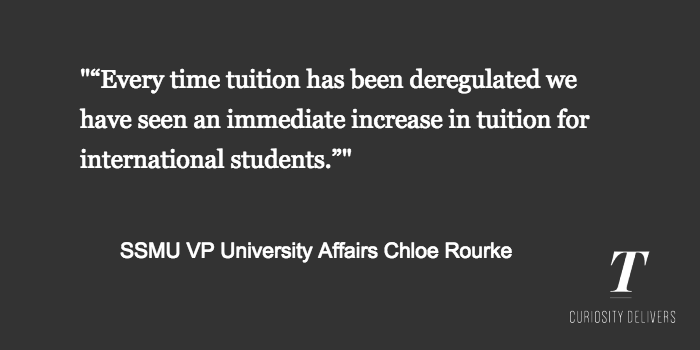
“The university has also stated multiple times that tuition deregulation does not necessarily mean a tuition increase,” said Rourke. “Due to Quebec’s complicated funding formulas, the deregulation of tuition would lead to millions of dollars more for McGill even if tuition rates remained constant; however, our concern is that these statements are misleading. Every time tuition has been deregulated we have seen an immediate increase in tuition for international students.”

SSMU has vocally opposed tuition deregulation due to concerns about its impact on the diversity of the student body.

“My primary concern with tuition deregulation is its impact on the socioeconomic diversity of our student population,” Rourke wrote. “McGill has an unusually high percentage of international students (approx 25 per cent of our population). We pride ourselves on our ‘diverse, international’ learning community, however socioeconomic diversity is an important aspect of a diverse campus that cannot be ignored. We know that students from middle-income families, particularly from the US, often choose to study a B.A. because the Faculty of Arts is still regulated, unlike Science, Engineering, or Management. If tuition is deregulated in all faculties, it would seriously threaten the ability of many students to study at McGill.”

Additionally, deregulating tuition will leave McGill free to set tuition fees at any price.

“McGill [administration] will try and argue that it’s economics [… and] they can’t raise it above the Canadian market average, because then […] they would be pushed out of the market, […] but they are forgetting that a lot of our international students are American, so a lot of their [economic] competition […] is often not other Canadian universities but other American universities,” Boytinck said. “So there’s absolutely nothing stopping McGill from raising those fees to American levels which is totally financially inaccessible and against everything that SSMU stands for.”

The Quebec government has yet to officially deregulate tuition. 

a, Science & Technology

App round-up: Restaurants, food, and texting

There’s an app for everything in 2016. Brilliant minds are continuing to create innovative concepts that simplify our lives in ways we didn’t even think were possible. But how good are all of these apps? And are they worth it?  

1. 10MinMontreal

If you’re like me, every month you come precariously close to going over your cell’s data plan.  When you’re out with friends, this can be a problem: Without a Wi-Fi connection it becomes much more difficult to find places to eat, study, get a quick cup of coffee or even go on an impromptu date. The app 10 Minutes in Montreal, by McGill U4 software engineering student Dan Crisan features different restaurants that are all within 10 minutes walking distance from a Montreal metro station, and it works entirely without any internet connection or data usage. Crisan’s main focus with this app was to make it entirely accessible to McGill students. 

“At the beginning, we were a bunch of friends talking about where we should bring our dates,” Crisan explained. “As a techie, I had a vague idea about a simple app where the first thing that shows up are ‘moods.’ ‘She likes Italian food?’ ‘Here are a bunch of Italian restaurants. It’s late and want to go for a drink?’ Here are some bars. I wanted something simple, and more than anything else, accessible.”  

Not only is this app convenient, but it has a sleek, simplistic, ad-free layout that makes it incredibly easy to use, with more student-targeted results than other vast databases like Yelp, for example. Two thumbs up.  Rating: 5/5.

(itunes.apple.com)
(itunes.apple.com)

2. ReeBee

Being a university student brings its own set of challenges, and shopping for groceries without going broke is one of the most difficult. Co-founders of ReeBee, Tobiasz Dankiewicz and Michal Martyniak, have created an app that allows users to intelligently shop for groceries without having to leaf through store flyers to find the best deals at the time.  This app has a simple design where you type in the product you’re looking for and get a breakdown of all the different price offerings at local stores near you. ReeBee allows you to save up to 40 to 50 per cent on groceries (and even other products, like those sold at stores like Future Shop), and it also lets you price match with major department stores.

“In just one second you can tap on a product, navigate to it, show it to the cashier and get the product at the discounted price,” Dankiewicz explained.  

The co-founders explain they’re looking to add a feature that allows personalization. For example, vegetarians won’t see ads for meat products. In addition, you can share your grocery lists with your roommates and family, and let others know what products you’re buying.  

Rating: 4/5. Useful, but a lot of students will still just go to the  grocery store closest to their apartment and not the one with the best prices.

(itunes.apple.com)
(itunes.apple.com)

3. Texi

Texi is an app that was released this past month by the Dilawri Foundation, the philanthropic sector of a Canadian automotive group, and is an initiative for their newly launched safe driving campaign. This app has a really cool concept. It creates initiatives for safe driving through a point system: The more miles you drive without texting the more points you obtain. Eventually, at the end of the month, you are eligible to enter different drawings based on the number of points you’ve received. The drawings have a wide range of prizes, from a new smartphone to a $500 travel voucher. Statistics show that about 20 per cent of Canadians will admit to texting and driving, and in some places, including Ontario and British Columbia, police officers have stated that there are more accidents due to texting and driving now than there are from drunk driving. Texi aims to stop texting and driving by rewarding safe drivers. 

“Clearly, this is an issue becoming major enough for our foundation to want to do something about it, and this is a solution that we think is going to work,” Galit Solomon, a spokesperson for the company, stated. 

Rating: 4.5/5. Super cool prizes, and for a great cause. 

a, Student Life

BSN x CKUT: Black Talk

On Monday, Feb. 15, Black Students’ Network (BSN) collaborated with CKUT 90.3 FM to produce Black Talk, thirteen hours of afrocentric radio programming. As part of their Black History Month series, the BSN-involved McGill students and Montreal locals alike fostered conversations on the black experience and issues within the black community.

The program was founded by McGill students in the BSN in 1987, yet Black Talk’s disappearance in 1996 meant the program was kept under the radar of the BSN executive until this year. It was only after serendipitously finding remnants of the program in its office, including an old poster and tapes of recorded segments, that the BSN decided to revitalize the program.

“We were cleaning up our office, and we found a lot of documentation, a lot of posters for stuff that [the BSN] had done before,” Isabelle Oke, U2 Arts and BSN External Coordinator, recalled. “One of them was Black Talk […] and we got inspired to try it out again.”

Because the BSN executive had limited knowledge of what Black Talk programming consisted of in the 1980’s and 1990’s, they took their own approach to choosing content to dedicate air time to, rather than limiting their programming to that which had been done in the past. The BSN held a call-out for volunteers to host programs on the topic of their choosing, empowering students and community members to contribute to the discussion on the black experience in Canada.

“We didn’t actually find the schedule from the last Black Talk,” Oke said. “We approached the programming this year [by] trying to have a mixture of community organization [and] personalities [talking about] topics brought forward by students, and some historical content. We also just tried to give air time to anyone who wanted it, which wasn’t a problem because everyone had really interesting stuff to talk about.”

The BSN hoped to bring the program back to life this year and re-establish it as an annual occurrence.

“The struggle right now is just trying to connect what it was into what it is now,” Michelle Blassou, U2 Arts and BSN Social Coordinator, said. “Hopefully it’ll revive back up and it’ll grow to what it used to be.”

To pay proper homage to the original Black Talk programming, Monday’s schedule included archived segments from versions of Black Talk that took place in the 1990’s. Among these was Hair Talk, a discussion on hair in the black community.

“Listening really helps to centre discussions and attitudes we have about hair today,” Oke said.

The guests on this archived program discussed the cultural and political implications of their choices of hairstyle. One guest explained that institutional systems of oppression put immense pressure on the hair styles of black women.


“There’s something […] covert about [the black experience in Canada],” Blassou said. “It’s not talked about a lot, so [it was nice to show] this is what it’s like here in Montreal, this is what it’s like at McGill.”

“The way society is now, we’re made to feel ashamed of not having 'good' hair,” a guest, Melanie, explained. “I began to feel like people have been brainwashed into thinking there is something wrong with the way their natural hair looks.”

Another guest noted that she felt as though wearing natural hair was a political statement of pride for her heritage.

“There came a point where I was like, ‘Yeah, I’m making a statement [with my hair], and I like the statement I’m making,’” she explained. “It’s a way for me to say that I am proud of my naturalness and my natural African heritage.”

The BSN also enlisted the help of Shanice Nicole, an ambassador at Four Brown Girls—an organization that aims to provide an outlet for empowerment and self-expression of women in the black community. She conducted a question-and answer-segment on sexual health in the black community. By holding a call-out for queries from the community, the BSN was able to answer questions that students found relevant in an anonymous manner.

The overarching goal of these programs was to create space for marginalized voices in the McGill and greater Montreal communities, and to spark dialogue on the black experience among students and locals.

“Black Talk was probably founded because of an absence of these kinds of things on campus [in the 1980’s],” Blassou said. “I think Black History Month is a good opportunity to see something like this—black-centric programming. But at the same time, this is the only time we’ll see programming like this, so there’s really a need for these kinds of conversations on campus and [a need] to foster this kind of community.”

Oke quoted a professor at McGill, Rachel Zellers, who noted that building this conversation composed of black voices talking about shared experiences is important in today’s cultural climate.

“Black people just seem to miss each other, and it just leads to a type of isolation in this space,” Oke quoted.

Furthermore, CKUT’s mandate aims to bring light to voices that are silenced in Western society, which makes for a strong collaboration with the BSN.

“[CKUT] is an awesome partnership just because [ours] are the kind of voices that they’re trying to prioritize,” Blassou said. “This is just a really different kind of collaboration for BSN, and hopefully it’ll pull in a different kind of audience. The nice thing about CKUT is that they have a really good following of a lot of people who [regularly] tune in, so it should be interesting to see how that expands our network.”

Ultimately, the organizers of Black Talk hoped to engage a wider audience of people at McGill and within Montreal in conversation about their lived experiences of racial oppression.

“There’s something […] covert about [the black experience in Canada],” Blassou said. “It’s not talked about a lot, so [it was nice to show] this is what it’s like here in Montreal, this is what it’s like at McGill.”

a, McGill, News, SSMU

SSMU Council approves AVEQ affiliation motion for referendum

A motion to affiliate with one of two new provincial student associations, the Association for the Voice of Education in Québec (AVEQ), was approved for the Winter Referendum at the Feb. 11 Students’ Society of McGill University (SSMU) Legislative Council.  Council approved other new motions to be voted on by students, including a motion to create a club fund fee, and heard a presentation by Tim Wilfong, from McGill Student Services, on the development of the co-curricular record.

AVEQ affiliation referendum

Students will be able to decide whether or not SSMU should move forward with joining the new provincial student federation, Association for the Voice of Education in Québec (AVEQ).

"I truly believe that it will be an effective association to advocate for McGill students' rights in so many different ways,” SSMU Vice-President (VP) External Emily Boytinck said.  “I'm excited to ask students if they want their voices to be heard at the provincial government."

SSMU councillors had individually submitted their preferences for AVEQ instead of the the Union Étudiante du Québec (UÉQ) in an online form prior to the meeting, with two councillors noting they would rather not ask the question this year.

"I'd like to state my opposition to the motion, and this has been mandated by the Medical Students' Society of McGill,” Medicine Representative Joshua Chin said  "My personal view is that […] we should not be voting on this at the moment, however it’s something we should review in the next academic year [….] It’s actually my ninth year at McGill, so I’ve seen plenty of student associations [and] federations  rise and fall."

Arts Senator Erin Sobat urged Council to move forward with the motion, citing the importance of SSMU’s presence within AVEQ to further its growth.

"I disagree strongly with the idea that this association is not robust enough," Sobat said. "It's partly not robust enough, because SSMU is not there as a member. I think it's very important that we be there to formally develop [AVEQ’s] stances, and guide this development."

Council ultimately approved the motion for referendum, with 17 Councillors voting yes, five voting no, and two abstaining.

Creation of a club fund fee discussed

Council approved for referendum a motion to instate a non opt-outable fee of $2.75 per student, per semester towards the creation of a SSMU Clubs Fund. SSMU VP Clubs and Services, Kimber Bialik, cited the financial necessity for the fee, explaining that in the first semester of this year alone, clubs applied for $117,000 in funding, and SSMU could only provide $25,000.

"[Clubs and Services] is one of the areas of SSMU that is wildly under-resourced," Bialik said. “It was already an issue that we couldn't support the clubs that we have, and now, going into a tenuous budget situation, I do not anticipate anywhere near the availability of funding that we have this year to be able to continue.”

Zachariah Houston, VP Finance and Operations addressed concerns over whether the clubs fund fee was indirectly related to the failed base fee increase during this semester’s special referendum.

 "This clubs fund fee […] is something we had talked about prior to centralizing the base fee increase,” Houston said. “[The amount] is what me and the VP Clubs and Services believed should be the amount of the fund."

Co-curricular record

Wilfong presented to Council an update on the development of a co-curricular record to outline students’ involvement in clubs, sports, unpaid volunteer work, or workshops—similar to an academic transcript.

"It includes what a student did, and what a student learned by participating in that,” Wilfong said. “Students are excited to get recognition for what they're doing.  Offering this recognition helps to increase their involvement."

Boytinck questioned how the co-curricular record may affect students who participate in fewer activities, or activities outside of the university.

"[The record] only recognizes certain university-allotted things,” she said. “But I don’t think [it] would recognize somebody who’s spent a lot of time in activist groups or […] in grassroots community organizations, and I’m wondering if [there are] plans for extending who is recognized by this, and critically looking at how this might encourage a culture of getting involved in everything”

The pilot program for the co-curricular record was launched in 2012, with an unofficial version having launched in Winter 2015.  Currently, 25 SSMU clubs and eight services are registered within the program as eligible activities, but in December 2015, Bialik approved the program’s expansion.

a, McGill, News

McGill’s Board of Governors interrupted by Divest McGill

Members of Divest McGill interrupted the McGill Board of Governors’ (BoG) first meeting of the new year on Feb. 11. The students demanded recognition of their petition to remove university investments from the fossil fuel industry, presenting it as an opportunity to work with the board towards making McGill a more environmentally conscious place. The BoG also heard from Principal Suzanne Fortier on McGill’s international prominence at the World Economic Forum (WEF), and on the progress made in developing the Royal Victoria Hospital (RVH) site into a constructive part of McGill’s campus.

Divestment from fossil fuels

Members of Divest McGill joined the meeting unannounced to appeal to the governors to consider their  petition to have McGill University remove investments in the fossil fuels industry.

“Where we put our money is the most important effect we can have on the climate crisis […] because of this we recognize that we need to move our investments out of fossil fuels,” said  Victor Frankel,  PhD candidate in biology, and environment commissioner of the Post-Graduate Students’ Society  of McGill (PGSS).

More than 40 McGill alumni have pledged to return their diplomas if the board has not moved to divest from the fossil fuels industry by March 30.

“We have support from almost the entire McGill community who are ready to support you when you chose to divest from fossil fuels,” said Robert Thibault, a third year doctoral student in neuroscience. “We hope you take this amazing opportunity to prove McGill as a leader in the world and in Canada.”

Interim Chair of the Committee to Advise on Matters of Social Responsibility (CAMSR) and Chair of the BoG Stuart Cobbett updated the board on the status of the committee report on Divest’s petition.

“We are now […] working on our report and we expect to be able to come back to the board for the consideration on schedule,” Cobbet said.

The report is expected to be completed in time for the board to make a decision at a special BoG meeting to be held March 22. When asked by another member about the possibility of community consultation prior to the release of the preliminary report, Cobbett announced the committee had decided against it.

“Our decision was that we thought that we should issue our report and not get involved in a  to-and-fro on a preliminary report.” Cobbett said.

The World Economic Forum 

McGill Principal  Suzanne Fortier travelled to Davos, Switzerland last month to attend the WEF. McGill was the only Canadian university represented in Davos and one of only 25 universities invited from around the world.

“As a result of this participation we have been approached to establish a more long term partnership with the World Economic Forum,” Fortier said. “With my colleagues I am working on that so McGill will be a participant in the forum for many years to come.”

RVH project 

Fortier went on to discuss the RVH development task-force’s progress. She stressed the importance of the multi-purpose nature of the new campus space. The goal of the task force is to break down the boundaries of a more traditional campus.

“The vision is really to create a real neighbourhood where there is a dynamic environment- an environment also that will bring us into the smart city/smart campus mode,” Fortier said. “We are building for the long term: If we do this project it will be for the next 100 years at least of McGill.”

Fortier reminded the board that the future of the project is contingent on acquiring the former RVH from the Quebec government.

“We are in the middle of a feasibility study and if the conditions are right we will move to acquire the site,” she said. “We are very clear on what conditions are needed for us to be in a position to acquire the site and develop it successfully. If the conditions are not right we will not move to acquiring the site.”


leacock building
a, News

AUS Council discusses potential space improvements in Leacock

The Leacock Building may soon be under renovations to improve usable student space because of the Arts Undergraduate Society (AUS). On Feb. 10, the AUS Legislative Council held their bimonthly meeting, during which they discussed these renovations as a potential use for AUS reserve funds, and approved a motion to require beneficiaries of AUS funding to publicly acknowledge the funding.

AUS President Jacob Greenspon presented an update on the Leacock Space Project, an initiative that began in 2014 through discussion by the AUS executives on how to use the estimated $265,000 in reserve funds. AUS has been working with the McGill Space Project, a student led group working to optimize the use of space on campus. In addition, AUS paid McGill Campus Space and Planning a $3,000 consultive design fee to look at redesigning five spaces in Leacock.

“The study encompasses the corridors and lobby of the first floor of the Leacock Building, as well as the mezzanine space on the second floor and the open space in the basement at the foot of the staircase, [as well as SNAX]” Greenspon said.  

Design changes would be aimed to create informal seating areas, including new furniture, a new floor finish to delineate the space as well as additional power outlets. The proposal requires the removal of some computers from the areas on the first floor under renovation. This prompted concern from Anthropology Students' Association (ASA) Vice-President (VP) External AItai Gibli.

“In my experience I always see students using those computers presumably not for Facebook,”Gibli said. “Isn’t that something that should be prioritized over aesthetics?”

According to Greenspon, student needs will be taken into account when modifying these spaces.

“I think students usage of those computers has gone down a lot, and I don’t think cutting all those computers is necessary, but maybe five [computers] will be enough,” Greenspon responded.

AUS VP Academic Gabriel Gilling questioned how much student consultation was considered for these design choices.

“I was wondering the extent to which students were consulted on what they wanted to see be improved in Leacock,” Gilling said. “I know there's been talk within the Faculty but have students been able to voice what they want to see?"

Greenspon responded that the process had been mostly executive-led.

"I was not on the executive last year so they can give better answers to this question, but my understanding was that this was an executive led issue,” Greenspon explained. “There was consultation especially with and the wider student body, but this was mostly an executive led issue.”

AUS is also considering renovations to SNAX.  

“There’s three possible subproject there which are a new booth for SNAX, including a glass display case, and an enclosure for the recycling bins under the stairs because right now they’re all over the place, and some sort of formal seating spaces,” Greenspon said. “There is a caveat here, that the recently signed Memorandum of Agreement (MoA) Letter of Permission states that SNAX may not have a seating area [….] But [the MOA] expires in 2016, so it may be an option in the future.”

While the five projects do not need to be undertaken together, the estimated total cost is $242,300. However, the final cost can vary as much as 30-50 per cent from the estimate according to Greenspon. The presentation highlighted four potential sources of funding besides the AUS reserve fund, the Arts Undergraduate Improvement Fund, the Faculty of Arts Info Tech Fund and the Arts Computer Lab Fund. Greenspon also mentioned the AUS Council's ongoing interest in renovating the Arts Lounge.

“There has been a lot of talk on the executive Council about doing some sort of renovations to the Arts lounge, and I think it’s worth considering that both these projects will compete for funding […] as well it being hard for executives to handle this many projects at one time,” Greenspon said.

Council also voted to pass a motion to amend the financial bylaws.

“This is a straightforward and simple movement, we’re just making a small amendment to the financial bylaws so that any unit that receives any sort of funding that [AUS] is able to give out,” Gilling said. “We just ask for public recognition that the fund comes from us. There two dual objectives in advertising our funds [and] through receiving recognition that we are funding it.”

a, Arts & Entertainment, Music

Beyoncé’s “Formation”: The Queen’s reign over a monumental weekend

It’s been a monumental week for Beyoncé. On the morning of Feb. 6, one of the most influential women in the world released her surprise new song and video, “Formation,” to her official website and a music streaming service, TIDAL. The single is her first in over a year, after a well-deserved break following the success of her unexpected self-titled album that took the music industry by storm in December 2013. One day after releasing “Formation,’ she accompanied Coldplay and Bruno Mars in the Super Bowl 50 halftime show where she then announced her world tour, which will happen this summer. The most significant aspect of those whirlwind twenty-four hours was without a doubt the masterpiece music video for “Formation.” The immediate response to the video exemplifies Beyoncé’s tight grip over the music industry; within one week, the video has racked up over 23 million views despite being unlisted on YouTube. But her power doesn’t just reign over the music world. After being mentioned in an iconic one-line, Red Lobster witnessed a 33 per cent spike in sales only one day following the song’s release.

Filmed in New Orleans, the video covers topics such as Hurricane Katrina, police brutality, and black heritage. The lyrics are unique and quotable, but still manage to express the controversial and significant messages needed. A consistent theme throughout the video remains evident: Beyoncé’s black culture and the pride she takes in it. Lyrics explaining her ancestry, featuring an Alabama father and Louisiana mother producing a “Texas bama,” are accompanied by her dancers in natural hair wearing twists, braids, and afros. The singer goes further than just an ode to her own heritage though, drawing on references to Dr. Martin Luther King in a newspaper headline reading “More than a Dreamer” that pays tribute to his legacy.

Released on the day after what would have been Trayvon Martin’s 21st birthday and the day before what would have been Sandra Bland’s 29th birthday, the timing of the video is extremely relevant to the message of black solidarity and pride. Both were victims of police brutality, and became figureheads of the Black Lives Matter movement. Beyoncé uses her influence to substantially advance the movement, reportedly bailing out black rights activists in both Baltimore and Ferguson. Symbols of police brutality in America are also scattered throughout the five-minute film: Police cars submerged in water transition to scenes of police vests and flashing lights. One poignant scene portrays a young African-American boy dancing to the beat of the music in all black and a hoodie. Before him stands a line of white police officers dressed in riot gear. As the dancer enacts “hands up, don’t shoot” the police copy in return and a tracking shot of a wall spray painted with “Stop shooting us” closes the scene.

Unfortunately, not everyone accepted the video with open arms. Many critics, including former New York City mayor Rudy Giuliani, attempted to boycott her Super Bowl performance by insisting that she used the stage as a “platform to attack police officers.” This is the hypocrisy: If Beyoncé had remained silent on the matter, she would be criticized by others for not using her monumental voice to make a change. Further, many are criticizing her for using the platform to promote her record and world-tour. But Beyoncé is more than just her activism, she is also a businesswoman. “I just might be a black Bill Gates in the making” serves as a smirking reminder that Beyoncé’s talent is a business. After her surprise album in 2013 sold over five million copies, her complete net worth to date is over $450 million. This world tour and album will undoubtedly rack in a substantial sum of money, and Beyoncé knows that, as she reminds listeners that the “best revenge is your paper.” She attempts to embody and present the circumstances of what it is like to be a black American in 2016 through culture and struggle. The purpose of the video is as simple as the fact that Beyoncé is black: Unafraid to show it and proud.

I Medici d McGill Winter concert
a, Arts & Entertainment, Music

Doctors deliver a superb orchestral performance at the I Medici di McGill Winter Concert

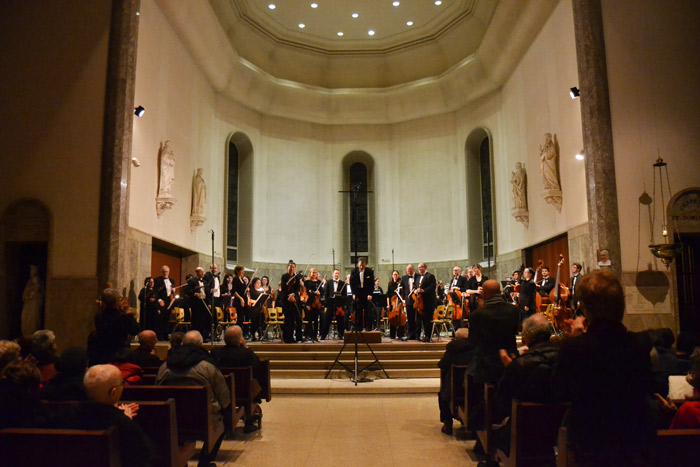
I Medici di McGill is an orchestra comprised of doctors and students of the McGill medical program who wish to contribute to the community through the healing power of music. This past Sunday, the stage was set for their Winter Concert, where old friends could be seen mingling and conversing with the ensemble throughout the intermission. The positive energy that filled the room fueled the ensemble through their diverse program. The orchestra touched upon the works of Verdi, Mozart, and Dvořák.

The afternoon began with the Nabucco Overture, a work from the famed Italian Opera composer Giuseppe Verdi. The vastness of the Notre Dame de Grace Church became evident once the quiet, lush brass chorale began the piece. Clean, lyrical playing from every member of the section resonated into the ceiling, allowing for each pause to melt into the next melodic line providing a luxurious tone colour. Although the resonance of the hall aided the ensemble in their quiet playing, it made precision a vital component of the louder sections as each and every mistake would painfully stick out. Attention to detail was apparent as in the members’ playing the notes of the brass section were clean as a whistle and the violins led the charge to the finale with driving fury. Beginning the program with an overture proved to be a smart tactic as the ensemble was able to expose a vast array of musical ideas in a short period of time thus, setting the tone for the rest of the performance.

Conductor Gilles Auger framed the second piece with his conspiracy that “Mozart was an alien.” He described how Mozart’s spectacular ability to compose in his head allowed him to write his pieces neatly on manuscript paper on the first shot. This ease of virtuosic accomplishment was portrayed in lead violinist Byungchan Lee’s fluid interpretation of the Fifth Violin Concerto. Every note bounced effortlessly off of Lee’s violin unaltered by any sense of struggle resulting in a serene musical experience. The ensemble expertly guided him through the piece, complimenting him with a light approach to Mozart’s challenging rhythmic lines. Lee was especially impressive at the end of each movement when he captivated the audience with an awe-inspiring improvised solo. The classical era valued beautiful melodic content and I Medici’s strings were able to embody this skillfully throughout the Concerto.

The final piece of the performance focused on the introspective Symphony No. 8 by Dvořák, which thrives on tension. The “Cello Symphony” (as Gilles Auger likes to call it) was a fitting finale to an exciting evening as the ensemble achieved electrifying tempos, extreme decibel levels, and high intensity. A flawless communication between the ensemble was evident from the very start; a long melodic idea was uttered first by the cellos, then passed on to the bassoons, before the principal flautist’s solo, which ended on a held note that felt as if it lasted for hours. With the second movement came dreary, descending chords that created a dark sounding aesthetic not seen in other parts of the program. Dvořák’s use of French horns was executed to perfection before moving on to the trumpet heavy finale. In this finale the trumpets finally got to showcase their powerful playing abilities and they did not disappoint. The high notes were played in perfect unison and the energy brought forth by this section translated into an epic performance from the whole ensemble. This moment was the true culmination of all the music played throughout the evening.

I Medici’s winter showcase was truly magnificent. Not only did they accomplish a relaxing sense of community, they also played on a level that made the fact that they were not music students quite unbelievable. Any performance of theirs is worth the inexpensive ticket price as they will surely not disappoint.

I Medici di McGill Orchestra’s Spring Public Concert will take place on April 3 at 4 p.m. at the Notre-Dame-de-Grace Church (5333 Avenue Notre-Dame-de-Grace).

a, Arts & Entertainment, Theatre

High infidelity: McGill Savoy Society’s “The Merry Widow” brings a classic into the modern era

Opera is an art form that has been in jeopardy for at least the last few decades. With a near complete lack of any notable new operas since the early 20th century, the entire genre is in danger of becoming stagnant without the intervention of passionate fans who are willing to update them for a modern audience. McGill’s Savoy Society delivers another valiant effort to keep opera alive in its production of The Merry Widow, its first non-Gilbert and Sullivan production since at least the 1980s.

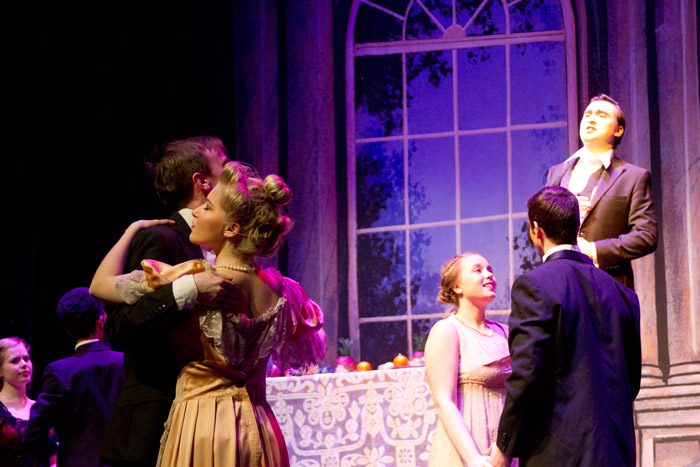
Composed by Franz Lehar, written by Viktor Leon and Leo Stein, and directed by Russell Wustenberg, the opera follows Anna (Ana Toumine), the widow of a recently-deceased banker focusing on the question of who she will marry, and thus share her wealth with. The Baron (Jonah Spungin) of an economically floundering Baltic state tries to convince her to marry a countryman to keep his nation from crumbling. Though she has a trail of suitors from all over the globe following her, she is drawn to Count Danilo (Bruno Roy), a caddish ex-lover who now spends his time boozing and womanizing. The show wrings every bit of farce that it can from the scenario, piling up intersecting subplots about love and infidelity among the cadre of elites who find themselves in the widow’s orbit.

Despite some of the expected creakiness of an opera written in 1905, the production has a comic sensibility that is surprisingly modern. A lot of this comes from the fact that most of the opera’s comedy comes from highly versatile territory: Comeuppance for the arrogant, physical comedy, and dramatic irony. In other places, the line readings are delivered with more of an edge than was probably present in its original incarnation. But most importantly, the play attempts to directly address the highly outdated gender politics of the opera. This was an explicit concern of the production team, who recognized that the mores of the past are greatly out of sync with the present.

“The biggest concern that I had […] was what was the context of the time?” said Stage Director Russell Wustenberg. “My biggest change is I actually took the most famous piece of music [from the opera…] and instead of having it entirely sung by men, I allowed the women to sing their response to the men.”

Of course, a production can only take so many liberties without losing thread of the text, so Anna never really considers the idea that she doesn’t have to marry anyone. Instead, the opera ends as one would expect, with a highly sentimental third act set in the fairy-lit glow of Anna’s ballroom, underlining the importance of love. While it’s somewhat disappointing that a production this comparably modern would end on such a predictable note, the sentiment feels earned, mainly due to the performances.

Toumine and Roy anchor the production, each bringing their own brand of charisma and playing off of each other in numbers like “All’s one to all men where there’s gold” with a fantastic ease and sense of timing. Valencienne (MacKenzie Stone) and Camille (Zachary Rubens) serve as younger, more naive counterpoints to the central couple, bringing a welcome ray of earnestness amid the cynicism of the older married couples. The rest of the cast serves a mainly comedic role with Spungin’s oblivious Baron and Talia Fuchs’ put-upon emissary Njegus as the clear standouts. The sheer number of subplots means that no character wears out their welcome, but each gets a moment to shine.

The music is top-to-bottom fantastic, accompanied by an especially well-oiled orchestra. Russell’s aforementioned tweaking of “You’re back to where you first began” lends a satirical edge to what could otherwise come off as woefully outdated. Accordingly, the choreography is loose and modern, full of anachronistic flourishes that imbue the opera with a modern energy. The sets and lighting are beautifully impressionistic, giving each act a distinct feel and colour palate that correspond with the emotion of the main characters.

Guided by Producers Narmada Gunawardana and Maia de Graaf, The Merry Widow manages to mostly transcend the trappings of its source material, making the opera feel modern again.

The Merry Widow is playing on Feb. 19 – 20 in Moyse Hall. Tickets are $10 for students.

Read the latest issue

Read the latest issue