
Latest News

Research Briefs, Science & Technology

Big discoveries from tiny rodents

In the past decades, the field of neuroscience has made astounding progress toward unravelling the intricacies of the human brain, but much of how it functions remains terra incognita. Adrien Peyrache, a researcher at the Montreal Neurological Institute (MNI) and Canada Research Chair in systems neuroscience, studies how brain structures that control navigation are linked to long-term memory storage, and how sleep plays a role in both of these important functions. 

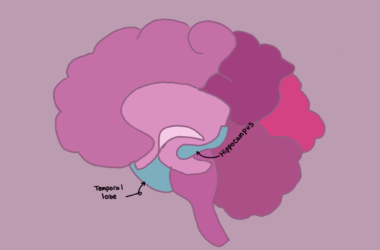
Peyrache mostly conducts his research on mice. They are surprisingly intelligent creatures with exceptional navigational skills that allow them to maneuver as easily in darkness as in broad daylight. When mice roam around, visual and spatial orientation information is sent to specific neurons deep in the brain known as head-direction (HD) cells. At a population level, these cells function like the needle of a compass: Specific neurons are activated when the head is facing a certain direction. As the mouse turns, other nearby neurons activate, and the compass needle turns. The brain’s navigation system integrates this compass with other inputs, such as the animal’s travelling speed. It then encodes its position in a ‘cognitive map’ located in the mouse’s hippocampus, a region of the brain associated with memory. 

During sleep, the brain does not simply turn off; rather, many regions are surprisingly active.  The movement of a mouse’s brain ‘compass’ during rapid-eye-movement (REM) sleep is almost identical to when it is awake. The ‘needle’ of the compass spins at the same speed as if the mouse were actually roaming freely. 

“It’s like the cortex doesn’t know it’s asleep,” Peyrache said. 

The same structures that are involved in spatial navigation are crucial for consolidating long-term memory, since both involve encoding movement through time and space. How exactly this relationship functions is still unknown, but Peyrache is confident that the data his team have collected so far confirm an important link. His work suggests that, while this phenomenon may occur because inactive neurons quickly die, there could be a link with memory consolidation.

Many complementary methods are used to study mouse brains. One of the main techniques is electrophysiology, which consists of using electrodes to record single neuron firings. Arrays of these electrodes are implanted in the brains of mice, who are then free to roam painlessly while data is collected.

Mice are a useful study subject for many reasons, including the similarity of their brains to other mammals, their small body size, and the vast array of tools that have been developed to study them. Research conducted on rodents can also lead to important human applications. Peyrache has been striving to make this transition in his work for many years, most recently in collaboration with the human electrophysiology unit at the MNI.

“[Our work] is basically bridging the gap between human and animal electrophysiological research,” Peyrache said.

Although electrophysiological technology is quite invasive, there is already a human population set up to further such research. For example, certain patients with epilepsy have electrodes implanted in their brains for clinical purposes, namely to identify the region in their brain responsible for their epileptic episodes. Peyrache compares the human brain to a building to describe how these electrodes work: Electroence (EEG) lets researchers hear a murmur through the walls, intracranial electrodes allow them to listen to conversations through the door, and macroelectrodes let them listen to a single person speaking. If the researchers hear someone speaking nonsense, then they have found the damaged population of neurons.

Peyrache’s work is at the forefront of research regarding single-neuron recording for the brain. Although his planned research on humans is not yet at the stage of ethical approval, it carries great potential. He expounds the virtues of both theoretical and application-driven scientific research.

“Science is not an easy world, but it’s also fantastic and inspiring,” Peyrache said.

McGill College Ave. at Christmas (Melanie Simon / McGill Tribune)
Commentary, Opinion

Scrooge was right

Although no consensus exists on what marks the beginning of the holiday season, I believe it occurs sometime between the first snowfall and the release of Starbucks seasonal drinks. The season marks the end of the year, and for students, a highly anticipated winter break. Though celebrated by many as a time of love, joy, and peace, not everyone welcomes the holidays with such enthusiasm. In fact, traditional festivities can serve to exacerbate feelings of stress and anxiety throughout the month of December for many people. The taxing nature of the holiday season is detrimental to some and offers reasons for abandoning traditional perceptions of the holidays this year.

 Dubbed ‘the most wonderful time of year’, there is immense pressure to live up to an impossibly high standard of joy during the holiday season. The reality of winter break is seldom full of as much holiday cheer as one is led to expect. In reality, people generally have overly ambitious expectations leading up to events and, as a result, will often be disappointed when their expectations are not met. Unfortunately, social media does little to inhibit this bias. Instagram feeds full of picture-perfect decorations, gingerbread-house building, and laughing families further inflate expectations and increase the pressure to emulate that joy.

McGill schedules only two weeks without classes or exams, which inherently advantages certain students over others. While the break period at McGill allows some students the time to return home, for others, the short break doesn’t offer enough time to travel long distances, especially when travel costs peak during this time of year. While some services exist in residences, such as the Holiday Hosting program, McGill ultimately does little to support students who are unable to return home during the holidays.

 The spirit of the holidays is pervasive in Christmas songs, cheesy holiday movies, and the umpteenth cup of eggnog, further increasing pressure to be jolly. Yet seldom do these holiday tokens encourage one to relax or de-stress. Instead, the holidays have become synonymous with stress-inducing trips to the mall, endless strings of tangled lights, and pine needles covering the living room in the case of Christmas. While it may not be necessary to part from long-standing traditions entirely, it is important to acknowledge the consumptive nature of the holiday season and the associated impacts it can have on one’s mental health. The modern holiday season aims to please the consumer, yet these habits are financially and environmentally unsustainable, and are likely to lead to increased stress levels in shoppers.

 Besides the pressure to enjoy oneself and balance the dichotomy of tradition versus sustainability, people experience the December blues for other reasons as well. General feelings of stress and anxiety are common. In fact, a 2006 study revealed that 61 per cent of participants experience stress often or occasionally during this time. Some contributing factors include increased financial strain, anticipating intrafamilial dynamics, and maintaining personal health habits.

 For many, the holidays mean balancing limited time between various family groups. With a finite amount of time, students with large or disjointed families are forced to fill their schedules with brunches, lunches, and dinners to ensure they make time for everyone. The short break does not allow all students to take the necessary time to relax and instead may be a substantial source of additional stress.

 Instead of attempting to enjoy the holidays at all costs, one should acknowledge feelings of stress and anxiety in themselves and their peers this December and take time to relax when needed. For students, winter break should be a time to rest and refresh for another upcoming semester. It is time to abandon the conventional image of the holidays and acknowledge that winter break can’t always be full of eggnog, ice-skating, and gifts. In the end, the holidays are not the end-all and be-all, in fact, they are only another season.

Sports

An open letter to female sports fans

Dear fellow female sports fans, 

It has been a mixed couple of decades for us. We’ve seen the enactment of Title IX and the success of Bianca Andreescu. Interest in sports is growing among younger women: In 2014, 48 per cent of women under 50 reported being interested or very interested in sports, compared to 36 per cent of women over 50. Gender distribution among NFL fans is almost equal, with 47 per cent of viewers being female.

I am inspired to see female sports fans work together and lift each other up. When I first got into sports, I was lucky enough to find a group of women online with whom I was comfortable talking, and that made a huge difference for me. 

But, at every turn, and with every instance of progress, our position with the sporting world has been called into question. If we follow women’s sports, we are told that no one cares, that there will never be an audience, and that they are not as entertaining, so we should watch real (men’s) sports. If we follow men’s sports, we are incessantly badgered with demands to prove that we are “real fans.” Do we only follow them because of our fathers? Our boyfriends? Do we only care about the attractive players? 

We keep watching, though. We support women’s leagues, even when the arenas are tiny and the players only have time to practice in between working their full-time jobs. We put up with patronizing pink merchandise from our favourite teams. We gather our friends and go to games, ready to wield memorized rosters, statistics, and historical facts in case we need to demonstrate that we fit men’s definitions of a “real fan” and win their approval.

Every woman who loves sports has faced opposition, and it breaks my heart to think about all the women who have stopped interacting with online fan communities because they grew tired of misogynistic slurs. And, when I think of the women who are hounded for daring to criticize a beloved player and are then told that they have to either be a girl or a sports fan, that heartbreak turns into rage.

Besides the harassment that we put up with both in person and online, we also have to live with the knowledge that there are athletes in our favourite leagues with histories of domestic violence, that male fans often do not care about. Abuse from famous athletes flies under the radar because a case was dropped for lack of evidence, or a settlement was reached outside of court, or the victim was afraid for her life. The knowledge that violence against women is treated as a speed bump in a player’s career is enough to make most women want to change the channel.

Even if you do not find the same community as I did, do not let that deter you from watching your favourite teams and supporting your favourite players, because you do not owe it to anyone to explain or defend your position as a sports fan. And, remember that there are other women in the same position, sharing the same experiences. 

So, with all that said, keep being amazing, (female) sports fans. I have a feeling that it’s only going to get better for us.

McGill, News

TEDx McGill holds annual conference on theme of ‘pushing the envelope’

TEDxMcGill’s annual conference was held on Nov. 16 and featured nine presentations from students, innovators, and business leaders notable for their actions that tested the limits of possibility. 

Emma Lim 

Emma Lim is a climate change activist and U0 Science student at McGill. As an organizer of Climate Strike Canada, Lim has been striking from school for climate justice since November 2018. Since then, she has become well known for her #NoFutureNoChildren Pledge, whereby she states that she will not have children until the government takes greater action to combat climate change. Lim talked about how Canada is currently not on track to meet acceptable greenhouse-gas emissions levels. 

“Canada isn’t […] on track to meet our Paris Climate Agreement goals, which would be just a 30 per cent reduction [in] emissions below early–2000s levels. Instead, we declared a national climate emergency and, less than 24 hours later, announced the purchase of a $4.4 billion pipeline expansion project.” 

Lim called on activists to go beyond making environmentally friendly changes in their own lives and pressure corporations that contribute to climate change. 

“The most impactful and powerful thing you can do as a young person, or even an older person, living in our society is to point your finger. Point your finger at the people who are responsible for this crisis,” Lim said. 

Tristan Surman

Tristan Surman is a U2 Arts student and filmmaker who has been planning events with the Toronto International Film Festival (TIFF) since the age of 15. After working as a multimedia editor for The McGill Tribune Surman moved on to a position in Johannesburg creating documentaries about local education.

Surman talked about how his organization, My Media Creative, works with artists to develop multimedia campaigns and provide learning experiences.

“There are so many tools that are way more accessible than ever, and if we actually want to empower young people to change discourses, to create innovations, […] we need to empower them with the tools that will actually get [their ideas] into people’s heads,” Surman said. “We need to expand the toolkit so [that] we can help people become more motivated students. [But] when we are empowering people with these communicative and creative skills, we need to adopt a different method of learning.”

Surman urged schools to break from the current mainstream method of teaching, incorporate more diverse ways of learning into their curricula, and provide more purpose-driven opportunities to students.

“How do we provide the conditions so [that] people can learn and do?” Surman said. “If we make sure people are empowered [with a tool set, provide] them a little bit of structure so [that] they can execute something, and link their learning to [a] purpose, [then we can make sure] that people can keep on doing great things and learn while doing them.”

Viveca Lee

Viveca Lee is a U2 Science student at McGill who is passionate about normalizing conversations about mental illness. Having recovered from anorexia nervosa as a teenager, Lee hopes to destigmatize the societal perception of eating disorders. In addition to her community outreach work, Lee holds a position as a research assistant at the Biopsychosocial Examination of Eating Patterns (BEEP) Lab.

Lee explained that despite eating disorders’ high mortality rates, these conditions remain insufficiently understood in our society.

“People with eating disorders are blamed for their condition,” Lee said. “They often get told things like, ‘Stop doing this to yourself.’ […] But eating disorders are not a choice. They are serious mental illnesses that affect at least one million people in Canada alone. […] When I had anorexia, it felt like my body was possessed by a demon that was constantly controlling my thoughts and actions.”

According to Lee, the behaviours that patients display are attributed to their disorder, and not their personality.

“I was in denial [that I had an eating disorder],” Lee said. “And denial is a common, characteristic symptom of anorexia nervosa. […] Although there isn’t a clear understanding of what exactly causes this lack of awareness, [research] suggests [that] starvation induces this defective information processing. […] These research findings […] validated my feelings of worthlessness and confusion for not being able to control my thoughts and actions.”

Aren Bezdjian 

Aren Bezdjian is a PhD candidate in Experimental Surgery at McGill’s Faculty of Medicine. He is internationally recognized as one of the few to have published 30 peer-reviewed scientific articles before the age of 30. 

The first section of his talk discussed the issue of incorrect interpretations of data from scientific studies. News outlets and social media platforms often take information out of context and draw false conclusions to receive public attention.

“Just because you find a correlation doesn’t mean [that] you can make a [false statement],” Bezdjian said. “A cursory reading of the abstract and title [of a scientific study] is not sufficient to make conclusions.” 

In the second half of his talk, Bezdjian explained how sound travels through the human body via bone conduction and emerging applications of this knowledge, discussing his work developing innovative hearing implants for deaf children. 

“Through these implants, [we have] allowed children to connect with the sound of their mother’s voice,” Bezdjian said. “This has [had] huge benefits in their development and quality of life.” 

Bezdjian concluded by advising the audience to remain critical of the information they consume and to take advantage of the brain’s neuroplasticity to continuously learn and improve. 

“Seek, and you will find answers to the ‘how’ and the ‘why’ [of the world],” Bezdjian said. “Passion is not innate. It is developed through life experiences [that] wire and rewire the brain.” 

Album Reviews, Arts & Entertainment

Highly Suspect misses the mark in experimenting with new sounds

In a world where most rock heroes are either aging or have already passed away, it is hard not to get excited when a promising young rock band like Highly Suspect appears. After the success of their first album, Mister Asylum, which landed the band two Grammy Nominations (Best Rock Album and Best Rock Song), it seemed like they had the music industry in the palm of their hand.

The promise of the band’s earlier work is one reason why it pained fans so deeply when Highly Suspect’s third studio album, MCID, turned out to be a disappointment. Of course bands evolve, as does the ambition that goes into creating a unique album. In this case, the band’s vision of a completely new sound was poorly executed, especially considering the sound and success Highly Suspect has already achieved. 

The album is inconsistent in its overall sound, with each song pulling the listener into completely different genres: From hip hop on “Tokyo Ghoul,” which features Young Thug, to “16,” which reflects the band’s former rock/groove sound. Throughout the album, there are intermittent, lo-fi tracks such as “Tetsuo’s Bike” and “Juzo,” which bring the listener, once again, into a different soundscape.

Frankly, the album is difficult to sit through. It lacks coherence and the lyrics are often rudimentary, even cringey. Take, for example, the opening track, “Fly,” wherein the last quarter of the song, the lead singer, Johnny Stevens, gives random shoutouts: “Shout out to Pam the cat / Shout out to Jolene the dog,” not adding anything to the music or the sound. 

Sadly, MCID is a confusing, poorly executed attempt at bridging gaps between genres. Although this album sorely missed the mark, listeners shouldn’t give up on Highly Suspect just yet. Their past work proves that the group is capable of bringing more to the table in the future.

1.5 out of 5 stars

McGill, News

Award-winning Harvard University professor Maya Jasanoff presents at McGill

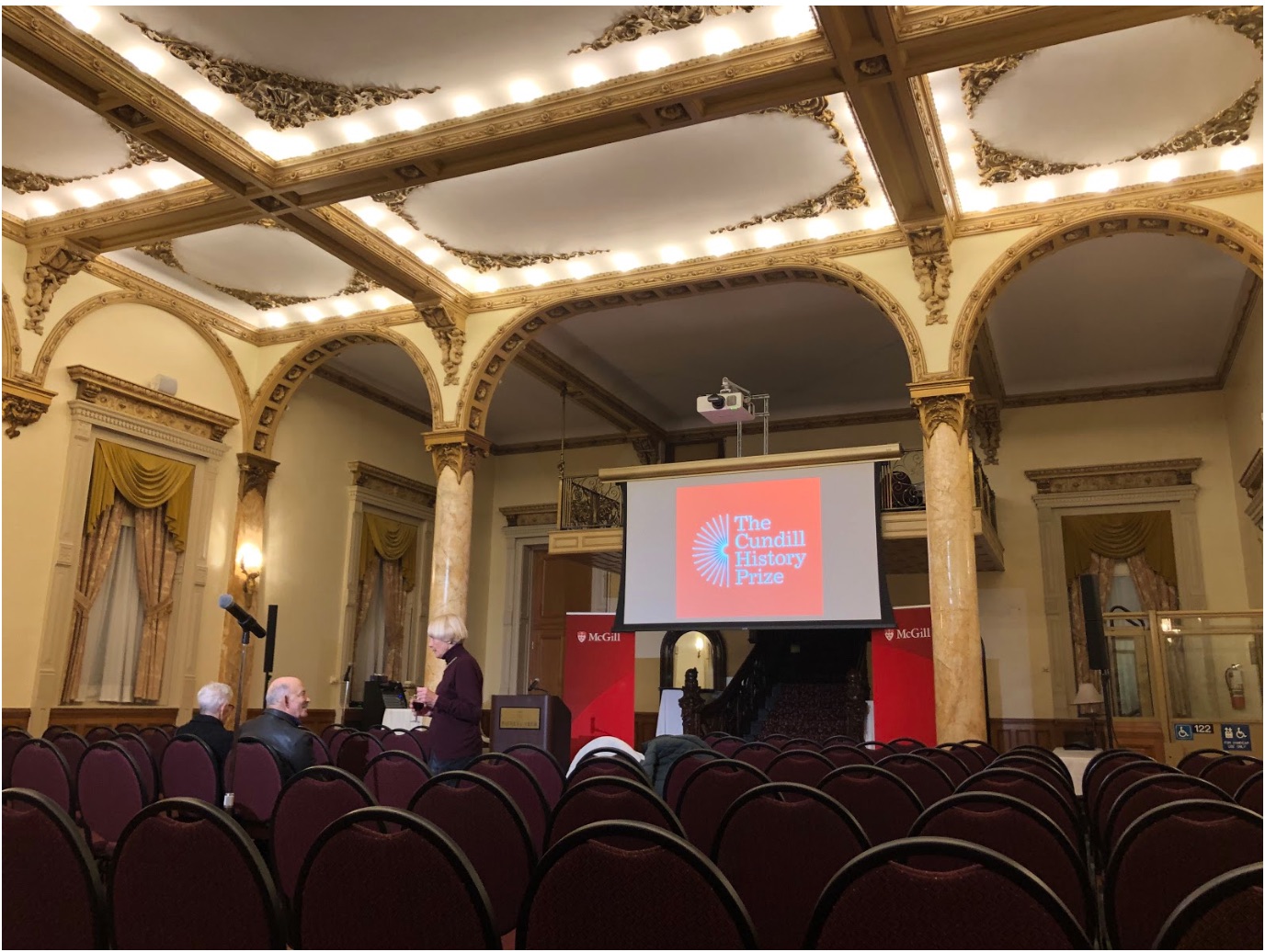
Harvard history professor Maya Jasanoff drew a crowd of over 100 attendees to the McGill Faculty Club on Nov. 13, where she delivered the annual Cundill Lecture. Jasanoff, who serves as the Coolidge Professor of History at Harvard, received the 2018 Cundill History Prize for her book The Dawn Watch: Joseph Conrad in a Global World. Established in 2008 by McGill alumnus F. Peter Cundill, the prize is awarded to one book annually on the basis of its profound literary, social, and academic influence in the field of history. In her lecture, Jasanoff detailed the journey of her novel and its subject, Polish-British writer Joseph Conrad. 

Christopher Chanco, a PhD student in the Department of History & Classical Studies, introduced the audience to the broad scope of Jasanoff’s writing.

“In her writing, Dr. Jasanoff has been exploring the global through the granular, finding the historical in the literary, and answering the big questions about global and social change through the lives of nomads and artists,” Chanco said. 

Jasanoff’s lecture was guided by the question, ‘How do you tell a history?’ She began by presenting a set of headlines that one might find in present-day newspapers, such as “Bomb goes off in London: Maybe terrorism.” She was quick to disprove the audience’s hunches. 

“If this looks like a history of our times, let me [correct] you,” Jasanoff said. “Each of these statements is really a description of something that also happened a century ago in a work of fiction; a novel, written by Joseph Conrad.” 

Jasanoff then criticized the common linear approach that historians adopt when trying to understand Conrad’s influences. At first, she also took on this approach, studying the archives of the University of Oxford’s Rhodes House in detail. 

“There, I realized I was looking at literature as a repository of period detail,” Jasanoff said. “I was trying to string together histories without a real purpose to the fiction.”

Jasanoff proceeded to link Conrad to his historical context, placing him in a world with growing colonialism, imperialism, and globalization.

“As I got to know him, I discovered that Conrad did not merely witness the step change of the scale and range of globalization,” Jasanoff said. “He, in certain ways, embodied it in his own global and transcontinental life.” 

In her exploration of Conrad, she found discrepancies between his narrative writings and his historical accounts, as well as a general lack of information. Jasanoff went on to explain that only four per cent of his collected work concerns his life before 1895.

“Conrad left very little documentary trace of the part of his life which would then go on to inform that fiction he spent the rest of his life writing about,” Jansanoff said. 

This posed a problem for Jasanoff, which she navigated by reading around the gaps that he left. 

“Though I cannot reliably get inside anyone’s head, using the tools of a historian, I can begin to figure out the conditions under which a person is operating,” Jasanoff said. 

Jasanoff’s strategy involved comparing her knowledge of Conrad’s environment to how he depicted it in his writing. This method gave her insight into the factors that informed his fiction. Seeking to further understand how Conrad concocted his stories, Jasanoff followed in his path and sailed across the Indian Ocean, where she came to a realization. 

“It was on board this ship that I realized that I was not writing a history of the British Empire,” Jasanoff said. “I was writing a history about globalization, because these ships still take the routes that Conrad took.” 

Yael Halevi-Wise, Associate Professor of English and Jewish Studies at McGill, delivered the closing remarks.

“Maya Jasanoff has shown more broadly that Conrad lived and wrote at the dawn of an era that we [now] recognize as a time of rushed, globalized movements and identities,” Halevi-Wise said. “[She] has compelled us to listen differently, court opportunities for unconventional dialogue, and above all, to [resist] homogeneity.”

Commentary, Opinion

Bill 40’s differential treatment of Anglophones demonstrates CAQ’s troubled agenda

Public hearings for Bill 40, which would remove all school boards in favour of service centres, began at the National Assembly on Nov. 4. While the bill fulfills one of the CAQ’s election promises, its provision to maintain elections for the board of directors of Anglophone, but not Francophone, service centres has proved to be its most controversial aspect. Education Minister Jean-François Roberge explained that the changes will streamline an inefficient system and save $45 million over the next four years. However, the bill is actually a hasty attempt to centralize power. In addition, the bill’s misstep in angering the Francophone community should not distract McGill from the CAQ’s continued mistreatment of English institutions.

Haphazardly changing the organization of the school system does not improve student education. Groups representing Francophone and Anglophone school boards alike brought up this point during Nov. 4’s public hearings. Instead, the bill is taking power away from voters, parents, and education professionals, granting the Minister of Education more executive power. Civic engagement and academic performance will be diminished, as observed in PEI and Nova Scotia, where Liberal governments recently removed school boards

At the very least, one would expect the government to follow the democratic process in deciding that it is best to remove elections, which means an adequate period for hearings and debate. Unfortunately, this has not happened. The timeline for hearings is unproportionally short considering the magnitude of the proposed changes, and would have been even shorter were it not for opposition pressure. The CAQ is working on a tight timeline as they hope to pass Bill 40 before Christmas, causing speculation that Premier Legault will use the process of closure to end debate on the bill as he did with the controversial Bills 9 and 21.

The CAQ has continuously exerted its power to the detriment of Quebec’s English institutions. While hearings for Bill 40 were running, Legault put the English Montreal School Board (EMSB) under trusteeship, accusing it of corruption. The timing of this news is a planned political move, one that effectively silences the EMSB, which previously filed legal action over the CAQ forcefully transferring schools to the French system, as well as to protect its staff from Bill 21. McGill should be especially wary of Roberge’s attempts to stretch beyond his power and impose austerity. As an English institution, McGill has historically already been treated disadvantageously; students should be particularly conscientious now, given the CAQ’s penchant to handicap Anglophones. 

In their rush to pass the bill, the CAQ has attempted to quell Anglophone dissent by changing the bill to allow English service centres to keep elections. Roberge explains this inequality by saying “in Canada there is a protection of minorities.” While it is not without justification, nor without precedent, to give special privileges to minorities (PEI and Nova Scotia kept their French school boards), it is frankly difficult to believe this supposed care for the Anglophone minority coming from this government. The CAQ is trying to placate the Anglophone community; it is afraid of legal challenges under the minority language education rights enshrined in Section 23 of the Charter of Rights and Freedoms. As a result, Francophones are claiming discrimination, while unsatisfied Anglophones maintain that Bill 40 may still infringe on Section 23 rights because of increased executive power.

The CAQ’s propensity to speedily instigate extensive change has backfired at a surprising moment. Education is not nearly as divisive or attention-grabbing as those issues concerning the CAQ’s headlining moves, such as Laws 9 and 21, which ostensibly target minorities. However, by upsetting the Francophone majority, the CAQ will potentially face a much fiercer opposition than before. McGill students should also stand in opposition to this violation of democratic principles. In particular, students must make their concerns known to the SSMU and administration, to rein in the Minister of Education and Higher Education whose sweeping reforms may soon concern universities.


Commentary, Opinion

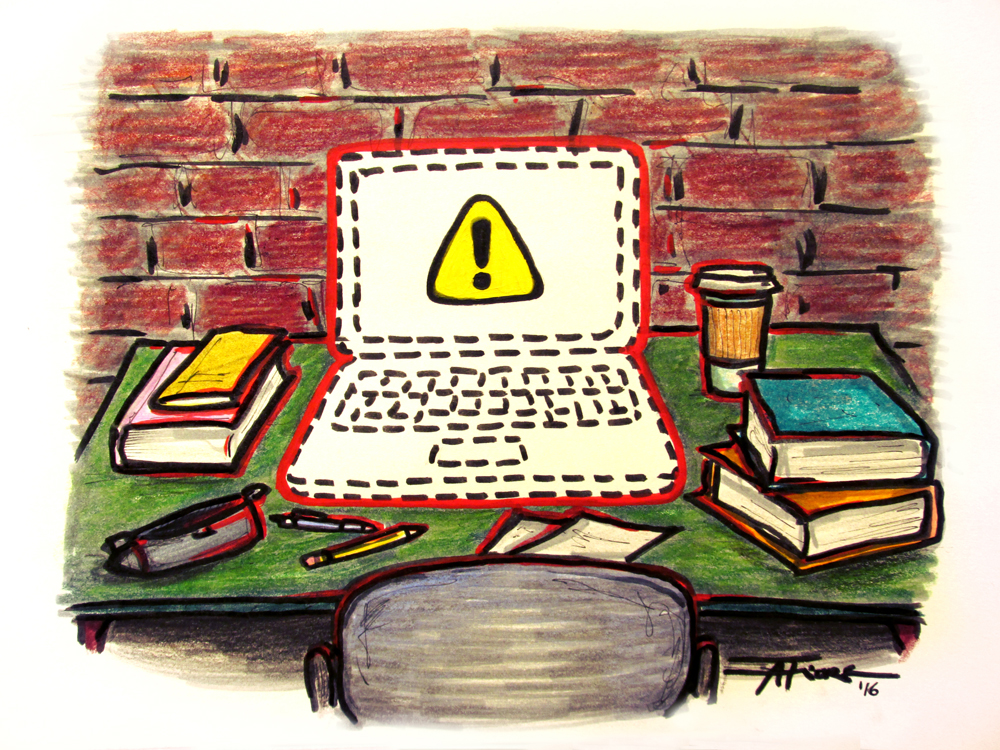
Students’ reliance on technology is increasingly distressing

Upon entering the typical McGill classroom, a sea of screens makes it clear that the use of laptops and tablets for note-taking has become commonplace. In response to this phenomenon, professors tend to clarify their technology policy during their first lecture of the semester: Even if they permit the use of laptops and tablets for note-taking, many will point to research that proves the damaging effects of technology use in the classroom, though these remarks are often ignored. In most cases, students should be trying to make the switch to handwritten notes, using technology to enhance their academic experience as opposed to letting it infiltrate every part of it. 

Almost universally, students get their course material on MyCourses, McGill’s ‘online classroom.’ Considering this, it seems logical and convenient to bring online tools into the physical classroom, too. Typing is generally faster than writing by hand, and software like Microsoft OneNote allows students to enhance study materials while providing the freedom to edit notes after lectures. Additionally, having access to search engines can help students avoid falling behind if a term or concept discussed is unclear, especially if the class is too large to ask questions. These factors alone might lead one to the conclusion that typing notes makes the most sense for the average student. 

However, in the long run, this convenience comes at a cost and can lead to poorer grades. Research from the University of California, Los Angeles has shown that those who write by hand tend to be more selective with what they take down in their notes instead of rushing to copy down everything verbatim when typing. While those who type notes can recall dates and facts at the same level as those who write by hand, more nuanced arguments tend to be absorbed better when students use a paper and pen.

Students have also become increasingly compulsive users of social media, with the average person checking their phone every 12 minutes. This is no accident; social media platforms are engineered to keep users addicted. This may explain why checking social media on a laptop is so appealing during lectures. Some students avoid this through self-discipline or applications that block specific websites, but most can be switched off relatively easily.

As time goes on, these distractions make it harder to concentrate for extended periods of time. A study conducted earlier this year compiled years of research on the subject, coming to a near-definite conclusion that certain brain functions, including levels of concentration and capacity for the retention of information, are negatively impacted by constant technology use. These effects can take a toll on students’ ability to be productive and actually absorb what is taught in lectures, which makes doing well more difficult. 

It is important to recognize that technology in the context of the classroom can be beneficial. Typing can make learning much easier for people with learning disabilities, as can text-to-speech software. There is also no doubt that greater access to information and the ability to use online databases and library material makes research easier. Further, online in-class quizzes can encourage students in large classes to attend lectures and catch up on readings, and recorded lectures can be crucial for those who need to miss class. However, the existence of these benefits does not mean that every aspect of students’ academic experiences should be digitized.

Technology in and of itself is not all bad; its positive impact on things like research, medicine, and communication should not be understated. The problems begin when these benefits lead to a belief that everything we do needs to be improved or made more convenient through digitization. Note-taking by hand is more than sufficient for the average person and can lead to better grades and long-term cognitive benefits. Those unhappy with their academic performance should consider eliminating unnecessary technology use. Though this may not make a difference for everyone, science says it’s worth a try. 

Features

Seeing the trees through the forest

Prologue: 

I’m perched high in the branches of the red cedar across the street from my childhood home. I have a book, Warrior Cats, and a water bottle, and I feel like I could stay here forever. In my head, I’ve already devised a rope harness system so I don’t fall out as I sleep. I can hear the other kids playing down on the street. They’re welcome to join me, but none of them would dare climb this high. But then I hear my father yell my name.

“Get down right now, but very carefully,” he says.

I knew this warning was coming as soon as he realized where I was. 

“I’m not saying you have to get out of the tree,” he reasons. “I’m just telling you to come down a little lower.” 

There is a particular feeling I get while resting up in a tall tree: It’s this sense of stability, a sense of slowing down in all of the hectic goings-on. When I come down, it isn’t quite the same.


Creative

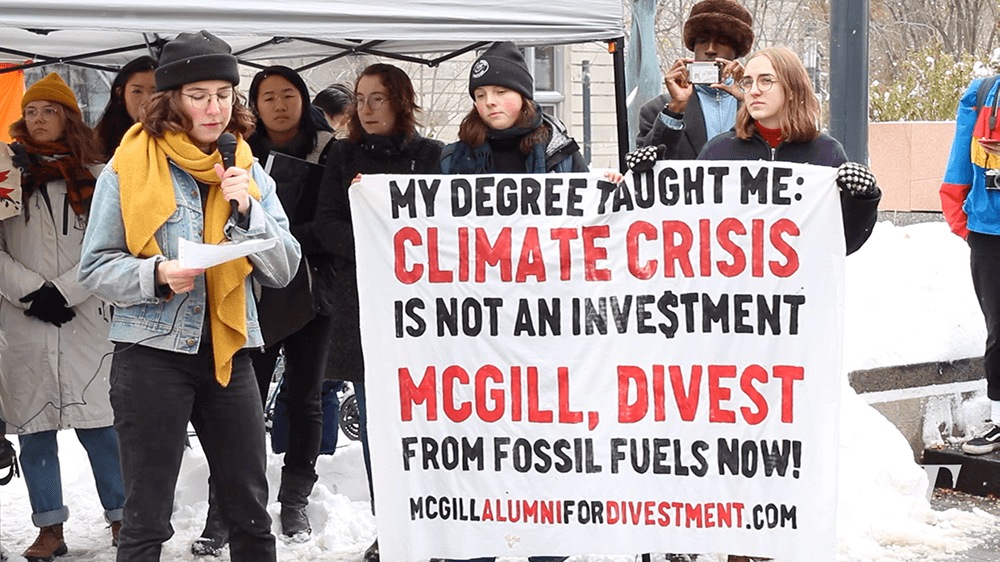
Climate on Campus: Divest McGill

On November 12, Divest McGill, C-JAM, and Greenpeace McGill held a manifestation to pressure McGill to divest.

Our Multimedia Editors interviewed members of Divest McGill and other climate activists in Montreal to discuss their demands, achievements in the climate justice movement, and what’s in store for climate groups on campus.

Video by Sarah Ford and Aidan Martin
Illustration by Zoe Lubetkin

Read the latest issue

Read the latest issue