

Latest News

SSMU President at General Assembly
News, SSMU

44 students attend SSMU General Assembly

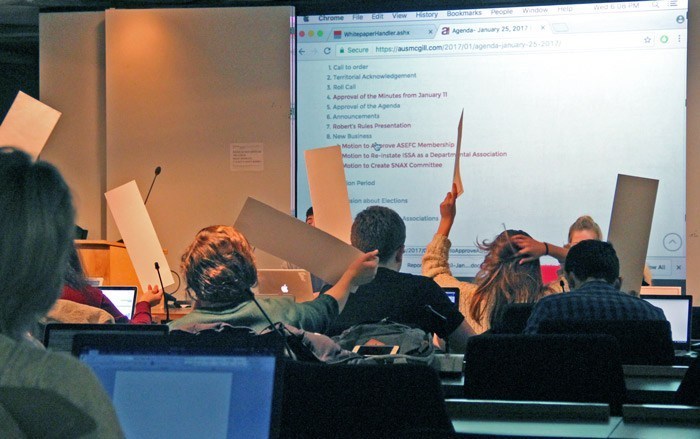
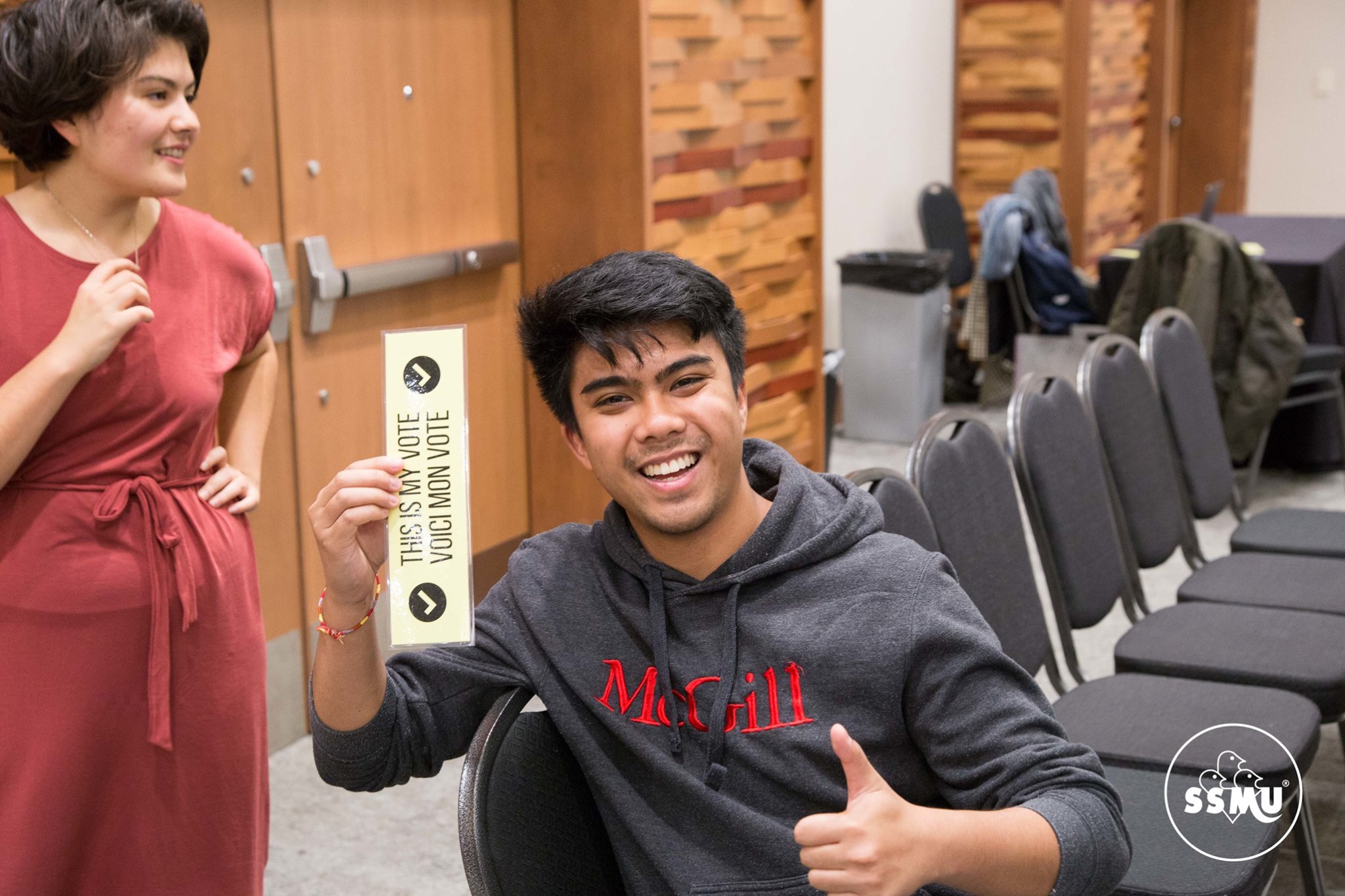
The Students’ Society of McGill University (SSMU) held its semesterly General Assembly (GA) on Oct. 28, with only 44 students in attendance. The GA, which failed to meet its 350 member quorum, ratified the Board of Directors and the Auditor. SSMU President Bryan Buraga joked about the pitiful attendance during his presentation.

“As you can see, we were so, so close to hitting [quorum] today,” Buraga said. “In the future, our goal is to definitely engage more students and bring forward resolutions that get many more people to attend. You can see this with the AUS GA with regards to the climate strike motion.”

Last week’s meeting marks the fourth consecutive GA that failed to meet quorum since Fall 2017. In a controversial move, the 2017/18 Board of Directors raised quorum from 100 to 350 members, which some SSMU members saw as an attempt to limit the power of GAs. Last year, Former SSMU President Tre Mansdoefer tried to lower the quorum to 150, however his motion ultimately failed at a Legislative Council meeting. 

In addition to raising two motions, SSMU Executives also took questions from the attendees. Medicine Senator Andre Lametti raised a question about the governance files available on SSMU’s website. 

“For several years, documents of the society have been titled ‘Jim Jones,’” Lametti said. “I’m not aware of who Jim Jones is, except for the notorious preacher involved involved in the massacre in South America. I was wondering when the SSMU executive is going to fix this issue.”

SSMU Vice-President (VP) Finance Sam Haward replied to the senator, saying that the title of the documents was not in reference to the leader of the infamous Peoples Temple cult, but instead is the name of a former SSMU employee.

“Many of the [governing] documents were created when Jim Jones was the General Manager [of SSMU], so all of the PDFs have the title ‘Jim Jones,’” Haward said. “I suppose it’ll be on the Executive to work with the President and the Governance Manager to […] remove the Jim Jones metadata.”

SSMU VP External Adam Gwiazda-Amsel asked a follow-up question to Lametti about what he thought the new name should be.

“I wonder if Andre Lametti would want to form an ad-hoc committee […] because this might be an interesting opportunity to have a commemorative name in the metadata,” Gwiazda-Amsel said.

After laughter from the crowd, Lametti refused the offer, saying it would be a bad use of SSMU resources. The next GA will be on Feb. 20, 2020. 

Flashback: 

The open letter sent to SSMU’s Executive by Indigenous student leaders last week was not mentioned during the Fall GA. However, VP Internal Sanchi Bhalla delivered an official statement at Legislative Council last week. According to Bhalla, the 12-hour delay in sending out a press release mandated by Indigenous student leaders happened because she did not have access to the SSMU MailChimp account, which contains the mailing list needed to send out mass emails. 

Sound Bite:

“Initially, I found out [about the letter] because Bryan posted on one of our groups [on Slack] asking “Hey, can we talk about the letter we received.” I [said] “What letter?” and then I checked my email [….] I had to leave the training [then] because I wasn’t in the state to handle it,” VP Bhalla said, on her reaction to receiving the letter asking for her resignation.

McGill, News

Prologue or epilogue: What’s next for the McGill Book Fair

Undeterred by a recent history rife with alternating closures and revivals, the McGill Book Fair opened its doors again for a three-day sale Oct. 29 – 31. Nearing its 50th anniversary, the fair sells tens of thousands of gently used books—ranging in genre from biographies to romance novels—along with an assortment of CDs, DVDs, vinyls, and sheet music. While book prices remain affordable at an average of $3 per book, the fair has raised a total of nearly $2 million for student scholarships and bursaries since 1975.

Created by the now-disbanded Women’s Associates of McGill in partnership with the McGill Women’s Alumnae Association in 1971, the event is entirely run by volunteers. Alumni Anne Johnston Williams and Susan Smith Woodruff have been co-coordinators for the past five years. With approximately 50,000 books sold annually, Woodruff estimates that about 65 per cent of all their supplies were sold this year.

“We had 802 boxes [of books], in 36 different genres,” Woodruff said. 

The fair has faced issues over the past decade. Operating with few volunteers, problems such as a lack of viable ways to transport books to campus are difficult to overcome. After expecting to close in 2011 due to the event’s physical toll felt by the few remaining volunteers, the fair was revived by students in 2012. Despite this new leadership, it experienced a hiatus in 2013 due to the construction on Redpath Terrace. The fair continued in 2014 with Willams and Woodruff taking over, but saw low turn-out due to a lack of advertising. In 2018, construction in Redpath Hall seemed to signal the permanent end of the fair. After marketing last year as the fair’s final run, they received new information from the administration.

“We really shocked people last year when we said we weren’t coming back,” Williams said. “We all said our goodbyes. [Then, the day after the fair], someone from [McGill] administration called to say there is no reason [that] you can’t have the Book Fair next year.”

This year, organizers continued to experience challenges that hindered efficiency when organizing the fair.

“As frequently happens, there [was] complication, personal changes and miscommunication,” Williams said. “When we came on Friday [to set up] of last week, there was still construction [equipment in the downstairs section].”

A total of 28 volunteers dubbed, ‘Book Fair-ies’, are tasked with administration duties year-round, while 75 others help during the fair itself. Suzie Slavin has been a volunteer  for over 12 years since her retirement as a librarian. As an avid book lover, Slavin explained the difficulties involved with running the fair. 

“It’s hard to get enough people,” Slavin said. “We work from February or March until [October], collecting books from people [and getting them] downtown. There are a lot of logistical issues. We do pricing and triage, [and other] preparatory work. And we communicate with the coordinators.”

Sustainability has always been a priority for the fair. Unsold books are given to local charity Renaissance, where donated goods are sold at accessible prices, and profits reinvested into the community.  Other organizations, like Books 2 Prisoners, purchase leftover materials. 

“We recycle and reuse [everything],” Woodruff said. “We’ve always shared as much as we can.” 

Woodruff and Williams are grateful for the work volunteers put into the fair, who work for months to collect, organize, price, and move countless boxes of donations. 

“We’ve had really great support from many, many people,” Williams said. “They have been phenomenal to us.”

After assuming the role of co-coordinators for five years, Woodruff and Williams are looking to pass on the torch. Currently, they are in the process of looking for a replacement coordinator, but have so far been unsuccessful.  

The revival of McGill’s book fair is part of a global trend: Data suggests that book sales have been on the rise since 2013. The Book Fair plays into this trend by repurposing old books that would have otherwise been forgotten or thrown out and giving them a second home with new readers. 

“The value of books waxes and wanes, and I think it’s the wax again, or so I hope,” Slavin said. “It’s important to bring old stuff to the attention of young readers.”

McGill, News

AUS Legislative Council ratifies Interfaculty Involvement Restriction Policy

The Arts Undergraduate Society (AUS) Legislative Council reconvened on Oct. 30 to discuss the Motion to Ratify the Interfaculty Involvement Restriction Policy (IRP). The policy aims to foster a safe environment by restricting individuals’ access to events if they have threatened the physical, mental, or emotional state of other individuals or groups involved. 

While each faculty has their own version of the IRP, the interfaculty policy extends the policies to cover individuals accused of harmful actions from different faculties’ events. 

Vice-President (VP) Social Kimberly Yang, who drafted the policy, spoke to the importance of its interfaculty component. 

“Often times, a lot of the survivors I work with want the ban extended further than just their faculty,” Yang said. “With this new IRP, survivors won’t have to go through the investigative process four times to get interfaculty results, which is extremely taxing for a [sexual violence] survivor.” 

Brent Jamsa, VP External of the Canadian Studies Association of Undergraduate Students (CSAUS), expressed concern over the lack of due process for appeals in the Interfaculty IRP. In response, Yang affirmed the need to pass the motion to begin investigative processes, and committed to adding an appeal process within the coming weeks. 

While an amendment to include a sunset clause was proposed, which would specify a time period for the policy’s repeal, the council later gave unanimous consent for its withdrawal at the request of Jamsa. The motion then passed.  

Afterwards, VP External Darshan Daryanani  reported that the Motion Regarding Support of University Governance Reform was discussed at the Students’ Society of McGill University (SSMU) Legislative Council meeting on Oct. 24, which proposes the removal and addition of seats on council. 

Alexandra Millar, VP External of the Bachelor of Arts and Science Integrative Council (BASiC), relayed BASiC’s unanimous dissatisfaction with the motion’s removal of an Arts and Science SSMU representative. 

“Although we get a say in AUS and SUS, it is important that someone advocates for students who are doing both,” Millar said. “If [the motion] does go through, and there is a referendum, we will be campaigning [for a] no.” 

Daryanani assured council that these concerns are being considered. 

“It was mentioned in the [SSMU Legislative] council [meeting] that [there was some] fear that taking away a seat because of overrepresentation may result in no representation at all,” Daryanani said. 

Jamal Tarrabain, AUS President, echoed the need to consider the diverse views of Arts & Science constituents. 

“BASiC students do have unique voices that are separate from Arts [students] and Science [students],” Tarrabain said. “I want to implore everyone at AUS Legislative Council to take those factors into consideration when we are looking at removing some of these positions.” 

Sound Bite

“Looking at the numbers of faculties is important, and ensuring that there is accurate representation is important; however, you also don’t want to enter the classification of tyranny of the majority,” Tarrabain said, in response to the proposed removal of the Arts and Science SSMU representative. 

Flashback

After receiving live updates from the Engineering Undergraduate Society (EUS) throughout the meeting, Yang announced to the council that EUS passed the Interfaculty IRP during their meeting, marking the motion successful in two out of four of the undergraduate societies so far.

Presentation of new nursing program.
McGill, News

McGill announces creation of online Bachelor of Nursing degree

McGill announced that it will be launching Quebec’s first online Bachelor of Nursing degree in on Oct. 24. The program, which aims to address a lack of baccalaureate-holding nurses in the province, will be offered in both English and French starting in 2021.

Quebec’s nurses are less educated than their peers across Canada. While 63-73 per cent of nurses hold a bachelor’s degree in other provinces, the number drops to only 46 per cent in Quebec. The difference can be attributed to Quebec’s unique requirements: Nurses only need to hold a nursing Diplôme d’études collégiales (DEC) from a CEGEP to practice, while in the rest of Canada, a bachelor’s degree in nursing is required.

Annie Chevrier, the Program Director for McGill’s Bachelor of Nursing Integrated and Online Continuing Nursing Education (CNE) Initiatives, explained the serious consequences of this education disparity.

“An increase in bachelor-prepared nurses has positive outcomes on Quebec’s healthcare system, specifically in improved patient outcomes,” Chevrier wrote in an email to ///The McGill Tribune./// “A 10 [per cent] increase in bachelor-educated nurses has shown to result in a [four to seven per cent] decrease in patient death [….] The Quebec population is aging. Care has been restructured such that patients in hospitals are more acutely ill and are discharged sooner. [So] critical care and community health nursing—competencies gained during a Bachelor of Nursing—are increasingly important.”

A donation from the Doggone Foundation made launching the program possible, explained James Clement, the Communications Manager of the Faculty of Medicine.

“[The Doggone Foundation’s] gift towards the BNI Online Program was for $1 million,” James Clement wrote in an email to the //Tribune//. 

Chevrier explained that an online program will allow nurses to further their education while still continuing to practice. 

“Amazingly, there are no online bachelor-level nursing programs for licensed nurses in Quebec,” Chevrier wrote. “A Quebec nurse’s only online options are in other provinces […] An online program offers increased flexibility for work and family life, while removing geographic barriers to access. Another part of improving accessibility is making the program bilingual […] A number of nurses who attend McGill are Francophone and are completing their first English program with us.”

Education professor Caroline Riches emphasized that online courses grant versatility that traditional courses do not offer.

“I think that the main benefits of online courses and programs are access and flexibility,” Riches wrote in an email to the Tribune. “[They offer] access to student[s] who do not live close enough to the university to attend on-campus, face-to-face classes, [and] flexibility for those who may be working full-time or on shifts.”

Riches believes that the online degree is a step in the right direction for McGill’s nursing program. 

“The main disadvantages or challenges for any online course or program [are a] lack of student engagement, lack of community, and motivation,” Riches wrote. “Nevertheless, there are ways to address this and increase online presence and build online community—which I am sure nursing is aware of [….] I am a big supporter of online courses and do think [that] McGill should expand its online offerings.”

Chevrier explained that concerns about online courses offering lower quality education were unwarranted, as the Online Design Team from McGill’s Teaching and Learning Services (TLS) would work to create comprehensive online materials.

“There is extensive research to support that online learning is an effective method of instruction for students in many disciplines, including nursing,” Chevrier wrote. “We are confident that this program will provide the same high-quality education that students expect from McGill [….] The vision behind the online design is student engagement, interactivity, and the creation of a vibrant community of learners.” 

Riches observed that offering the online program was a wise choice in improving Quebec healthcare.

“I think [that] it is important to offer courses and programs that meet the needs of the market – and nursing [h]as done this,” Riches wrote.

Research Briefs, Science & Technology

Mapping nature’s contributions to people

Currently, the United Nations (UN) estimates that there are approximately 7.7 billion people in the world, a number that is expected to reach 10 billion by 2050. Moreover, human populations are becoming more dense: 68 per cent of people are expected to live in urban centres by 2050. As these cities become more populated, their reliance on the local environment is expected to increase as well. In addition, climate change is projected to further reduce ecosystems’ ability to meet humanity’s growing demands.

This was the motivation behind a study published in Science this past October that examined the global mismatches between what nature can providetermed nature’s contributions to peopletoday and in 2050.

Elena Bennett, a professor in the Department of Natural Resources at McGill and a co-author on the article, further explained the motivation for the study and the way that researchers modelled nature’s contributions to people across the world.

“In this paper, what we really wanted to highlight was when you get a service, […] what slice of that is nature providing, and how important is that?” Bennett said in an interview with The McGill Tribune. “The way the model is built has two components. [First], where is nature that can provide a service? For example, for pollination, where are there pollinators [and habitats] that can support pollinators? [The second part] looks at where that is needed.”

Using three different projections, the two-part modelling approach revealed areas where nature is not meeting the needs of people and is unlikely to meet them in the future. This is especially true in regions in Africa and South Asia. 

The different projections did lead to some unexpected results. A projection labelled ‘fossil-fueled,’ a situation in which human use of fossil fuels has greatly expanded, leads to better overall outcomes for the global human population. In contrast, the ‘regional rivalry’ projection, detailing a world where resources are very scarce, would lead to an overall worse global outcome. Although surprising given the notoriety of the fossil fuel industry, Bennett explained that the outcome would arise due to a closing-off of borders and a reduction in global cooperation in the regional rivalry projection.

“Where Africa and South Asia have issues, it gets worse [under the regional rivalry projection] because there is no ability to use trade to mitigate or ameliorate the situation,” Bennett said. “In the fossil-fueled development, it’s […] development […] with the intention of preserving green space. It’s business-as-usual but with a little intensification.”

This points to the importance of global trade networks in facing environmental change: For example, global food trade is already identified as an important contribution to food security facing a changing climate. Still, trade does not work equally well for all of nature’s contributions to people.

“With other things like flood control, it doesn’t work unless you can move all the people from Bangladesh, [for example],” Bennett said. “But you can’t put more mangroves in Malaysia and hope that it’s going to help.” 

Bennett mentioned that technology can be an important proxy for nature where trade is not able to keep up with human populations.

“In [North America], we don’t rely on wetlands to provide water quality,” Bennett said. “We build water treatment plants. That’s a technological solution to something that, in the right place with a less dense population, nature would have done for us.”

In the study, the best-performing future scenario was labelled ‘sustainability.’ Bennet further elucidated what sustainability might need to look like to improve our global forecast.

“That’s the million dollar question: We don’t know,” Bennett said. “What this paper shows is [that] some combination of [conservation, technology, and trade] is what we really need, but we also really don’t know the implications of these.”

Sports

NCAA puts right foot forward

The National Collegiate Athletic Association (NCAA) Board of Governors voted unanimously on Oct. 29 to soon allow student-athletes to monetize their name, image, and likeness. The vote was in light of a bill recently passed in California that also allows NCAA athletes in the state to be similarly compensated. NCAA President Mark Emmert stated that California’s legislation, as well as calls for change from athletes such as LeBron James, were influential in the NCAA’s decision, as the organization has recently faced fierce criticism for not paying its athletes. 

The NCAA needs to work through many issues before athletes can receive any form of monetary compensation. Setting rules and regulations for how compensation is distributed is key to laying the groundwork for the payment of collegiate athletes.

First off, there is a large gap between the monetary value of collegiate athletes across conferences, sports, and genders. Division I football games regularly bring in millions of viewers. A star quarterback in a well-known Division I program, such as the University of Alabama, could receive much more profitable sponsorship deals because the wider reach of his sport allows for higher potential profits from advertising. In contrast, an Olympic-level female fencer may only be able to receive pay from an advertisement for a local business. This is because not all NCAA sports are televised live and some require a subscription to ESPN+ to watch in the United States, limiting the advertisements’ reach and the potential profits for sponsors. Thus, the NCAA must regulate these sponsorships from companies to keep financial balance among student-athletes who all fall under the same governing body.

Opening sponsorship opportunities for athletes also creates an entirely new problem within recruiting. The alumni and boosters who make large donations to university athletic programs could significantly affect the decisions of high school athletes, potentially creating an imbalance within collegiate sports. This is especially relevant in sports with high viewership and high monetary value for the NCAA, such as Division I men’s basketball. 

In 2018, Zion Williamson decided to attend Duke University to help him reach his ultimate goal of playing in the NBA. However, with monetary incentives open to recruits, that decision could have been altered. For example, Michael Jordan could have offered Williamson a Jordan brand sponsorship worth millions of dollars, were he to attend Duke’s chief rival and Jordan’s alma mater, the University of North Carolina. This would have likely factored heavily into Williamson’s decision. With this type of hypothetical becoming a possible reality in the future, the legislation outlining the monetization of athletes’ images and likeness must address this possible issue and ensure that recruitment stays fair across all sports and colleges. 

Although similar scenarios have arisen in collegiate athletics before, they will likely increase as the new regulations are instituted and punishments must be steep in order to deter programs from cheating the system. In 2010, the NCAA investigated University of Southern California (USC) football star and Heisman Trophy winner Reggie Bush and found that his family was given luxury gifts and hundreds of thousands of dollars from aspiring sports marketer Lloyd Lake. As a result, the USC football program and Bush were both given heavy sanctions including postseason bans, removal of thirty scholarships, and the forfeiture of both the 2004 National Championship and the 2005 Heisman trophy. Although many regarded the sanctions as harsh, similar consequences must be the norm if programs and players begin to abuse the new rules regarding monetization. 

The NCAA is heading in the right direction toward fairly compensating their athletes, but the plan remains in its early stages with many potential problems to address to ensure the success of this new proposal. The NCAA’s committee is set to issue a report in January 2020 at their annual meeting, and they have stated that a plan will be in place by January 2021. In doing so, athletes and fans alike may hope that the NCAA will appropriately consider these concerns to ensure that the only benefits of monetization are realized once the new policy is enacted.

Arts & Entertainment, Theatre

‘Mythic’ will leave audiences enchanted

Broadway has no shortage of Classics-inspired musicals this season. Hadestown, an adaptation of the myth of Orpheus and Eurydice won two Tonys, including best musical. For fans of Rick Riordan, The Lightning Thief opened on Broadway in October. The creators of Mythic now playing at the Segal Centre, hope for the same kind of success. The show is a fresh take on the well-known and oft-adapted story of Persephone (Julia McLellan), whose title character disappears into the underworld and is subsequently reunited with her mother, Demeter (Heather McGuigan). Breathing fresh life into a story that is thousands of years old requires substantial effort and imagination. Mythic appeals to modern viewers by linking the ancient Greek deities to a modern cultural equivalent: Pop music gods. Zeus (Aadin Church), wearing at least three different sparkly jackets and oversized shades while wailing on an equally bedazzled piano evokes Elton John; Aphrodite (Jessica Gallant) brings a Beyoncé-inspired flair with a Greek chorus of backup dancers, and Hades (James Daly) has an edgy-yet-approachable Brendan Urie look. 

Persephone, on the other hand, is a down-to-earth teenage girl struggling to define herself in the shadow of her mother. Demeter is a Donna Sheridanesque bohemian mother who, after becoming disenchanted with life as a god, left Olympus to raise Persephone on earth. After sneaking into a party at the Acropolis, Persephone meets Aphrodite and becomes entangled with bad boy Hades. The encounter leads to an unfortunate hookup that results in her becoming stranded in the underworld. 

The play is full of tropes, as one might expect from an archetypal story used to explain the origin of seasons, but what makes Mythic lovable is that it recognizes and leans into them. Hades’s long coat , skinny jeans, and combat boots—all black—might seem like a costume version of the brooding and often sinister Montreal softboy. It is this self-awareness that makes Mythic fun. What better way to make a clichéd story relevant than by including our very own modern clichés. Zeus himself proclaims his arrival as a “deus ex machina” (a Latin phrase used to describe the unlikely and very convenient appearance of a god to solve problems in Greek theatre). The set and lighting reflect the pop-rock spirit of the show as well—flashing lights and scaffolding set pieces make each song feel as much like seeing a concert as seeing a musical. 

Mythic is as much a story about parenthood as it is about romance or the origin of winter. All the main characters have strained relationships with their parents or children: Persephone struggles in Demeter’s shadow, and Aphrodite yearns for Zeus’s approval before realizing that she has greater worth as her own person. Not to mention that Zeus and his siblings murdered their own parents, the Titans. The Gods, though immortal, find themselves growing up and swearing that they will be better than their parents, only to slowly realize that they are no better.  However, each one of them remembers that their parents were doing their best, a theme that weaves its way through the dialogue and songs, so that no one character comes out as the villain.

Mythic takes an aeons old story and continues the tradition of remix and adaptation of Greek mythology so that it continues to be a living story that is interesting and relevant. With fun characters, music that is both catchy and emotionally charged, and a talented cast, Mythic will please romance, theatre, and Classics aficionados alike.

Mythic will run until Nov. 24 at the Segal Theatre.

Arts & Entertainment, Film and TV

Montreal does the Time Warp again

One rarely has the opportunity to throw toasted bread or toiletpaper across an elegant theatre venue—rarely, but not never. From Oct. 31—Nov. 2, Cinéma Impérial hosted its annual Rocky Horror Picture Show Halloween Ball, inviting audiences to partake in said toast and toiletpaper throwing mischief. The decades-old Halloween tradition drew thousands of costume-clad Rocky enthusiasts who waited in a line that stretched around the block.

The 1975 cult musical The Rocky Horror Picture Show follows engaged couple Janet Weiss (Susan Sarandon) and Brad Majors (Barry Bostwick), who are forced to seek refuge in a mysterious castle after their car breaks down during a rainstorm. They meet Dr. Frank N. Furter (Tim Curry), along with his entourage of eccentric guests and servants, who invite them to the unveiling of his creation, a muscular and supposedly flawless blond man named Rocky. 

Every Halloween since the release of the film, cities across the world have joined in the tradition of celebrating the campy classic by screening the film while a cast re-enacts it out on stage. The show is always an interactive experience, with the audience participating in call-backs, throwing props in the air, and cheering on the performers’ provocative antics.

The show was hosted by Tranna Wintour, local comedian, singer, and entertainer who has brought charm and wit to the Rocky stage for three years. Before the performance, Wintour hosted a traditional costume contest, calling preselected showgoers up on stage to be judged according to audience applause. 

Just before announcing the start of the show, Wintour spoke on a more serious note. She acknowledged the cultural significance and importance of a film like Rocky Horror to the 2SLGBTQIA+ community, but pointed out a caveat to celebrating the show: While the community praises the show for its representation, language has evolved, and it is “no longer acceptable to use words like transvestite or transexual to describe transgendered people,” she explained. 

The show itself was well executed on all fronts. Every performer, whether a main character or a groupie, exuded incredible amounts of energy, feeding the audience’s enthusiasm. There was never a scene during which the audience did not cheer for the comically hypersexual antics of the supporting cast members. At the start of the show, for example, Brad and Janet are driving through the rain. The car’s windshield wipers, however, were coyly portrayed by the suggestively opening and closing legs of a cast member lying on their back.

Heidi Rubin’s performance of Dr. Frank N. Furter was engaging and theatrical. Rubin was consistently synchronized with her character’s actions onscreen, nailing every strut, spin, and facial expression. The Voice, voiced by the show’s director Erin Fagen, drew many of the laughs from the audience. While Fagen paid homage to traditional callbacks, she also included contemporary jokes. “Uh oh, it’s Donald Trump,” Fagen quipped at the moment when Janet began to have sex with Frank N. Furter (believing that it is Brad), and accidentally took off his wig. 

True to Rocky Horror tradition, , the audience also joined the actors in performing: During one of the show’s big musical numbers, “Time Warp,” everyone rose from their seats to dance and bellow the lyrics along with the members on stage, creating a deafening atmosphere of excitement.

Rocky Horror is not just about the jokes or musical numbers; it is about the shared experience between audience and performers, and its playfully poignant theme of togetherness and acceptance.

While the Rocky Horror Picture Show tradition is celebrated across the world, only Cinéma Impérial’s production can boast the title of largest Rocky Horror Picture Show event in North America. Montreal’s production has traditionally drawn a large crowd of voguish and welcoming fans. It was this crowd that made this year’s performances so memorable.

Science & Technology, Student Research

Racialized people receive lower quality mental health services

Over the last few years, campaigns such as Bell Let’s Talk and a greater representation of mental health have increased awareness of and reduced stigma associated with accessing mental health services. Despite these steps forward, many people of colour still have trouble accessing quality services. Sommer Knight, a graduate student in the Department of Psychiatry, attempts to answer this issue in her research. Knight examines pathways to mental health service among minorities and the clinical challenges of involuntary admission for first episode psychosis (FEP) patients. 

To observe how differences in involuntary admissions influence help-seeking behaviours, which consist of actively seeking help from health care services, Knight asked FEP patients about their experiences to see how their background affected their attitude toward health care. She also reviewed patient charts to identify which risk factors place people at a greater risk for coercive treatment. These treatments include a wide range of procedures such as forced medication, seclusion, and involuntary admissions

Involuntary hospitalization is a legal procedure that forces an individual to receive inpatient treatment, where the patient resides in a 24-hour live-in care facility such as a psychiatric hospital, involuntarily. Involuntary admission can produce certain short-term benefits, such as  greater treatment adherence, fewer days in the hospital, and fewer violent incidents. However, coercive treatment can also have many negative effects on patients and can create important clinical challenges. 

“[Patients] felt that they lost their sense of value,” Knight said in an interview with The McGill Tribune. “[Involuntary admission] also affected whether they felt cared for by their team.” 

The long-term detrimental effects of coercive treatments may eclipse their short-term benefits. The method can be traumatic for patients, who lose their agency and control. In the last 10 years, research has shown that individuals who received coercive treatment have a poorer quality of life and lower self-esteem in the long run. 

In Canada, minorities seem to be disproportionately targeted by this policy. 

“Minorities, specifically those of African and Caribbean backgrounds, are more likely to receive police referrals or maintenance referrals instead of going voluntarily,” Knight said. 

High rates of involuntary commitment mean that racialized people often underutilize services. 

People of colour also face hurdles that disincentivize the use of mental health services. Language barriers, as well as imbalances of power and authority, impact the care that patients receive. In addition, Knight found that minorities experience abnormally long wait times for initial assessments, and mental health providers often fail to properly recognize and respond to these patients’ needs. As a result, mental health stigma and the belief that mental health treatment is ineffective are widespread within these communities.

Coercive treatment’s negative effects largely stem from the fact that the method is based on the assumption that mentally ill patients are usually dangerous, which is a common misconception. Psychiatrists, however, understand most mental disorders better than ever before and have thousands of available treatments that have much fewer negative effects than coercive treatment. Given that coercive treatment also disproportionately affects minorities, it is more important than ever for Canadians to deal with the problems of involuntary admission and discrimination in the provision of mental health services. 

As Knight points out, confronting the issue of discrimination in areas such as health care access is often overlooked, but as Canada becomes increasingly diverse, the issue can no longer be ignored.

“If the goal of medicine is to promote patient welfare, then […] it’s important that we […] ensure that everyone gets the care that they need,” Knight said.

Arts & Entertainment, Film and TV

‘Parasite’ is a brilliant class-conscious thriller

Parasite, the new film from South Korean director Bong Joon-ho, examines human performances of gender, class, and identity. The film seeks to explore the illusion of a fixed social reality and, with the deft touch of one of the premiere filmmakers of the century, creates a meta-commentary on the illusion of narrative film itself. As a result, the film’s central questions—what happens when things don’t go according to plan and when the script takes a turn out of your control—provide the framework for one of the most compelling and unpredictable films of the year. 

Parasite follows the Kims, a struggling, working-class family of four living in a Seoul basement apartment. The son, Kim Ki-woo (Woo Sik-Choi), finds a job as an English teacher for the daughter of an extremely wealthy family, the Parks. Soon enough, Ki-woo begins the process of replacing all the domestic employees of the Park family with his own relatives. Tensions then flare through countless twists and turns.

Parasite clearly has something to say about economic disparity in South Korea and the way powerful elites perceive the working class. It may even have something to say about the potential dissipation of cultural identity in the face of an increasingly globalized world. But the film is not that blunt; its final messages go beyond simple “rich people are bad” narratives. Bong and fellow screenwriter Han Jin-won, with the help of all around excellent performances—particularly from Song Kang-ho as the Kim patriarch and Jo Yeo-jeon as the mother of the Park family—have crafted complex characters and situations that defy easy categorization. Good and bad often blur together within expertly constructed scenes of suspense. When the narrative turns in an unexpected direction, it asks the audience to challenge the initial deception while rooting for it at the same time.

Bong seamlessly mixes genres: Parasite is essentially a home invasion thriller and political satire within the context of class warfare. Throughout his filmography, Bong has effortlessly blended political commentary with tragedy and comedy while still managing to tell original, captivating stories of family drama. He tends to intertwine undertones of comedy with very dark subject matter, and Parasite might be his funniest film to date. Everything runs smoothly in this film, not just the mixture of genres: The performers’ movements and cadences glide, and the camera drifts and cuts with such crispness that the film flows with incredible smoothness. There are entire scenes whose tension unfolds just through body gestures and camera tilts. Bong is not trying to obfuscate the plot by doing this—each cinematographic choice in Parasite is very deliberate. The performances are meant to be interpreted literally—as heightened and theatrical—to emphasize the performative facade of social distinctions. The film’s self-reflexivity acts as a mechanism to gesture towards real cultural problems. 

When a film has such a confident grasp on contemporary social issues and articulates them with grace, precision, and aesthetic and narrative singularity, it is not surprising to see it receive so many accolades. Parasite was the first Korean film to win the Palme d’Or at the Cannes Film Festival. It is a pleasurable watch and can be enjoyed by casual viewers and film buffs alike.

Read the latest issue

Read the latest issue