

Latest News

Commentary, Opinion

Suffering in silence: The media’s neglect of the Sudan massacre

On April 15, every news channel blared with the breaking story about the fire that damaged the Notre Dame Cathedral in Paris. Within days, 900 million euros in donations were pledged, at least $500 million from notable billionaires, to help rebuild the cathedral. The media has the capacity to spread news quickly, one would expect a humanitarian crisis as large as the one in Sudan to receive the same amount of attention. Currently, there is a political uprising in Sudan, and the Sundanese people continue to pay the price. The lack of coverage surrounding the Sundanese crisis is deplorable. Western countries have used Sudan’s reputation as a developing nation to justify turning a blind eye to its suffering. 

This lack of international media coverage parallels that for other political crises in developing nations worldwide. For instance, when 100 women gathered to protest election result in Côte d’Ivoire in 2011, they were met with a military attack. The story had potential to be a groundbreaking news story, yet media companies failed to provide coverage of the massacre. 

The Sudanese crisis began shortly after the burning of the Notre Dame cathedral in Paris.  Within hours, media coverage of the fire prompted millions of dollars in donations and messages of solidarity from world leaders. In contrast, the Sundanese crisis received little attention when it started. Thousands of dollars went towards publicizing Notre Dame fire, revealing the priorities of the international media to be geared toward the preservation of   history. The three historically black churches that burned down in Louisiana just one day after Notre Dame were given little coverage, further revealing the Eurocentric priorities of global media.

Due to media blackout, it is impossible for Sundanese journalists to publicly discuss the country’s issues. This is why it is the responsibility of influential countries, such as the U.S., to spread awareness about the massacre occurring in Sudan, and to take action to help stop it. 

In recent months, there has been an increase in awareness regarding the crisis in the U.S. and Canada. While international media coverage lacked, American influencers took matters into their own hands to share the news. A social media movement sparked as a result of celebrities like Rihanna using their platforms to advocate for Sudan, causing social media users to “blue out” their avatars to promote awareness about the crisis. Activism in the age of social media has become a huge way to share world issues, with the blue out movement becoming a large reason that Sudan is receiving the attention it deserves

This is not the first time celebrities have done the job of international media, and further reveals the failure of multi-million dollar global news companies to actually report on world news in a timely manner. The responsibilities of a social media influencer are not the same as the responsibilities of the actual media in terms of sharing news. Yet, it could be that the Western world places more importance about global issues if they are reported by influential celebrities rather than actual news outlets, revealing the dependence that first world countries have on social media as a source for world news.

As the people in Sudan continue to fight for basic human rights and the systematic political oppression in the North African country grows, the Western world has a responsibility to use its resources to help alleviate the problem and is called to take action as the media fails to provide adequate coverage. The problem runs closer to home if McGill’s international student population is considered. McGill houses students from all over the world, Sudan and South Sudan included. The implications of the Sundanese crisis extends beyond Sudan’s borders, impacting the families and extended families of those directly enduring the wrath of the Sundanese government.  As a renowned intellectual and academic community vested in the arts, history, and politics, McGill has a responsibility to lead the way in calling out human rights violations, advocating for the voiceless on a world stage. As a result, McGill has a specific responsibility to call attention to the Sundanese crisis. It is crucial that the students of McGill, and the rest of North America continue to advocate for civilian rights in Sudan and act as the voice of the Sundanese people as they continue to be silenced. 
Montreal, News

Montreal anti-colonial group claims responsibility for vandalism

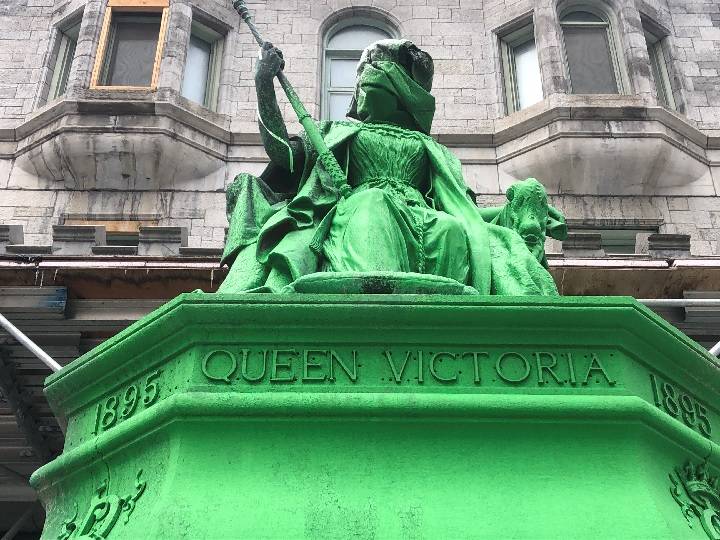
In a May 17 press release, the Montreal May Anarchists (MMA) claimed responsibility for vandalizing the statue of John A. Macdonald in Place du Canada and the statue of Queen Victoria in front of the Schulich School of Music on Sherbrooke street. According to their statement, the group doused the statues in green and red paint, choosing these colours for their anti-colonial and anti-imperial connotations, in response to the encouragement of another anti-colonial activist group, ‘Brigade de solidarité anticoloniale Delhi Dubin.’. 

The Queen Victoria statue, along with another statue of the monarch at Square Victoria, was previously vandalised with green paint in March. The anti-colonial group ‘Brigade de solidarité anticoloniale Delhi Dubin’ claimed responsibility for both acts in an online statement . According to the statement, the Brigade also planned a demonstration on March 24, close to St. Patrick’s Day, because of their belief that the statues, in their glorification of colonial figures, are an insult to the legacy of Irish freedom fighters.  

“Our action is [an] expression of anti-colonial and anti-imperialist solidarity, and we encourage others to take similar action against racist monuments,” Brigade member Udham Connolly wrote in the statement. 

The MMA responded to the call, recognizing the Brigade in its press release following the most recent act of vandalism, as well as #MacdonaldMustFall, another activist group that previously spray-painted the Macdonald monument on the International Day for the Elimination of Racial Discrimination on March 21. 

“The Macdonald Monument and the Queen Victoria statue should be removed from public space and instead placed in archives or museums, where they belong as historical artifacts,” the MMA wrote in their press release. “Public space should celebrate collective struggles for justice and liberation, not white supremacy and genocide.” 

Preservation of controversial historical figures in public spaces has long been the subject of debate, particularly on college campuses. Suzanne Morton, a professor in the McGill Department of History, believes such monuments are significant in that they reflect how we choose to represent and pass down our history.

“There is the actual person […] being commemorated, the history of the monument itself, and the way that current concerns interact with how [people] understand the [person] in the present,” Morton said in an interview with The McGill Tribune. “[Statues of Macdonald were] vandalized in the 1960s as a symbol of English Canadian domination of Quebec, and today, as a symbol of colonialism often associated with Indigenous peoples. The particular issues of criticism change over time.” 

Though she acknowledged that it is difficult for a single monument to represent an individual’s multifaceted legacy, Morton hopes that, the McGill community is up to the task of making our monuments more accurately represent the nuances of our history.

The push to eliminate reminders of colonial legacies also fuelled the recent #ChangeTheName campaign, which sought to scrap the former name of McGill’s men’s varsity teams. As organizers of #ChangeTheName, representatives of McGill’s Indigenous Students Alliance (ISA) are sympathetic to the principles espoused by off-campus anti-colonial groups. .

“The ISA stands in accordance with the message that vandalizing colonial artifacts on Indigenous territory sends,” Ella Martindale, former co-chair of the ISA, wrote in an email to the Tribune. “They do not belong on this land, and hopefully one day, those who oppose colonial violence, Indigenous peoples included, will be able to have these particular statues taken down.”

Commentary, Opinion

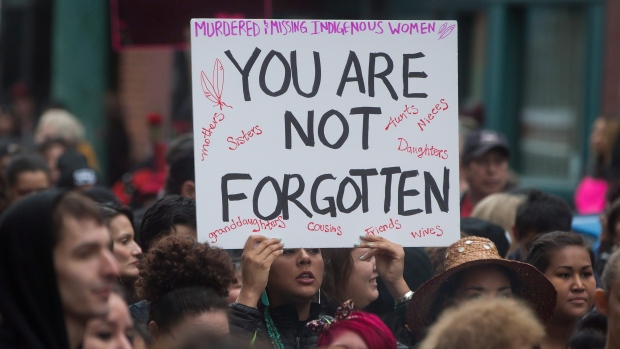
Missing and murdered Indigenous women and girls deserve justice, not language debates

On June 3, the National Inquiry into Missing and Murdered Indigenous Women and Girls (MMIWG) released its final report. The volume, which is over 1000 pages long, concludes that Canada’s treatment of Indigenous people amounts to genocide and requires immediate action. Since the findings were released, much of the surrounding media coverage has disproportionally revolved around the use of the term ‘genocide’ instead of the report’s other findings and recommendations. Sadly, the MMIWG report has resulted in a political uproar among non-Indigenous politicians, with unaffected parties arguing over languages instead of processing the expert testimony and lived experiences featured in the report and developing plans for effective action. In the face of this ongoing injustice, it is easy to feel powerless and blinded by these debates. Rather than becoming lost in these debates, those concerned should work to develop their understanding of Indigenous issues, which go beyond the scope of the National Inquiry’s report.  

There were over 2380 participants in the ‘Truth Gathering Process’ that formed the report. Of those, nearly 1500 of those were survivors or family members, 819 contributed ‘artistic expressions,’ and 83 were ‘experts, knowledge-keepers, and officials’ who provided testimony. Throughout the report, one can find devastating personal accounts, in-depth analyses, and 231 calls to action. It further solidifies the fact that Indigenous women are far more likely to be victims of homicide, sexual violence, and domestic violence than any other demographic. In fact, Indigenous women are 12 times more likely to go missing or be murdered than any other demographic of Canadian women, and their cases are too often mishandled by police and the courts. These facts require attention but have been largely overshadowed over what constitutes genocide. 

Published with the final report was a  47-page supplementary document that contains an explanation for why the term ‘genocide’ is the most appropriate way to describe these injustices. However, the National Inquiry does not claim to have the authority to formally declare that Canada has committed genocide, and it acknowledges the complex and contested nature of the term and its implications. Socially, the word tends to only be associated with the widespread and systematic murder of a group of people: However, the word’s actual definition and original meaning is far more complicated, and according to the United Nations (UN) definition of genocide, it can include other actions such as physical or mental harm, the forced transfer of children, and ‘group conditions of life’ meant to cause physical destruction of the group ‘in whole or in part.’ Expanding the scope of the term does not discount the gravity of its meaning, especially when this renewed understanding still fits within the boundaries of the UN’s widely accepted definition. This nitpicking takes up too much of the conversation concerning the treatment of Canada’s Indigenous groups. These trivialities distract from the need to develop plans which sufficiently address the severity of the situation.

The report’s conclusion has attracted a range of opinions, many from people unaffected by its findings. Andrew Scheer, leader of the Conservative Party of Canada, argued that although the treatment of Indigenous people is a tragedy, it does not qualify as genocide, but rather as a unique issue which requires attention. The hypocrisy in this statement is evident—under former Prime Minister Stephen Harper’s leadership, a committee was set up to look into MMIWG cases but failed to call for a national inquiry into the issue, despite long-standing demands from Indigenous groups.

On the other hand, current Prime Minister Justin Trudeau accepted the genocide conclusion while highlighting the need for action, something he claimed his government is already focused on. However, this is also hypocritical: Trudeaumetre, a website started in 2015 to track Liberal campaign promises, documents how the government has failed to uphold many of its promises when it comes to Indigenous issues, such as providing them with a veto over their territories. Canadian politicians have consistently failed to produce results that match their supposed commitment to the wellbeing of Indigenous peoples.

Ultimately, whether or not politicians agree on the use of the term ‘genocide,’ no one can dispute that Indigenous women and their families continue to suffer greatly. The report’s release is an opportunity for non-Indigenous people to develop a deeper understanding which they can use to make more informed political decisions and be mindful of the suffering of the Indigenous peoples of Canada going forward. The upcoming federal election will surely prompt politicians to make promises to improve the lives of Canada’s Indigenous population, many of which will be empty. If able to vote, people must be mindful of who is promising what and how these promises align with their past actions, be them in the form of votes in Parliament or otherwise. If anything is going to change for Indigenous peoples on a systemic level, politicians need to be held accountable.


Those requiring immediate emotional support can contact the MMIWG support line 24/7 at
+1 (844) 413-6649. Long-term mental and cultural support is accessible through Indigenous Services Canada and other support networks. If interested, you can help by volunteering with or donating to one of Montreal’s many Indigenous programs and services.

Arts & Entertainment, Comedy, Film and TV

Rachel Bloom discusses mental health and musical comedy in Crazy Ex-Girlfriend

Article contains minor spoilers for Crazy Ex-Girlfriend’s fourth season.

Comedian Rachel Bloom has every right to be tired. After her musical comedy television series Crazy Ex-Girlfriend aired its finale in April 2019, Bloom went on tour across the US,  performing some of the show’s most popular songs alongside her former cast members. As if that doesn’t sound tiring enough, Bloom’s latest tour, What Am I Going to Do With My Life?, will also feature songs from Crazy Ex-Girlfriend alongside the comedian’s own original stand-up. One of her upcoming stops is in Montreal for the Just For Laughs festival.

One might expect that writing, starring in, and producing four seasons of a musical comedy would leave a person absolutely exhausted. Yet, in a phone interview with The McGill Tribune, Rachel Bloom feels refreshed. She speaks with energy and care; she pauses before answering each question. She takes frequent breaks to laugh. She looks forward to seeing her fans in Montreal.

“Our fans are some of the smartest and kindest people I’ve ever met,” gushed Bloom. “At live shows […], no one’s ever clamouring over other people […] Everyone’s incredibly kind and polite to each other.”

In Crazy Ex Girlfriend, Bloom plays Rebecca Bunch, an ambitious East Coast–lawyer who relocates to California to chase after her childhood boyfriend. Initially, Rebecca channels all her energy into winning her crush back, but as the series progresses, she comes to learn valuable lessons about love, responsibility, and self-care.

In the show’s third season, Rebecca Bunch is diagnosed with borderline personality disorder. Showrunners worked alongside mental health professionals to ensure a sensitive and accurate portrayal of the mental illness, 

“At this point, a quarter of the people who I meet after live shows have borderline,” shared Bloom. “It’s a lot [more than…] just taking a selfie and being done. [Fan interactions] almost require me to be as present as when I am on stage. I want to listen and be there for them […] it’s wonderful […] but it’s an intense experience.”

Bloom graduated with a Bachelor of Fine Arts in Drama from the Tisch School of the Arts at New York University in 2009, and she later performed sketch comedy at the Upright Citizens’ Brigade Theatre. Her YouTube music videos and work on Crazy Ex-Girlfriend fuse her musical theatre talents and her dry, comedic wit. 

“I was a musical theatre major who started to do comedy, and for a couple of years, I found it hard to marry the worlds [….] Doing musical comedy was my way to finally bring the humanity and vulnerability to the sketch comedy that I wanted to do. It’s very personal for me.”

Crazy Ex-Girlfriend deals in difficult themes with tact and humour, and Bloom understands the enormous power of comedy in addressing mental illness. 

 “Comedy exposes the dark underbelly about how we all feel,” Bloom said. “I once read a book about comedy [….] [It said that] laughter is basically suppressed aggression. I don’t know if that’s true, but I do think there’s something about the communal release of comedy.”

In addition to addressing mental health, Bloom’s work often candidly discusses female sexuality. She initially became YouTube famous for a Britney Spears parody about being turned on by science fiction novels. In the pilot of Crazy Ex-Girlfriend, Bloom sings a raunchy and riotous number about gendered beauty standards. Although the songs in Crazy Ex-Girlfriend can be vulgar, the lyrics aim to humour and educate.

“I was a bullied kid, and I’m really, really cognizant of being a bully. I never want to be a bully. It scares me […] When you’re an outsider, the last thing you want to do is put down other outsiders.”

The title of Bloom’s upcoming tour (What Am I Going to Do With My Life?) pokes fun at her career’s uncharted trajectory as she transitions from Crazy Ex-Girlfriend to other creative work. The actress shared what aspects of her character, Rebecca Bunch, she wants to carry over into future endeavours. 

“I got a tattoo of the last lines of the show: ‘This is a song that I wrote.’ I think the point [of the line] is that you make your own destiny. Your life is a song that you write, you are in control of your life, and you don’t have to live the life other people want you to live. I got that on my body to remember that, and that is what I will be taking with me for the rest of my life.”

Rachel Bloom will be performing at Just for Laughs from July 23-27. Visit hahaha.com for more details about showtimes.

Arts & Entertainment, Comedy

She the People is a hilarious beacon of hope

When wielded just so, humour can be a powerful tool: Few understand this sentiment better than Carly Heffernan, the director of comedy club Second City’s boundary-pushing production She the People, does. Having enjoyed a successful four-month run in Toronto in 2018, Second City’s all-female show will make its Montreal premiere at Just for Laughs on July 22 at the Centaur Theatre. In anticipation of opening night, The McGill Tribune spoke with Heffernan about male allies, collaborative creation, and the art of ‘clapping back’ gracefully.

Comprised entirely of sketches written, acted, and directed by women, She the People is a timely and apt examination of both the politics and minutiae of being a woman in the 21st century; in a series of pithy, side-splitting skits, the production tackles everything from sexual violence to the humiliation of being broken up with via text message.

“This is a show that the audience talks about a lot, because we’re dealing with issues that are so relevant right now,” Heffernan said. “They’re also issues that have this sense of comedic catharsis to them.”

Heffernan cites the Second City emphasis on collaboration as a rewarding aspect of directing for one of North America’s most beloved comedy clubs. The company’s mandate to improve inclusivity and diversity in comedy is a breath of fresh air in the entertainment industry. In the case of She the People, Heffernan made every effort to extend this philosophy to the writing process, which she described as cooperative. 

“We always want to make sure that [our actors] feel like they’re telling the stories super authentically,” Heffernan said.“For me, it goes back all the way to the creation of those sketches and making sure the points of view that were written out were coming from an authentic place.” 

For Heffernan, authenticity is of the utmost importance in a revue like She the People. To distill something as vast and complex as the diverse experiences of women into a 72-minute show is no easy task. However, Heffernan insists that privileging the unique stories that emerged throughout the writing process allowed Heffernan and her team to explore the more universal themes that rose to the surface in a way that felt both honest and inclusive.

“I’ve often described this show as ‘by women, for everyone,’” Heffernan explained. “So often in comedy, we’re dealing with universal truths. We’re getting to the root and the heart of these issues that are bothering us […] and there’s this comedic catharsis that just comes out and it really opens up minds.”

While the primary impetus of She the People was always to celebrate women, Heffernan reports that the show has received support from all ends of the gender spectrum.

“For sure, I hypothesized that I’d get a lot of social media messages from people being like, ‘Where’s He the People?’ and I would have to direct them to the rest of the North American canon of art and culture for the last few centuries, […but] I’m very fortunate that we’ve had many great male allies.”

Indeed, Heffernan says that the overwhelmingly positive response to She the People has instilled in her hope for the comedy industry as a whole.

“I think comedy’s taking a turn, and it’s a really positive turn. It’s looking to take stories from people who have been marginalized […] and it’s shining a light on them [….] Even if there’s a little bit of fear there, once we get over that and see the actual art itself and the stories being told, then we open up, and it’s a really beautiful thing.”


Arts & Entertainment, Comedy

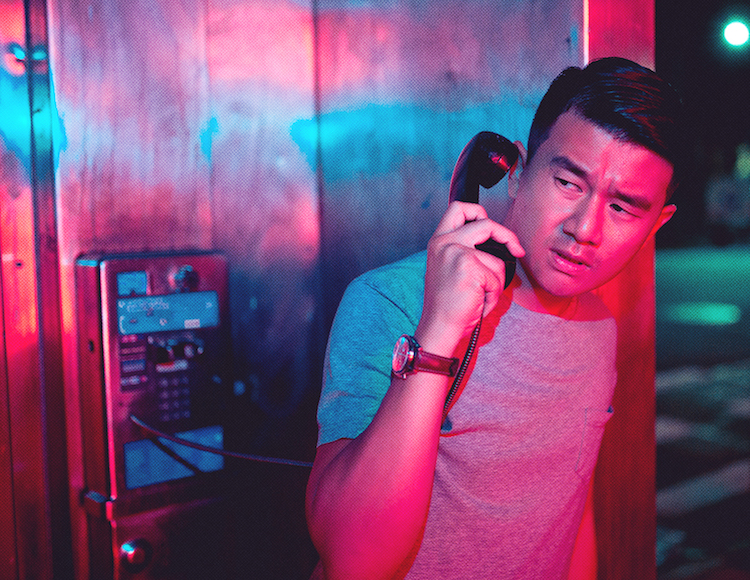
Ronny Chieng thinks we should all just relax

Internationally-acclaimed comedian Ronny Chieng has some advice for university students: He thinks we all should learn to go with the flow.

“I don’t think people teach kids how to deal with uncertainty,” Chieng said in an interview-turned-counselling-session with The McGill Tribune. “You’ll see for yourself […] When you graduate, you’ll see it doesn’t really matter that you didn’t get this job straight out of school, or you didn’t get that internship. In the long run, the important thing is to really figure out what you like doing.”

Even if it happens to derail the course of your interview slightly, it would be foolish not to take life advice from a guy like Chieng.

Chieng began performing stand-up in 2010 while completing his law degree at the Australian National University. Though he graduated in 2012, Chieng’s legal career was quickly eclipsed by his meteoric rise to comedic fame. By 2015, Chieng was a regular correspondent on The Daily Show, and just last year, the Malaysia native acted alongside Constance Wu and Henry Golding in Crazy Rich Asians. Despite his recent successes as a screen actor, however, Chieng insists that he feels most himself onstage.

“With stand up, for me anyway, I can get closer to my own unique perspective on things,” Chieng said. “Whereas with acting, you’re basically kind of trying to play a character. Most of the time, you’re playing a character that someone else wrote and trying to make someone else’s work into a performance.” 

Chieng draws heavily from personal experience in all his creative endeavors. In 2017, he co-wrote and starred in the semi-autobiographical Australian television series Ronny Chieng: International Student. The series was inspired by Chieng’s years as an undergraduate student at the University of Melbourne. Each of the six episodes follows the fictionalized Ronny as he bumbles his way through all the trials and tribulations of student life. 

“I don’t know about you, but, when I was in university, me and most of my peers were always very scared of the future,” Chieng said, recalling the period of anxiety that would go on to inspire one of his most successful creative ventures to date. “But after you leave college, you kind of get more perspective on things and you realize you don’t need to compare yourself to other people; you’re running your own race.”

Although Chieng is a firm believer in following your dreams, he also cautions young people not to get too attached to them. In 2010, for example, Chieng says his goal was to have his own Wikipedia page, a milestone he’s long since accomplished.

“But now all the information on it is so inaccurate, I wish it would stop,” Chieng said with a resigned sigh. “Someone said I’m scared of dogs and it somehow made it to the Wikipedia page. But I’m totally not scared of dogs at all.” 

One can perhaps conclude that the secret to Chieng’s success is his ability to stay true to himself and to take things in stride. His final words of wisdom were simple and sincere: Just trust the process.

“When you’re on your side of the doorway, you can’t tell, you can’t see that path, but once you’re on my side of it, when you’ve had a couple more years of experience, you’ll look back, you know, and you’ll see.”

Ronny Chieng will be performing at Just for Laughs from July 23-25. Visit hahaha.com for more details about showtimes.


Science & Technology

HIV in East Africa: An ongoing struggle

According to the World Health Organization (WHO), 19.6 million people are living with human immunodeficiency virus (HIV) in eastern and southern Africa as of 2017. As part of McGill’s Africa Field Study Semester (AFSS), students had the opportunity to interact with local individuals and public health practitioners that deal with HIV prevention and treatment on a daily basis. Through their visits to healthcare facilities, they learned about the ongoing HIV struggle in East Africa.

HIV is a virus that impairs the immune system, leading to immunodeficiency, or the inability to form a normal immune response to common infections. Transmitted through fluids such as breast milk, semen, and blood, the virus is often spread from mother to child, through sexual intercourse, and through sharing infected needles. People with HIV are also more susceptible to acquiring illnesses such as tuberculosis, meningitis, bacterial infections, and lymphomas. These illnesses can become even more severe if HIV advances into acquired immunodeficiency syndrome (AIDS). 

While developed countries have made major advances in terms of access to HIV treatment and the stigma associated with HIV, many developing countries, such as those in East Africa, continue to struggle with the devastating virus. AFSS students visited Jinja, a Ugandan fishing community on the shores of Lake Victoria whose high rates of HIV are largely due to low levels of education, economic hardship, and a migratory lifestyle. The fishermen live day to day with the little money they earn, and their lifestyle revolves around “the four w’s”: Waragi (alcohol), water, wealth, and women. After a long fishing trip, they often spend their earnings on waragi and have sex with different women. This high level of prostitution coupled with low condom usage increases HIV transmission. Additionally, due to the fishermen’s migratory lifestyle, access to HIV treatment poses a problem. For example, if fishermen obtain drugs at a clinic to treat HIV or prevent infection following exposure to the virus, they often do not follow up with their treatment because they have moved to another community. 

AFSS students also visited a Maasai community in Maji Moto, Kenya, another HIV-prone community. The prevalence of HIV in Maji Moto is due largely to the people’s polygamist lifestyle: On average, men in this Maasai community have three wives. If a Maasai man is infected with HIV, he will likely infect all his wives. Women, who can transmit HIV to their child during pregnancy, birth, or breastfeeding, are at a greater risk of acquiring HIV from heterosexual sex compared to men, since the layer of mucus surrounding the cervix is not thick enough to act as an effective barrier against the virus. Due to the Maasai polygamist lifestyle and the different ways in which women can transmit HIV to their children, people in Maasai communities are at a higher risk of getting infected with HIV. In addition, the Maasai community’s traditional way of life and bias against Western medicine impedes access to treatment. Many Maasai elders in Maji Moto believe that various plants and roots in the Kenyan bush can cure HIV, and, often, the Maasai people would prefer to visit the traditional medicine man rather than use Western treatments. 

Finally, students visited Kakamega, a city near the border of Kenya and Uganda that serves as home base for a transient truck driver community. Hosting one of the first HIV clinics in East Africa, many HIV-positive patients settled in the Kakamega area after the clinic was opened. Consequently, the Kenyan town became home to one of the highest rates of HIV in the country. When AFSS students spoke to the public health workers in this facility, they explained that truck drivers have sex with prostitutes, increasing HIV transmission on the Kenyan–Ugandan border. Similar to the fishermen, truck drivers move from place to place and often do not follow up with their HIV treatment. 

According to Avert, an international HIV and AIDS charity, overcoming the HIV epidemic in East Africa requires long-term commitment of the international community and national governments, as well as the involvement of civil society to address gender inequality, barriers to treatment, and the differing needs of each community. In trying to reach global HIV targets, Kenya and Uganda have made significant improvements, but the virus remains a major concern. Preventing infection and promoting routine treatments are of vital importance, and they will likely involve locally-driven educational initiatives to empower men and women and facilitate access to medical services.

McGill’s AFSS introduces students to the wildlife, history, and culture of East Africa. During the winter semester, students conduct research and take courses in Kenya, Uganda, and Tanzania.

Arts & Entertainment, Comedy

Adam Cayton-Holland brings jokes and frank mental health discussions to Just for Laughs

Content warning: Mentions of suicide. 

Denver comedian Adam Cayton-Holland wants to talk about tough topics most comedians choose to avoid, like his sister Lydia’s suicide. In Nov. 2018, Cayton-Holland published a memoir called Tragedy Plus Time, which discussed her passing and how he processes grief. 

“I was a little tired of wondering if people know this about me or [whether they are] tiptoeing around this issue, [like when] people try to bring it up awkwardly,” Cayton-Holland said in an interview with The McGill Tribune.

While writing the memoir felt cathartic to him, Cayton-Holland still felt the urge to process his grief on stage.

“I thought that [the book] would scratch the itch of me being an insufferable artiste and needing to process it in my work, but I felt compelled to talk about it on stage. But it’s not the kind of subject you can just [bring up] like, ‘Hey, comedy club! How are your fried cheese sticks? My sister killed herself,’” Cayton-Holland said. “You need a more appreciative, sensitive, nuanced audience.”

As a result, and at the encouragement of his comedian friends Sean Patton and Rory Scovel, Cayton-Holland tested out a loose adaptation of his memoir as a one-man show. 

“They were like, ‘you should do this as a show’,” Cayton-Holland said. “And they spoke to me, so I tried it, and from the first time I tried it, it felt good to me. It didn’t feel too triggering or indulgent. It felt right.”

Although he says the show is still a work-in-progress, Cayton-Holland is excited to perform his one-man show, Happy Place, at the Just For Laughs Festival this July. He anticipates an enjoyable return to the city of Montreal.

“I look forward to speaking broken French,” Cayton-Holland said. “I’d say I know 100 words of French and I don’t know how to conjugate verbs so I’m really fun to be around as I blatantly try to be a gross American speaking French everywhere I go.”

On stage, however, Cayton-Holland has found audiences are in tune with what he is saying. Mental illness is a topic he finds meaningful to discuss on stage, and he finds a lot of power in sharing his story.

“[I] can’t leave the venue because everyone wants to talk about their experience,” Cayton-Holland said. “You learn how prevalent mental illness, depression, and suicide are. [….] There’s no six degrees of separation when it comes to [this] stuff. It’s like everyone knows someone. Why, in 2019 when we’re all so ‘woke,’ there’s still a stigma about suicide is beyond me.”

After one show, Cayton-Holland was approached by a military veteran who provided a particularly meaningful message. 

“This was a dude who was a veteran [who] had a lot of friends [commit] suicide,” Cayton-Holland said. “And he basically said ‘I can’t believe you talked about mental illness for an hour and I was laughing the whole time.’”

Cayton-Holland wants to use his show as an avenue for addressing and coping with difficult topics.

“[The] spoonful of sugar is the comedy, so I try to make it funny,” Cayton-Holland said. “My goal is funny first. I don’t want it to be this gut-wrenching thing you have to endure. I want you to laugh and be like, ‘Holy shit, we just dealt with some heavy stuff.’”

Happy Place, after all, is a tribute to Cayton-Holland’s little sister and her role in his life. Cayton-Holland told the Tribune that his show has given him the opportunity to be the most himself, and the most open he has ever felt on stage.

“My little sister Lydia and I were very funny together, and I think a lot of my sense of humour came from her,” Cayton-Holland said. “When you’re brother and sister, you run weird little bits. You just have a way of joking that’s very, you know, you have a shorthand with one another. And, so, I feel like doing it on stage is almost like an attempt to recreate that a little bit with her.”

Adam Cayton-Holland will perform Happy Place at 8:30 p.m. on July 23-25 at Le P’tit Impro. Check hahaha.com for more info.

Arts & Entertainment, Comedy

Hasan Minhaj brings digital-age comedy to Just for Laughs

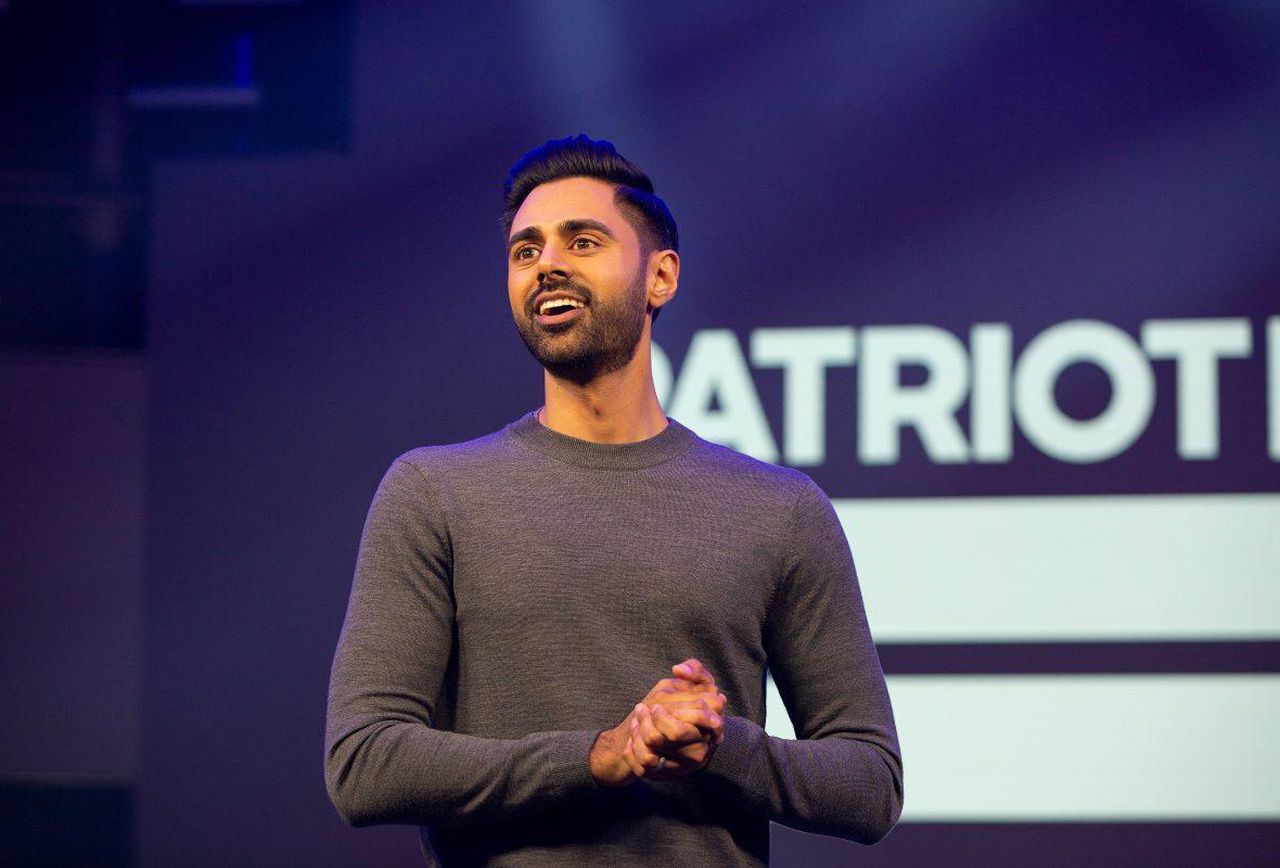
When Hasan Minhaj, host of Netflix’s Patriot Act, takes the Just for Laughs stage on July 26, he will likely surround himself with LED screens. It’s slowly becoming a trademark of his sets: From his parody news comedy to his standup special Homecoming King, information-dense visualizations are everywhere.

“Look at the way we live our everyday lives,” Minhaj said in an interview with The McGill Tribune. “We are constantly flagging through and deep-diving for information through LED screens every single day. You’re probably talking to me on your iPhone while you’re looking [at] questions on a MacBook as you have multiple tabs open in your Mozilla or Google Chrome browser.”

Early on, Netflix producers and critics expressed concerns to Minhaj about the format of his show. 

“[People asked me,] ‘Is it going to be too much for people to take in?’” Minhaj said. “And I was like, ‘No, people watch The Avengers on TV while they are Tweeting [and] texting a friend.’ This is just the way we live our lives now. This is the way people consume and think about information.”

Given that Patriot Act is streamed online, Minhaj makes an effort to discuss subjects that are timely and relevant, but also able to withstand the test of time. In a recent episode about internet access inequality, he joked about basketball player Kevin Durant’s recent leg injury, which sparked a loud reaction from his surprised audience.

“I like that dance between timely and timeless,” Minhaj said. “I love the feeling that you can hear [in] the audience when we did that Kevin Durant joke. It was the day after it happened, so people were like ‘Ooh.’ But internet inequality is […] a relatively evergreen topic, [and] the fight for it has been going for a really long time […] I love that dance. I’m a big fan of blurring those lines.”

In Minhaj’s third appearance at Just for Laughs, he will definitely bring the same energy that won Patriot Act so many fans. While Minhaj does not do cold monologue jokes on Patriot Act, his ability to dive quickly and deeply into a subject while building rapport with his audience will prove valuable to making a memorable gala.

“I knew [that] when we click on a piece of content, whether it’s a sports highlight on House of Highlights or just like a clip from SNL, we just want to get to the show,” Minhaj said. “We get right into the story because I know [that] when you’re clicking in, that is the viewer’s expectation. This isn’t the era of having to fill time because you have a time slot and you’re a one-hour variety show. I think we are seeing an end to that era.”

And, after all, returning to Montreal and performing at Just for Laughs is a meaningful and lasting mark in Minhaj’s career.

“I’m really excited to come back up and be a part of the festival,” Minhaj said. “The last time I was there, I was doing Homecoming King, and the time before that I was doing “New Faces,” and so the festival has kind of been at every critical inflection point of my career.”


The Hasan Minhaj Gala will take place in Salle Wilfrid-Pelletier at Place des Arts on July 26 at 9:45 p.m. 

Arts & Entertainment, Comedy

Spotlight: “The Nasty Show” at Just for Laughs

Just for Laughs’ annual Nasty Show will return to the MTELUS Theatre from July 17 to 27, with a full bill of raunchy, envelope-pushing, and hilarious acts. The McGill Tribune compiled some highlights-to-be from the upcoming show. 

Bonnie McFarlane

Gabe Nisker, Features Editor

Bonnie McFarlane knows that nut allergies are dangerous: When she performed a joke about escaping her marriage by causing an allergic reaction in her husband on a late-night show, she earned the attention of many allergy-affected families.

“They kept saying, you know, nut allergies are very serious,” McFarlane said in an interview with The McGill Tribune.. “And my response is, yes, that’s why I used it that way in that joke. I wanted it to kill my husband.”

McFarlane likes to tread in more dangerous waters and joke about serious topics. She names her favourite kind of joke as ‘the mislead’: She’ll start with one premise and hit the audience with an unexpected punchline.

“I really like writing jokes, and I have a very specific thing in my head when I’m writing jokes,” McFarlane said. “I like to go on stage to do it word-for-word […] I like to have the right word in the punchline exactly every time.”

McFarlane, originally from Cold Lake, Alberta, estimates that she has appeared at the Just For Laughs festival around a dozen times. In addition to her appearances on The Nasty Show this year, she will also have the chance to play fast and loose with a more improvised style: Alongside her husband, comedian Rich Vos, McFarlane will co-host Would You Bang Him?, a comedic game show where four female comics watch male comedians do a brief set each and ultimately decide, based on each of the men’s performances, whether they would have sex with any of them. 

“I don’t want my husband to find this out, but female comics talk a lot about who they would have sex with and who they wouldn’t have sex with,” McFarlane said. “I was like, ‘one day that would be a great game show.’ I told Rich about it and he was like “Yeah, let’s do it” and so we started doing the show. It’s so fun and hilarious. It’s stupid and it’s sexist. We call it a slut-shaming game show.”


Comedian CP

Sophie Brzozowski, Arts & Entertainment Editor

Chris ‘Comedian CP’ Powell has pretty much always known that he’s funny. Ten years and a lifetime ago, following one fateful open-mic night where he earned a standing ovation, Powell left a successful career as an advertising executive in Detroit to pursue comedy full-time. 

“I loved advertising,” CP said in an interview with the Tribune. “I loved the opportunities it gave me [.…] The only thing was that I just wanted the credit. I just wanted people to know that I was the guy who was funny, [that] I was the guy who was making this stuff. So comedy was a way for me to get that instant gratification from my audience and have them connected directly to my brainpower.”

Even over the phone, CP projects confidence and charisma, and in the years since he first began performing, he’s earned every ounce of hubris. Alongside a successful stand-up career, CP has also made waves in television since relocating to Los Angeles, California. Most recently, in 2018, Powell sold a pilot to the television network Adult Swim. The show, titled Ol Bud’s ANU Football Weekly, is a hilarious dive into the corrupt and lawless world of college football. 

CP insists, however, that stand-up will forever be his preferred medium of expression: The stage is the place where he feels most at home. Powell says he’s looking forward to taking full advantage of the no-holds-barred environment that The Nasty Show will no doubt provide.

“[Comedians are] the ones [who] are supposed to say the stuff that everybody else can’t say. It’s my job to say these things that everybody is thinking. That’s what you’re paying me for!” 

The Nasty Show will take place at MTELUS Theatre from July 17 to 27. Visit hahaha.com for more information on showtimes.

Read the latest issue

Read the latest issue