
McGill Martlets
67

Bishops Gaiters
39

Published by the SPT, a student society of McGill University

 Boundless: McGill Tribune Special Issue
November 30, 2016
Boundless: McGill Tribune Special Issue
November 30, 2016
 The Sport Authority EP. 7: Looking back at Sam Hinkie and The Process
April 12, 2016
The Sport Authority EP. 7: Looking back at Sam Hinkie and The Process
April 12, 2016
 Rare books: The hard spine of the modern library
April 5, 2016
Rare books: The hard spine of the modern library
April 5, 2016
 Boundless: McGill Tribune Special Issue
November 30, 2016
The Sport Authority EP. 7: Looking back at Sam Hinkie and The Process
April 12, 2016
Rare books: The hard spine of the modern library
April 5, 2016
Boundless: McGill Tribune Special Issue
November 30, 2016
The Sport Authority EP. 7: Looking back at Sam Hinkie and The Process
April 12, 2016
Rare books: The hard spine of the modern library
April 5, 2016
Cooking with spices is an exciting, economical, and healthy way to spruce up basic student dishes. However, meandering down the spice isle can be daunting for even the most advanced cook. Here are some common spices from a variety of global cuisines to help bring flavourful boosts of nutrition to even the simplest meals.
Cinnamon is cultivated from the brown bark of the cinnamon tree and comes in two varieties, Chinese and Ceylon. When the bark is harvested, it rolls into the tubular form known as cinnamon sticks, found in most grocery stores. Cinnamon has a long history, and was even used in ancient Egypt as an embalming agent. Later, it became one of the main commodities of trade between Europe and Asia, and grew in popularity in European cuisine during the Early Middle Ages. Cinnamon has many health benefits, including its antifungal and antibacterial properties, its ability to stabilize blood sugar, and its potential to boost cognitive function and memory.
Try this:
– A rice pilaf with roasted veggies, raisins, and chicken for a Middle Eastern-inspired dinner.
– Add a few dashes on whole grain toast with honey and butter.
– Sprinkle it in your morning coffee or tea for added flavour.
Basil is harvested from the leaves of the basil plant, and is a highly fragrant and versatile plant. There are 60 varieties, the most common being sweet basil, which is found in Italian cuisine, and Thai and lemon basil, which are found in Southeast Asian cuisines. Basil is revered in many different cultures around the world; in India, it is a symbol of hospitality, while in Italy, it symbolizes love. Basil is high in Vitamin K, has anti-inflammatory effects, and contains flavonoids, which serve as protection from radiation.
Try this:
– Make an easy pasta dish by topping cooked pasta with fresh chopped sweet basil, olive oil, and Parmesan cheese.
– Simmer diced tomatoes with dried basil, mushrooms, and zucchini for an easy tomato sauce.
– Try a salad with diced fresh basil leaves, spinach, purple onion, and mozzarella.
Curry powder is a fragrant spice mix, which varies in composition—reflecting South Asian cuisine. Most curry powder recipes include coriander, turmeric, cumin, fenugreek, and chilli peppers in their blends. Additional ingredients like garlic, ginger, and fennel seed may be included. Curry powder is well established in the dishes of the Indian peninsula. The spices in curry powder have a range of amazing health benefits. Turmeric, for example, has potent anti-inflammatory benefits and lowers cholesterol, while coriander lowers blood sugar and controls free radicals.
Try this:
– Create a curry by simmering rice, coconut milk, chopped vegetables, and chickpeas.
– Make a homemade salad dressing with olive oil, apple cider vinegar, diced garlic, and curry power.
– Add it in a stew with lentils, potatoes, sautéed onion, and garlic.
Chili peppers originate from Central and South America. They were introduced to the rest of the world in the 15th and 16th centuries, quickly becoming staples in many styles of cuisine. There are as many varieties of chili peppers as there are recipes to incorporate them in, making them versatile in savoury cooking. The spice is made by grinding dried peppers; some common types of dried pepper include habaneros, chipotle, and cayenne. Chili peppers are renowned for their health benefits in many cultures, helping fight inflammation and aiding weight loss. They also boost immunity and clear congestion, making them ideal for flu season.
Try this:
– Sauté leafy greens like kale with cayenne and garlic.
– Make a warming chili with diced tomatoes, black beans, chickpeas, corn, rice, and cayenne.
– Squeeze some lemon juice and cayenne pepper into a glass of water in the morning for a detoxifying kick.
 Boundless: McGill Tribune Special Issue
November 30, 2016
The Sport Authority EP. 7: Looking back at Sam Hinkie and The Process
April 12, 2016
Rare books: The hard spine of the modern library
April 5, 2016
Boundless: McGill Tribune Special Issue
November 30, 2016
The Sport Authority EP. 7: Looking back at Sam Hinkie and The Process
April 12, 2016
Rare books: The hard spine of the modern library
April 5, 2016
 Boundless: McGill Tribune Special Issue
November 30, 2016
The Sport Authority EP. 7: Looking back at Sam Hinkie and The Process
April 12, 2016
Rare books: The hard spine of the modern library
April 5, 2016
Boundless: McGill Tribune Special Issue
November 30, 2016
The Sport Authority EP. 7: Looking back at Sam Hinkie and The Process
April 12, 2016
Rare books: The hard spine of the modern library
April 5, 2016
If it’s the story at the heart of Citizenfour that gives the documentary its breathtaking urgency, it’s the film’s multilayered nature that makes a powerful statement on the modern relationship between a government and its citizens. Both a stunningly intimate character study and a larger, more global overview of governmental surveillance, Citizenfour reconciles the contrasting approaches to present an enlightening and emotionally-wrenching view of post-9/11 life.
The character at the heart of her study is former NSA employee Edward J. Snowden, who leaked classified information about the agency’s nasty habit of spying on civilians without warrants. Using the name that gives the film its title, he got in touch with Poitras in January 2013. That May, he flew to Hong Kong with the intention of disclosing what he knew, and Citizenfour director Laura Poitras and reporter Glenn Greenwald met him there in June in order to receive the information and present it to the world.
Much of the film concerns Poitras’ and Greenwald’s interactions with Snowden in the hotel room as they prepare to share the knowledge of the NSA’s iniquities. Along the way, we see the impending external pressure from media and government alike, as well as Snowden’s surprisingly stoic reactions to the threats. Even when he hears news of his partner being questioned as government officials search their home, he remains remarkably unfazed. He’s obviously concerned, but he appears to have been prepared for what was coming—he simply cares too much about sharing what he knows to let it stop him.
Citizenfour is a gripping, John Le Carré-like thriller in disguise as a documentary, and the film makes for compelling viewing, even if stripped of its larger political context. Even though we know the ending going into the film, Poitras’s intimate use of close-ups and a hand-held camera makes it captivating in a way that’s well-suited to her story’s gravitas. Though Snowden doesn’t get much in the way of character exposition—Poitras focuses heavily on his actions themselves—the few details we do see are more than enough to depict him as a strong-willed dissident. Poitras effectively conveys Snowden’s intense belief in his duty as a citizen and his desire to make the world a better place through his actions.
But she’s also not content to have her film be merely a hagiographical portrait. She frames the Snowden segments with footage of the former NSA intelligence official William Binney, who became a whistleblower shortly after 9/11 due to his disgust with the agency’s data collection policies. He shares scathing details about his former employer, as well as his frustration with the organization. Likewise, the prominent hacker Jacob Applebaum is also introduced, lecturing to potential NSA targets about the dangers they face. These segments simultaneously serve to confirm Snowden’s information and paint a more detailed picture of the shadowy, intricate web of governmental spying.
As Citizenfour emphasizes, all North American citizens and many foreigners are at high risk for being targeted by that web, which is only part of why the film makes for such essential viewing. Despite the importance of its message, it hardly feels like homework—the tale at its core is as gripping as any Hollywood thriller in recent memory. The horrifying information revealed on-screen makes you want to avert your eyes in disgust, but the power of Poitras’s filmmaking keeps you hooked. Citizenfour is a deeply political and angry film, but also one that doesn’t let its opinions detract from the strength of its art.
Citizenfour will be shown in Montreal starting Friday, Nov. 14 at Montreal Forum (2313 Saint-Catherine) and Montreal ExCentris (3536 Saint-Laurent). General admission is $12.99.
 Boundless: McGill Tribune Special Issue
November 30, 2016
The Sport Authority EP. 7: Looking back at Sam Hinkie and The Process
April 12, 2016
Rare books: The hard spine of the modern library
April 5, 2016
Boundless: McGill Tribune Special Issue
November 30, 2016
The Sport Authority EP. 7: Looking back at Sam Hinkie and The Process
April 12, 2016
Rare books: The hard spine of the modern library
April 5, 2016
For some, November represents the impending cold of the long Montreal winter and the struggle to prepare for finals and assignments. For others, it also brings a whole different meaning. November marks the month of “Movember,” a movement started in Australia eight years ago by Adam Garone and a group of his friends. This movement has made its way to campus in the form of Movember McGill, a club that aims to increase awareness about prostate cancer and raise money to fund prostate cancer research.
Movember McGill hosts a variety of events on campus, the most common one in the month of November where participants grow moustaches or support individuals who are growing moustaches for the cause. The club, which began six years ago, has been successful in its campaigns so far, with positive feedback from students around campus.
“I think guys love Movember because growing a beard or a moustache makes them feel manly,’ said Siena Aberdeen, U1 Management student. “If this leads to spreading awareness for prostate cancer, it’s all the better.”
While the Movember movement originally started as a cause to raise awareness for men’s prostate cancer, there are also many women who participate in Movember and aim to raise money for the cause.
“We all know that moustaches are not always seen as something attractive, so we need ‘Mo Sistas,’ [female Movember participants] to reach out to the men in their lives to tell them they look good with their moustaches, as well as start conversations with them on the reality of prostate and testicular cancer,” said Margaret Markin, co-chair of Movember McGill.
The original Movember movement grew out of Garone’s recognition that growing moustaches would provide visibility to combat prostate cancer’s invisible nature. Garone realized that creating this movement to grow moustaches for a month would be an interesting and innovative way to start conversations about prostate and testicular cancer. Movember has increased in momentum and has expanded to North America, Europe, and Asia.
“Garone realized that cancer is something quite invisible, whereas moustaches are very much visible,” said Sahil Kumar, co-chair of Movember McGill.
Canada started embracing the organization eight years ago, and is now the country that raises the second most donations globally after the United States, with $5 million funds generated this year.
This season, Movember McGill is collaborating with McGill Athletics to create “Move,” a fundraiser series of sport-related events such as hockey and basketball games on Nov. 21 and Nov. 22. The organization is also hosting a speaker series on Nov. 18 from 6:30 p.m. to 8:30 p.m. in Otto Maass Chemistry Building with professors who have Movember grants that fund multidisciplinary approaches to answer questions with regards to prostate cancer to inform donors on where their money is being spent. Movember McGill also travels around campus bars, such as Blues Pub, to fundraise and organize head-shaving sessions.
“We’ll be at Blues Pub raising money, and people are going to shave their head once we have reached certain goals of money,” said Jessica Ferkul, U4 Engineering and Movember co-chair.
Movember celebrates the end of the month with a Gala party on Nov. 28 at the Rialto Theatre. This is a costume event, where teams create themes around the moustaches they have grown.
Other groups that are not directly linked to Movember McGill also organize Movember events. For example, EUS is organizing an apartment crawl, Desautels will host a Movember-themed ‘4-à-7,’and the Post-Graduate Students’ Society (PGSS) hosts a special Movember poker tournament on a date that has yet to be decided
However, these societies tend to act independently, and Movember McGill’s role is to bring them together.
“Everyone does their own thing, and we want to become the liaison between the different organization’s that promote Movember events around McGill,” Kumar said.
Movember McGill aims to create a fun and inclusive environment where students, professors, staff, and security participate. “You feel a sense of pride and community when you bump into a fellow ‘Mo bro’ […] who is also trying to grow a moustache, even if he is a total stranger,” Ferkul said.
 Boundless: McGill Tribune Special Issue
November 30, 2016
The Sport Authority EP. 7: Looking back at Sam Hinkie and The Process
April 12, 2016
Rare books: The hard spine of the modern library
April 5, 2016
Boundless: McGill Tribune Special Issue
November 30, 2016
The Sport Authority EP. 7: Looking back at Sam Hinkie and The Process
April 12, 2016
Rare books: The hard spine of the modern library
April 5, 2016
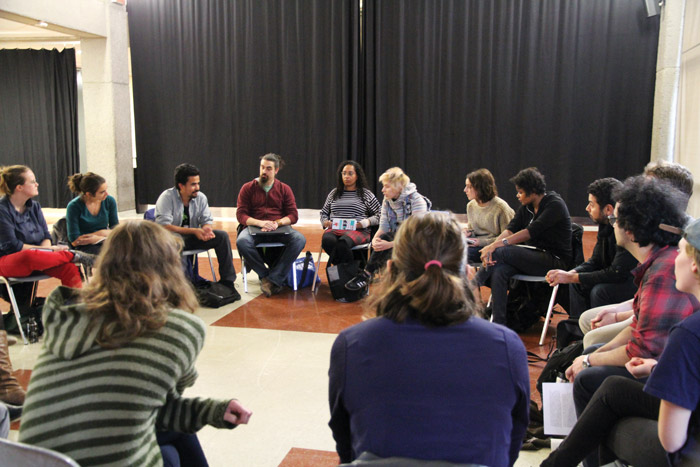
Last Thursday, the Quebec Public Interest Research Group (QPIRG) McGill hosted a workshop on migrant workers in Canada as a part of Culture Shock, an annual event series put on by QPIRG that explores issues affecting immigrants, indigenous people, refugees, and people of colour. The panel of speakers included Viviana Medina from the Temporary Agency Workers Association (TAWA), Enrique Llanes from the Temporary Foreign Workers Association (TFWA), and Noe Arteaga, a former agricultural worker. The speakers shared their experiences as advocates and ex-temporary workers and explained the injustices currently faced by migrant workers in Canada.
Llanes talked about the history of migrant workers in Canada and the Temporary Foreign Worker Program, which was founded in 1973 and originally managed by the Department of Human Resources and Skills Development Canada. Today, non-governmental organizations (NGOs) and private employers run the program and, according to Llanes, negotiate workers’ salaries with the government without consulting the workers themselves.
“The employer has a myriad of rights over the worker, and the worker becomes a commodity, ” Llanes said.
Llanes also explained the role of the consumer in perpetuating the mistreatment of temporary foreign workers.
“Consumers put pressure on [the workers] as well […] to have the best fresh produce,” said Llanes. “This is not just in one industry. [The program] brings people from Guatemala to pick your tomatoes. It brings women from the Philippines to take care of your children. It brings people from Mexico to make your McDonald’s coffee [….] So it racializes the workforce and leaves it completely unprotected.”
Llanes also explained how colonialistic ideals still influenced the Temporary Foreign Worker Program.
“[The] program is intended to reproduce a worldwide inequality that is paramount to preserve the current economic model.” she said. “[It’s] based on the ideological and physical domination exerted by Western countries over the periphery.”
Noe Arteaga, who came to Canada from Guatemala through the Agricultural Foreign Worker Program, described his experiences as a temporary foreign worker on a farm in Québec. According to Arteaga, although the program was a government initiative, it was administered by an NGO that charged workers a $2,000 fee to join and imposed rules on the workers that forbade them to go to church, make Canadian friends, or unionize.
According to Arteaga, Canadian employers also often neglect the responsibility for the health of their temporary foreign workers. Foreign workers were made to work up to twice as many hours as local labourers. Arteaga highlighted an example of a worker who was told to exterminate pests on tomato crops.
“He didn’t have the proper equipment or training,” Arteaga said. “This worker got sick, and the employers didn’t care [….] so the worker kept working, but his health declined. When he started to get more aggressive toward the employers [in asking for medical attention], they locked him in the dining room.”
Medina spoke about worker placement agencies, which allocate 50,000 workers in Quebec each year, but are poorly regulated by the government. According to Medina, over 200 unregulated placement agencies exist in Québec and prey on temporary foreign workers.
“These workers have been here, on average, for four or five years,” Medina said. “They haven’t been able to achieve permanent jobs with [the company] itself. Because they’re working for the placement agency, and not for the actual employer where they work, the employment agency gets a percentage of their salary.”
The federal and provincial governments have recently passed laws that are detrimental for temporary foreign workers, Arteaga explained. The most recent example is Bill 8, passed this October in the National Assembly of Québec, which allows associations of temporary workers but forbids them to unionize.
Attendee Rachel Dénommé, a first-year master’s student in Integrated Studies in Education and Society, said the temporary foreign worker problem should also be examined in a broader context.
“It’s a multi-layered issue, and […] they’re talking about exploitation and lived realities here; but this is caused by globalization and colonization, and this is part of a much longer history,” she said.
Boundless: McGill Tribune Special Issue
November 30, 2016
The Sport Authority EP. 7: Looking back at Sam Hinkie and The Process
April 12, 2016
Rare books: The hard spine of the modern library
April 5, 2016
Dean of Arts Christopher Manfredi presented a proposal for the creation of a new fee to the Arts Undergraduate Society (AUS) Council on Oct. 29. The proposed five-year fee for all Arts students would fund the Arts Internship Office (AIO), which administers the Arts Internship Program (AIP), as well as go towards improving advising and career services for Arts students.
Manfredi explained that part of the motivation to raise this fee is due to the Quebec government cutting a Ministère de l’Éducation, du Loisir et du Sport (MELS) program that currently funds the AIO as part of provincial budget cuts.
“Money that funds the people and the structure that makes the AIP run will end this [fiscal] year,” Manfredi said. “I have a great Arts Internship Program, I have a large amount of money that donors have given us to provide rewards for Arts interns, but right now I’m in danger of not having an office to administer this program.”
Manfredi proposed the creation of a student fee of $2.25 per credit to cover this deficit. The fee would be implemented in two stages. The first stage would aim to create a source of funding for the AIO in the future by raising $5 million over five years for an endowment fund, from which the AIO’s operating budget would come out of. Approximately $1.5 million of that would be raised from $1.50 per credit of the total fee, totalling around $300,000 annually. The remaining $3.5 million is expected to be raised through external fundraising.
At the same time, $0.75 per credit of the fee would generate approximately $135,000 annually to cover the operational costs of the AIO. The difference of around $55,000 would then be made up by contributions from Faculty of Arts members.
In the second phase, the AIO fee would be converted to an Arts advising and career services fee. The amount would remain the same—$2.25 per credit—generating approximately $405,000 annually. This money would go towards enhancing the capacity of the Arts advising and career services, according to Manfredi, with improvements such as increasing the number of advisors, student advisors, and administration support staff.
“[They’re] basically two different projects. The first project is [to] get the AIO on a permanent, sound budget, so we never have to worry about what the government does,” Manfredi explained. “I still think enhancing career and advising services is important.”
AUS president Ava Liu explained that she had originally been approached by the Dean with the idea of creating one fee for the improvement of advising and career services, but after consultation with the executive team, they decided to break the fee into two phases to improve transparency and give time for consultation.
“For advising, […] the original idea of the fee was to, and still is, to support the salaries of a lot of [new] people […] who we needed to hire […]” Liu said. “We prioritize changing the system over just adding more advisors. To do an advising overhaul is the reason it’s called phase two, because it would take more consultation, we’re looking at doing a longer term project this year to figure out what we would like from advising, and then maybe in the Fall 2015 […] putting that fee through a question. This was my approach to the problem, hence why there are two fees.”
AUS VP Academic Erin Sobat asked Manfredi what the university’s response was to the government cutting of funding for the AIO.
“What has been the response from the provost and the deputy provost in terms of making up that loss in funding, especially given the principal’s commitment to experiential learning?” Sobat asked, referring to Principal Suzanne Fortier’s previous affirmations of the McGill commitment to offering all undergraduates opportunities to learn through practice and field work.
In response, Manfredi said that the McGill administration understood the importance of the AIO.
“We’re starting to have these conversations,” Manfredi said. “They understand that the AIP is a critical component of the McGill Commitment.”
Manfredi continued to explain that AUS students would be able to decide whether to hold a referendum question in 2015. If held, the question would decide if the fee would be implemented at all.
“What I would hope to do […] is to have this question put forth to students next Spring, which would ask Arts students to approve a $2.25 per credit fee for the next five years to support the Arts Internship Office.”
 Boundless: McGill Tribune Special Issue
November 30, 2016
The Sport Authority EP. 7: Looking back at Sam Hinkie and The Process
April 12, 2016
Rare books: The hard spine of the modern library
April 5, 2016
Boundless: McGill Tribune Special Issue
November 30, 2016
The Sport Authority EP. 7: Looking back at Sam Hinkie and The Process
April 12, 2016
Rare books: The hard spine of the modern library
April 5, 2016
Ever since a group of college students created Facebook from the confines of a dorm, the idea of student start-ups has gained credibility and traction amongst tech-savvy millennials. The successful social networking company’s humble roots has offered inspiration for many young and ambitious student entrepreneurs. In fact, according to Rohit Agarwal, U3 Engineering student and the president of the McGill Entrepreneurship Society, university is the optimal time to start a company or an organization.
“There was this amazing line from Sam Haffar [co-founder of Chegg] who started his company when he was a student,” Agarwal explained. “He said, ‘As a student, your standards of living are low and your expectations are high. Right now, you don’t have to afford a high level of living, and you don’t have to feed anyone. If you have an idea, its easy to get started right now.’”
This sentiment was echoed by Clark Wiebe, U3 Science student and founder of Fit for a Cause (FFAC), an organization that raises funds through by-donation, student-led fitness classes, of which 100 per cent of the profits go to charity. Wiebe encourages those thinking of creating their own organization to get started now.
“[University is] probably the best time of your life to start anything,” Wiebe said. “It’s the time where everyone that surrounds you believes, and is convinced anything is possible. You are never surrounded by that sort of environment for the rest of your life, and it’s a tremendous resource to have.”
Contrary to popular perception, the idea behind a start-up does not have to be revolutionary or technologically innovative. It can exist alongside similar products, but it must have a Unique Selling Point (USP), backed by thorough and specific market research that ensures that the same product is not already out there. Take Snapchat, for example. Despite the fact that thousands of photo-sharing apps already existed, Snapchat added a USP where photos were only visible for up to 10 seconds. The company found its niche, and things clicked from there; the company is currently valued at $10 billion.
“If you are not different, why would people come to you?” Agarwal said. “You should know what the problem is, and how your startup is solving it differently. Who are your clients and what are their needs and desires?”
Furthermore, it is important to take inspiration from local needs.
“You can get ideas from just looking around and thinking of products that solve the problems that surround you,” said Tom Zheng, a recent McGill graduate who co-founded Wildcard—a Montreal night-life membership card—while still in school. “The value of your company should be directly related to the value it is giving back to society.”
In order to construct an idea, Agarwal suggested utilizing the resources at McGill—in particular other students.
“Don’t think that if you tell someone else your idea they will steal it,” Agarwal said. “Frankly speaking, this never happens because chances are some form of the idea already exists out in the world. But if you start talking to people, you get a lot more feedback and you get the opportunity to refine your idea.”
Additionally, certain student groups on campus seek to help students in their ventures. McGill’s Entrepreneurship Society connects students with local Montreal venture funds, such as Real Ventures and iNovia Capital, which offer free consultations with venture capitalists that can answer tough questions about business or law, and perhaps even offer investment. According to Wiebe, professors can also be a useful resource.
Similarly, students, alumni, and even faculty and staff members can enter the annual McGill Dobson Cup, a Dragon’s Den-like case competition where students from all faculties compete for start-up capital. Entering the Cup provides mentorship and validation of an idea by judges who have worked in industry for a number of years, and can provide advice on the merits of an idea. In addition to mentorship, it is the best opportunity for McGill students to get funding, offering over $60,000 in prize money.
Another massive factor in a start-up is the quality of the team involved.
“If the team is not thinking as one, if there are uneven levels of commitment or different ideas about the vision, it starts to go downhill,” Agarwal said. “But with a good team, you can survive […] the ups and the downs, even if the idea is not fool-proof.”
Zheng echoed the importance of finding the right people to create a start-up.
“You have to find someone who’s smarter than you, crazier than you, willing to take higher risks than you,” Zheng said. “If you find someone that is better at what you are doing than you, make that [person] your business partner. Finding a good business partner is like finding love; it just happens, and you know it’s right.”
After the platform and the team have been solidified, the next step is simple: Get started.
“People somehow think there is a set process,” Zheng said. “There isn’t. You have an idea in your head, you write it down, and you say, ‘What’s next?’”
Above all else, start-up hopefuls must ensure they are fully committed to the steps necessary to creating their company. Both Zheng and Agarwal agree that student entrepreneurship means you have to reorganize your priorities, as there are many sacrifices and risks that you must be prepared to take in order to keep the company afloat.
“If you decide to make a commitment, you have to stay true to do it,” said Ameya Pendse, a U3 political science and history student who co-founded the Carte M Card student discount last October. “You can’t just think of a business idea and expect it to just happen."
“There’s day-to-day work that you have to take into account, and if you’re a student, you have to understand that your grades are going to take a hit,” Pendse continued. “[My partner and I] would often miss whole days of class, each taking a different area of Montreal and going to over 50 businesses door-to-door. So before you make the commitment, make sure you want it that badly.”
In addition to building the model, getting visibility for the product also takes work.
“Social media is not enough,” Pendse said. “You need to have events, go to the Y-intersection, and stand there handing out free cards [to promote your product.]”
Pendse stated that took a huge risk when building his company. In addition to missing class, he gambled his tuition money by using it as funding for his company. Fortunately, he was able to not only break even, but also make a profit from Carte M Card, although he acknowledges that this is often not the case.
In fact, most start-ups rarely see immediate profit, if any at all. Companies will fail over and over again before they succeed, which, due to the lack of glamour in failure, is rarely reported in the media.
“There is this perception that startups are the short-cuts to success, but it just does not work like this,” Zheng said. “If you are in this for the money, you’re in the wrong business. You are in a space where companies don’t make money for a long time. And the same team that you see starting the big, successful company, has most likely failed 10 times before.”
The prospect of failure and the immense commitment are often what deters students from starting their own startups. Zheng says the biggest roadblock he encountered was self-doubt as a result of these two factors.
“When your GPA tanks […], when you have gotten rejected multiple times, when you are not performing your duties, that gets to you, and you begin to question everything,” he said. “You are going to be critical of yourself and you are going to be disappointed in yourself.”
So why continue despite the high failure rate and what Zheng refers to as an unspeakable stress? Because there is the possibility of success, and even if the company tanks, both Zheng and Pendse agree that the experience is worth it.
“I learned how to make contracts,” Pendse said. “I learned how to deal with businesses, to negotiate, how different people operate, [and] basic business skills. If we learn about any of those things at McGill it is all through a textbook. But to learn it by experience was very cool, especially at the age of 20.”
Furthermore, Zheng remarked that for those who are driven, fear of failure will not be a barrier.
“If you believe in what you believe in, you’re going to go for it and try to be among the [small per cent] of companies that succeed,” he said. “If you think you can succeed where others have failed, there’s no reason you shouldn’t do it.”
In general, Zheng also stated the entrepreneurial path has been beneficial to his spirit and sense of self.
“[I gained] the ability to understand that it isn’t that hard to change the world for the better,” Zheng said. “You gain skills but you also understand what you as an individual are capable of, and that you can do more than you thought you could.”
Agarwal agreed, stating that there is no limitation to the possibility that you could contribute something meaningful to the world.
“There’s always a problem and always a solution,” Agarwal said. “If you keep your eyes open and keep looking around, you never know when you can hit the billion-dollar idea.”
 Boundless: McGill Tribune Special Issue
November 30, 2016
The Sport Authority EP. 7: Looking back at Sam Hinkie and The Process
April 12, 2016
Rare books: The hard spine of the modern library
April 5, 2016
Boundless: McGill Tribune Special Issue
November 30, 2016
The Sport Authority EP. 7: Looking back at Sam Hinkie and The Process
April 12, 2016
Rare books: The hard spine of the modern library
April 5, 2016

With less than a minute left in the game, junior midfielder Rufus Frost drifted to the corner of the field, out of sight of the Ottawa goalie. (more…)
 Boundless: McGill Tribune Special Issue
November 30, 2016
The Sport Authority EP. 7: Looking back at Sam Hinkie and The Process
April 12, 2016
Rare books: The hard spine of the modern library
April 5, 2016
Boundless: McGill Tribune Special Issue
November 30, 2016
The Sport Authority EP. 7: Looking back at Sam Hinkie and The Process
April 12, 2016
Rare books: The hard spine of the modern library
April 5, 2016
Last Friday, thousands of people including students, unions, and social service organizations gathered for a one-day strike and protest on the austerity measures being imposed by the Quebec government under Liberal Premier Philippe Couillard.
The demonstration was declared illegal by the Montreal Police Service (SPVM) about 30 minutes after it began. The SPVM stated that the full itinerary for the march had not been provided in advance, but no arrests were made.
More than 85 groups—including university and CEGEP students and professors, healthcare workers, non-profit organizations, feminist groups, and unions such as the Confederation of National Trade Unions (CSN) and the International Workers of the World (IWW)—attended the demonstration to display their opposition to the Liberal government’s proposed budget cuts.
“We came out because of the austerity from the government in every social program, and health programs as well,” said Corinne Martin-Valois, a third-year social work student at Université du Québec à Montréal (UQAM). “Personally, I will work in social organizations later on. I don’t think we have a good future right now with our government, so that’s why I’m out here.”
Healthcare workers in particular were protesting Loi 10, named “An Act to modify the organization and governance of the health and social services network, in particular by abolishing the regional agencies.”
“Some of the cuts—what they’re going to do—is get rid of the top administration, and amalgamate more of the health centres,” said Barbara Bellingham of the Avante Women’s Centre in Bedford, Monteregie.
“It will affect us [Anglophones] quite strongly,” she said. “It’s difficult for us to get services in English as it is; and now instead of talking to our local board of directors, we have to go all the way to Longueil to get special requests for English services.”
The demonstration was organized by the non-profit organization, Non Aux Hausses, a coalition founded in 2009 to organize against cuts and privatization of social services.
François Cloutier, a student protesting with his peers from CEGEP Bois de Boulogne explained that many students had different viewpoints on the issue.
“We voted on a student strike on Wednesday, and since the vote was a majority, we decided that our student groups were against the austerity,” Cloutier said “Everybody has something to say, and that’s why we’re on the streets.”
Many of the attendees were dressed in costume as the protest was themed “Austerity: A Horror Story.”
“I came out to protest the austerity measures of the government with a couple of friends from the Medical Students’ Association of the University of Montreal,” said Edward Voyer, a first-year student in Medicine. He was dressed in costume as a plague doctor, holding a sign that read, “Etudiantes en Medicine Contre la Peste Liberal.”
McGill University will be among those affected by the government’s budget cuts.
The Students’ Society of McGill University (SSMU) General Assembly on Oct. 22 passed a motion that did not explicitly endorse a strike, but stated that SSMU would stand in solidarity against the austerity measures, which would cut approximately $172 million from university funding.
“[SSMU] is now mandated to inform and mobilize its members to participate in demonstrations in opposition to austerity measures,” SSMU VP External Amina Moustaqim-Barrette said. “Given this mandate, we will definitely be out representing the SSMU on Oct. 31 and in future protests.”