
Latest News

McGill, Montreal, News

Hundreds rally at Montreal’s “Every Child Matters” march

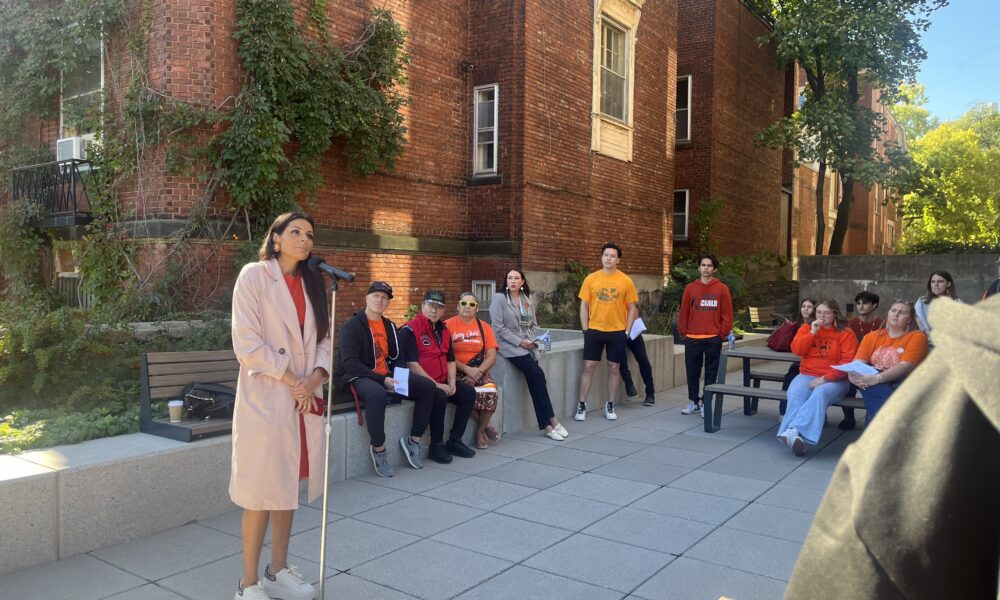
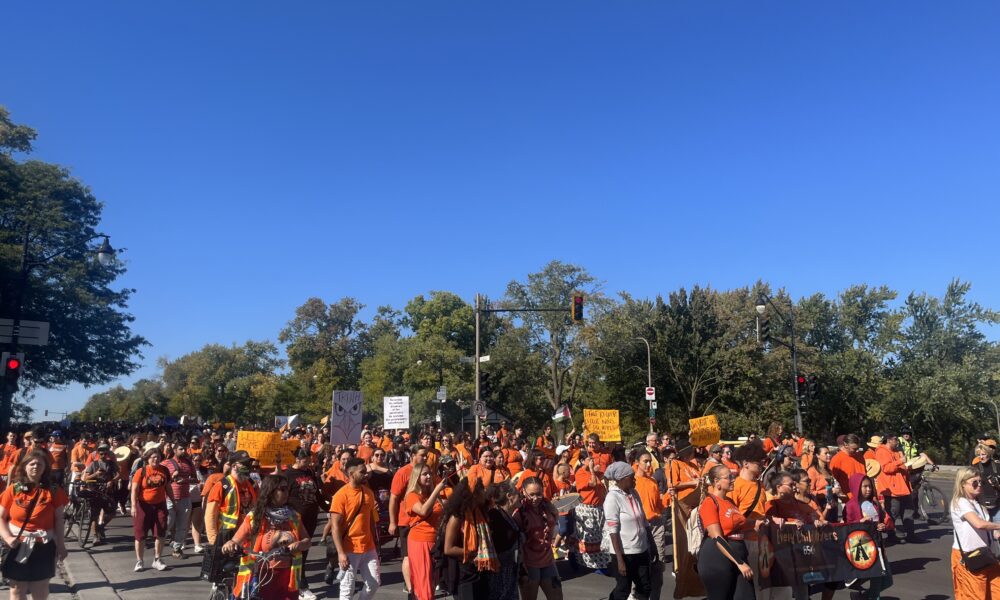
Hundreds called out “Land back!” and “No justice, no peace!” at Montreal’s Every Child Matters March on Sept. 30, the National Day for Truth and Reconciliation. The rally, which began at the Sir George-Étienne Cartier Monument and ended at Place du Canada, honoured the children killed in and the survivors of Canada’s residential schools, as well as their families. The Native Women’s Shelter of Montreal and the David Suzuki Foundation organized the event with help from POP Montreal and Resource Movement.

Before beginning the walk, Nakuset, the executive director of the Native Women’s Shelter of Montreal, invited several speakers to address the crowd. Kevin Deer, a Faithkeeper at the Mohawk Trail Longhouse, led a tobacco-burning ceremony and gave the opening speech.

“We’re all gathered here to commemorate some sadness that happened in our collective history as Native people,” Deer said. “Hopefully we can write a new page and a better future, learning from the past, validating all of the hurt and the pain, understanding why this happened [….] Let’s do what our ancestors agreed [on] with your ancestors, because they said that this treaty would endure as long as the sun shines, the grass grows, and the water flows [….] We’re in the time of the Indigenous spiritual resurrection.”

After Deer’s speech, the crowd listened to a song by songcarrier, composer, and activist Jeremy Dutcher, an address from residential school survivor Noëlla Mckenzie, and drumming from the Sacred Wolf Drummers before taking to the street.

Protestors formed a sea of orange as they poured into Avenue du Parc, waving posters that read “Every Child Matters” and “Bring our children home.” Jen Jerome led call-and-response chants with a megaphone at the front of the crowd, shouting, “We are not invisible!”

As the rally approached the Roddick Gates, Jerome denounced McGill’s treatment of the Kanien’kehá:ka Kahnistensera (Mohawk Mothers), who are currently involved in an ongoing legal battle with the university over possible unmarked graves at the site of McGill’s New Vic Project. Before joining the rally, a group in support of the Mohawk Mothers held a vigil at the New Vic site to bring attention to their fight to stop construction and have a comprehensive investigation at the site. 

According to the McGill Media Relations Office (MRO), archeological work at the New Vic site is being carried out according to the recommendations of the archeological panel that was jointly appointed by the Moahawk Mothers, McGill, and the Société québecoise des infrastructures (SQI). The university maintained that archeological work has been undertaken in the presence of cultural monitors, as per the settlement agreement that the Mohawk Mothers reached with McGill, the SQI, Royal Victoria Hospital, the City of Montreal, and the Attorney General of Canada

However, Rajendra Kapila Basdeo, a coordinator for the Kahnistensera Solidarity Committee at Milton Parc Citizens’ Committee who addressed attendees at the vigil, alleged that construction has destroyed evidence of possible unmarked graves and urged the university to meet the Mothers’ demands.

“The destruction of evidence from a genocide is part of the genocide,” Kapila Basdeo said. “We demand that [McGill] stop construction until a complete and final report on the work has been approved by all parties of the settlement.”

Outside the Roddick Gates, a host of speakers, including Mohawk artist and activist Ellen Gabriel and Director of the Quebec Indigenous Mentorship Network Alex McComber, who is also an assistant professor in the Department of Family Medicine at McGill. McComber underlined that reconciliation between settlers and Indigenous communities will require work over the course of several generations. 

“When [settlers] learn, they become responsible to then become changers of their nation, […]to teach their children so that their children and our children will get along better. They’ll make that new world in that good way,” McComber said.

Barbara Diabo, a Mohawk dancer who blends Pow Wow, Haudenosaunee dance, and mainstream contemporary styles, performed before the rally moved on to its final stop at Place du Canada.

In an interview with The Tribune, Cael Dixon, an Anishinaabe student at Concordia University, shared how intergenerational trauma has impacted his family and noted that events held in honour of the children impacted by the residential school system have been an important part of his family’s support system.

Indigenous storytellers and artists shared several more stories and songs and encouraged attendees to continue doing the work of reconciliation outside of the event. At around 4:30 p.m., demonstrators held onto each other and danced to the beat of a victory song performed by the Sacred Wolf Drummers, bringing the march to a close.


Arts & Entertainment, Music

The stories and sounds of Montreal’s Black women DJs

Montreal’s cultural fabric is shaped by its artists. From writers and sculptors to fashion designers and chefs, there is a scene for everyone. When it comes to musical history, the city’s Black communities hold great significance. The music scene extends to DJing, with events like Igloofest and Aire Commune, along with collectives like Boiler Room, showcasing its vibrancy and diversity. Given this cultural backdrop, I sought to explore the experiences of Black women DJs whose perspectives are underrepresented despite their significant contributions. I interviewed three Black women DJs to understand what the art means to them—and how their identities influence their artistry. 

Drawing on her Cameroonian heritage and upbringing in France, Inès, who performs under the name Ms Baby, skillfully blends traditional and contemporary African and European electronic influences with the richness of popular African American music. The result is a sound that resonates beautifully within Montreal’s diverse landscape. Playing African music, especially traditional tunes, holds immense significance, as countless African artists have shaped music globally while going unrecognized for it. For Inès, it’s not just about playing songs; it’s her mission to give those artists their flowers, honouring and celebrating their contributions to the music world. 

Another voice in the scene is Asha, a Toronto-born DJ with Guyanese parents who entered the electronic music scene after living in Berlin. Like Inès, she noted that many DJs draw from diverse global influences, but the creators behind the sounds are often overlooked. She emphasized that DJing involves much more than playing music; it requires research and proper crediting of the artists.

“If there’s one thing I wish people understood better, it’s how much weight the music you play carries,” Asha explained. “When you take on the role of a DJ, you’re not just spinning tracks; you’re also a curator of culture and history.” 

Asha noted that this awareness is not only about respecting artistry but also about recognizing the political implications of music selection. “In my opinion, DJing is political,” she asserted. “It’s about acknowledging the producers you support and the cultural energies you’re promoting.”

For Janelle (IAMNOTMYHISTORY), the music she chooses to play is largely influenced by her Trinidadian background. When asked about her DJ name, Janelle shared that it reflects her awareness of how Black history is often simplified or distorted in educational contexts. She pointed to the importance of recognizing the depth and complexity of her heritage beyond a single narrative. 

Janelle emphasized that her name is also a personal declaration. “I don’t want to be defined by my past,” she explained. “I am not just my history; I am so much more.” Her perspective embodies her desire to remain present and open to growth, allowing her to evolve as an artist and an individual. “While my background informs my music, I want to continue creating and exploring new avenues without being confined by what I’ve already accomplished,” she said. 

All three women highlighted the unique challenges of being Black women DJs in a male-dominated industry. Inès emphasized the importance of representation, noting that seeing other Black women DJing fostered a sense of belonging. She described the frustrating expectation for Black women DJs to simply be grateful to be given opportunities, which often results in low performance expectations and relegation to less prestigious slots. Despite these obstacles, the three women expressed empowerment in their journeys, citing the joy of sharing music in the city as a key source of their success.

As Black women artists like Inès, Asha, and Janelle navigate the complexities of being minorities in the DJ scene, they are carving out spaces that honour their heritage while also embracing their multifaceted identities. In a city where a shared love of music fosters creativity and collaboration, these DJs remind us that the past does not define one’s future; instead, it serves as a foundation to build limitless possibilities. As they continue to break barriers and inspire the next generation, the unique contributions of Black women DJs enrich Montreal’s artistic landscape, ensuring that their voices are heard in the sound of the city.

Arts & Entertainment, Pop Rhetoric

Bowen Yang might be the best person to talk about Chappell Roan

Season 50 of Saturday Night Live (SNL) premiered on Sept. 28 to the highest ratings it has received since 2020, but the comedic sketch show’s return was not without controversy. Cast member Bowen Yang appeared on Weekend Update dressed as famed internet hippo Moo Deng. In recent years, Yang has become a regular on these segments, frequently portraying animals or inanimate objects, like the absurd personification of the Titanic iceberg. His characters are hilariously melodramatic and serve as cutting cultural commentary on modern celebrities, so naturally, Yang’s baby hippo wasn’t all that different. However, about 30 seconds into the impression, it becomes obvious that Moo Deng is operating as a stand-in for rising pop icon Chappell Roan. This comes shortly after Roan announced that she would be stepping away from the All Things Go Music Festival to take some time for her mental health. 

The morning after the sketch aired, the internet got up in arms, calling it offensive for supposedly mocking Roan, a woman who is already enduring internet hate for calling out obsessive fans. However, this is just a really strong piece of satire; the sketch perfectly toes the line between poking fun at and bringing to light real issues that seem to be plaguing the new generation of pop stars. Yang himself most certainly understands the importance of prioritizing mental health, as he has faced struggles with depersonalization and, like Roan, took a break from his work to recuperate. 

The secret behind Yang’s ability to tap into this unique landscape of the modern celebrity might come from his years of co-hosting the podcast Las Culturistas with friend and comedian Matt Rogers. On the show, Rogers and Yang break down pop and celebrity culture through the lens of what cultures shaped them and who they were made for. Along with a variety of guests, the hosts are often able to pinpoint exactly why something or someone has captured the imagination of the general public. Years of this in-depth analysis prepared Yang to offer a near-perfect satirization of a modern celebrity persona. Casting it through the lens of an inanimate object or an animal simply heightens the eccentricities. 

Following the backlash to his sketch, Yang posted an Instagram story clarifying that his intention was always to support Roan and to emphasize that she should not be treated like a zoo animal. Yet the fact that Yang even had to address this “controversy” raises serious questions about the nature of fandom culture and the often dramatic behaviours that accompany it. 

On social media, audiences are divided; some are making fun of modern audiences’ inability to enjoy a man in a hippo costume impersonating a pop star, while others have gone as far as invoking identity politics, highlighting that Bowen is a “cishet gay man” (have we forgotten that “gay” and “heterosexual” are antonyms?) and is perpetuating misogyny by mocking and belittling women’s mental health struggles. These claims are so outlandish that they only further fuel Yang’s point about crazy fans. 

It’s clear that Yang is trying to illustrate the absurdity of the accusations against Roan rather than shaming her, as he said so explicitly in the skit: “Leave her alone. Let her take as much time as she needs for her mental health.” Just because fans can’t recognize the sketch as satire doesn’t mean it isn’t. It’s interesting how Roan was forced to address obsessive fan behaviour, yet this backlash exemplifies that very issue—fans taking things out of proportion. 

By highlighting characteristics that Roan is often accused of or defamed for having—namely, being rude or ungrateful—Yang can make light of just how ridiculous those complaints really are. If die-hard fans want to counter the “parasocial bestie” allegations, they’re going to have to loosen up a bit. With some critical thinking, it’s obvious that Yang’s message is simply to leave Roan alone. And while you’re at it, give the slippery, bouncing baby hippo some space, too.

Arts & Entertainment

Arts & Entertainment Hot Takes

Abolish the pop star ad-lib

By Charlotte Hayes, Staff Writer

After discovering Sabriana Carpenter through the song of the summer, “Espresso,” it suddenly dawned on me: A lot of young pop stars love an ad-lib. Singers often tack these cheeky improvised quips onto the beginning or end of a song to show off a little personality. For Carpenter, ad-libbing at the end of her hit song “Nonsense” helped the track go viral months after its release. Olivia Rodrigo also makes liberal use of them, with ad-libs appearing on songs like “brutal” off of 2021’s SOUR and “get him back” off of 2023’s GUTS. Here’s the thing: They’ve got to stop. I’ve heard way too many and I simply don’t care about how funny you thought a line was. It’s less a charming addition than it is an annoyance crowding the space at the end of the song. Sure, it can be fun once in a while, but if everyone starts doing them, it begins to feel manufactured. These ad-libs are an attempt at adding personality that ends up working as a veneer of insincerity, ultimately cheapening the final product. 

Téléfrançais! is nightmare fuel 

By Kellie Elrick, Arts & Entertainment Editor

I recently re-discovered a relic of my school days: Monsieur Ananas. Téléfrançais, a 1984-1986 French-Canadian children’s show, was once popular viewing in French Immersion classrooms. I remembered a merry pineapple man who sat on a fence and taught me French when my teachers got tired; a talking pineapple seemed well within the bounds of reason, and I remember thinking he was very polite. Upon seeing a clip algorithmically recommended to me, I thought it would be comforting to be transported back to childhood memories in this time of midterms and rain and chaos. But Good Lord! Monsieur Ananas was horrifying. I now saw him for the anthropomorphic, bulgy-eyed, tropical being he always was. I also did not remember that he lived in a junkyard. Or that he had human hands. His sentience distressed me. Sophie and Jacques, the two children, repeatedly insist that “les ananas ne parlent pas,” as Monsieur Ananas slow-blinks and makes gurgling sounds. The skeleton band, Les Squelettes, were mostly as I remembered them, though now, I am unsure of their location in relation to the junkyard. They play their music in a netherworld, against a dark background, but the possessed fruit puppet and the two French children can hear the music. Monsieur Ananas does the splits during the number (he has legs). Distressing as it is, the puppetry holds a certain absurd appeal to me, and I hope that future generations will be able to ride the trip that is Téléfrançais. I only regret that I have not been given the opportunity to use the phrase “les ananas ne parlent pas” more often.

‘Monsters: The Lyle and Erik Menendez Story’ represents everything that true-crime haters hate

By Yusur Al-Sharqi, Managing Editor

Exploitation abounds in true crime media, and Monsters: The Lyle and Erik Menendez Story/ is no exception. The nine-episode season delves into the notorious case of the Menendez brothers who, in 1989, murdered their parents in their Beverly Hills home. The brothers, played by Nicholas Alexander Chavez and Cooper Koch, were sentenced to life in prison after a highly publicized trial in which they argued that years of psychological and physical abuse at the hands of their father, a prominent Hollywood music producer, motivated their actions.Feedback on the show has been overwhelmingly negative and for good reason. While audiences acknowledge the cast’s stellar performances, they feel it can’t compensate for the confused narrative. Furthermore, the brothers and their family members have publicly denounced the show, claiming it is riddled with harmful misinformation and exploits their story. While shedding light on the boys’ trauma is an important step, placing it within a series titled Monsters, especially following a season centred on Jeffrey Dahmer—a serial rapist and killer who inflicted suffering on countless innocent boys and men—marks a serious miscalculation. It doesn’t help that producer Ryan Murphy responded to the criticism by asserting that the brothers should be thankful for the attention his show has given them. He noted that he intended to explore the various theories surrounding the murders rather than deliver a straightforward, factual account of the case, but the approach feels haphazard, resulting in an insensitive, sensationalist, and ultimately unsatisfying series. As scrutiny around the ethics of true crime continues to grow, Murphy cannot escape the backlash—and honestly, I can’t argue with it. This show made me feel disturbed not by its depiction of the crimes, but by the undeniable reality that it was crafted sensationally and without consent, exploiting real trauma for entertainment’s sake.

McGill, News

Indigenous speakers discuss reconciliation at sixth annual We Will Walk Together event

McGill’s Faculty of Education held its sixth annual We Will Walk Together / Skátne Entewathahíta event at the McTavish Terrace on Sept. 30 in recognition of the National Day for Truth and Reconciliation. The ceremony featured speeches from members of the Faculty of Education, Office of Indigenous Initiatives, and Indigenous students and elders, who recalled stories of residential school survivors and reflected on what reconciliation means for McGill and across Canada. Indigenous student organizers then led the crowd on a Critical Campus Tour, which aimed to spark conversations about McGill’s institutional history. 

Associate Professor Jordan Koch, who was the co-master of ceremonies of the event alongside Assistant Professor Michelle Kennedy, offered a land acknowledgement before welcoming former Akwesasne Grand Chief Michael Kanentakeron Mitchell to the mic to open the event. 

Mitchell shared a song and highlighted the importance of learning to care for the planet and each other in the wake of Canada’s genocide against Indigenous peoples. 

“It’s our ancient way of life that they took away from us and replaced it with something that didn’t belong to us,” Mitchell said. “And so we are now returning. You are all returning to what all Indigenous people have always carried and that’s the respect for Mother Earth and everything that lives.”

Kennedy then returned to the mic to introduce Ojibwe scholar and Associate Provost (Indigenous Initiatives) Celeste Pedri-Spade, who supervises the university’s progress on the 52 Calls to Action outlined by the Provost’s Task Force on Indigenous Studies and Indigenous Education. Pedri-Spade told the crowd that McGill needs to “stick to the plan” laid out by the 52 Calls to Action. These include concrete goals the university has been working towards since the plan was created in 2017, two years after the Truth and Reconciliation Commission issued its 94 calls to action for the Canadian government. Pedri-Spade underlined that reconciliation requires tangible action.

“Reconciliation is not a metaphor. It’s not a metaphor for Indigenization. It’s not a metaphor for any other kind of social justice issue that’s equally as important,” Pedri-Spade said. “We need to think about who fought for those 94 calls to action [….][The people] who fought for those calls were survivors […] and their families [….] They fought for compensation. They fought to hold institutions accountable [….] We’re here to remember [and] to center those people, their experiences, and their stories.”

Dean of Education Vivek Venkatesh came to the mic next and echoed Pedri-Spade’s call for university action. Venkatesh underscored the importance of listening to Indigenous voices and urged allies to educate themselves and others.

“To be effective allies, we must take the lessons we’re learning today and share them,” Venkatesh said.

Finally, Kennedy invited Ryder Cody, a Kitigan Zibi U3 Education student from Rapid Lake First Nation to speak to the crowd. Cody explained that the first step towards reconciliation is reckoning with Canada’s colonial legacy.

“Your government failed you. The real truth was swept under the rug, was buried. Well, little did they know they were burying seeds of hope, seeds of truth that are now blossoming,” Cody said. “Now it’s your duty to go out of your way and learn about the true history of Canada, the dark history. It’s not a dark chapter in Canada’s history, it’s the whole book.”

Cody ended his speech with a prayer. 

“Today, on this walk, let every step be a prayer for those who didn’t make it home. Let every step be a prayer for the children who did make it home. Let every step be a prayer for the children who have yet to come.”
Koch then introduced the students leading the Critical Campus Tour, who noted that they would be leading the crowd to the First People’s House, Hochelaga Rock, and the McLennan Library Building. The student organizers urged participants to reflect on how McGill has erased, misrepresented, and harmed Indigenous communities and how the university can do better.

Arts & Entertainment, Books

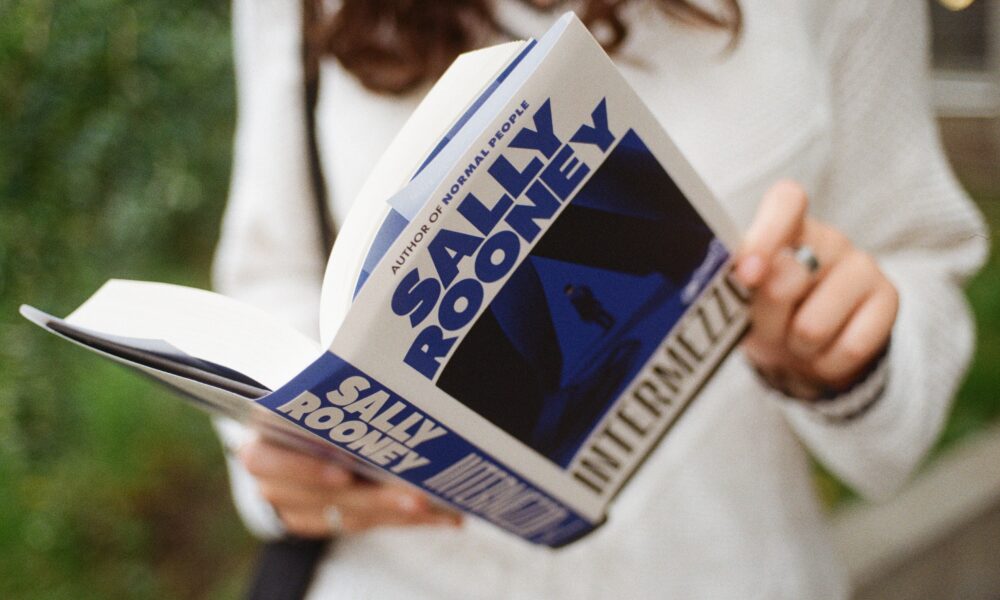
Sally Rooney’s latest masterpiece: ‘Intermezzo’

Since the release of the wildly popular television adaptation of her novel Normal People in 2020, author Sally Rooney’s books have been garnering obsessive attention from young people everywhere. Her three poignant past novels—two of which have been adapted into TV shows—captivated both international fans and those from Rooney’s home country of Ireland. Her latest novel, Intermezzo, was published on Sept. 24 and is already the fastest-selling book in Ireland this year, also reaching similar heights on U.K. and U.S. charts.

The story follows two brothers, Peter and Ivan, as they deal with the recent loss of their father and their complicated relationships with both women and each other. Peter is a successful lawyer who is emotionally detached from seemingly everyone in his life besides his ex-girlfriend, Sylvia, who remains a close friend despite breaking up with him after a tragic accident. He struggles to balance this relationship with his new, chaotic younger lover, Naomi. 

Ivan is a socially awkward chess prodigy who fears that his talents are declining until he meets an older woman named Margaret at a chess tournament. They fall into a thorny relationship, plagued by Margaret’s age, marriage, and past. The tension between the women, the age gaps, the brothers, their careers, and the finishing touch of their father’s death make for a messy and evocative story. 

As in her previous work, Rooney demonstrates her talent for balancing such complicated characters and plotlines with immense grace. For many authors, the act of writing can seem like a limiting form of media, as it necessitates simplifying the intricacies of real life into a digestible story. It is a near-impossible task to thoroughly explore every angle of every character needed to understand their complete reality, which is typically far more multidimensional than stories allow. However, Rooney has always masterfully fought against this; she allows her characters to be flawed and elaborate, without making her writing too decorative or wordy. This level of honesty and realism is what resonates with so many readers and is the common thread running through all of Rooney’s work. 

Unlike her previous novels, however, Intermezzo prominently features the theme of existentialism. Peter’s troubles with drug use and sleeping echo the nihilism of Ottessa Moshfegh’s My Year of Rest and Relaxation, which attracted a similar fanbase of young people grappling to find meaning in a cynical world. Nearly every other character in Intermezzo has a moment in which they seem to question their entire existence. Rooney’s trademark choppy sentences, which are even more exaggerated in Intermezzo than in her previous works, add to this feeling of a fast-paced and almost hollow reality. This existential tone is more intense than it has been in her past books, potentially reflecting a society that is becoming increasingly hard to navigate and extract meaning from. However, it is carefully balanced with comforting moments of peace and strong emotion, usually occurring in intimate scenes between lovers. 

This stark contrast between existentialism and sentimentality pushes readers through scenes that deal with difficult topics in hopes that there will be another moment of joy and love. Rooney never disappoints; although her work can be described as existential and painfully realistic, it is nevertheless hopeful and ultimately optimistic. 

Throughout the novel, Rooney develops a sense that life, even one that is subpar in most aspects, is still worth living because of its special moments. She boldly trumpets that love, be it romantic, platonic, or familial, is what gives meaning to a nonsensical world. Her characters agree; after sharing an intimate moment with Sylvia, the cynical Peter thinks to himself that “To love just these few people, to know myself capable of that, I would suffer every day of my life.” This powerful theme alone makes Intermezzo worth the read. 


Intermezzo was published on Sept. 24 and is now available for purchase.

Arts & Entertainment, Film and TV

Spike Lee inspires at Montreal International Black Film Festival’s Opening Night Gala

The Montreal International Black Film Festival (MIBFF) celebrated its 20th edition from Sept. 25 to 29, shining a powerful spotlight on the richness of Black cinema and emphasizing the importance of diversifying the cinematic landscape. MIBFF is the largest film event dedicated to Black cinema in Canada as well as the only bilingual Black film festival in North America. This year’s festival aimed to inspire attendees by illuminating Black filmmakers and offering a platform to advocate for Black storytelling within the industry. Academy Award-winning director Spike Lee was named the Honourary President of this year’s festival and took part in an intimate interview for the Opening Night Gala. 

Founded by Fabienne Colas, a director and producer who presides over 12 other arts and film festivals, MIBFF amplifies Black filmmakers and honours diverse narratives. The festival serves as a beacon for the importance of representation and inclusion on and off the screen. At the Opening Night Gala, Colas urged the industry and audiences to continue fighting for equal funding and grants for Black and BIPOC organizations. 

The crowd eagerly welcomed Spike Lee, a renowned filmmaker in the industry for over 45 years, upon his fourth appearance at MIBFF. Known for his thought-provoking body of work, the energy in the audience was palpable as Lee provided insight into the filmmaking process and industry. Lee’s approach is reflected in his unwavering passion to tackle social injustice, an aspect of filmmaking that is often overlooked.

Through his inspiring and stimulating conversation with Colas, Lee highlighted the persistent challenges that Black filmmakers face in gaining visibility for their projects as well as the need for increased representation behind the camera. Lee addressed the systematic obstacles faced by Black filmmakers, drawing parallels between the 35th anniversary of his radical film Do The Right Thing and the ongoing prevalence of racial injustice and police brutality, notably in regard to recent events such as the murder of George Floyd. While Lee’s filmography is distinguished by his urge to confront and raise awareness of social injustices, he also acknowledged the need for contemporary filmmakers to portray what resonates with their personal journey. When asked if he believed filmmakers today have a mission to raise awareness, Lee said that everybody has “different stories to tell.” 

There was a tangible sense of community and a shared purpose felt amongst the audience, with Lee’s candid nature serving as a refreshing view of the current film landscape. Having spent decades pushing the boundaries of storytelling within the industry, Lee shared invaluable advice to aspiring filmmakers, discussing the modern-day tools available to budding creatives as well as the importance of physical screenings. Proclaiming that “you have the tools,” Lee emphasized collaboration, maintaining that community and perseverance lead to success. Furthermore, he honed in on the need for Black creatives to occupy positions of authority behind the screen, rather than being outside the ‘room where it happens’. 

Lee’s personal anecdotes provided a glimpse into his journey, starting from watching classic Hollywood movies with his mother as a child to his current status as a legendary filmmaker. He also shared his most influential movies—highlighting Crooklyn as a personally significant project due to the family effort involved in the writing process and his own upbringing in Brooklyn; Lee confidently proclaimed that “Crooklyn beats everything”.

The festival serves as a testament to the importance of upholding Black cinema and the need to continue pushing for greater inclusion and representation within the film industry. As noted by Lee, events like MIBFF create crucial spaces for celebrating individual voices and serve as a call to action to both filmmakers and audiences to embrace their unique narratives.

Montreal, News

Hundreds call for greater action on climate change in Montreal-wide march

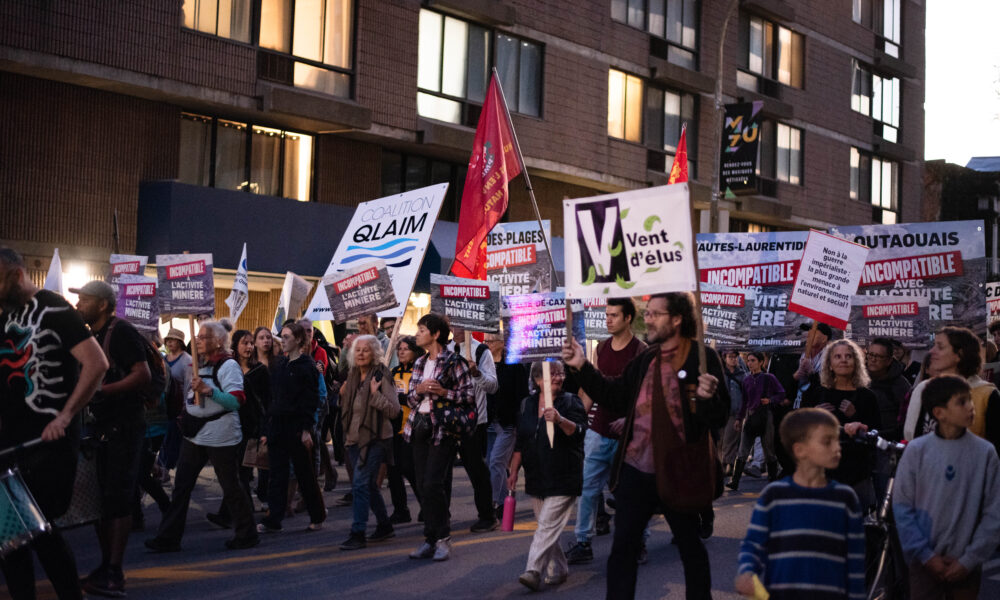
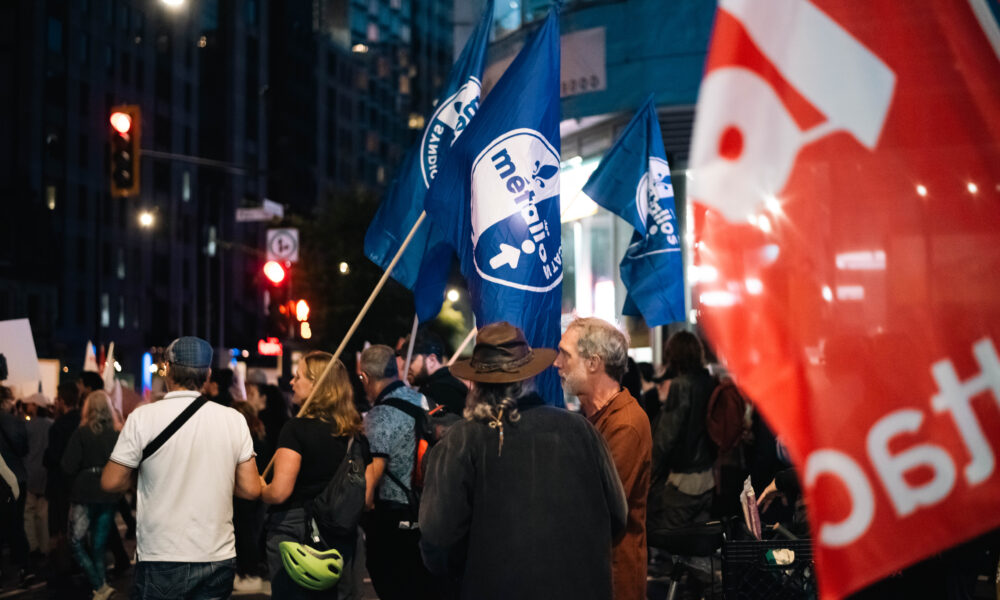
Over 400 people gathered at Monument à sir George-Étienne Cartier for Montreal’s annual climate march at 6:00 p.m. on Sept. 27. Ensemble pour la suite du monde—a collective of unions, activist organizations, and other groups—organized the march as part of a series of demonstrations happening across Quebec that day. 

As the sun set, protestors filled Avenue du Parc, carrying cardboard signs, bikes, and drums. The march took protestors down Rue Sherbrooke, past Roddick Gates, and ended in Dorchester Square at roughly 8:30 p.m., where several speakers took to a small stage to demand that the provincial government pursue democratically-governed action to mitigate climate change. 

A contingent of students from McGill also attended the march. Among them was Rebecca Hamilton, U2 Arts, who called for greater student involvement in climate justice activism at the university. Hamilton went on to stress the importance of community for collective action against climate change. 

“That’s what brought me out—the desire to be together with other people,” Hamilton said. “I feel excited about being at this broader action because it’s bringing together so many different sectors of Quebec civil society united by a shared vision for a democratic social-ecological transition.”

Hamilton urged the university to do its part to ensure a sustainable future through actions such as changing to renewable sources of heating, transforming its food systems, and subsidizing student passes to public transportation. 

Tamara Ghandour, U3 Science, who is involved in climate organizing at McGill, told The Tribune that they have been attending the march for the past several years. Ghandour explained that the climate march is an opportunity to rally students around the cause and to “set a precedent” for such mobilization at McGill. They noted that, although McGill committed to divesting from direct holdings in Carbon Underground 200 fossil fuel companies in December 2023, the university is still indirectly investing in companies contributing to climate injustice. 

“[McGill is] still investing in TD, which funded the Coastal GasLink project and a lot of pipeline projects on Indigenous territories in Canada,” Ghandour said. “Then also, obviously, McGill is investing in the genocide in Palestine, which is causing so much environmental damage. Carpet bombing releases a lot of carbon dioxide.”

In an email to The Tribune, the McGill Media Relations Office (MRO) explained that the university has taken several actions which “demonstrate the University’s environmental commitment.” These measures include McGill’s switch from natural-gas boilers to electric builders, which they estimate will reduce energy-related greenhouse gas emissions by 9000 tonnes CO2 equivalent per year. In addition, the MRO highlighted McGill’s support of sustainability initiatives on campus through the Sustainability Projects Fund, and their earning of a platinum sustainability rating under the Sustainability Tracking, Assessment, & Rating System in 2024. 

The MRO also wrote that McGill’s Board of Governors has mandated the Committee on Sustainability and Social Responsibility (CSSR) of the Board of Governors to explore divestment from companies that derive the majority of their revenue from the manufacture of weapons. Staff and students can share their opinions on this topic to the CSSR until Oct. 1 through a webform

When the march reached Dorchester Square, three speakers took turns addressing the crowd. President of the Fédération du personnel de soutien de l’enseignement supérieur within the Centrale des syndicats du Québec, Anne Dionne, spoke on behalf of the labour movement. Dionne demanded that the provincial government under François Legault listen to citizens and that decision-making surrounding climate justice be democratic. 

“As a society, we have a responsibility to protect our environment while guaranteeing decent living conditions for all,” Dionne said. “Workers’ rights advocates […] play a fundamental role. We have a duty to intervene to ensure that environmental policies are fair, inclusive, and respectful of all.”*

Marie Maltais—a Cegep student at Sainte-Foy in Quebec City—also took to the stage to represent the youth movement. Maltais argued that, although five years have passed since hundreds of thousands of protestors marched in 2019 to demand change, institutions—including the Quebec government—have yet to take action. Maltais also denounced collegiate institutions for failing to draw adequate attention to climate justice in many of their courses.

“Now is the time to stop encroaching on our time and that of the next generation,” Maltais said, “We are asking today that yesterday’s promises be kept, that is, to reduce greenhouse gas emissions, protect biodiversity, considerably reduce the production and accumulation of waste, and put in place a real energy transition plan for Quebec, in addition to starting a reform of education.”*

*This quote has been translated from French.

Off the Board, Opinion

My support for Palestine is rooted in, not opposed to, my Jewish identity

Last year, I was having a conversation with a friend on campus. She shared her sense of internal conflict as a member of Montreal’s Jewish community, and her challenges in reconciling the views she grew up around with the headlines and protests surrounding her. Eventually, she turned to me and said: “But what I struggle with in how you express your views is—do you not care about Jewish people—your people?” 

I was startled. Why did my support for Palestine translate to her as a disregard for Jewish livelihoods? I contemplated how to answer such a loaded question, and was immediately transported back to my hometown in Madison, Wisconsin, seven years ago.

In 2017, on the eve of Rosh Hashanah, the memorial next to my synagogue was desecrated with swastikas and pro-Trump slogans. At the age of 13, I didn’t fully grasp the gravity of the situation or the degree to which escalating acts of anti-Semitism were fueled by white nationalism. But I felt an intrinsically altered atmosphere as I entered the Gates of Heaven synagogue that year. A temple normally brimming with renewed faith and joy was obscured by fear and apprehension, which persisted throughout the High Holy Days services. 

In my family, as we fast through Yom Kippur, the Day of Atonement, we each choose a book to read in its entirety as a method of reflection. That year, I opted for The Book Thief, a novel documenting a young girl growing up in Nazi Germany. As I turned each page and the descriptive violence and hatred directed towards Jewish people mounted, tears welled in my eyes. Why didn’t people do more to stop this?

“And that’s why I will always advocate for Palestinians’ right to peace, sovereignty, and dignity,” I responded to my friend. Being Jewish—being a part of a religious group that has been persecuted and targeted time and time again—means we don’t get to just care about ourselves. We know what atrocities can occur with that outlook. Unequivocally standing against any crime against humanity is how I honour my Jewish identity.

Right now—today, and every day until liberation—that means standing in solidarity with Palestine, and against the military state of Israel, as it persists in committing unjustifiable acts of genocide and settler-colonialism, under the establishment of an apartheid system where Jews are granted more rights than non-Jews. I will always condemn acts of antisemitism, but I refuse to succumb to the rhetoric that our safety is dependent upon the oppression of others. And I repudiate the dangerous conflation of Israel and Judiasim, which enables accusations of antisemitism to be weaponized, particularly against those advocating for Palestinian rights.

Equating Israel with Judaism—a logic deeply intertwined with the foundation of Israel and deliberately perpetuated by its leaders—exposes the problematic argument my friend expressed: That criticism of Israel and Zionism is inherently criticism of Jewish people—and, therefore, is an antisemitic threat to all Jews. This oversimplification reduces a diverse, multifaceted religion to the policies of a single country. Unfairly linking Jewish identity to the actions of the right-wing Israeli state manufactures a paradox in which Israel is beyond critique. In doing so, it silences legitimate and necessitated objections to violence, and ironically, fuels antisemitism by using Jewish identity as an impenetrable shield for state-sanctioned brutalities. As Jews, we have a moral obligation to resolutely reject any justification of atrocities committed in our name.
Far from offensive, criticizing the extremist Israeli government should be viewed as an act of care that mutually benefits all; the ethno-nationalist state that subjugates and dehumanizes Palestinians under the pretext of Jewish safety is antithetical to that very purpose. The Jewish struggle should always be for justice, liberty, and life. It cannot be tainted by hatred. As we face acts of antisemitism, we must counter divisiveness with solidarity, and demand collective liberation. Like other forms of nationalism, we should resist a Zionist doctrine that teaches fear, mistrust, and that the best response to Jewish vulnerabilities is more bullets, a taller wall, a more humiliating checkpoint. I cannot selectively care about Jewish people without advocating for a future where Palestinians can live freely, with sovereignty and dignity. Our lives are all inextricably intertwined.

Student Life

How to stay safe and minimize risk while protesting

Protesting plays a vital role in student life. Standing up for your rights, advocating for those of others, and raising awareness for causes that you hold dear are powerful ways to make your voice heard. Currently, we are witnessing one of the biggest waves of student activism since the Vietnam War. Recent movements on campus such as the Palestinian Solidarity Encampment from Apr. 27 to July 10, or the trans-rights protest march on Sept. 20, highlight the rise in student-led protests. Racialized people, queer and trans people, and other minority groups are particularly at risk, especially when it comes to injuries, violent interactions with police, and getting arrested. In response, The Tribune is committed to providing you with the best information and tools to minimize risk while protesting.

Wearing practical clothing 

Wearing comfortable shoes that you can walk and run with is a must. Protesting often requires standing and walking for long periods of time so it is best to be appropriately dressed for movement. Aim for simple and comfortable articles of clothing that covers skin as much as possible—this includes hoodies or long-sleeved shirts as well as pants rather than shorts. This comes in handy in case you fall or get hurt. Bringing extra clothes is important as well, so that you have something to change into if you are exposed to dangerous substances, or are splashed with a substance like paint or water. 

To avoid being recognized for privacy reasons, cover identifiable tattoos or visible marks. If you have dyed hair, you may want to conceal it, and if you have long hair, tying it up can prevent it from getting caught or causing unnecessary discomfort. Wearing facemasks, scarves, or bandanas to cover your face is the best way to protect your identity. 

What to bring to a protest

Always carry water as protesting outside, especially on a sunny day, can be dehydrating. Additionally, if you get hurt during a protest, applying water to your wound will help you avoid infections. Bringing a snack can also be a good idea to avoid fatigue. To carry those items, a backpack is often more convenient than an over-the-shoulder bag for comfort. It’s also a good idea to bring some cash, in case you unexpectedly need it for transportation. 

Make sure to protect your eyes for safety reasons with shatter-resistant eye protection like glasses—they can also help you protect your identity for safety. If possible, avoid wearing contact lenses and makeup, as those can trap irritating chemicals.

If you require any medication, such as an inhaler or EpiPen, make sure to carry it with you in case of an emergency or arrest. Also, you might want to wear a medical alert bracelet with information about any medical conditions or allergies you might have.

Know your rights and protest in group

Last but not least, when attending protests, it is important to always know your rights. The Canadian Charter of Rights and Freedoms grants you the right to participate in peaceful protests, protest on public streets, camp in public parks, and wear masks. However, your right to protest differs if you are on private property and does not protect riots or the right to blockade lawful activities. Knowing your rights under the law is crucial, especially if you wind up engaging with a police officer. 

The Tribune also recommends that you avoid protesting alone. Knowing other individuals at the protest is the best way to stay safe, ensuring you have support if any issues arise. It is also a good idea to have a pre-planned location to meet up with others in case anything happens, and to make sure your phone is charged for communication purposes. After the protest, debriefing with your group and talking about what you experienced can be a valuable way to process the event together.

Read the latest issue

Read the latest issue