


Latest News

Student Life

Battling the McGill cold 

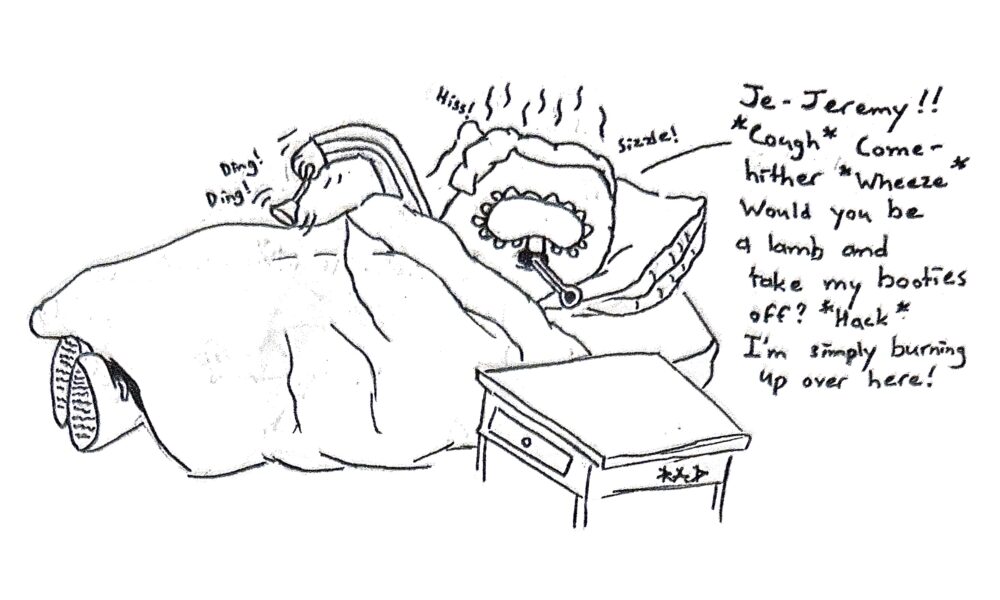
Have you noticed yourself sniffling or coughing more? Is the back of your throat starting to get that feeling? I hate to be the bearer of bad news, but you probably have the McGill cold. This bothersome illness can last from about five days to two months and can feel like a minor drag or the worst sickness you’ve ever experienced. With midterm season upon us, it’s more important than ever to develop your toolkit against this pesky winter inevitability. The Tribune has compiled four pro-tips to combat the notorious McGill cold.  

Get yourself a flu shot

The first and most important thing is to try to prevent the illness before it reaches you. Getting a flu shot at the beginning of the school year is an effective preventative measure to stave off influenza and strengthen your immune system. Although vaccinations may seem inaccessible, they’re more in reach than they may seem. Jean Coutu pharmacies offer free flu vaccinations by appointment, and there are a few right near McGill’s downtown campus! Getting vaccinated is easy and will do wonders to fend off the wretched McGill cold. 

Book a consultation with the McGill Student Wellness Hub

Want to talk to a medical professional? Call McGill’s Student Wellness Hub. They provide online or in-person consultations and can diagnose or prescribe you with the appropriate medication for whatever symptoms you’re facing. But be ready: Appointments fill up quickly. Set your alarm for 8:20 a.m., as the hub opens at 8:30 a.m. and your best chance at getting the earliest appointment is to be the first person on their line.  

Do not go out

Even if you already bought your Café Campus or New City Gas ticket, you should take the weekend off. This is easier said than done when you’ve already paid $25 CAD for an “early bird” cover charge, but pushing yourself to go out will only exacerbate your symptoms. Plus, being in a crowded environment like a club could allow the illness to spread, inevitably putting your fellow students and friends at risk. Instead, rest at home—binge the series you’ve been meaning to watch or catch up on some work you’ve been procrastinating; drink a cup of “throat coat” tea and go to bed early. A good night’s sleep will give your body more time to redirect its energy towards your immune system, strengthen it, and help you recover more quickly. Trust me, you’ll thank yourself in the morning. 

Indulge in nutritious comfort foods

When recovering from a cold, a steamy broth will be your best friend. Soothe your throat and your soul and get on Uber Eats to order some hot, comforting chicken noodle soup from Snowdon Deli. If anything is going to cure you, it’ll be the warm broth from one of Montreal’s most famous Jewish delis. Alternatively, some warm lentil soup will put your throat at ease, and its health benefits will strengthen your body for a speedier recovery. Remember to eat Vitamin-C-rich foods or take supplements.

Battling the McGill cold can be a long, hard fight. Whether it’s the infamous “Frosh Flu” or the feared finals season cold, the sickness will always find you. It’s crucial to take care of yourself to recover during this inevitable period. And remember, it is just as important to take preventative measures as it is to ask for help. Call on friends and family to help you through your battle against the multitude of winter illnesses! You shouldn’t have to fight a dreaded sickness alone. Follow these tips and hopefully your fight will be a little less wearing.  
Arts & Entertainment, Culture, Music, Pop Rhetoric

Bad Bunny’s Puerto Rican pride combats hateful rhetoric

The Super Bowl has long been an annual time of excitement for both Americans and international football fans alike. Although some love the opportunity to get together with friends and family to passionately root for their team, others with no interest in football still tune in for the halftime show. The musical performance during the game’s halftime has hosted acts by many iconic artists such as Prince, Michael Jackson, and Beyoncé. Even weeks later, this year’s performance by Bad Bunny still resonates. 

Bad Bunny is a Puerto Rican rapper and singer who rose to fame after releasing his 2016 song “Diles.” Today, he has six solo studio albums and is the only artist to have been named Spotify’s number one Global Top Artist four times. Bad Bunny’s music honours and celebrates Latine culture, denouncing American imperialism and the ongoing effects of colonialism—especially in his most recent album, DeBí TiRAR MáS FOToS

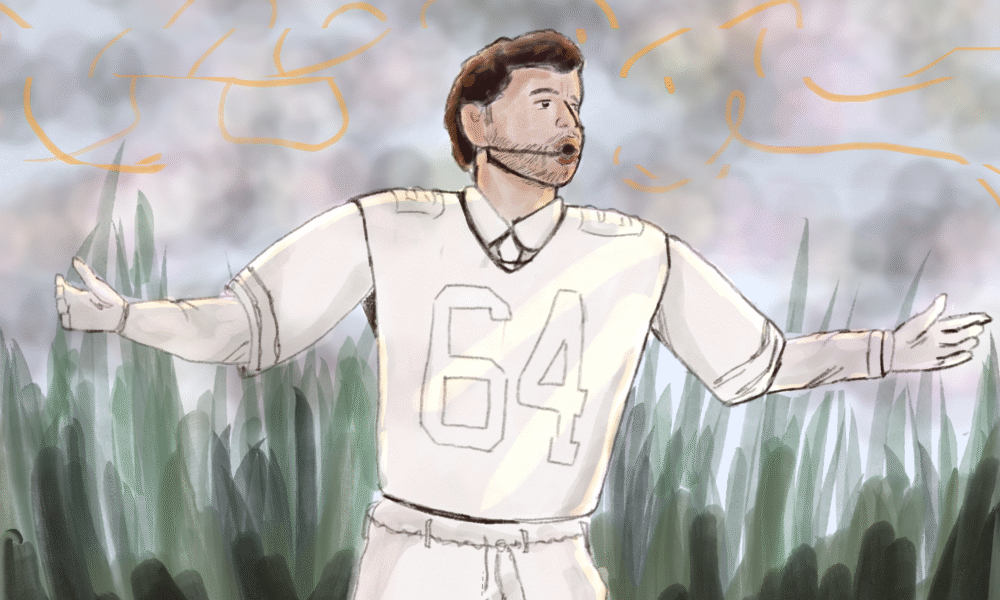
Throughout his Super Bowl performance, the staging itself venerated his Puerto Rican heritage. The set, a field of tall grass, paid homage to Latino labour—a reference to sugar cane extraction, which was collected through slave labour in the Americas. Bad Bunny also had actors play roles across many different industries dominated by Latino workers, including construction, food service, and more. In spotlighting labour that is often overlooked, the artist created a space of acknowledgement and appreciation for those workers and the generations before who have toiled in these workforces. 

Bad Bunny also celebrated love during his performance. He invited one lucky couple to get married on the football field, which ended with the introduction of Lady Gaga’s performance of Die With a Smile. This is a stunning example of how celebrities can use their fame to make others’ dreams come true. It also highlights how love in the face of hatred can encourage others to combat political polarization through community building.

One of the most noteworthy segments of the performance featured a Latino boy and his father watching Bad Bunny’s recent Grammy acceptance speech, where he discussed the vital impact of immigrants on American success, condemning ICE’s violent treatment of citizens and non-citizens alike, and advocating for the celebration of multiculturalism. Bad Bunny was the first artist to win Album of the Year for a fully Spanish album. Amidst the rise of anti-immigrant sentiment and prejudice towards Latin Americans, Bad Bunny serves as a model of Latino resilience and accomplishment for immigrants and youth. This inclusion highlights the importance of representation as a way to dismantle stereotypes that dehumanize marginalized groups. 

As Bad Bunny concluded his performance, he gave a shoutout to every country in the Americas. Naming them in geographic order from south to north, his final shoutout went to his home of Puerto Rico. As he exited the stage with a group of musicians and dancers carrying flags of the Americas, he sang the chorus of his song “DtMF”, filling the field with the elation of North and South American cultural diversity, forever marking this performance. On the stadium’s jumbotron, the message “The Only Thing More Powerful Than Hate is Love” shone in large print while Bad Bunny held a football that read the message Together, We Are America.

Bad Bunny’s display of pan-Americanism is particularly impactful during a time of intense division. Over time, global superpowers, specifically the U.S., have revealed prejudice towards Latin American communities, as evidenced by the increasing atrocities committed by ICE. Bad Bunny’s theme of unity in the face of hatred sends the message that everyone should have a place in America—the nation’s cultural diversity is its greatest strength.

Student Life, Word on the Y

Word on the Y: What McGillians are saying about the end of the Legault era

Quebec Premier Francois Legault announced on Jan. 14 that he would be stepping down from his position after eight years as the head of the Coalition Avenir Québec (CAQ), a leadership emblazoned by the weaponization of identity politics and controversy. Through various legislative agendas,  Legault forged a path rooted in partisan nationalism, rallying for the preservation of a Quebec identity through measures such as Bill 96 and Bill 21, which solidified his attachment to conservative secularism and nationalism

It is no surprise that rampant discussion has emerged from such controversies. That is why The Tribune took to the Y to see what McGillians have to say about Legault’s resignation and the future of Quebec. 

Camila Sierra, U1 Arts, reflected on the impact of Quebec’s restrictive legislation.

“It’s a relief, honestly, knowing that he’s resigning, and I hope that the values he’s taking with him are these very narrow-minded and conservative values that represent mostly white, richer parts of the population. I hope the values that are introduced are more inclusive and more intentional policies that don’t only focus on secularism […] [because] they weren’t really considering the kinds of populations that would be affected by the law [Bill 21] directly.”

Passed in 2019, Bill 21 bars public sector workers such as judges, police officers, prison guards, and teachers from wearing religious symbols while at work. However, under the guise of creating a secular province, the act disproportionately impacts religious minorities.

Bill 21 represents Quebec’s living history of racism and xenophobia still attempting to restrict the religious liberties of minorities today. It posits strict secularism as the standard, thus rendering outward expressions of faith by religious minorities more easily condemnable while purporting to be a policy of progression and equality. 

Jacintha Dykes, U4 Arts, discussed the implications of an identity-obsessed government as other issues continue to negatively impact Quebec residents and students in the province.

“I remember the tuition hikes, a couple years ago. That caused a lot of panic. I don’t think it’s productive to […] favour one part of the population over another. I think that it just creates a lot of division […] [and] distracts from actual issues.”

Vanessa Charleston, U1 Science, explained her own experience with Quebec language laws and how they shaped her early education.

“Going to an English school in Quebec my entire life, I have noticed that our schools just don’t get any funding. [Kids in Quebec typically] all go to French schools because [Legault] only wants kids to go to French schools [….] When I was a kid just starting school, my mom was going to put me into French school, but then she thought that there was not enough English for me to learn because they only do, at least from when I was a kid, roughly three hours of English a week.”

As of 2026, the Quebec government has maintained its 33 per cent tuition hike for out-of-province students enrolling in English universities. This not only discourages out-of-province Canadian students from attending top institutions like McGill, but also puts a financial strain on the university due to decreased application rates. By attempting to maintain a francophone majority, the government has instrumentalized and abused educational institutions to reestablish a narrow Quebec identity. 

Legault will remain the official Premier of Quebec until the election of his successor in April of 2026. The consensus on campus is clear: The CAQ must reevaluate its priorities and put forth a candidate ready to confront longstanding systemic issues in the province, from its healthcare shortage, the housing crisis, and a struggling education sector.

News

Pro-Palestine student activists  face legal charges for occupying James Administration Building

On June 7, 2024, 15 McGill students were arrested for occupying the third floor of the James Administration building in protest during the solidarity encampment for Palestine, and 13—referred to as the ‘Palestine 13’— continue to face criminal charges today, with legal fees amounting to $40,000 CAD. Students for Palestine’s Honour and Resistance (SPHR) at McGill, an advocacy group on campus that has organized multiple pro-Palestine demonstrations, is now campaigning to raise money for the Palestine 13’s ongoing legal battle. 

During the summer of 2024, over 100 McGill students participated in a solidarity encampment for Palestine, lasting from April 27 to July 10. The specific protest in question took place on June 6 outside the James Administration building, initially with approximately 50 students. 13 students entered the building, leading to their arrest for breaking and entering, and an additional two were arrested for obstruction of police work.  Shortly after, Service de police de la Ville de Montréal (SPVM) officers arrived at the scene in riot gear, employing tear gas and pepper spray to disperse the crowd. 

In a written response to The Tribune, a spokesperson from McGill’s Media Relations Office (MRO) stated that McGill did not and does not intend to infringe upon students’ right to protest, unless the given demonstration appears to be unsafe or negatively impacts the university’s learning environment.

“McGill is committed to upholding students’ rights to freedom of expression and peaceful assembly in the context of student activism,” the spokesperson wrote. “At the same time, both McGill and the [Students’ Society of McGill University] unequivocally condemn any acts of protest involving vandalism, violence, intimidation, or the obstruction of teaching, learning, research, and other core academic activities.”

Profs4Palestine, a collective of McGill professors in support of Palestine, disagrees with the actions taken by McGill and SPVM against the Palestine 13, who were protesting in support of defunding the genocide in Gaza. 

“All spaces are inherently political—campuses are no different from anywhere else in society. Those of us who work in universities largely believe in using campus spaces as places for open exchange, the debate of ideas, and locations for learning,” a representative from Profs4Palestine wrote to The Tribune. “A political space does not mean that people of a wide variety of views, positions, and politics cannot work together—the opposite in fact. It’s important that we do not try to claim a false neutrality for university campuses, it will not bring about the learning that needs to happen there.”

Across the United States and Canada, pro-Palestine protests have sparked hundreds of arrests. While public opinion generally supports students’ right to protest—a poll by the Angus Reid Institute found that 81 per cent of Canadians are ‘OK’  with student protests—police are still readily employed to stop these demonstrations

Francis Rose Zeitoun, a U3 student in the Faculty of Agricultural and Environmental Science involved with student group Mac Community For Collective Activism, stated in an interview with The Tribune that McGill’s response to protests on campus is against the spirit of the university and disrespectful to the student body as a whole.  

“Since getting to McGill a few years ago, I’ve seen the administration pick profit over people over and over again,” said Zeitoun. “Using our academic labour and tuition money to support things we have demanded and screamed for you to divest from is deplorable. McGill is not the administration, McGill is the students who’ve come and gone, the students who’ve worked hard to make campus a better place, the students who go forward in life with a McGill degree. To see the administration suing the students over what we want is enraging because they are not McGill, we are.”

Commentary, Opinion

The Olympics’ selectivity erodes neutrality

Since 1924, nations have come together to celebrate athletic excellence every fourth winter. This year, the Olympic Winter Games in Milan and Cortina mark a century of such tradition, setting record viewership just one week in. Amid the exciting celebrations of record-breaking athleticism, competing Olympians can hardly escape the political turmoil that is unfolding alongside the Games. Sports are inherently intertwined with politics, and the Olympic Committee must enforce rules governing participation consistently. Penalizing athletes of certain nationalities because of their government’s politics, all the while ignoring other ongoing injustices, reflects an unsettling selectiveness that further perpetuates political divides, corroding the three values on which the Olympics were founded—excellence, respect, and friendship.

The International Olympic Committee (IOC) has banned 14 countries from competing in the past due to various political issues: South Africa had been repeatedly banned due to Apartheid, while Germany and Japan had been excluded for their involvement in the Second World War. Most recently, the IOC banned Russia and Belarus from the Winter Olympics due to their war crimes in Ukraine, which forced many athletes to compete as individual neutral athletes (INA).

The IOC framed such bans as moral obligations, but also as a consequence of Russia’s repeated violations of the Olympic Truce—a United Nations-backed policy that calls for ceasefires immediately before, during, and after the Olympic Games. However, frameworks like the Olympic Truce hardly ever compel substantive political change. For example, Apartheid in South Africa did not end solely because athletes were barred from competing—it ended after decades of civil disobedience and activism, including widespread pressure from economic boycotts and sanctions. While sporting bans may be symbolic to advancing world peace through their role in broader international pressure campaigns, their selective application cannot be justified as a tool for achieving justice.

What these bans do achieve, however, is reducing athletes to a monolithic identity. When athletes’ only option to compete is to strip themselves of any national symbol, their pride in representing their homeland and their culture is treated as complicity in their government’s actions.

Such tension is further exemplified by Ukrainian Skeleton Athlete Vladyslav Heraskevych’s “memory helmet” featuring portraits of athletes killed in the Russo-Ukraine War, which led the IOC to ban Heraskevych from competing. This act was deemed a violation of Rule 50 of the Olympic Charter, which aims to keep the sport podium neutral. But sports are political. Heraskevych did not introduce politics into the Olympics; he merely commemorated the many Ukrainian athletes whose lives were lost. The IOC cannot act as the inconsistent arbiter of geopolitical morality while claiming that its arenas are neutral.

Global actors and human rights organizations have condemned Israel’s genocide in Palestine. Iran’s brutal crackdown on protestors is likewise criticized. Even the United States’ military invasion of Venezuela has been denounced as a violation of international law. These conflicts and their impacts have persisted through multiple Olympic Games, yet none of these countries were barred from the Olympics, and none of their athletes have been forced to compete as INAs. When athletes cannot represent their nation through the craft they dedicate themselves to, the IOF directly undermines the Olympics’ founding principles of excellence, respect, and friendship, setting inconsistent and unfair rules by which athletes must play the Games.

Excellence should be measured by athletic merit, not nationality. Respect requires the acknowledgement that athletes are global citizens, not campaigns of their government’s complicity. Friendship calls for the cultivation of athletic connection even amid adverse political conditions. When some athletes’ identities are written off as an extension of their government’s actions while others’ are overlooked, some national identities become politically unfavourable while others are affirmed as diplomatically tolerable.

The Olympics’ immense visibility comes with great responsibility: If the IOC chooses to invoke morality as grounds for participatory bans, sanctioning countries that have committed international crimes, they must lay out transparent criteria and enforce them consistently, regardless of global negligence or diplomatic alliances. Otherwise, the IOC should acknowledge the limits of sporting sanctions. Sports are inevitably political, but sporting sanctions carry limited power outside of moral symbolism. Symbolism cannot uphold justice when applied selectively.

Hockey, Know Your Team, Sports

Know Your Team: McGill Men’s Hockey

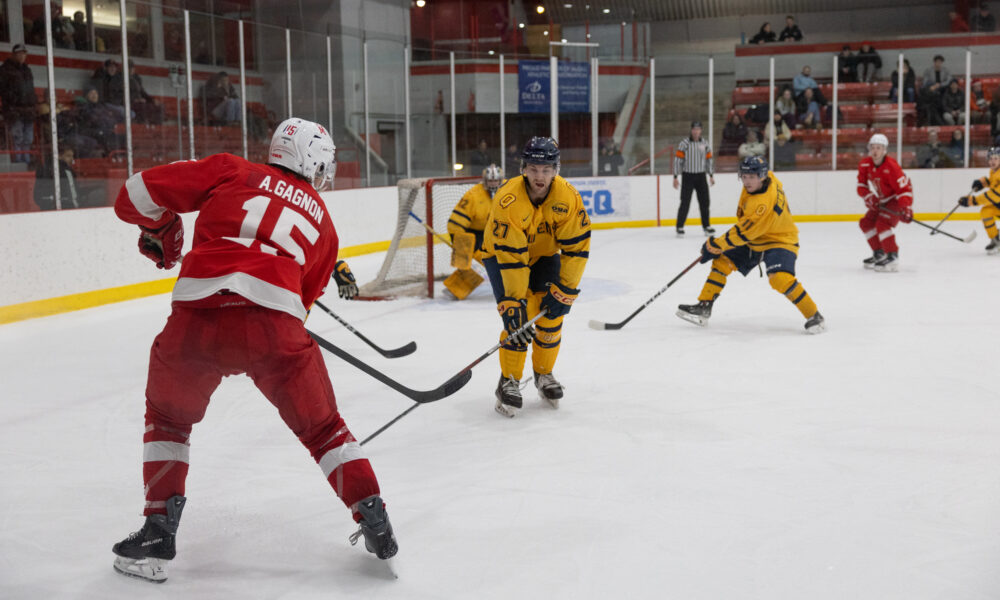
On Feb. 20, McGill Redbirds Hockey headed to Kingston to play a second game against the Queen’s University Gaels in the Ontario University Athletics (OUA) East Quarter-finals. Centre William Rouleau, U3 Management, scored first, giving McGill a temporary lead in the third period. The game would go to overtime following a Gaels equalizer, ultimately ending in a 2-1 loss for the Redbirds. Still, Rouleau highlighted that playing for McGill has been a privilege.

“It’s reminding ourselves that we play hockey for moments like these, that pressure is a privilege and [that] we have a chance to accomplish something great,” Rouleau said in an interview with The Tribune.

Forward Alexandre Gagnon, MA Kinesiology, is among the five players on the team expected to graduate this year. As team captain, he mentioned his efforts in being a role model for the team’s underclassmen.

“My role is really to use my experience to guide the younger players, help them understand what’s coming and how the playoffs unfold, and how important every game is,” the Ottawa Senators fan said. “But I’m not alone in that process, we have a great group of guys with strong leadership and even younger guys […] that contribute to keeping good vibes and a good morale.”

After their first game against the Gaels on Feb. 18, where McGill lost 6-2, defenseman Nicolas Pavan, U3 Education, reflected on how the team could improve moving forward.

“On their side, they played well defensively, they just got the puck out really fast and they were able to chip pucks out into the neutral zone,” Pavan said. “It’s the next [shift] that counts. You can’t do anything about the last one, and you just got to play the next one.”

Forward Patrick Larkin, U3 Arts, highlighted that being there for the team means bringing positive energy into the locker room and the arena.

“For me, just being vocal, energetic, and happy in the room, that’s one of my biggest attributes in every team that I’ve played on,” Larkin said. “When you get to playoff hockey, it’s very much a selfless game. 

It needs to be based on everyone coming together.”

In the second game against the Gaels, goaltender Nicolas Ruccia, U0 Continuing Studies, saved an impressive 41 of 43 shots. Ruccia pointed out that the players have a strong connection with each other on and off the ice, which is definitely a factor in their performance.

“A huge part of hockey is momentum and in a game, both teams are going to have their moments,” Ruccia said. “On the ice, the key for us is just managing the pressure and working collectively in those moments. Off the ice, we have really solid leadership and gel between us all, and that tightness will definitely help in those moments.”

Off the ice, the Redbirds players train with Redbirds Alum and Varsity Strength & Conditioning Coach Neal Prokop. In a written statement to The Tribune, Prokop highlighted the intensity of playoff hockey.

“A trip to the OUA finals will mean the potential of playing nine high-intensity games in 19 days,” Prokop said. “We can’t forget the athletes will still be practicing, travelling on a bus, taking full courseloads, and preparing for exams alongside their classmates [….] Thus the off-ice routine during playoffs is very dependent on how a series goes, and how the athletes feel.”

In an interview with The Tribune, Head Coach David Urquhart reaffirmed that this year’s team players are all self-motivated, and that it has been a pleasure to coach them.

“We have veteran leadership within the group that has been in these tough situations before and been able to come out the other side,” Urquhart said. “[We relied] heavily on them within the games to take control of the morale in the locker room and the effort and execution on the ice [….] I definitely would be picking our team if I had to pick any team to coach.”

As the Redbirds’ 149th campaign comes to an end, non-graduating players will continue to train during the off-season, preparing for the 150th anniversary season that will start in October 2026.

Arts & Entertainment, Music

Silva Bumpa blows the roof off Newspeak as UK garage continues to soar in Montreal

Being on the sold-out dancefloor of Newspeak last Friday felt like being transported to a smoke-filled Manchester warehouse or an underground party in the heart of Sheffield. For Montreal’s UK bass community, this was no ordinary club night. Feb. 13 had occupied calendars for several months, as rising garage producer and DJ Silva Bumpa made his long-awaited Montreal debut at one of the city’s perennial electronic music venues.

As Silva Bumpa loaded the first track of his two-hour set, anticipation buzzed through the room. The Sheffield native’s groovy UK garage music style has made him one of the leading figures of the new generation. 

Judging by the expressions of disbelief that accompanied each sub-bass frequency and synth melody, the crowd’s high expectations were met.

“His style makes you so excited and grateful to be there,” Ignacio Hampton, U2 Arts, said in an interview with The Tribune

Silva Bumpa’s selections are remarkably tight and consistent, making for an extremely cohesive set. He has carved out a distinct style of bumpy, nostalgic garage that prioritizes maintaining a continuous groove throughout a set, rather than producing singular moments of bass-heavy drops. Whether he’s picking from his extensive production catalogue or his prized folder of dubplates, he fills his sets with club-ready tools built for the dancefloor. When discussing his production techniques in an interview with MusicRadar, Silva Bumpa said, “Layering is everything for me. Separating out sub, having stuff that gives punch, stuff that gives texture, and stuff that gives powerful sub energy so that it can hit on a sound system.” This demonstrates the garage prodigy’s astute ability to make tunes that are functional for a rave. 

Coming off an all-night long tour in the UK last fall, Silva Bumpa is at ease when he’s controlling the pace of his sets, selecting tracks that keep the audience engaged while still allowing the dancefloor to breathe. Clearly a master at reading crowds, he consistently builds up the club’s energy before dropping some of his most explosive tracks, such as “Wrap it Up,” a bassline-influenced standout from his 2025 EP Check Dis Out. One of the most memorable moments of the set came when Silva Bumpa mixed “Doin’ It” after playing a monstrous edit of Basement Jaxx’s “Where’s Your Head At,” a staple of UK rave culture. Since ATW, a label run by fellow garage heavyweights Interplanetary Criminal and Main Phase, released “Doin’ It” last summer, it has become a viral anthem. 

Despite Silva Bumpa’s commercial success, he has stayed true to his northern roots, with the celebrated sounds of Sheffield bassline and speed garage influencing his trademark style. The Steel City has played a huge role in the legacy of UK dance music. One of Sheffield’s most iconic clubs, Niche is regarded as the most influential venue for the development of modern bassline.

Raver Kenzo Ebanda explained his appreciation for Silva Bumpa’s style in an interview with The Tribune.  

“Especially in this venue, that more sweaty, underground feel that he has fit really well. We don’t usually get that many sets like that in Montreal. I feel like a lot of the UK [garage music] is more of that mainstream stuff,” Ebanda said.

One of the standout tunes that conveyed the vibe of the underground was Interplanetary Criminal’s “Memories,” a jaw-dropping dub that’s been on every bass-head’s search history for months.

Silva Bumpa’s impressive showing at Newspeak was the latest chapter in an evolving love story between North American audiences and UK garage. With various local collectives thriving and more garage stand-outs slated to grace the city’s clubs in the coming months, the future is bright for bass music in Montreal.

Arts & Entertainment, Theatre

Players’ Theatre’s ‘The One Act Play That Goes Wrong’ is its worst play yet

“I didn’t know this was supposed to be bad,”—I overheard the audience member next to me whisper. This sentence perfectly encapsulates the theatrical genius of Players’ Theatre’s newest play, The One Act Play That Goes Wrong, which ran from Feb. 17 to Feb 20. Originally written by Henry Lewis, Henry Shields, and Jonathan Sayer, Odessa Rontogiannis, U3 Arts, directed the Players’ Theatre adaptation, delivering just what was needed: The worst play ever, in the best way possible.

The production is meant to confuse the audience. In The Murder at Haversham Manor, a play-within-a-play, spectators watch as the Cornley Polytechnic Drama Society puts on a whodunnit mystery revolving around the death of Charles Haversham (Luca McAndrew, U1 ArtSci), as the actors attempt to keep the show from falling apart. Some scenes came out more cohesive than others, but the bad ones were particularly hilarious, with every actor scrambling to disguise forgotten lines, broken props, and wrong cues, all while navigating the two plotlines unfolding on stage.

One thing is certain: The casting was flawless. Each cast member was able to fully embody their character while simultaneously portraying an actor who is trying to. Shea McDonnell, U2 Arts, exemplified the tension of a confused co-star playing an authoritative figure, while Lauren Hodgins, U2 Arts, personified rivalrous envy on stage. Gemma Martin, U1 Arts, epitomized the timidity of a typical stage manager: Her flat acting and awkward hesitations blurred the line between the performer and the character.

Just when the scene starts turning stale, the unexpected happens: McAndrew, with his explosive acting, bursts onto the stage at the wrong time. The set falls apart, with the stage manager rushing in to hold everything together. The PA system announces that a Duran Duran CD box has been found. The set plunges into total chaos. The cast runs out of breath as they reenact the same scene for the fourth time, each repetition an escalation in absurdity and disorder.

From lights on to curtain call, the production team deserves praise for being perfectly imperfect. There was a meticulous amount of confusion with the lights, the announcements, and the endless repetition of  Toccata and Fugue in D Minor. The technical ‘mistakes’ were executed with careful control, making the audience question whether a malfunction was truly a malfunction or a part of the script. We’ll never truly know—but we don’t need to.

Even the props deserve acknowledgement—or criticism. The production felt as if the Players’ Theatre’s budget was burnt through: Uneven papers cut into circles served as snowballs, and were later reused as blood after being coloured red. But the play’s true comedy lies in the discomfort it feeds to the audience—another skillful choice. Meanwhile, Inspector Carter’s costume design, along with the most enthusiastic acting by Naomi Decker, MA in English, created a character that many audience members will never forget.

Ultimately, The One Act Play that Goes Wrong succeeds because it invites the audience to simply let go of perfection—of expectation, of interpretation, and of true meaning. For an hour, we were able to kick back and enjoy the banter between Bennett Samberg, U3 Arts, and Elias Luz, U1 Arts, who played Perkins and Cecil. For an hour, we were not expected to decode hidden symbolisms behind sophisticated acting or follow intricate plot twists. This production demonstrates that the joy of theatre lies not in polished perfection, but in the chaotic process of figuring it out.

By the time McAndrew utters their final line in the play, the audience is sure of one thing—the play was supposed to be bad. Disaster is the design, and its utter mediocrity is key to its humorous delivery. Rontogiannis successfully created a space where her actors and staff could use the stage as a creative outlet, and in the process, spark ripples of laughter through the crowd.

Cast member Shea McDonnell is a Staff Writer at The Tribune and was not involved in the publication of this article.

Behind the Bench, Sports

From Montreal to Milano Cortina: McGillians at the Olympics

This year, over two dozen McGillians took part in the 2026 Winter Olympics in Milan and Cortina, Italy. Current McGill students and staff were among the athletes, coaches, officials, and media professionals shaping the Games both on and off the ice.  

One of the most high-profile figures is Lilah Fear, a 2023 Arts graduate who held the rare role of Olympic flag bearer, marking the fourth McGillian in history to receive that honour. Fear represented Great Britain in ice dancing alongside partner Lewis Gibson, performing a rhythm dance on Feb. 9 and the free dance final on Feb. 11.

Also competing was Kayla Tutino, known to many McGill students from her time as associate women’s hockey coach from 2022 to 2024. Tutino suited up for Italy’s women’s hockey team and made her mark by scoring Italy’s first goal of the tournament in a 4-1 victory over France

Five coaches and technical staff also carried the school’s legacy into the Olympics. Among them were multiple figures with ties to hockey, including assistant coach Alexandre Tremblay and goalkeeping coach Karel St-Laurent—both alumni of McGill’s hockey program—who worked with the Italian women’s team. Mikael Nahabedian, a former McGill Martlets video technician, also served as the team’s video coach.

Meanwhile, McGill also had a connection with Jamie Kompon, (BEd ‘87), the assistant coach of the National Hockey League’s (NHL) Florida Panthers who is now supporting the German Olympic team, and Stephen Gough (BA ‘98, LLB ‘08), a former Canadian Olympian who served as the head coach for the U.S. short-track speed skating team

Additionally, this Olympics featured nine McGill alumni working in administration and official capacities, including Richard Pound (BCom ‘62, BCL ‘67), an International Olympic Committee member and former McGill varsity swimmer who competed at the 1960 Rome Olympics himself. On the organizational front, Canada’s presence at the games was bolstered by McGill graduates such as Jennifer Heil (BCom ‘13), a former Olympic champion who served as chef de mission for the Canadian Olympic Committee (COC), and Marie-Andrée Lessard (BCom ‘01), who served as the COC’s senior director of Games. Others include Eric Myles (EMBA ‘11), the COC’s chief sport officer, Claire Carver-Dias (BA ‘01), a former Olympic bronze medalist now in COC operations, and Manny Almela (BA ‘99), guiding press operations at the Games. 

Five of the Games’ medical professionals also have ties to the university, including physicians from the McGill Sport Medicine Clinic and specialists like Robert Foxford, who was attending his sixth Olympics as a sports medicine physician. Additionally, five alumni served in media roles, including former National Football League (NFL) player Laurent Duvernay-Tardif covering events for Radio-Canada, and Jennifer Lorentz (BA ‘01), a graphic designer with NBC Sports on her eighth Olympic assignment. 

McGill’s connection to the Olympics stretches back more than a century. Since the first McGillian appeared at the 1904 Olympics, alumni have accumulated 34 Olympic medals, and several have carried national flags at opening ceremonies. Yet this historic legacy may face an uncertain future. In late 2025, McGill announced sweeping cuts to its varsity and club sports portfolio, eliminating 25 teams and clubs across a range of sports, including track and field, rugby, badminton, and Nordic skiing. The decision sparked considerable backlash from athletes, alumni, and much of the student body. 

Without certain varsity sports, future generations of McGillians may have fewer opportunities to train, compete, and pursue Olympic-level achievement. Phil Edwards, a former McGill track athlete who won five Olympic bronze medals between 1928 and 1936, developed his skills at McGill and later became the most decorated alumnus at the Olympics for several years. Edwards is just one of the many talented alumni who shone at the Olympics, who may not have achieved the same success without the opportunities and training McGill provided. With vast cuts to varsity teams within the McGill community, the university is clipping the wings of many athletes who may have had the potential to flourish as these Olympians have. As McGill diminishes its athletic scope, its presence at the Olympics will surely follow.  

Off the Board, Opinion

Against reducing, reusing, and recycling

As a full-time English Literature student and part-time movie-watcher, one of my greatest pleasures is building a mental web of intertextuality: The way texts are influenced by, adapted from, or allude to previous texts. Canonical works such as the Bible, Greek and Roman classics, and Shakespearean plays have long served as the foundations of or inspirations for works across literature and film. 

Milton’s Paradise Lost and Steinbeck’s East of Eden radically reimagine stories from the Book of Genesis. Carson’s Autobiography of Red draws from and gives new life to fragments of the lyric poet Stesichorus’s Geryoneis. My Own Private Idaho, The Lion King, 10 Things I Hate About You, The Talented Mr. Ripley, and countless other seemingly modern tales imaginatively retell or rework Shakespeare’s plays, themselves retellings of older stories. What makes adaptations like these work is that they believe in the works they are drawing from while establishing their own unique vision.

Walking into Emerald Fennell’s Wuthering Heights adaptation last week, I certainly was not expecting anything near Paradise Lost’s level of innovation and depth. Somehow, it still managed to disappoint. 

Emily Brontë’s Wuthering Heights is a novel about obsession, rage, revenge, cruelty, and abuse. It’s about the class resentment and racial anxieties of the 19th-century British Empire. It grabs hold of its reader and doesn’t let them go. It does not invite the reader to mourn; it demands that we sit with our discomfort. 

Fennell’s Wuthering Heights saps the novel of all this substance, flattening it into a glossy, Romeo and Juliet-esque tragedy marketed as “the greatest love story of all time.” The novel, on the other hand, actually only grants about a third of its narrative space to Cathy and Heathcliff’s relationship, focusing primarily on cycles of violence and abuse. Heathcliff is a victim of brutality and of racial Othering, but our readerly empathy for these struggles is stretched and challenged as he perpetuates calculated violence against other characters. Casting Jacob Elordi as Heathcliff and framing his character as a sardonic and misunderstood dreamboat instead of a complex, tormented, terrifying figure goes beyond mere divergence from the source material: It squashes any possibility of transmitting the novel’s thoughtful commentary on social dynamics in 19th-century England. What the film lacks in real nuance it attempts to make up for in shock value and aesthetics, yet it ends up falling short of any meaningful intervention, entirely out of touch with what makes its source material so compelling. 

What stuck out most to me, though, was that I couldn’t even enjoy criticizing the film because it isn’t an isolated failure. The film is symptomatic of a much larger, disappointing cultural trend: Reliance on the profitability of nostalgia at the expense of originality and creativity. Studios greenlight lacklustre sequels and adaptations because they perform predictably and consistently well at the box office. Despite mixed reviews and criticism, Wuthering Heights is still the highest-grossing title of the year so far, bringing in $83 million USD at the global box office on opening weekend. 

Clearly, though, despite the prevalence of adaptations like //Wuthering Heights//, there remains a strong cultural desire for original and innovative works. The massive commercial success and critical acclaim of recent films such as Everything Everywhere All at Once and Sinners prove as much. Even so, these original works don’t stand entirely alone. Everything Everywhere All at Once began as Daniel Kwan and Daniel Scheinert’s response to The Matrix but draws in allusions to other director styles and films, from Wong Kar-Wai to Princess Mononoke. Sinners reinvents the vampire genre and deepens familiar character archetypes and dynamics through the dimensions of race, religion, and class. 

Creation always comes from a vast and interconnected web of inspirations. The parameters for good retelling, then, are not so different from the parameters for good art in general. For an adaptation to work, it must both believe in the works it’s drawing from while establishing its own unique vision. All works should contribute to this conversation across time, as this connection is what allows art to deepen its individual and interwoven meanings instead of being watered down. 

Read the latest issue

Read the latest issue