Latest News

Science & Technology, STEM EVENTS

From eco-grief to empowerment: A blueprint for environmental activism and hopeful change

There is no doubt that there is increasing urgency to address environmental challenges around the world. On Nov. 15th, the McGill Environment Student Society (MESS) hosted a lecture on climate change, with a focus on how an uncertain climate future brings about increased anxiety. Featuring Jen Gobby, an affiliate assistant professor at Concordia University in the Department of Geography, Planning and Environment, this event marked the inaugural session of MESS’ “Meet the Faculty” seminar series. 

“One story we hear over and over again—in classes, on the news—is climate change as a crisis,” Gobby said in her talk. “And it is. It’s an ecological crisis. It’s a social crisis. It’s an inequality crisis. It is a crisis.”  

Under these conditions, undergraduate students not only navigate their degrees, but also grapple with social issues, including climate change. Gobby’s recollection of her personal struggles resonated with the audience, which was filled with Bieler School of Environment students. Research increasingly shows that climate anxiety and eco-grief are significant psychological effects of this ongoing problem. In her talk, Gobby attempted to outline ways in which we can regain individual power to combat these negative emotions.

“Our emotions are a sign of our deep care of each other, of this earth, of the land we’re on, our own futures, of our families,” Gobby said. 

Emotions are the fundamental driving force towards achieving climate justice, but they are not easily accessible for all. For some, they are empowering, while for others, emotions make political engagement all the more challenging. Gobby discussed how difficult it can be to debate about topics that resonate closely to you. She proposed that this contributes to why we see so much climate denial right now. 

“It can actually lead us to repress their feelings or fully disengage, or even deny climate change.” 

To remain active in the fight against climate change and to avoid despair, Gobby argued that we need to implement self-care strategies to ensure healthy coping mechanisms. Maintaining this commitment to action while looking out for your mental health is a serious challenge, though outlining this process can go a long way. These mechanisms are what suit you—it can be as simple as listening to a meditation podcast, reading a new novel you have been wanting to read, or doing community work. 

“One of the things that has helped me address my climate [anxiety], and other kinds of anxieties and stresses, is being part of climate movements,” Gobby said. 

At this point in the talk, Gobby opened the floor for students and faculty alike to share their own insights in regards to activism. Some mentioned Divest McGill’s initiatives, Indigenous rights movements, and youth climate marches across Canada. The discussion highlighted that advocacy comes in many different forms, including science communication, various art media, and on-the-ground activism. All of these approaches help build momentum in raising awareness and fostering a sense of united purpose among those involved. 

“There are thousands and thousands of researchers like ourselves, postdocs, graduate students, undergraduate students, professors, who would like to use their skills to contribute to transformative movements, but maybe don’t know where to build those connections,” Gobby explained. 

To address this issue, Gobby coordinates Research for the Frontlines, an organization committed to advancing the cause of climate justice in Canada by providing a platform for people to intertwine academia and activism. 

To bridge the two, Gobby foregrounds activism in her academic work, centring high-impact, community-based research. She presented her research framework that highlights the abuse of natural resource extraction to sustain our everyday lifestyles, prioritizing the voices of those disproportionately impacted and the systems of oppression that drive the climate crisis. 

“[We need to] look at what’s wrong with the systems […] that dominate our societies or cultures these days and fix them because they haven’t been working for long before the climate crisis began,” Gobby said. “We need to transform them, not just improve them.” 

Arts & Entertainment, Music

The Grammy Awards bring nothing but disappointment

The day the Grammy Awards nominations come out is like Christmas morning to me. There is quite possibly nothing I enjoy more than opening Pitchfork that morning and scrolling through, hoping to see my favourite albums and songs of the year nominated for their respective categories. Does it ever happen? Usually not. I have vivid memories of last year’s ceremony, sitting on my couch, watching my TV with my fingers double crossed, praying that Beyonce’s RENAISSANCE would win Album Of The Year (AOTY). Of course, that didn’t happen. Instead, Harry Styles won for Harry’s House. As Beyonce’s second work following her magnificent 2017 album Lemonade—which was also tragically snubbed—she deserved to win because of that loss and because of what RENAISSANCE meant to Black listeners. I could list my years of disappointment over AOTY winners, but it would sadly be endless. 

This year, though, I am allowing myself to have hope. With three and a half of my favourite albums of the year being nominated for AOTY, I’ve calculated a 43.75 per cent chance that I will be satisfied while watching this year’s award ceremony. 

My Hopes: 

I would be most ecstatic with Lana Del Rey (LDR)’s ninth studio album Did You Know That There’s A Tunnel Under Ocean Boulevard? (DYKTTATUOB) taking the trophy. But, I will still be almost as happy if SOS by SZA or the record by boygenius wins. I might be content with Taylor Swift’s Midnights, but definitely not happy—thus the half chance. 

On the topic of LDR, I believe she deserves to win something. Even just one Grammy. After being notoriously snubbed in 2019 when her album Norman Fucking Rockwell! didn’t win AOTY (or anything else!), it’s important that she wins now. DYKTTATUOB is her second-best album—the record has such a high quality of lyricism, with intimate familial themes woven throughout. Her winning either AOTY—or for one of the other categories she was nominated for—will restore some of my faith in the Grammys. 

I hope that either SZA or boygenius sweeps this year. SZA’s win would be justified after losing the Grammy following the release of Ctrlher critically acclaimed debut album—and the success of boygenius’ the record in bringing visibility and joy to the queer community should not go unrecognized. And in a perfect Venn diagram of the two, I’m rooting for SZA and Phoebe Bridgers to win Best Pop Duo/Group Performance for their song “Ghost in the Machine” on SOS.

Seeing Ice Spice get nominated for some awards made me incredibly happy. As a fellow New Yorker, she will always have a special place in my heart. I hope to see her win Best New Artist, and she and Nicki Minaj definitely should win Best Rap Song for “Barbie World” as the song is super fun and upbeat, and was incredibly popular this past summer. 

Overall, I’m proud to see so many of my favourite artists nominated, just as I am proud that women artists have received the majority of nominations this year. A bit of my faith in the Recording Academy and their decisions has been restored. Who they decide to give the awards to, however, will most likely make me lose such faith all over again. 

My Predictions:

My actual prediction, however, is that the Recording Academy will absolutely rip all of our hearts out again. My expectations are that I will sigh, like always, after every award category, with the exception of maybe one or two. Like the realist I am, I’m aware of how unlikely it is that my faith will remain, thus continuing my endless cycle of hope to disappointment that comes every year following Music’s Biggest Night

The Grammys will air live on Sunday, Feb. 4, 2024 (8:00 to 11:30 p.m. ET) on the CBS Television Network and will stream on Paramount+.

Science & Technology

Fuzzy Robots: Karon Maclean showcases emotionally-aware machinery

On Nov. 13, Karon MacLean, professor in the University of British Columbia’s Department of Computer Science, gave a talk covering her lab’s research on emotionally-interactive robots. MacLean’s work, which began with constructing robots at MIT in the 1980s, has always gone against the grain of traditional robotic engineering. 

“The hierarchy was very much that the more complicated your technology was, […] that was more respected,” MacLean explained in an interview with The Tribune. “And I was very low on that totem pole, because I actually thought that the interesting part was what’s in your head.”

This interest in the cognitive side of robotics—the reactions and models that users engage with—pushed MacLean to develop simple but expressive devices. 

“I just had this idea that if I can make people think things that aren’t there, using very minimal cues, isn’t that more powerful, because you don’t need all this complicated technology?” MacLean said. 

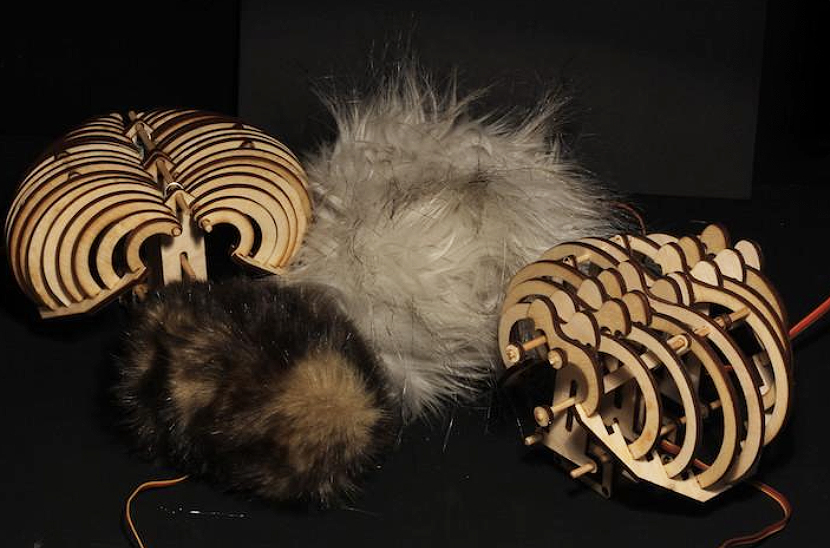
Ultimately, MacLean found her niche with hand-held, fur-covered robots that aimed to sense their users’ emotions and respond by displaying emotions of their own. Her attempts were guided by her observations of therapy animals, aiming to simulate some aspects of their behaviour. 

“I do not think we could ever replace [a therapy animal]. That’s not really my goal,” MacLean said in her lecture. “But could we understand it? And can we help a little bit in some of these situations?”

Taking this into account, MacLean thinks about her lab’s robots as part of a feedback loop: First, the user, perhaps someone experiencing psychological distress, picks up the robot and touches it, essentially pretending that it’s a small animal like a cat or a rabbit. Then, the robot employs machine learning to interpret the touch data, formulating an educated guess about the user’s emotional state. At that point, its programming kicks in and it changes to display an emotion of its own, for example changing the rate at which it is breathing, or moving its robotic ears up and down. On the human side, the user notices that the robot is showing this emotion. This interaction has the potential, MacLean’s research suggests, to actually change how the user is feeling, ideally making them calmer and more relaxed. The robot then picks up on this new emotion, and the cycle continues. 

Her lab’s first attempt to implement this involved designing robots to help calm children about to go under anesthesia. This proved to be a trickier task than expected. 

“One of the first criteria they came up with is, ‘whatever you do, the kids will throw up on it,’” MacLean said. 

In addition to this, the robot needed to be able to survive being thrown and stepped on, while still having state-of-the-art sensors and internal software intact.

While these initial projects, constructed in the early 2000s, had to be quite large to meet all of these constraints, modern technology and innovative design allows MacLean’s lab to now construct small, lightweight models that are even more effective. 

“They’re very customizable,” MacLean said. “And we can make all these different sizes, and shapes and oblong things.” 

In fact, the modern incarnations of the robots, nicknamed CuddleBits, are simple enough to be made in workshops with high school students. 

All of these models centre around MacLean’s primary research interest: The role of haptics—technology that engages with the sense of touch—in human-machine interaction. Common examples of this are the way a smart phone vibrates in response to button presses, and how some video game consoles vibrate to communicate game events. 

Within this field, MacLean is particularly interested in haptics’ potential to incorporate emotion—both the user’s real emotions, and the robot’s simulated ones. 

“It became increasingly clear to me that what’s going on through your sense of touch is so dominated in peoples’ minds by emotion and affect […] that if you don’t take this into account when you’re doing interaction design based on touch, you’re just gonna miss most of the opportunities,” MacLean explained. “At some point, we just really jumped in with both feet, and started working on emotional robots.”

McGill, News

McGill’s joint Senate and BoG meeting sees dialogue on the university’s third century

McGill’s annual joint Senate and Board of Governors (BoG) meeting took place in the Faculty Club on Nov. 14, addressing the theme of “Building on McGill’s Record of Excellence for the Third Century: Challenges and Opportunities Ahead.” 

Maryse Bertrand, Chair of the BoG, briefly introduced the topic before handing the microphone off to Principal and Vice-Chancellor Deep Saini for opening remarks at his first joint Senate-BoG meeting. Saini began by acknowledging the importance of plurality and dialogue between the two bodies. Touching on the fact that the public’s perception of the role of universities is changing, he emphasized the institution’s role in equipping students with skills that will help establish McGill as a trusted voice to the public. 

“Higher education is entering a new reality [….] We must consider the factors that have contributed to McGill’s reputation as a top university while finding ways to build upon this reputation,” Saini said. 

Bertrand then led a warm-up session that involved the entire room. Amidst this activity, she highlighted the recent decision of the Quebec government to raise tuition fees for out-of-province and international students. Despite these challenges and obstacles, Bertrand confidently asserted her belief in McGill’s resilience and unwavering reputation. 

Following the warm-up, senators and members of the Board were invited to discuss the question, “Considering the opportunity and challenges facing universities, how do we best prepare for the future of higher education at McGill?” in their individual round table groups. PGSS Secretary-General Satish Kumar Tumulu gave the first answer, emphasizing McGill’s place as a centre for sourcing knowledge in service of various communities. Other members of the BoG and Senate highlighted this point as well as the fact that McGill’s research sector has been its biggest strength but that this research must reach the broader community. 

The night then proceeded to take a round-table format, where each table was assigned a question by Bertrand and given 45 minutes to discuss before an appointed speaker would present the results of each team to the room. 

Some groups discussed the question of the changing perceptions of a university degree’s value and accessibility. Table one emphasized how over the past 60 years, economic factors and shifting industry demands have prompted a reevaluation of educational priorities. Tables one, two, and three all focused on how the university aims to bridge the gap between academia and industry demands by fostering inclusivity and transparency, ensuring students are prepared for a rapidly changing job market. 

Jacob Levy, a Member-at-Large on the Senate and Chair of McGill’s Department of Political Science, spoke on how McGill has not yet faced ideological repression by the provincial government despite their unsteady relationship, putting the institution in a privileged position to create changes. 

“If we intend for a guild to be a force in facing challenges in fixing [student’s] education […] then I think that we want to take advantage of our relatively protected position so far, to be forceful as advocates for the independent and critical voices within academia,” Levy said. “We are among the research universities that have so far not been under that kind of content-based [ideological] attack. That makes us relatively more attractive to both faculty and students.”

Shifting focus to the role of universities in combating misinformation and public distrust, tables four to six spoke on the importance of maintaining information plurality while actively combating disinformation. The tables recognized the need for transparency, emphasizing faculty involvement in teaching students how to discern truth from misinformation. These efforts also extend to rebuilding trust, particularly among historically marginalized minorities such as neurodivergent people and people of colour, reaching rural communities, and ensuring institutional inclusivity. 

Lastly, tables seven to ten discussed educating a future-ready generation with the knowledge, skills, and drive to navigate their careers and their lives. The tables collectively discussed moving toward an adaptive learning approach that shifts emphasis from grades to critical thinking and personal growth.

Moment of the meeting: 

Principal Saini said in his closing remarks that the institution needed to invest in a fleet of BeaverTail trucks. He was referencing a comment made earlier by a member regarding the trucks’ ability to enter communities and spread information—a line discussed throughout the meeting.  

Soundbite

“Don’t lose the research part of the university. It has been its biggest strength, but it needs to reach the communities.” — Vice Principal (Research and Innovation) Martha Crago, who sits on the Senate, on the importance of research diversity at McGill.

Ask Ainsley, Student Life

Ask Ainsley: How not to get lost

Dear Ainsley, 

I write to you in utmost embarrassment. It has come to my attention that I have absolutely no sense of direction. In the past, I have been so reliant on my Maps app and my friends that I didn’t realize I had no clue where I was going. It was only recently, when I decided to switch to a dumb phone and commit myself to reading philosophy and becoming a full-time pilates instructor, that all of this hit me. The other day, I was walking to a friend’s house for her wine and cheese night,  I ended up right where I started. What should I do? Please help. 

Thank you, 

Hopeless Helen

“To live is to suffer, to survive is to find some meaning in the suffering.” — Friedrich Nietzsche 

Dear Hopeless Helen, 

I completely understand where you are coming from—know that you are not alone. Follow these tips to get you out of your directionless slump. 

Acknowledge the Shame

Few speak up about their lack of internal compass due to the haunting feeling that torments us all: Shame. First, you must acknowledge that shame. Stop wallowing and get yourself out of bed. Go to the bathroom and take a good look at yourself in the mirror. Do you like what you see? No? Is it because you have deep, unresolved insecurity about your sense of direction? 

That’s what I thought. 

Repeat this mantra:

“I am Helen 

I will tell ‘em 

I will be good at finding my way 

And so I say

Hip Hip Hooray!” 

If your name is not Helen, you’ll have to think of your own mantra. I may have great advice, but I don’t have the time or energy to write a poem for every name out there.

Buy a Map

Step two might be the hardest of all: Buying a map. Not many places sell real maps anymore. But I know a spot. It’s called The Map Store*. Nobody knows where it is because you need a map to get to it. 

Once you have found the Map Store, make sure to buy the biggest and most in-depth map of Montreal you can find. My ex-boyfriend Stuart once went all the way to the map store and bought a map of Edmonton by accident. I dumped him right then and there. 

Plan Your Route

Plan a 20-minute to five-hour walk from your house to somewhere cool. I do not know where you live or what you think is cool so this is a very difficult step for me to help you with. Sometimes you have to do things yourself and can’t have a column lady hold your hand through everything. C’est la vie.

You Are Ready to Take on the Day and Go Everywhere!

Grab your map and a couple of friends and hit the road! Leave your phone at home—in fact, leave everything at home! There is literally no need for keys, wallet, water, or food when you have a map**. 

Making a Mistake

If you find that you are lost, do not back down. Do not start crying. Remember that you are Helen. You are extraordinary, and even the greats make mistakes. If you are with a group, you will have to convince them that this is where you meant to lead them. This is how I ended up playing a great game of strip poker in a retirement home. If you are alone, there are always ways to retrace your steps. That’s why I bring breadcrumbs to mark my path wherever I go, which works 100 per cent of the time, without any fault**. 

I hope this advice helps, and remember: Acknowledging your problem is the first step to solving it. 

To many more great walks,

Ainsley

*Not to be confused with Aux Quatre Points Cardinaux, one of Montreal’s actual map stores.

**At the behest of the law, I have been told to include The Tribune is not responsible for any mishaps resulting from the aforementioned advice.

Along Party Lines, News

Along Party Lines: A guide to Montreal’s municipal politics

Montreal’s municipal government announced the approved city budget for 2024 on Nov. 15. The budget sees a $235 million increase in spending and, on average, a 4.9 per cent increase in residential property taxes. The 2024 budget also sees increases in spending on public transit and housing, as well as a $35 million increase in funding for the Service de Police de la Ville de Montréal (SPVM). To help students decode what this new budget may mean for their lives, The Tribune presents a guide to Montreal’s municipal politics.

How are Montreal’s municipal politics organized?

Montreal’s city council, made up of 65 elected officials, is the central decision-making authority for the city. It comprises Mayor Valérie Plante, city council chair Martine Musau Muele, 18 borough mayors, and 45 independently elected council members. The city council approves the annual budget and is responsible for city-wide issues and plans, including ensuring clean drinking water and overseeing large projects such as the expansion of Montreal’s metro system.

In addition to the city council, each of Montreal’s 19 boroughs has its own council. Borough councils oversee issues such as garbage collection, recreation, and construction within their boundaries. 

What parties are in power in Montreal?

Four parties are currently represented on the city council: Projet Montréal with over half of the seats, Ensemble Montréal with one third of the seats, Équipe LaSalle Team with three seats, and Équipe Anjou with two seats. In addition, there are two independents on the council. 

As the second-most-represented party, Ensemble Montréal, is the official opposition. The party has representatives from eight different boroughs on the city council. 

Both the Ville-Marie and Le Plateau Mont-Royal boroughs are represented almost entirely by members of Projet Montréal. These boroughs incorporate residents from neighborhoods including Downtown Montreal, the International District, Old Montreal, the Quartier des Spectacles, Milton-Parc, Le Plateau, and Mile End. In addition to these two boroughs, Projet Montréal has representatives from nine others on the city council.

What are Projet Montréal and Ensemble Montréal’s policy stances?

While Ensemble Montréal has expressed significant discontent with the 2024 budget’s tax increases, the two parties released similar stances regarding policing, housing, and the environment before the most recent election in 2021.

Both parties support increasing the public security section of the budget. Ensemble Montréal supports significantly expanding SPVM’s funding and hiring more police officers. Both parties have said that they support increasing the use of body cameras and the involvement of social workers. 

During the 2021 election, Projet Montréal pledged to build 60,000 affordable housing units. Ensemble Montréal, on the other hand, promised 50,000 new housing units with 10,000 being social housing. The 2024 city budget allocated over $50,000,000 toward the creation of affordable as well as government-subsidized housing.

In regard to the environment, Projet Montréal is aiming to make the city carbon neutral by 2050. The party has  plans of planting trees and increasing access to electric-car parking. They also banned the use of single-use plastics this March . Similarly, Ensemble Montréal has outlined a goal to get Montreal to carbon neutrality by 2045 largely through expanding  the number of green spaces in the city.

How can I make my voice heard?

Aside from voting, citizens can get involved with municipal politics in a number of ways. There are 11 standing committees where city councillors seek community input on subjects ranging from cultural life to transportation systems. 
The city of Montreal’s website contains a calendar of all upcoming public participation events—meetings where citizens can go to voice concerns or opinions to governing bodies.

Student Life

Busy hands, idle minds

“Wow, all I’ve done today is school!” If, like myself, this thought runs through your head as you walk home in the dark at 4:30 p.m., it may be time to find an after-school activity. 

Learning a new skill, particularly over the course of multiple weeks, has many benefits for students’ well-being. When we allow our brains to focus on something that may not be academically productive, we create an opportunity to destress. Committing to a multi-week program establishes a routine, something especially important in the short days of the Montreal winter. Read on to learn about some of the options available to you around Montreal.

Pottery

Price: $370

Duration: 7 weeks, 3 hours/week

Address: 5333 Avenue Casgrain, Suite 804

Language: English

For those itching to get behind the (pottery) wheel, Atelier Spirale offers pottery courses for all levels in both wheel-throwing and hand-building. As an added bonus, those enrolled in the course can access open studios on Saturdays from 11 a.m. to 2 p.m. to work independently. Registration for the winter session, which starts on Jan. 8, is live now and will close once full. 

Circus

Price: $325

Duration: 11 weeks, 2 hours/week

Address: 181 Avenue du Cirque

Language: Bilingual (English & French)

Did you know Montreal is home to the National Circus School? Along with training future Cirque duSoleil performers, the school runs a wide variety of adult recreational courses for those of us who aren’t lucky enough to be graduating with a degree in Circus Arts. Beginners and intermediates can explore circus techniques such as trapeze and silk acrobatics. Adult classes take place on Saturdays between Jan. 13 and April 4. If swinging from the ceiling or riding a unicycle has always been on your bucket list, mark your calendars for the start of registration on Dec. 4.

Improv

Price: $258 

Duration: 6 weeks, 2 hours/week

Address: 3706 and 3716 rue Notre-Dame Ouest

Language: English

Improv classes have many benefits for health and well-being. Students learn to be present, embrace mistakes, and build self-confidence in their humour and public speaking skills. Impro Montreal runs a 6-week course for improvisers of all levels. Unsure if improv is for you? The studio offers a one-hour Freebie Improv Workshop to those interested in learning more before committing to a full course. 

Archery

Price: $95

Duration: 12 weeks, 3 hours/week

Address: 5485 Chemin de la Côte Saint-Paul

Language: English or French

Who knew you could learn archery in Montreal? Archers du Sud-Ouest is an archery club that runs weekly lessons out of the Centre Gadbois. Equipment is provided, and the club even offers a free intro session to newcomers. Adult lessons take place every Tuesday and Thursday from 8 to 9:30 p.m. between January and April.

Latin Dance

Price: $40-70

Duration: 7 weeks, 1 hour/week

Address: 372 St. Catherine Street W

Language: English

Salseros is a Students’ Society of McGill University (SSMU) club providing affordable Salsa and Bachata lessons for all levels. The club also hosts various socials and events throughout the semester to introduce students to the Montreal Latin dance scene. While you can sign up as a pair, it’s not necessary to come with a partner; the club will pair leaders and followers in-class. Registration for the winter semester opens in January and will be announced on the club’s Facebook and Instagram pages. 

Honourable Mentions 

The McGill Arts Collective hosts free, bi-weekly roundtable events and workshops to help students of all abilities practice their artistic skills. 

McGill Athletics offers a variety of affordable group fitness, dance, and sports classes at the Currie Gymnasium.

McGill Swing Kids runs weekly swing-dance lessons at local studios. Your first lesson is free of charge! 

News, Recap, SSMU

Recap: SSMU Board of Directors Nov. 16 meeting

The Students’ Society of McGill University’s (SSMU) Board of Directors (BoD) met on Nov. 16. Before the board dove into the meeting’s agenda, they welcomed a new director, Fawaz Halloum. 

Sierra Fallis, Deputy Speaker, led the board through the meeting’s agenda points. First was an executive committee report presented by Vice-President (VP) Student Life, Nadia Dakdouki. She shared that the executive committee was working on campaigning for a SSMU base fee increase. 

Next the board turned to approving meeting motions. The only motion discussed during the public portion of the meeting was a motion to release an announcement to membership regarding the Solidarity for Palestinian Human Rights McGill (SPHR). Fallis shared that the statement had been written but required approval by the board prior to its release. The motion was promptly moved to the confidential session of the meeting.

“The statement is going to be public […] but I think that there could be confidential considerations to sending out the statement,” board member Lisa Pennel suggested.

As there was nothing else on the public agenda, the meeting moved into the confidential session, after which the meeting was adjourned.

As of Nov. 20, SSMU has not released a public statement regarding SPHR.

Editorial, Opinion

Fall 2023 SSMU Referendum Endorsements

The Tribune’s Editorial Board presents its endorsements for the Students’ Society of McGill University (SSMU) Fall 2023 referendum questions. The Tribune’s editors researched and discussed each of the questions before voting on each endorsement. The endorsements reflect a majority vote of the editorial board, with editors who have conflicts of interest abstaining from pertinent questions.

MUSTBUS Fee Increase: Yes

MUSTBUS is a student-run co-op bus service created in 2019 that offers cheap bus tickets to McGill students. Round-trip tickets currently cost approximately $30 for a day trip and $60 for an overnight trip. In Winter 2023, MUSTBUS ran over 20 trips to destinations, including Boston, Toronto, Ottawa, and New York City. MUSTBUS is asking to increase the opt-outable fee for its services by $3—from $2 to $5. This will allow the company to meet inflation and to offer more bus trips, more destinations, and lower costs for customers. MUSTBUS’ main issue has been being unable to meet the student demand, with tickets for trips selling out within minutes. The Tribune endorses the $3 fee increase, as it is opt-outable and demand for MUSTBUS’ services has been displayed.

Creation of the Student Nutrition Accessibility Club Fee: Yes

The creation of the Student Nutrition Accessibility Club (SNAC) fee will support the club starting in Fall 2024 and lasting until the end of Winter 2029. The club’s services include weekly distributions of free, fresh produce and monthly educational nutrition workshops. The club is currently supported by the McGill Sustainability Projects Fund, which provided $15,260 to its initiatives for Fall 2023. The fee, which students can opt out of, is $1.30 per semester and will not only allow SNAC to continue bringing its services to McGill students, but also increase the club’s capacity to distribute free produce and expand the number and scope of the educational programs. Due to the prevalence of food insecurity on campus and the lack of affordable options, The Tribune supports the creation of this fee and the expansion of SNAC’s services.

Safety Services Fee Increase: Yes

Safety Services offers a variety of valuable services on the McGill campus, including the McGill Student Emergency Response Team (MSERT), the Sexual Assault Centre of the McGill Students’ Society, and both the DriveSafe and WALKSAFE programs. Each of these services picks up the slack in the critical area of student safety, helping to support, protect, and care for students where the McGill administration has fallen short. The fee increase proposed in this question, which raises the non-opt-outable fee from $5.65 to $7.01 per semester, would affect the funding for only MSERT. It would allow them to continue offering their free First Aid courses, the current funding for which expires this semester. It would also enable them to expand their offerings of free courses and workshops for the general public, as well as to purchase critically-needed new training equipment and training courses for their volunteer emergency responders. 

Base Fee Increase: Yes, with reservations

SSMU is asking for an increase to the SSMU base fee—the mandatory fee that all SSMU members pay. This fee is used to support the Society’s everyday operations, including funding over 250 clubs, services such as the SSMU Eating Disorder Center and the Sexual Assault Center, and the SSMU office. The base fee, which was last increased in 2019, is currently $68.48 per semester for most full-time undergraduate students and, if this motion passes, will increase by 71 per cent to $117.21. 

According to the motion initiating the fee, the increase would be used to raise wages for unionized staff and to help the Society meet unprecedented levels of inflation. In an email to The Tribune, SSMU explained that this year’s executive team decided to pause growth and put a hiring freeze in place at the beginning of their term to combat the current financial situation, which has forced the society to dip into reserve funds in recent years. Without a fee increase, SSMU says that it would “likely have to drastically reduce its operational scale,” thus impacting the services and programs available to students. The Society has also stated that it plans to use the additional funds to help mobilize against the Quebec government’s proposed tuition hikes through campaigning and student outreach. 

While paying workers proper wages, maintaining services for students, and ensuring the financial sustainability of the students’ union is vital, SSMU should be more forthcoming about how this $48.73 increase will be spent if the motion passes. SSMU members, like SSMU employees, are under unprecedented pressure from tuition hikes, inflation, high housing costs, and food insecurity, and they deserve a detailed breakdown of where the additional revenue from this fee increase would go. Further, SSMU has been plagued by low student engagement for years; if this fee passes, it is imperative that SSMU dedicate substantial resources to increasing student outreach and engagement so that SSMU members know the tools available to them through their students’ union and how to engage in student democracy. Overall, The Tribune endorses a vote of “Yes” for this non-opt-outable fee, as living wages for SSMU employees and the resources SSMU provides are vital, but cautions that SSMU must do better to be transparent and increase student engagement.

Radio CKUT Fee Increase: Yes

CKUT is a non-profit community radio station based at McGill which provides 24/7 programming. It is one of the only places on campus where students can get access to high-quality sound equipment and studios to learn broadcast journalism and radio skills. The Tribune sees value in supporting other campus media outlets in order to foster a healthy student democracy—particularly amid Bill C-18. CKUT’s programming platforms institutionally-neglected voices and reports on the undercurrents of the arts and news of Montreal. The station is requesting a $2 raise to their semesterly opt-outable fee, bringing the fee for most full-time students from $5 to $7. Given the burden of inflation and the fact that they have not requested a fee increase since 2012, The Tribune advocates for a “Yes” vote for a CKUT fee increase. 

First Year Fee Renewal: Yes

SSMU’s First Year Council is an elected body that represents first years, advocates for them, and aims to help them adjust to university life. It also holds events, such as mixers, giveaways, and therapy dog hangouts. The Tribune sees helping new students get acclimated and learn how to engage in campus democracy as crucial. That being said, the paper encourages careful spending of the funds collected from this fee. If passed, SSMU must ensure that first year students are being brought events that help them learn about mental health resources on campus, know their rights, socialize, and engage with campus democracy. As such, The Tribune endorses a “Yes” vote on this $0.50 opt-outable fee. 

Creation of the Community Solidarity Fund, Fee, and Solidarity Funding Committee: Yes

The Tribune votes “Yes” on establishing a $1 opt-outable fee to finance a Community Solidarity Fund, which would be overseen by a Solidarity Funding Committee. This initiative stands to increase the amount of funding available to social-justice-focused initiatives whose aims align with SSMU’s positions. It also would be more accessible than other types of funding, which often require that recipients have organizational bank accounts or a larger organization willing to accept funds on their behalf. The policy has built-in safeguards: Recipients will have to write a report detailing what they used the funds for within three months of receiving the money, and no one individual or group will be able to receive over 7.5 per cent of the overall fund in a given year. Consultations were conducted with SSMU’s Funding Commissioner, SSMU’s Indigenous Affairs Commissioner, SSMU’s Equity Commissioners, the SSMU Vice President (VP) Student Life, the SSMU VP Sustainability and Operations, and the Quebec Public Interest Research Group at McGill. Given the importance of supporting social justice projects and the thorough research that went into the proposal of this fee, The Tribune supports the establishment of the Community Solidarity Fund.

Ratification of the Board of Directors Members: Yes

Section 6.5 of the SSMU Constitution stipulates that SSMU’s Board of Directors, its highest governing body, must be ratified through either a General Assembly or a referendum. As per the Constitution, “The Board of Directors shall supervise the management and administer the business and affairs of the Society and shall exercise all of the powers of the Society, except for those which the Act expressly reserves to the Members.” This vote would officially make Alexandre Ashkir, Nadia Dakdouki, Lalia Katchelewa, Liam Gaither, and Jacob Shannon members of the SSMU Board of Directors from November 15, 2023 until November 14, 2024. The Tribune urges a “Yes” vote so that SSMU’s Board of Directors can carry out its role.

Policy Against Genocide in Palestine Referendum Question: Yes

The Tribune strongly endorses a “Yes” vote on the adoption of the Policy Against Genocide in Palestine. This policy seeks to confront the lacking and insensitive responses of McGill University toward supporting Palestinian students and redressing settler colonialism here and abroad. The Tribune recognizes this policy as a testament to Palestinian students, groups, and allies courageously organizing for self-determination and for an anticolonial world in line with previous popular mobilizations and the relentless work of Black and African students at McGill to cut ties with South African apartheid. In voting for this policy, the university can acknowledge and build on the multiracial, multireligious, and pluralist movement for peace that Palestinian, Arab, Jewish, and Muslim students have forwarded.

McGill has invested and collaborated with donors, institutions, and corporations actively complicit in Israel’s settler colonial apartheid. As it stands, McGill’s investments, collaborations, and words enact violence on Palestinian students, and help erase Palestinian families, land, and struggle abroad. The policy asks McGill to cut ties and divest from violent stakeholders. These include investments in arms and weapons manufacturers and contractors that develop technologies that kill Palestinians—$500,000 in Lockheed Martin and $1.6 million in Thales—and investments in killing our planet, with $1.4 million in Chevron, Israel’s main fossil fuel extractor. McGill also holds partnerships with universities, such as Tel Aviv University, which funds military research for Israel, and the Hebrew University of Jerusalem, whose strategic location in Israeli-occupied East Jerusalem has allowed the university to house a military base. McGill cannot call for “compassion, inclusivity, and respect” without divesting and disavowing these institutions.

On campus, the policy asks McGill to condemn the Israeli bombing and genocide, retract threats to Palestinian students and groups, and provide concrete support to Palestinian and Arab students. The policy calls on SSMU to release a public statement, provide support for Palestinian and Arab students, and commit to a consistent, solidaristic position against genocide and settler colonial apartheid with Palestinian students and the Palestinian struggle for liberation. These should be the expectations for a university and the individuals who represent all students’ interests. The Tribune endorses a “Yes” vote because it is the first step toward repairing McGill’s outsized role in silencing Palestinian students and pro-Palestine movements and in sustaining settler colonial apartheid.


Editorial, Opinion

McGill’s neglect of Indigenous veterans fuels settler colonialism

Content warning: sexual violence, settler colonialism.

Observed a few days before Remembrance Day, Indigenous Veterans Day on Nov. 8 commemorates the notable contributions of Indigenous veterans to Canada’s historical military pursuits. Despite official recognition since the day’s establishment in 1994, the broader acknowledgment of Indigenous contributions remains insufficient, and the lack of care provided to Indigenous veterans is abominable. The failure to widely recognize the invaluable role of Indigenous peoples in Canada’s military fuels settler colonialism, while excluding Indigenous resistance to violent nation-building.

The treatment of veterans in Canada has historically rendered one truth: Canada fails to provide sufficient support for its veterans, especially Indigenous veterans. By the end of World War II, over 3,000 Indigenous soldiers, sailors, and air crew members served in the Canadian Forces. However, upon transitioning back to civilian life, many faced racism and encountered systemic obstacles to gaining rights and personhood. Until 1960, the Canadian government did not afford Indigenous soldiers the same rights and benefits after service––such as access to housing and financial and health supports––as non-Indigenous veterans. The general neglect of Canadian veterans is evident to this day as many returnees, grappling with various forms of trauma, confront mental health issues, houselessness, and drug addiction. When compounded by the enduring effects of intergenerational trauma and colonial violence that Indigenous peoples experience, the Canadian government’s neglect yields perilous consequences. McGill’s failure to acknowledge Indigenous Veterans Day illustrates the institution’s hypocrisy, erasing the diverse military experiences that form Canadian history. 

The decision of many Indigenous individuals to enlist in the military stems from inequality and injustice. The military, functioning as a business, strategically targets those from lower-income communities, enticing them with promises of financial and social benefits that many never receive. Historically, some Indigenous peoples have chosen military service as a means to escape the exploitation they face within Canada, only to encounter further exploitation and discrimination within the military.The military must cease targeting Indigenous people to serve for a settler colonial nation that does not provide them adequate care nor recognizes their need for support and redress. Urgently required is the establishment of culturally-responsive trauma and healing services for veterans, addressing the unique needs of Indigenous veterans and fostering genuine healing in the aftermath of war.

This oversight extends to the additional lack of recognition toward Indigenous women veterans. With the Canadian military being a ‘brotherhood’ predominantly composed of white cisgender men, their interests consistently take precedence. This results in a perpetuation of sexual violence, particularly toward women of colour. The Canadian justice system, built on the exclusion of Indigenous peoples under the Indian Act, habitually overlooks cases of sexual violence in the military. Disturbingly, this form of violence disproportionately affects Indigenous women, who are sexually assaulted at three times the rate of non-Indigenous women and represent 16 per cent of all female homicide victims while only comprising 4.3 per cent of the population of Canadian women. Canada must intensify its efforts to mitigate this violence and protect Indigenous women in the armed forces and beyond.

The absence of any mention of Indigenous Veterans Day in McGill’s communications adds another layer of insensitivity, raising questions about the institution’s commitment to decolonization. McGill’s performative and hypocritical actions toward the Kanien’kehà:ka Kahnistensera (Mohawk Mothers) fails to address the concerns about unmarked graves that the Mothers have raised. Acknowledging Indigenous Veterans Day goes beyond honouring the bravery of veterans; it means confronting war’s inseparable connection to colonialism. 

The acknowledgement of Indigenous Veterans Day must involve a confrontation with the violence that institutions have continually and historically inflicted upon Indigenous peoples—a reality in which McGill participates. For the university to stand with Indigenous peoples, it must go beyond superficial gestures, such as sending out emails selectively, and work toward a meaningful recognition of the diverse contributions Indigenous communities have made. True improvement in the university’s relationship with Indigenous communities cannot be limited to public relations strategies and requires substantive actions, conversations, and attention.

Read the latest issue

Read the latest issue